
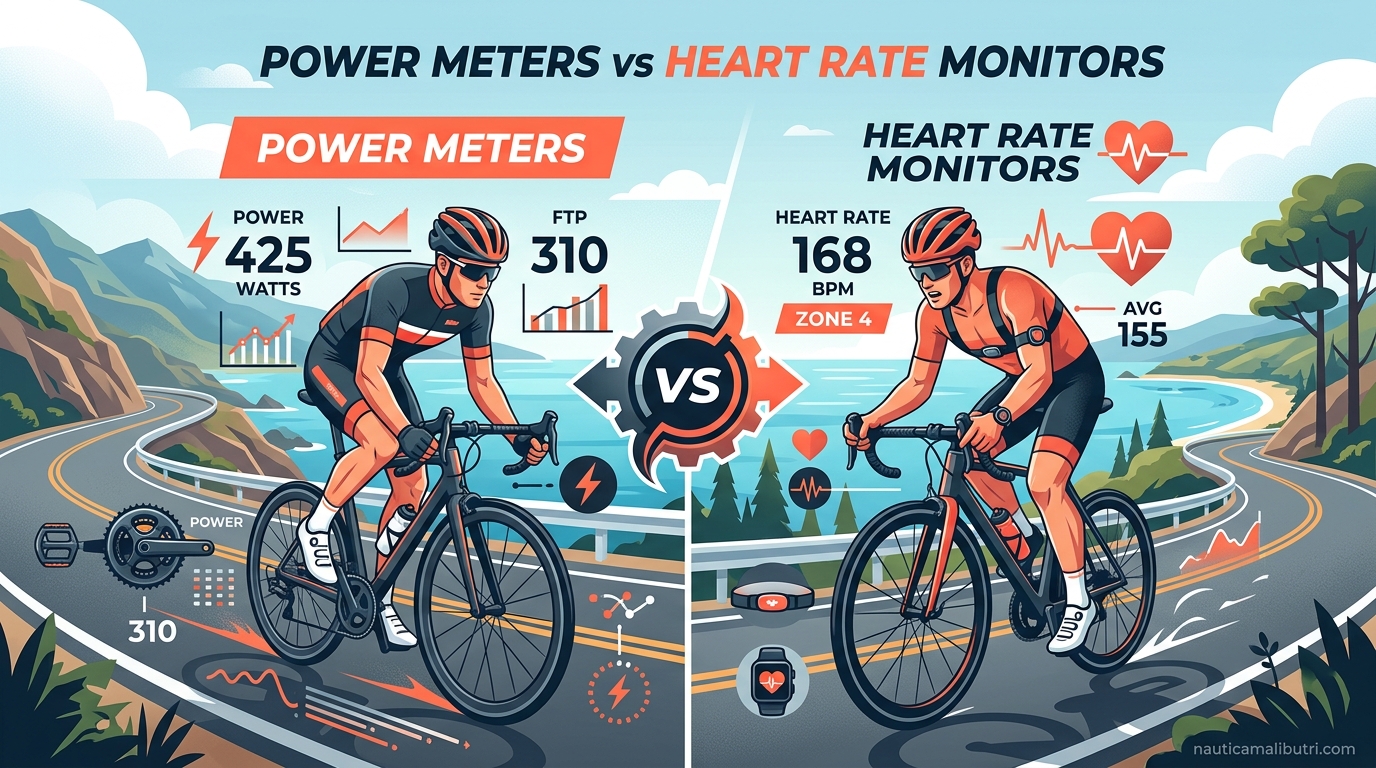
Every cyclist faces the same question at some point: should I train with a heart rate monitor or invest in a power meter? After 12 years of racing and coaching triathletes through the Malibu Triathlon and beyond, I have watched people agonize over this decision, often buying the wrong device for their goals and wasting money in the process.
The truth is that power meters and heart rate monitors measure completely different things. One tracks your body’s response to effort. The other tracks the actual work you produce. Understanding this distinction changes everything about how you train.
In this guide, you will learn exactly how power meters vs heart rate monitors differ, when each tool shines, and how to use them together for maximum results. We will cover the science behind both devices, the pros and cons nobody talks about, and give you a clear framework for deciding which makes sense for your cycling goals.
Table of Contents
What Is a Heart Rate Monitor and How Does It Work?
A heart rate monitor measures your cardiovascular system’s response to exercise in beats per minute (BPM). It tracks how fast your heart pumps to deliver oxygen to working muscles. This measurement reflects your body’s internal reaction to physical stress.
Most cycling heart rate monitors use one of two technologies. Chest straps measure the electrical signals your heart generates with each beat through electrodes pressed against your skin. These straps transmit data to your bike computer or phone wirelessly using Bluetooth or ANT+ protocols. The accuracy of chest straps typically falls within 1 to 2 BPM of medical-grade ECG equipment.
Optical sensors found in wristbands and arm bands work differently. They shine light into your skin and measure how blood flow changes alter light absorption. This technology, called photoplethysmography, estimates heart rate by detecting pulse waves. While more comfortable for all-day wear, optical sensors lag slightly behind chest straps and can lose accuracy during high-intensity efforts with lots of arm movement.
Your heart rate reflects your body’s internal effort. When you push harder, your heart beats faster to supply more oxygen. When you recover, it slows down. This makes heart rate a useful proxy for exercise intensity, though it comes with significant limitations we will explore in detail.
The concept is simple: your heart is a pump, and like any pump, it must work harder to deliver more blood when demand increases. During cycling, your leg muscles consume oxygen to produce energy. The more intensely you ride, the more oxygen they need. Your cardiovascular system responds by increasing heart rate to circulate more oxygen-rich blood.
What Is a Power Meter and How Does It Work?
A power meter measures the actual mechanical work your legs produce while pedaling, expressed in watts. It quantifies exactly how much force you apply to the pedals combined with how fast you turn them. One watt equals one joule of energy per second, providing an absolute measurement of your output.
The technology inside a power meter relies on strain gauges, tiny sensors that detect microscopic deformation when force is applied. These precision instruments live inside crank arms, pedal spindles, rear hubs, or spider assemblies depending on the power meter type. When you push down on a pedal, the strain gauges measure the bending or compression of the component.
Your power meter combines this torque measurement with your cadence to calculate watts using a straightforward formula: power equals torque multiplied by angular velocity. Torque represents the twisting force you apply, measured in newton-meters. Angular velocity represents how fast you spin the cranks, measured in radians per second.
Unlike heart rate, power output represents your external performance. A watt is a universal unit of measurement. Whether you are fresh or fatigued, hot or cold, caffeinated or relaxed, the power meter shows exactly what your legs are doing at that moment. This objectivity makes power the gold standard for structured training.
Different power meter types place strain gauges in various locations. Spider-based systems sit between your chainrings and crank arm, measuring total force at the drivetrain. Pedal-based systems live inside the pedal spindle, measuring force at the foot interface. Crank arm systems measure force in the arm itself. Hub-based systems measure at the rear wheel. Each location offers trade-offs in accuracy, weight, and convenience.
Training with Heart Rate: The Pros and Cons
Heart rate monitors have been a cycling staple since the 1980s for good reasons. They are affordable, simple to use, and provide valuable insights about your body’s state. But they also carry significant limitations that frustrate many cyclists once they progress beyond basic fitness building.
Pros of Heart Rate Training
Heart rate monitors offer the most accessible entry point into structured training. A reliable chest strap from brands like Polar or Wahoo costs between $40 and $80, making it the cheapest way to start tracking exercise intensity with real data. For cyclists just beginning their fitness journey, this affordability removes a major barrier.
Your heart rate provides insights that power cannot offer. It reflects your body’s overall stress level, including accumulated fatigue, approaching illness, and recovery status. When your heart rate runs 10 BPM higher than normal at a given pace, your body is sending a clear message. This makes heart rate invaluable for recovery rides and monitoring overtraining before it becomes a serious problem.
The physiological connection matters for health tracking beyond cycling. Many cyclists continue wearing heart rate monitors during strength training, hiking, swimming, and daily activity because it tracks cardiovascular fitness across all life stressors, not just bike workouts. A power meter only works on a bicycle. A heart rate monitor works everywhere.
For beginner cyclists, heart rate zones provide a gentler learning curve. The concepts feel intuitive: your heart beats faster when you work harder. This natural correlation helps new riders understand intensity without drowning in complex metrics. Starting with heart rate builds the habit of data-driven training before graduating to more sophisticated tools.
Cons of Heart Rate Training
The biggest limitation of heart rate training is the lag. Your cardiovascular system responds slowly to intensity changes. When you sprint, power spikes immediately but your heart rate takes 90 to 120 seconds to catch up to the new demand. When you stop pedaling completely, power drops to zero instantly while your heart continues pounding for minutes.
This lag makes heart rate nearly useless for short intervals. A 30-second effort might end before your heart rate even registers the intensity spike. A one-minute interval only shows meaningful heart rate elevation for the final 15 seconds. You cannot pace efforts accurately using a metric that responds this slowly.
External factors constantly skew heart rate readings, creating day-to-day inconsistency that frustrates structured training. Temperature plays a huge role: riding in 85-degree heat raises heart rate 10 to 20 BPM for the same power output compared to riding in 60-degree weather. Your body works harder to cool itself, demanding more cardiovascular resources.
Dehydration pushes heart rate higher as blood volume decreases and blood thickens. Even mild dehydration of 2% body weight noticeably elevates heart rate at submaximal efforts. Caffeine spikes heart rate through sympathetic nervous system activation. Stress, poor sleep, altitude exposure, and emotional state all alter your heart rate at a given workload.
Day-to-day variability makes precise training zones difficult to maintain. You might hold 150 BPM at 200 watts on Tuesday after a good night’s sleep. Thursday, after work stress and poor nutrition, you need 165 BPM to produce the same 200 watts. This inconsistency forces you to guess at appropriate intensities rather than following reliable targets.
Training with a Power Meter: The Pros and Cons
Power meters revolutionized cycling training when they became affordable in the mid-2000s. They eliminated the guesswork and variability that plagued heart rate training. But they are not perfect tools, and understanding their limitations helps you use them wisely rather than blindly following numbers.
Pros of Power Training
Power meters provide truly instant feedback. The moment you push harder, the number jumps. The second you ease off, it drops. This real-time responsiveness transforms interval training, allowing you to hold precise intensities from the first pedal stroke rather than guessing and adjusting.
During a set of 2-minute intervals at 300 watts, your power meter shows exactly 300 watts within one second of starting the effort. Your heart rate monitor might show 135 BPM at the start, 152 BPM at 30 seconds, 165 BPM at 90 seconds, and finally stabilize near 170 BPM as the interval ends. Which metric helps you execute the workout correctly?
Power data is objective and consistent in ways heart rate cannot match. A watt is always a watt. Whether you are tired, energized, hot, cold, stressed, or relaxed, 250 watts represents the same mechanical output. This consistency lets you track true fitness progression over months and years without the noise that distorts heart rate data.
Race pacing becomes scientific with power. You can set specific wattage targets for climbs, flats, headwinds, and tailwinds that keep you in your sustainable zone. Many cyclists credit power meters with helping them finish strong instead of blowing up halfway through events. Knowing your Functional Threshold Power allows precise pacing regardless of terrain or conditions.
Data analysis reveals insights about your fitness that subjective feeling cannot provide. Tracking metrics like FTP, maximum power outputs, and training stress over time shows whether your training is actually working. You can spot plateaus, peaks, and declines with numerical precision. This removes the subjectivity that leads many cyclists to overtrain or undertrain based on feelings.
Cons of Power Training
Power meters cost significantly more than heart rate monitors, creating a real barrier to entry. Entry-level single-sided crank-based systems start around $300. Dual-sided pedal systems that measure each leg independently can exceed $1,000. Spider-based systems from reputable manufacturers typically range from $400 to $700. This price point excludes many beginners and recreational riders.
The data overwhelm hits many new power meter users hard. Suddenly you have access to normalized power, intensity factor, training stress score, variability index, efficiency factor, and dozens of other metrics. Without proper guidance, cyclists either ignore the valuable data entirely or develop unhealthy obsessions over meaningless number fluctuations.
Power meters require occasional calibration and maintenance to maintain accuracy. Spider-based systems need zero-offset adjustments before rides. Pedal-based systems require periodic battery changes. Some units drift over time and need recalibration against known standards. While not burdensome, these requirements exceed the simple care needed for a heart rate monitor.
Most importantly, power meters do not tell you how your body feels. You can push 300 watts while deeply fatigued, fighting illness, or on the verge of overtraining. Power shows output, not the physiological cost of producing that output. Rigidly following power targets despite warning signs from your body leads to burnout, illness, and injury.
Power data alone cannot distinguish between a sustainable 300 watts and a desperate 300 watts that will destroy you by the ride’s end. Only heart rate, perceived exertion, and honest self-assessment reveal that critical difference.
Power vs Heart Rate: The Key Differences That Matter
Understanding why these tools produce different results requires grasping a fundamental concept that many cyclists miss entirely. The distinction between input and output changes how you interpret every workout and training decision.
Input vs Output: The Critical Distinction
Legendary coach Joe Friel, who pioneered modern endurance training methodology, uses a brilliant analogy to explain this difference. Imagine your body as a car engine. Your heart rate is like the tachometer, measuring how hard the engine is working. Your power meter is like the speedometer, measuring how fast you are actually going.
Heart rate represents input: the physiological effort your cardiovascular system expends to meet demands. It shows how hard your body works. Power represents output: the mechanical work your muscles actually produce. It shows what you accomplish. These are related but distinct measurements that often diverge significantly.
A car engine can rev at 5,000 RPM while barely moving if the car is in neutral or climbing a steep grade in low gear. Similarly, your heart can beat rapidly without producing much power if you are fatigued, overheated, or fighting a strong headwind. Conversely, you can produce high power with a relatively low heart rate when fresh, cool, properly fueled, and aerobically efficient.
This input-output distinction explains why heart rate and power often tell different stories during workouts. A cyclist might produce 250 watts at 155 BPM one day and need 170 BPM to produce that same 250 watts another day. The output stayed constant. The input required to produce it changed dramatically.
Smart cyclists use both metrics together to understand whether their body is working efficiently or struggling against accumulated stress. When power stays steady but heart rate climbs, your efficiency has dropped. When both rise together proportionally, you are simply working harder. When power drops but heart rate stays high, fatigue or illness has stolen your capacity.
The Lag Problem: Why Timing Matters
The 90 to 120 second delay between power changes and heart rate response creates real training problems for certain workout types. During short intervals under three minutes, your heart rate barely budges while your power spikes and drops repeatedly.
Consider a typical high-intensity interval set: 30 seconds all-out at 400 watts, followed by 30 seconds recovery at 100 watts, repeated 10 times. Your power meter shows perfect oscillation between high and low outputs with instant transitions. Your heart rate monitor shows a gradually climbing line that plateaus around rep six and stays elevated throughout the set.
Which metric helps you execute this workout correctly? The power meter guides you to hit the target watts immediately for each 30-second effort. The heart rate monitor becomes essentially useless for pacing these short intervals, providing only confirmation that you worked hard afterward.
For steady-state efforts like tempo rides or time trials, the lag matters less. Heart rate eventually stabilizes and provides useful guidance for maintaining consistent physiological load. Your cardiovascular system catches up after three to five minutes of steady effort, making heart rate reasonably reliable for longer sustained work.
But for the high-intensity interval training that drives fitness improvements most efficiently, only power gives you actionable feedback in real time. The lag makes heart rate pacing impossible for efforts shorter than three minutes.
External Factors: What Affects Each Metric
Understanding how different conditions impact heart rate versus power helps you interpret data correctly during training and racing.
Temperature and thermal stress: Heat raises heart rate significantly for the same power output. Your body diverts blood to the skin for cooling, increases sweat production, and works harder to maintain core temperature. These thermoregulatory demands increase cardiovascular stress. Power stays steady because your legs still produce the same mechanical work, but the physiological cost increases substantially.
Hydration and fatigue: Dehydration thickens blood and raises heart rate as your cardiovascular system compensates for reduced plasma volume. Accumulated fatigue reduces cardiac efficiency, requiring more beats to deliver the same oxygen. Both conditions push heart rate higher at any given power output, making power the more reliable metric for maintaining absolute training targets.
Caffeine and stimulants: Pre-workout caffeine spikes heart rate 5 to 15 BPM through sympathetic nervous system activation without affecting your power-producing capacity. Many cyclists notice their heart rate runs 10 BPM high on caffeinated rides despite feeling normal power. Emotional stress triggers the same fight-or-flight response, artificially elevating heart rate before you even touch the pedals.
Altitude: Higher elevations raise heart rate as your body compensates for reduced oxygen availability in the air. Power output may drop as a consequence of hypoxia, but the heart rate elevation happens regardless of actual work rate. Training at altitude requires different heart rate zones than sea level, while power targets remain more consistent.
None of these factors change your power output unless they actually limit your muscular capacity. This stability makes power the superior metric for objective training progression and race pacing across varying conditions.
Understanding Cardiovascular Drift
Cardiovascular drift describes the gradual rise in heart rate that occurs during sustained exercise even when power output stays constant. It is one of the most important physiological phenomena for endurance athletes to understand and manage.
Here is what happens during a long steady ride. You hold 200 watts consistently using your power meter as a guide. For the first 30 minutes, your heart rate stays comfortably at 145 BPM. By hour two, it climbs to 155 BPM. By hour three, you are at 162 BPM despite never changing your power output or perceived effort level.
This drift occurs because your body redirects blood flow to cool the skin as core temperature rises during prolonged exercise. Less blood returns to the heart between beats, so it must beat faster to maintain cardiac output and oxygen delivery. Dehydration compounds the effect by reducing blood volume, forcing the heart to work even harder.
From a training perspective, cardiovascular drift matters because it shows why heart rate zones become unreliable during long efforts. If you tried to maintain a heart rate zone instead of a power target, you would gradually reduce your actual workload as the drift progressed. Starting at 150 BPM might require 220 watts initially but only 180 watts by the second hour.
Elite endurance athletes use cardiovascular drift as a fitness marker. When your aerobic fitness improves, you see less drift at a given power output during long rides. This improvement reflects better thermoregulation, increased plasma volume from training adaptations, and improved cardiac efficiency. Tracking drift over time reveals fitness changes that absolute power numbers might not show.
Practical management of cardiovascular drift includes staying well-hydrated, dressing appropriately for temperature, and accepting that heart rate targets need adjustment during long workouts. Power remains your anchor while heart rate floats upward.
How to Use Heart Rate and Power Together
The optimal training setup uses both power and heart rate simultaneously rather than treating them as competing tools. Each device covers the other’s blind spots. When combined thoughtfully, they provide a complete picture of your fitness, health, and performance.
Efficiency Factor: The Combined Metric
Training platforms like TrainingPeaks calculate a powerful metric called Efficiency Factor (EF) that combines both measurements into one trend line. EF equals your normalized power divided by your average heart rate for a workout.
For example, if you average 195 watts normalized power and 150 BPM average heart rate during a workout, your EF equals 1.30. This ratio represents your aerobic efficiency during that session.
A rising EF over time indicates improving aerobic fitness. You are producing more power per heartbeat, meaning your cardiovascular system operates more efficiently. This trend matters more than absolute power numbers for many cyclists because it shows true physiological improvement independent of daily condition variations.
Comparing EF for similar workouts weeks apart reveals fitness trends. If your EF climbs from 1.25 to 1.40 over three months of base training, your aerobic engine has grown significantly even if your FTP only increased modestly. This metric captures efficiency gains that raw power misses.
Setting Training Zones with Both Metrics
Establish power zones first using a Functional Threshold Power test or ramp test protocol. These zones remain relatively stable over weeks and months, changing only with real fitness adaptations. Power zones provide your primary intensity targets for all structured workouts.
Then observe what heart rate ranges correspond to each power zone when you are well-rested, properly hydrated, and riding in moderate temperatures. Record these heart rate ranges as secondary reference points. They will vary day to day, but you will learn your typical patterns.
During workouts, use power as your primary intensity guide. It responds instantly and stays consistent. Monitor heart rate as a secondary check on your physiological state. When heart rate runs significantly higher than your established range for a given power zone, you may be fatigued, dehydrated, overheated, or fighting illness.
Conversely, when heart rate stays suppressed below normal ranges for a given power, you might be particularly fresh, well-rested, or experiencing positive adaptation. Use this information to adjust daily targets intelligently.
When to Prioritize Which Metric
Use power for any interval under five minutes, all race pacing decisions, and tracking long-term fitness progression. The instant feedback and objective consistency make it unbeatable for these applications.
Use heart rate for recovery rides, long steady endurance efforts over two hours, and monitoring overall health status between hard workouts. Its sensitivity to fatigue, illness, and stress provides early warning signals that power misses entirely.
During stage races, multi-day events, or heavy training blocks, heart rate becomes increasingly important. Your power capacity may stay high while your recovery status deteriorates beneath the surface. Only heart rate reveals this accumulating fatigue before it causes collapse or illness.
Many experienced cyclists train primarily by power during hard workouts while wearing heart rate monitors specifically for recovery tracking and health monitoring. This hybrid approach leverages each tool’s strengths while minimizing weaknesses.
Understanding Power Output Benchmarks
Many cyclists wonder what constitutes “good” power numbers for their goals and abilities. The answer depends on body weight, sex, age, and cycling experience. Power relative to body weight matters more than absolute watts for climbing performance and most racing applications.
A typical untrained cyclist might sustain 150 watts for 20 minutes at threshold effort. After six months of consistent structured training, 200 watts becomes achievable. Dedicated amateur racers with two to three years of training often hold 250 to 300 watts for 20 minutes. Elite professional cyclists push 400+ watts at threshold, with some climbers reaching 450 watts despite low body weights.
Relative to body weight, the benchmarks look different. Recreational riders typically achieve 2.0 to 2.5 watts per kilogram at threshold. Competitive amateur racers range from 3.0 to 4.0 watts per kilogram. Regional elite riders often exceed 4.5 watts per kilogram. World Tour professionals exceed 5.5 and sometimes reach 6.5 to 7.0 watts per kilogram during major climbs.
So is 300 watts for 20 minutes good? For a 90 kg beginner, it represents solid progress above the untrained level. For a 60 kg female racer, it marks elite territory competitive at national levels. For a 75 kg male amateur, it indicates strong fitness around 4.0 watts per kilogram, placing you above average among recreational cyclists. Context always matters more than absolute numbers.
Your personal progression matters most for tracking improvement. Record your best 20-minute power every six to eight weeks during focused training. Improvements of 5% to 10% annually indicate excellent training response. Plateaus lasting over three months suggest the need for training stimulus changes.
Frequently Asked Questions
What is the difference between a power meter and a heart rate monitor?
A power meter measures the mechanical work your legs produce in watts, while a heart rate monitor measures your body’s cardiovascular response in beats per minute. Power shows your actual output. Heart rate shows your physiological effort. Power responds instantly to intensity changes while heart rate lags 90-120 seconds. Power stays consistent across different conditions while heart rate varies with temperature, fatigue, and stress.
Do pros use power meters?
Yes, virtually all professional cyclists use power meters for training and racing. Power meters provide the precise pacing and data analysis necessary for elite performance. Some pros, like Tadej Pogačar, occasionally race without heart rate monitors while always using power meters. The instant feedback and objective consistency make power meters essential at the professional level.
Is 300 watts for 20 minutes good?
300 watts for 20 minutes represents solid fitness for most recreational male cyclists. For a 75 kg rider, this equals 4.0 watts per kilogram, placing you above average among amateur cyclists. For lighter riders, this ratio improves significantly. Elite female cyclists and lighter male racers would find 300 watts at threshold highly competitive. Heavier riders would need higher absolute watts for the same relative fitness.
Is power zone better than heart rate training?
Power zone training is superior for interval work, race pacing, and tracking fitness progression due to instant feedback and objective consistency. Heart rate training works well for steady endurance rides and monitoring recovery status. The best approach combines both: use power for intensity targets and heart rate for health monitoring. Neither tool alone provides the complete picture.
If I have a power meter, do I still need a heart rate monitor?
Yes, heart rate monitors provide valuable insights that power meters cannot offer. Heart rate tracks your body’s stress response, recovery status, and overall health. It reveals fatigue, illness, and overtraining before power numbers decline. Many experienced cyclists train primarily by power while wearing heart rate monitors for recovery tracking and health insights. The combination provides the most complete training data.
Which should I buy first – power meter or heart rate monitor?
Buy a heart rate monitor first if you are new to structured training and on a budget. It provides an affordable entry point into data-driven cycling. Upgrade to a power meter when you start doing intervals under five minutes, racing regularly, or want precise fitness tracking. If budget allows, buying both simultaneously gives you the best training setup from day one.
Conclusion
The debate over power meters vs heart rate monitors misses the fundamental point. These tools measure completely different aspects of your cycling performance. Heart rate tracks input: how hard your cardiovascular system works to meet demands. Power tracks output: how much mechanical work your muscles actually produce. Both measurements matter for complete training analysis.
Your best strategy depends on budget constraints and cycling goals. Start with a heart rate monitor if you are new to structured training and want an affordable introduction to data-driven cycling. Add a power meter when you start serious interval work, racing regularly, or want precise fitness progression tracking. Use power for instant feedback during hard efforts and scientific race pacing. Use heart rate for monitoring recovery status and overall health between workouts. Together, they transform training guesswork into precision.
Technology continues advancing with new features and integration options, but the underlying principles stay constant. Train hard with purpose, recover adequately, and measure what matters for your goals. Whether you choose heart rate monitoring, power measurement, or both systems together, consistent training execution beats perfect data collection every time. Get the tools that fit your current budget and goals, then focus on the actual work that makes you a faster, healthier cyclist.