
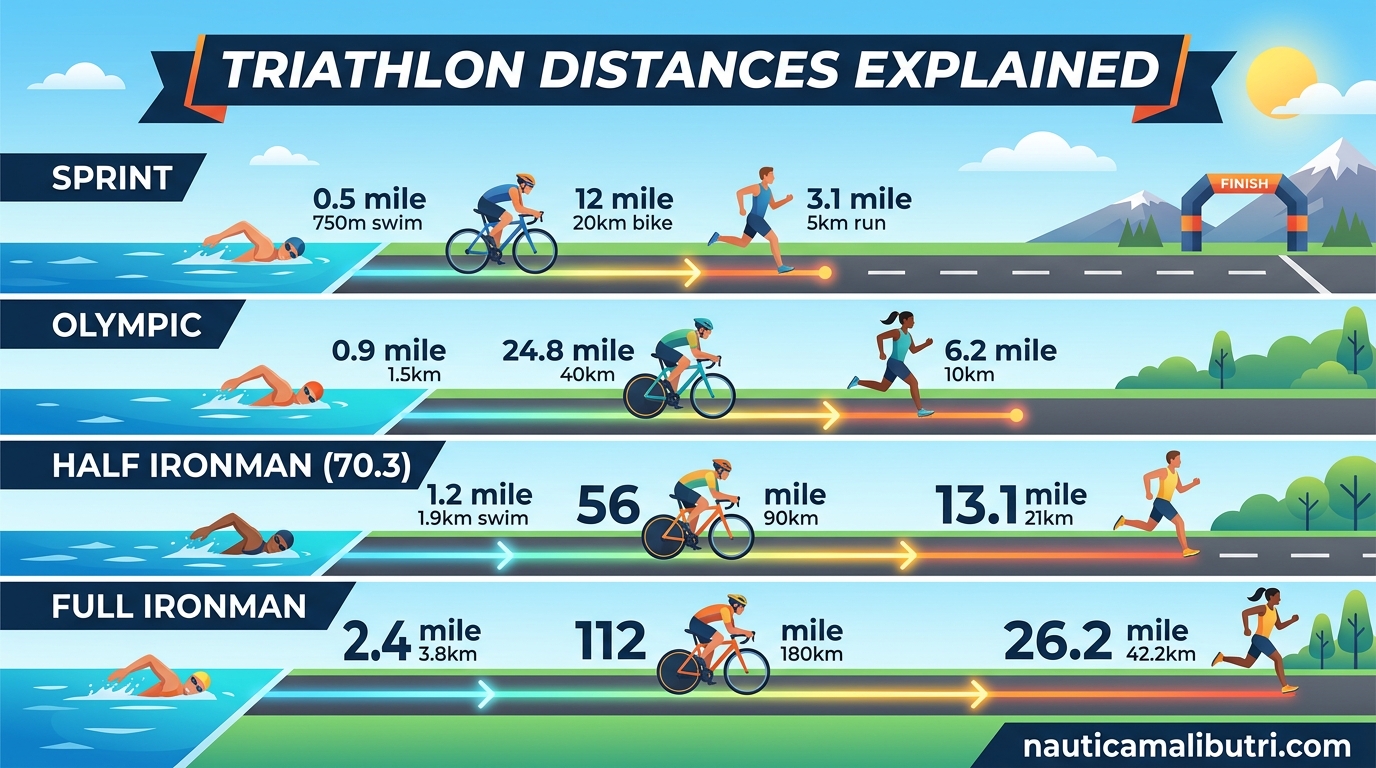
Triathlon distances explained simply: the sport offers five main race formats, ranging from beginner-friendly super sprints to the legendary full Ironman. Each distance combines swimming, cycling, and running in varying proportions that determine both the challenge level and training commitment required.
I remember standing at my first triathlon expo, completely overwhelmed by the numbers being thrown around. 70.3? 140.6? Sprint vs Olympic? It felt like everyone else had memorized a secret code. After completing over a dozen races across every distance format, I can tell you that understanding these distances upfront makes choosing your first race infinitely less stressful.
This guide breaks down every standard triathlon distance with exact measurements in both miles and kilometers. You will learn what to expect from each format, realistic completion times based on real athlete data, and how to pick the right distance for your fitness level and goals.
Table of Contents
Triathlon Distances at a Glance
Before diving into each format, here is a quick comparison of all standard triathlon distances:
- Super Sprint: 400m swim / 10km bike / 2.5km run (total ~8.5km or 5.3 miles)
- Sprint: 750m swim / 20km bike / 5km run (total ~25.75km or 16 miles)
- Olympic (Standard): 1.5km swim / 40km bike / 10km run (total ~51.5km or 32 miles)
- Half Ironman (70.3): 1.9km swim / 90km bike / 21.1km run (total ~113km or 70.3 miles)
- Full Ironman (140.6): 3.8km swim / 180km bike / 42.2km run (total ~226km or 140.6 miles)
The numbers 70.3 and 140.6 refer to the total miles covered in half and full Ironman races respectively. These are trademarked Ironman brand distances, though many non-Ironman races offer the same distances under names like “half distance” or “long course.”
Super Sprint Triathlon Distance
The super sprint is the shortest standardized triathlon distance and the perfect entry point for absolute beginners, children, and anyone testing the multisport waters. With a 400-meter swim (roughly 8-10 pool lengths), a 10-kilometer bike ride, and a 2.5-kilometer run, the entire event typically finishes in under an hour.
Super sprint races are often held at local community pools with bike and run courses on closed neighborhood streets. The swim portion usually takes place in a pool rather than open water, removing the anxiety many beginners feel about swimming in lakes or oceans. This distance allows you to experience all three sports and two transitions without the physical demand of longer formats.
Most athletes complete a super sprint in 40 to 60 minutes depending on fitness level. The bike leg is short enough that road bikes are not necessary. Many participants successfully use hybrid bikes or even mountain bikes. If you are nervous about your first triathlon or want to introduce kids to the sport, this is the distance to start with.
Sprint Triathlon Distance
The sprint distance is the most popular triathlon format worldwide and the distance we use at the Nautica Malibu Triathlon. It consists of a 750-meter swim (about 15 pool lengths), a 20-kilometer bike ride, and a 5-kilometer run. The total distance of 25.75 kilometers makes it challenging yet achievable for most fitness enthusiasts.
After speaking with hundreds of first-time triathletes at our Malibu event, I can confirm what Reddit communities echo: the sprint distance hits the sweet spot for beginners. It is substantial enough to feel like a real accomplishment while remaining manageable with 8-12 weeks of consistent training.
Average completion times range from 1 hour 15 minutes for competitive athletes to 2 hours 30 minutes for beginners. The 750-meter swim typically takes 15-25 minutes, the 20km bike 40-60 minutes, and the 5km run 25-40 minutes depending on your pace. Transition times add another 5-10 minutes total.
The sprint distance works well for pool-based swims or protected ocean bays. Cut-off times are generous, usually allowing 3+ hours total. This format builds confidence for moving up to Olympic distance or provides a satisfying one-day challenge for recreational athletes.
Olympic Triathlon Distance (Standard)
The Olympic distance, also called the standard distance, follows the official format used in Olympic Games since Sydney 2000. This distance doubled the sprint format: 1.5 kilometers swimming, 40 kilometers cycling, and 10 kilometers running. Total distance is 51.5 kilometers or 32 miles.
This format demands serious respect. The 1.5km open water swim takes most age-groupers 30-45 minutes. The 40km bike leg requires 75-120 minutes depending on terrain and fitness. Then you still face a full 10km run, which takes another 50-70 minutes after biking.
Elite athletes complete Olympic distance triathlons in under 1 hour 50 minutes. Age-group finishers typically range from 2 hours 15 minutes to 3 hours. Most races impose a 3 to 4-hour cut-off time.
The Olympic distance requires consistent training of 7-10 hours weekly for at least 12-16 weeks. Open water swimming skills become essential. You will need a proper road bike or triathlon bike rather than a hybrid. This distance suits athletes with some endurance sport background who want a significant challenge without the massive time commitment of Ironman training.
Half Ironman Distance (70.3)
The half Ironman distance, designated 70.3 for its 70.3-mile total length, represents a major step up in endurance demands. The format includes a 1.9-kilometer swim (1.2 miles), a 90-kilometer bike ride (56 miles), and a half-marathon run of 21.1 kilometers (13.1 miles).
This distance requires a substantial training block of 4-6 months with 10-14 hours of weekly training. The swim alone takes most athletes 35-50 minutes in open water. The bike leg demands 3-4 hours of continuous riding. Then you run a half marathon on tired legs.
Completion times vary dramatically based on course difficulty and athlete experience. Fast age-groupers finish in 4 hours 30 minutes. Most competitors fall between 5 and 7 hours. Race cut-offs typically range from 8 to 8.5 hours total.
The half Ironman suits endurance athletes ready for a serious challenge. You should complete several sprint and Olympic races before attempting this distance. Nutrition strategy becomes critical. Many athletes report the bike-to-run transition (the “brick” effect) as the biggest challenge. Your legs will feel like concrete for the first few miles of the run.
Full Ironman Distance (140.6)
The full Ironman distance, designated 140.6 for its 140.6-mile total, stands as one of the most demanding single-day endurance events in mainstream sports. The distances are staggering: a 3.8-kilometer open water swim (2.4 miles), a 180-kilometer bike ride (112 miles), and a full marathon run of 42.2 kilometers (26.2 miles).
Training for an Ironman requires 6+ months of dedicated preparation with 12-20 hours of training weekly. The swim takes most age-groupers 1 to 1.5 hours. The bike leg consumes 6 to 8 hours depending on course elevation. Then you run a full marathon, typically taking 4 to 6 hours on exhausted legs.
Race day itself spans up to 17 hours. Official Ironman races enforce strict cut-offs: 2 hours 20 minutes for the swim, 8 hours 10 minutes from start for the bike finish, and 17 hours total for the entire event. Missing any cut-off ends your race immediately.
Completion times range from 8 hours for elite age-groupers to 16+ hours for back-of-the-pack finishers. Most first-time Ironman finishers cross the line between 12 and 15 hours. The emotional experience of hearing “You are an Ironman” at the finish line draws thousands of athletes to this distance despite the grueling preparation required.
Average Completion Times by Distance
Understanding realistic time expectations helps with race selection and pacing strategy. Here are typical finish times based on real race data from age-group athletes:
Super Sprint: Beginners finish in 55-75 minutes. Intermediate athletes complete it in 40-50 minutes. Advanced competitors often finish under 35 minutes.
Sprint: First-timers typically finish between 2 hours and 2.5 hours. Intermediate athletes range from 1 hour 25 minutes to 1 hour 50 minutes. Competitive age-groupers finish in 1 hour 10 minutes to 1 hour 25 minutes.
Olympic: Beginners need 2.75 to 3.5 hours. Intermediate athletes finish between 2 hours 15 minutes and 2 hours 45 minutes. Advanced competitors complete the distance in 1 hour 55 minutes to 2 hours 15 minutes.
Half Ironman (70.3): Most first-timers finish between 6 and 7.5 hours. Intermediate athletes range from 5 to 6 hours. Competitive age-groupers finish in 4 hours 15 minutes to 5 hours.
Full Ironman (140.6): First-time finishers typically range from 13 to 16 hours. Intermediate athletes finish between 11 and 13 hours. Advanced age-groupers complete the distance in 9.5 to 11 hours.
Course terrain dramatically affects these times. Hilly bike courses add 15-30 minutes compared to flat courses. Ocean swims with currents can vary by 10-20 minutes. Hot run conditions slow everyone down.
How to Choose Your First Triathlon Distance
Selecting the right distance for your first triathlon requires honest assessment of your current fitness, available training time, and comfort level with each discipline. Based on forum discussions with thousands of beginner triathletes, here is what actually works.
Start with sprint distance. Even if you run marathons or cycle centuries, the unique challenge of combining three sports with transitions requires practice. Our team has seen countless strong single-sport athletes struggle in their first triathlon because they underestimated the multisport demands. The sprint distance teaches you pacing, transition skills, and race-day nutrition without the pressure of extreme endurance.
Assess your swim ability honestly. Swimming causes the most anxiety for beginners. If you cannot comfortably swim 400 meters without stopping, choose a super sprint or practice until you can. Pool-based sprint triathlons offer the most beginner-friendly environment. Open water swims add complexity with sighting, currents, and pack swimming.
Consider your training availability. Sprint distance requires 4-6 hours weekly for 8-12 weeks. Olympic demands 7-10 hours weekly for 12-16 weeks. Half Ironman needs 10-14 hours weekly for 16-20 weeks. Full Ironman requires 12-20 hours weekly for 20-26 weeks. Be realistic about your schedule.
If you are still unsure, register for a sprint. You can always move up distances as you gain experience. Moving down because you overestimated your readiness is much harder on your confidence.
Training Requirements for Each Distance
Each triathlon distance requires different weekly training commitments and specific preparation strategies. Here is what you actually need to commit to for each format.
Super Sprint Training: 3-4 hours weekly for 6-8 weeks. Focus on completing each discipline comfortably. Brick workouts (bike followed immediately by run) help your legs adapt to the transition. One session per sport weekly is sufficient.
Sprint Training: 4-6 hours weekly for 8-12 weeks. Include two sessions per sport weekly with one brick workout. Build to continuous swims of 1000+ meters, bike rides of 25+ miles, and runs of 4+ miles. Practice your transitions.
Olympic Training: 7-10 hours weekly for 12-16 weeks. Schedule three sessions per sport weekly with longer weekend workouts. Build endurance with 2000+ meter swims, 40+ mile bikes, and 8+ mile runs. Include weekly brick sessions.
Half Ironman Training: 10-14 hours weekly for 16-20 weeks. Requires structured periodization with base, build, and peak phases. Weekend workouts become critical: long bikes of 3+ hours and runs of 10+ miles. Nutrition practice during long sessions is essential.
Full Ironman Training: 12-20 hours weekly for 20-26 weeks. This becomes a lifestyle commitment. Long weekend bikes extend to 5-6 hours. Runs build to 18+ miles. You must practice race-day nutrition repeatedly. Recovery becomes as important as training.
Understanding Transitions: T1 is the swim-to-bike transition. T2 is the bike-to-run transition. Practice both repeatedly. Lay out your gear logically. Experienced triathletes can complete T1 in under 2 minutes and T2 in under 90 seconds. Beginners often spend 5+ minutes in each.
Frequently Asked Questions
What are the standard triathlon distances?
The five standard triathlon distances are: Super Sprint (400m swim, 10km bike, 2.5km run), Sprint (750m swim, 20km bike, 5km run), Olympic/Standard (1.5km swim, 40km bike, 10km run), Half Ironman/70.3 (1.9km swim, 90km bike, 21.1km run), and Full Ironman/140.6 (3.8km swim, 180km bike, 42.2km run).
What is the best triathlon distance for beginners?
The sprint distance (750m swim, 20km bike, 5km run) is the best choice for most beginners. It provides a substantial challenge while remaining achievable with 8-12 weeks of training. The super sprint distance works well for absolute beginners with lower fitness levels or those nervous about open water swimming.
How long is each triathlon distance?
Super Sprint totals 8.5km (5.3 miles), Sprint totals 25.75km (16 miles), Olympic totals 51.5km (32 miles), Half Ironman totals 113km (70.3 miles), and Full Ironman totals 226km (140.6 miles). Each combines swimming, cycling, and running segments.
What is a good time for a sprint triathlon?
A good time for a first-time sprint triathlon finisher is between 2 hours and 2.5 hours. Intermediate athletes typically finish in 1 hour 25 minutes to 1 hour 50 minutes. Competitive age-groupers often complete sprint triathlons in 1 hour 10 minutes to 1 hour 25 minutes.
What does 70.3 and 140.6 mean in triathlon?
70.3 and 140.6 refer to the total miles covered in half and full Ironman triathlons respectively. Half Ironman (70.3) covers 70.3 miles total, while full Ironman (140.6) covers 140.6 miles. These distances are trademarked by Ironman but widely used to describe races of equivalent length.
Can I walk the run portion of a triathlon?
Yes, walking during the run portion is completely allowed in triathlon. Many beginners use a run-walk strategy, especially for longer distances. Some athletes walk aid stations while refueling. The only requirement is finishing within published cut-off times, which vary by race and distance.
Final Thoughts
Understanding triathlon distances explained in plain terms removes the intimidation factor that keeps many people from trying this incredible sport. Whether you choose a super sprint to test the waters or commit to the full Ironman journey, each distance offers its own unique challenges and rewards.
The triathlon community welcomes athletes of all abilities and speeds. Your first race is about finishing, not finishing fast. Start with a sprint distance, build your confidence through experience, and progress at your own pace. The Nautica Malibu Triathlon offers one of the most beginner-friendly sprint courses in the country, with a protected beach swim and closed bike course along the Pacific Coast Highway.
See you at the start line.