
After logging thousands of miles across three disciplines over the past decade, I have learned that what you do immediately after a run matters just as much as the run itself. The best post run stretches to do are not complicated yoga poses or advanced flexibility moves. They are simple, targeted static holds that help your muscles transition from exertion to recovery while they are still warm and receptive.
Whether you are training for your first sprint triathlon or preparing for a full Ironman, post-run stretching should be a non-negotiable part of your routine. In this guide, I will share the exact stretches our training team uses after every session. These movements target the major muscle groups that take a beating during the run leg, helping you recover faster and perform better in your next workout.
We will cover seven essential post-run stretches that require no equipment and can be done anywhere. You will also learn the science behind why stretching matters, proper technique to avoid injury, and time-efficient routines for busy athletes who need to transition quickly from training to life.
Table of Contents
Why Post-Run Stretching Matters for Recovery
Static stretching after running serves multiple recovery functions that go beyond simply feeling good. When you stretch warm muscles, you increase blood flow to the tissues that just worked hard. This enhanced circulation helps remove metabolic waste products like lactic acid while delivering fresh oxygen and nutrients that speed up the repair process.
Research consistently shows that post-run stretching reduces delayed onset muscle soreness (DOMS), that stiff, achy feeling that hits 24 to 48 hours after a hard effort. By maintaining and improving your range of motion, regular stretching also helps prevent common running injuries like shin splints, IT band syndrome, and runner’s knee. Tight muscles are more prone to strains and compensation patterns that throw off your gait.
For triathletes specifically, post-run recovery is even more critical. After a brick workout where you transition directly from bike to run, your hip flexors and quadriceps are already fatigued from the cycling position. The run leg adds additional stress to these same muscles. Without proper stretching, this compounded fatigue can lead to chronic tightness that affects your swimming posture and cycling power in subsequent training sessions.
Beyond the physical benefits, stretching activates your parasympathetic nervous system. This is your body’s “rest and digest” mode, which counteracts the adrenaline and cortisol released during exercise. Taking ten minutes to stretch after a run helps shift your body into recovery mode faster, improving sleep quality and overall adaptation to training stress.
How to Stretch Properly: Form and Technique
Before diving into specific stretches, let us cover the fundamentals that make the difference between helpful recovery and potential harm. First, timing matters. You want to begin your post-run stretches within ten minutes of finishing your run while your muscles are still warm. This is when they are most pliable and responsive to lengthening.
Hold each stretch for fifteen to thirty seconds. Anything less than fifteen seconds does not give your muscle fibers enough time to relax and lengthen. Holding for more than sixty seconds does not provide additional benefit and can actually cause irritation. Do two to three sets per side for optimal results.
Breathing is often overlooked but essential. Use a nose inhale for a count of four, then a slow pursed lip exhale for a count of six. This breathing pattern enhances the relaxation response and helps you sink deeper into each stretch without forcing anything. Never hold your breath during a stretch.
Most importantly, do not bounce. Bouncing or pulsing during a stretch triggers your stretch reflex, which actually causes the muscle to contract and resist lengthening. Instead, ease into each position gradually and hold steady. You should feel mild tension but never sharp pain. If something hurts, back off immediately.
The 7 Essential Post-Run Stretches
These seven stretches form a complete routine that targets every major muscle group worked during running. Perform them in this order, moving from lower body to upper body to create a logical flow. Each stretch includes step-by-step instructions, the primary muscles targeted, and breathing guidance.
1. Standing Quad Stretch
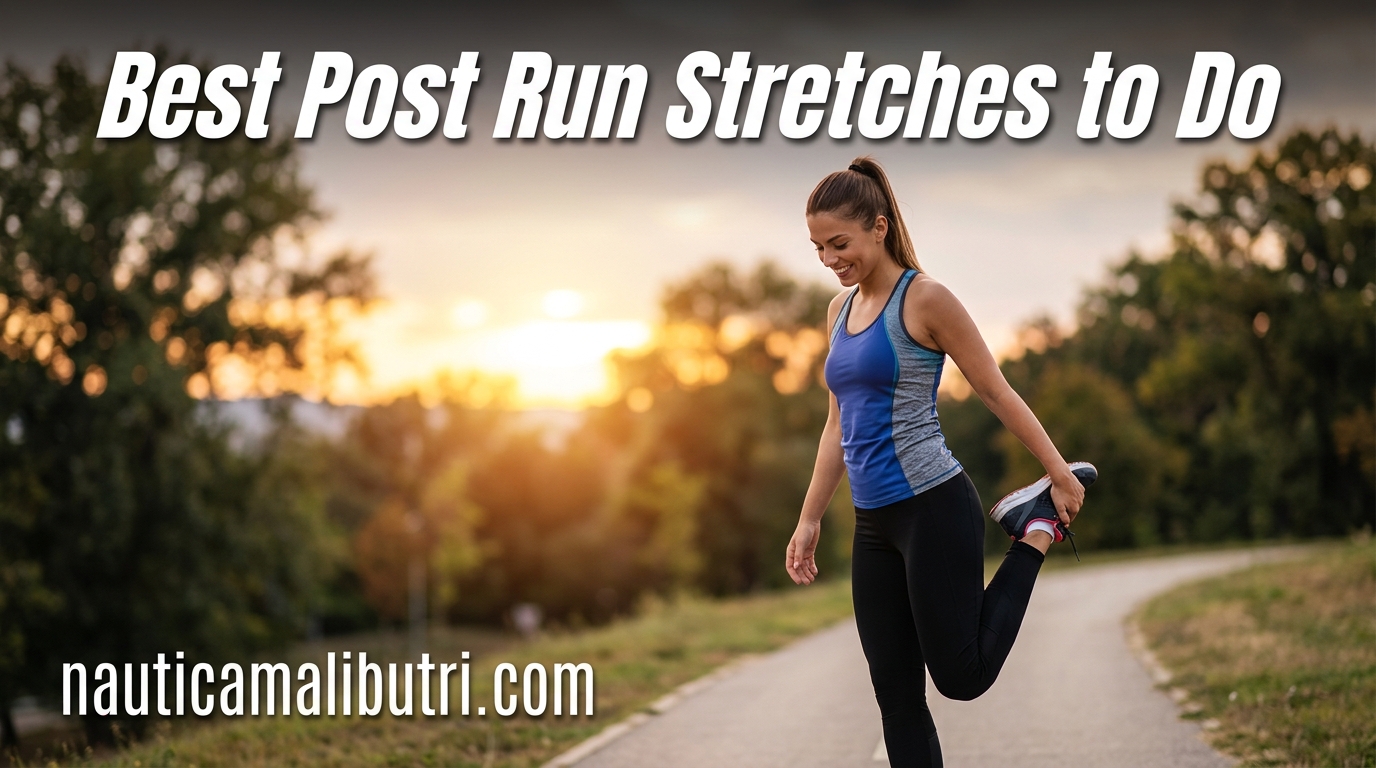
The standing quad stretch targets your quadriceps and hip flexors, which work hard propelling you forward with every stride. This is especially important after hill repeats or speed work when your quads take a beating controlling your descent.
Stand tall with feet hip-width apart. Bend your right knee and bring your heel toward your glutes, grasping your right ankle with your right hand. Keep your knees close together and your torso upright. If you have trouble balancing, use a wall or tree for support. Hold for twenty to thirty seconds while breathing slowly.
You should feel a gentle stretch along the front of your thigh. If you feel any knee discomfort, ease up on the intensity. For triathletes, pay extra attention to this stretch after brick workouts since cycling already shortens the hip flexors. Switch legs and repeat.
2. Hamstring Stretch
Your hamstrings act as the braking system during running, controlling your leg swing and stabilizing your knee. Tight hamstrings are a major contributor to lower back pain and can alter your running mechanics.
Place your right heel on a low surface like a curb, step, or bench, keeping your leg straight but not locked. Hinge forward at your hips, keeping your back flat rather than rounding your spine. Reach your hands toward your toes or rest them on your thigh for support.
Stop when you feel a stretch in the back of your thigh. You should not feel this in your lower back. If you do, bend your supporting knee slightly and focus on hinging from the hips. Hold for twenty to thirty seconds, then switch legs. This stretch can also be performed seated on the ground if you prefer.
3. Calf Stretch Against Wall
The calves power your push-off phase and absorb significant impact with each foot strike. Tight calves contribute to Achilles tendon issues, plantar fasciitis, and shin splints, making this stretch essential for injury prevention.
Stand facing a wall with your hands flat against it at shoulder height. Step your right foot back, keeping your heel flat on the ground and your leg straight. Lean into the wall until you feel a stretch in your upper calf (gastrocnemius). Hold for twenty seconds.
Then bend your back knee slightly while keeping your heel down. This shifts the stretch to your lower calf (soleus) and Achilles tendon. Hold for another twenty seconds. Switch legs and repeat both positions. Many runners neglect the bent-knee variation, but the soleus works just as hard as the gastrocnemius during running.
4. Hip Flexor Lunge Stretch
The hip flexors, specifically the iliopsoas muscle group, become chronically tight in runners, especially those who sit at desks during the day. Tight hip flexors pull your pelvis into an anterior tilt, which strains your lower back and reduces your running efficiency.
Begin in a lunge position with your right foot forward and left knee on the ground. Place your hands on your right thigh for support. Keep your torso tall and slightly forward, tucking your pelvis under to avoid arching your lower back.
Gently press your hips forward until you feel a stretch in the front of your left hip. You may also feel this in your left thigh. Hold for twenty to thirty seconds, breathing deeply and trying to sink a bit deeper with each exhale. Switch legs and repeat. This stretch feels particularly good after long runs when your hip flexors have been working hard stabilizing your stride.
5. Figure-Four Glute Stretch
Your glutes are the powerhouse of running, generating the force that propels you forward. The piriformis muscle, located deep within your glutes, often becomes tight and can compress the sciatic nerve, causing pain that radiates down the leg.
Stand near a wall or sturdy surface for balance. Cross your right ankle over your left knee, creating a figure-four shape with your legs. Slowly bend your left knee and hinge forward at your hips as if sitting back into a chair. Use the wall for support if needed.
You should feel an intense stretch in your right glute. Keep your chest lifted and avoid rounding your back. Hold for twenty to thirty seconds, then carefully release and switch sides. This stretch can also be performed lying on your back if standing balance is challenging.
6. Seated Butterfly Stretch
The adductor muscles of your inner thigh stabilize your leg during the stance phase of running and help control knee position. Tight adductors can contribute to groin strains and affect your running gait.
Sit on the ground with your knees bent and soles of your feet together. Grasp your ankles or feet with your hands. Sit up tall with a neutral spine, then gently press your knees toward the ground using your elbows for light assistance.
Do not force your knees down. Let gravity and your breathing do the work. As you exhale, you will feel your hips relax and your knees drop slightly lower. Hold for twenty to thirty seconds. This stretch also opens up your hips and feels great after a hard effort when your whole lower body feels tight.
7. Supine Spinal Twist
Running creates rotational forces through your spine and pelvis with every stride. Your lower back and thoracic spine need attention to maintain mobility and prevent compensatory stiffness that can affect your form.
Lie flat on your back with your legs extended. Bend your right knee and bring it toward your chest. Then cross your right knee over your body toward the left side. Extend your right arm out to the side at shoulder height and turn your head to look toward your right hand.
Your right knee may or may not touch the ground, depending on your flexibility. Use your left hand to gently press your right knee toward the floor if needed. You should feel a stretch through your lower back and outer hip. Hold for twenty to thirty seconds, breathing deeply into the twist. Switch sides and repeat. This stretch also promotes relaxation, making it a perfect way to finish your routine.
Time-Efficient Stretching Routines for Busy Athletes
We all have days when a full stretching routine feels impossible. Between work, family, and training commitments, sometimes you need to prioritize. Here are two time-efficient options that still deliver results.
The five-minute quick routine hits the essentials when you are pressed for time. Focus on the hip flexor lunge stretch, hamstring stretch, and calf stretch against the wall. These three movements target the muscle groups most prone to tightness in runners. Do one thirty-second hold per side for each stretch. This minimal routine is far better than skipping stretching entirely.
The ten-minute complete routine covers all seven stretches with proper hold times. This is your standard post-run protocol for regular training days when you have a bit more time. For triathletes doing brick workouts, consider this non-negotiable. The compounded stress of bike-to-run transitions requires full attention to recovery.
For recovery runs at an easy pace, you can get away with the five-minute routine. For tempo runs, long runs, or any session with significant intensity or duration, prioritize the full ten-minute routine. Your muscles have worked harder and need more support transitioning to recovery mode.
Remember that consistency beats perfection. A five-minute routine done after every run is more beneficial than an occasional twenty-minute session. Build the habit first, then expand the duration as time allows.
Common Stretching Mistakes to Avoid
Even with the best intentions, many runners make errors that reduce the effectiveness of their stretching or worse, cause harm. Recognizing these common mistakes will help you get more from your routine.
Bouncing or pulsing during stretches is the most common error. This triggers your stretch reflex and causes the muscle to contract rather than relax. Instead, hold each position statically and breathe. Let time and gravity do the work.
Overstretching is another frequent issue, especially for competitive athletes who are used to pushing through discomfort. Stretching should never be painful. You should feel mild tension, maybe a six out of ten intensity maximum. If you are gritting your teeth or holding your breath, you are going too far.
Stretching cold muscles is ineffective and potentially harmful. Always complete your run first, then stretch while your body temperature is still elevated. If you have been sitting around cooling off for twenty minutes, do a brief five-minute walk to warm up before stretching.
Finally, know when not to stretch. If you have an acute muscle strain, joint injury, or severe pain, skip stretching and consult a physical therapist. Stretching damaged tissue can worsen the injury. Similarly, if you experience numbness, tingling, or sharp pain during any stretch, stop immediately.
Frequently Asked Questions About Post-Run Stretches
Should runners stretch after a run?
Yes, runners should stretch after a run. Static stretching when muscles are warm improves range of motion, reduces delayed onset muscle soreness (DOMS), and may help prevent injuries like shin splints by increasing blood flow and flexibility. Post-run stretching also activates the parasympathetic nervous system to shift your body into recovery mode faster.
What are signs of overstretching?
Signs of overstretching include: persistent soreness lasting more than 24 hours, joint instability or looseness, tingling or numbness, sharp pain during the stretch, and reduced strength or coordination afterward. If you experience these symptoms, reduce your stretching intensity and duration, and ensure you are only stretching warm muscles post-run.
Can you stretch too much after running?
Yes, you can stretch too much after running. Overstretching can cause muscle strain, joint instability, and delayed recovery. Stretch only to the point of mild tension, hold for 15-30 seconds, and avoid bouncing or forcing the stretch. More is not better when it comes to flexibility work after a run.
Do you need to stretch for a recovery run?
For easy recovery runs, a shorter 5-minute stretching routine focusing on major muscle groups is sufficient. Prioritize hip flexors, hamstrings, and calves since these work hardest during running, regardless of intensity. While you can skip stretching after very easy efforts, a brief routine will still enhance recovery and maintain flexibility.
Make Post-Run Stretching a Non-Negotiable Habit
The best post run stretches to do are the ones you will actually complete consistently. Start with the seven essential movements outlined in this guide and build the habit of stretching within ten minutes of finishing every run. Your future self, especially on race day, will thank you.
Remember that recovery is training. The adaptations that make you stronger and faster happen during rest, not during the workout itself. By taking ten minutes to stretch after every run, you are investing in your ability to train harder tomorrow and perform better at your next event.
Pick one of the time-efficient routines that fits your schedule and commit to it for the next thirty days. Track how your body feels, especially during those brick workouts that simulate race-day fatigue. I think you will find that consistent post-run stretching becomes something you look forward to, a ritual that marks the transition from the intensity of the run to the reward of recovery.