
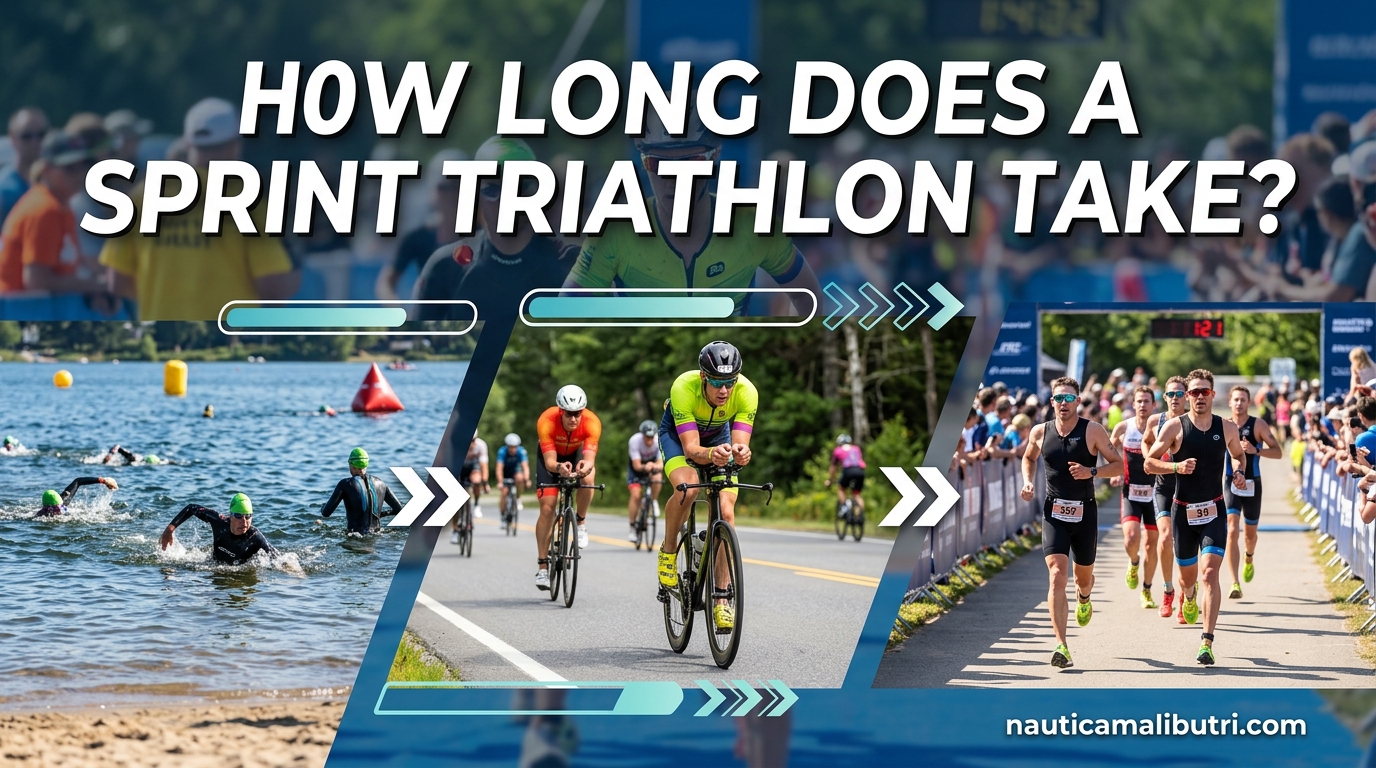
A sprint triathlon takes most athletes between 1 hour 20 minutes and 1 hour 40 minutes to complete. Elite professionals finish in roughly 50-55 minutes, while first-timers typically cross the line between 1 hour 30 minutes and 2 hours.
If you are wondering how long does a sprint triathlon take for your specific fitness level, the answer depends on your training background, age, and course conditions. Our team has guided hundreds of beginners through their first sprint distance events at the Nautica Malibu Triathlon, and we have seen finish times ranging from under an hour to over two hours.
This guide breaks down exactly what to expect time-wise for each discipline. You will learn average splits for the swim, bike, and run, plus realistic training requirements to hit your goal time.
Table of Contents
Sprint Triathlon Distances Explained
A sprint triathlon covers 750 meters swimming, 20 kilometers cycling, and 5 kilometers running. That is roughly half the distance of an Olympic triathlon and one of the most beginner-friendly formats in the sport.
Here is the complete breakdown with both metric and imperial measurements:
- Swim: 750 meters (0.47 miles) – typically completed in 12-20 minutes
- Bike: 20 kilometers (12.4 miles) – typically completed in 35-50 minutes
- Run: 5 kilometers (3.1 miles) – typically completed in 25-35 minutes
The total race distance is approximately 25.75 kilometers or 16 miles. Most events also include two transition periods: T1 (swim to bike) and T2 (bike to run). These transitions usually add 3-6 minutes to your overall time.
Course distances can vary slightly depending on the venue. Ocean swims might be adjusted for safety conditions, and bike courses may differ based on available roads. Always check the specific event details before race day.
Average Sprint Triathlon Times by Skill Level
Your finish time depends heavily on your experience level and training background. Here are realistic expectations based on athlete categories:
Elite and Professional Athletes: 50-55 minutes. These athletes average under 1:10 per 100 meters in the swim, hold 25+ mph on the bike, and run sub-6-minute miles. They also execute transitions in under 90 seconds each.
Competitive Age-Groupers: 1 hour 5 minutes to 1 hour 20 minutes. These athletes train 8-12 hours weekly year-round and have typically completed multiple sprint triathlons. They are strong in at least one discipline and competent in the other two.
Recreational Athletes: 1 hour 20 minutes to 1 hour 40 minutes. This is the most common finish time range. These athletes train consistently but balance triathlon with work, family, and other commitments. Many complete 3-4 training sessions per week.
Beginners and First-Timers: 1 hour 30 minutes to 2 hours or more. If this is your first sprint triathlon, finishing under 2 hours is a solid achievement. Focus on completing all three disciplines safely rather than chasing a specific time.
Age also plays a role in finish times. Athletes in their 20s and 30s typically post the fastest times, while those in their 40s and 50s might add 5-15 minutes to their overall finish. However, many athletes continue competing well into their 60s and 70s with impressive results.
Time Breakdown by Discipline
Breaking down your expected time by discipline helps you identify strengths and weaknesses in your training. Here are realistic time ranges for each leg of a sprint triathlon:
Swim: 750 Meters
The swim leg takes most athletes 12-20 minutes in a pool and 15-25 minutes in open water. Strong swimmers finish closer to 10-12 minutes, while beginners might need 20-30 minutes.
Open water swims in the ocean are typically 10-20% slower than pool times due to waves, currents, and navigation. For the Malibu event, expect your ocean swim to take 2-4 minutes longer than your pool training times.
Bike: 20 Kilometers
The bike leg is the longest portion of the race time-wise, typically taking 35-50 minutes for most athletes. Strong cyclists average 22-25 mph, completing the 12.4 miles in 30-35 minutes. Recreational riders averaging 16-18 mph finish in 42-47 minutes.
Course terrain dramatically affects bike times. A flat course like the Malibu triathlon allows for faster times than a hilly route. Wind conditions on race day can also add or subtract several minutes from your expected split.
Run: 5 Kilometers
The final 5K run takes most athletes 25-35 minutes to complete. Fast runners targeting a strong finish average 7-8 minute miles for a 22-25 minute split. Casual runners completing their first triathlon might run 10-12 minute miles, finishing in 31-37 minutes.
The run often feels hardest because your legs are fatigued from the bike. Many athletes experience heavy legs for the first half-mile until their running rhythm returns. This is normal and expected.
Transitions
Transition 1 (swim to bike) typically takes 2-4 minutes. This includes exiting the water, running to the transition area, removing your wetsuit if worn, putting on your bike gear, and running your bike to the mount line.
Transition 2 (bike to run) is usually faster at 1-2 minutes. You rack your bike, change into running shoes, and head to the run course. Practicing transitions during training can save you 1-2 minutes on race day.
What Affects Your Sprint Triathlon Time
Several factors beyond your fitness level influence how long your sprint triathlon takes. Understanding these variables helps you set realistic expectations and adjust your race strategy accordingly.
Course Terrain and Elevation
Flat courses yield faster times than hilly ones. The Malibu triathlon course is relatively flat, making it ideal for beginners and those targeting fast finish times. Courses with significant hills can add 5-10 minutes to your overall time compared to flat routes.
Weather Conditions
Heat slows everyone down, particularly on the run. Temperatures above 80 degrees Fahrenheit can add 5-10% to your expected finish time. Wind affects the bike leg most dramatically, with strong headwinds potentially adding several minutes to your split.
Ocean vs Pool Swimming
Open water ocean swims are almost always slower than pool times. Waves, chop, and navigation challenges make the 750-meter ocean swim equivalent to approximately 850-900 meters of pool swimming effort. The salt water also affects your buoyancy differently than fresh water.
At the Malibu event, the Pacific Ocean conditions at Zuma Beach can vary significantly. Morning races typically encounter calmer waters, while afternoon events might face stronger winds and chop.
Wetsuit Usage
Wearing a wetsuit typically improves swim times by 5-10% due to added buoyancy and reduced drag. Most sprint triathlons allow wetsuits when water temperatures are below 78 degrees Fahrenheit. However, wetsuits add time in transition as you remove them.
Transition Efficiency
Poorly executed transitions can cost you 2-5 minutes compared to efficient ones. Practice your transition setup and execution during training. Lay out your gear logically, practice removing your wetsuit quickly, and rehearse the bike mount and dismount.
Malibu Ocean Swim Considerations
The Nautica Malibu Triathlon features an ocean swim at Zuma Beach, which presents unique timing considerations compared to pool-based triathlons.
Pacific Ocean conditions vary by season and time of day. Morning races typically benefit from calmer waters and less wind. The swim course is typically a triangle or out-and-back pattern with buoys marking the route. Currents generally run parallel to shore but can create chop that slows your pace.
Expect your ocean swim time to be 2-4 minutes slower than your pool time for the same distance. This accounts for navigation, sighting, wave impact, and the lack of walls to push off. If you typically swim 750 meters in 15 minutes in a pool, plan for 17-19 minutes in the ocean.
Wetsuits are usually permitted and recommended for the Malibu event due to Pacific Ocean temperatures. The added buoyancy helps compensate for the energy spent navigating waves. Practice swimming in your wetsuit before race day to get comfortable with the restricted shoulder movement and increased buoyancy.
Ocean swimming also requires different sighting techniques. You must lift your head higher to spot buoys over waves, which disrupts your stroke rhythm. Practice sighting every 6-8 strokes during training to build this skill.
Training Time Required for Sprint Triathlon Success
Your finish time correlates directly with your training consistency and volume. Here is what you need to commit weekly to achieve different time goals:
For a sub-1:30 finish: Plan on 10-12 hours of training per week for 8-12 weeks. This breaks down to roughly 3 swim sessions, 3 bike sessions, 3 run sessions, and 1 brick workout (bike followed immediately by run).
For a 1:30-1:45 finish: Commit to 8-10 hours weekly for 10-12 weeks. You can reduce this to 6-8 hours if you have a strong background in one discipline. Focus on your weakest sport for the greatest time gains.
For a 1:45-2:15 finish: 6-8 hours weekly for 8-10 weeks is sufficient. Prioritize completing the distance over speed work. Consistency matters more than intensity at this level.
Apply the 80/20 rule to your training: 80% of your training should be at an easy, conversational pace, while 20% is at high intensity. This approach builds endurance while avoiding burnout and injury. Many beginners make the mistake of training too hard too often, which limits their progress.
Include one brick workout weekly, which means completing a bike ride immediately followed by a short run. This trains your body to transition from cycling to running muscles, which is the most challenging physiological adjustment in triathlon.
Prioritize recovery and sleep. Our team has observed that athletes who get 7-8 hours of sleep consistently outperform those who skimp on rest, even with identical training volumes. Nutrition also plays a critical role in supporting your training load.
Tips to Improve Your Sprint Triathlon Time
Once you have established a training base, these strategies can help you shave minutes off your finish time:
Master Your Transitions: Practice your transition setup until it becomes automatic. Lay out your gear in the order you will use it. Practice removing your wetsuit quickly, mounting your bike smoothly, and executing a flying dismount. Two minutes saved in each transition equals a 4-minute improvement.
Pace the Bike Correctly: Many beginners ride too hard on the bike, leaving nothing for the run. Aim for a perceived exertion of 6-7 out of 10 on the bike, saving energy for a strong run finish. Remember that a fast bike split means little if you walk the run.
Negative Split the Run: Start the run conservatively for the first mile, then gradually increase your pace. This approach often produces a faster overall run time than starting too fast and fading. It also feels much better psychologically to finish strong.
Draft on the Bike (Where Legal): Many sprint triathlons allow drafting on the bike leg. Riding 3-4 bike lengths behind another athlete reduces wind resistance and can save significant energy. Check your specific event rules before race day.
Race Day Nutrition: Do not skip breakfast on race morning. Eat a familiar meal 2-3 hours before the start. During the event, consume water or sports drink on the bike and consider a gel 10 minutes before the run if your race will exceed 90 minutes.
How Long Does a Sprint Triathlon Take: Frequently Asked Questions
What is an average time for a sprint triathlon?
Most athletes finish a sprint triathlon between 1 hour 20 minutes and 1 hour 40 minutes. Elite professionals complete the distance in 50-55 minutes, while beginners typically finish between 1 hour 30 minutes and 2 hours.
What is the time limit for a sprint triathlon?
Most sprint triathlons have cut-off times between 2 hours 30 minutes and 3 hours. These limits ensure athlete safety and allow organizers to reopen roads and facilities. Check your specific event requirements, as cut-off times vary by race.
How long does the swim take in a sprint triathlon?
The 750-meter swim typically takes 12-20 minutes in a pool and 15-25 minutes in open water. Ocean swims with waves and currents usually add 2-4 minutes compared to pool times.
How long does the bike leg take in a sprint triathlon?
The 20-kilometer bike leg takes most athletes 35-50 minutes. Strong cyclists averaging 25 mph finish in 30-35 minutes, while recreational riders at 16-18 mph complete the course in 42-47 minutes.
How long does the run take in a sprint triathlon?
The 5-kilometer run typically takes 25-35 minutes. Fast runners targeting strong finishes average 7-8 minute miles for a 22-25 minute split, while beginners might run 10-12 minute miles for a 31-37 minute finish.
What is the 80/20 rule for triathlon?
The 80/20 rule means 80% of your training should be at an easy, conversational pace, while 20% is at high intensity. This approach builds endurance while avoiding burnout and injury, and it has been proven effective across all endurance sports.
Conclusion
How long does a sprint triathlon take? For most athletes, the answer falls between 1 hour 20 minutes and 1 hour 40 minutes. Beginners should feel confident aiming for a 1:30-2:00 finish, while competitive age-groupers target sub-1:20 performances.
Remember that your first sprint triathlon is about finishing, not setting records. The sprint distance is the most beginner-friendly format in the sport, requiring only 6-10 hours of weekly training to complete successfully.
Focus on consistent training across all three disciplines, practice your transitions, and arrive at the start line well-rested and properly fueled. The Nautica Malibu Triathlon at Zuma Beach offers an ideal setting for your first sprint triathlon experience, with a flat course and stunning Pacific Ocean views.
Ready to start your triathlon journey? Set a realistic goal based on your current fitness, commit to 8-12 weeks of consistent training, and enjoy the incredible feeling of crossing that finish line.