
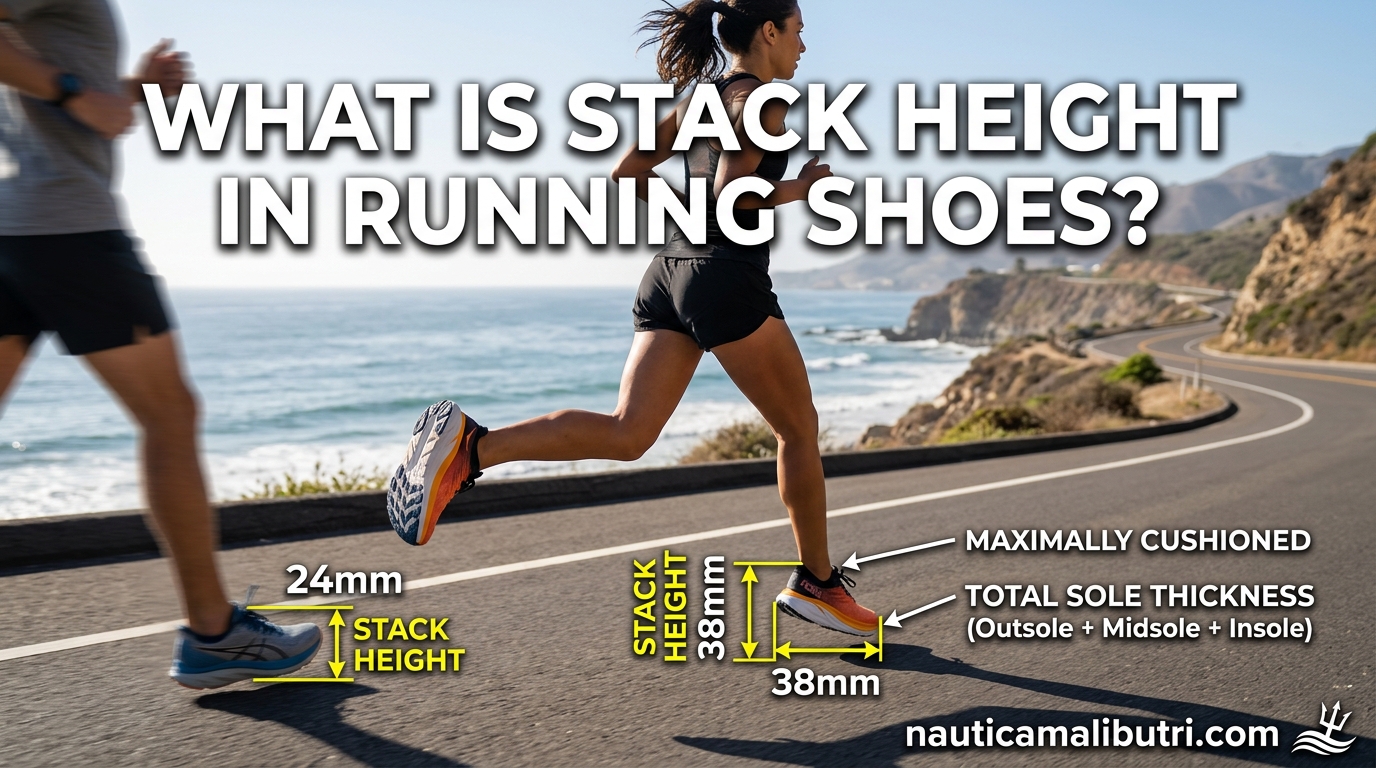
Stack height is the amount of cushioning material between your foot and the ground in a running shoe, measured in millimeters. It includes the combined thickness of the midsole, insole, and outsole. Understanding this spec helps you choose shoes that match your running style, prevent injuries, and improve your comfort on the road or trail.
I remember the first time I looked at a shoe spec sheet and saw numbers like 35mm/27mm. I had no idea what those figures meant or why they mattered. After testing dozens of shoes over the years, I now know that stack height affects everything from how your foot strikes the ground to how fresh your legs feel after a long run.
In this guide, we will break down exactly what stack height means, how it differs from heel drop, and how to find the right amount of cushioning for your needs. Whether you are training for the Nautica Malibu Triathlon or just trying to make your morning jog more comfortable, this information will help you make smarter shoe choices.
Table of Contents
What is Stack Height in Running Shoes?
Stack height refers to the total thickness of material separating your foot from the running surface. Manufacturers measure it in millimeters from the bottom of the outsole to the top of the insole where your foot rests. The measurement includes three components: the rubber outsole that grips the ground, the foam midsole that provides cushioning, and the removable insole that sits directly under your foot.
Most running shoes list two stack height numbers. The first refers to the heel, and the second refers to the forefoot. A shoe labeled 35mm/27mm has 35 millimeters of material under your heel and 27 millimeters under the ball of your foot. This distinction matters because your foot sits at different heights depending on where the shoe makes contact.
The concept sounds simple, but stack height has become one of the most important specifications for runners to understand. It directly impacts ground feel, shock absorption, stability, and even your running form. Shoes with higher stack heights have become increasingly popular, with some models now reaching 40 millimeters or more under the heel.
Stack Height Categories Explained
Running shoes fall into distinct categories based on their stack height measurements. Understanding these categories helps you narrow down your options quickly and find shoes that match your preferences.
Barefoot and Minimalist (0-15mm)
Barefoot-style shoes offer the least amount of cushioning, with stack heights ranging from 0 to about 15 millimeters. These shoes prioritize ground feel and natural movement over protection. They force your feet to work harder and strengthen the small muscles in your feet and lower legs.
Minimalist shoes appeal to runners who want to feel every pebble and crack in the pavement. They encourage a forefoot or midfoot strike pattern and can help improve running form. However, they provide minimal shock absorption, making them unsuitable for high-mileage training without a gradual adaptation period.
Low Stack (15-25mm)
Low stack shoes offer a middle ground between barefoot minimalism and modern cushioning. With 15 to 25 millimeters of material, these shoes provide enough protection for daily training while maintaining excellent ground feel and responsiveness.
Many experienced runners prefer low stack shoes for tempo runs, speed work, and shorter races. They feel snappy underfoot and encourage efficient turnover. However, runners who log high weekly mileage or who are heavier may find them too firm for recovery days.
Medium Stack (25-35mm)
Medium stack shoes represent the traditional standard for daily training shoes. With 25 to 35 millimeters of cushioning, they balance protection with ground feel. Most neutral daily trainers fall into this category.
These shoes work well for the majority of recreational runners. They offer enough cushioning to handle moderate mileage without feeling disconnected from the ground. Many shoe rotation strategies use a medium stack shoe as the daily workhorse, supplemented by higher or lower stack options for specific workouts.
High Stack (35-45mm)
High stack shoes have surged in popularity, especially with the rise of super shoes featuring carbon fiber plates. With 35 to 45 millimeters of foam, these shoes maximize cushioning and energy return. They feel plush underfoot and excel at absorbing impact forces.
Heavier runners, heel strikers, and those logging high mileage often prefer high stack shoes for their protective qualities. The extra foam reduces leg fatigue during long runs and helps muscles recover faster between sessions. However, the elevated platform can feel unstable for some runners, especially on uneven terrain.
Maximalist (45mm+)
Maximalist shoes push stack heights beyond 45 millimeters, creating a platform-like feel. These ultra-cushioned shoes prioritize comfort above all else. They work well for easy recovery runs and runners dealing with joint issues who need maximum shock absorption.
The extreme cushioning comes with trade-offs. Maximalist shoes reduce ground feel significantly and can feel bulky during faster efforts. Some runners also report ankle stability issues due to the high platform. World Athletics has banned shoes over 40 millimeters for elite competition, though recreational runners can wear whatever feels comfortable.
How to Measure Stack Height
Manufacturers measure stack height using a standardized protocol. They place the shoe on a flat surface and use a caliper to measure from the ground to the top of the insole. The measurement is taken at the center of the forefoot and the center of the heel to get both numbers.
World Athletics uses a specific 12 percent rule for competition measurements. They measure from the end of the shoe to find the precise location for stack height assessment. This prevents manufacturers from adding extra foam only at the extreme edges to game the system.
If you want to measure your own shoes at home, you will need a digital caliper. Remove the insole first to get the most accurate reading. Measure at the center of the forefoot and the center of the heel, then add the insole thickness back if you want the total stack height as your foot experiences it.
Stack Height vs Heel Drop: Understanding the Difference
Many runners confuse stack height with heel drop, but they measure different things. Stack height tells you the total thickness of the shoe. Heel drop tells you the difference between heel and forefoot heights.
A shoe with a 35mm heel stack and 27mm forefoot stack has an 8mm heel drop (35 minus 27 equals 8). The drop affects your foot angle and stride mechanics. Zero drop shoes have equal heights at heel and forefoot, while traditional shoes typically have 8 to 12 millimeters of drop.
You can have high stack with low drop, or low stack with high drop. A shoe with 40mm at the heel and 32mm at the forefoot has high stack and moderate drop. A shoe with 20mm at the heel and 12mm at the forefoot has low stack but the same 8mm drop. Understanding both specs helps you predict how a shoe will feel and perform.
Runners who switch between shoes with different drops often experience calf and Achilles tightness. Your body adapts to a specific foot angle, and sudden changes stress different muscle groups. Keep this in mind when trying shoes with dramatically different specifications than your current pair.
How Stack Height Affects Your Running Experience
Ground Feel and Responsiveness
Lower stack heights connect you directly to the running surface. You feel the texture of the road, the camber of the sidewalk, and the transition from asphalt to concrete. This enhanced proprioception helps you adjust your stride naturally and can improve running efficiency.
Higher stack heights create a floating sensation that some runners love and others hate. The thick foam absorbs small surface irregularities, creating a smooth ride. However, you lose the feedback that helps you fine-tune your form. Many runners describe high stack shoes as feeling like running on a mattress.
Shock Absorption and Impact Forces
Every footstrike generates impact forces that travel up through your feet, ankles, knees, and hips. Stack height determines how much of that force the shoe absorbs versus how much reaches your body. Higher stack shoes reduce the shock that your muscles and joints must handle.
Heavier runners generate more force with each step and often benefit from additional cushioning. The same logic applies to heel strikers, who land with more impact than forefoot strikers. If you experience persistent joint pain after runs, a higher stack shoe might help reduce the stress on your body.
Foot Strike Patterns
Stack height influences how your foot contacts the ground. Lower stack heights encourage a midfoot or forefoot landing because landing on your heel without cushioning hurts. Higher stack heights make heel striking comfortable and sustainable, which is why many modern shoes cater to heel strikers.
Research suggests that foot strike pattern affects running economy and injury risk, though individual variation matters more than any universal rule. Some runners naturally prefer one pattern regardless of shoe choice. The key is finding a stack height that supports your natural gait rather than forcing a change that feels unnatural.
Energy Return and Running Economy
Modern midsole foams do more than just cushion. Advanced materials like Pebax and supercritical EVA compress on impact and then spring back, returning energy to your stride. Higher stack shoes can pack more of this responsive foam, potentially improving running economy during races.
The famous carbon-plated super shoes combine high stack heights with rigid plates to create a lever effect. These shoes have been shown to improve running economy by 4 percent or more in laboratory studies. The stack height allows room for both the thick foam and the plate that makes the magic happen.
Stability and Balance
High stack heights create a taller platform that can feel unstable, especially on turns or uneven surfaces. Your foot sits farther from the ground, increasing the leverage that small surface variations have on your ankle. Runners with weak ankles or balance issues often struggle with very high stack shoes.
Trail runners generally prefer lower stack heights for better stability on technical terrain. Road runners can handle higher stacks since the surface is predictable. If you plan to wear high stack shoes for trail running, look for models with wide bases and sidewall designs that cup your foot for stability.
Pros and Cons by Stack Height Type
High Stack Shoes
High stack shoes excel at protecting your legs during long runs and high-mileage weeks. The thick foam absorbs impact forces that would otherwise stress your joints and muscles. Many runners find they recover faster when wearing maximal cushioning for their easy runs.
The downsides include reduced ground feel, potential stability issues, and added weight from all that foam. Some runners also report that high stack shoes mask poor form, allowing them to overstride without the immediate feedback that would normally encourage correction. The tall platform can also feel awkward during sharp turns or on cambered roads.
Low Stack Shoes
Low stack shoes connect you to the ground and encourage efficient running mechanics. They feel fast and responsive, making them ideal for speed work and racing. The lower profile also tends to be lighter, reducing the energy cost of lifting your feet with each stride.
The main drawback is reduced protection from impact forces. Low stack shoes transfer more stress to your feet, ankles, and legs. Without adequate adaptation time, this can lead to soreness or injury. These shoes also provide less cushioning for long runs, which may leave your legs feeling battered after high-mileage efforts.
World Athletics Competition Rules
World Athletics, the governing body for track and field, implemented stack height limits for elite competition in 2026. For road races up to the marathon distance, shoes cannot exceed 40 millimeters of stack height at the heel. This rule prevents technology from overshadowing athletic performance.
The measurement protocol specifies that stack height must be measured at a point 12 percent of the shoe length from the end. This prevents manufacturers from creating shoes with normal-looking soles that have hidden foam extensions at the extreme heel or toe to bypass the limit.
Recreational runners do not need to worry about these regulations unless they plan to compete in sanctioned events. Even then, most age-group competitions do not enforce shoe checks. The rules primarily affect elite athletes chasing prize money and records. However, knowing the 40mm limit helps you understand why certain racing shoes max out at exactly that height.
Choosing the Right Stack Height for You
Finding your ideal stack height requires considering multiple factors. Start by thinking about your running mechanics. Heel strikers typically benefit from higher stack heights that cushion the impact of landing on the back of the foot. Forefoot strikers can get away with lower stacks since they land with more natural shock absorption.
Your body weight matters too. Heavier runners generate more force with each step and usually need more cushioning to protect their joints. Lighter runners can often handle lower stack heights without experiencing excessive impact stress.
Consider the terrain you run on most often. Road runners can experiment with the full range of stack heights. Trail runners should lean toward lower stacks for stability on uneven ground. Triathletes face a unique challenge since bike-to-run transitions leave legs wobbly, making high stack shoes potentially more difficult to control immediately off the bike.
Distance also plays a role. Shorter runs and races allow you to get away with less cushioning. Marathon training and ultramarathon distances demand more protection to keep your legs fresh through high-volume weeks. Many serious runners maintain a shoe rotation with different stack heights for different purposes.
Common Misconceptions About Stack Height
One persistent myth claims that high stack shoes automatically provide better cushioning. While more foam generally means more shock absorption, the foam quality matters just as much as the quantity. A 30mm stack of premium responsive foam might feel softer than a 40mm stack of basic EVA. Do not assume taller equals softer.
Another misconception suggests that low stack shoes cause injuries. Research does not support this claim. Injury risk depends on how your body adapts to whatever shoe you wear. Sudden switches between dramatically different stack heights cause problems, not the stack heights themselves. Gradual adaptation prevents issues regardless of your chosen category.
Many runners also believe that stack height and heel drop measure the same thing. As explained earlier, they describe completely different characteristics. A shoe can have high stack with zero drop, or low stack with high drop. Confusing these specs leads to purchasing mistakes.
Finally, some runners think all modern shoes must be high stack to be good. This trend-driven thinking ignores the fact that personal preference varies enormously. Plenty of runners still prefer the ground feel and responsiveness of lower stack shoes. The best shoe is the one that works for your body and running goals, not the one that follows current fashion.
Transitioning Between Stack Heights Safely
Switching between shoes with different stack heights requires patience. Your muscles, tendons, and nervous system adapt to a specific amount of cushioning and ground feedback. Sudden changes shock these systems and often lead to soreness or injury.
When transitioning to lower stack shoes, start with short runs of 15 to 20 minutes. Use the new shoes only once or twice per week initially. Your calves and Achilles will need time to adapt to the reduced heel height and increased workload. Expect some muscle soreness, but stop if you feel sharp pain or joint issues.
Moving to higher stack shoes is generally easier than going the other direction. Your body appreciates the extra cushioning immediately. However, take time to adjust to the altered stability and ground feel. Practice cornering and running on uneven surfaces before taking your new high stack shoes on a long trail run.
A typical adaptation timeline spans 4 to 6 weeks. During this period, rotate between your old and new shoes rather than making an immediate full switch. Gradually increase the percentage of miles in the new shoes as your body adjusts. Patience during this transition prevents the tendon and muscle issues that many runners experience when they change stack heights too quickly.
What is a good stack height for running shoes?
A good stack height depends on your running style and goals. Most daily trainers fall in the 25-35mm range, which works well for the majority of runners. Heel strikers and heavier runners often prefer 35-40mm for extra cushioning. Forefoot strikers and those who value ground feel typically do well with 15-25mm. There is no single best stack height—personal comfort and injury prevention matter more than following trends.
Is stack height the same as heel drop?
No. Stack height measures the total thickness of material between your foot and the ground. Heel drop measures the difference in height between the heel and forefoot. A shoe with 35mm heel stack and 27mm forefoot stack has 35mm of total stack height and 8mm of heel drop. You can have high stack with low drop, or low stack with high drop—they are independent measurements.
Is lower stack height better?
Lower stack height is not inherently better or worse—it depends on your needs. Low stack shoes offer better ground feel, lighter weight, and encourage natural running mechanics. However, they provide less shock absorption and can stress your joints during high-mileage training. The best stack height matches your foot strike pattern, body weight, and the distances you run.
Why are running shoes getting taller?
Running shoes have increased in stack height due to advances in midsole foam technology. New materials like Pebax and supercritical EVA provide excellent energy return even in thick layers, allowing manufacturers to add cushioning without excessive weight. Carbon-plated super shoes also require room for both the plate and the responsive foam. Consumer preference for softer, more protective rides has also driven this trend.
What stack height is best for marathon training?
Marathon training typically benefits from medium to high stack heights in the 30-40mm range. The extra cushioning protects your legs during long runs and high-mileage weeks, helping you recover faster between sessions. Many marathoners use high stack shoes for daily training and long runs, then switch to slightly lower stacks or racing flats for speed work and the race itself.
Can stack height affect running injuries?
Stack height can influence injury risk, but sudden changes matter more than any specific measurement. Rapidly switching from high to low stack shoes often causes calf and Achilles issues. Dramatically increasing stack height can create stability problems. The key is gradual adaptation. Choose a stack height appropriate for your foot strike and weight, then transition slowly to let your body adjust.
Conclusion: Finding Your Ideal Stack Height
Understanding what stack height means in running shoes empowers you to make informed decisions about your footwear. The measurement tells you how much material separates your foot from the ground, affecting everything from impact protection to ground feel. Whether you prefer the connection of a low stack shoe or the cushioning of a high stack model depends on your body, your running style, and your goals.
Remember that no single stack height works for everyone. Heel strikers, heavier runners, and high-mileage athletes often gravitate toward higher stacks for protection. Forefoot strikers, lighter runners, and those who value responsiveness may prefer lower profiles. The key is matching the shoe to your needs rather than following trends.
Take time to transition when changing stack heights. Your body adapts to the cushioning level you normally use, and sudden switches cause problems. Gradually introduce new shoes into your rotation, listen to your body, and adjust based on how you feel during and after runs. With patience and experimentation, you will find the stack height that keeps you running comfortably for years to come.