
If you have been shopping for running shoes lately, you have probably seen the term “drop” tossed around in product descriptions and reviews. I remember standing in my local running store three years ago, completely confused when the salesperson asked if I preferred a high or low drop shoe. I had no idea what she meant, and I was too embarrassed to ask.
Drop in running shoes refers to the difference in height between the heel and forefoot of a shoe, measured in millimeters. This single measurement affects how your foot strikes the ground, which muscles work hardest, and even your injury risk. Understanding drop has completely changed how I buy running shoes, and it can do the same for you.
After talking to physical therapists, researching lab testing data, and testing dozens of shoes myself, I have learned that there is no universally “best” drop. The right choice depends on your body, your stride, and your running goals. This guide will give you everything you need to make an informed decision.
Table of Contents
What Is Drop in Running Shoes?
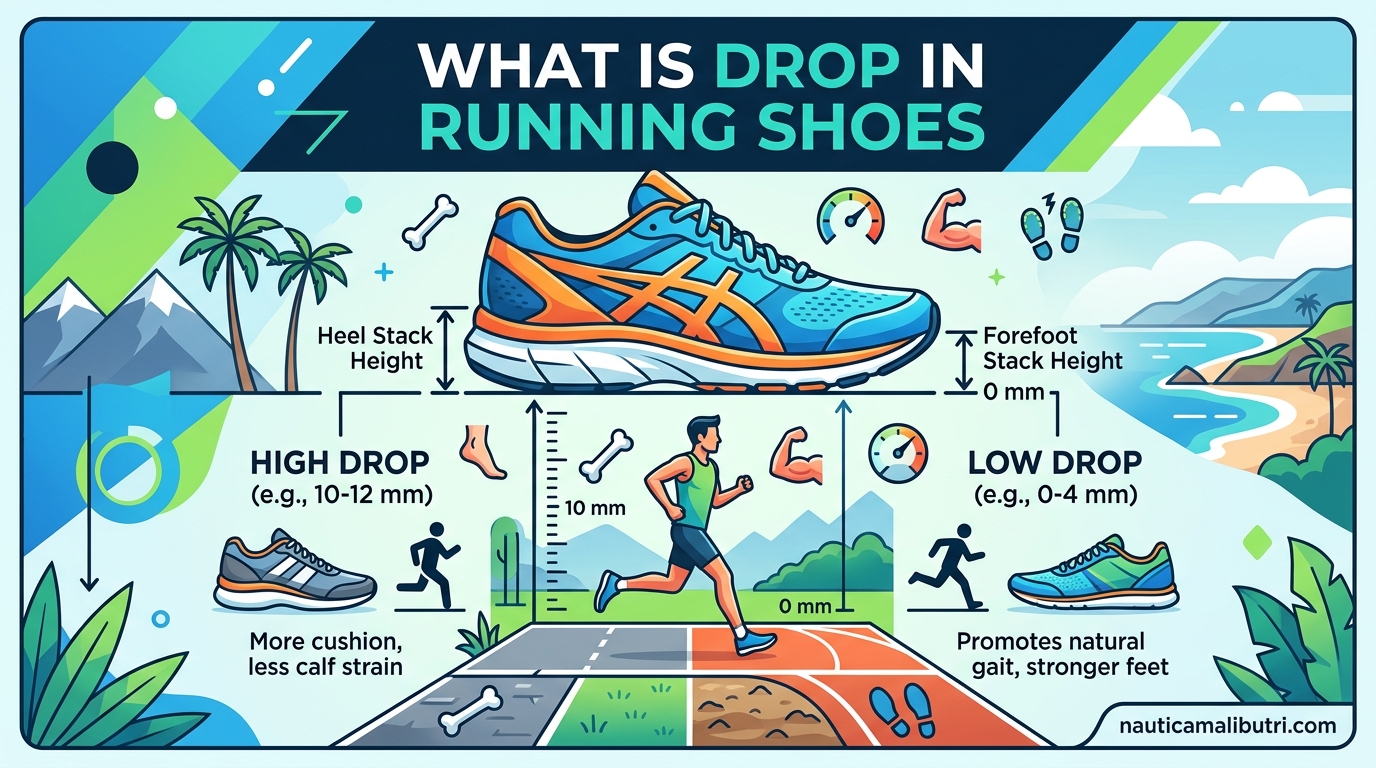
Drop in running shoes, also called heel-to-toe drop or heel drop, is the height difference between where your heel sits and where your forefoot sits inside the shoe. It is always measured in millimeters, and it creates the angle at which your foot rests relative to the ground.
Here is the simplest way to visualize it. Imagine placing a book under your heel while standing barefoot. Your heel is now higher than your forefoot. The thickness of that book represents the drop. A 10mm drop is like having a stack of ten credit cards under your heel. A zero drop shoe is like standing completely flat on the floor.
The measurement comes from subtracting the forefoot stack height from the heel stack height. If a shoe has a 30mm thick midsole under the heel and a 20mm thick midsole under the forefoot, the drop is 10mm. This is different from total stack height, which we will explain later.
Drop Categories Explained
Running shoes fall into four main drop categories, each producing a different running experience. Understanding these categories helps you narrow down your options quickly.
Zero Drop (0mm)
Zero drop shoes position your heel and forefoot at exactly the same height from the ground. Brands like Altra specialize in this category. These shoes promote a forefoot or midfoot strike pattern and distribute impact forces more evenly across your foot.
The trade-off is that zero drop shoes place more demand on your calf muscles and Achilles tendon. Your ankle has to dorsiflex more with each step, which stretches these tissues further. Most runners need a gradual adaptation period to avoid injury.
Low Drop (1-4mm)
Low drop shoes create a minimal angle between heel and forefoot. This category has grown popular among minimalist and natural running enthusiasts. The slight elevation provides a tiny bit of heel lift while still encouraging a relatively flat foot position.
Many runners find this category offers a middle ground. You get some of the natural stride benefits of zero drop without as aggressive a transition. However, your calves and Achilles still work harder than they would in traditional higher-drop shoes.
Mid Drop (5-8mm)
Mid drop shoes represent the middle ground that works for the widest range of runners. This category includes many popular daily trainers from brands like Brooks, Nike, and Saucony. The moderate angle supports various foot strike patterns without strongly favoring one over another.
If you are unsure where to start, mid drop shoes offer the safest default choice. They accommodate heel strikers without forcing forefoot strikers into an uncomfortable position. Many experienced runners keep a mid drop shoe in their rotation for easy days.
High Drop (8mm+)
High drop shoes elevate your heel significantly above your forefoot. Traditional running shoes often fall into this category, with drops ranging from 8mm up to 12mm or even higher in some cases. This design encourages heel striking and reduces strain on the Achilles and calves.
The elevated heel transfers more impact force to your knees and hips instead. For runners with chronic calf or Achilles issues, high drop shoes can provide relief by reducing the range of motion required at the ankle. Many trail running shoes use higher drops to help with steep descents.
How Drop Affects Your Foot Strike
Your foot strike pattern describes which part of your foot contacts the ground first when you run. Drop influences this pattern significantly, though it does not completely determine it.
High drop shoes make heel striking feel natural and comfortable. The elevated heel puts your foot in a position where the back edge contacts the ground first. This is not necessarily bad, despite what some running form gurus claim. Many fast, injury-free runners are heel strikers.
Low and zero drop shoes tilt your foot forward, making forefoot or midfoot striking the path of least resistance. Your body naturally avoids slamming your heel into the ground when it sits lower than your forefoot. This shifts impact absorption to your arches, ankles, and calves.
Here is the important part that often gets missed. Drop influences foot strike, but it does not force it. I have seen runners maintain a forefoot strike in 12mm drop shoes and others heel strike in zero drop Altras. Your body finds a way to do what feels natural, even if the shoe suggests otherwise.
Body Part Impacts: What Drop Means for Your Knees, Ankles, and Achilles
The drop of your running shoes determines where impact forces travel through your body. Understanding this helps you choose a drop that works with your injury history and biomechanics.
Knees and Hips
Higher drop shoes tend to load your knees and hips more heavily. When your heel strikes the ground first, the impact travels up through your shin and into your knee joint. The knee flexes more to absorb this shock, which can aggravate existing knee issues.
If you have patellar tendonitis, IT band syndrome, or general knee pain, experimenting with a lower drop might help. By shifting impact to your calves and ankles, you reduce the repetitive stress on your knees. Several runners in my training group have switched to mid or low drop shoes specifically for knee pain relief.
Ankles and Achilles
Lower drop shoes place greater demands on your ankle joint and Achilles tendon. With your heel closer to the ground, your ankle must bend more during each stride. This stretches the Achilles and activates the calf muscles more intensely.
For runners with tight calves, limited ankle mobility, or a history of Achilles tendinopathy, low drop shoes can aggravate these issues. The increased range of motion required at the ankle puts repetitive strain on vulnerable tissues. In these cases, a higher drop shoe provides relief by reducing ankle dorsiflexion demands.
Lower Back and Posture
The effect of drop on your lower back is more subtle but worth considering. Higher heels tend to tilt your pelvis slightly forward, which can increase lumbar lordosis. Some runners with lower back issues feel better in lower drop shoes that keep them in a more neutral position.
However, this varies significantly by individual. Your overall posture, hip flexibility, and core strength matter more than shoe drop for back health. Do not expect changing shoe drop to fix serious back problems, but it can be one factor in your overall comfort equation.
Drop vs Stack Height: Do Not Confuse These Two Measurements
Many runners confuse drop with stack height, but they measure completely different things. Understanding the distinction helps you make smarter shoe choices.
Drop measures the difference between heel and forefoot height. Stack height measures the total thickness of the midsole under either your heel or forefoot. A shoe can have high stack height and low drop, or low stack height and high drop.
Consider two examples. The Hoka Bondi has a 4mm drop but massive stack heights of 39mm in the heel and 35mm in the forefoot. It feels plush and cushioned despite the low drop. Conversely, a traditional racing flat might have a 10mm drop but only 20mm total stack height in the heel, creating a firm, responsive feel.
When evaluating shoes, look at both numbers together. A high drop with low stack height feels completely different from the same drop with high stack height. The former feels like a firm wedge, while the latter feels like a cushioned ramp.
How to Choose the Right Drop for Your Running Style
Finding your ideal drop requires honest assessment of your body, your running habits, and your goals. Here is a practical framework for making the choice.
Assess Your Natural Foot Strike
Start by determining how you actually run, not how you think you run. Have a friend film you from the side during the middle of a run when you are not thinking about form. Watch which part of your foot contacts the ground first.
If you land on your heel, you are a heel striker. If you land on the ball of your foot or flat across the whole foot, you are a forefoot or midfoot striker. Choose a drop that supports your natural pattern rather than fighting it. Heel strikers usually prefer mid to high drops, while forefoot strikers gravitate toward low to zero drops.
Consider Your Injury History
Your injury history provides valuable clues about which drop might work best. If you have struggled with calf strains, Achilles issues, or plantar fasciitis, a higher drop shoe might reduce stress on those areas. If knee pain, IT band problems, or hip issues have plagued you, a lower drop could shift load away from those joints.
This is not medical advice, just biomechanical logic. Impact forces have to go somewhere. If one area of your body is vulnerable, reducing load there often means increasing it elsewhere. The goal is finding the balance that keeps you running consistently.
Match Drop to Terrain and Distance
Road runners can use any drop that feels comfortable for their stride. Trail runners often benefit from slightly higher drops for steep descents, where the elevated heel provides stability and reduces calf strain. However, technical terrain and uneven surfaces sometimes favor lower drops that keep you closer to the ground.
For racing, many runners prefer lower drops that promote efficiency and ground feel. For recovery runs and long easy miles, a slightly higher drop can reduce muscular fatigue. Elite runners often rotate between different drops for different types of workouts.
How to Transition Between Different Drop Shoes Safely
Switching drops too quickly is a common cause of running injuries. Your muscles, tendons, and even your nervous system need time to adapt to new movement patterns. Here is how to make the transition safely.
Start by wearing your new drop shoes for just one or two easy runs per week. Keep your regular shoes for everything else. After two weeks without issues, increase to three runs per week. Continue this gradual progression over six to eight weeks until you can wear the new shoes exclusively.
Watch for warning signs during the transition. Mild muscle soreness in new areas is normal, especially in your calves with lower drop shoes. Sharp pain, persistent tightness, or changes to your running form are red flags. If you experience these, back off and give your body more time.
Consider rotating between two drop categories rather than completely replacing one with another. Many experienced runners keep both high and low drop shoes in their rotation, using different drops for different purposes. This approach maintains adaptability and reduces overuse risk.
Common Myths About Shoe Drop Debunked
The running world is full of misinformation about shoe drop. Let us clear up the biggest misconceptions.
Myth: Lower drop is always better. There is no scientific evidence that low or zero drop shoes reduce injury risk for all runners. Some studies suggest the opposite, that sudden switches to low drop increase injury rates. The best drop is the one that works for your specific body and stride.
Myth: Everyone should run in the same drop. Human bodies vary enormously in flexibility, strength, and structure. What works for a flexible forefoot striker might injure a tight heel striker. Individual variation matters more than universal rules.
Myth: Brand measurements are always accurate. Independent lab testing shows that stated drop measurements often differ from reality by 1-3mm. Manufacturing variations, measurement methods, and midsole compression all affect the actual drop you experience. Use brand numbers as general guidance, not gospel truth.
Frequently Asked Questions
What is the ideal drop for a running shoe?
There is no single ideal drop for all runners. The best choice depends on your foot strike pattern, injury history, and personal comfort. Most runners do well with mid drop shoes (5-8mm) as a starting point. Heel strikers often prefer 8-12mm, while forefoot strikers may choose 0-4mm.
Are lower drop running shoes better?
Lower drop shoes are not universally better. They promote forefoot striking and reduce knee stress but increase calf and Achilles demands. Runners with knee or hip issues sometimes benefit from lower drops, while those with Achilles or calf problems often do better with higher drops.
What heel drop is best for knees?
Lower heel drops (0-6mm) typically reduce knee stress by shifting impact forces to the ankles and calves. If you have knee pain, IT band syndrome, or patellar issues, experimenting with a lower drop shoe might help. Transition gradually to avoid creating new problems in your lower legs.
What is the purpose of a drop in running shoes?
Drop exists primarily to accommodate different foot strike patterns and body mechanics. Higher drops support heel strikers and reduce Achilles strain. Lower drops encourage forefoot striking and natural foot positioning. The purpose is not to correct form but to match the shoe to the runner.
Final Thoughts
What is drop in running shoes? It is the height difference between your heel and forefoot that influences how you run and where impact forces travel through your body. Understanding this measurement helps you choose shoes that work with your natural stride rather than against it.
After years of testing different drops and talking to experts, my advice is simple. Start with a mid drop shoe (5-8mm) if you are unsure. Pay attention to how your body responds. If you have specific injury concerns, experiment with moving up or down in drop to shift stress away from problem areas. Always transition gradually.
The perfect shoe does not exist, but the right shoe for you does. Armed with an understanding of drop, you can make informed choices and spend more time enjoying your runs instead of nursing injuries. Happy running in 2026 and beyond.
1 thought on “What Is Drop in Running Shoes (September 2026) Complete Guide for Runners”