
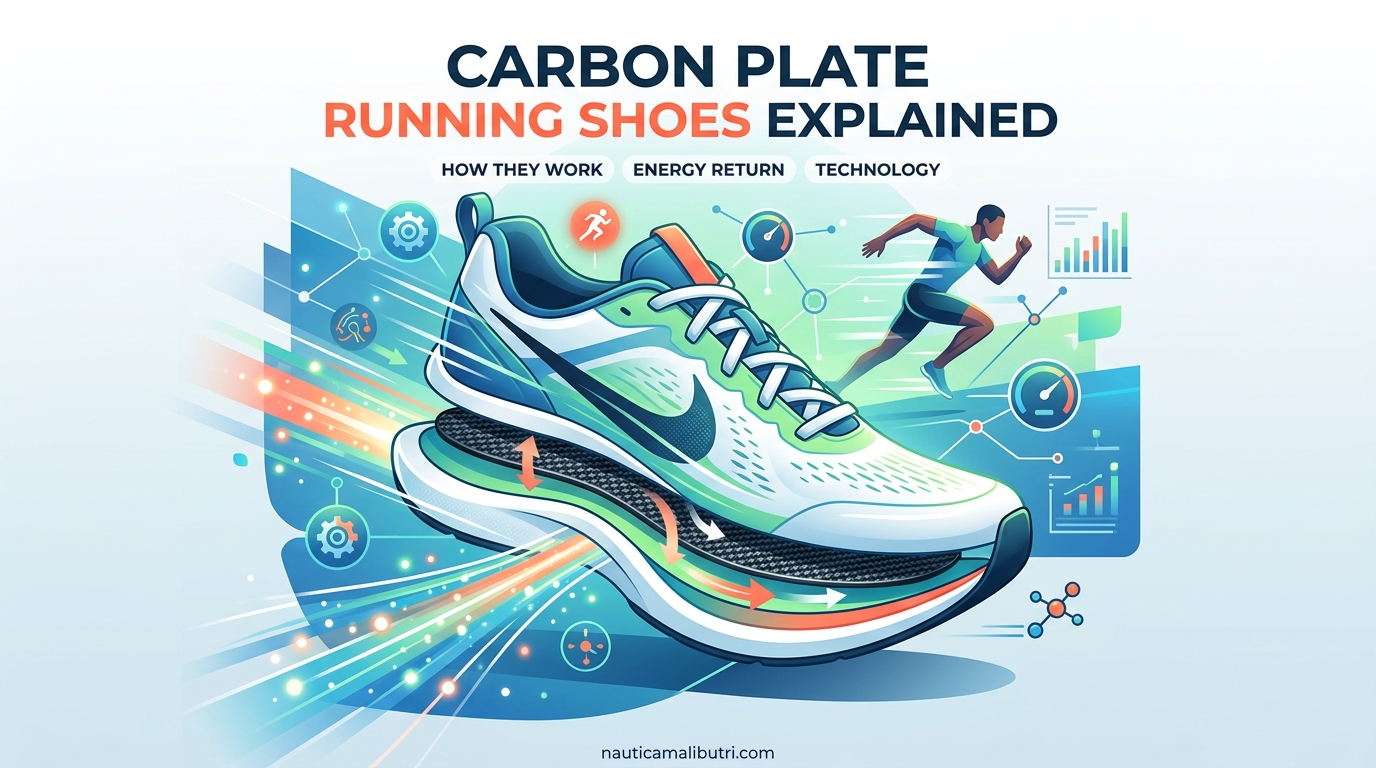
Carbon plate running shoes explained simply: these are advanced racing shoes built with a curved carbon fiber plate embedded within a thick layer of responsive foam. The technology has revolutionized endurance running since its mainstream debut, helping elite and amateur athletes achieve faster times with less fatigue. For triathletes specifically, understanding how these shoes work can make a real difference in your Ironman or half-Ironman performance when your legs are already fatigued from the swim and bike.
In this guide, we will break down exactly what carbon plate technology is, how it works at the physics level, and most importantly, how triathletes can leverage these shoes for race day success. Whether you are racing your first Olympic distance or tackling a full Ironman, this explanation will help you decide if carbon plate shoes deserve a spot in your transition bag.
Table of Contents
What Are Carbon Plate Running Shoes?
Carbon plate running shoes are a category of high-performance racing footwear that incorporate a thin, curved carbon fiber plate sandwiched within an ultra-thick midsole made of advanced foam compounds. Lab testing shows that these plated midsoles are 16% softer and 50% stiffer than traditional running shoes without plates.
The carbon fiber plate itself is typically one to two millimeters thick and runs the full length of the shoe from heel to toe. It is not rigid like a board; instead, it has strategic flexibility and curvature designed to work with your natural foot mechanics. The plate acts as a lever, working in harmony with the thick foam midsole to create what running scientists call a “teeter-totter” effect.
The Anatomy of a Super Shoe
Understanding the components helps clarify why these shoes perform differently than standard trainers. The three key elements are the carbon fiber plate, the superfoam midsole, and the rocker geometry.
The superfoam midsole is the foundation. These foams are significantly lighter and more responsive than traditional EVA foam, returning 80-90% of the energy you put into them versus 50-60% from standard midsoles. This energy return percentage is what creates the bouncy sensation many runners describe.
The rocker geometry refers to the curved shape of the sole from heel to toe. This curved design works with the carbon plate to create a smooth rolling motion, reducing the amount of work your calves and ankles must do during each stride.
How Carbon Plate Technology Works
Carbon plate running shoes work by manipulating the biomechanics of your foot strike and toe-off phases to reduce energy loss and improve propulsion efficiency. The technology targets the metatarsophalangeal joint, which is the area where your toes connect to the ball of your foot.
When you run in traditional shoes, your foot flexes at this joint during toe-off, dissipating some energy as heat rather than returning it as forward motion. The carbon plate limits this excessive flexion while the curved rocker geometry helps your foot roll through the gait cycle more efficiently.
The Lever Effect Explained
Think of the carbon plate as a lever that spans the entire length of your foot. When your heel strikes the ground, the plate bends slightly and stores elastic energy. As you transition through midstance and into toe-off, that stored energy releases and helps propel you forward.
This lever effect is particularly noticeable during the late stance phase of running when your body weight is concentrated over the forefoot. The plate’s longitudinal stiffness resists bending at the exact point where traditional shoes allow the most energy loss. Combined with the thick, responsive foam, this creates the sensation of being pushed forward with each step.
Rocker Geometry and Gait Efficiency
The rocker geometry in carbon plate shoes is not just a curved sole for aesthetics. It is engineered to reduce the range of motion required at your ankle joint during running. Research indicates this reduced ankle flexion translates to lower metabolic cost, meaning you burn less oxygen to maintain the same pace.
The rocker works by creating a pivot point that helps your foot transition from heel strike to toe-off with less muscular effort. Your foot effectively rolls over the curved platform rather than having to actively push through each phase. This rolling sensation is why many runners describe the feeling as “running downhill even on flat ground.”
Metabolic Savings and Running Economy
Running economy refers to how much oxygen your body uses to maintain a given pace. Improvements in running economy mean you can run faster at the same effort level or maintain your target pace with less cardiovascular stress. Studies on carbon plate shoes have documented running economy improvements ranging from 2% to 6%.
While 2-6% might sound modest, over the course of a marathon or Ironman run, this translates to significant time savings. A 4% improvement in running economy could mean shaving 8-10 minutes off a four-hour marathon. For triathletes who have already depleted their glycogen stores during the swim and bike, any metabolic savings becomes even more valuable.
Triathlete Tip: The metabolic savings from carbon plate shoes compound over long distances. In an Ironman where your run might take four to six hours, even small efficiency gains add up to substantial energy preservation in the final 10K when most athletes hit the wall.
Benefits of Carbon Plate Running Shoes
The primary benefit of carbon plate running shoes is improved performance through reduced energy cost and enhanced propulsion. Runners consistently report feeling fresher in the later stages of long races when wearing these shoes compared to traditional racing flats or trainers.
Performance Improvements Across Distances
Real-world race data shows that carbon plate shoes help runners achieve personal best times across all distance events. The benefits are most pronounced in half marathon and marathon distances where accumulated fatigue makes the energy return properties more noticeable.
Age-group triathletes report similar experiences. Reddit users frequently mention that carbon plates allow you to maintain the same pace for less effort, which becomes crucial during the Ironman marathon when your legs are already hammered from the 112-mile bike.
Reduced Muscle Fatigue
One of the less-discussed but equally important benefits is the reduction in muscle fatigue, particularly in the calves and ankles. The carbon plate and rocker geometry work together to reduce the eccentric load on your calf muscles during each stride.
In traditional shoes, your calf muscles work eccentrically to control ankle dorsiflexion during foot strike and push-off. The stiffness and rocker design of carbon plate shoes reduce this eccentric demand, meaning your calves stay fresher longer. This is particularly relevant for triathletes who have already used their calves extensively during the bike leg.
Long-Distance Racing Advantages
Over longer distances, carbon plate shoes do wonders by reducing fatigue in the latter parts of the race. The superfoam does not compress and deaden the way traditional foams do after 20-30 kilometers of pounding. The plate continues providing that lever effect mile after mile.
For marathoners and Ironman athletes, this consistency is crucial. Standard racing flats often feel great for the first 10K but lose their responsiveness as the foam compresses. Carbon plate shoes with superfoam maintain their energy return properties throughout the entire race distance.
Training Consideration: While the benefits are clear for race day, most coaches recommend reserving carbon plate shoes for race day and key workouts rather than daily training. The altered mechanics can mask developing fatigue and change your running form in ways that increase injury risk during high-volume training blocks.
Carbon Plate Running Shoes for Triathletes: Race Day Application
The triathlon application of carbon plate running shoes represents one of the most compelling use cases for this technology. Ironman and half-Ironman racing creates a unique physiological environment where the benefits of carbon plate shoes are amplified compared to standalone running events.
When you exit T2 after 112 miles on the bike, your legs are already compromised. Your quads are fatigued from pedaling, your calves are tight from the constant ankle motion, and your glycogen stores are partially depleted. The metabolic savings and reduced muscular demands of carbon plate shoes become even more valuable in this pre-fatigued state.
T2 Transition Advantages
The transition from bike to run in triathlon is one of the most challenging physiological shifts in endurance sports. Your legs must instantly switch from a seated, circular pedaling motion to an upright running gait. This transition often feels like running on wooden stilts for the first mile.
Carbon plate shoes can help ease this transition. The rocker geometry and stiff platform provide immediate feedback and structure that can help you find your running rhythm more quickly. The propulsive nature of the shoes compensates for the dead-leg feeling that typically characterizes the first few kilometers off the bike.
Sock-less Transition Considerations
Many triathletes choose to run without socks to save transition time. The interior design of most carbon plate racing shoes accommodates this practice better than traditional trainers. The seamless uppers and minimal internal stitching reduce friction points that could cause blisters during sock-less runs.
The quick lace systems found on many carbon plate models also facilitate faster transitions. Elastic or bungee lacing systems allow you to pre-set the tension you prefer and simply slip the shoes on in T2 without fumbling with traditional laces. This can save 30-60 seconds in transition.
Ironman-Specific Benefits
For full Ironman racing, carbon plate shoes offer distinct advantages that justify their cost even for age-group athletes. The marathon distance after a 2.4-mile swim and 112-mile bike is a different beast than a standalone marathon. Your running mechanics are compromised from hour one.
Triathlon forum discussions consistently highlight that for a full Ironman, it is the superfoam that counts more than the carbon plate itself. The thick, protective midsole provides cushioning that helps protect your feet when they have swollen from the heat and prolonged activity. The plate adds the propulsion, but the foam provides the protection your battered legs need.
Calf Fatigue in Triathlon Racing
Calves take a beating during the bike leg. Constant ankle flexion to generate power fatigues the gastrocnemius and soleus muscles before you even start running. The reduced calf demand from carbon plate shoes becomes a significant advantage in this context.
Forum users frequently mention that they experience far less calf cramping and fatigue when racing Ironman in carbon plate shoes compared to traditional racing flats. The stiff plate and rocker geometry take over some of the work your calves would otherwise have to do, preserving them for when you need them most.
Bike-to-Run Muscle Activation
The muscular activation patterns when running off the bike differ from fresh running. Your hip flexors and hamstrings are often tighter, your cadence tends to be lower, and your ground contact time increases. Carbon plate shoes can help compensate for these altered mechanics.
The propulsive assistance from the plate helps maintain stride length even when your hip extension is compromised. The rocker helps you maintain turnover despite tight hip flexors. These compensatory mechanisms can help you hold a more normal running form despite the physiological constraints of triathlon racing.
Race Morning Strategy: Many experienced triathletes recommend doing a short 5-10 minute run in your carbon plate shoes on race morning before the swim. This primes your neuromuscular system to the shoe’s mechanics and ensures the shoes feel right before you put them in transition. Nothing new on race day includes making sure your carbon plate shoes are already broken in and familiar.
Key Features to Look For
When evaluating carbon plate running shoes, several technical specifications determine how the shoe will perform and feel. Understanding these features helps you select the right shoe for your specific needs as a triathlete.
Stack Height and Midsole Thickness
Stack height refers to the thickness of the midsole foam, measured in millimeters at the heel and forefoot. World Athletics regulations limit stack height to 40mm for road racing, and most carbon plate shoes push right up against this limit. The thick stack provides both cushioning and the leverage needed for the plate to work effectively.
For triathletes, a higher stack height can be beneficial for the marathon portion of an Ironman. The extra cushioning helps protect your feet when they are swollen and sensitive after hours of racing. However, some runners find very high stacks feel unstable, particularly when cornering or on uneven road surfaces.
Plate Design and Curvature
Not all carbon plates are designed the same way. Some feature a full-length plate that runs from heel to toe, while others use a partial plate that only extends through the forefoot. Full-length plates generally provide more propulsion and structure but can feel less flexible.
The curvature or scoop of the plate also varies between models. More pronounced curvature creates a more aggressive rocker effect, which increases the feeling of forward propulsion but also requires some adaptation. Less curved plates feel more natural to runners who prefer a traditional ride.
Drop and Heel-to-Toe Offset
Drop refers to the difference in height between the heel and forefoot, measured in millimeters. Most carbon plate shoes feature drops between 4mm and 10mm. Lower drop shoes encourage a more midfoot or forefoot strike pattern, while higher drops provide more heel cushioning.
Your natural foot strike pattern and the type of racing you do should inform your drop selection. Forefoot strikers often prefer lower drops, while heel strikers may benefit from the extra cushioning of a higher drop shoe. For Ironman racing, many triathletes gravitate toward slightly higher drops as their mechanics degrade late in the race.
Upper Construction and Fit
The upper of a carbon plate shoe is typically minimal and lightweight to keep overall weight down. Most use engineered mesh or thin synthetic materials that breathe well and dry quickly. This is particularly relevant for triathletes who may be running with wet feet after the swim.
Look for uppers with minimal internal seams if you plan to run sock-less. The fit should be snug but not tight, with enough room in the toe box to accommodate foot swelling that occurs during long-course racing. Many triathletes recommend sizing up half a size for Ironman events to account for this swelling.
Outsole Durability and Traction
Carbon plate shoes prioritize weight savings and performance over durability. The outsoles are often thin rubber strategically placed only in high-wear areas. This keeps weight down but means the shoes may not last as many miles as traditional trainers.
For triathlon racing, traction becomes important if you are racing in wet conditions or on technical courses. Some carbon plate shoes have minimal rubber coverage that can feel slippery in the rain. Check outsole patterns and rubber compounds if your target races include wet or technical terrain.
Who Should Use Carbon Plate Running Shoes
Carbon plate running shoes benefit a wide range of runners, but they are not universally the right choice for everyone. Understanding the pace thresholds, experience requirements, and use case recommendations helps you decide if these shoes deserve a spot in your race day kit.
Pace Thresholds for Effectiveness
One of the most common questions from age-group triathletes is whether they run fast enough to benefit from carbon plate shoes. The good news is that the benefits are not limited to elite runners. Research and real-world experience show benefits across a wide pace range.
Runners have successfully raced marathons at 6:00 per kilometer pace (approximately 9:40 per mile) in carbon plate shoes and reported significant benefits. The mechanics of the shoes work regardless of pace, though the subjective feeling of propulsion may be more subtle at slower speeds. The energy return and fatigue reduction properties apply to all runners.
Beginner Considerations
Should beginners use carbon plate shoes? The answer depends on what you mean by beginner. If you are new to running but have built up adequate mileage and are preparing for your first structured race, carbon plate shoes can absolutely be part of your race day setup.
However, beginners should avoid using carbon plate shoes for all their training. The altered mechanics and propulsive assistance can mask developing weaknesses and prevent you from building the proper musculature and running form that traditional training develops. Reserve the super shoes for race day and key workouts.
Race Distance Recommendations
Carbon plate shoes provide benefits across all race distances, but the return on investment increases with distance. For 5K and 10K events, the benefits are real but modest. For half marathons and marathons, the benefits become substantial. For Ironman racing, they approach essential status for competitive age-groupers.
The cost-per-mile equation also favors using carbon plate shoes for longer events. At $250-$300 per pair with 150-200 miles of optimal performance life, these shoes are expensive for short races where the time benefit might only be 10-30 seconds. For an Ironman marathon where they might save you 10-15 minutes, the value proposition is much stronger.
Who Should Avoid Carbon Plate Shoes
Some runners may not benefit from or should avoid carbon plate shoes entirely. If you have significant stability issues or severe overpronation, the high stack height and narrow platforms of many carbon plate shoes could increase injury risk. You may be better served by stability trainers even for racing.
Runners with certain foot injuries or chronic conditions may also find the stiff plates uncomfortable. Conditions like plantar fasciitis, metatarsalgia, or Morton’s neuroma can be aggravated by the rigid structure and high stack of carbon plate shoes. As always, individual fit and comfort trump technology.
Real Talk from the Forums: Experienced triathletes consistently emphasize that while carbon plate shoes help, they do not run the race for you. A well-trained athlete in traditional shoes will always beat an undertrained athlete in super shoes. The shoes provide an edge, not a miracle.
Frequently Asked Questions
What is the point of a carbon plate in running shoes?
The carbon plate serves as a lever that reduces energy loss at the metatarsophalangeal joint while working with the thick foam midsole to create propulsion. The plate stores elastic energy during foot strike and releases it during toe-off, effectively helping propel you forward with each stride while reducing the muscular work your calves must perform.
What are the disadvantages of carbon plate shoes?
Carbon plate shoes are expensive, typically costing $250-$300 with limited durability of 150-200 miles. The high stack height can feel unstable on uneven terrain or sharp turns. The stiff plate and altered mechanics can cause issues if used for daily training, potentially masking fatigue or contributing to injury. Some runners experience calf or Achilles tightness from the changed loading patterns.
Why can’t you wear carbon plated shoes every day?
Daily use of carbon plate shoes is not recommended because the altered mechanics can mask developing fatigue and prevent proper muscular adaptation. The propulsive assistance reduces the training stimulus your legs receive, potentially leaving you underprepared for race day. Additionally, the limited durability makes daily use economically impractical. Save them for race day and key workouts.
Should beginners use carbon plate shoes?
Beginners can use carbon plate shoes for race day but should avoid them for daily training. Building a proper aerobic base and developing efficient running mechanics is best accomplished in traditional trainers. Once you have established consistent training habits and are preparing for your first structured race, carbon plate shoes can provide a race day advantage without interfering with your development.
How much faster are carbon plate running shoes?
Studies show carbon plate shoes improve running economy by 2-6%, which typically translates to time savings of 1-4% depending on distance. For a four-hour marathon, this means saving 4-10 minutes. For an Ironman marathon after a long bike, the savings can be even more significant due to reduced fatigue. Actual results vary based on individual running mechanics and race conditions.
Are carbon plate shoes good for triathlon?
Carbon plate shoes are excellent for triathlon racing, particularly for half-Ironman and full Ironman distances. The metabolic savings become more valuable when your legs are pre-fatigued from the swim and bike. The rocker geometry helps with the challenging bike-to-run transition, and the reduced calf demand is beneficial after using your calves extensively during the bike leg. Many experienced triathletes consider them essential for competitive long-course racing.
Are carbon plated shoes good for daily running?
Carbon plated shoes are not recommended for daily running. Reserve them for race day, tempo runs, and occasional key workouts. Daily use in carbon plate shoes can lead to dependency on the propulsion assistance and mask developing fatigue or injury signals. Use standard trainers for the bulk of your mileage to build proper strength and mechanics, then switch to carbon plate shoes when you need that extra performance edge.
Conclusion
Carbon plate running shoes explained for triathletes comes down to this: these shoes offer a genuine performance advantage through improved running economy, reduced fatigue, and enhanced propulsion. For Ironman and half-Ironman racing, the benefits are amplified by the pre-fatigued state of your legs coming off the bike.
The technology is accessible to age-group athletes across all pace ranges, not just elites. The key is using them appropriately: reserve carbon plate shoes for race day and key workouts, train in traditional shoes to build strength and mechanics, and choose a model that fits your foot strike pattern and race distance needs.
As you prepare for your next triathlon, consider adding carbon plate shoes to your T2 bag. The metabolic savings and reduced muscular demands could be the difference between struggling through the final 10K and finishing strong with a smile on your face.