
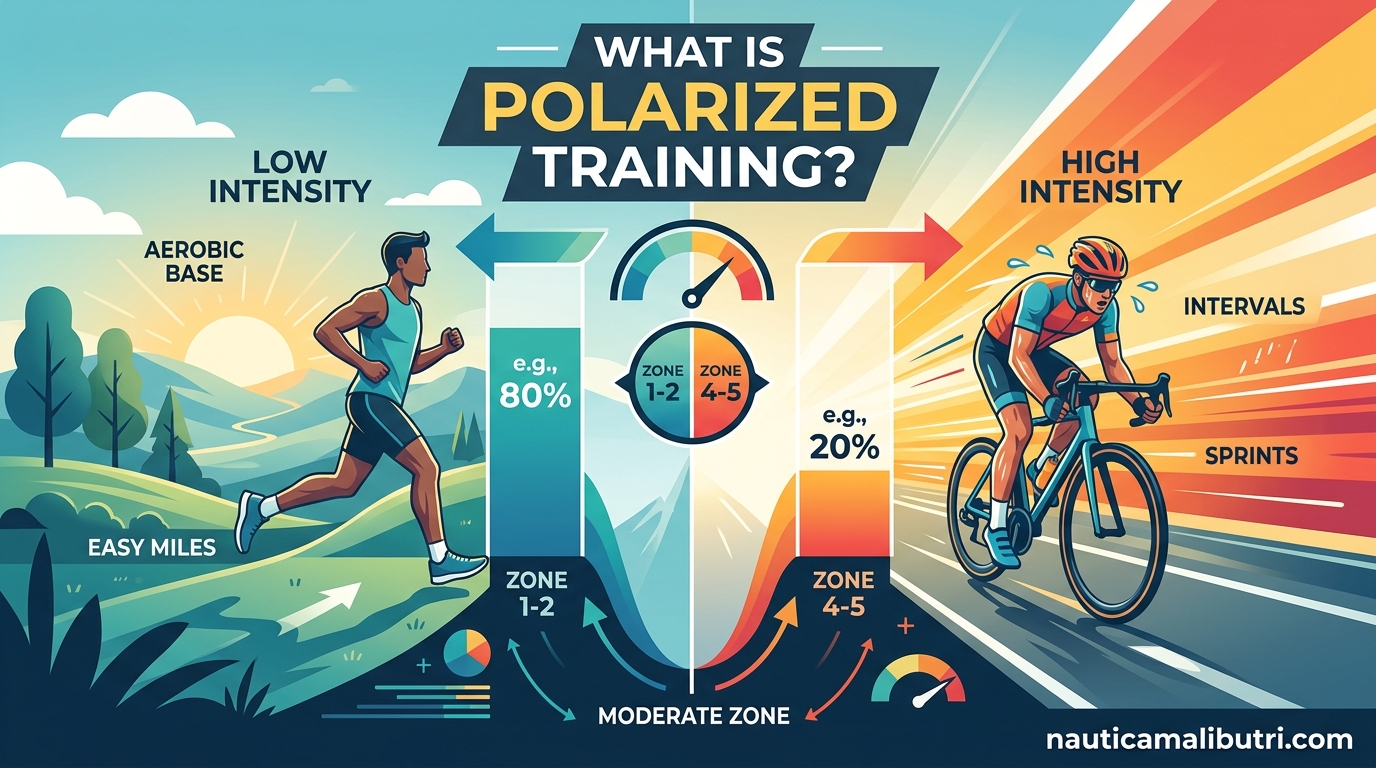
Polarized training is an endurance training method where approximately 80% of your training is done at low intensity while 20% is performed at high intensity, with minimal time spent in the moderate middle zone. This approach, backed by years of exercise science research, has become the go-to method for elite endurance athletes across cycling, running, and triathlon.
I first encountered polarized training when I was struggling with constant fatigue during my build phases. My training log showed I was spending most of my time in that murky middle ground, neither going easy enough to build aerobic capacity nor hard enough to trigger real performance adaptations. Once I shifted to a true polarized approach, my race times improved and I stopped feeling burned out by mid-season.
In this guide, I will explain exactly what polarized training is, how the 80/20 rule works, and why this training distribution might be the key to unlocking your endurance potential in 2026.
Table of Contents
What Is Polarized Training
Polarized training organizes your workouts into two distinct intensity poles: low and high. The distribution typically follows an 80/20 split, meaning 80% of your training time stays at conversational intensity while 20% pushes near your maximum sustainable effort.
The concept comes from research pioneered by Dr. Stephen Seiler, an exercise physiologist who studied how elite endurance athletes actually train. He discovered that despite popular belief about threshold training, top performers spend surprisingly little time at moderate intensities.
The 80/20 Rule Explained
The 80/20 rule forms the backbone of polarized training. Here is how the percentages break down in practice:
80% Low Intensity: This portion includes Zone 1 and Zone 2 efforts where you can maintain a conversation. Your heart rate stays below ventilatory threshold (roughly 75-80% of max heart rate). These sessions build aerobic capacity, mitochondrial density, and fat oxidation efficiency.
20% High Intensity: This portion includes Zone 3 efforts at or above your threshold. These sessions trigger VO2max improvements, lactate tolerance, and neuromuscular adaptations. You should be breathing hard and unable to speak in full sentences.
Some research shows slight variations, with some elite athletes using a 75/25 or 90/10 split depending on their sport and training phase. The key is not the exact percentage but the principle of polarization itself: avoiding the middle.
The 3-Zone Intensity Model
To understand polarized training, you need to know the three-zone model that researchers use. Unlike five-zone systems popular in training apps, the scientific model simplifies intensities into three clear buckets:
Zone 1 (Low): Below first ventilatory threshold (VT1). You can easily hold a conversation. RPE 1-3 out of 10. Heart rate roughly 60-75% of maximum.
Zone 2 (Moderate): Between VT1 and VT2 (lactate threshold). Conversation becomes clipped and difficult. This is the ‘gray zone’ that polarized training avoids. RPE 4-6. Heart rate 75-85% of maximum.
Zone 3 (High): Above second ventilatory threshold (VT2). You are breathing hard and focus shifts to maintaining effort. RPE 7-10. Heart rate 85-100% of maximum.
In polarized training, you deliberately skip Zone 2. You either go easy in Zone 1 or go hard in Zone 3. That gap in the middle is what makes this approach different from how most amateur athletes train.
The Science Behind Polarized Training
Dr. Stephen Seiler’s research transformed how we understand endurance training. Through studying elite athletes across multiple sports, he found a consistent pattern: the best performers train mostly easy and occasionally very hard.
Why Low Intensity Builds the Base
Zone 1 training triggers specific physiological adaptations that form the foundation of endurance performance. When you train at low intensity, your body increases mitochondrial density in muscle cells, improves fat oxidation efficiency, and builds capillary networks to deliver oxygen.
These adaptations require significant time under tension. You cannot shortcut aerobic development with intensity. The 80% low-intensity volume gives your body the repeated stimulus it needs to build a robust aerobic engine without accumulating stress.
Low-intensity training also keeps your autonomic nervous system in check. You recover faster between sessions, allowing you to accumulate more total training stress over weeks and months. This durability matters for triathletes balancing three disciplines.
Why High Intensity Triggers Performance Gains
The 20% high-intensity portion targets different adaptations. Zone 3 sessions improve your VO2max, increase lactate threshold, and enhance neuromuscular recruitment. These workouts stress your cardiovascular and muscular systems beyond their current capacity, forcing adaptation.
Research shows that relatively small doses of high-intensity work produce disproportionate fitness returns. Just two to three hard sessions per week can drive significant performance improvements when paired with adequate low-intensity volume.
The ‘Gray Zone’ Problem
The middle intensity, Zone 2, creates what coaches call the ‘gray zone.’ When you train here, you accumulate fatigue without generating enough stimulus for meaningful adaptation. You are going too hard to build aerobic base effectively, but not hard enough to trigger high-end fitness gains.
Many recreational athletes fall into this trap. They feel like easy training is ‘not real training,’ so they push just hard enough to feel like they worked out. The result is chronic fatigue without performance improvement. Polarized training explicitly eliminates this zone.
Polarized vs Pyramidal vs Threshold Training
Three main training intensity distributions dominate endurance sport. Understanding the differences helps you choose the right approach for your goals and available training time.
Polarized Training: 75-80% Zone 1, 0-5% Zone 2, 20-25% Zone 3. The defining feature is minimal time in the moderate middle. Creates high adaptation with manageable fatigue.
Pyramidal Training: 70-75% Zone 1, 15-20% Zone 2, 10-15% Zone 3. Resembles a pyramid shape with moderate intensity forming the middle. Common among competitive amateur cyclists and runners.
Threshold Training: 40-50% Zone 1, 30-40% Zone 2, 10-20% Zone 3. Emphasizes sustained efforts at lactate threshold. Popular among time-crunched athletes who believe they need intensity every session.
Which Approach Is Best
Research consistently shows polarized training produces superior results for athletes with adequate training time (8+ hours per week). The pyramidal approach works well for competitive age-groupers who race frequently. Threshold training suits time-limited athletes but carries higher burnout risk.
For triathletes specifically, polarized training offers advantages across all three disciplines. Swimming and running particularly benefit from the aerobic base development, while cycling responds well to the high-intensity work.
Benefits of Polarized Training for Triathletes
After implementing polarized training with dozens of age-group triathletes, I have observed consistent benefits that go beyond simple fitness improvements.
Superior Aerobic Development
The high volume of Zone 1 work builds an aerobic base that threshold training cannot match. Triathletes report improved fat oxidation during long events, meaning they rely less on carbohydrate stores and avoid bonking. Their easy pace gets faster while staying in Zone 1.
Reduced Burnout and Injury Risk
Constantly training in the gray zone beats up your body without delivering proportional fitness gains. By keeping easy days truly easy, polarized training allows your connective tissues and muscles to recover. Overuse injuries decrease significantly.
Mental burnout also drops. Hard sessions are genuinely hard and psychologically rewarding. Easy sessions require no mental strain. You avoid the soul-crushing grind of constant moderate efforts that neither challenge nor refresh you.
Sustainability Across a Season
Polarized training creates what Dr. Seiler calls ‘durability,’ the ability to maintain training loads over extended periods without breakdown. This matters for triathletes with long build phases lasting 20-30 weeks before an Ironman or half-Ironman.
The model also adapts well to life stress. When work or family demands increase, you can reduce total volume while maintaining the 80/20 split. Your fitness stays intact even when training time drops.
How to Implement Polarized Training
Transitioning to polarized training requires discipline. Most athletes struggle initially because easy feels too easy and hard feels terrifying. Here is how to structure your approach.
Define Your Training Zones
First, establish accurate zone boundaries using one of these methods:
Heart Rate Method: Calculate maximum heart rate through a field test or lab assessment. Zone 1 caps at roughly 75% of max, Zone 2 runs 75-85%, Zone 3 starts above 85%. Use a chest strap for accuracy; wrist monitors lag during intervals.
Power Method (Cycling): Establish Functional Threshold Power (FTP) through a 20-minute test. Zone 1 stays below 55% of FTP, Zone 2 runs 56-75%, Zone 3 begins at 90% and extends to 120%+ for intervals.
Pace Method (Running): Determine threshold pace from a recent 10K or half-marathon. Zone 1 runs 45-75 seconds per mile slower than threshold. Zone 2 falls within 15-45 seconds of threshold. Zone 3 includes intervals at or faster than threshold pace.
Structure Your Training Week
A typical polarized week for a triathlete training 10-12 hours might look like this:
Monday: Rest or easy Zone 1 swim (30 minutes)
Tuesday: High-intensity bike intervals (60 minutes total, 30 minutes Zone 3 work)
Wednesday: Easy Zone 1 run (45 minutes)
Thursday: High-intensity run intervals (50 minutes total, 20 minutes Zone 3 work)
Friday: Easy Zone 1 swim (45 minutes)
Saturday: Long Zone 1 bike (2.5 hours)
Sunday: Long Zone 1 run (60 minutes) plus easy swim (30 minutes)
This structure delivers roughly 20% high-intensity work across the week while keeping the remaining 80% genuinely easy. Notice that the hard sessions come after rest days, ensuring you can hit the target intensities.
Measuring Your Intensity Distribution
Use time-in-zone analysis rather than session counts. A 2-hour easy ride counts as 120 minutes of Zone 1, not ‘one easy session.’ Similarly, a 60-minute interval workout with 20 minutes of warm-up, 20 minutes of hard work, and 20 minutes of cool-down counts as 40 minutes Zone 1 and 20 minutes Zone 3.
Most training software like TrainingPeaks or intervals.icu provides time-in-zone reports. Review weekly to ensure you are hitting the 80/20 split. Many athletes discover they are actually at 60/40, with far too much moderate work.
Common Mistakes and How to Avoid Them
Even knowing the theory, athletes make predictable errors when adopting polarized training. Here is what to watch for based on patterns I see in training logs.
Drifting Into the Gray Zone
The most common mistake is letting easy days become moderate. You feel good, so you push the pace slightly. Suddenly you are at 80% of max heart rate instead of 70%. This small drift accumulates across a week and destroys the polarization effect.
Fix this by setting an upper heart rate or power ceiling for easy sessions. If you exceed it, you must stop or slow down immediately. Use a watch alarm to alert you when you drift high.
Too Much High Intensity
Enthusiastic athletes sometimes invert the ratio, doing 40% high intensity because they believe more hard work equals more fitness. This leads to overtraining, elevated resting heart rate, and declining performance.
Respect the 20% limit. High-intensity work creates stress that requires recovery. Doing too much high-intensity volume without adequate base fitness actually reduces your aerobic capacity over time.
Not Enough Low Intensity Volume
Polarized training only works when the 80% low-intensity portion is substantial. If you train 4 hours per week, 80% equals just over 3 hours of base work. That may not be enough to drive adaptation.
This is the primary concern for low-volume athletes. You may need to extend training blocks or accept that polarized training works best when you can accumulate meaningful Zone 1 hours.
Ignoring Recovery Signals
Even with proper intensity distribution, life stress, poor sleep, and nutrition deficits accumulate. If your resting heart rate is elevated or you feel persistently fatigued, add an extra rest day regardless of what the plan says.
Does Polarized Training Work for Low-Volume Athletes
A recurring question on triathlon forums concerns athletes training under 8 hours per week. Does polarized training work when your total volume is limited?
The Volume Challenge
At 6 hours weekly training time, 80% equals approximately 5 hours of low-intensity work and 1 hour of high-intensity work. Five hours of base training may not provide enough stimulus for significant aerobic development in experienced athletes.
Research on polarized training typically studies athletes doing 12-20 hours weekly. The evidence base for low-volume polarized training is thinner, though some studies show benefits even at 6-8 hours.
Modified Approaches for Time-Crunched Athletes
If your schedule limits you to under 8 hours weekly, consider these adjustments:
Shift toward a pyramidal distribution with slightly more Zone 2 work. The 70/20/10 split may work better than strict 80/20 when total volume is low.
Extend your training blocks. Instead of 4-week build phases, use 6-8 week blocks to allow adaptations to accumulate from your limited volume.
Prioritize consistency over perfection. Missing sessions hurts low-volume athletes more than high-volume athletes. Get your sessions in, even if the intensity distribution is not perfect.
Consider whether threshold training might suit your situation better. While polarized training is optimal for many athletes, it requires sufficient volume to work properly.
Frequently Asked Questions
What is the polarized training method?
Polarized training is an endurance training method where approximately 80% of training is done at low intensity (Zone 1) and 20% at high intensity (Zone 3), with minimal time spent in moderate intensity (Zone 2). This approach maximizes aerobic base development while triggering high-end performance adaptations through brief hard efforts.
Is polarized training the best?
Research consistently shows polarized training produces superior results compared to threshold or high-volume moderate training for athletes with adequate training time (8+ hours per week). Elite endurance athletes across cycling, running, and triathlon predominantly use polarized approaches. However, time-crunched athletes may benefit from threshold or pyramidal training instead.
What is the 75 25 rule in cycling?
The 75/25 rule is a variation of polarized training where 75% of training time is spent at low intensity and 25% at high intensity. Some research shows elite cyclists use this slightly higher intensity distribution during specific training phases. The principle remains the same: spend most of your time going easy and the remainder going hard, avoiding the moderate middle zone.
What is the 80 20 rule in cycling?
The 80/20 rule states that 80% of cycling training should occur at low intensity (conversational pace, Zone 1-2) while 20% should be high intensity (hard efforts, Zone 3). This intensity distribution, derived from research on elite cyclists, maximizes aerobic development while providing enough stimulus for performance gains. The key is avoiding the ‘gray zone’ of moderate intensity that produces fatigue without adequate adaptation.
How long before seeing results from polarized training?
Most athletes notice initial improvements in 3-4 weeks, with significant performance gains appearing after 8-12 weeks of consistent polarized training. The first changes typically include feeling more recovered and having easier conversations during previously challenging paces. Race performance improvements usually manifest after completing a full 12-16 week training block.
Can beginners use polarized training?
Beginners can use polarized training principles, though they should focus on building Zone 1 volume before adding significant high-intensity work. New athletes benefit from 3-6 months of predominantly easy training to establish aerobic base fitness. Once they can train 6-8 hours weekly consistently, adding structured Zone 3 intervals creates rapid improvement without the burnout risk of threshold-heavy approaches.
Conclusion
Polarized training offers triathletes a proven framework for maximizing fitness while managing fatigue. By spending 80% of your training time at truly easy intensities and 20% at genuinely hard efforts, you avoid the gray zone trap that plagues so many recreational athletes.
The research is clear: elite endurance performers across cycling, running, cross-country skiing, and rowing organize their training this way. Dr. Stephen Seiler’s work gave us the scientific backing, but athletes had intuitively discovered this approach decades earlier through trial and error.
If you are currently training mostly at moderate intensities, transitioning to polarized training requires discipline. You must slow down your easy days significantly and commit to real suffering on hard days. The payoff is improved aerobic capacity, reduced burnout risk, and sustainable progress across a long triathlon season.
Start by auditing your current training distribution using time-in-zone analysis from your watch or training software. If you are like most age-groupers, you will discover far too much moderate work. Shift toward the 80/20 split over the next month and watch your fitness transform.