
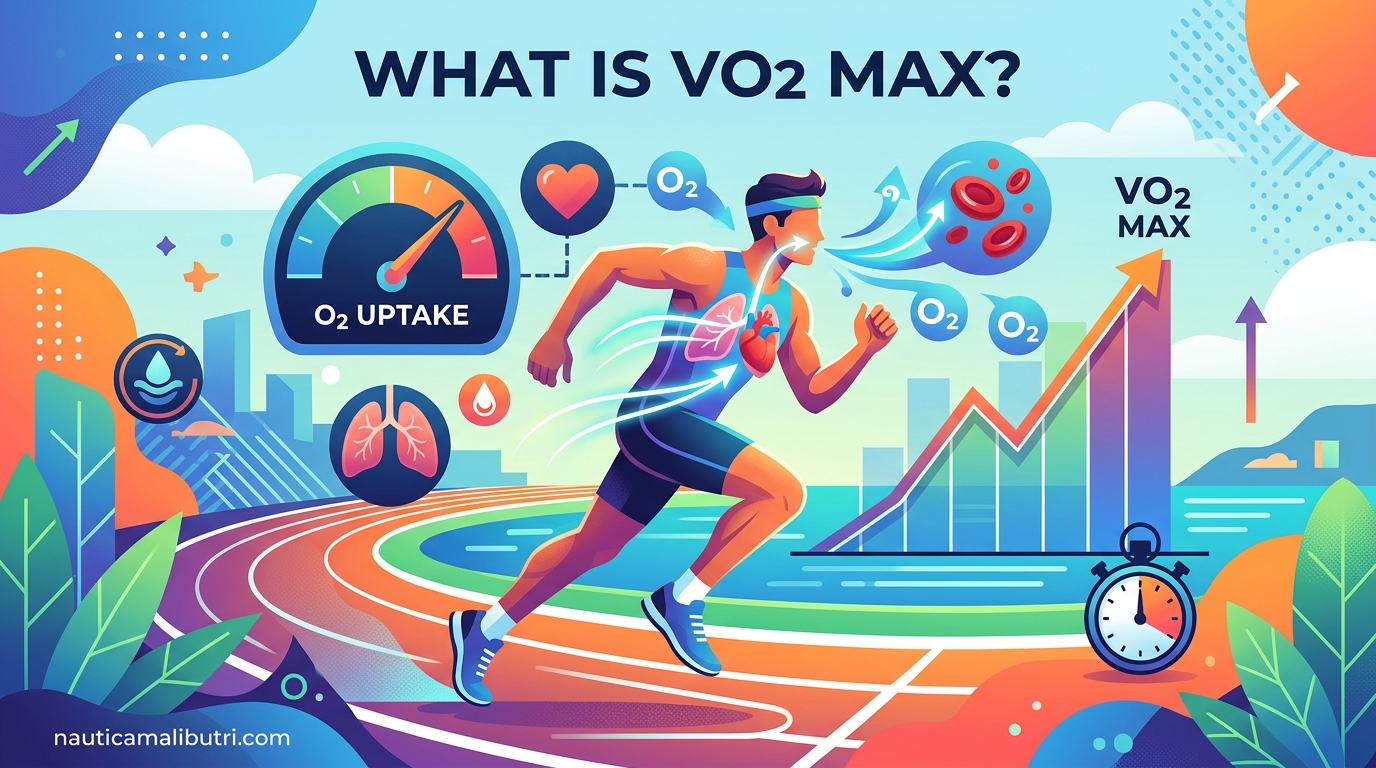
What is VO2 max? It is the maximum amount of oxygen your body can use during intense exercise, measured in milliliters of oxygen per kilogram of body weight per minute (ml/kg/min). This single number tells you how efficiently your heart, lungs, and muscles work together to produce energy.
For triathletes training for events like the Nautica Malibu Triathlon, understanding VO2 max matters more than almost any other fitness metric. I have watched athletes transform their race performance by focusing on this one measurement. Higher VO2 max scores correlate directly with faster swim splits, stronger bike legs, and more sustainable run paces.
In this guide, I will break down exactly what VO2 max means, how to interpret your numbers, and how to apply this knowledge to your triathlon training in 2026.
Table of Contents
What is VO2 Max?
VO2 max stands for “Volume of Oxygen Maximum.” It represents the upper limit of oxygen your body can consume, transport, and use to generate energy during physical activity.
The measurement works like this: when you exercise, your muscles demand more oxygen to produce ATP (adenosine triphosphate), the energy currency your cells use. Your lungs pull in oxygen, your heart pumps it through your bloodstream, and your muscles extract it to fuel contractions. VO2 max captures the peak efficiency of this entire system.
Elite endurance athletes typically achieve VO2 max values between 60 and 80 ml/kg/min. The average sedentary adult falls between 30 and 40 ml/kg/min. Genetics play a role in your ceiling, but consistent training can improve your score by 10-30% regardless of your starting point.
Research published in the Journal of the American College of Cardiology consistently shows that VO2 max ranks as one of the strongest predictors of cardiovascular health and longevity. It is not just about race performance. It is about health.
How VO2 Max is Measured
Lab testing remains the gold standard for accurate VO2 max measurement. During a graded exercise test, you wear a mask connected to a metabolic cart while running on a treadmill or cycling on a stationary bike.
The test protocol works like this: you start at a low intensity, and every 2-3 minutes the technician increases the workload. You continue until you reach volitional exhaustion. The metabolic cart measures the volume and concentration of oxygen you inhale versus what you exhale. When your oxygen consumption plateaus despite increasing workload, that is your VO2 max.
Most triathletes rely on wearable estimates instead. Garmin devices, Apple Watch, and other fitness trackers calculate VO2 max using heart rate data, pace, and proprietary algorithms. These estimates typically fall within 5-10% of lab results for most users.
Forum discussions from triathletes reveal a common frustration: wearable numbers can fluctuate based on factors unrelated to fitness. Poor sleep, dehydration, heat, and even caffeine can skew readings. For tracking trends over time, wearables work well. For absolute precision, schedule a lab test at a sports medicine facility.
What is a Good VO2 Max for Your Age?
Good VO2 max scores depend heavily on age and gender. Men typically score 15-20% higher than women due to larger heart size, greater hemoglobin concentration, and higher muscle mass. Both genders see gradual decline with age, roughly 1% per year after age 30.
Here are general VO2 max norms for men by age:
20-29 years: Excellent is 50+, Good is 44-49, Average is 38-43, Below Average is under 38
30-39 years: Excellent is 48+, Good is 42-47, Average is 35-41, Below Average is under 35
40-49 years: Excellent is 45+, Good is 39-44, Average is 32-38, Below Average is under 32
50-59 years: Excellent is 42+, Good is 36-41, Average is 29-35, Below Average is under 29
For women, subtract approximately 5-7 points from each category. A 35-year-old woman with a VO2 max of 42 would rank in the “good” category, while the same score for a man would be “average.”
Triathletes typically land in the “excellent” or above ranges. Age-group podium finishers at events like Nautica Malibu often register scores of 55-65 ml/kg/min. Professional triathletes regularly exceed 70 ml/kg/min.
VO2 Max and Triathlon Performance
VO2 max predicts endurance performance across all three triathlon disciplines, though the relationship varies by sport. Running shows the strongest correlation because weight-bearing exercise demands more oxygen per kilogram of body mass.
Cycling VO2 max typically runs 5-10% lower than running VO2 max for the same athlete. The bike supports your body weight, reducing the oxygen cost of movement. However, cycling power output still depends heavily on aerobic capacity. Strong cyclists at Nautica Malibu need robust VO2 max scores to maintain 20+ mph averages on the flat coastal roads.
Swimming presents unique challenges for VO2 max measurement. Water position, technique, and breathing patterns affect oxygen consumption more than pure cardiovascular fitness. Many triathletes actually achieve higher measured VO2 max values while swimming than while running, but this reflects technical efficiency as much as fitness.
The real advantage for triathletes comes from training at intensities near VO2 max. These sessions stress your cardiovascular system and trigger adaptations: increased stroke volume, higher capillary density, improved mitochondrial function. Over months, these changes lower your heart rate at race pace and delay the point where lactate accumulates.
At Nautica Malibu Triathlon specifically, the ocean swim and rolling bike course reward athletes with well-developed aerobic engines. The half-mile swim requires sustained output without rest. The bike leg features elevation changes that punish undertrained cardiovascular systems. A higher VO2 max means you maintain steady power where others spike and fade.
How to Improve Your VO2 Max
Improving VO2 max requires consistent training at intensities that challenge your oxygen delivery system. Research shows that high-intensity interval training (HIIT) produces the fastest gains, though steady-state aerobic work builds the foundation.
The most effective protocol for triathletes includes one or two VO2 max sessions per week. These intervals last 3-5 minutes at 90-95% of maximum heart rate, with equal recovery periods. Start with 4 x 3 minutes and progress to 5 x 4 minutes over several weeks.
Longer aerobic sessions at tempo pace also drive improvement. Spend 20-40 minutes at your lactate threshold once weekly. This intensity sits below VO2 max but above easy pace, teaching your body to process lactate while maintaining output.
Consistency matters more than any single workout. Studies show that 12-16 weeks of structured training can raise VO2 max by 10-20% in previously untrained individuals. Even well-trained athletes see 3-5% improvements with focused blocks.
Recovery enables adaptation. Your VO2 max does not improve during hard intervals. It improves during rest when your body rebuilds stronger. Schedule easy days, prioritize sleep, and fuel properly to maximize training effect.
For triathletes, sport-specific training produces the best results. Running intervals build running VO2 max most efficiently. Cycling intervals build cycling VO2 max. If you are preparing for Nautica Malibu, include sessions in all three disciplines, but emphasize your weakest sport for balanced fitness.
Frequently Asked Questions
What is a good VO2 max for my age?
For men aged 20-29, a good VO2 max is 44+ ml/kg/min. For ages 30-39, aim for 42+. For ages 40-49, 39+ rates as good. Women should subtract 5-7 points from these benchmarks. Triathletes typically score in the ‘excellent’ range of 50+ regardless of age.
How can I improve my VO2 max?
The most effective methods are high-intensity interval training (3-5 minute efforts at 90-95% max heart rate) and tempo workouts (20-40 minutes at threshold pace). Consistency over 12-16 weeks produces measurable improvements. Include 1-2 VO2 max sessions weekly alongside aerobic base training.
How do I calculate my VO2 max?
The gold standard is a lab-based graded exercise test with a metabolic cart. For estimates, wearables like Garmin and Apple Watch calculate VO2 max using heart rate and pace data. You can also use field tests like the Cooper 12-minute run or 1.5-mile run test, then apply standard formulas.
What does VO2 max tell you?
VO2 max tells you how efficiently your body uses oxygen during exercise. It indicates cardiovascular fitness, predicts endurance performance, and correlates with overall health and longevity. Higher scores mean your heart, lungs, and muscles work together more effectively to produce energy.
Conclusion
What is VO2 max? It is the most important number most triathletes ignore. This measurement captures your aerobic capacity, predicts your race potential, and indicates your cardiovascular health.
If you are training for Nautica Malibu Triathlon in 2026, prioritize VO2 max development in your program. Include interval sessions, track your progress with wearable estimates or lab testing, and watch your race times drop. A higher VO2 max does not guarantee podium finishes, but it unlocks the fitness you need to race at your best.
Start with one focused VO2 max session this week. Your future self will thank you on race day.