
If you’ve spent any time around endurance athletes, you’ve probably heard someone drop their VO2 max number like it’s a badge of honor. “I’m sitting at 52 right now,” they’ll say, as if that single digit explains everything about their fitness. But what is VO2 max, actually? And why does it matter so much for triathletes?
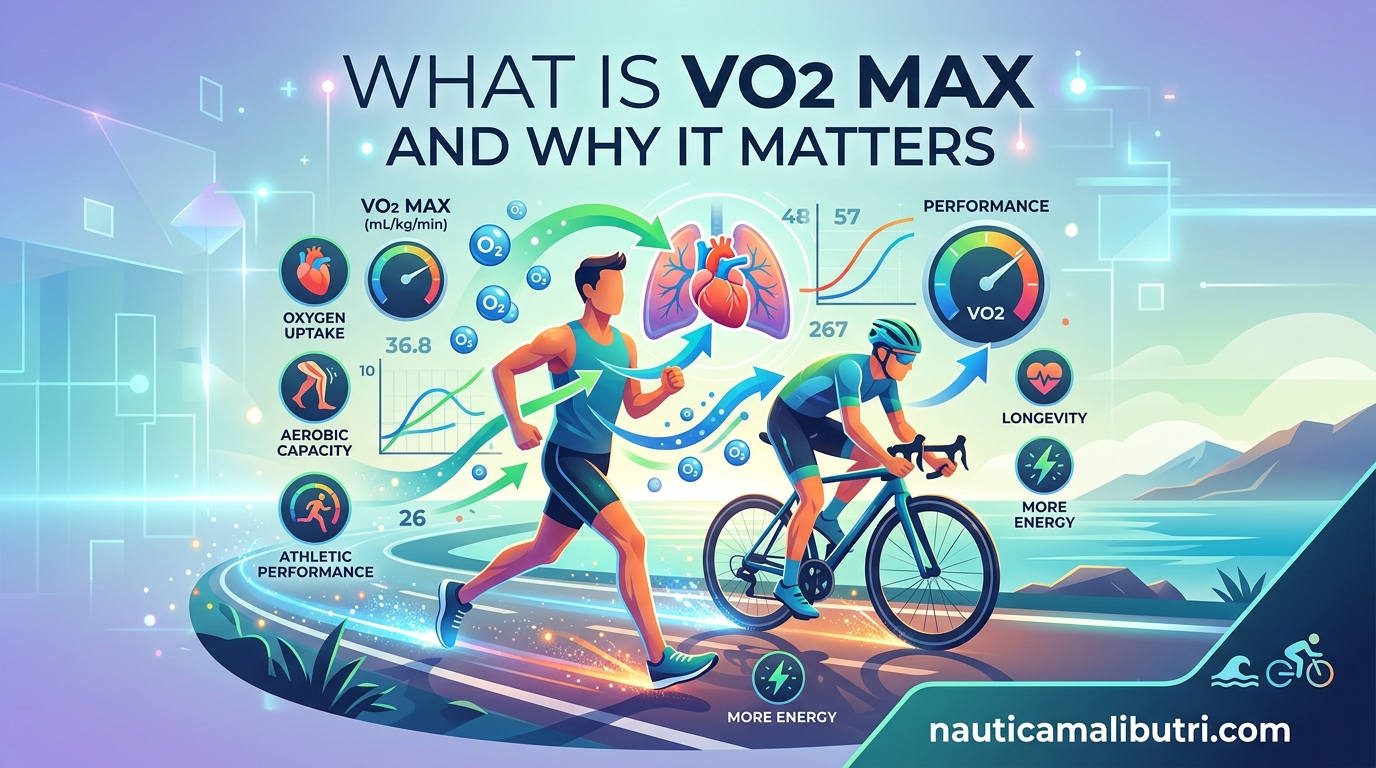
VO2 max is the maximum volume of oxygen your body can absorb and use during exercise. It’s measured in milliliters of oxygen per kilogram of body weight per minute, or ml/kg/min for short. Think of it as your body’s engine size. A higher VO2 max means your cardiovascular system can deliver more oxygen to your working muscles, which translates to better endurance and performance.
In 2026, wearable devices have made VO2 max tracking accessible to everyone, not just elite athletes with access to sports labs. Understanding your VO2 max and how to improve it could be the key to shaving minutes off your next race.
Table of Contents
What Is VO2 Max? Breaking Down the Science
VO2 max stands for “volume (V) of oxygen (O2) maximum.” It represents the upper limit of your aerobic capacity. When you exercise, your muscles need energy. They get that energy by breaking down a molecule called ATP, or adenosine triphosphate. To create ATP, your body needs oxygen. The more oxygen you can process, the more ATP you can produce, and the harder and longer you can exercise.
Here’s a simple analogy. Imagine your muscles are a campfire, and oxygen is the wood you feed it. A small campfire needs less wood to keep burning. A massive bonfire needs a constant supply of logs to maintain its flames. VO2 max tells you how big your bonfire can get and how much fuel you can deliver to keep it roaring.
The Three Components of Oxygen Transport
Your VO2 max depends on three interconnected systems working together. First, your heart and lungs must pull oxygen from the air and pump it into your bloodstream. A stronger heart pushes more blood with each beat. Healthy lungs transfer oxygen efficiently into that blood.
Second, your capillaries must deliver that oxygen-rich blood to your muscles. More capillaries mean better distribution. Third, your muscles must extract and use that oxygen efficiently. Well-trained muscle cells have more mitochondria, the tiny power plants that convert oxygen into usable energy.
If any of these three components is weak, your VO2 max suffers. This is why training for VO2 max improvement targets all three systems, not just one.
Why VO2 Max Matters for Your Health and Performance
VO2 max is one of the strongest predictors of cardiovascular health and longevity. Research consistently shows that higher VO2 max values correlate with reduced risk of heart disease, stroke, and premature death. In fact, some cardiologists consider VO2 max a better predictor of mortality than traditional risk factors like smoking or high blood pressure.
For triathletes specifically, VO2 max matters because it directly impacts your race performance. Your aerobic capacity determines how fast you can swim, bike, and run before your body shifts to anaerobic metabolism, where fatigue accumulates rapidly. A higher VO2 max means you can maintain a faster pace while staying in your aerobic zone.
The Performance Benefits
Beyond the health implications, a higher VO2 max delivers real performance advantages. You recover faster between intervals. You can sustain higher intensities during long sessions. You handle heat and altitude better because your cardiovascular system operates more efficiently.
Perhaps most importantly for triathletes, a strong VO2 max helps during the run leg. After swimming and cycling, your body is already fatigued. A higher aerobic capacity gives you a larger buffer before you hit your limit. This is why elite triathletes often have VO2 max values in the 70s and 80s, while recreational athletes typically fall in the 40s and 50s.
How to Measure Your VO2 Max
The gold standard for measuring VO2 max is a laboratory test. You run on a treadmill or cycle on a stationary bike while wearing a mask that measures the oxygen you inhale and the carbon dioxide you exhale. The test gradually increases intensity until you reach exhaustion. The highest oxygen consumption rate recorded is your VO2 max.
These lab tests are accurate but expensive and inconvenient. Most triathletes rely on estimates from wearable devices. Garmin watches, Apple Watches, and other fitness trackers use algorithms based on your heart rate, pace, and workout data to estimate your VO2 max. While not as precise as lab testing, these estimates are reasonably accurate and track changes over time effectively.
Submaximal Testing Options
If you don’t have a wearable device, several submaximal tests can estimate your VO2 max. The Cooper test involves running as far as possible in 12 minutes. The Rockport one-mile walk test measures your time and heart rate after walking one mile as fast as possible. These tests use formulas to predict your VO2 max without requiring you to push to absolute exhaustion.
VO2 Max by Age and Gender
VO2 max naturally declines with age, typically dropping about 1% per year after age 30. Men generally have higher values than women due to differences in heart size, hemoglobin levels, and body composition. Use these tables to see where you stand:
| Age | Men – Poor | Men – Fair | Men – Good | Men – Excellent |
|---|---|---|---|---|
| 20-29 | Under 38 | 38-43 | 44-51 | Over 52 |
| 30-39 | Under 35 | 35-39 | 40-47 | Over 48 |
| 40-49 | Under 32 | 32-35 | 36-43 | Over 44 |
| 50-59 | Under 29 | 29-31 | 32-39 | Over 40 |
| 60+ | Under 25 | 25-27 | 28-35 | Over 36 |
| Age | Women – Poor | Women – Fair | Women – Good | Women – Excellent |
|---|---|---|---|---|
| 20-29 | Under 31 | 31-35 | 36-43 | Over 44 |
| 30-39 | Under 28 | 28-32 | 33-38 | Over 39 |
| 40-49 | Under 25 | 25-28 | 29-34 | Over 35 |
| 50-59 | Under 22 | 22-25 | 26-32 | Over 33 |
| 60+ | Under 19 | 19-22 | 23-28 | Over 29 |
VO2 Max Across Triathlon Disciplines
Your VO2 max varies depending on which sport you’re testing. Most athletes achieve their highest VO2 max values while running. Running uses more muscle mass and requires your cardiovascular system to work against gravity, driving oxygen demand higher.
Cycling VO2 max values typically run 5-10% lower than running values for the same athlete. Cycling supports your body weight, reducing the cardiovascular load. Swimming VO2 max measurements are complicated by breath holding and different muscle recruitment patterns. Many triathletes find their swim VO2 max difficult to measure accurately outside a lab.
This variation matters for training. If you only track running VO2 max, you might miss fitness gains from cycling intervals. Consider tracking discipline-specific metrics or using your watch’s estimate based on your primary sport.
How to Improve Your VO2 Max
VO2 max is trainable, but genetics set your ceiling. Elite endurance athletes are born with high aerobic capacities, but anyone can improve their VO2 max through consistent training. Most beginners see rapid gains in their first six months of structured training. Advanced athletes require more targeted approaches to push their numbers higher.
High-Intensity Interval Training
The most effective way to boost VO2 max is high-intensity interval training. These workouts push you to 90-95% of your maximum heart rate for intervals lasting 3 to 5 minutes. The classic protocol involves 5 repetitions of 4 minutes hard followed by 3 minutes easy recovery.
Sprint interval training offers another option. This approach uses shorter, harder efforts, such as 30 seconds all-out followed by 4 minutes of easy recovery. Research shows both protocols effectively improve VO2 max, so choose based on your preference and schedule.
Steady-State Endurance Work
While intervals drive VO2 max improvements, aerobic base training supports those gains. Long, steady sessions at 60-75% of your maximum heart rate build capillary density and mitochondrial efficiency. These adaptations don’t directly raise your VO2 max ceiling, but they help you utilize a higher percentage of that capacity during races.
Sport-Specific Considerations
Triathletes should train VO2 max across all three disciplines. Running intervals deliver the biggest VO2 max bang for your buck, but cycling intervals reduce impact stress while still driving cardiovascular adaptations. Swimming VO2 max work is challenging due to breathing constraints, but threshold sets with short rest intervals can help.
Many coaches recommend prioritizing run VO2 max work during base and build phases, then maintaining with one session per week while adding bike intervals as race season approaches. This approach maximizes your running fitness, which typically matters most for overall triathlon performance.
Frequently Asked Questions
What is a good VO2 max level by age?
A good VO2 max depends on your age and gender. For men in their 30s, 40-47 ml/kg/min is considered good. For women in their 30s, 33-38 ml/kg/min rates as good. These numbers decline naturally with age. Focus on your percentile relative to your age group rather than comparing to elite athletes.
Why is VO2 max so important?
VO2 max matters because it predicts cardiovascular health and endurance performance. Higher values mean your body transports and uses oxygen more efficiently. This translates to better race times, faster recovery, and reduced risk of heart disease. For triathletes, it’s a key indicator of fitness across swim, bike, and run.
What is the best exercise to improve VO2 max?
High-intensity interval training works best for improving VO2 max. Try 4-minute intervals at 90-95% of max heart rate with 3-minute recoveries. Sprint intervals of 30 seconds all-out also work well. Running typically produces the highest VO2 max gains, but cycling intervals reduce injury risk while still building aerobic capacity.
Can you be fit and have a low VO2 max?
Yes, you can be fit with a lower VO2 max. VO2 max measures aerobic capacity, but fitness includes strength, flexibility, skill, and efficiency. Some athletes with modest VO2 max values excel through superior technique and mental toughness. However, a higher VO2 max generally makes endurance sports easier.
What is the average VO2 max for a triathlete?
Recreational triathletes typically have VO2 max values between 45-55 ml/kg/min for men and 38-48 ml/kg/min for women. Age-group competitors often reach 55-65 for men and 48-58 for women. Elite triathletes routinely exceed 70 ml/kg/min, with some reaching into the 80s.
Is a VO2 max of 47 good?
A VO2 max of 47 is good for most adults. For a man in his 30s or 40s, 47 falls in the good to excellent range. For a woman, 47 is excellent regardless of age. Context matters, though. Elite male endurance athletes often exceed 65, so 47 would be modest at that level. Compare yourself to age and gender norms, not professionals.
Key Takeaways
VO2 max represents your body’s ability to absorb and use oxygen during exercise. It serves as both a health metric and a performance predictor for triathletes. Understanding what is VO2 max and why it matters can guide your training decisions and help you set realistic goals.
In 2026, tracking VO2 max has never been easier. Wearable devices give you regular estimates without lab visits. Focus on improving your number through interval training, but remember that VO2 max is just one piece of the fitness puzzle. Consistency, technique, and mental preparation matter just as much on race day.
Whether you’re training for your first sprint triathlon or chasing a Kona qualification, building your aerobic capacity pays dividends. Start tracking your VO2 max, implement interval sessions into your weekly schedule, and watch both your numbers and your race times improve.