
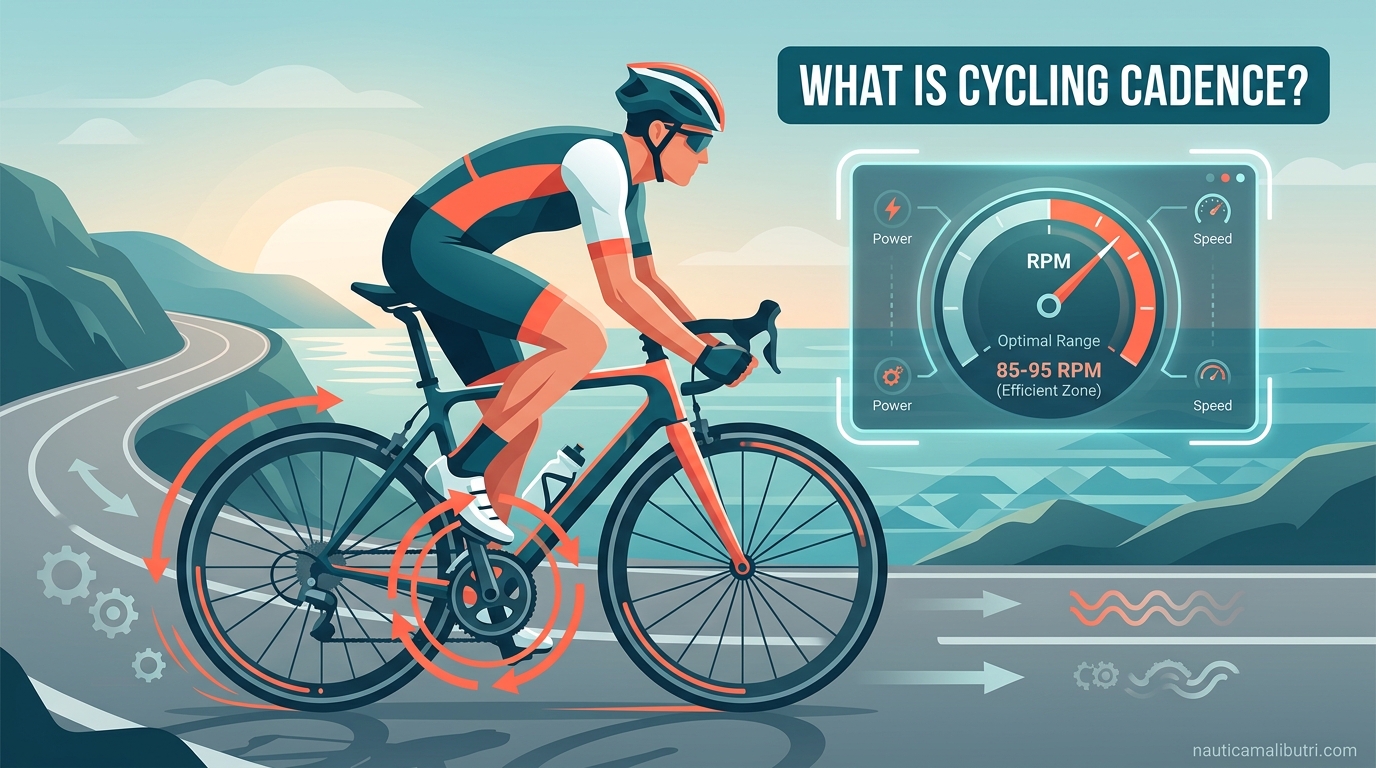
Cycling cadence is the speed at which you turn the pedals, measured in revolutions per minute (RPM). It represents how many complete pedal rotations you make in one minute while riding. Understanding your cadence is one of the most important skills for improving your cycling efficiency, especially if you are training for triathlons.
I remember when I first started cycling seriously. I had no idea what RPM meant or why anyone cared about how fast they spun their legs. I just pushed the pedals as hard as I could and hoped for the best. That approach worked for a while, but eventually I hit a plateau. My legs would burn out on long rides, and transitioning from bike to run felt like my legs were made of concrete.
Once I started paying attention to cadence, everything changed. My endurance improved, my knees stopped hurting, and those brutal brick workouts became manageable. In this guide, I will explain exactly what cycling cadence is, why it matters for triathletes, and how you can find your optimal pedaling rate.
Table of Contents
What is Cycling Cadence
Cycling cadence is simply the rate at which you pedal, expressed in revolutions per minute (RPM). One revolution equals one complete circle of your crank arm. If your cadence is 90 RPM, you are completing 90 full pedal strokes every minute.
Cadence and RPM are the same thing. When cyclists talk about spinning at 90 or grinding at 70, they are referring to their cadence measured in revolutions per minute. Bike computers and cadence sensors display this number in real-time so you can monitor your pedaling rate throughout your ride.
Cadence works together with power and torque to determine how much force you apply to the pedals. Lower cadences require more force per stroke, which loads your muscles more heavily. Higher cadences spread the same power across more pedal strokes, placing greater demand on your cardiovascular system instead.
Why Cadence Matters for Triathletes
Understanding cadence is essential for triathletes because it directly impacts your bike-to-run transition, your overall race performance, and your injury risk. The way you pedal during the bike leg determines how your legs feel when you start running.
A higher cadence during the bike portion leaves your leg muscles fresher for the run. When you spin at 90 RPM or above, you rely more on your cardiovascular fitness and less on raw muscular force. This preserves your quads and hamstrings for the running segment, which is why you will see most elite triathletes maintaining high cadences throughout the bike leg.
Lower cadences may feel more powerful in the moment, but they create significant muscle fatigue that carries over into your run. Grinding up hills at 60 RPM might get you to the top faster, but your legs will feel heavy and unresponsive when you dismount. For triathletes, the goal is to finish the bike leg ready to run, not completely depleted.
Cadence also plays a critical role in injury prevention. Pedaling at too low a cadence puts excessive strain on your knee joints and connective tissue. Many cyclists who experience chronic knee pain are simply pushing too hard a gear at too slow a cadence. Finding your optimal RPM helps distribute forces more evenly across your muscles and joints.
Optimal Cadence Ranges by Rider Level
There is no single perfect cadence that works for everyone. Your ideal pedaling rate depends on your fitness level, cycling experience, muscle fiber composition, and the type of riding you do. Here are the typical ranges that work best for different rider levels.
Beginners: 60 to 85 RPM
If you are new to cycling, your natural cadence probably falls between 60 and 85 RPM. Many beginners gravitate toward the lower end of this range because it feels more stable and controlled. Pushing a bigger gear at 65 RPM creates less perceived effort than spinning rapidly.
However, staying at the low end of this range for extended periods can lead to knee pain and premature muscle fatigue. As a beginner, aim to gradually increase your cadence toward 80 RPM over time. This will build better pedaling efficiency and reduce injury risk.
Intermediate Riders: 75 to 95 RPM
Most experienced recreational cyclists and amateur triathletes find their sweet spot between 75 and 95 RPM. This range offers the best balance of muscular and cardiovascular efficiency for sustained riding. Olympic distance triathletes typically maintain cadences in the mid-80s during competition.
Within this range, personal preference and body type matter. Riders with stronger leg muscles often prefer 75 to 80 RPM, while lighter, more cardio-focused athletes feel comfortable at 90 to 95 RPM. Both can be effective depending on your physiology and training background.
Advanced and Professional Riders: 90 to 110 RPM
Elite cyclists and professional triathletes typically sustain cadences between 90 and 110 RPM during races. Professional road sprinters may spin even faster, hitting 110 to 120 RPM during final sprints. Ironman champions like Jan Frodeno and Anne Haug consistently maintain 90 to 95 RPM throughout the 112-mile bike leg.
These high cadences require exceptional cardiovascular fitness and neuromuscular coordination. You cannot simply decide to spin at 100 RPM and expect it to work. It takes months of specific training to develop the efficiency and aerobic capacity needed to sustain high RPMs without bouncing in the saddle or wasting energy.
How to Measure Your Cadence
Measuring your cadence requires either a dedicated sensor or manual counting. The most accurate and convenient method is using a cadence sensor mounted on your bike. These small devices attach to your crank arm and chainstay, wirelessly transmitting RPM data to your bike computer or smartphone.
Popular options include Garmin, Wahoo, and Magene sensors. Most modern GPS bike computers like the Garmin Edge or Wahoo Elemnt series can display cadence alongside speed, power, and heart rate. If you train indoors, smart trainers and Peloton bikes also display cadence automatically.
If you do not have a sensor, you can count manually. Simply count your right leg pedal strokes for 15 seconds and multiply by 4. This gives you a rough RPM estimate. Check yourself periodically during rides to develop a feel for different cadences.
High Cadence vs Low Cadence: What is the Difference
High and low cadence riding activate different energy systems and muscle groups. Understanding these differences helps you choose the right approach for your goals and training phase.
Low cadence riding, typically below 75 RPM, emphasizes muscular strength and force production. Each pedal stroke requires more torque, engaging your fast-twitch muscle fibers and building leg strength. This style is useful for developing power and climbing ability, but it creates more muscle fatigue and stress on your joints.
High cadence riding, above 90 RPM, shifts the load to your cardiovascular system. Your heart and lungs work harder to deliver oxygen to rapidly contracting muscles, while the actual force per pedal stroke decreases. This spares your leg muscles but requires greater aerobic fitness and pedaling smoothness to execute efficiently.
For triathletes, the sweet spot usually leans toward higher cadences to preserve running muscles. However, incorporating some low cadence work during training builds the strength needed for hills and headwinds.
Training Drills to Improve Your Cadence
Improving your cadence takes deliberate practice. These drills will help you develop a smoother, more efficient pedal stroke while expanding the RPM range you can comfortably maintain.
Spin-Ups
Spin-ups are the most effective drill for developing high cadence capability. Start in an easy gear at 80 RPM. Every 30 seconds, increase your cadence by 5 RPM without shifting gears. Continue until you reach your maximum sustainable cadence or start bouncing in the saddle. Hold that peak for 30 seconds, then recover for 2 minutes. Repeat 4 to 6 times.
This drill teaches your nervous system to fire muscles faster and more efficiently. Over time, your comfortable maximum cadence will increase from perhaps 100 RPM to 110 or even 120 RPM.
Single-Leg Drills
Single-leg drills eliminate the dead spots in your pedal stroke. Unclip one foot and rest it on a trainer stand or let it hang. Pedal smoothly with one leg for 30 to 60 seconds, focusing on eliminating the clunk at the top and bottom of each stroke. Switch legs and repeat.
These drills feel awkward at first. Most riders discover they are not applying power smoothly through the entire revolution. Practice until you can maintain a consistent power output with each leg independently.
Cadence Pyramids
Cadence pyramids build endurance across a range of RPMs. Start at 80 RPM for 2 minutes. Increase to 85 RPM for 2 minutes, then 90, 95, and 100. Work your way back down the pyramid. Maintain the same power output throughout by adjusting gears as needed.
This workout teaches you to hold consistent power regardless of cadence, a valuable skill for racing when terrain or wind forces RPM changes.
Tempo Cadence Intervals
During a tempo ride, spend 5 minutes at 5 to 10 RPM above your natural cadence. Maintain your normal endurance power output. After 5 minutes, return to your self-selected cadence for 5 minutes of recovery. Repeat 4 to 6 times.
This drill gradually shifts your default cadence higher without forcing an abrupt change. Many triathletes find their natural cadence creeps up 5 to 10 RPM after 4 to 6 weeks of consistent tempo cadence work.
Common Cadence Mistakes to Avoid
Even experienced cyclists make cadence errors that limit their performance and increase injury risk. Here are the most common mistakes I see and how to fix them.
Grinding too low a gear is the biggest error among amateur triathletes. Many riders push 60 to 70 RPM for extended periods, believing they are being more efficient. In reality, they are accumulating unnecessary muscle fatigue and stressing their knee joints. If you regularly ride below 75 RPM on flat terrain, shift to an easier gear and raise your cadence.
Bouncing at high cadence is another frequent issue. When riders try to spin faster than their coordination allows, their hips rock and they lose power transfer. If you cannot maintain 90 RPM without bouncing, spend more time doing single-leg drills and spin-ups to improve your smoothness.
Neglecting strength work is a mistake for high-cadence devotees. While spinning fast is efficient, you still need muscular strength for hills, accelerations, and headwinds. Include some low cadence, high torque intervals in your training to maintain strength across all RPM ranges.
Frequently Asked Questions
What is a typical cycling cadence?
A typical cycling cadence for recreational riders ranges from 75 to 95 revolutions per minute (RPM). Beginners often ride at 60 to 85 RPM, while professional cyclists and triathletes typically maintain 90 to 110 RPM during races. The most efficient cadence varies by individual based on fitness level, muscle composition, and riding style.
Is RPM the same as cadence?
Yes, RPM (revolutions per minute) and cadence refer to the same measurement. Cadence is the cycling term for pedal speed, and it is always expressed in RPM. One revolution equals one complete 360-degree rotation of the crank arm. Bike computers and sensors display this as a number representing how many full pedal strokes you complete each minute.
What is the 75 rule in cycling?
The 75 rule in cycling refers to heart rate training, not cadence. It suggests that during base training, cyclists should keep their heart rate below 75% of their maximum heart rate. This rule helps build aerobic fitness while minimizing stress on the body. While some riders may coincidentally ride at 75 RPM, there is no direct connection between the 75 rule and cycling cadence.
Does higher cadence waste energy?
Higher cadence does not waste energy, though it may feel that way initially. When you increase cadence, your cardiovascular system works harder while muscular load decreases. This trade-off often feels less efficient to beginners who are more muscularly strong than aerobically fit. With training, high cadence becomes efficient and spares your leg muscles for running in triathlons.
Can low cadence cause knee pain?
Yes, consistently riding at low cadence (below 70 RPM) can cause knee pain. Low cadence requires more force per pedal stroke, increasing stress on your knee joints and connective tissue. This is especially problematic during climbs or when pushing big gears. Raising your cadence and using easier gears typically resolves cadence-related knee issues.
Final Thoughts on Cycling Cadence
Cycling cadence is one of those cycling fundamentals that separates casual riders from serious athletes. Understanding what is cycling cadence and how to optimize it will improve your efficiency, reduce injury risk, and make your bike-to-run transitions much more manageable.
The key takeaway is that there is no single perfect cadence for everyone. Your optimal RPM depends on your fitness level, body type, and goals. Most triathletes perform best in the 80 to 95 RPM range, but developing the ability to ride comfortably anywhere from 70 to 110 RPM gives you tactical flexibility on race day.
Start by measuring your natural cadence on typical rides. If you are below 75 RPM, work on raising it gradually through spin-ups and tempo cadence intervals. If you are already in the 85 to 95 range, focus on drills that improve smoothness and eliminate dead spots in your pedal stroke.
With consistent practice, proper cadence becomes automatic. You will finish bike legs fresher, run stronger off the bike, and enjoy cycling more because your body is working efficiently instead of fighting against itself.