
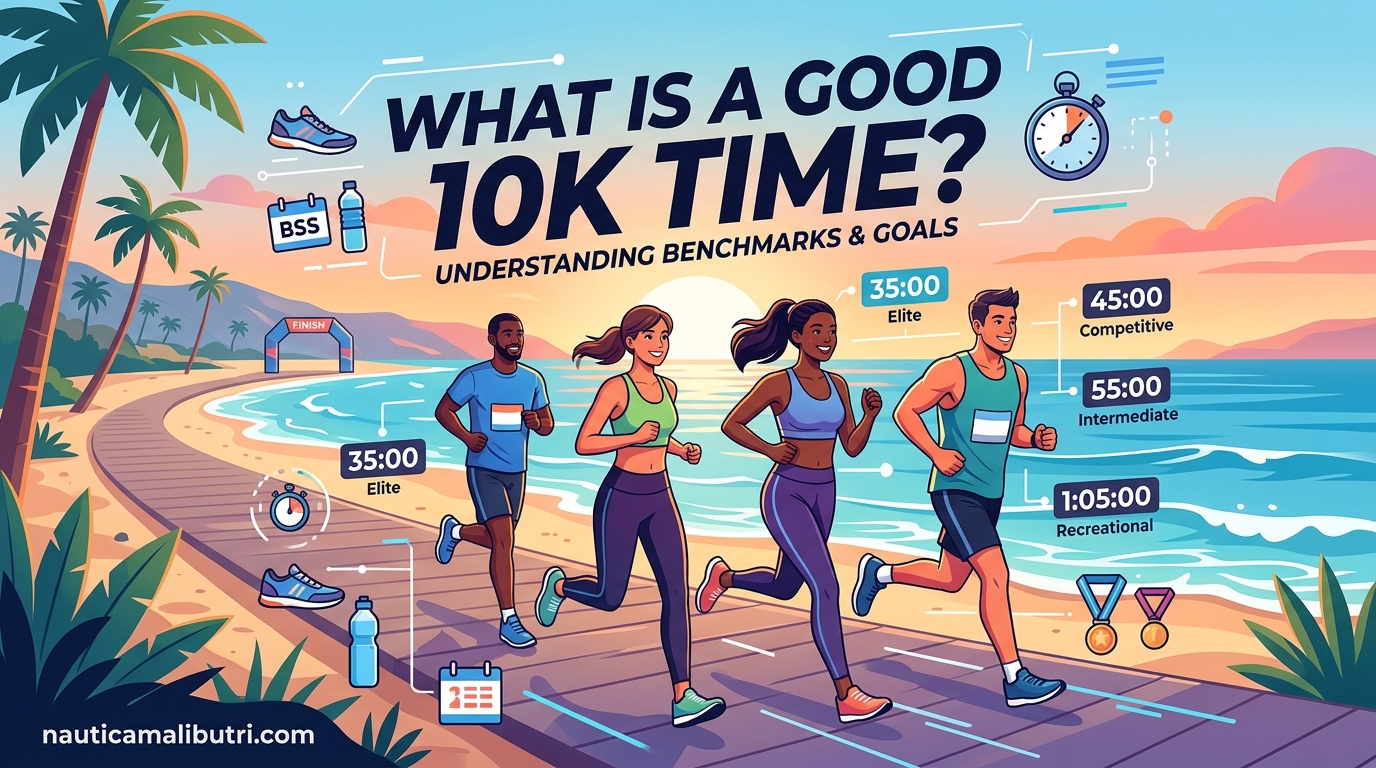
You have been training for weeks, building up your mileage, and finally completed your first 10K race. You cross the finish line, catch your breath, and immediately wonder: was my time any good? This question hits nearly every runner after their first 6.2-mile effort. Whether you finished in 50 minutes or 75 minutes, understanding what is a good 10k time can help you set realistic goals and appreciate your progress in 2026.
In this guide, I will break down the numbers that matter. We will look at average times by age and gender, explain the different ability levels from beginner to elite, and cover what makes a 10K time truly respectable. Our team has analyzed data from thousands of race finishers to give you benchmarks that actually mean something for real runners.
Because this is Nautica Malibu Triathlon, we will also explore how 10K performance fits into triathlon racing. The 10K run is the final leg of an Olympic-distance triathlon, and finishing strong after swimming and biking requires a different approach than a standalone road race.
Table of Contents
The Quick Answer: What is a Good 10K Time?
A good 10K time for most recreational runners falls between 50 and 70 minutes. This range represents solid fitness for the 6.2-mile distance without requiring elite-level training. Breaking it down further:
- Sub-50 minutes: Competitive amateur level, placing you in the top 25% of most local races
- 50-60 minutes: Respectable recreational runner, a common goal for intermediate athletes
- 60-70 minutes: Solid beginner to novice level, a realistic first-race target
- 70-80 minutes: True beginner territory, completing the distance is the achievement
These benchmarks come from analyzing tens of thousands of race finishers across age groups. The running community widely accepts sub-60 minutes as the first major milestone worth celebrating. Reddit runners often call this the “real runner” threshold because it requires consistent training beyond casual jogging.
Average 10K Times by Age and Gender
Age and gender significantly impact what constitutes a good 10K time. Biological factors like muscle mass, aerobic capacity, and recovery speed create natural differences. Age-group racing categories exist because a 45-year-old finishing in 52 minutes has achieved something very different from a 25-year-old with the same clock time.
Below are typical finish times for recreational runners by age group. These figures represent averages across all finishers, not elite performances:
Average Male 10K Times by Age
| Age Group | Average Time | Pace per Mile | Pace per KM |
|---|---|---|---|
| 20-29 | 52:00 | 8:22 | 5:12 |
| 30-39 | 54:00 | 8:42 | 5:24 |
| 40-49 | 57:00 | 9:11 | 5:42 |
| 50-59 | 62:00 | 9:59 | 6:12 |
| 60-69 | 70:00 | 11:16 | 7:00 |
Average Female 10K Times by Age
| Age Group | Average Time | Pace per Mile | Pace per KM |
|---|---|---|---|
| 20-29 | 58:00 | 9:20 | 5:48 |
| 30-39 | 60:00 | 9:39 | 6:00 |
| 40-49 | 64:00 | 10:18 | 6:24 |
| 50-59 | 70:00 | 11:16 | 7:00 |
| 60-69 | 78:00 | 12:34 | 7:48 |
Age-graded scoring allows fair comparison across age groups. A 55-year-old male running 50 minutes achieves roughly the same age-graded percentage as a 30-year-old running 42 minutes. Both represent strong performances relative to their biological peers. Triathlon age-group awards use similar calculations to ensure fair competition.
Understanding Running Ability Levels
Running ability exists on a spectrum, and understanding where you fit helps set appropriate goals. The VDOT system, developed by running coach Jack Daniels, provides a scientific framework connecting race times to fitness levels. Your VDOT score estimates your VO2 max and helps predict equivalent performances across distances.
Here is how 10K times map to common ability categories:
| Ability Level | Male Time Range | Female Time Range | Description |
|---|---|---|---|
| Beginner | 65-80+ minutes | 70-85+ minutes | New to running, building base fitness |
| Novice | 55-65 minutes | 60-70 minutes | Runs consistently, completed several races |
| Intermediate | 45-55 minutes | 50-60 minutes | Structured training, competitive locally |
| Advanced | 38-45 minutes | 42-50 minutes | Serious training, age-group podium potential |
| Elite | Under 30 minutes | Under 34 minutes | Professional or sub-elite competitor |
These categories help contextualize your performance. A 48-minute 10K places a 40-year-old male in intermediate territory, a solid achievement requiring regular training. The same time for a 25-year-old female also represents intermediate fitness, though closer to the advanced threshold.
Most recreational runners fall between novice and intermediate. Moving between levels typically requires months or years of progressive training. Jumping from novice to intermediate usually demands adding structured workouts like tempo runs and interval sessions to your routine.
What is a Good 10K Time for Beginners?
Beginners should focus on finishing, not speed. A good 10K time for your first attempt is any time that gets you across the finish line running. That said, having a realistic target helps with pacing and mental preparation.
For true beginners with 8-12 weeks of training, expect to finish between 65 and 75 minutes. This translates to roughly 10:30 to 12:00 per mile pace. If you have been walking regularly and add run-walk intervals, sub-70 minutes is absolutely achievable.
Your first 10K goal should be finishing without walking. Your second 10K goal can be sub-60 minutes. This progression builds confidence and prevents injury from doing too much too soon. Forum discussions reveal that many beginners feel intimidated by fast times they see online. Remember that social media and race results highlight faster runners while thousands of back-of-the-pack finishers complete successfully too.
After completing your first 10K, a sub-60 minute attempt makes an excellent next target. This requires roughly 9:40 per mile pace, achievable for most healthy adults with 3-4 months of consistent training. Breaking the hour barrier represents the transition from beginner to novice in most classification systems.
10K Times in Triathlon Racing
The 10K run takes on special significance in triathlon, particularly Olympic-distance events. After a 1.5K swim and 40K bike, your legs feel very different than at the start of a standalone road race. This triathlon context changes what constitutes a good 10K time.
In draft-legal triathlons, athletes can bike in packs and enter the run with fresher legs. Non-draft legal races require solo cycling effort, leaving more fatigue for the run leg. A 45-minute standalone 10K runner might run 48-52 minutes in a non-draft triathlon. Brick workouts, where you run immediately after biking, prepare your body for this unique sensation.
Transition Two (T2) adds another variable. Fumbling with bike shoes, finding run shoes, and getting your bearings takes time. Elite triathletes complete T2 in 30-40 seconds. Age-groupers often need 90 seconds to 2 minutes. This affects your overall run split timing.
Strong bike fitness actually helps 10K run performance in triathlon. Higher FTP and cycling efficiency mean less relative effort during the bike leg, preserving run muscles. Many triathletes discover their 10K times improve within a season even without specific run training because swim and bike fitness raises their aerobic ceiling.
At the Nautica Malibu Triathlon, the 10K run course presents its own challenges. Understanding the terrain helps set realistic expectations for your triathlon 10K split compared to a flat road race.
How to Improve Your 10K Time
Improving your 10K requires specific training beyond casual jogging. Whether you want to break 60 minutes, 50 minutes, or 40 minutes, structured workouts make the difference.
Build Your Aerobic Base
Most of your running should feel conversational. Easy runs build capillary density, mitochondrial efficiency, and aerobic capacity. Aim for 3-5 easy runs per week totaling 15-25 miles for beginners, 25-40 miles for intermediates. These sessions should feel relaxed, allowing you to speak in full sentences.
Add Threshold Training
Tempo runs at threshold pace improve your ability to process lactate. Threshold roughly corresponds to the fastest pace you could sustain for one hour. For many recreational runners, this falls between 10K and half marathon pace. Try 20-30 minutes at threshold, or broken into intervals like 3 x 10 minutes with 2-minute recovery.
Include Interval Sessions
Interval training at 5K pace or faster improves VO2 max and running economy. Sample workouts include 6 x 800 meters at 5K race pace with equal time recovery, or 4 x 1 mile at 10K pace with 90-second rest. These hard efforts should total 10-15% of your weekly mileage.
Practice Race Pacing
Negative splitting, running the second half faster than the first, produces optimal 10K results. Most beginners start too fast and fade. Practice this during training by beginning runs conservatively and gradually increasing effort. Aim to run your first mile 10-15 seconds slower than goal pace.
Strength Training and Recovery
Two strength sessions weekly improve running economy and injury resistance. Focus on single-leg exercises like lunges, step-ups, and single-leg deadlifts. Sleep 7-9 hours nightly and schedule rest days. Improvement happens during recovery, not just during workouts.
10K World Records and Elite Benchmarks
Understanding elite performances provides perspective on recreational benchmarks. The current world records stand as remarkable achievements of human physiology:
- Men: 26:11, set by Joshua Cheptegei in 2020 (4:12 per mile pace)
- Women: 29:01, set by Agnes Tirop in 2021 (4:40 per mile pace)
These times represent the absolute limits of human performance, requiring genetic gifts and professional training from childhood. Elite recreational runners, those winning local races, typically run 32-38 minutes for men and 36-42 minutes for women.
The gap between elite and recreational should inspire rather than discourage. A 50-minute 10K is 24 minutes slower than the world record, yet represents strong fitness that only a small percentage of the general population achieves. Focus on your personal progress rather than comparisons to professionals.
Frequently Asked Questions
What is a respectable time for a 10K?
A respectable 10K time is generally between 50 and 70 minutes for recreational runners. Sub-60 minutes is widely considered a solid achievement worth celebrating, while sub-50 minutes places you in competitive amateur territory. What matters most is the effort relative to your training background and age.
Is 10K in 60 minutes good?
Yes, 60 minutes is a good 10K time for most recreational runners. Breaking the hour barrier represents the transition from beginner to intermediate level. It requires roughly 9:40 per mile pace and consistent training over several months. Many runners celebrate sub-60 as their first major milestone.
What is a good 10K time for a beginner?
For beginners, a good 10K time ranges from 65 to 75 minutes. First-time racers should focus on finishing rather than speed. With 8-12 weeks of training, most healthy adults can complete a 10K between 70 and 80 minutes. Any finish is an achievement for your first attempt.
Is a 1 hour 10K bad?
No, a 1-hour 10K is not bad at all. This represents a solid recreational running level that requires consistent training. It places you faster than many age-group finishers in local races. For beginners, breaking 60 minutes is a major milestone. For intermediate runners, it is a respectable maintenance level.
What is a good 10km time by age?
Good 10K times vary significantly by age. For men 20-29, sub-50 minutes is strong. For men 50-59, sub-60 minutes represents solid fitness. Women 20-29 achieve good times around 55 minutes, while women 50-59 around 65 minutes shows strong performance. Age-graded calculators help compare fairly across age groups.
How long does a beginner take to run a 10K?
Most beginners complete a 10K between 65 and 80 minutes. With dedicated training over 8-12 weeks, sub-70 minutes becomes achievable. Run-walk strategies can help complete the distance for those newer to running. Focus on finishing comfortably before targeting specific time goals.
Is 2 hours good for a 10K?
Two hours for a 10K means averaging roughly 19 minutes per mile, which is walking pace. While completing any distance is an achievement, 2 hours suggests either walking the entire course or taking extended breaks. Most healthy adults can train to run or run-walk a 10K in under 90 minutes with consistent effort.
How does triathlon affect 10K time?
Triathlon 10K times are typically 5-15% slower than standalone road race times due to swim and bike fatigue. Non-draft legal races show larger impacts than draft-legal events. Brick training helps prepare your legs for the unique sensation of running off the bike. Strong cycling fitness actually aids run performance by preserving energy.
Final Thoughts
So what is a good 10k time? For most recreational runners in 2026, finishing between 50 and 70 minutes represents a solid achievement. Sub-60 minutes marks the threshold from beginner to intermediate. Sub-50 minutes signals competitive fitness. World records remind us of human potential, but your personal progress matters more than comparisons.
Age, gender, training background, and whether you are racing standalone or within a triathlon all affect benchmarks. The tables and guidelines in this article give you realistic targets based on real data from thousands of finishers.
If you are preparing for the Nautica Malibu Triathlon, your 10K training should include brick workouts to prepare for the bike-to-run transition. Remember that swimming and cycling fitness contribute to your run performance in ways that pure runners do not experience.
Whatever your current level, consistency beats intensity. Three runs per week for six months will transform your 10K time more than any single heroic workout. Set your next goal, follow a structured plan, and trust the process. The finish line will be waiting.