
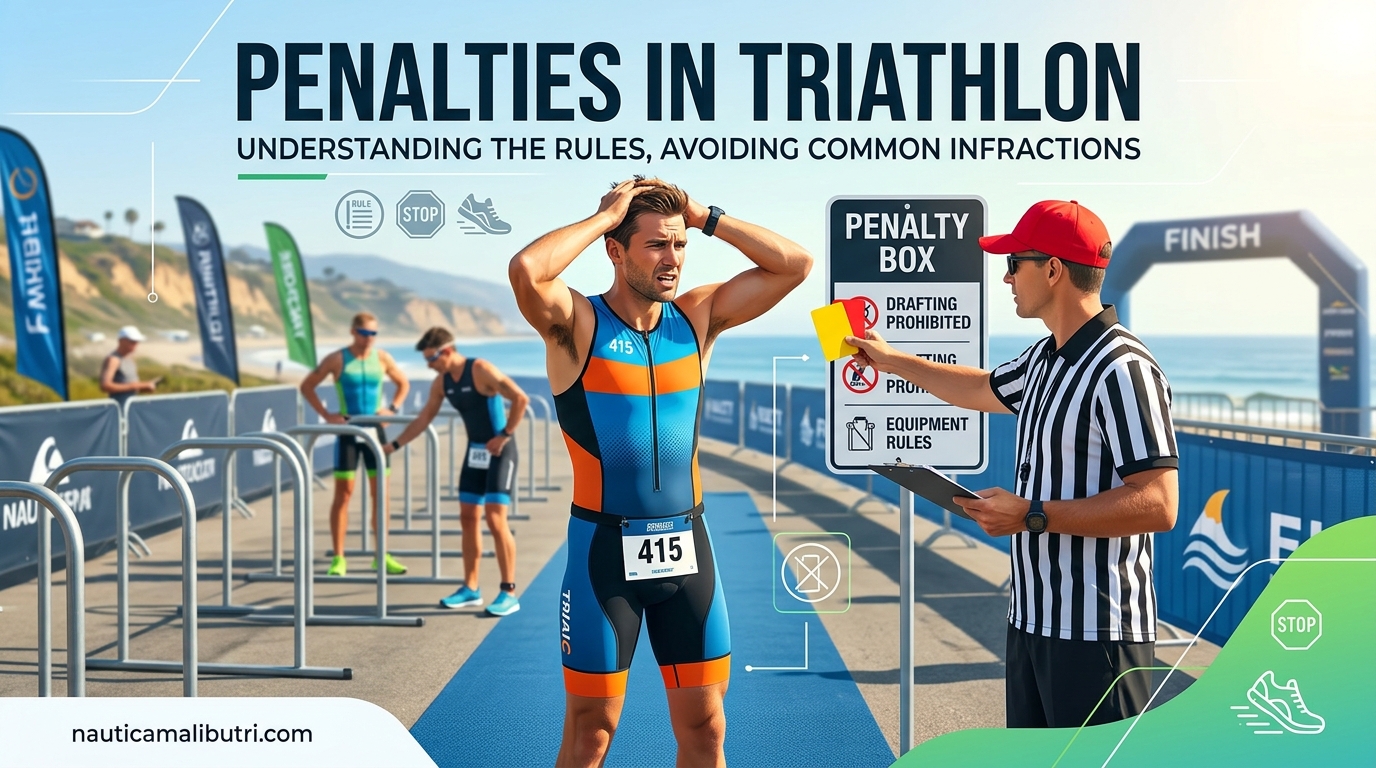
Understanding penalties in triathlon is essential for every athlete stepping up to the starting line. Whether you’re racing your first sprint or your tenth Ironman, knowing the rules can save you from costly time penalties or disqualification. Most violations are completely avoidable with the right preparation and awareness.
Triathlon penalties are enforced under the competitive rules set by USA Triathlon (USAT) and other governing bodies. These rules exist to ensure fair competition and athlete safety across all race distances. This guide has been compiled from official rulebooks, race official feedback, and real athlete experiences to help you race clean and smart.
Table of Contents
How Do You Get a Penalty in Triathlon?
You receive a penalty in triathlon when referees observe you violating specific competitive rules during the race. Officials are stationed throughout the course, particularly at key areas like mount/dismount lines, transition zones, and along the bike course. They assess violations using a card system and can issue verbal warnings, time penalties, or disqualification depending on the severity of the infraction.
Time penalties require you to stop at a designated penalty box on the course. You must serve the full time before continuing, or you risk disqualification. The most common penalties relate to helmet violations, drafting, blocking, transition area rules, and littering.
The Penalty Card System Explained
Triathlon officials use a color-coded card system to communicate penalties quickly and clearly during a race. Understanding what each card means helps you respond appropriately when signaled.
Yellow cards indicate technical violations. These include minor infractions like helmet strap issues or improper gear placement in transition. A yellow card typically results in a stop-and-go penalty, requiring you to stop briefly at the next penalty box before continuing.
Blue cards are issued for drafting violations in non-draft legal events. Drafting means riding too closely behind another athlete to gain an aerodynamic advantage. When you receive a blue card, you must serve a variable time penalty at the next penalty box – usually 2 minutes for sprint and Olympic distances, or 5 minutes for half and full Ironman races.
Red cards mean immediate disqualification. Serious offenses like dangerous riding, repeated violations after warnings, or unsportsmanlike conduct can result in a red card. If you receive a red card, you must exit the course immediately and will be listed as disqualified (DQ) in the results.
Helmet Rules and Penalties
Helmet violations are the most common penalty we see among beginner triathletes. The rules are strict and apply from the moment you enter transition to rack your bike until the moment you leave transition after the bike leg.
Your helmet must be CPSC approved and properly buckled before you touch your bike. This means the chin strap must be fastened securely before you unrack your bike in T1. Many athletes get penalized for unbuckling their helmet too early after returning to transition in T2. Keep your helmet on and buckled until your bike is racked back on its spot.
A helmet violation typically results in a variable time penalty. For sprint and Olympic distance races, expect a 2-minute penalty. For 70.3 and full Ironman events, the penalty increases to 5 minutes. In some cases, particularly egregious violations or repeated offenses can result in disqualification.
Drafting Rules and Penalties
Drafting penalties are the most controversial and frequently discussed among age-group triathletes. In non-draft legal races, you must maintain adequate distance from the bike in front of you to avoid gaining an unfair aerodynamic advantage.
The draft zone extends 22 feet behind each bicycle – approximately three bike lengths. When you enter this zone while traveling at a faster speed, you have 15 seconds to complete your pass. If you fail to pass within 15 seconds, you must drop back outside the draft zone before attempting another pass. You cannot maintain position inside the draft zone while matching the speed of the rider ahead.
If you are overtaken by another rider, you must immediately drop back out of their draft zone. You cannot intentionally stay in front of someone who has passed you. Getting a blue card for drafting means serving time in the penalty box. The time penalty varies by race distance: 2 minutes for sprint and Olympic, 5 minutes for 70.3 and full Ironman events.
Blocking Rules
Blocking occurs when you impede the forward progress of another athlete. In triathlon, you must ride on the right side of the road and only move left to pass. Riding on the left side when not actively passing, or failing to move right after completing a pass, constitutes blocking.
This rule creates particular anxiety for slower cyclists who worry about being passed constantly by faster athletes. The key is staying aware of your surroundings. Check behind you periodically, and always be ready to move right when you hear “on your left” from a passing rider. If you drift left while being overtaken, you may receive a blocking penalty.
Blocking penalties are typically issued as yellow cards or blue cards depending on severity. Repeated blocking after warnings can escalate to disqualification. Practice riding a straight line in training, and always err on the side of staying far right.
Transition Area Rules
The transition area has its own set of rules designed to ensure safety and fairness. All gear must remain within the boundaries of your designated space. Spreading equipment into neighboring areas or into the aisle can result in a penalty.
When racking your bike, the front wheel must be down in the rack. Some races allow rear-wheel or seat racking, but never assume – check the specific race rules in your athlete guide. Outside assistance is strictly prohibited in transition. No friends, family, or spectators can help you with gear, nutrition, or equipment. Race officials and designated volunteers are the only people allowed to assist athletes.
Mount and dismount lines must be respected. You cannot mount your bike until you cross the designated mount line exiting T1. You must dismount before the line when entering T2. Crossing these lines while mounted on your bike is an immediate penalty.
Other Common Rule Violations
Beyond the big five violations, several other rules can trip up unprepared athletes. Littering and abandonment of equipment carry penalties in most races. You cannot discard anything – gel wrappers, empty bottles, flat tubes – outside designated aid stations or trash zones. Plan to carry trash with you until the next aid station.
Headphones and earbuds are prohibited during the bike and run portions of every USAT-sanctioned race. This includes bone-conduction headphones. The rule exists for safety – you must be able to hear instructions from officials, traffic, and other athletes. Race numbers must remain visible at all times during the run leg. Some races require numbers on the front, others on the back – check your athlete guide.
Unsportsmanlike conduct covers behavior that brings the sport into disrepute. This includes verbal abuse of officials, intentional interference with other athletes, or dangerous riding. These violations can result in immediate disqualification.
Variable Time Penalties by Race Distance
Time penalties vary depending on the race distance and the severity of the violation. Understanding these differences helps you gauge the impact a penalty might have on your race result.
For sprint and Olympic distance triathlons, most technical violations carry a 2-minute penalty. This includes helmet infractions, transition area violations, and minor drafting offenses. In 70.3 and full Ironman events, these same violations typically result in a 5-minute penalty.
Some violations carry fixed penalties regardless of distance. Serious drafting offenses, blocking, and equipment abandonment may result in immediate disqualification at any race distance. Check your specific race’s athlete guide for any variations from standard USAT rules.
How to Handle a Penalty During Your Race
Receiving a penalty during your race can be emotionally devastating, especially if you have trained for months. The key is maintaining composure and following proper procedure to minimize the impact on your race.
When an official shows you a card, acknowledge it and begin looking for the next penalty box. Arguing with officials during a race never works and can escalate your penalty. Once you reach the penalty box, stop completely and inform the volunteer which violation you committed. The volunteer will time your penalty and signal when you can resume.
Never leave a penalty box early. Exiting before your time is complete results in immediate disqualification. Use the penalty time to hydrate, eat a gel, and mentally reset. Many athletes have still achieved personal best times despite serving a penalty. Your race is not over until you cross the finish line.
How to Avoid Penalties in Triathlon
The best way to handle penalties is to avoid them entirely. A few simple habits before and during your race can keep you penalty-free and focused on performance.
Before race day, review the athlete guide carefully. Rules vary between races, particularly regarding draft zones, helmet requirements, and transition procedures. Arrive early to walk through transition and identify the mount/dismount lines, penalty box locations, and your exact rack position.
During the race, stay alert and aware of your surroundings. Check behind you frequently on the bike course. Keep right except when passing. Never unbuckle your helmet until your bike is fully racked. Carry all trash until the next aid station. When in doubt, give other athletes more space rather than less.
Practice these habits in training. Set up mock transitions during brick workouts. Train on open roads where you can practice holding a straight line and staying right. The more familiar these behaviors become, the less likely you are to violate rules on race day.
How do you get a penalty in triathlon?
You get a penalty when race officials observe you violating competitive rules. Common violations include helmet infractions (unbuckled strap), drafting too closely behind another rider in non-draft legal events, blocking faster athletes by riding on the left side, littering outside aid stations, and receiving outside assistance. Penalties range from verbal warnings to time penalties served at penalty boxes to disqualification for serious or repeated offenses.
What is a blue card in triathlon?
A blue card in triathlon indicates a drafting violation in non-draft legal races. When you receive a blue card, you must serve a variable time penalty at the next penalty box – typically 2 minutes for sprint and Olympic distances, or 5 minutes for half and full Ironman events. Drafting occurs when you ride within 22 feet (three bike lengths) behind another athlete for more than 15 seconds without completing a pass.
What is a yellow card in triathlon?
A yellow card represents a technical violation in triathlon. These are issued for minor infractions such as helmet strap issues, improper gear placement in transition, or failing to rack your bike correctly. A yellow card typically results in a stop-and-go penalty where you must briefly stop at the next penalty box before continuing your race.
How long is a triathlon penalty?
Triathlon penalties vary by race distance and violation type. For sprint and Olympic distance races, most time penalties are 2 minutes. For 70.3 and full Ironman events, standard penalties increase to 5 minutes. Stop-and-go penalties (yellow card) require only a brief stop. Serious violations can result in disqualification with no time penalty option.
Can you get a penalty in the transition area?
Yes, transition area violations are common penalties. You can be penalized for improper bike racking (front wheel must be down), gear extending beyond your designated space, outside assistance from non-officials, mounting before the mount line, or dismounting after the dismount line. These typically result in 2-5 minute time penalties depending on race distance.
What is the 80/20 rule in triathlon?
The 80/20 rule in triathlon refers to training methodology, not racing penalties. It suggests athletes should spend 80% of their training time at low intensity and 20% at moderate to high intensity. This approach maximizes fitness gains while minimizing injury risk and burnout. The rule was popularized by coach Matt Fitzgerald and applies to all three disciplines.
What are the 4 disciplines of a triathlon?
A triathlon consists of three sequential disciplines: swimming, cycling, and running. The fourth element often referenced is the transition between sports – T1 (swim-to-bike) and T2 (bike-to-run). While transitions are not officially a separate discipline, they are timed portions of the race where specific rules apply regarding equipment, mounting, and gear placement.
What happens if you get a penalty in an Ironman race?
In Ironman races, most penalties require serving 5 minutes in a designated penalty box. Officials will show you a card indicating the violation. You must proceed directly to the next penalty box, inform the volunteer of your violation, and wait for the full 5 minutes. Leaving early results in disqualification. Multiple penalties can accumulate, and serious violations may result in immediate disqualification without a time penalty option.
Understanding penalties in triathlon helps you race with confidence and avoid costly mistakes. Most violations fall into five categories: helmets, drafting, blocking, transition rules, and littering. Each is preventable with proper knowledge and preparation.
Remember that race officials want to see fair competition, not hand out penalties. They will often give verbal warnings for minor infractions before issuing cards. Stay alert, follow the rules, and focus on your performance. With these guidelines in mind, you can approach your next triathlon knowing exactly what to do – and what not to do – on race day.