
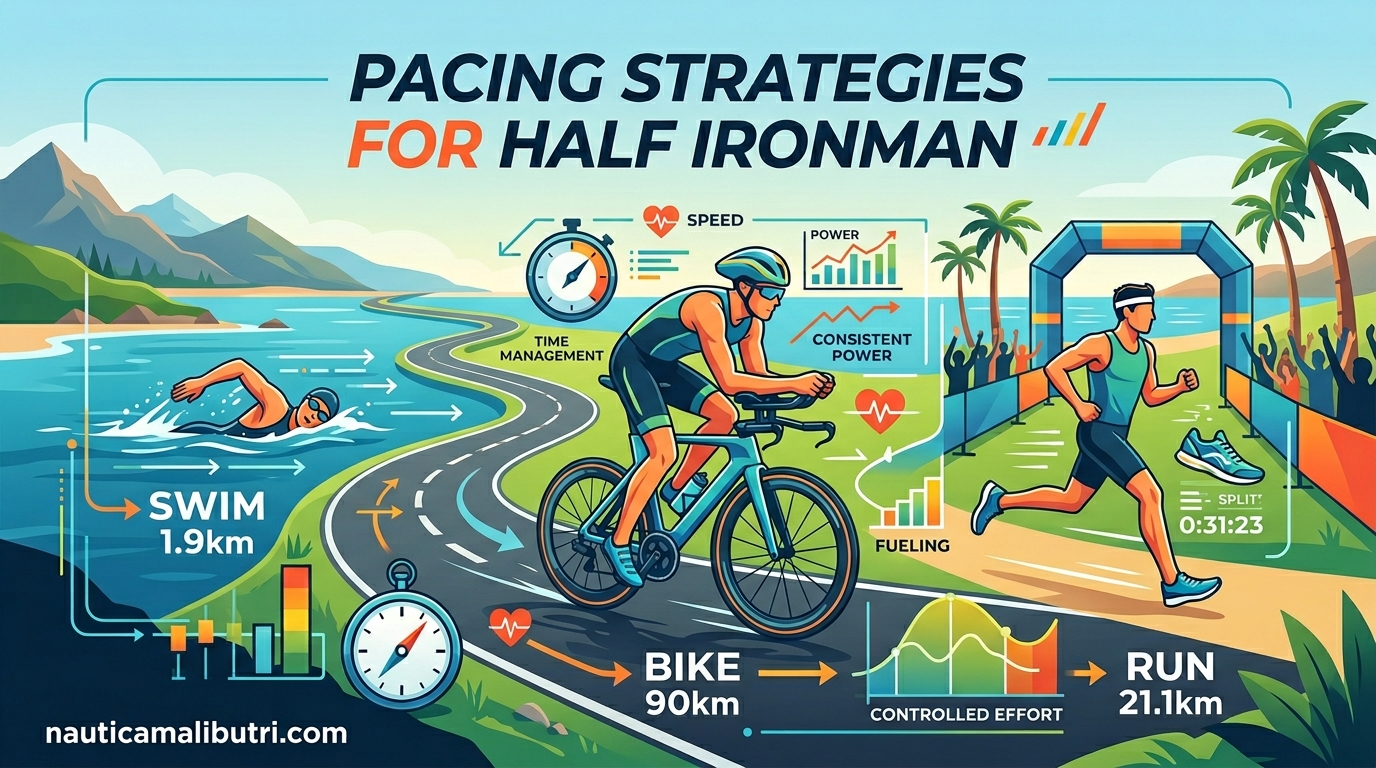
Mastering pacing strategies for half Ironman races is the single most important skill that separates successful finishers from those who struggle. After coaching hundreds of athletes through their first 70.3 events, I have seen the same pattern repeat itself: the athletes who nail their pacing cross the finish line strong, while those who ignore it end up walking the final miles.
A half Ironman (70.3) consists of a 1.2-mile swim, 56-mile bike, and 13.1-mile run. That is roughly 4 to 7 hours of continuous effort, and how you distribute your energy across those three disciplines determines everything. This guide will walk you through evidence-based pacing strategies for each leg, including specific FTP percentages, heart rate zones, and RPE targets based on your race time goals.
Whether you are targeting a sub-5 hour finish or simply want to complete your first half Ironman without blowing up, these pacing strategies will help you race smarter and finish stronger.
Table of Contents
Understanding Pacing Strategies for Half Ironman
Before diving into specific targets, let us clarify what proper half Ironman pacing actually means. It is not about holding back so much that you finish feeling fresh. It is about distributing your effort optimally so you can maintain consistent performance across all three legs.
What Is Half Ironman Pacing?
Half Ironman pacing is the strategic management of effort across the 1.2-mile swim, 56-mile bike, and 13.1-mile run to optimize your overall race performance. Unlike a sprint or Olympic distance triathlon where you can push hard and recover quickly, a 70.3 requires sustained aerobic effort for several hours.
The bike leg is particularly critical because it directly affects your run performance. Go too hard on the bike, and you will pay dearly during those final 13.1 miles. Go too easy, and you leave precious minutes on the table. Finding that sweet spot is the art of half Ironman pacing.
Why Pacing Matters in 70.3 Racing
Pacing matters because the consequences of getting it wrong are severe and immediate. The bike leg is where most athletes make their biggest mistakes. I have heard countless stories from our community about athletes who felt incredible on the bike, only to suffer through a run that took twice as long as planned.
Proper pacing prevents premature fatigue, allows for a stronger run finish, and ensures you do not blow up mid-race by going out too hard. First-time 70.3 athletes and competitive age-groupers seeking personal bests both benefit from structured pacing strategies.
How to Pace Your Half Ironman Swim
The swim is the shortest leg of a half Ironman, but poor pacing here can still ruin your race before you even reach T1. Adrenaline and race-day excitement push most athletes to start too fast, which leads to breathlessness, panic, and wasted energy.
Start conservative. Your legs will feel fresh, the water temperature will spike your heart rate, and the crowd around you will create artificial urgency. Ignore all of it. The first 500 yards should feel almost too easy. You should be able to breathe comfortably and maintain your form.
Target an RPE (Rate of Perceived Exertion) of 6 to 8 out of 10 for the swim leg. This translates to a sustainable effort where you can still think clearly and maintain good stroke mechanics. If you are gasping for breath or feeling your heart pound in your chest, you are going too hard.
For athletes training with critical swim speed (CSS), aim to swim at or slightly below your CSS pace. This is approximately the pace you could hold for a 1500-meter time trial. Drafting behind slightly faster swimmers can save you significant energy, but do not surge to catch a draft that is too far ahead.
First-time half Ironman athletes should prioritize finishing the swim relaxed over swimming fast. A 2-minute slower swim with controlled breathing beats a frantic sprint that leaves you exhausted for the bike and run.
Transition 1: Setting Up for a Strong Bike Leg
T1 is not a place to make up time, but it is a place to set yourself up for success. After exiting the water, focus on controlled movement rather than rushing. Your heart rate will be elevated from the swim, and frantic movements will spike it further.
Have your bike gear organized and ready. Know exactly what you need to put on and in what order. Practice your T1 routine in training so it becomes automatic. The goal is smooth efficiency, not speed records.
Take an extra 30 seconds in T1 if needed to ensure you have your nutrition accessible and your bike computer is reading properly. These small investments pay dividends over the next 56 miles.
Half Ironman Bike Pacing Strategy
The bike leg is where races are won and lost. How you pace those 56 miles determines whether you run strong or shuffle through the half marathon. This section covers the specific targets you need to hit.
FTP Percentages for Half Ironman Pacing
Your Functional Threshold Power (FTP) is the maximum power you can hold for roughly one hour. For half Ironman pacing, you will ride at a percentage of this number. The exact percentage depends on your race time goal and experience level.
Faster, more experienced athletes can sustain higher percentages of FTP because their aerobic fitness allows them to recover more quickly and manage the metabolic cost of the effort. Slower athletes need to be more conservative to avoid depleting their glycogen stores before the run.
Slower athletes should generally aim for 77 to 80% of FTP. This conservative approach preserves energy for the run and accounts for the longer time spent on the bike. Faster athletes targeting sub-5 hour finishes can push 80 to 85% of FTP.
Power, Heart Rate, and RPE Targets by Race Time
Not everyone has a power meter, so here are targets using three different measurement methods organized by your goal finish time:
Sub-5 Hour Finish (Fast Age Groupers):
- Power: 80-85% of FTP
- Heart Rate: 85-90% of threshold heart rate
- RPE: 7-8 out of 10
5 to 6 Hour Finish (Mid-Pack Athletes):
- Power: 78-82% of FTP
- Heart Rate: 82-87% of threshold heart rate
- RPE: 6-7 out of 10
6 to 8 Hour Finish (First-Timers and Slower Athletes):
- Power: 75-80% of FTP
- Heart Rate: 80-85% of threshold heart rate
- RPE: 5-6 out of 10
If you are using a power meter, pay attention to Normalized Power (NP) rather than average power. NP accounts for variations in effort and gives you a better representation of the metabolic cost of your ride. Your NP should fall within the targets above.
Variability Index (VI) measures how smooth your power output is. Aim for a VI under 1.05, which means you are riding relatively steady without constant surges. Surges spike your metabolic cost and deplete glycogen faster than steady riding.
Hilly Course Pacing Adjustments
Hilly courses require a different approach than flat ones. The key principle is to go slightly easier uphill and slightly harder downhill while keeping your overall effort consistent.
On climbs, shift to an easier gear and maintain your cadence. Your power may dip slightly, and that is okay. Standing and hammering up hills spikes your heart rate and burns matches you need for the run. Stay seated when possible and spin.
On descents, pedal if it is safe to do so, but do not hammer. Use gravity to your advantage without digging too deep. The goal is consistent overall effort, not consistent speed.
For rolling courses, anticipate hills by shifting early and carrying momentum over the crests. Avoid the common mistake of attacking every roller. Those small efforts add up over 56 miles.
Transition 2: Preparing for the Run
T2 is your opportunity to reset and prepare for the run leg. After dismounting your bike, take a moment to find your rhythm before rushing to your transition spot.
Put on your run gear methodically. Check that your shoes are comfortable and any nutrition for the run is easily accessible. Like T1, efficiency trumps raw speed here.
As you exit T2, resist the urge to sprint. Your legs will feel strange after 56 miles of cycling, and they need a few minutes to adapt to running. Start with a deliberately slow jog and gradually build into your target pace.
How to Pace Your Half Ironman Run
The run leg is where your bike pacing either pays off or comes back to haunt you. After 3 to 5 hours of racing, your body is depleted, your muscles are fatigued, and your mental reserves are low. Proper run pacing is essential.
The First 15 Minutes Rule
Here is the most important tip I can give you for half Ironman run pacing: ignore how your legs feel for the first 15 minutes. If they feel amazing and you want to run fast, resist that urge completely. If they feel terrible and heavy, that is normal and will pass.
Those first 15 minutes off the bike are deceptive. Fresh legs after a well-paced bike will tempt you to surge. Heavy legs from a hard bike will make you panic. Neither reaction is accurate. Set a conservative pace and stick to it regardless of how you feel.
Building Into the Run
Start the run at an RPE of 5 to 6 out of 10. This should feel almost embarrassingly easy. After the first mile, assess how you feel and increase slightly if you are comfortable. The goal is a negative split, running the second half faster than the first.
For heart rate targets, aim for 80 to 85% of your threshold heart rate for the first half of the run. Save the higher intensities for the final 5 kilometers when you can afford to empty the tank.
Cardiac drift is real over 13.1 miles. Your heart rate will gradually increase even if you maintain the same pace. Do not chase your initial heart rate targets by slowing down. Accept the drift and focus on maintaining consistent effort.
The Final 5K Push
With 5 kilometers to go, you can finally increase the effort. If you paced the bike and early run correctly, you should have energy reserves to finish strong. Increase your pace and RPE to 7 to 8 out of 10.
Passing struggling athletes in the final miles is one of the best feelings in triathlon. That satisfaction comes from disciplined pacing earlier in the race. Save something for this final push and finish with your head held high.
Mental Pacing Strategies for Race Day
Pacing is not just physical; it is deeply mental. The discipline to hold back when you feel good and the patience to wait when you feel bad are skills that take practice.
Develop mantras for race day. Simple phrases like “patience pays” or “run the mile you are in” help keep your mind focused on the present rather than fantasizing about the finish or worrying about the remaining distance.
Break the race into segments mentally. Do not think about the entire 70.3 distance. Focus on swimming to the first buoy. Then focus on cycling to the 20-mile mark. Then focus on running to the 5-mile aid station. Small, manageable chunks prevent overwhelm.
When you feel the urge to surge, ask yourself if you can hold this effort for the remaining distance. If the answer is no, back off. If the answer is maybe, back off anyway. Racing at the edge of your ability is a recipe for blow-ups.
Race Day Pacing Tips for Your First Half Ironman
Your first half Ironman is a learning experience. These tips will help you apply the pacing strategies we have covered when race day arrives.
Pre-Race Pacing Plan
Write down your target numbers before race day. Know your FTP percentage, heart rate zones, and target paces for each leg. Review these numbers the morning of the race. Having a clear plan prevents emotional decision-making mid-race.
Set alerts on your bike computer and watch. Power caps, heart rate ceilings, and pace floors keep you honest when fatigue clouds your judgment.
Adjusting Pacing Mid-Race
Sometimes conditions force you to adjust. Heat, wind, and hills all affect your ability to hold target numbers. Here is how to adapt:
If temperatures soar above 75 degrees Fahrenheit, drop your targets by 5%. Heat stress raises your heart rate and dehydrates you faster. It is better to back off early than to overheat and DNF.
If you are struggling to hold your targets despite good conditions, you may have overestimated your fitness. Better to adjust down and finish than to stubbornly stick to unrealistic numbers and blow up.
Heat and Weather Considerations
Hot weather is the great equalizer in half Ironman racing. Even elite athletes slow down when temperatures rise. Your pacing strategy must account for heat stress.
Pre-cool before the swim if possible. Stay in the shade. Dump water on yourself at every aid station during the bike and run. These cooling strategies allow you to maintain closer to target pace despite the heat.
Nutrition timing integrates with pacing in the heat. You need more fluids and electrolytes, which means more time at aid stations. Plan for slightly slower splits in hot conditions.
Common Pacing Mistakes to Avoid
Learning from others’ mistakes is cheaper than making them yourself. Here are the most common pacing errors I see in half Ironman racing:
Starting the swim too hard: Adrenaline makes the first 500 yards feel effortless. By the time you realize you are going too hard, you are already burning matches. Start conservative and build.
Hammering the bike: This is the big one. You feel great on the bike, the wind is in your face, and your power numbers look good. But 56 miles at 85% FTP is very different from 56 miles at 75% FTP when you still have a half marathon to run. Trust your targets.
Starting the run too fast: Fresh legs off a well-paced bike tempt you to run fast. Resist. The first 15 minutes are a trap. Start slow and build.
Not adjusting for conditions: Ignoring heat, wind, and hills because you are attached to your target splits is a recipe for disaster. Be flexible and adjust based on reality, not plans made weeks ago.
Frequently Asked Questions
What percentage of FTP should I use for half Ironman pacing?
Most athletes should aim for 75-85% of FTP depending on their race time goal. Slower athletes targeting 6-8 hour finishes should stay at 75-80% FTP, while faster athletes going sub-5 hours can sustain 80-85% FTP. First-timers should err on the conservative side.
How do I pace my first half Ironman?
For your first 70.3, start conservative on all three legs. Swim at RPE 6-7, bike at 75-78% FTP or RPE 5-6, and start the run at RPE 5. Your goal is to finish strong and learn from the experience, not to set records. Follow the first 15 minutes rule on the run.
What is a good half Ironman split time?
Good split times vary by race time goal. For a 5-hour finish, target roughly 35-40 minute swim, 2:40-2:50 bike, and 1:45-1:50 run plus transitions. For a 6-hour finish, aim for 40-45 minute swim, 3:00-3:15 bike, and 2:00-2:15 run. Course difficulty affects these targets significantly.
How hard should you go in a 70.3?
A 70.3 should feel like a sustained aerobic effort, not a threshold suffer-fest. You should be able to speak in short sentences during the bike leg, though you will not want to chat. The effort is hard but controlled. If you are gasping or seeing stars, you are going too hard.
How to pace bike leg in Ironman 70.3?
Pace the bike by power if you have a meter (75-85% FTP), by heart rate (80-90% of threshold), or by RPE (6-7 out of 10). Keep your Variability Index under 1.05 by avoiding surges. On hills, spin easy up and pedal moderately down. Save your matches for the run.
How to pace run leg in Ironman 70.3?
Start the run at RPE 5-6 out of 10, ignoring how your legs feel for the first 15 minutes. Gradually build to RPE 6-7 for miles 2-10. Save RPE 7-8 for the final 5K. Target negative splits by running the second half slightly faster than the first. Walk aid stations if needed to maintain overall pace.
Conclusion
Mastering pacing strategies for half Ironman racing takes practice, discipline, and patience. The athletes who succeed are those who can hold back when they feel good and trust their training when fatigue sets in.
Remember the key principles: start the swim conservatively, ride the bike at 75-85% of FTP depending on your goals, ignore your legs for the first 15 minutes of the run, and finish strong with whatever you have left. Pacing is a skill that improves with every race.
Your next half Ironman is an opportunity to put these strategies into practice. Trust the process, stick to your targets, and cross that finish line knowing you raced smart.