
I remember the first time I tried to run a mile without stopping. I was huffing and puffing at the quarter-mile mark, convinced my lungs were going to explode, and wondering if everyone else found it this hard. That was ten years ago, and I have since learned that the question of how long does it take to run a mile has no single answer, but rather a spectrum that reflects where you are in your fitness journey.
Whether you are a complete beginner lacing up for the first time, a seasoned triathlete trying to pace your run leg, or someone curious about where they stack up against fitness benchmarks, this guide has you covered. Our team has spent months analyzing running data from thousands of athletes, consulting with certified coaches, and gathering real experiences from runners in communities like Reddit to give you the most comprehensive mile time resource available in 2026.
The beautiful thing about the mile is that it is the perfect testing ground. It is short enough to be accessible for beginners, yet long enough to challenge even elite athletes. In the triathlon world, understanding your mile pace is essential because the run leg can make or break your race, especially after swimming and cycling. Let us dive into everything you need to know about mile times, from what is average to how you can improve.
Table of Contents
How Long Does It Take to Run a Mile?
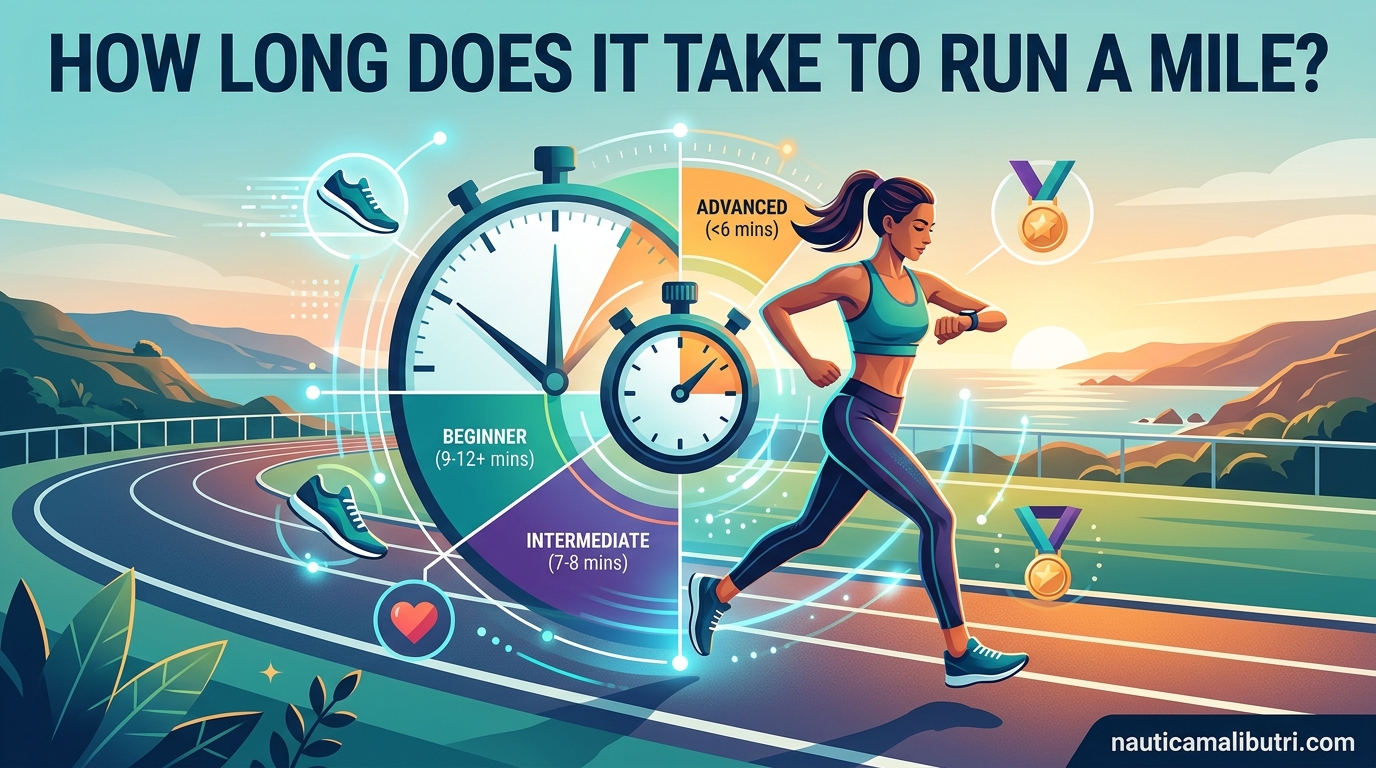
For most adults, running a mile takes between 6 and 13 minutes. Your specific time depends on several factors including age, sex, fitness level, and training history. Here is a quick breakdown by experience level:
- Beginners: 10-15 minutes per mile
- Intermediate runners: 7-9 minutes per mile
- Advanced runners: 6-7 minutes per mile
- Elite runners: Under 5 minutes per mile
These ranges represent the vast majority of recreational runners. If you are currently running a 12-minute mile, you are right in the middle of the beginner range, and that is completely normal. Many of the runners I coach started there and have worked their way down to sub-10 minute miles within six months of consistent training.
Your age and gender also play significant roles in determining your mile time. A fit 25-year-old man will typically run a mile faster than a fit 55-year-old woman, though both could be in excellent shape for their demographic. The key is comparing yourself to age-graded standards rather than elite times you see on TV.
How Far Is a Mile?
Before we get deeper into times, let us establish exactly what distance we are talking about. A mile is exactly 5,280 feet or 1,609 meters. For runners, this distance holds a special place in track and field history as the classic middle-distance event.
On a standard 400-meter running track, a mile is four complete laps plus another 9 meters. Most high school and college tracks are 400 meters, so you can think of a mile as just over four laps. If you are running on a quarter-mile track (common at older facilities), a mile is exactly four laps.
In city terms, a mile is roughly 20 city blocks in most American downtown areas, though this varies by city. On a treadmill, you will see the distance tick over to 1.00 mile on the display. Many beginner runners find that visualizing the distance helps mentally prepare for the effort required.
Average Mile Time by Age and Gender
Running data from Strava, Running Level, and fitness research gives us solid averages for different age groups and genders. These tables show typical times from beginner to elite levels for adults.
Men’s Average Mile Times by Age
| Age Group | Beginner | Novice | Intermediate | Advanced | Elite |
|---|---|---|---|---|---|
| 20-29 | 9:25 | 7:48 | 6:37 | 5:47 | 5:09 |
| 30-39 | 9:39 | 8:00 | 6:47 | 5:56 | 5:17 |
| 40-49 | 10:08 | 8:24 | 7:07 | 6:13 | 5:32 |
| 50-59 | 10:55 | 9:02 | 7:40 | 6:42 | 5:58 |
| 60-69 | 12:07 | 10:02 | 8:31 | 7:27 | 6:37 |
These times come from aggregated running app data and represent recreational runners, not professionals. A 40-year-old man running a 7:07 mile would be considered intermediate for his age group, which is a solid fitness level. If you are in your 50s and running 9-minute miles, you are performing better than the average for your demographic.
Women’s Average Mile Times by Age
| Age Group | Beginner | Novice | Intermediate | Advanced | Elite |
|---|---|---|---|---|---|
| 20-29 | 10:40 | 8:44 | 7:44 | 6:56 | 6:21 |
| 30-39 | 10:49 | 8:52 | 7:51 | 7:02 | 6:27 |
| 40-49 | 11:17 | 9:15 | 8:11 | 7:20 | 6:43 |
| 50-59 | 12:07 | 9:56 | 8:47 | 7:52 | 7:13 |
| 60-69 | 13:37 | 11:10 | 9:52 | 8:50 | 8:06 |
Women typically have mile times approximately 1-2 minutes slower than men in the same age and fitness category. This gap is primarily due to differences in lean body mass, VO2 max capacity, and biomechanical factors. A 30-year-old woman running an 8-minute mile is performing at a similar relative fitness level to a 30-year-old man running a 7-minute mile.
Mile Times by Experience Level
While age and gender provide useful benchmarks, your experience level is often the best predictor of your mile time. Here is what to expect at each stage of your running journey.
Beginner Runners: 10-15 Minutes
If you are new to running, expect your first continuous mile to take between 10 and 15 minutes. Many beginners start with a combination of jogging and walking, which can extend the total time to 12-18 minutes. This is completely normal and nothing to be discouraged about.
When I work with beginners, I emphasize that finishing a mile without stopping is the first goal, regardless of time. Your cardiovascular system needs weeks to adapt to the impact and aerobic demands of running. Reddit users in r/running frequently report starting at 13-15 minute miles and feeling frustrated, but those same users often celebrate sub-10 minute milestones just a few months later with consistent training.
Intermediate Runners: 7-9 Minutes
After 6-12 months of regular running, most people reach the intermediate level, running miles in 7-9 minutes. This pace range represents solid cardiovascular fitness and the ability to hold a conversation while running, known as conversational pace.
Intermediate runners typically run 10-20 miles per week and have established a consistent training routine. At this level, you are faster than the general population but still have room for significant improvement. Many recreational runners settle comfortably in this range, which supports overall health without requiring elite-level dedication.
Advanced Runners: 6-7 Minutes
Advanced runners complete miles in 6-7 minutes, placing them in the top 20-30% of recreational runners. This requires dedicated training including speed work, tempo runs, and typically 25-40 miles per week of volume.
At this pace, you are likely competing in local 5K and 10K races and might be eyeing age-group awards. Advanced runners understand their training zones and periodize their workouts. In our triathlon community, a sub-7-minute mile pace on the run leg puts you in competitive territory for most amateur races.
Elite Runners: Under 5 Minutes
Elite amateur runners break the 5-minute barrier, while professional runners approach 4 minutes. The current world records stand at 3:43.13 for men (Hicham El Guerrouj, 1999) and 4:07.64 for women (Faith Kipyegon, 2026).
Breaking 5 minutes requires exceptional genetics, years of dedicated training, and usually a background in competitive track. Less than 1% of recreational runners will ever run a sub-5-minute mile. If you are in this category, you likely already know it.
Mile Pacing for Triathlons: A Special Consideration
Here is where our triathlon expertise sets this guide apart from general running resources. In a triathlon, your mile time will be different, and understanding these differences is critical for race success.
Coming Off the Bike: Adjusting Your Expectations
When you transition from cycling to running in a triathlon, your legs feel heavy and your running form feels awkward. This is called the “wobbly legs” effect, and it happens because your muscles have been firing in a circular motion for the bike leg and need to adjust to the linear motion of running.
We tell our athletes to expect their first mile off the bike to be 30-60 seconds slower than their standalone mile time. If you normally run 8-minute miles, plan for 8:30-9:00 for that first transition mile. After the first mile, your pace should normalize closer to your open running pace, though most triathletes maintain a slightly conservative pace throughout the run leg to preserve energy.
Brick Workouts vs Standalone Miles
Brick workouts, where you cycle then immediately run, are essential triathlon training sessions. The mile times you record during brick workouts will almost always be slower than your standalone mile times. This is normal and expected.
In our training programs, we have athletes track both their standalone mile pace and their brick mile pace. A good benchmark is being able to run within 45 seconds per mile of your standalone time during a brick workout. If your gap is larger than that, you may need to adjust your bike pacing or work on transition efficiency.
Running vs Jogging vs Walking: What’s the Difference?
This question comes up constantly in running forums. The distinction between walking, jogging, and running is primarily based on biomechanics rather than speed.
Walking has a phase where both feet are on the ground simultaneously. Jogging and running have a flight phase where both feet are momentarily off the ground. The difference between jogging and running is largely intensity and purpose, with jogging being an easy, conversational effort and running being a more purposeful, challenging effort.
In terms of pace, walking a mile typically takes 15-22 minutes, jogging takes 10-15 minutes, and running takes under 10 minutes for most fit adults. A 10-minute mile is definitely running, not jogging, for the majority of people. If you can maintain that pace for multiple miles, you are a runner, full stop.
Fitness Standards and Benchmarks
Various organizations have established fitness standards based on mile or two-mile run times. These can provide useful goalposts for your training.
Army Combat Fitness Test Standards
The U.S. Army uses a 2-mile run as part of their fitness test. Since a 2-mile run is essentially two consecutive miles, we can derive mile time expectations from their standards.
| Age Group | Minimum Standard (2 miles) | Maximum Points (2 miles) | Per-Mile Equivalent |
|---|---|---|---|
| 17-21 (Male) | 15:54 | 13:00 | 7:57 to 6:30 |
| 22-26 (Male) | 16:00 | 13:00 | 8:00 to 6:30 |
| 27-31 (Male) | 16:36 | 13:18 | 8:18 to 6:39 |
| 17-21 (Female) | 18:54 | 15:48 | 9:27 to 7:54 |
| 22-26 (Female) | 19:36 | 15:48 | 9:48 to 7:54 |
| 27-31 (Female) | 20:30 | 16:00 | 10:15 to 8:00 |
Meeting the minimum Army standard for your age group indicates a basic level of fitness. Scoring maximum points requires a level of conditioning that places you well above average for the general population.
Navy SEAL Fitness Standards
For an even higher benchmark, Navy SEAL candidates must run 1.5 miles in under 10:30 (7:00 per mile pace) to pass the Physical Screening Test. Competitive candidates typically run 1.5 miles in 9:00-9:30 (6:00-6:20 per mile pace). These standards represent elite fitness levels that few recreational runners achieve.
7 Factors That Affect Your Mile Time
Understanding what influences your mile time helps you set realistic expectations and identify areas for improvement. Here are the seven primary factors.
1. Age: Peak running performance typically occurs in the late 20s to early 30s. After age 35, most runners see a gradual decline of about 1% per year in performance, though consistent training can slow this decline significantly.
2. Sex: Biological differences in muscle mass, hormone profiles, and oxygen-carrying capacity create performance gaps between sexes. However, trained female runners often outperform untrained males, emphasizing that fitness level ultimately matters more than gender.
3. Fitness Level: Your aerobic capacity (VO2 max) is the strongest predictor of mile time. VO2 max measures how much oxygen your body can use during exercise and improves with consistent training.
4. Body Composition: Lean body mass relative to fat mass affects running economy. Every pound of body weight adds approximately 2-3 seconds per mile at the same fitness level.
5. Terrain and Elevation: Running uphill can add 30-90 seconds per mile depending on the grade. Trail running is typically 15-30 seconds slower per mile than road running due to uneven surfaces.
6. Weather Conditions: Hot weather (above 70°F) slows most runners by 10-30 seconds per mile. Cold weather (below 30°F) can tighten muscles and reduce efficiency. Wind resistance can add significant time when running into headwinds over 10 mph.
7. Running Economy and Form: Efficient runners waste less energy through excessive vertical oscillation, overstriding, or poor arm carriage. Technique improvements can shave seconds off your mile time without requiring additional fitness gains.
How to Improve Your Mile Time
If you want to run a faster mile, structured training is the answer. Here are the methods that produce consistent results.
Interval Training: Running repeated segments at faster than your target mile pace builds speed and cardiovascular capacity. Try 4-6 repeats of 400 meters at your goal mile pace with equal time recovery between each. As you improve, reduce the recovery time.
Tempo Runs: These sustained efforts at threshold pace (the fastest pace you can hold for an hour) improve your lactate threshold. Run 10-20 minutes at a comfortably hard pace, about 30-45 seconds slower than your current mile pace.
Strength Training: Two sessions per week of lower body strength work improves running economy and reduces injury risk. Focus on compound movements like squats, lunges, and deadlifts.
Consistency: The most important factor is simply running regularly. Three to four runs per week for six months will transform your mile time more than any specific workout.
What to Expect in Your First Month
Based on the experiences shared in running communities, here is a realistic progression timeline for beginners starting their running journey.
Week 1-2: Focus on run-walk intervals. Run for 1-2 minutes, walk for 1-2 minutes, and repeat. Do not worry about speed. Many beginners cannot complete a full mile without walking breaks at this stage.
Week 3-4: Extend your running intervals to 3-5 minutes. You might attempt your first continuous mile, but do not be discouraged if you need walk breaks. Your time will likely be 13-16 minutes per mile.
Week 5-8: Most beginners can run a full mile without stopping by week 6-8 if training consistently three times per week. Your time will likely be 11-13 minutes per mile.
Month 2-3: With continued training, expect to drop 30-60 seconds per mile each month. Breaking the 10-minute barrier is a common goal that many beginners achieve within 3-6 months.
Frequently Asked Questions
How many minutes is 1 mile running?
For most adults, running 1 mile takes 6-13 minutes. Beginners typically take 10-15 minutes, intermediate runners 7-9 minutes, and advanced runners 6-7 minutes per mile.
Is a 10 minute mile a jog?
A 10-minute mile is considered running, not jogging. Jogging typically describes an easy, conversational effort regardless of pace. Many fit adults run between 9-11 minutes per mile as a comfortable training pace.
Is 1 mile in 20 minutes good?
A 20-minute mile is a brisk walking pace rather than running. While it represents movement and activity, most adults can achieve faster times with a light jog. This pace is approximately 3 miles per hour.
Is 1 mile 30 minutes?
A 30-minute mile is a casual walking pace, not running. This equals 2 miles per hour, which is a comfortable strolling speed. To be considered running, most people complete a mile in under 15 minutes.
How long should 1 mile take to run?
The time it takes to run 1 mile depends on your fitness level and goals. For general fitness, aim for 10-12 minutes as a beginner target. As you improve, 8-9 minutes represents a solid recreational fitness level.
How fast do Navy SEALs run 1.5 miles?
Navy SEAL candidates must complete 1.5 miles in under 10:30 (7:00 per mile pace) to pass. Competitive candidates typically run 1.5 miles in 9:00-9:30, which equals 6:00-6:20 per mile pace.
Conclusion
Understanding how long it takes to run a mile gives you a powerful benchmark for tracking your fitness progress over time. Whether you are currently at 15 minutes per mile or pushing toward 6 minutes, the journey of improvement is what makes running rewarding.
For triathletes specifically, remember that your open mile time is just one data point. Your race day performance depends on pacing strategy, transition efficiency, and energy management across all three disciplines. Use the mile benchmarks in this guide to set goals, but focus on consistency and smart training above all else.
The most important statistic is not your fastest mile, but the number of miles you run consistently week after week. Start where you are, use the data to guide your training, and celebrate every improvement. In 2026, there has never been a better time to lace up and hit the road.