
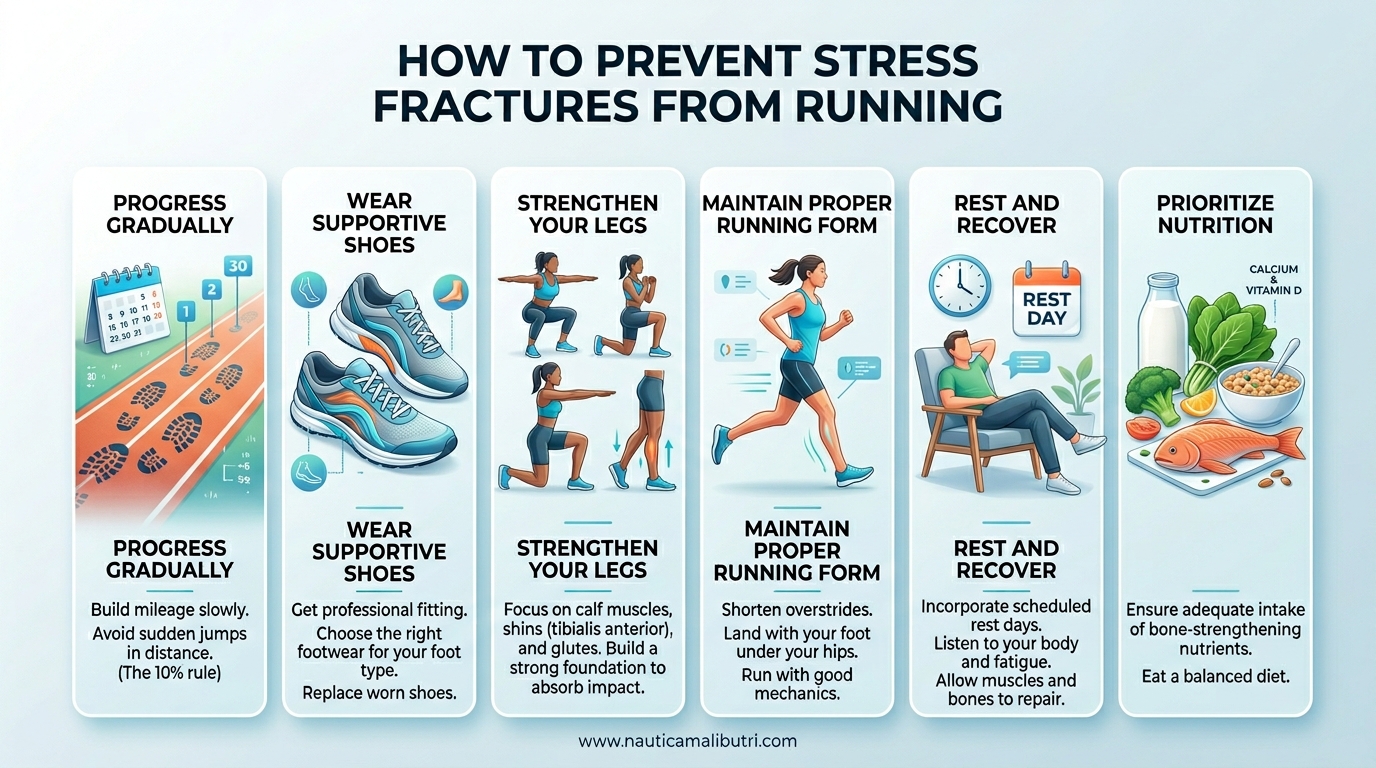
Stress fractures sideline nearly 20% of competitive runners at some point in their careers. I have seen training cycles derailed, race registrations wasted, and passionate athletes lose months of progress to these tiny bone cracks that start as barely noticeable aches.
Learning how to prevent stress fractures from running is not just about avoiding pain. It is about protecting the consistency that builds fitness over years. Whether you are training for your first 5K or your tenth marathon, understanding bone stress injury prevention will keep you on the road instead of the recovery bench.
In this guide, I will share evidence-based strategies that sports medicine doctors and experienced runners use to stay injury-free. You will learn the warning signs to watch for, the training mistakes that increase your risk, and practical steps you can implement this week to build more resilient bones.
Table of Contents
What Is a Stress Fracture?
A stress fracture is a small crack in a bone caused by repetitive force over time. Unlike an acute fracture from a single traumatic event like a fall, stress fractures develop gradually when the cumulative load from running exceeds what your bone can handle.
Your bones are constantly remodeling. Specialized cells called osteoclasts break down old bone tissue while osteoblasts build new bone. This process adapts your skeleton to the demands you place on it. When you run consistently, your bones actually become stronger as they remodel to handle the impact forces.
Problems arise when the breakdown happens faster than the rebuilding. If you increase your weekly mileage too quickly, run on unforgiving surfaces, or do not give your body adequate recovery time, the micro-damage accumulates faster than your bones can repair it. Eventually, a stress reaction develops, which can progress to a full stress fracture if ignored.
Stress Reaction vs Stress Fracture
Understanding the difference between a stress reaction and a stress fracture matters for both prevention and treatment. A stress reaction is the precursor stage where bone tissue is irritated and inflamed but has not yet cracked. At this stage, you might feel mild discomfort during runs that resolves with rest. Continuing to run on a stress reaction almost always leads to a full fracture.
| Characteristic | Stress Reaction | Stress Fracture |
|---|---|---|
| Pain level | Mild, activity-related | Moderate to severe, may persist at rest |
| Recovery time | 2-4 weeks | 6-12 weeks or longer |
| Activity restriction | Reduced loading | Complete rest or immobilization |
| Imaging findings | Edema on MRI, normal X-ray | Visible fracture line on MRI, may show on X-ray |
Runners often ignore early warning signs because stress reaction pain feels similar to normal muscle soreness. The key difference is location. Stress fractures cause pinpoint pain at a specific spot on the bone, while muscle soreness is more diffuse and changes with movement.
What Causes Stress Fractures in Runners?
Stress fractures result from an imbalance between the mechanical load you apply to your bones and your body’s ability to adapt to that load. Several factors tip this balance toward injury.
Training Errors
The most common cause is the terrible too’s: too much, too soon, too fast. Jumping from 20 miles per week to 40 miles per week in a single month overwhelms your bones’ remodeling capacity. Adding intense speed work before building an aerobic base creates spikes in ground reaction force that your skeleton is not prepared to absorb.
Ignoring rest days is another major factor. Bone remodeling happens during recovery periods, not during the run itself. Without adequate rest, you never give your osteoblasts time to strengthen your skeleton.
Biomechanical Factors
Your running mechanics significantly affect how much stress reaches your bones. Overstriding, where your foot lands far in front of your center of mass, creates braking forces that send shock waves up your tibia and femur. A low running cadence, typically under 160 steps per minute, increases the impact peak of each footfall.
Foot structure matters too. Runners with high rigid arches or very flat feet may distribute impact forces unevenly, concentrating stress in specific areas of the metatarsals or tibia.
Nutritional and Hormonal Factors
Under-fueling is a hidden epidemic in running. When you do not consume enough calories to support both your training and basic physiological functions, your body prioritizes essential processes over bone maintenance. This condition, known as Relative Energy Deficiency in Sport or RED-S, dramatically increases stress fracture risk.
Calcium and vitamin D deficiencies directly impair bone mineralization. Female athletes with irregular menstrual cycles face additional risk due to lower estrogen levels, which normally help maintain bone density.
High-Risk Groups
Certain runners face elevated stress fracture risk and should be especially vigilant with prevention strategies:
- Female athletes, particularly those with a history of eating disorders or irregular periods
- Runners with low body weight or recent significant weight loss
- Beginning runners transitioning from sedentary lifestyles
- Marathon trainees during peak mileage weeks
- Runners with previous stress fractures
- Older runners experiencing natural bone density decline
How to Recognize Stress Fracture Symptoms
Early detection can mean the difference between a two-week training modification and a three-month forced layoff. Knowing what to look for helps you intervene before a stress reaction becomes a fracture.
The Characteristic Pain Pattern
Stress fracture pain has distinct qualities that differentiate it from normal training soreness. The pain is localized to a specific point on the bone that you can often pinpoint with one finger. It typically starts as a dull ache during runs, progresses to pain with daily activities like walking, and may eventually hurt even at rest or at night.
Shin splints, in contrast, cause diffuse pain along the inner edge of the tibia. Muscle soreness shifts location with movement and improves with warming up. Stress fracture pain gets worse as you continue running and often persists after you stop.
The Hop Test
The hop test is a simple self-assessment that sports medicine professionals use. Stand on the affected leg and hop up and down gently. If this produces sharp pain at a specific spot, suspect a stress fracture. Normal muscle soreness usually does not hurt with this movement, or the pain is spread across a larger area.
Common Stress Fracture Locations in Runners
Different running patterns and risk factors predispose runners to fractures in specific locations:
- Metatarsals (forefoot): The second and third metatarsals are most commonly affected, especially in runners with foot strike issues or worn-out shoes
- Tibia (shin): The inner posterior edge of the shin bone, often from overstriding or training volume errors
- Femoral neck (hip): A high-risk location that can have serious complications if not treated properly
- Calcaneus (heel): Less common but can occur with hard heel striking
- Fibula (outer lower leg): Usually from excessive twisting or uneven surfaces
Any pain that persists beyond a few days, worsens with activity, or localizes to a specific bony spot warrants medical evaluation. Do not try to run through bone pain.
How to Prevent Stress Fractures From Running: 8 Proven Strategies
Prevention is far easier than recovery. These eight strategies address the root causes of bone stress injuries and build a more resilient running body.
1. Follow the 10% Rule for Training Progression
The 10% rule is the cornerstone of injury prevention. Never increase your weekly mileage by more than 10% from one week to the next. If you ran 20 miles this week, run no more than 22 miles next week.
This conservative approach gives your bones time to remodel and strengthen in response to increasing load. Research consistently shows that runners who exceed 10% weekly increases have significantly higher injury rates.
Here is how the 10% rule works in practice over a four-week base-building phase:
| Week | Total Miles | Long Run | Notes |
|---|---|---|---|
| Week 1 | 20 miles | 6 miles | Baseline week |
| Week 2 | 22 miles | 7 miles | 10% increase |
| Week 3 | 24 miles | 7.5 miles | 9% increase |
| Week 4 | 26 miles | 8 miles | 8% increase |
After three to four weeks of increasing volume, schedule a recovery week where you drop mileage by 15-20% before continuing to build. This cyclical approach prevents the accumulation of bone fatigue.
2. Replace Running Shoes Every 300-400 Miles
Running shoes lose their shock absorption properties gradually, often before you notice visible wear. The midsole foam compresses with each footfall, reducing its ability to cushion impact forces. Worn shoes transfer more stress directly to your bones.
Most running shoes need replacement between 300 and 400 miles. Lighter minimalist shoes may need replacement closer to 250 miles, while some durable trainers can last up to 500 miles. Track your shoe mileage in your training log.
Signs that your shoes need replacement include:
- Visible compression wrinkles in the midsole foam
- Feeling more beat up after runs than usual
- New aches in your feet, shins, or knees
- The shoe feels flat or dead when you press on the midsole
Rotate between two pairs of shoes to extend their life and give the foam time to rebound between runs. Different shoe models on different days also varies the stress patterns on your bones.
3. Strengthen Your Bones With Targeted Exercises
Bone responds to impact forces by becoming denser and stronger. Strategic plyometric and resistance training stimulates this adaptive response without the repetitive stress of running.
Jumping exercises are particularly effective for bone density. Single-leg hops, box jumps, and skipping rope create high-impact forces in short bursts that signal your bones to strengthen. Just 5-10 minutes of plyometric work twice weekly provides significant protective benefits.
Resistance training for the lower body supports bone health by improving muscular shock absorption. Strong glutes, quads, and calves reduce the load that reaches your bones with each step. The runner community consistently emphasizes that squats and lunges are essential for injury prevention.
Key exercises to include twice weekly:
- Squats and split squats for glute and quad strength
- Calf raises to improve shock absorption
- Single-leg deadlifts for hip stability
- Box jumps or hop jumps for bone stimulus
- Lateral lunges for movement variety
4. Optimize Your Running Form and Cadence
How you run affects how much stress reaches your bones. Small mechanical improvements can significantly reduce injury risk without requiring more fitness.
Overstriding is the most common form flaw that increases stress fracture risk. When your foot lands far in front of your body, you create a braking force that jars your skeleton. Aim to land with your foot directly under your center of mass, not reaching out ahead of you.
Running cadence, or steps per minute, correlates with overstriding. Increasing your cadence by 5-10% naturally reduces stride length and encourages midfoot landing. Most injury-prone runners have a cadence below 160 steps per minute. Try counting your steps for 30 seconds and multiplying by two.
To increase cadence without exhausting yourself:
- Use a metronome app set 5% higher than your natural cadence
- Practice on easy runs for just a few minutes at a time
- Focus on quick, light steps rather than pushing harder
- Let your breathing and perceived effort guide intensity
5. Choose Appropriate Running Surfaces
Running surface stiffness affects the impact forces your bones absorb. Concrete is the hardest and most stressful surface. Asphalt is slightly more forgiving. Trails, grass, and tracks provide the most cushioning.
Varied surfaces distribute stress across different areas of your bones, preventing the repetitive loading that causes stress fractures. Trail running is particularly beneficial because the uneven terrain varies impact patterns and strengthens stabilizing muscles that protect your joints.
Strategic surface selection for bone health:
- Do easy recovery runs on softer surfaces like trails or grass
- Save concrete running for necessary urban routes only
- Use the track for speed work to reduce impact at high velocities
- Gradually transition to softer surfaces if you usually run on roads
Be cautious when transitioning to trails, though. The uneven terrain requires different muscle recruitment. Build trail volume gradually to avoid compensation injuries.
6. Prioritize Recovery and Sleep
Bone remodeling happens during rest, not during the workout. Chronic sleep deprivation impairs this recovery process and increases stress fracture risk. Studies show that athletes getting less than 7 hours of sleep have significantly higher injury rates.
During deep sleep, growth hormone release peaks, stimulating tissue repair and bone strengthening. Poor sleep quality or insufficient duration shortchanges this essential adaptation process.
Recovery strategies that support bone health:
- Maintain a consistent sleep schedule with 7-9 hours nightly
- Schedule at least one complete rest day weekly
- Use deload weeks every 3-4 weeks to allow systemic recovery
- Manage life stress, as cortisol elevation impairs bone formation
Do not view rest as lost training time. It is when your body becomes stronger.
7. Fuel Your Body With Bone-Building Nutrition
You cannot build strong bones without adequate nutrients. Under-fueling is one of the most preventable causes of stress fractures, yet it remains common among runners concerned about body weight.
Calcium is the primary mineral in bone tissue. Adult runners need approximately 1,000-1,300 mg daily depending on age and sex. Dairy products, leafy greens, fortified foods, and calcium-rich fish like sardines provide good sources.
Vitamin D enables calcium absorption. Many runners are deficient, especially those training indoors or in northern climates. Testing your levels and supplementing if needed is a smart preventive measure.
Protein provides the building blocks for bone matrix. Aim for 1.2-1.6 grams per kilogram of body weight daily, distributed across meals.
An anti-inflammatory diet supports bone repair. The running community consistently emphasizes foods that fight inflammation and speed recovery:
- Fatty fish rich in omega-3s like salmon and sardines
- Colorful vegetables and fruits high in antioxidants
- Nuts and seeds for healthy fats
- Turmeric and ginger for their anti-inflammatory properties
- Adequate hydration to support all physiological processes
Female runners should be especially vigilant about adequate nutrition. Missing menstrual periods due to low energy availability is a red flag that bone health is compromised.
8. Incorporate Strategic Cross-Training
Cross-training reduces repetitive bone stress while maintaining cardiovascular fitness. Activities like cycling, swimming, and rowing provide aerobic stimulus without the impact forces of running.
Rowing is particularly valuable during injury recovery and for prevention. It builds back and core strength while giving your legs a break from impact. Many experienced runners recommend rowing as the best cross-training option during stress fracture rehabilitation.
Effective cross-training strategies:
- Replace one easy run weekly with a non-impact cardio session
- Use cycling or swimming during base-building phases to reduce cumulative load
- Maintain intensity with intervals on the bike or in the pool
- Try rowing for full-body conditioning that supports running posture
Cross-training is not just for injured runners. Proactive athletes use it to build volume while managing bone stress.
When to See a Doctor for Shin Pain
Not all bone pain requires medical intervention, but certain symptoms demand professional evaluation. Knowing when to seek help prevents minor stress reactions from becoming serious fractures.
Red Flags That Require Immediate Medical Attention
Schedule a doctor appointment if you experience:
- Pain that persists beyond 2-3 days of rest
- Pain that wakes you at night
- Inability to bear weight on the affected leg
- Visible swelling or bruising over a bone
- Pain that localizes to a specific point on the bone
- Numbness or tingling in the foot
Hip or groin pain warrants particularly prompt evaluation. Femoral neck stress fractures can have serious complications if they progress to complete breaks.
The Diagnostic Process
Sports medicine doctors use several tools to diagnose stress fractures. X-rays often appear normal in early stress reactions because the crack is too small to see. MRI is the gold standard diagnostic tool, revealing bone edema and hairline fractures that X-rays miss.
Your doctor may also assess training history, nutrition, and biomechanics to identify contributing factors. Blood tests can check for vitamin D deficiency, calcium levels, and hormonal issues affecting bone health.
Do not rely on internet forums or self-diagnosis for bone pain. A medical professional can distinguish between low-risk and high-risk stress fractures and guide appropriate treatment. The difference between a tibial stress fracture and a femoral neck stress fracture is significant in terms of recovery protocol.
Frequently Asked Questions
How do runners avoid stress fractures?
Runners avoid stress fractures by following the 10% rule for weekly mileage increases, replacing shoes every 300-400 miles, incorporating strength training and plyometrics twice weekly, optimizing running form and cadence, choosing softer surfaces when possible, getting 7-9 hours of sleep, eating adequate calcium and vitamin D, and including cross-training to reduce repetitive impact. Consistency with these prevention strategies matters more than any single intervention.
How to tell if you have a stress fracture from running?
You may have a stress fracture if you experience localized pain at a specific point on a bone that worsens with activity and improves with rest. The pain often progresses from only during running to pain with walking and eventually pain at rest. The hop test, hopping gently on the affected leg, typically produces sharp pain at the fracture site. Unlike muscle soreness, stress fracture pain is pinpoint and does not shift location.
How painful is a stress fracture?
Stress fracture pain varies by location and severity but typically starts as a dull ache during running. In early stages, pain may only occur during activity and resolve with rest. As the fracture progresses, pain becomes sharper and may persist during daily activities like walking. Advanced stress fractures can cause throbbing pain at rest or at night. Femoral neck and navicular stress fractures tend to be more painful than metatarsal fractures.
How often do runners get stress fractures?
Studies show that up to 20% of competitive runners experience a stress fracture at some point in their careers. The incidence is highest among track and field athletes, with rates around 10-20% annually. Female runners have approximately twice the risk of male runners, largely due to hormonal and nutritional factors. Beginning runners and those training for marathons face elevated risk during periods of rapid mileage increases.
Conclusion
Learning how to prevent stress fractures from running gives you the power to train consistently for years rather than cycling through injury and recovery. The eight strategies in this guide work together to build a resilient body that can handle the demands you place on it.
Start with the fundamentals: follow the 10% rule, replace your shoes on schedule, and never skip strength training. Add nutrition optimization, sleep prioritization, and surface variety as you establish those habits. Pay attention to warning signs and respond to bone pain with rest rather than stubbornness.
Remember that one runner in our community put it after 30 years of healthy running following a single stress fracture: recurrence is preventable with the right approach. Your bones adapt to the loads you apply when you give them adequate time and resources to rebuild. Train smart, recover well, and keep running strong through 2026 and beyond.