
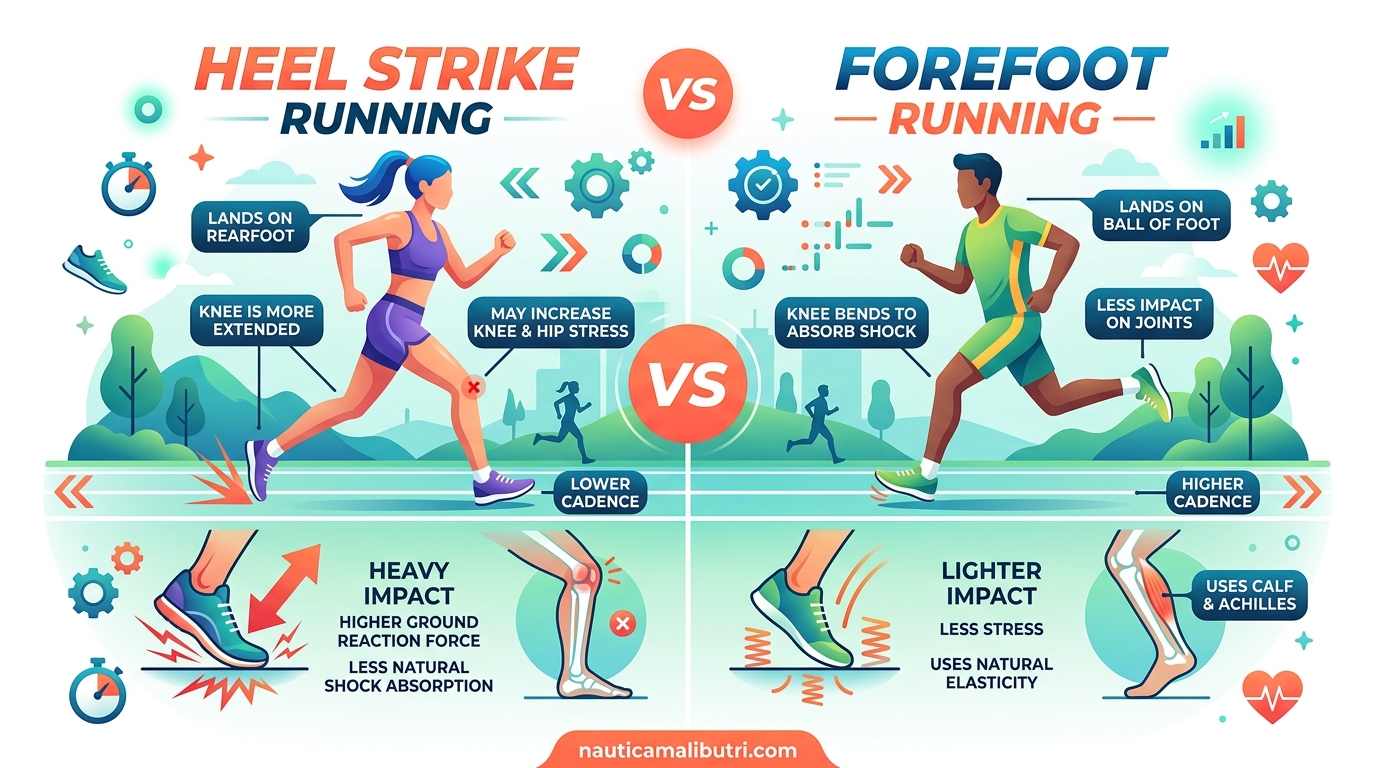
Every time I lace up for the run leg of a triathlon, I notice something interesting about my fellow athletes. Some land on their heels with each stride. Others seem to bounce along on the balls of their feet. The debate over heel strike vs forefoot running has divided the running community for years, and if you are training for your next triathlon, you have probably wondered which technique is right for you.
Here is what the data tells us: between 75% and 95% of recreational runners are heel strikers. That might surprise you if you have been told that forefoot striking is the “natural” way to run. The truth is more nuanced, and understanding the differences between these foot strike patterns can help you run more efficiently and avoid injury.
In this guide, I will break down everything triathletes need to know about foot strike patterns. You will learn how to identify your current strike type, understand the pros and cons of each approach, and discover how cycling affects your running gait during that critical bike-to-run transition.
Table of Contents
What Is Foot Strike and Why Does It Matter?
Your foot strike pattern describes which part of your foot touches the ground first when you run. This seemingly small detail affects how impact forces travel through your entire kinetic chain, from your feet up through your ankles, knees, hips, and lower back.
The Three Types of Foot Strike
Heel strike (rearfoot strike) occurs when your heel makes initial contact with the ground, followed by your midfoot and forefoot. Most recreational runners naturally use this pattern, especially when wearing modern running shoes with elevated heels.
Midfoot strike happens when your heel and forefoot land simultaneously, distributing impact across the entire foot. This pattern is less common naturally but is often what runners aim for when trying to “fix” their form.
Forefoot strike occurs when the ball of your foot lands first, with your heel touching down afterward or sometimes not at all. This is the pattern often associated with barefoot running and minimalist shoes.
The Biomechanics Behind Foot Strike
When your foot hits the ground, your body experiences ground reaction forces equal to 1.5 to 3 times your body weight. Where and how that force is absorbed depends largely on your running gait and foot strike pattern.
Heel strikers typically experience higher initial impact peaks that transmit more force through the knees and hips. Forefoot strikers load their calf muscles and Achilles tendons more aggressively. Neither pattern is force-free, they simply distribute stress differently.
Your running economy, the amount of oxygen you consume at a given pace, can be affected by foot strike as well. Some studies suggest that your most economical stride is often the one that feels most natural to you, not necessarily the one that looks prettiest on video.
How to Identify Your Foot Strike Type
Before you can optimize your foot strike pattern, you need to know what you are currently doing. Here are four methods I recommend to triathletes who want to assess their running form.
Video Analysis
The simplest way to check your foot strike is to have someone record you running on a treadmill from the side. Review the footage in slow motion to see what touches first. Many running stores and physical therapy clinics offer this service for free or a small fee.
Check Your Shoe Wear Patterns
Flip over a well-worn pair of running shoes and examine the outsole. Heel strikers typically show wear concentrated on the outside rear corner. Forefoot strikers display wear under the ball of the foot. If you see even wear across the heel and forefoot, you might be a midfoot striker.
Treadmill Self-Assessment
Run on a treadmill at your easy pace and focus on what you feel hitting the belt first. Do not try to change anything, just observe. If you feel your heel hitting with each step, you are a heel striker. If you feel your toes or ball of foot making contact first, you are a forefoot runner.
Professional Gait Analysis
For triathletes serious about optimizing performance, a professional gait analysis at a sports medicine clinic or specialized running store provides the most detailed data. These assessments often include pressure mapping and high-speed video to give you a complete picture of your mechanics.
Heel Strike Running: Advantages and Disadvantages
Heel striking gets a bad reputation in some running circles, but the reality is more balanced. Let me walk you through what research and experience tell us about this common running form.
Advantages of Heel Striking
Heel striking provides excellent stability, especially for slower paces and longer distances. The longer stride length associated with heel striking can be more economical at easy to moderate intensities. Most modern running shoes are specifically designed with cushioning systems that work best for heel strikers.
Contrary to popular belief, many elite distance runners are heel strikers. A study of runners at the 2007 Sapporo Half Marathon found that 75% of elite runners landed on their heels. If heel striking prevented speed, you would not see it at the front of world-class races.
Disadvantages of Heel Striking
The main concern with heel striking is the risk of overstriding, where your foot lands too far in front of your center of mass. This creates a braking force with each step and increases impact forces on your joints. Overstriding is the real problem, not the heel strike itself.
Heel strikers do show higher rates of certain injuries, particularly to the knees and hips. The initial impact peak transmits more force through these joints compared to forefoot patterns. If you have a history of knee issues, your foot strike pattern might be worth examining.
Is Heel Striking Bad for Runners?
No, heel striking is not inherently bad. The evidence does not support forcing a change if you are running comfortably and injury-free. The key is avoiding overstriding and ensuring your foot lands under your center of mass rather than far out in front of your body.
Forefoot Strike Running: Advantages and Disadvantages
The popularity of forefoot running exploded after the publication of “Born to Run” in 2009. The book suggested that humans evolved to run without shoes and that modern cushioned shoes had ruined our natural form. While the message was compelling, the science is more complex.
Advantages of Forefoot Striking
Forefoot striking can improve running efficiency at faster paces by utilizing the natural spring energy stored in your Achilles tendon and calf muscles. The shorter ground contact time helps with speed and responsiveness, which is why many sprinters and middle-distance runners naturally forefoot strike.
By landing with a more bent knee and ankle, forefoot strikers reduce the initial impact peak that travels through the skeletal system. This can lower stress on the knees and hips, potentially benefiting runners with joint issues in those areas.
Many triathletes find that a forefoot-dominant pattern helps them maintain better posture and cadence during the challenging final miles of a race when fatigue sets in.
Disadvantages of Forefoot Striking
The transition to forefoot striking places significantly more load on your calf muscles and Achilles tendons. These tissues need months to adapt to the new demands. Rush the transition and you risk calf strains, Achilles tendonitis, or metatarsal stress fractures.
Forefoot striking is metabolically more expensive at slower paces. Your calf muscles work harder to control the landing and push-off, which can lead to earlier fatigue during long runs or races. This is a critical consideration for Ironman-distance triathletes.
The fad of minimalist running led many runners to switch too quickly, resulting in injury rates that initially spiked when the trend was at its peak. If you decide to transition, patience is essential.
Foot Strike and Injury Risk: What the Research Shows
When researchers compare injury rates between heel strikers and forefoot strikers, the results are nuanced. A comprehensive meta-analysis published in the NIH/PMC database found that changing to a midfoot or forefoot strike does not consistently reduce injury risk for most runners.
Injury Patterns by Foot Strike Type
Heel strikers experience higher rates of knee pain, patellofemoral syndrome, and hip issues. The higher initial impact forces and typical overstriding pattern load these joints more aggressively. If you are a heel striker with chronic knee problems, examining your foot strike might be worthwhile.
Forefoot strikers show higher incidence of Achilles tendon problems, calf strains, and metatarsal stress fractures. The increased load on the posterior chain and forefoot structure creates different stress concentrations. I have worked with several triathletes who developed Achilles issues during their transition to forefoot running.
The Overstriding Factor
Here is the most important takeaway from the research: foot strike matters less than where your foot lands relative to your body. Overstriding, the habit of landing with your foot far in front of your center of mass, increases injury risk regardless of whether you land on your heel or forefoot.
A heel striker who lands under their center of mass is often better off than a forefoot striker who reaches far forward with each step. Focus on stride mechanics and landing position before worrying about which part of your foot touches first.
Foot Strike for Triathletes: Bike-to-Run Transition
Here is where this guide diverges from general running advice. As triathletes, we face a unique challenge that pure runners do not: the bike-to-run transition. Understanding heel strike vs forefoot running in this specific context can make a measurable difference in your race performance.
How Cycling Affects Your Running Gait
When you spend 30 minutes to 6 hours in aero position depending on your race distance, your body adapts to the cycling motion. Your hip flexors tighten. Your glutes deactivate. Your neuromuscular system becomes optimized for circular pedaling rather than linear running.
When you hit T2 and start the run, your body is not in the same state as it is during a standalone run workout. Many triathletes report feeling “rubbery legged” or having a disconnected feeling between their brain and their feet. This altered neuromuscular state affects your natural foot strike pattern.
Finding Your Post-Bike Foot Strike
Most triathletes naturally adopt a flatter, more midfoot-dominant pattern for the first mile after the bike. The tight hip flexors and shortened stride length that come off the bike make aggressive heel striking difficult. Pay attention to this during your brick workouts, it is your body finding the most efficient pattern in its current state.
After the first mile, your running gait typically normalizes as your hip flexors loosen and your stride opens up. Some triathletes find they naturally shift back toward their normal training pattern. Others discover that the flatter foot strike feels better and stick with it for the entire run leg.
Race Distance Considerations
For sprint triathlons, your run leg is short enough that you can maintain a more aggressive forefoot-dominant pattern if that is what you train. The higher turnover and shorter ground contact time can help you squeeze out maximum speed over 3.1 miles.
Olympic distance athletes need to balance efficiency and turnover. A midfoot to slight forefoot pattern often works best here, providing good turnover without the calf fatigue that comes from aggressive forefoot striking over 10 kilometers.
For 70.3 and Ironman distances, efficiency trumps everything. Most successful long-course triathletes use a flatter foot strike that minimizes eccentric loading on the calves. The goal is a sustainable pattern that preserves your legs for the final 10 miles when the race really begins.
Cadence and Foot Strike Relationship
There is a strong relationship between your cadence and your foot strike pattern. Higher cadence, typically above 170 steps per minute, encourages a flatter landing that naturally reduces overstriding. Many triathletes find that focusing on cadence automatically improves their foot strike without conscious effort.
During your next brick workout, try this: do not think about your foot strike at all. Instead, count your steps for 30 seconds and multiply by 2. If you are below 170, gradually increase your turnover by 5% over several weeks. You will likely find your landing pattern shifts toward midfoot naturally.
Foot Strike and Running Economy
Your running economy describes how much oxygen you use at a given running speed. Better economy means you can run faster using less energy, which matters enormously when you are already fatigued from swimming and cycling.
Efficiency by Strike Type
Research on running economy and foot strike has produced mixed results. Some studies suggest that habitual heel strikers become less economical when forced to forefoot strike, and vice versa. Your body becomes efficient at what you practice.
A landmark study by researchers at the University of Massachusetts found that when runners switched to a non-habitual foot strike pattern, their running economy decreased by about 3-5% initially. This suggests that forcing a change without adequate adaptation time can actually hurt your performance.
Race-Specific Recommendations
For short course racing where speed matters most, the propulsion advantage of a forefoot-dominant pattern may outweigh the metabolic cost. For long course racing where energy conservation is critical, the efficiency of your habitual pattern is likely best.
The best approach for triathletes is to train in the pattern that feels most natural and economical for you, then trust that pattern on race day. Race day is not the time to experiment with new foot strike techniques.
How to Transition Between Foot Strike Patterns Safely
If after reading this guide you decide to experiment with a different foot strike, please do so carefully. I have seen too many triathletes derail their training with transition injuries that were entirely preventable.
Step 1: Assessment and Goal Setting
Start by documenting your current pattern using the methods described earlier. Set specific, measurable goals. If you are a heel striker wanting to try midfoot, define what that looks like for you. Vague goals lead to inconsistent execution.
Step 2: Gradual Introduction
Apply the same 10% rule you use for increasing weekly mileage. Start by running 10% of your normal volume in the new pattern, with the remainder in your habitual form. Increase by 10% each week only if you remain pain-free.
For most triathletes, a full transition takes 3-6 months. Anyone promising faster results is ignoring the physiological reality of tendon and muscle adaptation.
Step 3: Strengthening Exercises
Before you begin the transition, build strength in the tissues that will work harder. For forefoot transitions, prioritize calf raises, eccentric heel drops for the Achilles, and intrinsic foot muscle exercises. For heel strike transitions, focus on quadriceps and hip strength.
Step 4: Form Drills
Add running drills to your warm-up routine. High knees, butt kicks, and ankling drills help reinforce new movement patterns without the fatigue of a full run. These drills should feel exaggerated. The goal is to create a new motor pattern that will carry over to your regular running.
Step 5: Monitoring and Adjustment
Keep a log of your transition runs and any aches or pains that develop. Mild muscle soreness is normal. Sharp pain, especially in the Achilles or metatarsals, is not. Back off immediately if you experience the latter.
Transition Timeline Expectations
Most runners need 12-16 weeks before the new pattern feels natural. Performance may initially decrease as your body adapts. Do not make the switch during race season. The off-season or base training period is the time to experiment.
Frequently Asked Questions About Foot Strike
Is it better to forefoot strike or heel strike?
Neither is universally better. Research shows that your habitual foot strike is often most economical for you. Heel striking is natural for 75-95% of runners and works well for slower paces and longer distances. Forefoot striking may offer advantages for speed and reduced knee impact but increases calf and Achilles loading. The best strike pattern is the one that feels comfortable and keeps you injury-free.
Should you strike with your heel or toe when running?
Most runners should use the pattern that feels natural. If you are a comfortable heel striker without injury issues, there is no need to change. If you struggle with knee pain, experimenting with a flatter or forefoot-dominant pattern might help. The key is landing under your center of mass rather than reaching far forward with each step.
Is heel striking bad for runners?
No, heel striking is not inherently bad. While it is associated with higher initial impact forces, many elite distance runners are heel strikers. The real problem is overstriding, which often accompanies heel striking. A heel striker who lands under their center of mass is typically better off than a forefoot striker who overstrides.
What percentage of runners are heel strikers?
Studies consistently show that 75% to 95% of recreational runners are heel strikers. Among elite runners at half marathon and marathon distances, approximately 75% land on their heels. This suggests that heel striking is the natural pattern for most humans, especially when wearing modern running shoes.
Is a forefoot strike always better than a heel strike?
No, forefoot striking is not always better. While it reduces knee impact and can improve propulsion, it increases load on the calves and Achilles tendons. The transition period carries significant injury risk. For many runners, especially those doing long-distance triathlons, a midfoot or moderate heel strike may be more sustainable than an aggressive forefoot pattern.
Heel Strike vs Forefoot Running: Final Thoughts
The debate over heel strike vs forefoot running has generated more heat than light in the running community. After reviewing the research and working with hundreds of triathletes, my conclusion is simple: the best foot strike is the one that keeps you running consistently and injury-free.
Most runners are heel strikers, and that is perfectly fine. If you are comfortable and performing well, resist the urge to chase the latest running form trend. If you are dealing with chronic injuries or feel you could be more efficient, a gradual, careful transition to a different pattern might be worth exploring.
For triathletes specifically, focus on how cycling affects your running gait during the bike-to-run transition. Practice your brick workouts. Pay attention to your natural post-bike foot strike. And remember that race day is for executing what you have trained, not for experimenting with new techniques.
The most important factor is not whether you land on your heel or forefoot. It is whether you are overstriding, whether your cadence is appropriate, and whether you are staying consistent with your training. Get those elements right, and your foot strike will likely take care of itself.