
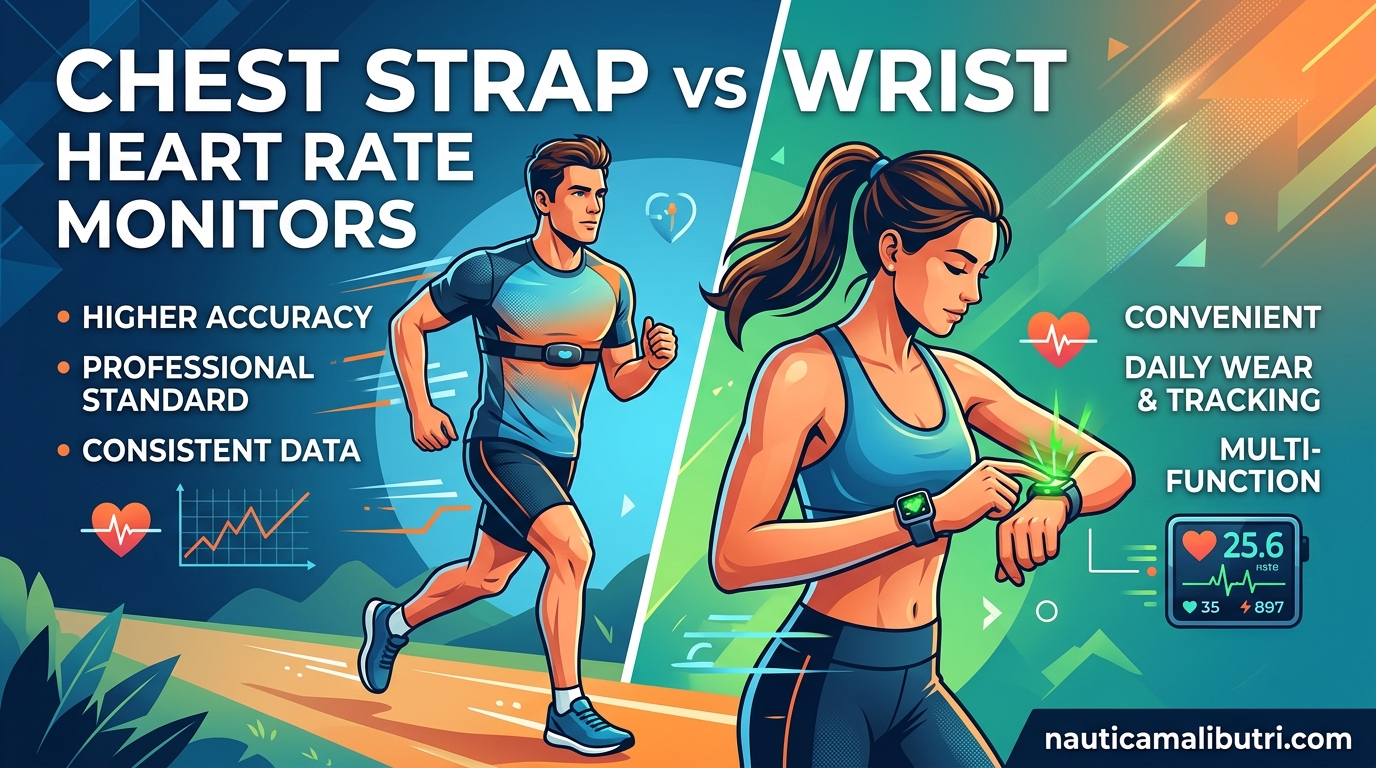
Choosing between a chest strap and wrist heart rate monitor could be the difference between nailing your Zone 2 training or unknowingly drifting into threshold effort. As triathletes, we rely on heart rate data to structure workouts, monitor recovery, and pace on race day. Yet many athletes do not realize that where you wear your heart rate monitor dramatically affects the accuracy of that data.
I have tested both chest strap and wrist-based optical sensors across hundreds of training sessions, from easy base miles to brutal VO2 max intervals. The difference is not just theoretical. During steady-state runs, my wrist watch and chest strap typically agree within 1-2 BPM. But during high-intensity intervals, I have seen gaps of 15-20 BPM between the two.
Let me break down exactly how each technology works, what the research says about accuracy, and when you should choose one over the other for your triathlon training.
Table of Contents
How Chest Strap Heart Rate Monitors Work
Chest strap heart rate monitors use electrocardiography (ECG or EKG) technology to detect your heartbeat. This is the same fundamental method used in hospitals for cardiac monitoring. The strap contains electrode sensors that pick up the electrical impulses generated by your heart muscle each time it contracts.
These electrical signals are incredibly consistent and strong at the chest because the heart sits directly beneath the sternum. The chest strap amplifies these signals and transmits them to your watch, bike computer, or phone. Because ECG measures the actual electrical activity of the heart, it is widely considered the “gold standard” for consumer heart rate monitoring.
Research published in the Journal of Medical Internet Research found that chest straps like the Polar H7 achieved 99.6% accuracy when compared to clinical ECG equipment. That near-perfect accuracy holds true across different activities, skin tones, and environmental conditions. The electrodes respond instantly to each heartbeat with virtually no lag time.
However, chest straps are not perfect. They require skin contact and moisture to conduct electrical signals effectively. The strap needs to sit snugly against your chest without shifting. Chafing can be an issue during long runs. And some athletes simply find the restrictive feeling uncomfortable, especially during hard breathing efforts.
How Wrist Heart Rate Monitors Work
Wrist-based heart rate monitors use a completely different technology called photoplethysmography (PPG). Instead of detecting electrical signals, PPG uses optical sensors to measure blood flow. The watch shines green LED light into your wrist and uses photodiodes to detect how much light reflects back.
Here is the clever part. Blood absorbs green light. When your heart pumps, blood volume increases in your wrist capillaries, absorbing more light. Between beats, less blood flows through, so more light reflects back. The sensor measures these tiny fluctuations in reflected light to calculate your heart rate.
PPG sounds elegant, but it has inherent limitations. The signal is much weaker than electrical ECG readings. Movement creates “noise” that the algorithm must filter out. Skin tone, ambient temperature, and how tightly you wear the watch all affect accuracy. The sensor must also average readings over time, creating a lag of 30 seconds or more when your heart rate changes quickly.
Modern smartwatches use sophisticated algorithms and accelerometers to improve PPG accuracy. Some even combine optical sensors with other data points like accelerometer movement patterns. But the fundamental physics remain. PPG measures blood flow changes, not the actual heartbeat itself.
Chest Strap vs Wrist Heart Rate Accuracy: The Data
The most comprehensive study comparing these technologies comes from Stanford University researchers published in the Journal of Personalized Medicine. They tested seven popular wrist-worn devices against a clinical ECG and a chest strap during both rest and exercise. The results were revealing.
At rest, most wrist devices performed reasonably well, typically within 5% of the clinical reference. But during exercise, accuracy varied dramatically by activity type and intensity. Some devices showed errors of 20-40 BPM during high-intensity workouts.
A 2017 study in PMC specifically tested wrist devices against the Polar H7 chest strap during aerobic exercise. Researchers confirmed that wrist-worn devices are consistently less accurate than chest strap monitors, particularly during activities with lots of arm movement.
Real-World Test Findings
DC Rainmaker, the independent wearables reviewer whose testing protocols are widely respected in the endurance sports community, has conducted extensive side-by-side comparisons. His data shows that wrist-based optical sensors typically lag 30-60 seconds behind chest straps when heart rate changes rapidly.
That lag is critical for triathletes. During a 400-meter interval on the track, your heart rate might spike from 120 to 170 BPM within seconds. A chest strap captures that change immediately. Your wrist watch might still show 130 BPM 30 seconds into the rep, giving you false feedback about your effort level.
Forum discussions on Reddit’s r/triathlon and r/Garmin communities reflect these findings. One user who analyzed 47 hours of concurrent chest strap and wrist data found their wrist monitor averaged 2 BPM lower overall with a standard deviation of 8.2 BPM. Another user reported that during steady efforts, both agreed within 1-2 BPM. But during short intervals, the chest strap reacted “way faster” with lag times making the wrist data “useless for pacing.”
Accuracy Comparison Table
| Metric | Chest Strap (ECG) | Wrist Monitor (PPG) |
|---|---|---|
| Accuracy vs Clinical ECG | 99.6% | 85-95% |
| Typical BPM Error | ±1 BPM | ±2-10 BPM |
| Lag Time | Near instant | 30-60 seconds |
| Best For | Intervals, racing | Easy runs, daily tracking |
| Skin Tone Sensitivity | None | Reduced accuracy on dark skin |
| Motion Artifacts | Minimal | Significant during arm movement |
| Comfort | Requires tight fit | Always on, convenient |
Factors That Affect Wrist Heart Rate Accuracy
Several variables can make your wrist heart rate readings less reliable. Understanding these factors helps you decide when to trust the data and when to reach for a chest strap.
1. Skin Tone and Pigmentation
This is rarely discussed but scientifically documented. Green light PPG sensors struggle to penetrate darker skin tones as effectively. Melanin absorbs green light, reducing the signal strength returning to the sensor. Research has shown that optical heart rate monitors can be significantly less accurate for people with darker skin, sometimes reading 10-20 BPM off during exercise.
2. Watch Fit and Position
The watch needs to sit snugly against your skin without sliding. Too loose and ambient light interferes with readings. Too tight and it can restrict blood flow or become uncomfortable. The sensor should sit on the flat part of your wrist, about 1-2 finger widths up from the wrist bone.
3. Temperature and Circulation
Cold weather reduces blood flow to your extremities. When your hands are cold, less blood reaches the wrist capillaries, making PPG readings unreliable. Many athletes find their wrist monitor reads erratically or not at all during winter runs until they warm up.
4. Sweat and Moisture
Ironically, excessive sweat can interfere with optical sensors. Water between the sensor and skin scatters light, creating noise in the signal. Some watches handle this better than others, but heavy sweaters often see accuracy degradation during long, hot workouts.
5. Movement Artifacts
This is the big one for triathletes. Running creates rhythmic arm swing. Cycling involves gripping handlebars. Swimming has water pressure and arm rotation. All of these movements create “noise” that the algorithm must filter from the blood flow signal. Sometimes the algorithm confuses arm movement cadence with your actual pulse, a phenomenon called “cadence lock” where your watch displays your step or pedal cadence instead of heart rate.
6. Activity Intensity Changes
Rapid heart rate changes stress PPG algorithms. The sensor needs time to adjust when you shift from easy jogging to sprinting. This is why wrist monitors work fine for steady efforts but struggle with interval training.
When to Use Chest Strap vs Wrist Monitor
The right choice depends on your training goals for that specific session. Here is how I break it down as a triathlete.
Use a Chest Strap For:
Interval Workouts and HIIT
Any workout with rapid heart rate changes demands a chest strap. VO2 max intervals, track repeats, threshold intervals, sprint sets. The instant response and accuracy ensure you are hitting the right training zones.
Zone 2 Training
When you are specifically trying to cap your effort at a low aerobic threshold, accuracy matters. Wrist monitors reading 5-10 BPM low could have you training above your target zone, undermining the workout purpose.
Racing and Time Trials
Pacing by heart rate in a triathlon or time trial requires real-time accuracy. You cannot afford lag when deciding whether to push harder or back off on the bike or run.
Cycling with Power
If you train with power on the bike, you want accurate heart rate data to correlate with your power zones. Chest straps provide that precision for post-ride analysis.
Use Wrist Monitor For:
Easy Recovery Runs
During easy aerobic runs where your heart rate stays relatively steady, wrist monitors perform well enough. The convenience of not wearing a chest strap for a 30-minute jog outweighs the minor accuracy trade-off.
Daily Activity and Sleep Tracking
All-day heart rate monitoring and sleep tracking are where wrist devices shine. You are not wearing a chest strap 24/7, so your watch provides valuable baseline data about resting heart rate and recovery trends.
Long Steady-State Workouts
Once your heart rate stabilizes during a long easy ride or run, wrist accuracy typically improves. For 2-3 hour base miles, wrist monitoring is usually “good enough” if you are not obsessively checking zones.
Swimming
Most chest straps do not work well in the water. Optical wrist monitors can capture swim heart rate data, though accuracy varies by watch model and swimming intensity. For pool swimming, the wrist is often your only option.
Comfort and Convenience Trade-Offs
Accuracy is not the only factor. Practical usability matters when you are training 10-15 hours per week.
Chest straps require more setup. You have to remember to charge or replace the battery. The strap needs to be wet or have conductive gel for best contact. Finding the right tightness takes experimentation. Too loose and the signal drops. Too tight and you get chest tightness or chafing during long sessions. Some athletes simply hate the restrictive feeling of a strap around their chest during hard efforts.
Wrist monitors win on convenience. They are always there. No extra gear to remember. No chafing. No adjustment during workouts. But you pay for that convenience with reduced accuracy during the precise training sessions where heart rate data matters most.
Many serious triathletes use both. Wrist for daily tracking and easy sessions. Chest strap for structured workouts and races. This hybrid approach gives you the best of both worlds.
Frequently Asked Questions
Is a wrist or chest heart rate monitor more accurate?
Chest strap heart rate monitors are significantly more accurate than wrist-based monitors. Chest straps using ECG technology achieve approximately 99.6% accuracy compared to clinical standards, while wrist monitors using PPG optical sensors typically have an error range of 2-10 BPM depending on activity type, skin tone, and environmental conditions.
Why does my wrist heart rate differ from my chest strap?
Wrist monitors use optical sensors that measure blood flow changes with a 30-60 second lag, while chest straps detect electrical impulses instantly. Factors like skin tone, watch fit, temperature, arm movement, and rapid heart rate changes all contribute to accuracy differences between the two methods.
Can I trust wrist heart rate for interval training?
Wrist heart rate monitors are not recommended for interval training due to significant lag time when heart rate changes rapidly. During intervals, your wrist monitor may display readings 30-60 seconds behind your actual heart rate, making pacing by heart rate unreliable. Use a chest strap for any workout with rapid intensity changes.
Does skin tone affect wrist heart rate accuracy?
Yes, optical heart rate monitors using green light PPG sensors can be less accurate on darker skin tones. Melanin absorbs green light, reducing signal strength and potentially causing readings 10-20 BPM off during exercise. This is a documented limitation of current optical sensor technology.
Which heart rate monitor is best for triathlon training?
For triathlon training, use a chest strap for interval workouts, Zone 2 training, and racing where accuracy matters most. Use your wrist monitor for easy recovery sessions, daily activity tracking, and swimming where convenience or water resistance is prioritized. Many triathletes use both depending on the specific training session.
Bottom Line for Triathletes
Chest strap vs wrist heart rate accuracy is not a question of good versus bad. It is about choosing the right tool for the specific training purpose.
For structured workouts, intervals, Zone 2 training, and racing, chest straps provide the accuracy and responsiveness you need to train effectively. The 99.6% accuracy of ECG technology gives you confidence that you are hitting your target heart rate zones.
For easy runs, daily tracking, and convenience, wrist monitors work well enough. The technology has improved significantly, and for steady efforts the accuracy is acceptable.
My recommendation: Own both. Wear the chest strap when accuracy matters for your key workouts. Use the wrist monitor for everything else. This approach gives you the precision of ECG when you need it and the convenience of always-on optical monitoring for recovery metrics and lifestyle tracking.
Your heart rate data guides your training. Make sure you are getting the right data for the right sessions.