
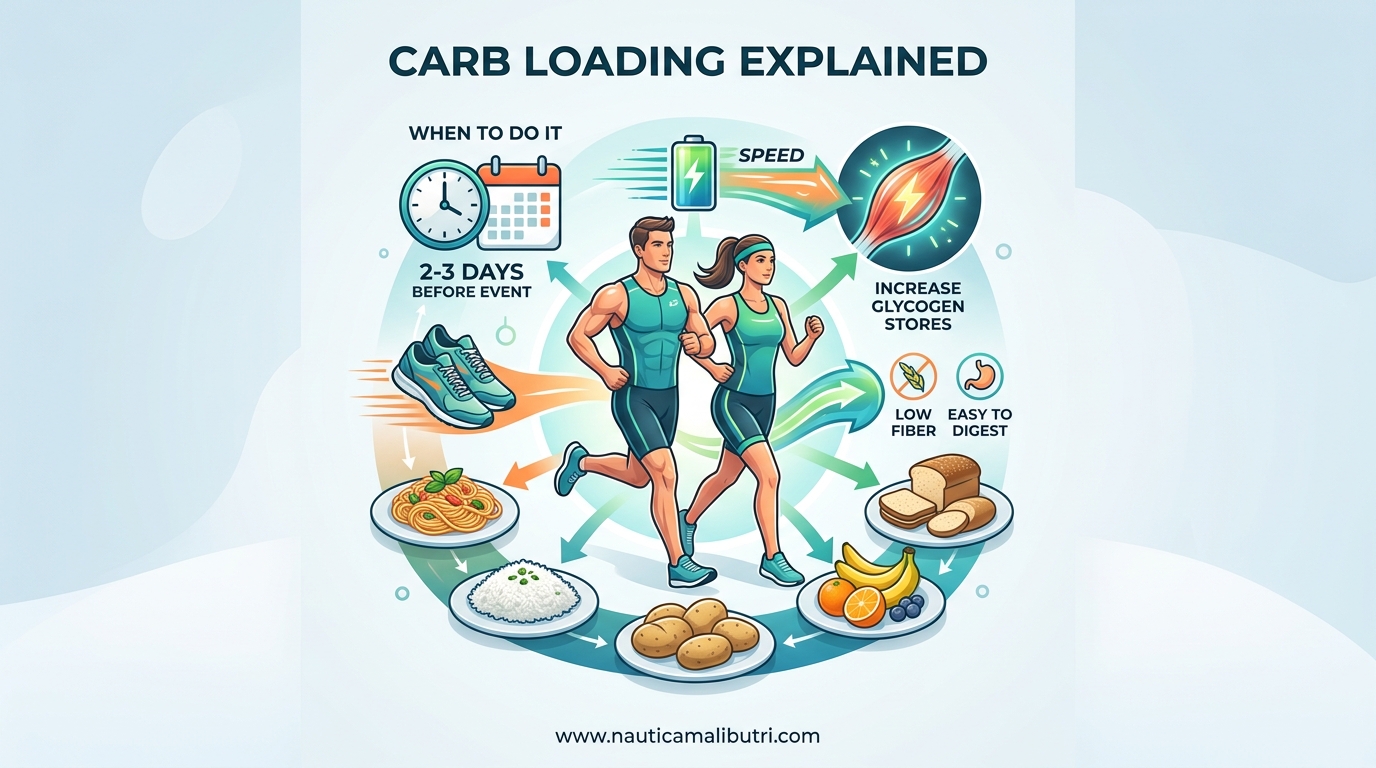
Carb loading explained simply means maximizing your body’s fuel stores before a big endurance event. I have used this strategy for half marathons, century rides, and triathlons ranging from sprint to full IRONMAN distance. When done right, it can improve your performance by 2-3% and help you avoid the dreaded wall.
In this guide, I will break down exactly how carb loading works, why it matters specifically for triathletes, and how to execute it without the common pitfalls that leave athletes bloated and miserable on race morning. You will learn the science behind glycogen storage, get practical formulas for calculating your carb needs, and discover triathlon-specific protocols that most generic guides ignore.
Table of Contents
What Is Carb Loading
Carb loading is a nutritional strategy where endurance athletes increase carbohydrate intake in the days leading up to an event to maximize muscle glycogen stores. Your body normally stores about 100 to 120 millimoles of glycogen per kilogram of muscle. During a proper carb load, you can boost these stores by 25 to 50% above normal levels.
The classic target is consuming 10 grams of carbohydrates per kilogram of body weight daily for 36 to 48 hours before competition. For a 70kg athlete, that equals 700 grams of carbs per day, which is roughly double normal intake. This surge in carbs, combined with reduced exercise during your taper, signals your muscles to stockpile glycogen.
Modern sports science has refined this approach significantly since the 1960s. Researchers now know that depletion phases and week-long protocols are unnecessary. Studies by Bussau and colleagues demonstrated that just 24 hours of high carbohydrate intake can maximize glycogen stores when paired with rest.
How Carb Loading Works
Your muscles and liver store carbohydrates as glycogen, which your body converts to glucose for energy during exercise. When you consume excess carbohydrates during a loading phase, your muscles store more glycogen than they typically hold. This extra fuel becomes critical when events last longer than 90 minutes.
Here is what happens inside your body during carb loading:
Increased glycogen synthesis: With reduced training and high carb availability, your muscles upregulate glycogen synthase, the enzyme responsible for converting glucose into stored glycogen. This creates a supersaturation effect.
Water retention occurs: For every gram of glycogen stored, your body retains 3 to 4 grams of water. This explains why you might gain 1 to 2 kilograms during carb loading. It is normal, temporary, and actually helps with hydration.
Fatigue resistance improves: Research consistently shows that maximizing glycogen stores delays the onset of fatigue by 15 to 25% in endurance events. You can maintain higher intensity longer before tapping into fat oxidation, which is less efficient for high-output efforts.
Who Benefits from Carb Loading
Carb loading provides measurable benefits for endurance athletes participating in events lasting longer than 60 to 90 minutes. This threshold exists because your body stores enough glycogen for roughly 90 minutes of moderate to high-intensity exercise without supplemental fueling.
Marathon runners see significant benefits since they typically finish in 2 to 6 hours, well beyond glycogen limits. Triathletes competing in Olympic distance and longer absolutely need carb loading. Cyclists doing century rides or races over 50 miles should load. Long-distance swimmers preparing for events over 2 kilometers benefit as well.
However, carb loading is unnecessary for shorter efforts. A 5K run, sprint triathlon, or 30-minute HIIT session does not require elevated glycogen stores. Your normal muscle glycogen will handle these durations without issue. Loading for short events may actually cause GI distress without providing any performance advantage.
Carb Loading for Triathlon
Triathlon presents unique carb loading challenges because you are preparing for three distinct disciplines with varying intensities and durations. Unlike marathon runners who pace steadily, triathletes must fuel for a swim start, aggressive bike leg, and potentially gut-challenging run finish. Your loading strategy should match your race distance.
Sprint Triathlon (750m Swim / 20km Bike / 5km Run)
Sprint triathlons typically finish in 60 to 90 minutes for most age-groupers. At this duration threshold, full carb loading is optional. A 24-hour moderate increase to 8g per kg bodyweight the day before, combined with a normal race morning breakfast, provides adequate fuel without digestive burden.
I have completed dozens of sprint races without formal loading. Focus instead on a low-residue dinner the night before and familiar breakfast race morning. Your normal glycogen stores plus race-day nutrition will carry you through.
Olympic Distance Triathlon (1.5km Swim / 40km Bike / 21km Run)
Olympic distance events last 2 to 3 hours for most athletes. This is where carb loading becomes essential. Start your protocol 36 hours before your wave start. Target 9 to 10g per kg bodyweight for two full days while tapering training volume to near zero.
Practice your exact race morning breakfast during your final training block. The Olympic distance bike leg is long enough that poor loading will show in your run split when glycogen depletion hits around kilometer 15.
IRONMAN 70.3 (1.9km Swim / 90km Bike / 21km Run)
Half-IRONMAN events demand a full 48-hour carb loading protocol. Begin precisely two days before your race start time. You need 10g per kg minimum, and some athletes benefit from 10 to 12g per kg depending on body composition.
My personal approach for 70.3 races includes starting Thursday morning for a Saturday race. I front-load carbs earlier in the day to avoid sleeping with a full stomach. Thursday evening and all day Friday become carb-focused with minimal fiber.
Full IRONMAN (3.8km Swim / 180km Bike / 42km Run)
Full IRONMAN distance requires the most aggressive carb loading strategy. You will be racing 8 to 17 hours, consuming thousands of calories on course, but starting with full stores is still critical. Begin 48 hours before race start with 10g per kg target.
Race morning becomes part of your loading strategy. Consume 2 to 3g per kg bodyweight 3 to 4 hours before your swim start. This tops off liver glycogen after your overnight fast. Then continue fueling during the race itself.
The swim start adrenaline and saltwater swallowing can challenge your stomach. A properly executed carb load plus practiced race nutrition prevents the walk-of-shame marathon finish that destroys your split goals.
How Many Carbs Do You Need
Research consistently recommends 8 to 12 grams of carbohydrates per kilogram of body weight daily during your loading phase. I use 10g per kg as my baseline target, which works for most triathletes. Heavier athletes or those with higher metabolic rates may need the upper end of this range.
Here is how to calculate your personal target:
Step 1: Record your body weight in kilograms. If you measure in pounds, divide by 2.2.
Step 2: Multiply your weight by 10. For a 70kg athlete, that is 700 grams of carbs per day. For an 85kg athlete, you are looking at 850 grams.
Step 3: Distribute across meals and snacks. Aim for 150 to 200g per meal with carb-heavy snacks between.
Hitting 700g of carbs daily feels overwhelming at first. Most athletes eat 250 to 400g carbs normally, so this represents a significant increase. Here are practical ways to reach your target without force-feeding yourself:
Choose liquid carbs for part of your intake. Sports drinks, fruit juices, and smoothies pack carbs without the bulk of solid food. White rice at 45g carbs per cup is more efficient than brown rice at 35g with extra fiber. Dried fruit, pretzels, and white bread with honey add density without volume.
I track my intake using a simple app during loading days. Seeing the running total helps me pace intake and avoid the midnight realization that I am 200g short of target.
When to Start Carb Loading
The optimal carb loading window begins 36 to 48 hours before your event start time. This timing maximizes glycogen synthesis while minimizing GI distress from prolonged high-carb eating. Starting earlier provides no additional benefit and may cause bloating.
Here is the exact timeline for a Saturday morning race:
Thursday morning (48 hours out): Begin increasing carb intake at breakfast. Start reducing training volume to easy 30-minute sessions or complete rest.
Thursday evening: First fully carb-focused dinner. White pasta, white rice, or potatoes with minimal fiber and fat.
Friday (24 hours out): Full carb loading day. Every meal and snack should prioritize refined carbohydrates. Avoid high-fiber foods completely. Hydrate aggressively with electrolytes.
Saturday morning (race day): Top-off breakfast 3 to 4 hours before start. Simple carbs only, familiar foods only.
Your exercise taper is just as important as carb timing. Continuing hard training while trying to load carbs creates a tug-of-war where neither goal succeeds. Research shows that glycogen synthesis is highest when muscles are rested and insulin sensitivity is elevated.
Carb Loading Protocols
Two main carb loading protocols exist today. The classic approach developed in the 1960s involved a glycogen depletion phase followed by loading. Modern research has simplified this significantly, making carb loading accessible without week-long preparation.
Classic 6-Day Protocol (Historical)
The original method, developed by Scandinavian researchers in the 1960s, involved three days of hard training on low carbs followed by three days of rest with high carbs. This created a supercompensation effect where glycogen stores rebound above normal levels.
However, this depletion phase left athletes exhausted and mentally drained before competition. The stress of three hard days with restricted carbs often outweighed the benefits. Modern sports science has largely abandoned this approach for endurance athletes.
Modern 2-3 Day Protocol (Recommended)
Research by Sherman in the early 1980s demonstrated that the depletion phase was unnecessary. A 1981 study showed that a three-day high-carb protocol without depletion produced identical glycogen levels. Bussau’s 2002 research further refined this, finding that just one day of high carb intake with rest could maximize stores.
The modern approach I recommend for triathletes:
Duration: 36 to 48 hours of elevated carb intake
Carb target: 10g per kg bodyweight daily
Exercise: Complete rest or easy 20 to 30-minute sessions
Fiber: Low-residue diet to minimize gut bulk
This protocol is easier to execute, less mentally taxing, and produces equivalent results. Unless you are a researcher studying historical methods, skip the depletion phase entirely.
Hydration During Carb Loading
Every gram of glycogen stores requires 3 to 4 grams of water. This means proper hydration is essential during your loading phase. Dehydrated muscles cannot store glycogen effectively, undermining your entire strategy.
Increase fluid intake to pale yellow urine color throughout your loading days. Include electrolytes, particularly sodium, to help your body retain the water it needs for glycogen storage. Do not panic about temporary weight gain from this water retention, it actually improves your hydration status on race day.
Foods to Eat and Avoid
Successful carb loading requires strategic food choices. You need maximum carbs with minimum fiber, fat, and protein. These other macronutrients slow digestion, increase satiety too quickly, and add gut bulk you do not want on race morning.
Here is your carb loading food guide:
Foods to Prioritize:
White rice, white pasta, and white bread provide dense carbs without fiber. Pancakes, waffles, and bagels work well for breakfast. Pretzels, rice cakes, and crackers make perfect snacks. Bananas, ripe fruits, and fruit juices offer easy liquid carbs. Sports drinks and energy gels can supplement meals.
Honey, maple syrup, and jam add carb density to any meal. Peeled potatoes, especially mashed or roasted without skin, are excellent. Low-fiber cereals with milk or alternatives work for quick breakfasts.
Foods to Limit or Avoid:
Whole grains including brown rice, whole wheat bread, and quinoa add fiber that creates gut residue. High-fiber vegetables like broccoli, beans, lentils, and large salads should be eliminated. High-fat foods including fried items, creamy sauces, and excessive cheese slow digestion and displace carb calories.
Large protein portions from steak, heavy fish, or protein shakes fill you up without adding carbs. Spicy foods and unfamiliar cuisines risk GI distress. Alcohol interferes with glycogen synthesis and hydration.
The Low-Residue Diet Explained
Low-residue means low fiber specifically. Fiber is indigestible plant matter that adds bulk to your digestive tract. During carb loading, you want minimal gut content on race morning to prevent bathroom emergencies during your race.
Switch to white versions of all grains. Peel fruits and vegetables. Avoid nuts, seeds, and legumes entirely. This keeps your digestive system relatively empty while still providing the carbs you need for fuel storage.
Gut Training During Carb Loading
This section addresses the biggest gap I see in generic carb loading guides. You must train your gut to handle high carb intake, just as you train your legs for the bike. Triathletes who attempt aggressive carb loading without practice often end up bloated, nauseated, or worse on race day.
I learned this lesson the hard way during my first 70.3. I followed a textbook carb loading plan but had never practiced eating this way during training. Race morning brought immediate GI distress that haunted my entire run leg.
Here is how to integrate gut training into your preparation:
Practice carb loading before long training sessions: Before your longest bricks and weekend rides, execute a mini carb load for 24 hours. This teaches your digestive system to process high carb loads while under mild exercise stress.
Test your race morning breakfast repeatedly: Eat the exact breakfast you plan for race day before every long training session for at least 4 weeks. Your gut will adapt to processing that specific meal before exercise.
Train with race-day nutrition: Use the same gels, drinks, and chews during training that you will consume on course. Gut training means your intestines upregulate carbohydrate transporters in response to repeated high-carb exposure.
Gradually increase carb targets: If 10g per kg feels overwhelming in practice, start with 7g and work upward over several training cycles. Your gut adapts with repeated exposure.
Experienced triathletes on forums consistently cite gut training as the most overlooked aspect of race preparation. You can have perfect fitness, but if your stomach rebels at mile 10 of the run, your race is over.
Common Carb Loading Mistakes
Even experienced athletes make these carb loading errors. Avoiding these mistakes can be the difference between a PR and a DNF. Here are the most common pitfalls:
1. Overeating total calories instead of just carbs: Loading does not mean eating everything in sight. A large fatty steak dinner displaces the carb calories you actually need. Focus on increasing carbs while keeping fat and protein moderate.
2. Choosing high-fiber whole grains: Brown rice and whole wheat pasta seem healthier, but the fiber creates gut bulk and potential race-day bathroom emergencies. Save the fiber for after your race.
3. Trying new foods during loading week: Race week is not the time to experiment with that new energy bar or exotic cuisine. One bad reaction can ruin months of training. Stick to foods you have tested repeatedly.
4. Neglecting hydration: Dehydrated muscles cannot store glycogen. The water weight you gain during proper loading is temporary and beneficial. Drink aggressively throughout your loading phase.
5. Carb loading for events under 90 minutes: Sprint triathlons and 5K races do not require loading. You will gain water weight and risk GI issues with no performance benefit. Reserve loading for truly endurance events.
6. Panicking about temporary weight gain: Seeing the scale jump 1 to 2 kilograms during carb loading stresses many athletes. This is water bound to glycogen, not fat. You will lose it during the race as you burn through glycogen stores.
Frequently Asked Questions
Should you carb load for a triathlon?
Yes, carb loading benefits triathletes for Olympic distance and longer events lasting over 90 minutes. Sprint triathletes may not need formal loading. For 70.3 and full IRONMAN, a 48-hour protocol consuming 10g carbs per kg bodyweight is essential for optimal performance.
How to get 700g of carbs a day?
Hit 700g daily by combining dense carb sources: white rice (45g per cup), pasta (40g per cup), bagels (50g each), bananas (25g each), fruit juice (25g per cup), and sports drinks (15g per serving). Spread across 3 meals and 3 snacks. Use liquid carbs like smoothies to reduce bulk.
Is carb loading good for marathon runners?
Yes, carb loading significantly benefits marathon runners. Research shows it improves endurance performance by 2-3% and delays fatigue. Marathoners should consume 10g carbs per kg bodyweight for 36-48 hours before race start while tapering training volume.
What is the 48 hour carb loading rule for peak marathon performance?
The 48-hour rule means starting high-carb intake exactly two days before your event. Begin at the same time of day as your race start. Consume 10g carbs per kg bodyweight daily with complete rest or minimal exercise. This timing maximizes glycogen stores without unnecessary prolonged eating.
Conclusion
Carb loading explained for triathletes comes down to three core principles: timing your 36 to 48 hour loading window correctly, consuming 10 grams of carbs per kilogram of bodyweight daily, and choosing low-residue foods that will not haunt you on race morning. When executed properly, this strategy can improve your performance by 2 to 3% and prevent the catastrophic bonk that ends races.
The triathlon-specific protocols I have outlined here, from sprint to full IRONMAN, give you a framework that generic guides cannot provide. Remember that gut training is just as important as the loading itself. Practice your race nutrition during long training blocks so your digestive system is prepared when it matters.
Your next step is calculating your personal carb target based on bodyweight and planning your loading meals for your upcoming event. Start practicing now, and you will arrive at your next triathlon with fully stocked glycogen stores and a stomach that can handle the demands of swim, bike, and run. Race day success starts in the kitchen during taper week.