
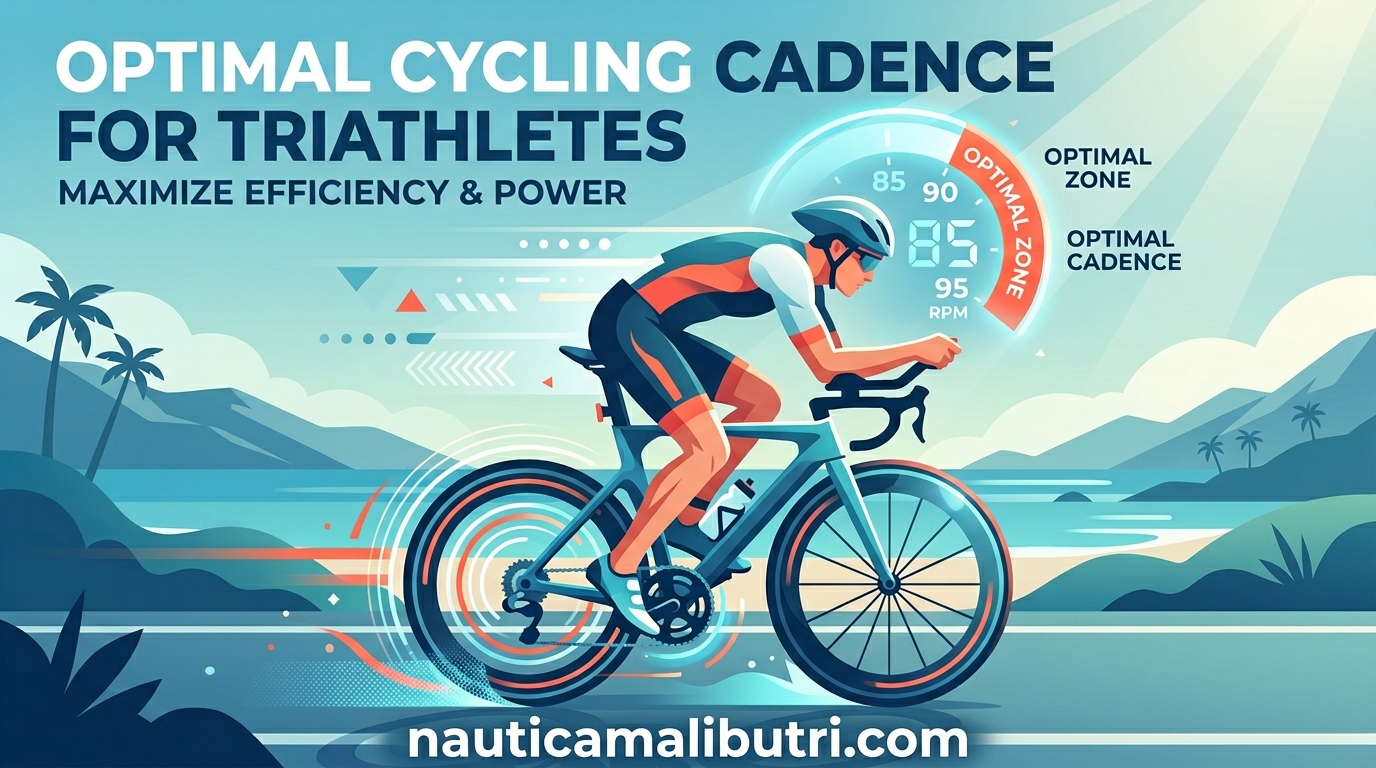
The optimal cycling cadence for triathletes falls in the range of 70 to 90 revolutions per minute (RPM), with most athletes finding their sweet spot between 80 and 85 RPM. This range maximizes pedaling economy, reduces muscular fatigue, and sets your legs up for a strong run off the bike. Unlike road cyclists who often spin at 90 to 100 RPM, triathletes must balance bike performance with the demands of the marathon or run leg that follows.
Our team has spent years coaching athletes through the Nautica Malibu Triathlon and other events, and we have seen firsthand how proper cadence training can transform race outcomes. The right RPM does not just make you faster on the bike. It preserves your running muscles for when you need them most.
In this guide, you will learn the science behind cadence selection, how to find your personal optimal RPM, specific drills to improve your pedal stroke, and why your cadence choice directly impacts your run performance.
Table of Contents
What is Cycling Cadence
Cycling cadence is the speed at which you turn the pedals, measured in revolutions per minute (RPM). One revolution equals one full circle of the crank arm, from the 12 o’clock position back to 12 o’clock. Most cyclists naturally pedal somewhere between 60 and 100 RPM, though trained athletes often self-select higher ranges.
You can measure your cadence using a bike computer with a cadence sensor, a power meter that includes cadence data, or by counting your pedal strokes for 15 seconds and multiplying by four. Many modern GPS watches and cycling apps also estimate cadence from motion sensors, though dedicated sensors provide the most accurate readings.
Understanding your baseline cadence is the first step toward optimization. Simply ride at a comfortable endurance pace and note your natural RPM. This self-selected cadence often reveals important clues about your muscular development and cardiovascular fitness.
Optimal Cycling Cadence for Triathletes
For triathlon, the typical cadence range is 70 to 90 RPM, which maximizes economy, energy use, and sets you up well to run off the bike. For most athletes, the optimal cadence will fall in the 80 to 85 RPM range. This differs from road cycling, where a higher cadence around 90 to 100 RPM is often optimal for pure cycling performance.
The reason triathletes use a slightly lower cadence relates to the unique demands of the sport. Road cyclists finish their event on the bike. Triathletes must dismount and run a 5K, 10K, half marathon, or full marathon afterward. Every pedal stroke at a lower, more forceful cadence recruits more fast-twitch muscle fibers, which are the same fibers you need for running.
Research published in the Journal of Sports Sciences found that experienced triathletes self-select cadences around 80 RPM during Ironman-distance events. This self-selection appears to represent an optimal balance between metabolic efficiency and muscular stress. Your body naturally gravitates toward what works best when fatigue sets in.
Low vs High Cadence: Effects on Your Body
The cadence you choose creates a trade-off between muscular strain and cardiovascular demand. Understanding this relationship helps you make smarter decisions during training and racing.
Low Cadence (60-75 RPM)
Lower cadences require more force per pedal stroke to maintain the same power output. This increased muscular demand places greater stress on your quadriceps, hamstrings, and glutes. While this can build strength and may be more metabolically efficient in terms of oxygen consumption, it comes at a cost.
The problem for triathletes is that low cadence cycling fatigues the same muscle groups needed for running. Research shows that run times following a low cadence bike leg can be significantly slower than after cycling at a higher cadence. That efficiency gain on the bike may cost you minutes on the run.
High Cadence (90-110 RPM)
Higher cadences reduce the force required per pedal stroke, shifting the workload toward your cardiovascular system. Your heart rate and breathing rate increase to supply the faster muscle contractions with oxygen and clear metabolic byproducts.
The advantage for triathletes is that high cadence cycling primarily uses slow-twitch muscle fibers and spares your fast-twitch fibers for the run. Studies have demonstrated that triathletes who cycle at 90 to 100 RPM can run approximately one minute faster in a 10K following the bike leg compared to those who ride at 70 to 80 RPM.
However, there is a limit. Extremely high cadences above 110 RPM become inefficient due to increased internal friction and coordination demands. Most athletes also cannot sustain very high cadences for the duration of a long-course triathlon without accumulating fatigue.
The Triathlon Sweet Spot
At 80 to 85 RPM, you achieve a balance that minimizes muscular fatigue while keeping cardiovascular demand manageable. This range allows you to maintain good power output without exhausting your legs before the run.
How Cadence Affects Your Run Off the Bike
The bike-run transition is where cadence choices reveal their true impact. The muscles you fatigue on the bike are the same ones you need for running. Your quads, hamstrings, and calves must transition from thousands of circular pedal strokes to the linear motion of running.
Research conducted on triathletes completing a 40K bike followed by a 10K run found that those who cycled at 90 to 100 RPM ran significantly faster than those who cycled at 70 to 80 RPM. The higher cadence group preserved their leg strength and neuromuscular coordination for the run.
The mechanism behind this relates to muscle fiber recruitment. Lower cadences require more force, which recruits more fast-twitch muscle fibers. These fibers fatigue quickly and are essential for running economy. Higher cadences rely more on slow-twitch fibers and cardiovascular fitness, sparing your fast-twitch capacity.
We have observed this pattern consistently in athletes preparing for the Malibu Triathlon. Those who train consistently at 85 to 90 RPM report fresher legs in T2 and faster opening run splits. The difference is often most noticeable in the first two kilometers of the run, where low-cadence cyclists struggle with heavy, fatigued legs.
Finding Your Personal Optimal Cadence
While 80 to 85 RPM represents a general recommendation, your personal optimal cadence depends on several factors. These include your cycling experience, muscle fiber composition, race distance, terrain, and fitness level.
Step 1: Establish Your Baseline
Ride for 20 minutes at a comfortable endurance pace on flat terrain. Do not look at your cadence display. Simply ride at what feels natural and sustainable. After 20 minutes, check your average cadence. This is your self-selected cadence.
Step 2: Test Different Ranges
On subsequent rides, experiment with cadences 10 RPM below and 10 RPM above your baseline. Note your heart rate, perceived exertion, and leg sensations at each cadence. Look for the range where you feel smoothest and most sustainable.
Step 3: Consider Your Background
Runners transitioning to triathlon often prefer higher cadences that feel similar to their running turnover. Strong cyclists from a road background may naturally prefer lower, more forceful pedaling. Neither is wrong, but triathlon-specific training should push you toward the 80 to 90 RPM range.
Step 4: Account for Race Distance
Your optimal cadence for a sprint triathlon may differ from your Ironman cadence. Longer events typically favor slightly lower cadences that reduce cardiovascular stress over many hours. Shorter races allow you to push higher cadences that spare your legs for shorter runs.
Step 5: Use Power Data
If you have a power meter, analyze your cadence at different power outputs. Many athletes naturally increase cadence as power increases. Understanding this relationship helps you plan pacing strategies for hilly courses or windy conditions.
Cadence by Race Distance
Different triathlon distances place different demands on your body, and your optimal cadence should reflect these differences. Here is how to approach cadence selection based on race distance.
Sprint Triathlon (750m swim, 20K bike, 5K run)
For sprint distance events, aim for 85 to 95 RPM. The short bike leg means you can afford higher cardiovascular demand, and the brief 5K run that follows benefits greatly from fresh legs. The total event time is short enough that muscular fatigue from lower cadences becomes less relevant.
Olympic Distance (1.5K swim, 40K bike, 10K run)
The Olympic distance represents a middle ground, with most athletes benefiting from 80 to 90 RPM. The 40K bike requires sustainable pacing, while the 10K run is long enough that leg preservation matters significantly.
Half Ironman (70.3)
For 70.3 events, target 75 to 85 RPM. The 90K bike leg is long enough that excessive cardiovascular stress accumulates. You want to save energy for the half marathon while maintaining good bike speed. Self-selection studies show most experienced 70.3 athletes naturally settle around 80 RPM.
Full Ironman
Ironman racing favors the lower end of the optimal range, typically 70 to 80 RPM. The 180K bike leg is a test of energy management. Lower cadences reduce heart rate and breathing demand, conserving glycogen for the marathon. Many elite Ironman athletes ride at 75 to 80 RPM successfully.
5 Essential Cadence Drills for Triathletes
Improving your cadence requires specific training that develops neuromuscular coordination and pedaling efficiency. These five drills form the foundation of cadence development for triathletes.
1. Single-Leg Drills
Single-leg drills isolate each leg to identify and correct weaknesses in your pedal stroke. Unclip one foot and rest it on the trainer or let it hang free. Pedal for 30 to 60 seconds with your clipped-in leg only, focusing on smooth circles through the entire revolution.
Pay attention to the dead spots at 12 o’clock and 6 o’clock positions. Your goal is to eliminate any clunking or unevenness. Switch legs and repeat. Start with low resistance and build as your coordination improves.
2. Endurance Spinning
Endurance spinning develops your ability to maintain high cadences smoothly. Ride for 5 to 10 minutes at a cadence 10 to 15 RPM above your normal range, while keeping the resistance light enough to maintain form. Your heart rate will rise, but focus on staying relaxed and avoiding bouncing in the saddle.
This drill improves your neuromuscular efficiency at higher RPMs. As you adapt, your self-selected cadence will naturally increase. Perform this drill once or twice per week during base training.
3. Kick and Pull Drill
The kick and pull drill emphasizes the transition phases of the pedal stroke. Focus on kicking your toe forward over the top of the stroke (11 o’clock to 1 o’clock) and pulling your heel backward through the bottom (5 o’clock to 7 o’clock).
These are the zones where most cyclists lose power. By consciously practicing these transitions, you develop a more complete and efficient stroke that supports higher cadences without increased effort.
4. Isolated Leg Training (ILT)
Similar to single-leg drills but performed on the road or trainer with both feet clipped in. Pedal with one leg applying power while the other simply follows the motion without contributing. Alternate legs every 30 seconds.
This drill highlights how much each leg contributes to your overall power. Most cyclists have a dominant leg that does more work. ILT helps balance this asymmetry, leading to smoother, more efficient pedaling at any cadence.
5. Cadence Intervals
Cadence intervals build your capacity to generate power across a range of RPMs. After a good warm-up, perform 3 to 5 intervals of 3 to 5 minutes each. Start each interval at your natural cadence, then increase by 5 RPM every minute until you reach your maximum sustainable cadence.
Recovery between intervals should be easy spinning. This workout expands your comfortable cadence range and teaches you to produce power efficiently at higher RPMs.
Maintaining Cadence in Aero Position
One of the most common issues triathletes face is a significant drop in cadence when transitioning from the base bar to the aero position. Forum discussions reveal that many riders experience a 10 to 15 RPM drop when getting into aerobars.
This happens because the aero position changes your hip angle and limits your ability to use your full pedal stroke. Your hip flexors are compressed, and your knee comes higher at the top of the stroke. Many athletes also feel less stable in aero, leading to a more conservative, lower cadence.
The solution starts with bike fit. A proper triathlon bike fit optimizes your hip angle for aero riding while allowing efficient pedaling. If your fit is too aggressive, you may sacrifice too much power for aerodynamics.
Specific drills can help. Practice high-cadence work specifically in your aero position during trainer sessions. Start with short periods of 2 to 3 minutes and extend as your comfort and coordination improve. Focus on keeping your upper body relaxed and your pedal stroke smooth.
We recommend spending at least 50 percent of your indoor training time in the aero position. This builds the specific strength and coordination needed to maintain your target cadence on race day.
Terrain-Specific Cadence Guidance
Different terrain demands different cadence strategies. Understanding how to adapt your RPM to conditions helps you maintain efficiency and speed across varied courses.
Headwinds
When facing a strong headwind, resist the urge to grind a big gear at low cadence. While it may feel satisfying to push through, the muscular cost is high. Instead, shift to an easier gear and maintain your target cadence. Your speed will drop, but your energy expenditure will be more sustainable.
Hills
Climbing typically requires lower cadences due to the resistance of gravity. However, try to avoid dropping below 70 RPM on longer climbs. Very low cadence climbing fatigues your legs quickly. Stand periodically to recruit different muscles and give your seated muscles a break.
Descending
Downhills offer an opportunity to spin out your legs and prepare for the next climb or flat section. Shift into easier gears and maintain a quick, light cadence. This flushes metabolic byproducts and keeps your muscles ready.
Drafting
When drafting behind another cyclist, you can maintain a slightly higher cadence at the same power output due to the reduced wind resistance. Use this advantage to spin efficiently and save energy.
Malibu Triathlon Considerations
The Nautica Malibu Triathlon course features rolling hills along the Pacific Coast Highway and potential coastal winds. The terrain rewards athletes who can maintain consistent cadence across varying gradients. Practice gear selection that keeps you in your target range regardless of the slope.
Frequently Asked Questions
What is the best cadence for a triathlon bike?
The best cadence for a triathlon bike is 70 to 90 RPM, with 80 to 85 RPM being the optimal range for most athletes. This differs from road cycling because triathletes must conserve leg muscles for the run that follows. Sprint triathletes can push toward 90 to 95 RPM, while Ironman athletes often favor 75 to 80 RPM for energy conservation.
What is the 80/20 rule in triathlon?
The 80/20 rule in triathlon training refers to doing approximately 80 percent of your training at low intensity and 20 percent at moderate to high intensity. This principle, based on research by Stephen Seiler, applies across swimming, cycling, and running. For cadence specifically, about 80 percent of your cycling should be at your natural self-selected cadence, with 20 percent dedicated to cadence drills and high or low cadence work.
What is the most efficient cadence for cycling?
The most efficient cadence for cycling depends on your definition of efficiency. Metabolically, lower cadences around 60 to 70 RPM are most efficient in terms of oxygen consumption. However, for triathletes, the most efficient cadence balances bike performance with run preservation, typically falling in the 80 to 85 RPM range. Self-selected cadence, which your body naturally gravitates toward, often represents your most efficient option.
How many rpms do pro triathletes hit?
Pro triathletes typically pedal between 85 and 95 RPM for most racing situations. However, there is significant individual variation. Some elite triathletes like Caroline Steffen have succeeded with cadences as low as 70 to 75 RPM. Pro cyclists in road races often use 100+ RPM, but triathletes prioritize run preservation over pure cycling optimization.
What was Lance Armstrong’s cadence?
Lance Armstrong was famous for his extremely high cadence, typically pedaling at 100 to 110 RPM even on climbs. This high cadence style, learned from his coach Chris Carmichael, was considered revolutionary in the late 1990s and early 2000s. While this approach worked for Armstrong as a pure cyclist, it is higher than what most triathletes should aim for due to the running demands of triathlon.
Conclusion
Finding your optimal cycling cadence for triathletes is a process of experimentation, measurement, and adaptation. The general range of 70 to 90 RPM provides a starting point, with 80 to 85 RPM serving as the sweet spot for most athletes.
Remember that your optimal cadence is personal. It depends on your muscle fiber composition, cycling background, race distance, and fitness level. Use the testing protocol outlined in this guide to find your individual range.
Most importantly, train your cadence deliberately. The drills and workouts described here will help you develop the neuromuscular efficiency to maintain your target RPM across varied terrain and through the challenging aero position. Your legs and your run splits will thank you.