
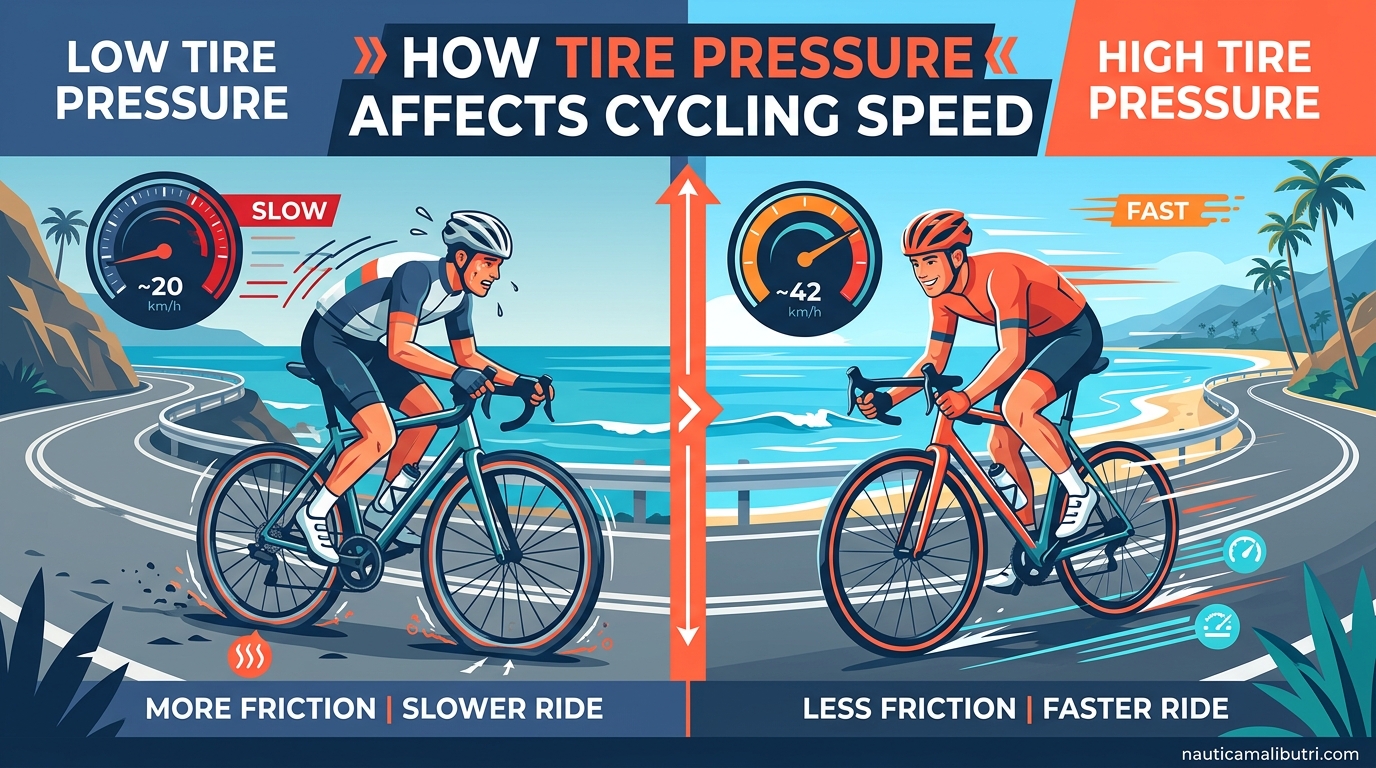
Here is something that might surprise you: I used to pump my road bike tires to the maximum pressure printed on the sidewall before every ride. I thought higher PSI meant less tire flex, less rolling resistance, and therefore more speed. I was wrong. After testing different pressures over hundreds of miles and reviewing data from industry experts, I discovered that how tire pressure affects cycling speed is far more nuanced than the old “harder is faster” mantra.
This guide will break down the science behind tire pressure and speed in plain language. You will learn why the pros have moved away from rock-hard tires, how to find your personal optimal pressure, and specific strategies for triathlon race day. Whether you are training for your first sprint or your tenth Ironman, understanding this relationship can save you watts, improve comfort, and make you faster overall.
Table of Contents
How Tire Pressure Affects Cycling Speed: The Science Simplified
Yes, tire pressure absolutely affects cycling speed, but not in the way most cyclists assume. As pressure increases, your tire deforms less at the contact patch, which reduces energy lost to casing flex. However, higher pressure also makes the tire bounce more over road imperfections, transferring vibration to you and your bike. This creates suspension losses that can cancel out, or even exceed, the gains from reduced rolling resistance.
The relationship follows a U-shaped curve. At very low pressures, the tire flexes excessively, creating high hysteretic losses. At very high pressures, the tire skips and bounces over rough surfaces, creating high suspension losses. The sweet spot is somewhere in the middle, and it changes based on your weight, tire width, and road conditions.
Understanding Rolling Resistance
Rolling resistance is the force resisting motion when a tire rolls on a surface. It comes from two main sources: the deformation of the tire casing as it contacts the road (hysteretic losses) and the vertical movement required to roll over surface imperfections (suspension losses). Lowering pressure reduces suspension losses but increases hysteretic losses. Raising pressure does the opposite.
On smooth laboratory drums, higher pressure always wins because there are no surface imperfections to bounce over. Real roads have cracks, patches, gravel, and texture. This is why lab testing led engineers astray for decades. The fastest pressure on glass is not the fastest pressure on asphalt.
The Myth That Higher Pressure Is Always Faster
For years, cyclists believed that maximum sidewall pressure was the path to speed. Track cyclists pumped tubulars to 160 PSI. Road racers squeezed 120 PSI into 23mm tires. The logic seemed sound: a harder tire deforms less, so it should roll faster. But real-world testing proved this wrong.
Joshua Poertner, former technical director at Zipp and now CEO of Silca, pioneered much of the modern understanding of tire pressure optimization. His team discovered that above a certain pressure threshold, the energy lost to vibration outweighs the energy saved from reduced tire flex. On anything but perfectly smooth surfaces, there is a break point where adding more air actually slows you down.
The Breaking Point Explained
Imagine riding over a rough chip-seal road at 110 PSI. Every tiny bump causes your tire to skip slightly off the surface. Your body absorbs these micro-impacts, and energy that should propel you forward gets dissipated as heat and vibration. Drop that pressure to 80 PSI, and the tire can absorb those same bumps, maintaining contact with the road and keeping your momentum.
The breaking point varies by rider weight and tire width. A 150-pound cyclist on 28mm tires might find their optimal pressure around 75-80 PSI. A 200-pound rider on the same tires might need 90-95 PSI. A 200-pound rider on 25mm tires might need 100+ PSI to avoid pinch flats, but will face higher suspension losses.
Hysteretic Losses vs Suspension Losses: What Actually Slows You Down
To understand how tire pressure affects cycling speed, you need to know the difference between these two competing forces. They work against each other, and optimal pressure is where they balance.
Hysteretic Losses: The Cost of Flex
Hysteretic losses occur because rubber and casing materials are not perfectly elastic. When your tire deforms at the contact patch, some energy gets lost as heat in the tire material rather than returning to propel the bike forward. Higher pressure reduces the size of the contact patch and the amount of deformation, which lowers hysteretic losses.
This is why, on smooth surfaces, higher pressure is genuinely faster. There are no bumps to bounce over, so suspension losses are minimal. The only resistance comes from tire deformation, and more air means less flex.
Suspension Losses: The Cost of Vibration
Suspension losses, also called impedance losses, happen when your tire cannot absorb road imperfections and instead transmits vibration to the rider and bike. Your body acts like a damper, absorbing vertical movement and converting forward momentum into heat. Rougher surfaces create more suspension losses.
At lower pressures, the tire itself absorbs small bumps, acting as a micro-suspension system. The tire deforms around imperfections rather than bouncing over them. This keeps the rider stable and preserves momentum, even though the tire itself is flexing more.
Finding the Balance
The optimal pressure is where the combined losses from hysteresis and suspension are minimized. For most road conditions, this is lower than the maximum pressure printed on your sidewall. Modern testing suggests that being 10 PSI under optimal is better than 1 PSI over optimal, because the performance penalty for over-inflation is steeper.
How to Find Your Optimal Tire Pressure
Finding your personal optimal pressure requires some experimentation, but you can start with proven baselines and fine-tune from there. Here is a step-by-step method to dial in your setup.
Step 1: Start with a Baseline
Use your weight and tire width to establish a starting point. These are general guidelines for paved roads:
For 25mm tires: Start around 90-100 PSI for a 150-pound rider, adding 5 PSI per 20 pounds of additional weight.
For 28mm tires: Start around 75-85 PSI for a 150-pound rider, adding 4 PSI per 20 pounds.
For 30mm+ tires: Start around 65-75 PSI for a 150-pound rider.
Remember to include the weight of your bike, gear, and water. A 150-pound rider with a 17-pound bike and 3 pounds of gear should calculate based on roughly 170 pounds total.
Step 2: Test on Your Typical Roads
Ride a familiar route at your baseline pressure and note your average speed, comfort level, and perceived effort. Drop pressure by 5 PSI and repeat the same route under similar conditions. Most riders find they feel slower at lower pressures initially, but data often shows similar or better average speeds with improved comfort.
Pay attention to road buzz in your hands and saddle. High-frequency vibration indicates pressure is too high. A squishy feeling or noticeable tire squirm in corners indicates pressure is too low.
Step 3: Adjust for Road Surface
Rougher surfaces require lower pressure to maintain the same comfort and efficiency. If you ride primarily on smooth asphalt, you can run slightly higher pressure. For chip-seal, rough concrete, or roads with frequent cracks, drop 5-10 PSI from your baseline. For gravel or cobblestones, you may need to drop 15-20 PSI.
Step 4: Fine-Tune by Feel
Your optimal pressure should feel supple and controlled, not harsh and buzzy. You should not feel the tire bottoming out on normal bumps, but you should feel small imperfections being absorbed rather than transmitted. Cornering should feel confident without noticeable tire roll.
Triathlon-Specific Tire Pressure Strategy
Triathletes have unique considerations when optimizing tire pressure. Race day conditions, transition logistics, and the demands of a multisport event all play into the equation.
Race Day Preparation
Check your tires the night before your race and inflate to your target pressure. Temperature changes between your hotel room and the start line can affect pressure, so account for this if you pump up indoors but start in cooler morning air. A drop of 10 degrees Fahrenheit reduces tire pressure by roughly 1-2 PSI.
Inspect the race course profile and surface conditions. If the bike course includes rough roads, railroad crossings, or significant elevation changes, consider running 5 PSI lower than your training pressure for improved comfort and control.
Transition Area Considerations
In T1, quickly check your tires visually and give them a squeeze. If they feel soft, use a CO2 inflator or mini pump to top off. In T2, your tires may have lost some pressure from the ride, but since you are moving to the run, this is less critical.
Some experienced triathletes slightly over-inflate before the swim, anticipating that the cold water and time in transition will bring pressure down to optimal levels by the time they start riding.
Course-Specific Adjustments
For hilly courses with fast descents, prioritize confidence and control over pure rolling efficiency. A slightly lower pressure improves cornering grip and reduces the chance of losing traction on variable surfaces. For flat, smooth courses like many Ironman events, you can run closer to the high end of your optimal range.
Aero Considerations
The 105% rule suggests that for optimal aerodynamics, your tire width should not exceed 105% of your rim’s internal width. Wider tires at lower pressures can create a lightbulb shape that increases drag. If you are running wide tires, ensure your rims are appropriately wide to maintain a smooth transition from tire sidewall to rim edge.
Real-World Testing: What the Data Shows
Independent testing from organizations like Silca, Bicycle Rolling Resistance, and media outlets like GCN has consistently shown that optimal tire pressure saves watts compared to both under-inflation and over-inflation.
Silca’s testing indicates that running 10 PSI above optimal costs approximately 3-5 watts per wheel compared to the sweet spot. Running 1 PSI above optimal costs roughly the same as running 10 PSI below. This asymmetry means erring slightly low is safer than erring slightly high.
Bicycle Rolling Resistance tests consistently show U-shaped curves in their data, with clear optimal points that vary by tire model, width, and surface. High-quality supple tires with flexible casings tend to have broader optimal ranges and perform better at lower pressures than stiff, heavy tires.
Speed Differences by Surface
On smooth asphalt, the difference between 90 PSI and 110 PSI might be negligible or slightly favor the higher pressure. On rough chip-seal, the lower pressure might be 0.5-1 km/h faster while also being significantly more comfortable. On cobblestones or rough gravel, the gap widens further, with lower pressures showing clear advantages.
Over a 40km time trial, these differences compound. A 0.5 km/h advantage equals roughly 1 minute saved. That could be the difference between a podium finish and an also-ran.
Why Comfort Equals Speed
One of the most important lessons in tire pressure optimization is that comfort and speed are not opposing forces. They are the same force viewed from different angles.
When your tires are over-inflated, every road imperfection creates a micro-bounce that your body must absorb. This constant vibration fatigues your muscles, numbs your hands, and requires energy to stabilize. Over the course of a long ride or race, this fatigue accumulates, reducing your power output and focus.
Properly inflated tires absorb these imperfections, keeping you stable and relaxed. You maintain better aerodynamic position, pedal more smoothly, and finish stronger. The speed gain from improved comfort often exceeds the theoretical loss from slightly higher rolling resistance.
The Long-Distance Factor
This comfort-speed relationship becomes more pronounced as distance increases. A slightly harsh setup might be tolerable for a one-hour criterium, but over 180km in an Ironman, it can break you. Triathletes especially should prioritize comfort knowing that preserved energy on the bike translates directly to better run performance.
Frequently Asked Questions
Does tire pressure affect bike speed?
Yes, tire pressure significantly affects bike speed through rolling resistance. Higher pressure reduces tire flex but increases vibration losses on real roads. The optimal pressure balances these factors and is typically lower than maximum sidewall ratings.
Is 40 psi too high for a bike?
For most road bikes, 40 PSI is actually quite low. Road tires typically run 70-100 PSI depending on rider weight and tire width. However, for mountain bikes or wide gravel tires (40mm+), 40 PSI might be appropriate or even high. Always check recommended ranges for your specific tire.
What is the 105% rule in cycling?
The 105% rule is an aerodynamic guideline stating that tire width should not exceed 105% of the rim’s internal width for optimal airflow. For example, a 28mm tire should pair with a rim at least 26.7mm wide internally to maintain smooth aerodynamic transition.
Why don’t pros ride at maximum pressure anymore?
Professional cyclists have moved away from maximum pressure because real-world testing proved that optimal pressure is lower than previously believed. Teams now use power meter data and specific surface testing to find the fastest pressure for each course, often 20-30 PSI below old norms.
How do I know if my tire pressure is too low?
Signs of insufficient pressure include noticeable tire squirm when cornering, the feeling of riding through sand on hard surfaces, rim impacts on bumps, and visible tire deformation when weighted. If you hear rim hits or feel unstable in turns, add air immediately.
Should I adjust tire pressure for wet conditions?
For wet roads, many experts recommend dropping 5-10 PSI to increase the tire’s contact patch and improve grip. The larger contact area provides better traction and confidence when cornering on slick surfaces. Just ensure you do not go so low that you risk pinch flats or tire roll.
Conclusion
How tire pressure affects cycling speed is one of the most misunderstood concepts in cycling. The old belief that harder is faster has been thoroughly debunked by real-world testing and modern understanding of rolling resistance physics. The truth is more nuanced: optimal pressure balances hysteretic losses against suspension losses, and that balance point is lower than many cyclists expect.
For triathletes, getting tire pressure right offers a rare combination of free speed and improved comfort. You do not need new equipment or intense training. You just need a pump, a pressure gauge, and the willingness to experiment. Start with the baselines in this guide, test on your local roads, and dial in your personal sweet spot. Your body will thank you, and your split times might surprise you.