
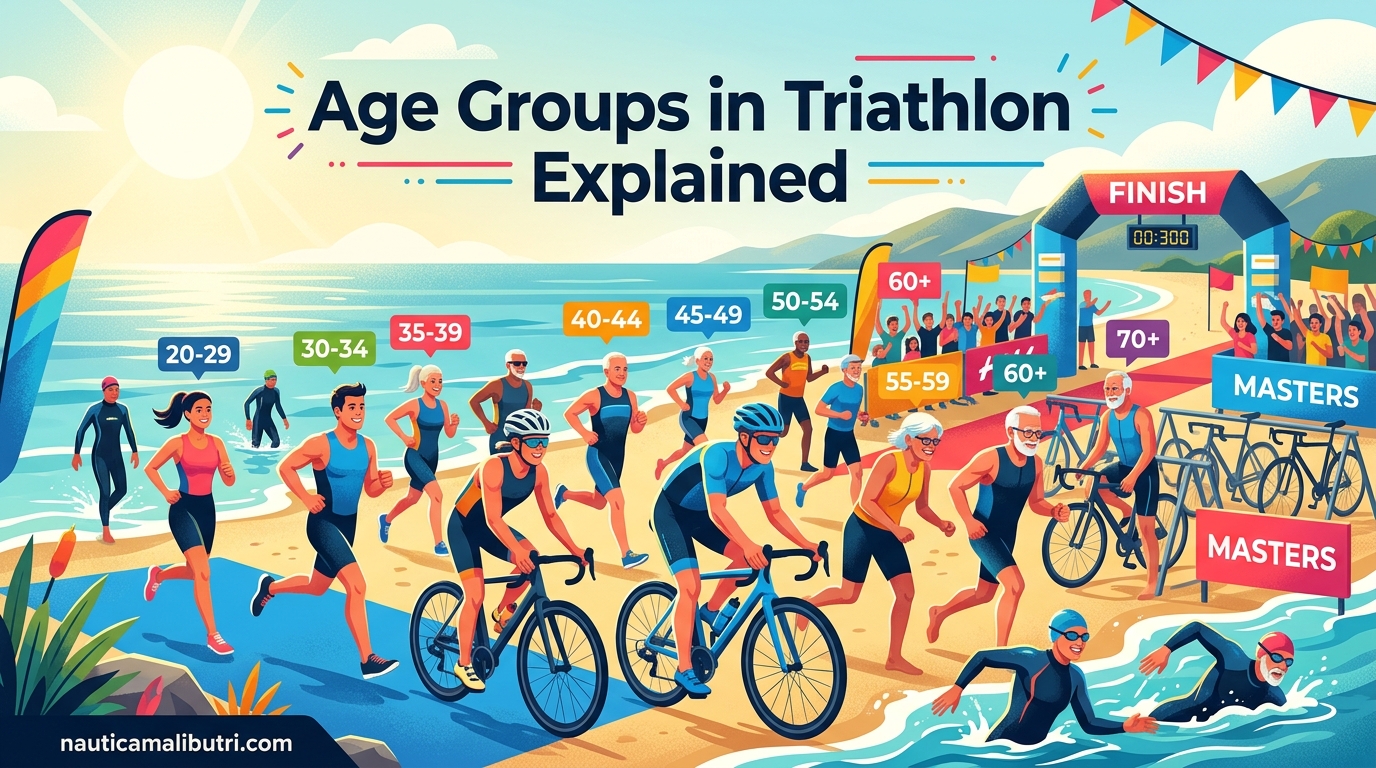
Triathlon age groups are how amateur athletes compete fairly against others in their life stage. Your age group is determined by your age on December 31 of the race year, not your age on race day. Most events use standard 5-year brackets starting at age 18, grouping athletes into categories like 25-29, 30-34, and 35-39.
If you are new to triathlon, understanding these age groups is essential for registration, race-day logistics, and setting realistic goals. Whether you are racing at the Nautica Malibu Triathlon or any other event worldwide, the age group system ensures you compete against peers with similar physiological profiles.
In this guide, we explain everything you need to know about age groups in triathlon. You will learn what it means to be an age-grouper, how the December 31 rule works, the standard age brackets used across the sport, and how different governing bodies like USAT, World Triathlon, and Ironman structure their categories.
Table of Contents
What Is an Age-Grouper
An age-grouper is any triathlete who does not hold a professional or elite license and competes in events organized by age categories. The term distinguishes amateur athletes from professionals who race for prize money and sponsorships.
Age-groupers make up the vast majority of triathlon participants. According to USA Triathlon, over 99 percent of registered triathletes compete as age-groupers. These athletes race for personal achievement, age group podium positions, and qualification spots for championship events.
The age-grouper system creates a level playing field. A 45-year-old accountant training 8 hours per week can compete for a podium spot against other 45-year-olds with similar time constraints. Without age groups, that same athlete would be racing against 25-year-old professionals and dedicated amateurs with unlimited training time.
Being an age-grouper does not mean you are not competitive. Many age-groupers train with the intensity and dedication of professionals. The difference lies in eligibility. Professional triathletes hold licenses from their national federations or World Triathlon that allow them to accept prize money. Age-groupers cannot accept prize money without forfeiting their amateur status.
Standard 5-Year Age Brackets
Triathlon age groups follow a standard structure using 5-year increments starting at age 18. This system applies to most sanctioned races in the United States and internationally.
The 18-19 bracket is unique because it covers only two years. After that, brackets run in 5-year blocks through the 75-79 age group. Athletes aged 80 and older compete together in the 80+ category.
Here are the standard age brackets used in triathlon:
| Age Bracket | Typical Race Year Age Range | Common Nickname |
|---|---|---|
| 18-19 | 18 to 19 years old | Collegiate/Youth |
| 20-24 | 20 to 24 years old | Young Adult |
| 25-29 | 25 to 29 years old | Open |
| 30-34 | 30 to 34 years old | Open |
| 35-39 | 35 to 39 years old | Open |
| 40-44 | 40 to 44 years old | Masters |
| 45-49 | 45 to 49 years old | Masters |
| 50-54 | 50 to 54 years old | Masters |
| 55-59 | 55 to 59 years old | Masters |
| 60-64 | 60 to 64 years old | Senior |
| 65-69 | 65 to 69 years old | Senior |
| 70-74 | 70 to 74 years old | Veteran |
| 75-79 | 75 to 79 years old | Veteran |
| 80+ | 80 years and older | Super Senior |
The 5-year bracket system balances fairness with practicality. Narrower brackets would create categories with too few athletes. Wider brackets would put 49-year-olds against 40-year-olds, creating disadvantages for the older athlete.
Competition intensity varies by age group. Based on forum discussions among triathletes, the 30-34, 35-39, and 40-44 brackets are typically the most competitive. These age groups attract athletes in their peak earning years who can afford quality equipment, coaching, and race entries. Life stage also matters. Athletes in their 30s and 40s often have established careers and family routines that allow consistent training.
The December 31 Race Age Rule
Your triathlon age group is determined by your age on December 31 of the race year. This rule applies regardless of when your birthday falls or when the race takes place.
Here is how it works. If you turn 40 on November 15, 2026, you race in the 40-44 age group for the entire year. Even races in January, February, or March would place you in the 40-44 bracket.
Conversely, if your birthday is January 15, 2026, you race in your current age group for the entire calendar year. You do not advance to the next bracket until the following year.
This system creates some interesting scenarios. An athlete born on December 31 might race nearly an entire year in an older age group. Someone born on January 1 gets maximum time in each bracket. Race directors use this fixed date to ensure consistency across the season.
The December 31 rule matters for championship qualification. World Triathlon and USAT national championships base qualification on your age group as of December 31. You cannot qualify at age 34 for the 35-39 championship in the same year. You must wait until the next calendar year.
USAT vs World Triathlon vs Ironman Age Group Systems
Different governing bodies use slightly different age group structures. Understanding these differences matters if you race across multiple organizations or aspire to championship events.
USA Triathlon (USAT) System
USAT is the national governing body for triathlon in the United States. USAT-sanctioned events follow the standard 5-year bracket structure described above. USAT also offers Youth and Junior categories for athletes under 18.
USAT National Championships require qualification through age group rankings or specific qualifying races. The top age group finishers at national championships can earn spots on Team USA for international competition.
World Triathlon System
World Triathlon (formerly ITU) governs the sport globally. Their age group championships use the same 5-year brackets but add additional requirements. To compete at the World Triathlon Age Group Championships, athletes must qualify through their national federations.
World Triathlon also uses different age group terminology for junior and youth categories. Junior Elite athletes compete in draft-legal races with different rules than age-groupers.
Ironman System
Ironman age groups generally follow the 5-year bracket system with one key difference. Ironman 70.3 and full Ironman World Championships use these brackets for qualification and results.
Ironman also offers the Age Group Qualifying (AGQ) program. Top finishers in each age group at qualifying races earn slots to the Ironman World Championship in Kona or the 70.3 World Championship.
| Organization | Age Brackets | Championship Qualification | Unique Features |
|---|---|---|---|
| USA Triathlon | 5-year brackets, 18-19 through 80+ | National rankings or qualifying races | Team USA selection; Youth categories available |
| World Triathlon | 5-year brackets, 18-19 through 80+ | National federation qualification | International championship events; Junior Elite separate |
| Ironman | 5-year brackets, 18-24 through 80+ | Top finishers at qualifying events | AGQ program; Kona and 70.3 World Championships |
The key difference between these systems is how you qualify for championship events. USAT uses a points-based ranking system combined with specific qualifying races. World Triathlon requires qualification through your national federation, which in the United States means USAT. Ironman offers slots directly at qualifying races based on finish position.
Non-Age Divisions You Should Know
Age is not the only way triathlons organize competition. Several optional divisions exist that let athletes compete based on other criteria.
Clydesdale and Athena Divisions
Clydesdale and Athena divisions are weight-based categories. Clydesdale typically applies to men weighing 220 pounds or more. Athena applies to women weighing 165 pounds or more. These are opt-in divisions, meaning you choose to register in them.
These divisions recognize that body size affects performance. A 230-pound athlete expends more energy per mile than a 160-pound athlete. The Clydesdale and Athena categories create competitive opportunities for larger athletes who might struggle to podium in age groups dominated by lighter competitors.
You can typically enter both your age group and a Clydesdale or Athena division. Awards are given separately for each category.
Paratriathlon
Paratriathlon includes divisions for athletes with physical impairments. Categories are based on the type and severity of impairment rather than age. The divisions include:
- PTWC: Wheelchair users
- PTS2-5: Standing athletes with various impairments
- PTVI: Visually impaired athletes
Paratriathlon is now an official Paralympic sport. Age group paratriathletes can also compete in non-para races, usually racing in their age bracket.
Novice and First-Timer Waves
Many local races offer novice or first-timer waves. These are not age groups but start waves designed for athletes new to the sport. They typically start after the competitive age group waves and provide a supportive environment for beginners.
At the Nautica Malibu Triathlon, first-timers can expect dedicated support and a welcoming atmosphere in these waves.
Relay Teams
Relay teams are another way to participate without racing your full age group. Teams of two or three athletes split the disciplines. Relays often have their own awards categories separate from individual age groups.
Youth and Junior Categories
Athletes under 18 compete in separate youth and junior categories. These divisions exist for safety, fairness, and development.
Youth Triathlon
Youth categories typically cover ages 7 through 15. Distances are shorter and vary by age. A 7-year-old might swim 50 meters, bike 2 miles, and run 500 meters. A 15-year-old might complete a sprint-distance event.
USAT and most race organizers use age-appropriate distances to prevent injury and build skills progressively.
Junior Categories
Junior categories cover ages 16 through 19. Junior athletes can race adult distances but compete in separate divisions. Junior Elite is a specialized category for athletes on the path to professional competition.
Junior athletes must balance school, development, and racing. Many collegiate triathlon programs recruit from the junior ranks.
Athletes transition from youth to junior to age-grouper categories as they develop. The progression is designed to create safe, appropriate competition at every stage.
Age Group Competition at Nautica Malibu Triathlon
The Nautica Malibu Triathlon follows standard age group conventions with local adaptations for the California racing scene. The event uses 5-year age brackets for both the Olympic and Sprint distance races.
Wave starts at Nautica Malibu typically begin with elite and professional athletes, followed by age groups in descending order starting from the oldest brackets. This organization minimizes congestion on the course and creates a smooth flow through transition areas.
The California racing scene is known for competitive age groups, particularly in the 40-54 range. Many Malibu participants are experienced triathletes with multiple races per season. This creates a challenging but motivating environment for athletes looking to test themselves against quality competition.
Registration for age group categories at Nautica Malibu opens well in advance of race day. Popular age groups can fill quickly, so early registration is recommended.
Tips for Competing in Your Age Group
Based on experiences shared in triathlon forums and from our team’s observations, here are strategies for succeeding in age group competition.
Understand the Competition Level
Some age groups are more competitive than others. The 30-34, 35-39, and 40-44 brackets often feature the deepest fields. These age groups attract athletes with established careers, disposable income for equipment and coaching, and enough training history to have developed significant fitness.
Women in their 50s represent a particularly strong demographic. Forum discussions reveal that many female athletes in this range perform at levels comparable to athletes 20 years younger. Life stage plays a role. Women in their 50s often have more time for training as children leave home and careers stabilize.
Train for Your Age
Recovery needs change with age. Athletes in their 20s and 30s can often handle higher volume with less recovery time. Masters athletes (40+) benefit from more recovery days, strength training, and attention to mobility.
Training intensity should match your age bracket. Older athletes often succeed with polarized training: high intensity on hard days, genuine recovery on easy days. The middle ground of moderate intensity becomes less effective as athletes age.
Set Realistic Goals
Age group podiums require different standards depending on your bracket. A time that wins the 60-64 age group might place mid-pack in the 35-39 group. Research past results from your target races to understand what it takes to podium.
Qualification for championship events also varies by age group. World Triathlon and USAT publish qualifying times and rankings that show exactly where you stand.
Manage Age Group Transitions
If your birthday is early in the year, you will spend most of the season in a new age group. Use this transition year to learn the competitive landscape. Watch how the new bracket races and adjust your strategy accordingly.
Frequently Asked Questions
How do triathlon age groups work?
Triathlon age groups divide athletes into competitive categories based on their age. Groups are organized in 5-year increments starting at age 18 (18-19, 20-24, 25-29, etc.). Your age group is determined by your age on December 31 of the race year. Athletes without professional licenses race as age-groupers, competing only against others in their age bracket for podium positions and awards.
What are the age groups in USA Triathlon?
USA Triathlon uses standard 5-year age brackets from 18-19 through 80+. The brackets are 18-19, 20-24, 25-29, 30-34, 35-39, 40-44, 45-49, 50-54, 55-59, 60-64, 65-69, 70-74, 75-79, and 80+. USAT also offers separate Youth categories for athletes under 18.
What age can you start triathlon?
Children as young as 7 can participate in youth triathlons with age-appropriate distances. USAT offers categories for ages 7-15 in youth events. Junior categories cover ages 16-19. Adult age groups begin at age 18. There is no upper age limit for triathlon participation.
How is race age calculated in triathlon?
Race age in triathlon is calculated using the December 31 rule. Your age group is determined by your age on December 31 of the race year, regardless of when your birthday actually falls. If you turn 40 on November 1, you race in the 40-44 age group for the entire calendar year.
What is the hardest triathlon age group?
The most competitive age groups are typically 30-34, 35-39, and 40-44. These brackets attract athletes with established careers, quality equipment, and consistent training time. However, competition intensity varies by event and region. Women in their 50s have also emerged as a highly competitive demographic in recent years.
What is a Clydesdale in triathlon?
Clydesdale is a weight-based division for male triathletes weighing 220 pounds or more. Athena is the equivalent division for female triathletes weighing 165 pounds or more. These are optional categories that recognize the performance differences associated with body size.
Can a 70 year old do a triathlon?
Yes, athletes in their 70s regularly complete triathlons. Age groups exist for 70-74 and 75-79, plus an 80+ category. Many races feature competitors well into their 80s. Training appropriately for your age and fitness level makes triathlon accessible at any age.
What is the difference between age group and elite in triathlon?
Age-groupers are amateur athletes competing in age-based categories. Elite or professional triathletes hold licenses allowing them to accept prize money and sponsorships. Elite athletes typically race in separate waves or categories. Some professional athletes may race in age group events but cannot accept amateur awards.
Conclusion
Age groups in triathlon create a fair competitive structure for amateur athletes of all ages. Understanding how age groups in triathlon work helps you register correctly, set realistic goals, and compete against appropriate peers.
Remember the key principles: your age group is based on your age on December 31 of the race year. Most races use 5-year brackets starting at age 18. Different governing bodies have slightly different systems for championship qualification, but the basic brackets remain consistent.
Whether you are racing in your first sprint triathlon or chasing a podium at the Nautica Malibu Triathlon, knowing your age group is the first step to competitive success. Register in the correct bracket, train for your life stage, and enjoy racing against athletes who share your journey.
The age-grouper community welcomes athletes from 18 to 80 and beyond. Find your bracket, line up at the start, and become part of one of the most inclusive competitive sports in the world.