
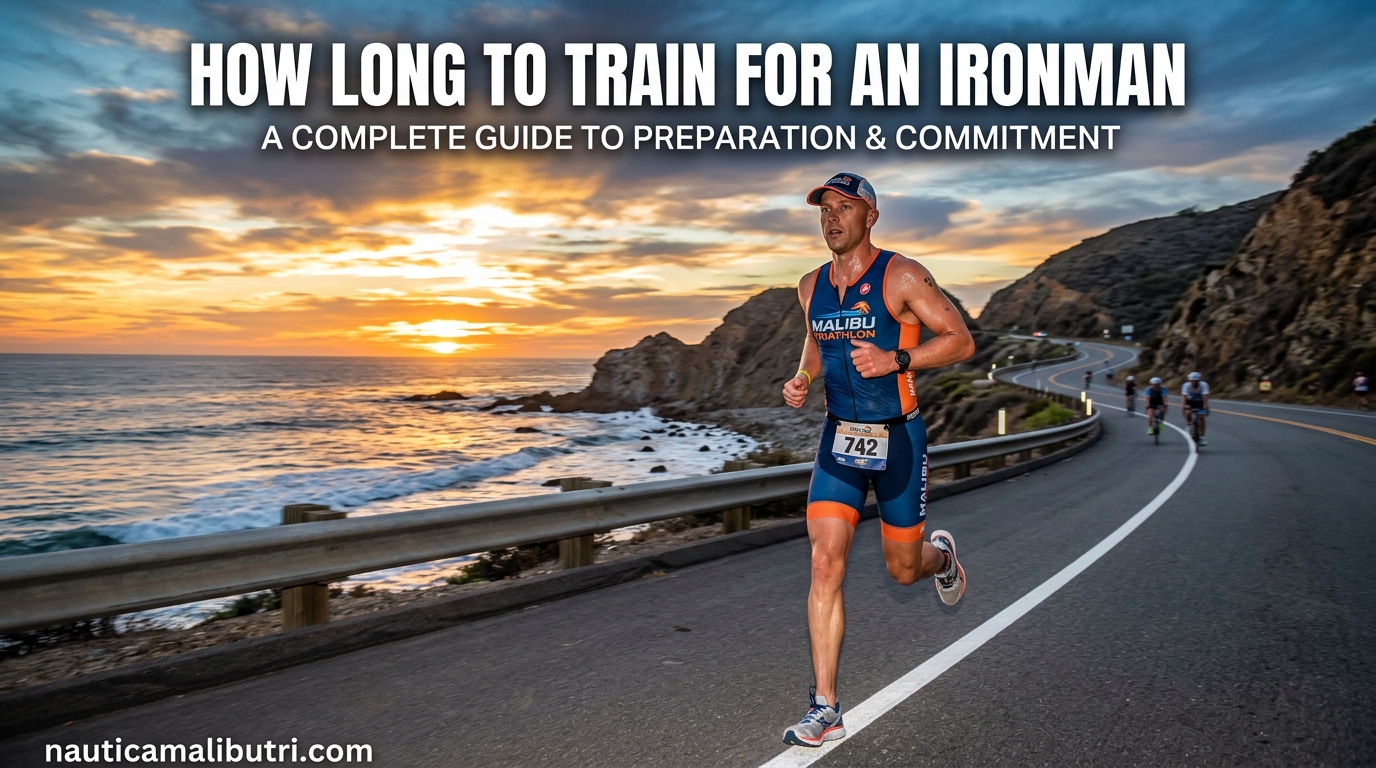
How long to train for an Ironman? Most athletes need 6 to 12 months of dedicated preparation, though the timeline varies dramatically based on your starting fitness level. A complete beginner with no endurance background might need 18 to 24 months, while an experienced triathlete stepping up from a half Ironman could be ready in as little as 6 months.
I’ve spent years helping athletes prepare for their first 140.6-mile challenge. Our team has guided everyone from couch potatoes to marathon runners through this journey. The truth is, there’s no one-size-fits-all answer. Your personal Ironman training timeline depends on your current fitness, available training hours, and whether you can already swim properly.
This guide breaks down exactly what to expect, phase by phase. You’ll learn how many months you personally need, how many hours per week to commit, and what separates a successful training block from a miserable experience.
Table of Contents
What Is an Ironman Triathlon?
An Ironman triathlon is the ultimate test of endurance in the multisport world. The full distance consists of a 2.4-mile (3.86 km) open water swim, followed by a 112-mile (180.25 km) bike ride, and finishing with a 26.2-mile (42.2 km) marathon run.
That’s 140.6 miles total, typically completed in one day with strict cut-off times at each discipline transition. Most finishers cross the line between 12 and 17 hours after starting. The clock starts when you hit the water and stops when you cross the finish line.
Why does this require such extensive training? Your body needs to adapt to handle each individual discipline, then combine them back-to-back. The swim demands upper body endurance most people never develop. The bike leg requires the ability to sit and pedal for 5 to 7 hours without breaking down. The run asks you to complete a marathon after your legs are already fatigued from the previous 114 miles.
How Long to Train for an Ironman by Experience Level
The single biggest factor in your training timeline is where you’re starting from. Someone who runs marathons regularly faces a very different journey than someone who hasn’t exercised in years.
Complete Beginner (18-24 Months)
If you’re starting from scratch with limited fitness background, plan for 18 to 24 months of progressive building. This isn’t pessimistic. It’s realistic based on what I’ve seen work.
Year one focuses on building an aerobic base and learning the three disciplines. You’ll start with shorter triathlons, maybe a sprint or Olympic distance race. Year two ramps up toward full Ironman volume.
Forum discussions consistently support this timeline. As one Reddit user shared: “If you just want to finish a year, if you want to start with a time goal in mind then 2-3 years minimum.” This matches my experience exactly. Rushing the process leads to injury or a miserable race day.
Some Fitness Base (12-18 Months)
If you exercise regularly but haven’t done endurance events, expect 12 to 18 months of focused training. Maybe you run 5K races, cycle on weekends, or swim laps occasionally. That’s a solid foundation to build from.
The first 6 months develop sport-specific endurance. You’ll need to learn proper form in your weakest discipline, usually swimming. Months 6 through 12 build Ironman-specific volume with progressively longer sessions.
One critical piece: don’t skip the base building phase. Your tendons, ligaments, and aerobic system need time to adapt. Jumping into high volume too quickly is the fastest route to overuse injuries.
Experienced Triathlete (9-12 Months)
If you’ve completed shorter triathlons and have a solid aerobic base, 9 to 12 months is typically sufficient. You’re already comfortable with swim-bike-run transitions and have built the movement patterns.
Month 1-4 focuses on base maintenance and technique refinement. Months 5-8 build specific Ironman endurance with progressively longer sessions. Months 9-12 include your peak volume and taper.
This timeline assumes consistency. Missing weeks of training will push your readiness back. The aerobic fitness you built over years doesn’t disappear quickly, but it does require maintenance.
Half Ironman Finisher (6-9 Months)
If you’ve recently finished a 70.3 triathlon, you’re in the best position for a quick Ironman build. Six to nine months of focused training can take you from half to full distance.
The jump from 70.3 to 140.6 isn’t just double the distance. It’s exponentially more demanding on your endurance systems. Your training volume needs to increase by roughly 50-75%, not 100%.
One forum participant put it well: “If you know how to swim proper freestyle and are in generally good shape, I would say 3-4 months of dedicated training.” That assumes an existing endurance base. Don’t mistake this for a beginner timeline.
The Four Training Phases Explained
Ironman training isn’t one continuous block of hard work. Smart athletes divide their preparation into distinct phases, each with a specific purpose.
Base Building Phase (3-4 Months)
This is the foundation everything else builds on. Base phase focuses on aerobic development at low intensity. Think conversational pace, not gasping for breath.
Your weekly hours stay moderate, usually 6 to 10 hours. The emphasis is on frequency and consistency, not brutal sessions. You’re teaching your body to burn fat for fuel and building capillary density in your muscles.
Zone 2 training dominates this phase. That’s heart rate zone 2, roughly 60-70% of your max heart rate. It feels almost too easy, which frustrates many beginners. Trust the process. This slow work builds the aerobic engine that carries you through 140 miles.
Build Phase (2-3 Months)
Once your base is established, the build phase adds intensity and volume. Weekly training increases to 10-14 hours. Some structured intensity enters the mix.
The 80/20 rule applies here: about 80% of your training remains easy, 20% becomes moderately hard. This might include tempo runs, threshold bike intervals, or slightly faster swim sets. The hard work stimulates fitness gains. The easy work allows recovery and aerobic development.
Long sessions become truly long during this phase. Your weekend bike rides stretch to 4-5 hours. Long runs approach 2 hours. These sessions build the specific endurance you need for race day.
Peak Phase (4-6 Weeks)
This is the hardest part of training. Volume reaches its maximum, typically 14-18 hours per week. You’re doing race-specific sessions that simulate the demands of Ironman day.
Your longest bike ride hits 5-6 hours, possibly up to 100+ miles. Longest runs reach 2.5-3 hours, covering 18-22 miles. You might do brick workouts where you run immediately after biking to practice the transition.
Here’s a reality check from forum discussions: “10-12hr avg should be fine. You need some occasional very long cycling rides 8+ hours and long 30k runs.” That peak volume prepares you mentally and physically.
Taper Phase (2-3 Weeks)
The final phase reduces volume dramatically to let your body recover and supercompensate. Training drops to 6-8 hours per week, a 40-50% reduction from peak.
Intensity stays light to moderate. You’re maintaining feel for the sports without creating fatigue. This is mentally challenging for many athletes who fear losing fitness. The science is clear: tapering improves performance significantly.
Most athletes feel terrible during the first week of taper. Your body is finally processing accumulated fatigue. By race week, you should feel fresh, eager, and slightly anxious with unused energy.
Weekly Training Hours by Phase
Here’s exactly how many hours you need to commit each week:
Base Phase: 6-10 hours per week. This includes 2-3 swims (1-1.5 hours total), 2-3 bikes (3-4 hours total), and 3-4 runs (2-3 hours total). Add some strength training if you have time.
Build Phase: 10-14 hours per week. Volume increases across all disciplines. Weekend sessions get significantly longer. One rest day per week is essential.
Peak Phase: 14-18 hours per week. This is where training becomes a part-time job. Weekend bike rides consume 5-6 hours alone. You need family support and schedule flexibility.
Taper Phase: 6-8 hours per week. Drastic reduction while maintaining session frequency. Keep workouts short and easy.
Time distribution follows roughly: 20% swimming, 50% cycling, 30% running. Cycling gets the most hours because it’s the longest discipline and lowest injury risk.
Discipline-Specific Training Guidelines
Each discipline of Ironman demands specific preparation. Neglect any one, and race day becomes a nightmare.
Swim Training: Technique Is Everything
The 2.4-mile swim intimidates more beginners than the bike or run combined. Most people lack efficient freestyle technique, making the distance seem impossible.
Weekly swim volume starts around 3,000-4,000 meters in base phase. By peak phase, you’re swimming 6,000-8,000 meters per week across 2-3 sessions. That’s roughly 2,500-3,000 meters per workout.
One swim per week should be in open water if possible. Pool swimming doesn’t prepare you for navigation, sighting, or the anxiety of mass starts. Many beginners need 6-12 months just to become comfortable in open water.
If you can’t swim freestyle efficiently, consider lessons. Poor technique wastes energy and creates panic. I’ve seen strong runners quit at Ironman because the swim destroyed them mentally.
Bike Training: Build the Engine
Cycling is where you spend the most training time, and for good reason. The 112-mile bike leg determines your entire race.
Weekly bike hours progress from 3-4 hours in base phase to 8-10 hours at peak. Your long ride builds from 2 hours to 5-6 hours. One key session is the weekly long ride, gradually extending duration.
Bike training should be mostly aerobic. Save intensity for specific sessions. The goal is teaching your body to produce power for hours without breaking down. Your bike fit matters enormously. A poor position creates pain that makes the marathon impossible.
Nutrition practice happens on the bike. You need to consume 200-300 calories per hour during the race. Training rides are where you experiment with what your stomach tolerates.
Run Training: Prepare for the Marathon
The marathon at the end of an Ironman is unlike any standalone 26.2-mile race. You’re starting it with 114 miles already in your legs.
Weekly run volume progresses from 2-3 hours to 4-5 hours. Your long run builds from 60-90 minutes to 2.5-3 hours. But here’s the key: you never run a full marathon in training. The longest training run is typically 18-22 miles, done 3-4 weeks before race day.
Running after biking is essential practice. Your legs feel like concrete after 112 miles on the bike. Brick workouts, even short 15-20 minute runs after long rides, teach your body the feel of the bike-to-run transition.
Be conservative with run volume. Running creates the highest injury risk. One missed long run won’t ruin your race, but a stress fracture from overtraining will.
Brick Workouts: The Secret Weapon
Brick workouts combine two disciplines back-to-back, just like race day. They’re named after their inventor, with the story going that after a bike-run session, his legs felt like bricks.
The most common brick is bike-to-run. After a long bike ride, you immediately run for 15-45 minutes. This teaches your legs to transition from cycling muscles to running muscles.
Include one brick workout weekly during build and peak phases. They don’t need to be long. Even a 20-minute run after a 3-hour bike ride provides adaptation. The mental practice is just as valuable as the physical.
Factors That Affect Your Training Timeline
Six to twelve months is the general guideline, but individual factors push you toward the shorter or longer end.
Current Fitness Level: A lifetime of sedentary living requires more base building than someone who played college sports. Your cardiovascular system adapts faster than your connective tissues.
Swimming Experience: Non-swimmers face the steepest learning curve. Cycling and running have natural movement patterns. Swimming is technical and foreign to most adults. Weak swimmers should add 3-6 months to their timeline.
Available Training Time: If you can only train 8 hours per week, you need more weeks to reach adequate volume. Someone training 15 hours weekly progresses faster. Consistency beats sporadic big weeks.
Recovery Ability: Older athletes and those with stressful jobs need more recovery time. You don’t get fitter during training. You get fitter during recovery from training.
Injury History: Previous injuries, especially stress fractures or tendon issues, require cautious progression. Better to arrive at the start line slightly undertrained than injured.
The Couch to Ironman Roadmap
If you’re starting from zero, here’s your month-by-month path to the finish line. This assumes 18-24 months total preparation.
Months 1-6: Build basic fitness. Start with 30 minutes of activity, 3-4 times per week. Learn to swim freestyle. Complete your first sprint triathlon (500m swim, 20K bike, 5K run).
Months 7-12: Develop sport-specific endurance. Weekly volume reaches 8-10 hours. Complete an Olympic distance race (1.5K swim, 40K bike, 10K run). Build to 2-hour bike rides and 90-minute runs.
Months 13-18: Begin Ironman-specific training. Enter a 70.3 half Ironman. Weekly volume hits 12-14 hours with long rides of 3-4 hours and runs of 2 hours.
Months 19-24: Full Ironman build. Peak at 14-18 hours weekly. Complete 5-6 hour bike rides and 2.5-3 hour runs. Execute proper taper. Race day.
This roadmap assumes consistent training. Miss significant time, and you push back your target race. Life happens, but each interruption delays adaptation.
Training with Limited Time
Not everyone can commit 15+ hours weekly. Here’s how to train for an Ironman with time constraints.
The minimum viable training appears to be around 10 hours per week at peak volume. Forum discussions mention athletes completing Ironman on 9-hour weekly averages through focused, high-quality sessions.
Prioritize the long sessions. Your weekend bike ride is non-negotiable. The weekly long run matters almost as much. Everything else is bonus volume.
Use time-efficient training methods. Indoor bike trainers let you train early morning or late evening. Lunch runs maximize available time. Open water swims on weekends replace pool time.
Intensity becomes more important with limited hours. You can’t just accumulate easy volume. Some structured threshold work helps maximize limited training time.
Warning Signs of Overtraining
More training isn’t always better. Here’s how to recognize when you’re pushing too hard.
Persistent Fatigue: Feeling tired after hard sessions is normal. Feeling tired constantly, especially in the morning, suggests overreaching.
Declining Performance: If your times are getting slower despite increased training, back off. Fitness improvements come in waves, not straight lines.
Mood Changes: Irritability, loss of motivation, and depression can signal overtraining. The mental symptoms often appear before physical ones.
Sleep Disruption: Training too hard can cause insomnia or poor sleep quality. Since recovery happens during sleep, this creates a vicious cycle.
Elevated Resting Heart Rate: Check your morning heart rate before getting out of bed. An increase of 10+ beats per minute suggests incomplete recovery.
When these signs appear, take 3-5 days easy. One missed week won’t hurt your race. Pushing through fatigue leads to illness or injury.
Frequently Asked Questions
What is the 80/20 rule in triathlon?
The 80/20 rule states that 80% of your training should be easy intensity and 20% should be moderate to hard. This applies to all three disciplines. The easy work builds aerobic base without creating excessive fatigue. The hard 20% provides the stimulus for fitness improvements. Many beginners make the mistake of training too hard too often, which limits adaptation and increases injury risk.
Is 6 months enough to train for an Ironman?
Six months is enough if you have a strong endurance base, such as having completed a half Ironman recently. For complete beginners, 6 months is insufficient and risks injury or a miserable race experience. Even experienced athletes need that time for the specific demands of Ironman distance. The answer depends entirely on your starting fitness level and prior triathlon experience.
What is the minimum training needed to finish an Ironman?
The minimum appears to be around 10 hours per week during peak training for athletes with some fitness background. Some forum participants report finishing on 9-hour weekly averages, though this requires high-quality, focused training. Complete beginners should not attempt minimal training approaches. The minimum viable approach still requires 6-9 months of consistent work for those with existing endurance fitness.
Is a 7 hour Ironman good?
A 7-hour Ironman is exceptionally fast and would place you near the professional level. The world record is just over 7 hours. For age group athletes, finishing under 12 hours is considered strong. Under 11 hours is very competitive. Under 10 hours puts you near the top of your age group at most races. A 7-hour finish suggests you have elite-level talent and years of dedicated training.
Do I need to run a marathon before doing an Ironman?
No, you do not need to complete a standalone marathon before your first Ironman. Most Ironman training plans peak with an 18-22 mile long run, not the full 26.2 miles. The marathon during an Ironman feels completely different from a standalone marathon anyway, given the preceding 114 miles. Focus on building consistent running volume rather than racing multiple marathons during your buildup.
How much does swimming experience affect the training timeline?
Swimming experience significantly impacts your timeline. Non-swimmers often need 3-6 months just to develop comfortable freestyle technique before serious Ironman training begins. Weak swimmers face not just physical challenges but mental ones, including open water anxiety. If you cannot swim freestyle efficiently, add extra months to your preparation timeline or invest in swim lessons early.
Can I train for an Ironman with a full-time job and family?
Yes, thousands of athletes complete Ironman every year while balancing demanding careers and family responsibilities. The key is schedule consistency and communication with your support system. Early morning sessions, lunch workouts, and focused weekend training make it possible. You may need 12-18 months instead of 6-9 to spread the training load. Many athletes report that the discipline required actually improves their time management in other areas.
What is a brick workout and why is it important?
A brick workout combines two disciplines back-to-back, typically bike-to-run. The name comes from the heavy feeling in your legs when transitioning from cycling to running. These workouts are important because they train your body to handle the specific demands of race-day transitions. Even a short 20-minute run after a long bike ride provides valuable adaptation. Include one brick session weekly during your build and peak training phases.
Final Thoughts on How Long to Train for an Ironman
The question how long to train for an Ironman doesn’t have one universal answer. It depends on your starting point, available time, and commitment level. A complete beginner needs 18-24 months. An experienced half Ironman finisher might need only 6-9 months.
What matters most is respecting the distance. Ironman is hard. The training is time-consuming. But crossing that finish line after 140.6 miles is one of the most rewarding experiences in endurance sport.
Start with an honest assessment of your current fitness. Choose a realistic timeline. Follow the four training phases progressively. Listen to your body to avoid overtraining. Most importantly, enjoy the journey. The person you become during Ironman training is often more valuable than the finisher medal.
If you’re ready to start, pick your target race date and count backward. Build your base. Stay consistent. Trust the process. The finish line is waiting.