
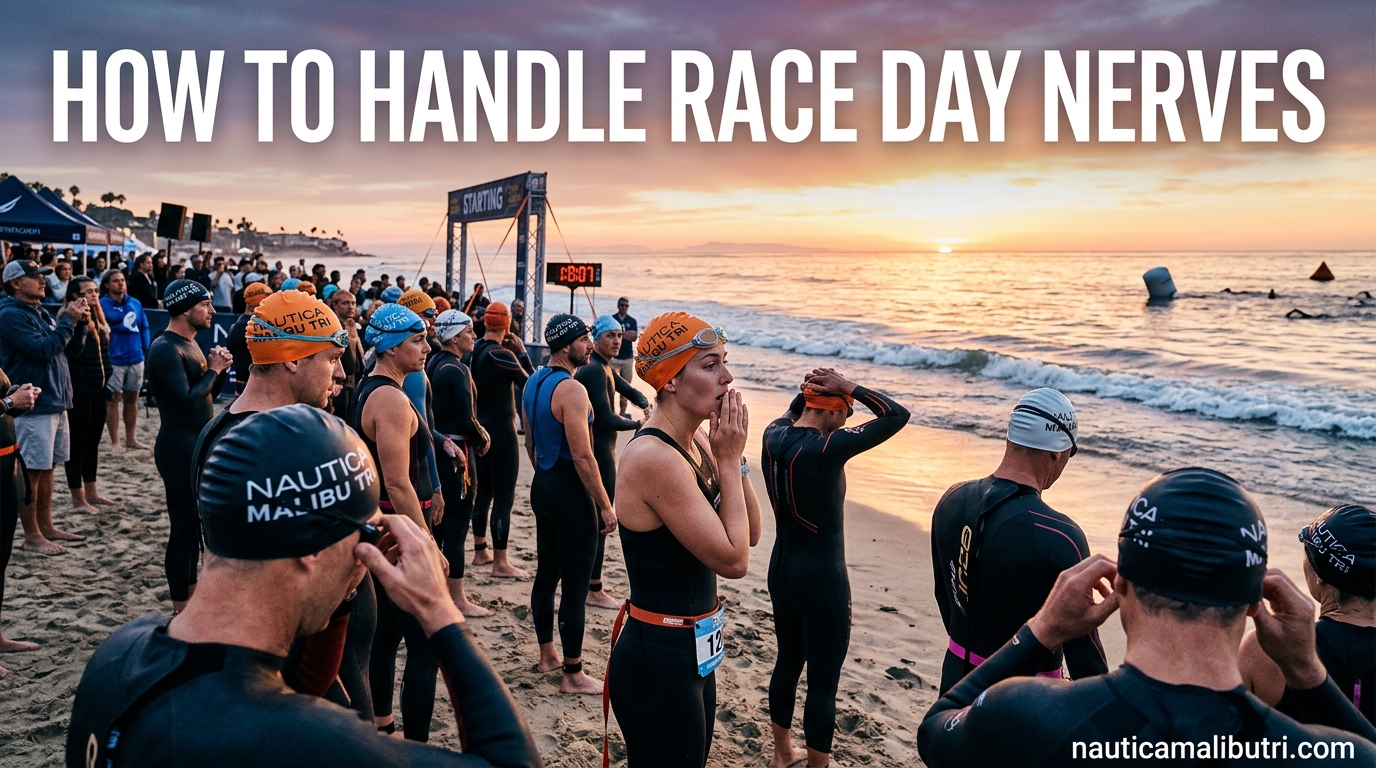
Standing in the start corral with your heart pounding and hands shaking is a feeling every triathlete knows. I have been racing for over a decade, and I still get butterflies every single time.
Learning how to handle race day nerves transformed my performance. Those jitters that once paralyzed me now fuel my best races. This guide will show you exactly how to manage pre-race anxiety so you can perform at your peak when it matters most.
Table of Contents
Understanding Race Day Nerves
Race day nerves are a form of performance anxiety triggered by your brain’s threat-detection system. When you stand at the start line, your body perceives the upcoming effort as a challenge that requires maximum readiness.
This response is your sympathetic nervous system activating the fight-or-flight mechanism. Adrenaline and cortisol flood your bloodstream, preparing your muscles for intense activity. Your heart rate elevates, breathing quickens, and blood flow redirects to your essential systems.
Common Symptoms of Pre-Race Anxiety
Physical symptoms include a racing heartbeat, butterflies in your stomach, sweaty palms, and frequent bathroom trips. Many athletes experience nausea, tightness in the chest, or shaky hands.
Mental symptoms include racing thoughts, self-doubt, difficulty concentrating, and negative scenarios playing in your mind. You might feel irritable or find yourself obsessing over race details.
Why Nerves Are Actually Good
According to research cited by Runner’s World, these physiological responses are your body preparing for peak performance. The elevated heart rate improves oxygen delivery. The adrenaline sharpens your focus and reaction time.
The key distinction is between helpful arousal and debilitating anxiety. When nerves feel manageable and even exciting, they enhance performance. When they overwhelm you, they drain energy and confidence.
How to Handle Race Day Nerves: 7 Proven Strategies
These techniques have helped thousands of athletes transform anxiety into competitive advantage. Each strategy builds on the others to create a comprehensive approach to managing race day nerves.
1. Accept and Reframe Nervousness as Excitement
The first step is accepting that nerves are normal and universal. Professional triathletes, Olympic runners, and world champions all experience pre-race anxiety. One forum user shared that they cried in the start corral at a major race, reminding us that even elite athletes feel the pressure.
Reframe your physiological response. Instead of thinking “I am nervous,” tell yourself “I am excited.” Both emotions create identical physical sensations, fast heartbeat, elevated energy, heightened awareness. The difference is your interpretation.
Research from Harvard Business School shows that simply labeling arousal as excitement improves performance compared to trying to calm down. Your body is already primed for action. Channel that energy toward your race.
2. Control What You Can Control
Race day contains countless variables outside your influence. Weather conditions, other athletes’ performances, course changes, and equipment failures can happen. Focusing on these creates unnecessary anxiety.
Make a list of what you can control: your sleep the night before, your nutrition timing, your warm-up routine, your equipment check, and your mental preparation. Direct your attention exclusively to these elements.
Create contingency plans for likely scenarios. Pack backup nutrition, check weather forecasts, and know the course layout. Preparation eliminates the unknowns that fuel anxiety.
3. Develop a Pre-Race Routine
A consistent pre-race routine signals safety to your nervous system. Repetition creates familiarity, and familiarity reduces the threat response. Your routine becomes an anchor that grounds you regardless of external circumstances.
Start building your routine during training. Practice your race morning breakfast timing, your warm-up sequence, and your mental preparation. Execute the same routine before key training sessions.
Your routine should include specific timing: when you wake up, what you eat, when you arrive at the venue, when you start your warm-up, and when you reach the start line. Precision removes decision fatigue and creates calm.
4. Use the 4-7-8 Breathing Technique
Controlled breathing directly influences your autonomic nervous system. The 4-7-8 technique, popularized by Dr. Andrew Weil, activates the parasympathetic response that counteracts fight-or-flight arousal.
Practice this technique in the days before your race and use it on race morning. Inhale through your nose for four seconds. Hold your breath for seven seconds. Exhale completely through your mouth for eight seconds. Repeat four times.
Many athletes report this technique reduces heart rate and creates immediate calm. One triathlete shared that practicing 4-7-8 breathing during the days before a race helps manage anxiety that builds well before race morning.
5. Practice Race Day Visualization
Visualization prepares your mind for success. When you mentally rehearse your race, you reduce the novelty that triggers threat responses. Your brain recognizes the scenario as familiar rather than unknown.
Find a quiet space in the week before your race. Close your eyes and imagine every detail of race day. Visualize yourself calmly preparing your gear, arriving at the venue, and moving through your routine.
Picture yourself at the start line feeling confident and ready. See yourself executing each segment of the race successfully. Imagine crossing the finish line with the time and experience you want. Make the images vivid and positive.
6. Deploy Positive Self-Talk and Mantras
The conversation in your head shapes your emotional state. Negative self-talk amplifies anxiety. Positive self-talk builds confidence and redirects nervous energy constructively.
Create a personal mantra that resonates with you. Short phrases like “I am prepared,” “I am strong,” or “I belong here” counter negative thoughts. Repeat your mantra when you notice self-doubt creeping in.
Research on athletic performance shows that instructional self-talk, focusing on technique and process, outperforms purely motivational statements during competition. Combine both types: remind yourself of your preparation and focus on specific execution cues.
7. Stay Present with Grounding Techniques
Anxiety thrives when your mind projects into the future. Worrying about outcomes, comparing yourself to others, or imagining failure all pull you away from the present moment where you actually have control.
Use grounding techniques to return to the present. Focus on physical sensations: feel your feet on the ground, notice your breathing rhythm, or touch your race number and feel the texture. These simple actions interrupt anxious thought patterns.
Practice mindfulness in training. Pay attention to your body during workouts without judgment. This skill transfers directly to race day, helping you recognize anxious thoughts without getting caught in them.
Pre-Race Routine and Race Morning Tips
The night before your race deserves as much attention as race morning itself. Many athletes report that anxiety starts days before the event, making preparation throughout the final week essential.
Sleep Strategies for the Night Before
Sleep anxiety is common among athletes. The pressure to get good rest can paradoxically keep you awake. Accept that you may not sleep perfectly and that one night of imperfect sleep rarely affects performance.
Create a relaxing bedtime routine. Avoid screens for an hour before sleep. Use the 4-7-8 breathing technique to wind down. If you wake up during the night, practice the same breathing rather than checking the time.
Trust your training. The work you have done over months matters far more than one night of sleep. Reminding yourself of this fact reduces sleep anxiety itself.
Race Morning Checklist
Wake up with plenty of time to avoid rushing. Rushing triggers cortisol and starts your day in a stressed state. Give yourself at least two hours before you need to leave for the venue.
Eat your practiced breakfast three to four hours before the start. Stick to familiar foods that you have tested in training. Avoid high-fiber or high-fat foods that might cause digestive issues.
Arrive at the venue early enough to complete your routine without hurry. Extra time reduces logistical stress and gives you space to adapt to unexpected issues.
What Not to Do Before Your Race
Avoid comparing yourself to other athletes at the start line. Everyone has different preparation, goals, and backgrounds. Comparison triggers social anxiety and distracts from your own race plan.
Do not try new equipment, nutrition, or strategies on race day. Novelty increases uncertainty and anxiety. Stick with what you have practiced.
Avoid excessive caffeine, which can amplify physical anxiety symptoms. If you use caffeine, take your normal amount at your normal timing.
Triathlon-Specific Strategies
Triathlon presents unique anxiety triggers that single-sport athletes do not face. The swim start, transitions, and multi-discipline nature require specific mental preparation.
Managing Swim Start Anxiety
The mass swim start creates intense physiological and psychological stress. Being surrounded by hundreds of athletes in open water triggers survival instincts. This response is completely normal.
Position yourself appropriately for your ability and comfort level. If open water swimming creates anxiety, start toward the side or back of your wave. You lose seconds but gain calm.
Practice open water swimming before race day. Familiarity with the environment reduces threat perception. Even one or two open water sessions help enormously.
Handling Transition Nerves
Transitions create pressure because they are visible to spectators and other athletes. The fear of fumbling equipment or forgetting items adds stress.
Rehearse your transitions during training. Practice the exact sequence of movements until they become automatic. Automatic movements require less mental bandwidth and reduce anxiety.
Keep your transition area simple. Fewer items mean fewer decisions and less chance of error. Simplicity creates confidence.
First-Leg Confidence Building
Each triathlon leg brings different challenges. Many athletes feel most anxious about their weakest discipline. Address this by focusing on process rather than outcome during that segment.
Set discipline-specific mantras. For the swim: “Relaxed and smooth.” For the bike: “Steady and strong.” For the run: “Smooth and controlled.” These cues give your mind a positive focus.
Frequently Asked Questions
How to stop race day nerves?
You cannot completely stop race day nerves, and you should not want to. Instead, accept the nerves as your body preparing for performance. Use the 4-7-8 breathing technique, develop a consistent pre-race routine, reframe nervousness as excitement, and focus only on what you can control. These strategies transform anxiety from a hindrance into a competitive advantage.
What are the symptoms of pre-race anxiety?
Common symptoms include racing heartbeat, butterflies in the stomach, sweaty palms, frequent bathroom trips, nausea, tightness in the chest, shaky hands, racing thoughts, difficulty concentrating, and negative mental scenarios. These physical and mental responses are your body’s fight-or-flight system activating in preparation for intense physical effort.
Why do I get anxiety before a race?
Pre-race anxiety occurs because your brain’s threat-detection system perceives the upcoming race as a significant challenge. Your sympathetic nervous system releases adrenaline and cortisol to prepare your body for maximum effort. This response is evolutionary and universal. Even professional athletes experience race day nerves. The anxiety reflects that you care about your performance.
What not to do before running a race?
Avoid comparing yourself to other athletes, trying new equipment or nutrition, consuming excessive caffeine, arriving late, skipping your warm-up, or obsessively checking the weather. Do not engage with negative self-talk or catastrophizing thoughts. Avoid making last-minute changes to your race plan. These actions increase anxiety and reduce performance.
How to not be nervous before a race?
Rather than trying to eliminate nervousness, focus on managing it. Accept that nerves are normal and reframe them as excitement. Practice deep breathing techniques like 4-7-8 breathing. Develop and follow a consistent pre-race routine. Use positive self-talk and mantras. Visualize successful race execution. Stay present using grounding techniques rather than worrying about outcomes.
Conclusion
Learning how to handle race day nerves is a skill that improves with practice. The strategies in this guide work because they align with your body’s natural responses rather than fighting against them.
Start implementing these techniques in your training. Practice the breathing exercises, build your pre-race routine, and rehearse your mental preparation. When race day arrives, you will have the tools to transform anxiety into your competitive edge. Your next race could be your best one yet.