
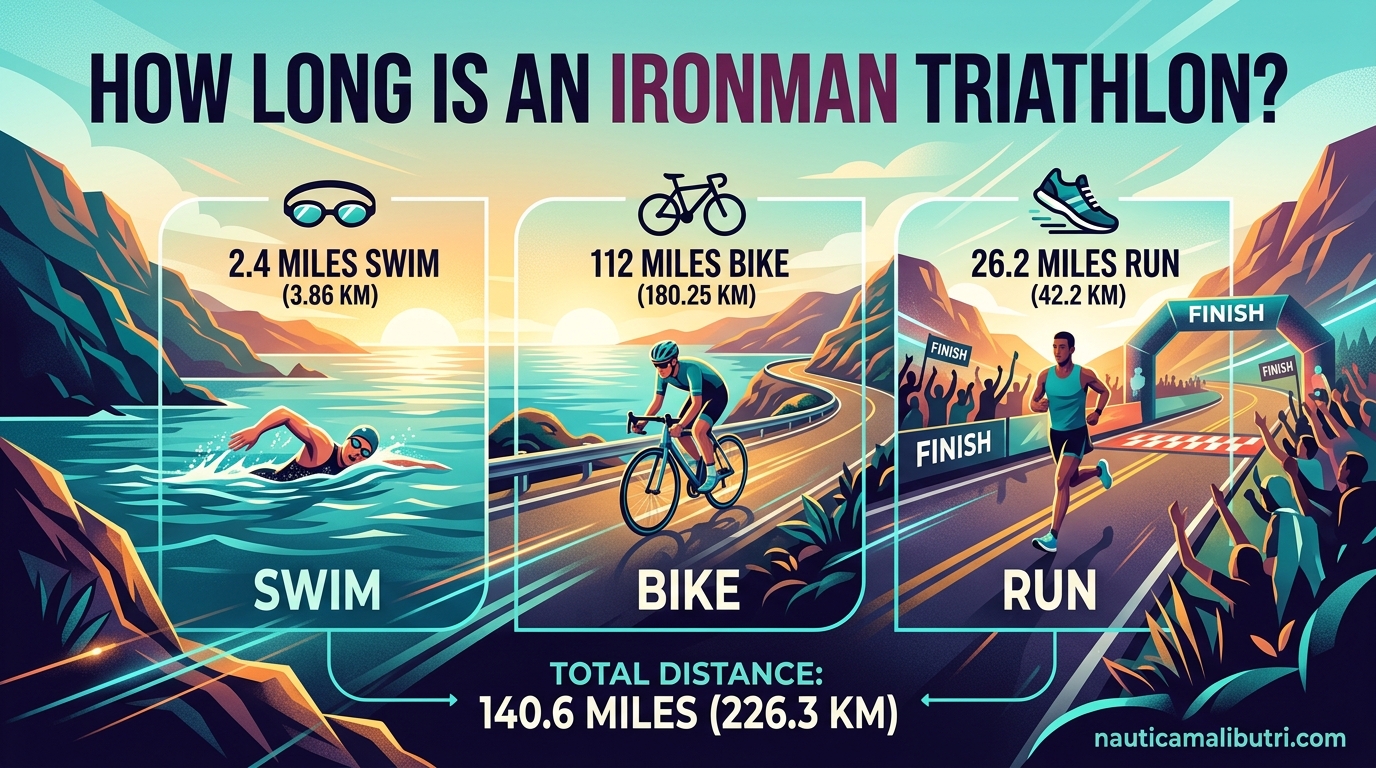
An Ironman triathlon is 140.6 miles (226.3 kilometers) of continuous endurance racing. Athletes must complete a 2.4-mile swim, 112-mile bike ride, and 26.2-mile marathon run in that exact order. How long is an Ironman triathlon when it comes to time? Most finishers cross the line between 12 and 16 hours, with a strict 17-hour cutoff that determines who officially earns the title of Ironman.
I have completed three full Ironman races and volunteered at countless others. The distance never gets easier to comprehend, even when you have trained for months. Standing at the starting line, knowing you are about to cover the equivalent of traveling from one city to another under your own power, creates a unique mix of excitement and respect for what lies ahead.
Understanding the full scope of an Ironman requires looking at both the distance and the time commitment. In this guide, I will break down exactly what 140.6 miles means across each discipline, explain the cutoff times that create pressure on race day, and share realistic finishing times based on ability level. Whether you are considering your first Ironman or simply curious about this iconic challenge, you will find every number and detail you need.
Table of Contents
How Long Is an Ironman Triathlon by Discipline
The Ironman distance breaks down into three distinct legs, each presenting its own challenge. The 2.4-mile (3.8 km) open water swim comes first, typically in a lake, ocean, or river depending on the race location. Most athletes spend between 1 hour and 2 hours 20 minutes in the water, with the 2 hour 20 minute mark serving as the cutoff time at most events.
The swim demands technical skill and comfort in open water conditions. Wetsuits are usually allowed when water temperatures fall below certain thresholds, providing buoyancy and warmth. Strong swimmers gain minimal time here compared to weaker swimmers, making this leg more about survival and energy conservation for most age groupers.
After exiting the water, athletes enter T1 (Transition 1) to change from swim gear to bike gear. The 112-mile (180 km) bike leg consumes the majority of race day for most competitors. Cycling takes athletes 5 to 7 hours on average, with the 10 hour 30 minute cumulative cutoff looming for slower finishers.
The bike course terrain varies dramatically by race location. Flat courses like Ironman Florida allow faster times, while hilly venues like Ironman Lake Placid or Ironman Wales create significant challenges. Nutrition strategy becomes critical here, as athletes must consume calories while pedaling to fuel the remaining marathon ahead.
T2 (Transition 2) marks the shift from bike to run, often taking longer than T1 as athletes change shoes and mentally prepare for the final leg. The 26.2-mile (42.2 km) marathon run brings the total to 140.6 miles. Run times range from sub-3 hours for elites to 6+ hours for back-of-pack finishers.
The marathon portion tests mental fortitude more than physical fitness at this stage. Legs feel heavy from 100+ miles of prior effort. The run often occurs during the hottest part of the day. Walking becomes common, even among strong runners, as the body protests against continued exertion.
Triathlon Distance Comparison
Understanding Ironman distance requires context from other triathlon formats. Here is how all major race distances compare:
| Race Type | Swim | Bike | Run | Total Distance |
|---|---|---|---|---|
| Sprint | 0.5 mi (750m) | 12 mi (20km) | 3.1 mi (5km) | 16 mi |
| Olympic (Standard) | 0.9 mi (1.5km) | 24.8 mi (40km) | 6.2 mi (10km) | 32 mi |
| Half Ironman (70.3) | 1.2 mi (1.9km) | 56 mi (90km) | 13.1 mi (21.1km) | 70.3 mi |
| Full Ironman (140.6) | 2.4 mi (3.8km) | 112 mi (180km) | 26.2 mi (42.2km) | 140.6 mi |
The jump from Olympic to 70.3 represents a massive increase in endurance demands. Moving from 70.3 to full Ironman doubles the challenge again, particularly the run leg which goes from half marathon to full marathon distance.
Ironman Time Limits and Cutoff Times
Race organizers enforce strict time limits to ensure athlete safety and venue logistics. The overall cutoff stands at 17 hours from the official start time, meaning a 7:00 AM start requires crossing the finish line by midnight. Missing this cutoff means you do not receive an official finish or the coveted M-Dot medal.
Intermediate cutoffs create additional pressure points throughout the day. Most races enforce a 2 hour 20 minute swim cutoff, measured from when you enter the water. Athletes still swimming when this deadline passes are pulled from the course for safety. The bike leg carries a 10 hour 30 minute cumulative cutoff, measured from the race start, not from when you began the bike.
These intermediate deadlines exist because darkness, traffic reopening, and volunteer shifts create logistical constraints. Race directors cannot keep roads closed or support staff available indefinitely. The 10:30 bike cutoff ensures roads reopen with enough daylight remaining for the marathon to finish safely.
Some races implement additional run course cutoffs at specific aid stations, typically around miles 13 or 18. These vary by venue and conditions, announced at athlete briefings before race day. Understanding your race’s specific cutoff structure helps with pacing strategy and anxiety management.
How Long Does It Take to Finish an Ironman
Finish times vary dramatically based on training background, age, course difficulty, and conditions. Breaking down averages by athlete category helps set realistic expectations for race day.
Professional Triathletes
Elite professionals race Ironman events in 8 to 9 hours under ideal conditions. The current world records stand near 7 hours 30 minutes for men and 8 hours for women on fast courses. These athletes swim under 50 minutes, bike under 4.5 hours, and run sub-2:40 marathons after 100+ miles of prior exertion.
Professional racing differs significantly from age group competition. Pros race draft-legal on the bike in some events, creating faster bike splits through pack dynamics. They also benefit from earlier wave starts, racing in cooler morning temperatures before the heat builds.
Competitive Age Groupers
Strong amateur athletes typically finish between 10 and 12 hours. These athletes train 12 to 20 hours weekly for months leading up to race day. They complete the swim in 1:10 to 1:30, ride 5:00 to 5:45, and run 3:30 to 4:15 marathons.
This group often qualifies for the Ironman World Championship in Kona, Hawaii through top age group finishes. Qualifying times vary by age group and race venue, but generally require sub-10:30 finishes for men under 40 and sub-11:00 for older categories.
Mid-Pack Finishers
The largest group of athletes crosses the line between 12 and 14 hours. These dedicated age groupers train consistently while balancing full-time jobs and family commitments. Typical splits include 1:30 to 1:50 swims, 6:00 to 6:45 bike rides, and 4:00 to 5:30 marathons.
Mid-pack athletes represent the heart of Ironman racing. They demonstrate that ordinary people with busy lives can accomplish extraordinary endurance feats through disciplined preparation. Many in this group are first-time finishers achieving a bucket-list goal.
Back-of-Pack and First-Timers
Athletes finishing between 14 and 17 hours often include first-timers, older competitors, or those managing injuries. They may walk significant portions of the marathon or struggle through the swim. Every athlete crossing the finish line before midnight earns equal respect, regardless of time.
The 17-hour cutoff creates emotional scenes at finish lines worldwide. Athletes sprinting down the chute at 11:58 PM after 17 hours of effort embody the “Anything is Possible” spirit that defines Ironman culture.
Ironman vs 70.3: What Is the Difference
The numbers 70.3 and 140.6 appear constantly in triathlon discussions, but their meaning is not always obvious to newcomers. The 70.3 designation refers to the total miles covered in a Half Ironman race, exactly half the full Ironman distance.
Breaking down the 70.3 distance reveals the proportional relationship. The Half Ironman includes a 1.2-mile swim, 56-mile bike, and 13.1-mile run. Compare this to the full Ironman’s 2.4-mile swim, 112-mile bike, and 26.2-mile run. Every discipline doubles from 70.3 to full Ironman.
Time commitments differ significantly between the two distances. Most athletes finish 70.3 races in 5 to 7 hours, roughly half the time of a full Ironman. The 70.3 cutoff typically ranges from 8 to 8.5 hours depending on the specific event.
Training volume requirements also scale proportionally. Forum discussions from triathlon communities reveal that 70.3 training averages 8 to 12 hours weekly, while full Ironman preparation demands 12 to 20 hours. The monthly training volume difference is substantial, with Ironman athletes logging 30 to 35 hours monthly versus 20 to 25 for 70.3 preparation.
Many coaches recommend completing at least one 70.3 before attempting the full distance. This progression allows athletes to practice race-day nutrition, equipment choices, and pacing strategy in a lower-risk environment. The 70.3 serves as both a stepping stone and a respected achievement in its own right.
The History of the Ironman Distance
The Ironman distance originated from an argument during a 1977 awards ceremony in Hawaii. Navy Commander John Collins and his friends debated whether swimmers, cyclists, or runners were the most fit athletes. Collins suggested combining three existing Hawaiian events to settle the question once and for all.
The challenge linked the 2.4-mile Waikiki Roughwater Swim, 112-mile Around-Oahu Bike Race, and 26.2-mile Honolulu Marathon. Each event already existed as a standalone race of significant stature. Combining them created something entirely new in endurance sports.
On February 18, 1978, fifteen competitors gathered on Waikiki Beach for the inaugural Hawaiian Iron Man Triathlon. The entry fee was modest, the support minimal, and the concept unproven. Gordon Haller, a taxi driver and former Navy communications specialist, won the first race in 11 hours 46 minutes 58 seconds.
Julie Moss changed Ironman history during the 1982 race. Leading the women’s field late in the marathon, she collapsed from dehydration and exhaustion within sight of the finish line. Her crawl across the line, losing first place in the final moments, became an iconic moment broadcast on ABC’s Wide World of Sports. That footage transformed Ironman from a niche Hawaii event into a global aspiration.
Valerie Silk took over race organization in 1981 and began expanding beyond Hawaii. The M-Dot logo became synonymous with endurance achievement. By 2026, Ironman-branded events take place on six continents, with the World Championship remaining in Kailua-Kona, Hawaii each October.
How Long Does It Take to Train for an Ironman Triathlon
Training for an Ironman requires significant time investment over months of preparation. Most training plans span 16 to 24 weeks of structured buildup, preceded by a base fitness period. First-timers often benefit from 9 to 12 months of progressive preparation.
Weekly training hours vary by experience level and goals. Competitive age groupers average 12 to 20 hours weekly during peak training. First-timers might complete an Ironman on 8 to 12 hours weekly with efficient programming, though more time generally produces better results and race-day comfort.
Monthly volume metrics from experienced triathletes reveal typical benchmarks. Run volume reaches 100 to 130 kilometers monthly. Cycling accumulates 550 to 625 kilometers. Swimming adds 8 to 15 kilometers depending on athlete comfort in the water. These numbers represent serious commitment alongside full-time employment.
The 80/20 rule guides most modern Ironman training programs. This approach allocates 80% of training time to low-intensity, conversational-pace work and 20% to moderate or high-intensity efforts. Research supports this distribution for endurance development while minimizing injury and burnout risk.
Race-day simulations become essential during final preparation weeks. Athletes practice their full nutrition strategy, equipment choices, and pacing plans during long brick sessions. These rehearsals build confidence and reveal any issues before standing on the actual starting line.
Frequently Asked Questions
What does 70.3 mean in Ironman?
70.3 refers to the total distance in miles of a Half Ironman triathlon. It represents exactly half the full Ironman distance of 140.6 miles, consisting of a 1.2-mile swim, 56-mile bike ride, and 13.1-mile run.
How long does it typically take to finish an Ironman?
Most athletes finish an Ironman triathlon between 12 and 16 hours. Professional triathletes complete the distance in 8 to 9 hours, while first-time finishers often require 14 to 17 hours. The strict cutoff time is 17 hours from the race start.
Do you eat during an Ironman?
Yes, athletes must consume significant calories during an Ironman to maintain energy. Most consume 200 to 400 calories per hour through sports drinks, gels, bars, and real food on the bike. Proper fueling prevents the dreaded ‘bonk’ during the marathon.
How long does it take to train for an Ironman triathlon?
Most athletes follow 16 to 24 week structured training plans for an Ironman. First-timers often benefit from 6 to 12 months of progressive buildup. Peak training weeks require 12 to 20 hours of swimming, cycling, and running combined.
What is the 80/20 rule in triathlon?
The 80/20 rule means spending 80% of training time at low intensity and 20% at moderate to high intensity. This distribution optimizes endurance development while minimizing injury and burnout risk, making it the preferred approach for most Ironman training programs.
Final Thoughts
How long is an Ironman triathlon? The numbers tell part of the story: 140.6 miles of swimming, cycling, and running completed within 17 hours. But the full answer extends beyond statistics into months of preparation, sacrifices made, and boundaries pushed.
Whether you aim for a sub-10 hour finish or simply want to hear Mike Reilly declare “You are an Ironman” before midnight, the journey transforms you. The distance does not change, but your relationship with what seems possible certainly does.
If this guide has sparked your interest in tackling the full distance, start with a single step. Research local 70.3 events as stepping stones. Connect with a triathlon club for guidance and community. The Ironman finish line awaits those willing to commit to the preparation it demands.