
Medical Disclaimer: The content in this article is for informational purposes only and does not constitute medical advice. Always consult a qualified healthcare provider before beginning any treatment program or if you experience severe pain, swelling, or difficulty walking.
Nothing ruins a training block quite like that sharp, stabbing sensation at the back of your heel when you roll out of bed at 5 AM for your scheduled brick workout. I’ve watched too many triathletes go from peak fitness to sideline spectators because they ignored early warning signs of Achilles tendonitis.
As someone who has coached athletes through Ironman training while managing their own Achilles issues, I can tell you this: understanding Achilles tendonitis causes and treatment isn’t just academic knowledge. It’s the difference between crossing that finish line and watching from the sidelines.
In this guide, I’ll walk you through everything you need to know about Achilles tendonitis, from the anatomy of your calf muscles to the specific modifications triathletes need during recovery. Whether you’re dealing with morning stiffness that makes your first steps feel like walking on glass, or you’re trying to prevent this injury from derailing your 2026 race season, this article covers it all.
Table of Contents
What Is the Achilles Tendon and What Does It Do?
The Achilles tendon is the thickest and strongest tendon in your entire body. This robust band of fibrous tissue connects your calf muscles to your heel bone (calcaneus), acting as the crucial link that transfers power from your legs to your feet during every running stride, pedal stroke, and push-off from the wall in the pool.
Your calf consists of two main muscles that merge to form the Achilles tendon. The gastrocnemius is the larger, more visible muscle that gives your calf its defined shape. It crosses both your knee and ankle joints, making it active when you’re running uphill or sprinting. The soleus sits underneath the gastrocnemius and plays a major role in endurance activities like long-distance running and cycling, where it helps maintain posture and generates force during the push phase.
When these muscles contract, they pull on the Achilles tendon, which then pulls your heel bone upward. This action creates the push-off force that propels you forward with each step. During a typical Ironman run leg, your Achilles tendon handles forces up to eight times your body weight with every foot strike.
Tendonitis vs Tendinosis vs Tendinopathy
These terms get used interchangeably online, but they describe different conditions with different implications for your recovery. Understanding the distinction helps you communicate accurately with medical professionals and set realistic expectations for healing.
Achilles tendonitis refers to acute inflammation of the tendon, typically caused by sudden overuse or a specific injury incident. This is the early stage where you experience swelling, warmth, and sharp pain. If caught and treated properly at this stage, recovery can take weeks rather than months.
Achilles tendinosis describes a chronic degenerative condition where the tendon structure breaks down without significant inflammation. The collagen fibers become disorganized, and the tendon may thicken or develop nodules. This is what happens when tendonitis goes untreated or when an athlete continues training through pain for months. Recovery from tendinosis typically takes 3-6 months minimum.
Tendinopathy is the umbrella term that encompasses both conditions and has become the preferred medical terminology. When doctors refer to Achilles tendinopathy, they’re acknowledging that both inflammatory and degenerative processes may be present simultaneously.
Insertional vs Non-Insertional Achilles Tendonitis
The location of your pain matters significantly for treatment and prognosis. Non-insertional Achilles tendonitis affects the middle portion of the tendon, about 2-6 centimeters above where it attaches to the heel bone. This is the most common type in active adults and typically responds well to conservative treatment including eccentric exercises.
Insertional Achilles tendonitis occurs at the point where the tendon attaches to the calcaneus. This type often involves inflammation of the retrocalcaneal bursa, a fluid-filled sac that reduces friction between the tendon and bone. Insertional cases may be associated with bone spurs that develop where the tendon inserts, and they often require longer recovery periods and different rehabilitation exercises.
The morning stiffness and pain pattern differs between these types. Non-insertional cases typically hurt most during the push-off phase of running, while insertional pain often flares when the ankle is fully flexed upward, such as when walking uphill or wearing shoes with rigid heel counters.
What Is the Main Cause of Achilles Tendonitis?
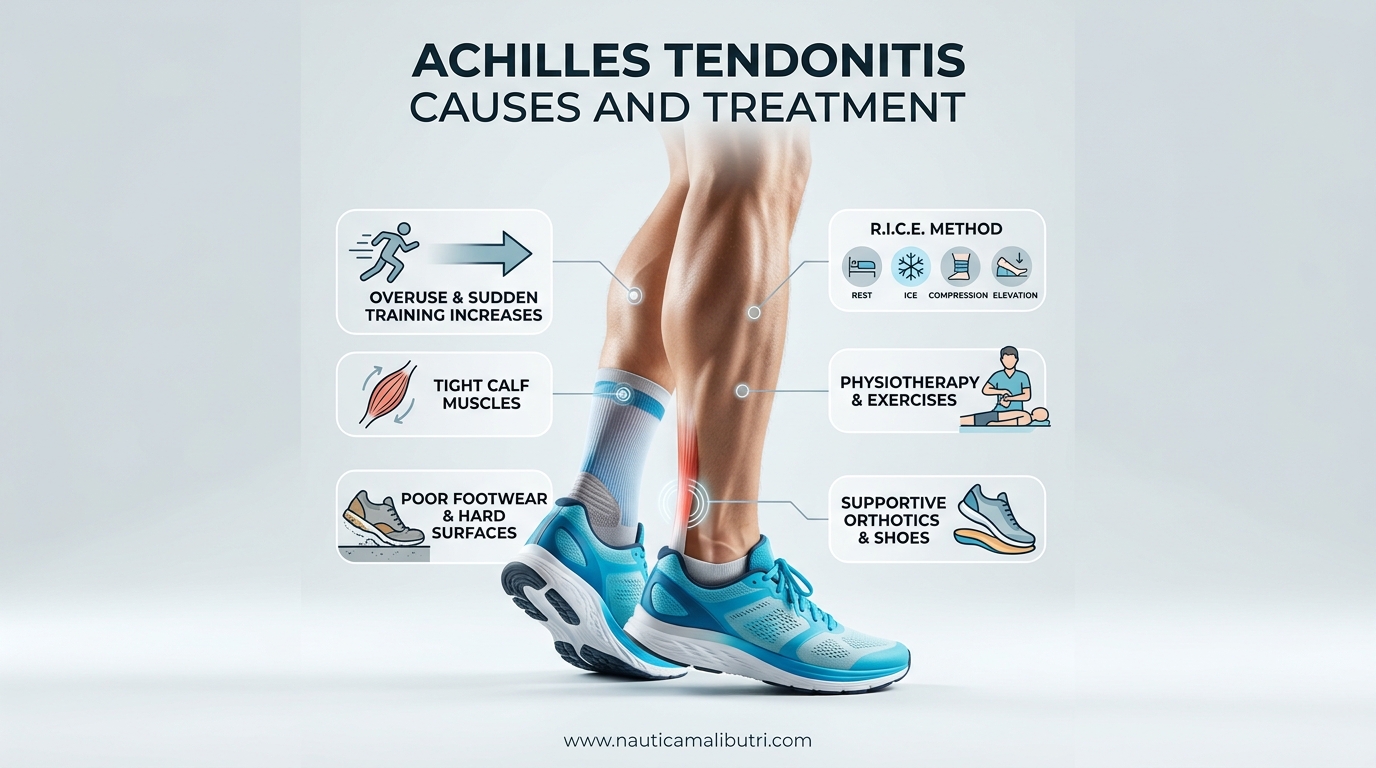
The main cause of Achilles tendonitis is overuse and repetitive stress without adequate recovery time. Unlike acute injuries from a single traumatic event, Achilles tendonitis develops gradually as cumulative microtears in the tendon fail to heal between training sessions.
Your Achilles tendon has a relatively poor blood supply compared to other tissues in your body, especially in the mid-portion where non-insertional tendonitis commonly occurs. This limited blood flow means the tendon repairs itself slowly. When you stack hard workouts day after day without sufficient recovery, these microtears accumulate faster than your body can repair them.
The typical progression looks like this: you feel mild stiffness in the morning that warms up after a few minutes of walking. You interpret this as normal post-workout soreness and continue training. The stiffness persists and starts appearing during workouts. You compensate by altering your running form, which stresses the tendon differently. Eventually, the pain becomes sharp enough that you can’t ignore it.
Training Errors That Trigger Achilles Tendonitis
Certain training mistakes consistently show up in the histories of triathletes who develop Achilles problems. The most common error is the “too much, too soon” trap. This happens when athletes increase their running volume or intensity too quickly, violating the 10% rule that suggests increasing weekly mileage by no more than 10% per week.
Sudden shifts in training terrain also play a major role. Transitioning from treadmill running to hilly outdoor routes, adding hill repeats without adequate preparation, or spending too much time running on cambered roads can all overload the Achilles. I’ve seen numerous cases where an athlete’s first beach run of the season triggered severe tendonitis because the soft sand created an unstable surface that forced extra work from the calf muscles.
Equipment changes represent another frequent trigger. Switching to shoes with a lower heel-to-toe drop, wearing racing flats for too much training volume, or suddenly adopting minimalist footwear can all increase strain on the Achilles. Your tendon adapts to the demands you place on it, but adaptation takes time. Abrupt changes don’t allow for that adaptation period.
Risk Factors for Triathletes
Age significantly impacts your Achilles injury risk. The tendon becomes less flexible and less able to handle stress as you age, with risk increasing substantially after age 30. Weekend warriors who maintain high fitness in their 40s and 50s but sit at desks all week face particularly high risk because their tendons aren’t conditioned for sudden weekend warrior intensity.
Biomechanical factors also contribute heavily. Flat feet or high arches both create problems by altering how force distributes through the foot and ankle. Overpronation, where the foot rolls inward excessively during the stance phase of running, increases torque on the Achilles. Tight calf muscles limit ankle flexibility and force the tendon to stretch more during push-off.
Previous injury history matters too. Athletes who have experienced Achilles tendonitis once have a significantly higher risk of recurrence, especially if the original injury never fully healed. Scar tissue from previous calf strains or ankle sprains can also alter biomechanics and increase tendon stress.
The T2 Transition Problem
Triathletes face a unique risk factor that single-sport athletes don’t experience: the bike-to-run transition. When you jump off your bike after a hard ride and start running, your Achilles tendon goes from a relatively shortened position on the bike to immediate high-intensity loading during the run.
Cycling keeps your ankle in a plantar-flexed position (toes pointed down) for extended periods. This shortens the Achilles and calf muscles. When you immediately transition to running, the tendon must rapidly stretch and load, often before blood flow and tissue temperature have optimized for the demands. This mechanical and thermal shock explains why many triathletes first notice Achilles pain during the run leg of brick workouts or races.
What Are Two Signs of Achilles Tendonitis?
The two most reliable signs of Achilles tendonitis are morning stiffness with first-step pain and pain during the push-off phase of walking or running. These symptoms typically appear gradually and follow a predictable pattern that helps distinguish tendonitis from other conditions.
Morning stiffness manifests as pain and reduced range of motion when you first get out of bed. Many athletes describe the sensation as feeling like their heel is made of glass or that they’re walking on a bruise. This happens because the tendon shortens slightly during sleep when it’s not being used. The first steps of the day require stretching this stiffened tissue, which irritates any inflamed or damaged areas.
Push-off pain occurs when you rise onto your toes or propel yourself forward while walking or running. This pain typically localizes to a specific point along the tendon rather than spreading throughout the calf or foot. You might notice it most when climbing stairs, sprinting, or during the final kick of a race when you’re generating maximum power.
Additional Symptoms to Watch For
Beyond the two primary signs, several other symptoms help confirm Achilles tendonitis. Localized swelling or thickening along the tendon often accompanies the condition. You might be able to feel a distinct bump or tender nodule when you palpate the area.
Warmth around the tendon indicates active inflammation. If you compare the temperature of your affected ankle to your healthy one, you may notice the injured side feels warmer to the touch. Redness sometimes appears with the warmth, though this is less common than in other inflammatory conditions.
Pain that worsens with activity but improves with rest is another hallmark. Unlike muscle strains that might loosen up as you warm up, Achilles tendonitis pain typically intensifies as your workout progresses. The tendon warms up initially, but continued loading eventually overwhelms its capacity.
Symptoms That Indicate Serious Injury
Certain symptoms require immediate medical attention because they suggest more serious conditions. A sudden pop or snap sensation accompanied by immediate, severe pain often indicates a complete tendon rupture. This is a medical emergency that typically requires surgical repair.
Inability to push off or rise onto your toes suggests significant tendon damage. If you can’t perform a single-leg calf raise on the affected side, you need professional evaluation regardless of whether the injury seemed traumatic or gradual.
Pain that radiates into the foot or up into the calf, numbness or tingling, or pain that persists even at rest all warrant medical evaluation. These patterns might indicate nerve involvement, vascular issues, or conditions other than simple tendonitis.
How Is Achilles Tendonitis Diagnosed?
Most cases of Achilles tendonitis can be diagnosed through a comprehensive physical examination without the need for imaging studies. A sports medicine physician or physical therapist will evaluate your symptoms, examine the affected area, and assess your movement patterns to confirm the diagnosis and rule out other conditions.
The diagnostic process typically begins with a detailed history of your symptoms, training patterns, and any recent changes in equipment or activity. Your provider will ask when the pain started, what activities aggravate it, and whether you’ve noticed any swelling or morning stiffness. They’ll also inquire about previous injuries and your current training volume.
The Pinch Test for Achilles Tendon
The pinch test, also called the Thompson test or squeeze test, helps evaluate the integrity of the Achilles tendon. To perform a basic version yourself, lie face down with your feet hanging off the edge of a bed. Have someone squeeze your calf muscle. If the tendon is intact, your foot should point downward in response to the squeeze.
For diagnostic purposes, healthcare providers use a more nuanced version of this test along with palpation of the tendon. They’ll locate the exact point of tenderness along the tendon and assess whether swelling or thickening is present. The location of maximum tenderness helps distinguish insertional from non-insertional cases.
Range of motion testing reveals limitations in ankle flexibility. Your provider will measure how far you can flex your ankle upward (dorsiflexion) and assess whether this movement reproduces your symptoms. Limited dorsiflexion often correlates with calf tightness and increased Achilles stress.
When Imaging Is Necessary
Diagnostic imaging becomes necessary when the diagnosis is uncertain, symptoms don’t improve with conservative treatment, or surgery is being considered. Ultrasound imaging provides a dynamic view of the tendon, allowing the radiologist to observe its structure while you move your ankle. This real-time assessment can reveal tears, calcifications, or structural abnormalities.
MRI scans offer the most detailed view of soft tissue structures and are particularly useful for evaluating the severity of tendon degeneration or identifying partial tears. While more expensive than ultrasound, MRI provides comprehensive information that helps guide treatment decisions for complex or chronic cases.
X-rays don’t show soft tissues like tendons, but they can reveal bone spurs, calcifications within the tendon, or other bony abnormalities that might contribute to insertional tendonitis. Your doctor might order X-rays if they suspect bone involvement.
Differential Diagnosis
Several conditions mimic Achilles tendonitis and require different treatments. Retrocalcaneal bursitis involves inflammation of the bursa between the Achilles tendon and heel bone, causing pain deep to the tendon rather than within it. This often coexists with insertional tendonitis but may occur independently.
Sever’s disease affects adolescents and involves inflammation of the growth plate where the Achilles attaches to the heel. This condition only occurs in growing children and teenagers. Plantar fasciitis causes heel pain but localizes to the bottom of the foot rather than the back.
Referred pain from the lower back or hip can sometimes manifest as posterior heel pain. Nerve entrapment, particularly of the sural nerve, creates similar symptoms but includes numbness or tingling. Systemic conditions like gout or inflammatory arthritis can also affect the Achilles tendon.
How to Make Achilles Tendonitis Go Away
Treating Achilles tendonitis requires patience, consistency, and a willingness to modify your training while the tendon heals. The approach varies depending on whether you’re dealing with acute tendonitis or chronic tendinosis, but all treatment protocols share common principles: reduce load on the tendon, promote healing, and gradually restore strength and flexibility.
Here’s the reality that many athletes struggle to accept: complete rest alone rarely solves Achilles tendonitis. The tendon needs controlled, progressive loading to remodel and strengthen. The key is finding the right balance between rest and activity, which is where most self-directed treatment plans fail.
Step 1: RICE Protocol for Immediate Management
The RICE method (Rest, Ice, Compression, Elevation) forms the foundation of early treatment. Rest doesn’t necessarily mean complete cessation of all activity, but it does mean eliminating painful activities. If running hurts, stop running. If cycling is pain-free, you can likely continue with modifications.
Ice therapy reduces pain and inflammation during acute phases. Apply ice for 15-20 minutes at a time, using a barrier between the ice and your skin to prevent frostbite. Many athletes find success with contrast therapy, alternating between ice and heat to promote blood flow while managing inflammation.
Compression through an elastic bandage or compression sock can help control swelling. Elevation above heart level when resting further reduces fluid accumulation. These measures provide symptomatic relief and create a better environment for healing, though they don’t address the underlying mechanical issues.
Step 2: Activity Modification for Triathletes
Will walking help Achilles tendonitis? The answer depends on severity. During acute phases, even walking might aggravate the tendon. As symptoms improve, walking becomes not only safe but beneficial for maintaining circulation and preventing deconditioning.
Swimming represents the ideal cross-training activity for triathletes dealing with Achilles issues. The water supports your body weight, eliminating impact forces while allowing cardiovascular training. Freestyle and backstroke keep the ankle in a neutral position, though breaststroke might aggravate some cases due to the whip kick motion.
Cycling can usually continue with modifications. Lower your saddle slightly to reduce ankle flexion at the bottom of the pedal stroke. Consider shorter crank arms if you have them available. Avoid high-resistance, low-cadence efforts that require forceful downward pressure.
Running volume should decrease significantly or stop entirely depending on pain levels. Many athletes can maintain some running using the walk-run method or by running on soft surfaces like grass or trails rather than pavement. The key is staying below the pain threshold that aggravates the condition.
Step 3: Eccentric Exercises and Progressive Loading
Eccentric exercises form the cornerstone of Achilles tendonitis rehabilitation. These exercises strengthen the tendon by having the muscle lengthen while under tension, which stimulates collagen production and remodeling. Research consistently shows that structured eccentric loading programs produce better outcomes than passive treatments.
The classic Alfredson protocol involves standing on the edge of a step with your heels hanging off. Rise up using both feet, then slowly lower yourself down using only the affected leg. Take 3-4 seconds for the lowering phase. Start with both knees straight to target the gastrocnemius, then repeat with knees bent to emphasize the soleus.
Begin with 3 sets of 15 repetitions twice daily, progressing to more challenging variations as strength improves. You should feel the tendon working, but sharp pain indicates you’ve progressed too quickly. The discomfort should be mild and should not worsen significantly by the next day.
Progressive loading means gradually increasing the demands on the tendon over weeks and months. After mastering bodyweight exercises, you might add a weighted backpack, progress to single-leg work, or incorporate plyometric movements. This systematic approach rebuilds the tendon’s capacity to handle training loads.
Step 4: Physical Therapy Interventions
A skilled physical therapist can accelerate your recovery through targeted interventions beyond exercise prescription. Manual therapy techniques like soft tissue mobilization and joint mobilization address restrictions in surrounding tissues that contribute to abnormal loading patterns.
modalities like ultrasound or electrical stimulation might provide symptomatic relief, though evidence for their effectiveness in tendon healing is mixed. More promising approaches include blood flow restriction therapy, which allows strength gains at lower loads, and heavy slow resistance training, which has shown excellent results in research studies.
Your physical therapist will also evaluate and address biomechanical contributors. This might include gait retraining to reduce overpronation, prescription of orthotics or heel lifts to temporarily reduce tendon strain, or recommendations for footwear changes. They’ll assess your entire kinetic chain, identifying weaknesses in the hips or core that contribute to excessive Achilles loading.
Step 5: Advanced Treatments
When conservative treatments fail after 3-6 months, advanced interventions become options. Extracorporeal shockwave therapy (ESWT) delivers acoustic waves to the tendon, stimulating healing responses. Multiple studies show ESWT effective for chronic Achilles tendinopathy, with success rates around 60-80%.
Platelet-rich plasma (PRP) injections concentrate growth factors from your own blood and inject them into the damaged tendon. Results vary, with some studies showing benefit and others finding no significant advantage over placebo. PRP is generally considered for cases that haven’t responded to other treatments.
Surgery remains the last resort for cases that fail all conservative measures over 6-12 months. Procedures range from simple debridement of damaged tissue to more complex reconstructions for severe degeneration or rupture. Recovery from surgery typically requires 6-12 months before full return to sport.
Recovery Timeline Expectations
Setting realistic expectations prevents the discouragement that leads many athletes to abandon treatment protocols or return to sport too early. Acute Achilles tendonitis caught and treated properly can resolve in 6-12 weeks. This assumes you actually followed the treatment plan rather than merely acknowledging it while continuing to train through pain.
Chronic tendinosis requires a longer timeline, typically 3-6 months for significant improvement and up to 12 months for complete resolution. The tendon remodels slowly, and there’s no shortcutting this biological process. Many athletes report feeling “cured” at 3 months, only to relapse because they ramped up training too aggressively.
Return to running should follow a structured protocol even after symptoms resolve. Start with walk-run intervals on flat surfaces, gradually increasing run segments while monitoring for any return of symptoms. Most sports medicine physicians recommend having at least two weeks of completely pain-free daily activities before attempting any running.
Training Through Achilles Tendonitis: A Triathlete’s Guide
The triathlete’s dilemma is real: you have three sports to maintain, a race calendar that doesn’t wait for injuries, and the knowledge that stopping completely leads to fitness losses that take months to rebuild. The good news is that you don’t necessarily need to choose between training and recovery.
Training through Achilles tendonitis requires strategic modifications that maintain cardiovascular fitness while reducing the mechanical stress that aggravates the tendon. This approach differs from the “rest and do nothing” advice often given to single-sport athletes, and it’s where having a triathlon-specific perspective becomes invaluable.
Maintaining Fitness With Reduced Run Volume
The first principle is accepting that your run volume must decrease, possibly to zero during acute phases. This doesn’t mean your fitness has to plummet. The cardiovascular system doesn’t care whether you’re running, cycling, or swimming. It responds to heart rate and duration, not the specific activity producing that stimulus.
Replace run workouts with bike or swim equivalents. A 60-minute run becomes a 75-90 minute bike ride at similar intensity. A track interval session translates to comparable efforts on the bike trainer or in the pool. You’ll maintain aerobic capacity, lactate threshold, and even VO2 max through cross-training.
The fitness component you’ll lose is run-specific neuromuscular efficiency and tissue resilience. Your legs won’t be prepared for the impact forces of running, which is why you can’t simply resume normal training once the Achilles heals. Build back gradually, accepting that your first few weeks back will feel awkward regardless of how fit you’ve stayed in the pool and on the bike.
Swimming as Primary Training Modality
When Achilles tendonitis forces you to back off running, swimming becomes your best friend. The water provides resistance for strength, allows continuous cardiovascular work without impact, and can even facilitate recovery through hydrostatic pressure and temperature effects.
Increase your swim frequency to 5-6 sessions per week if your schedule allows. Include quality workouts that maintain anaerobic capacity. Pull sets with a buoy become particularly valuable because they emphasize upper body while giving your legs complete rest.
Aqua jogging provides another option for maintaining run-specific fitness. Using a flotation belt in deep water, you mimic running motion without any ground contact forces. Many elite runners use aqua jogging during injury recovery specifically because it maintains neuromuscular patterns better than cycling or swimming alone.
Cycling Adjustments and Cleat Position
Cycling is generally Achilles-friendly, but small adjustments reduce any strain on the healing tendon. Start with saddle height: lowering it slightly reduces ankle flexion at the bottom of the pedal stroke. You don’t want to go too low, which would compromise power and cause knee issues, but a 5-10 millimeter drop is often helpful.
Cleat position matters more than most triathletes realize. Moving your cleats back toward the heel reduces the leverage arm that the Achilles must overcome during the pedal stroke. This decreases the force required from the calf muscles and reduces tendon loading. Many riders benefit from positioning the cleat so the pedal axle sits under the ball of the foot or even slightly behind.
Consider your cadence and gearing. Higher cadence at lower resistance reduces the peak forces applied during each pedal stroke. Aim for 90-100 RPM rather than grinding bigger gears at 70-80 RPM. This not only helps your Achilles but often produces better power output and bike splits anyway.
Brick Workout Modifications
Brick workouts present particular challenges for Achilles management. The transition from cycling to running creates exactly the conditions that stress a healing tendon: the ankle has been held in plantar flexion, blood flow has been compromised by the aero position, and you’re about to load the tendon immediately with running impact forces.
During recovery phases, modify bricks to reduce the run component significantly. A typical brick might become a 2-hour bike followed by just 10-15 minutes of easy jogging. You’re maintaining the neuromuscular pattern of the transition without accumulating the repetitive stress of a longer run.
Add a specific warm-up routine before the run portion. Walk for 2-3 minutes, perform dynamic calf stretches and ankle mobilizations, and start the run at a very easy pace. Some athletes benefit from changing into running shoes with a higher heel drop than their bike shoes to reduce the stretch on the Achilles during the initial steps.
Race-Day Decision Making
The most stressful decisions for injured triathletes involve registered races. You’ve paid the entry fee, booked the travel, and told everyone you’re racing. Then your Achilles flares the week before. Should you start or should you DNS (did not start)?
The decision framework depends on severity and the specific race. A sprint or Olympic distance race with mild, controlled symptoms might be acceptable if you modify expectations and are willing to withdraw mid-race if pain escalates. An Ironman with significant symptoms should prompt serious consideration of DNS, given the damage that 26.2 miles of running could cause.
Consider the downstream consequences. Racing through an Achilles injury can convert a manageable 6-week recovery into a 6-month nightmare. I’ve seen athletes push through one race only to miss the entire next season because the tendon ruptured or became so degenerated that it required surgery.
If you do race, implement every modification available. Use run-walk from the start rather than waiting for pain to force it. Walk through every aid station. Choose conservative pacing that keeps you well below threshold intensity. And have an exit strategy: know exactly what level of pain means you need to withdraw.
How Can Triathletes Prevent Achilles Tendonitis?
Prevention is infinitely preferable to treatment. Once you’ve experienced Achilles tendonitis, you become acutely aware of how much you depend on this tendon for everything from walking to racing. The good news is that most cases are preventable with appropriate training practices and attention to the risk factors we discussed earlier.
Prevention strategies fall into three categories: load management, tissue preparation, and equipment choices. Neglect any of these areas, and you leave yourself vulnerable to the overuse patterns that cause Achilles tendonitis.
Progressive Training Load Management
The 10% rule isn’t perfect, but it’s a reasonable guideline for increasing running volume. More importantly, pay attention to the density of hard efforts. Three high-intensity sessions in a week create more cumulative stress than the same volume spread differently. Ensure at least 48 hours between demanding run workouts.
Periodize your training deliberately. Hard weeks should be followed by easier recovery weeks. Build phases lead to peak phases, then transition to recovery. This undulating pattern allows tissues to adapt and repair between blocks of heavy loading. Athletes who maintain the same high volume year-round without structured recovery periods eventually break down.
Monitor your total training stress across all three sports. Your Achilles doesn’t distinguish between run stress and bike stress. A hard cycling week followed by a hard run week compounds the loading even if each sport’s volume looks reasonable in isolation. Use a training log that captures overall stress, not just sport-specific metrics.
Calf Strengthening and Stretching
Strong, flexible calves protect the Achilles by handling more of the load themselves rather than transferring it to the tendon. Incorporate specific calf strengthening into your routine twice weekly, even when healthy. Single-leg calf raises, both straight-knee and bent-knee variations, build the eccentric strength that helps prevent tendon overload.
Should I stretch a sore Achilles? The answer depends on the stage of the condition. During acute phases with active inflammation, aggressive stretching can worsen the injury. During recovery and prevention phases, appropriate stretching maintains the flexibility that reduces tendon strain.
Focus on both the gastrocnemius and soleus with different stretch positions. The wall stretch with a straight leg targets the gastrocnemius. The same stretch with a bent knee shifts emphasis to the soleus. Hold stretches for 30-60 seconds without bouncing, feeling a gentle pull rather than pain.
Dynamic stretching before workouts and static stretching after provides the best combination. Pre-run leg swings, ankle circles, and gentle calf raises prepare the tissues for activity. Post-workout static stretching takes advantage of the warmth and blood flow generated during exercise.
Shoe Selection and Rotation
Footwear significantly impacts Achilles loading. Shoes with a higher heel-to-toe drop (10-12mm) reduce the stretch on the Achilles during the stance phase compared to low-drop or zero-drop options. While minimalist shoes have their advocates, they require gradual adaptation and aren’t suitable for all athletes, particularly those with a history of Achilles issues.
Rotate between different shoes rather than wearing the same pair for every run. Different shoe geometries create slightly different loading patterns, distributing stress across various tissue structures rather than hitting the same points repeatedly. A typical rotation might include cushioned trainers for easy days, slightly firmer shoes for tempo work, and race-specific shoes for key sessions.
Replace shoes before they’re completely worn out. Midsole foam loses resilience well before the outsole shows significant wear. Running in dead shoes increases impact forces and changes biomechanics in ways that stress the Achilles. Track your mileage and retire trainers after 300-500 miles depending on your body weight and running surface.
Pre-Run Activation Routine
Many Achilles injuries occur in the first few miles of a run when the tendon hasn’t fully warmed up. A structured pre-run activation routine increases tissue temperature, improves blood flow, and prepares the neuromuscular system for the demands to come.
Start with 5-10 minutes of easy movement to raise core temperature. This could be brisk walking, easy jogging, or dynamic movements like high knees and butt kicks. Follow with specific ankle and calf mobilizations: ankle circles, calf raises, and controlled stretches.
Activation exercises wake up the muscles that protect the Achilles. Try single-leg balance work, light plyometrics like skipping or pogo jumps, and a few short strides at increasing intensity. By the time you start your main workout, your Achilles should feel warm and ready rather than stiff and vulnerable.
Frequently Asked Questions About Achilles Tendonitis
Will Achilles tendonitis go away?
Yes, Achilles tendonitis will go away with proper treatment and patience. Acute cases typically resolve within 6-12 weeks, while chronic tendinosis may take 3-6 months or longer. The key is consistent adherence to rehabilitation protocols including eccentric exercises, activity modification, and progressive loading. Ignoring symptoms or returning to sport too quickly often leads to recurrence or progression to more serious conditions.
Will walking help Achilles tendonitis?
Walking can help Achilles tendonitis during certain recovery phases by maintaining circulation and preventing deconditioning, provided it doesn’t cause sharp pain. During acute phases, even walking may need to be limited. As symptoms improve, walking becomes beneficial for tissue remodeling. The key is staying below the pain threshold that aggravates the condition and avoiding hills or uneven surfaces that increase tendon stress.
Should I stretch a sore Achilles?
You should not aggressively stretch a sore Achilles during acute phases with active inflammation, as this can worsen microtears and delay healing. Gentle stretching becomes appropriate during the recovery phase to maintain flexibility. Focus on eccentric loading exercises rather than passive stretching for rehabilitation. Always consult a physical therapist for guidance on appropriate stretching timing and technique for your specific case.
What is a pinch test for Achilles tendon?
The pinch test, or Thompson test, checks Achilles tendon integrity by squeezing the calf muscle while the patient lies face down with feet hanging off a table. If the tendon is intact, the foot should point downward when the calf is squeezed. Absence of this response suggests a complete rupture requiring immediate medical attention. Healthcare providers also use palpation during this test to locate tender areas and assess swelling or thickening.
When should I see a doctor for Achilles pain?
See a doctor immediately if you experience a sudden pop with severe pain, cannot push off or rise onto your toes, or have pain that persists at rest. Schedule an appointment if symptoms don’t improve after 2-3 weeks of self-care, pain interferes with daily activities, or you notice significant swelling or thickening along the tendon. Early professional evaluation leads to faster recovery and reduces the risk of chronic problems.
Final Thoughts
Achilles tendonitis causes and treatment might seem overwhelming when you’re staring down a season of races and wondering if you’ll make it to the start line. The information in this guide gives you the roadmap, but the execution depends on your willingness to listen to your body and respect the healing process.
Remember that most chronic Achilles problems started as minor issues that could have resolved in weeks if treated properly. The athletes who struggle for months or years are typically those who tried to train through pain, who skipped their rehab exercises, or who returned to full training the moment symptoms subsided rather than waiting for complete healing.
As you plan your 2026 race season, build prevention strategies into your routine. Strengthen your calves, manage your training load intelligently, and address small aches before they become debilitating injuries. If you’re currently dealing with Achilles tendonitis, commit to the recovery process fully. The fitness you maintain through swimming and cycling will carry you through, and the patience you demonstrate now will pay dividends when you’re running strong next season.
1 thought on “Achilles Tendonitis Causes and Treatment (September 2026) Top Guide”