
You finish a training run feeling completely exhausted. Your legs are heavy, your breathing is ragged, and you wonder why you’re not getting faster despite all this effort. I have been there. After coaching triathletes for over a decade, I see this pattern constantly. Athletes training too hard, too often, and wondering why their race times plateau.
Heart rate zones explained simply means understanding that not all training effort is created equal. Your heart rate is a window into your body’s metabolic state. Train in the right zone, and you build endurance efficiently. Train in the wrong zone, and you accumulate fatigue without gaining fitness.
In this guide, I will walk you through everything you need to know about target heart rate zones. You will learn what each zone does for your body, how to calculate your personal zones accurately, and how to apply this knowledge specifically to triathlon training. By the end, you will know exactly why that easy Zone 2 run matters more than those gut-busting sprints.
Table of Contents
What Are Heart Rate Zones?
Heart rate zones are specific percentage ranges of your maximum heart rate (MHR) that correspond to different exercise intensities. Think of them as gears on a bicycle. Each gear serves a purpose, and using the right gear at the right time makes your ride efficient.
Your maximum heart rate represents the fastest your heart can beat during maximum exertion. While this number decreases with age, it is unique to you. The standard estimate is 220 minus your age, but we will cover more accurate methods later.
Heart rate zone training works because your body uses different fuel sources and metabolic pathways at different intensities. Low intensity burns primarily fat. High intensity burns primarily glycogen. Understanding these heart rate zones helps you train the specific systems you want to improve.
For triathletes, zone training is essential. Triathlon requires endurance across three disciplines. Without zone discipline, athletes often over-train at moderate intensities. This creates fatigue without building the aerobic base needed for long-course racing.
Heart Rate Zones Explained: The Complete Breakdown
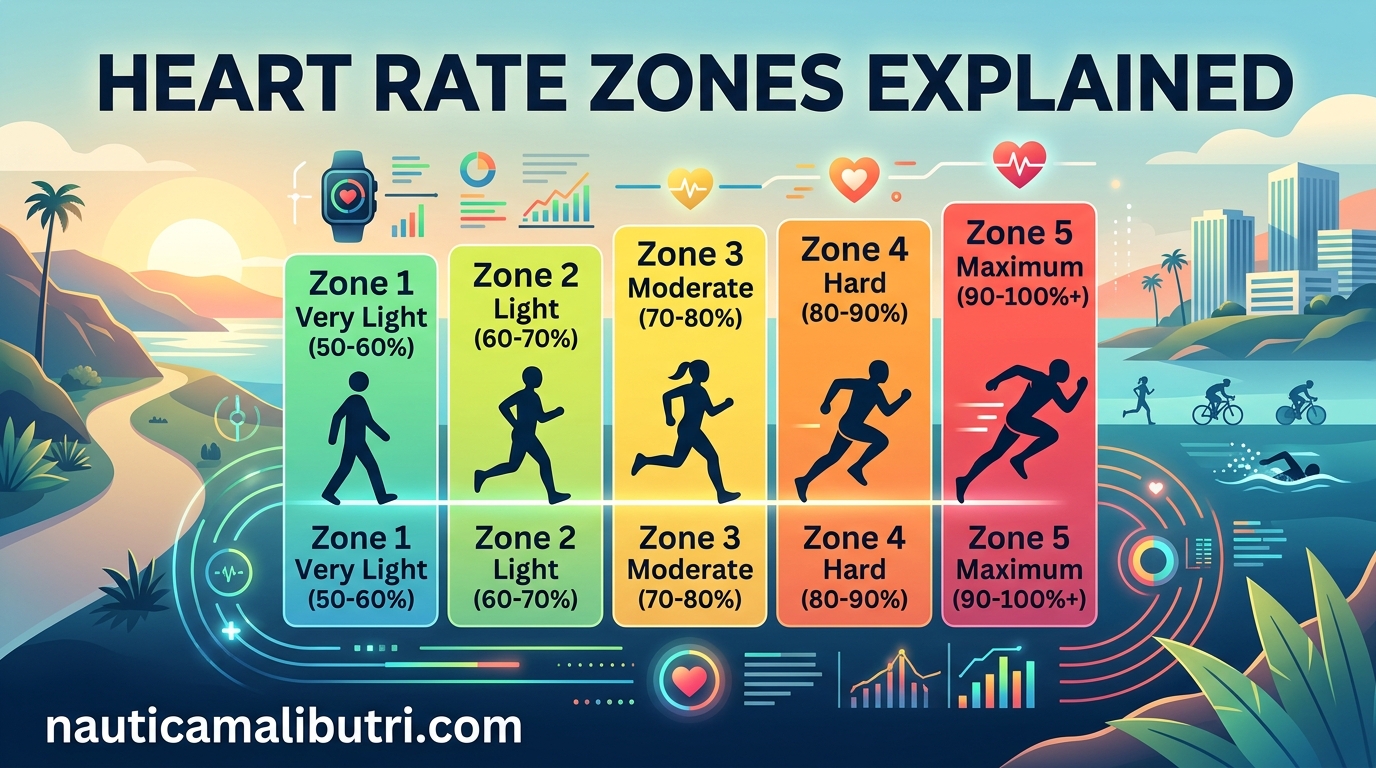
Most training systems define five heart rate zones. Each zone represents a percentage range of your MHR and produces specific fitness adaptations. Here is the complete breakdown every triathlete needs to understand.
Zone 1: Active Recovery (50-60% of MHR)
Zone 1 feels almost effortless. You could hold a full conversation without any breathing difficulty. This zone is often described as “very light” exercise intensity.
Training in Zone 1 serves an important purpose. It promotes blood flow to tired muscles without adding stress. After a hard race or intense training block, Zone 1 sessions help you recover faster than complete rest. I recommend 20-30 minutes of easy swimming, cycling, or walking in this zone during recovery days.
Your body primarily burns fat for fuel in Zone 1. The intensity is so low that oxygen supply easily meets demand. This makes Zone 1 perfect for base-building early in your season.
Zone 2: The Aerobic Foundation (60-70% of MHR)
Zone 2 is where magic happens for endurance athletes. The intensity increases slightly. You can still talk in full sentences, but your breathing is noticeable. This zone is often called the “fat burning zone” or “aerobic base” zone.
Here is something that confuses many athletes. Zone 2 feels harder as you get fitter. This seems backwards, but there is a clear physiological reason. When you start training, your aerobic system is weak. Your legs give out before your cardiovascular system reaches its limit. As you build fitness, your muscular endurance improves faster than your heart’s capacity. Now your cardiovascular system becomes the limiting factor.
This is why beginners find Zone 2 easy and elites find it challenging. An elite athlete can run 6-minute miles at a Zone 2 heart rate. A beginner might walk to stay in Zone 2. The zone percentage stays the same, but the pace changes dramatically with fitness.
Zone 2 training builds mitochondria density in your muscles. These cellular powerhouses process oxygen and fat into energy. More mitochondria mean better endurance. For triathletes, Zone 2 should comprise 70-80% of your total training volume. This builds the aerobic engine that carries you through long races.
Zone 3: Tempo Training (70-80% of MHR)
Zone 3 is where breathing becomes labored. You can speak in short phrases, but conversation is uncomfortable. This is often called “tempo” pace or “moderate” intensity.
Many coaches warn athletes about the “gray zone” of Zone 3. This intensity is hard enough to create fatigue, but not hard enough to produce significant fitness gains. Beginners often train here by default. It feels like a “good workout” because you are working hard, but it does not build aerobic base like Zone 2 or improve speed like Zone 4.
Zone 3 has its place in triathlon training. It helps with race pace preparation for Olympic distance events. It also builds mental toughness and improves your body’s ability to clear lactate. However, use it strategically rather than by default.
Zone 4: Threshold Training (80-90% of MHR)
Zone 4 is uncomfortable. Talking is limited to single words or gasps. Your legs burn. Your breathing is heavy and rhythmic. This zone targets your lactate threshold.
The lactate threshold is the exercise intensity where lactate accumulates faster than your body can clear it. Train near this threshold, and your body adapts by becoming more efficient at processing lactate. This means you can sustain higher intensities before fatigue sets in.
For triathletes, Zone 4 work is crucial for Olympic and Sprint distance racing. These events require sustained efforts near threshold. However, limit Zone 4 training to 10-15% of your weekly volume. This intensity creates significant fatigue that requires recovery.
Zone 5: Maximum Effort (90-100% of MHR)
Zone 5 is all-out effort. Breathing is maximal. Your legs scream. You can only sustain this for seconds to minutes. This zone targets your VO2 max and anaerobic capacity.
VO2 max represents the maximum amount of oxygen your body can use during exercise. Training at VO2 max intensity improves your cardiovascular system’s pumping capacity and your muscles’ oxygen extraction ability. These adaptations help across all intensities.
Use Zone 5 sparingly in triathlon training. It is most relevant for sprint finishes and hill climbs. During base-building phases, you might do zero Zone 5 work. During peak training for short races, it might represent 5% of your volume.
How to Calculate Your Heart Rate Zones
Knowing the zones is useless without knowing your personal numbers. Here are the methods for calculating your maximum heart rate and training zones accurately.
The 220 Minus Age Formula
The most common method for estimating maximum heart rate is simple. Subtract your age from 220. A 35-year-old athlete would estimate 185 beats per minute (220 – 35 = 185).
This formula provides a rough starting point. It was developed from population studies and works reasonably well for sedentary adults. However, it has significant limitations for athletes. Your actual MHR might be 10-20 beats higher or lower than the formula suggests. Genetics, fitness level, and individual variation make this estimate imprecise.
I recommend using the 220-minus-age formula only if you have no other data. It is better than nothing, but field testing provides much better accuracy.
The Karvonen Formula (Heart Rate Reserve)
The Karvonen method accounts for your resting heart rate, making it more personalized. This formula uses heart rate reserve (HRR) rather than simple percentage of MHR.
First, measure your resting heart rate. Take your pulse first thing in the morning before getting out of bed. Do this for several days and average the results. A well-trained triathlete might see 45-55 beats per minute.
Calculate your heart rate reserve by subtracting resting HR from maximum HR. If your MHR is 185 and resting is 50, your HRR is 135.
To find your zones, multiply HRR by the zone percentage, then add your resting heart rate. For Zone 2 (60-70%): Lower bound = (135 × 0.60) + 50 = 131 bpm. Upper bound = (135 × 0.70) + 50 = 145 bpm.
This method is more accurate than simple percentage of MHR because it accounts for your fitness level. Athletes with low resting heart rates get higher target zones, which matches their capabilities.
Field Testing Methods
The most accurate way to determine your zones is field testing. These tests push you to actual maximum effort in a controlled way.
The running test is simple but brutal. Warm up thoroughly for 15-20 minutes. Then run hard up a sustained hill for 3 minutes. Recover with easy jogging for 3 minutes. Repeat the hard 3-minute hill effort. Your highest recorded heart rate is likely your true maximum.
For cycling, a similar protocol works. Warm up, then do two 3-minute all-out efforts separated by 3 minutes of easy spinning. Record your highest heart rate.
Swimming presents challenges because water pressure affects heart rate. Your max HR in water will typically be 10-15 beats lower than on land. Do a time trial set of 400 meters at maximum sustainable effort. The last 100 meters should be all-out. Add 10-15 beats to your recorded maximum to estimate land-based zones.
Example Zone Calculation
Let me walk through a practical example. Sarah is a 40-year-old triathlete with a resting heart rate of 48 bpm. She did a field test and hit 182 bpm on her final hill repeat.
Using her actual MHR of 182 and resting HR of 48, her heart rate reserve is 134.
Here are Sarah’s personalized zones:
Zone 1 (50-60%): 115-128 bpm
Zone 2 (60-70%): 128-142 bpm
Zone 3 (70-80%): 142-155 bpm
Zone 4 (80-90%): 155-169 bpm
Zone 5 (90-100%): 169-182 bpm
Compare this to the 220-minus-age estimate. That would give Sarah a max of 180 and zones that are slightly different. Her field testing revealed she has above-average capacity for her age, so the formula would underestimate her zones.
Heart Rate Zones for Triathlon: Swim, Bike, Run
Triathlon presents unique challenges for heart rate zone training. Each discipline affects your heart rate differently. Understanding these differences helps you train more effectively.
Why Zones Differ by Discipline
Your heart rate varies between swimming, cycling, and running even at the same perceived effort. This happens for physiological and mechanical reasons.
Swimming produces lower heart rates than running at comparable effort. Water pressure on your body aids venous return, making your heart work more efficiently. You are horizontal, which also helps blood flow. Additionally, you cannot breathe freely in swimming, creating slight oxygen limitation that keeps HR suppressed.
Cycling typically produces heart rates 5-10 beats lower than running at the same oxygen consumption. You are seated and supported, reducing the muscular demand for blood flow. However, power output on the bike is highly variable due to terrain and wind.
Running produces the highest heart rates. You support your full body weight against gravity with every step. This creates constant muscular demand that drives heart rate up. Running zones typically run 5-10 beats higher than cycling zones for the same effort level.
Swim-Specific Considerations
Heart rate monitoring in swimming is challenging. Most chest straps do not work well in water. Optical wrist monitors often give erratic readings due to water interference and stroke mechanics.
For pool swimming, I recommend using perceived effort and pace rather than heart rate. Know your Zone 2 pace from time trials. For example, if your threshold 100-meter pace is 1:30, your Zone 2 pace might be 1:45-1:50.
Open water swimming allows better heart rate monitoring with modern watches. Your zones will run 10-15 beats lower than running. Adjust your targets accordingly.
Bike-Specific Considerations
Cycling is where heart rate zones shine. The steady-state nature of riding allows you to lock into specific zones for sustained periods. However, heart rate responds slowly on the bike. It may take 2-3 minutes for your heart rate to stabilize after an intensity change.
This lag means heart rate is poor for short intervals but excellent for tempo and endurance work. For intervals under 3 minutes, use power or perceived effort. For rides over 20 minutes at steady intensity, heart rate works beautifully.
Environmental factors affect cycling heart rate significantly. Heat raises heart rate 5-10 beats at the same power. Dehydration has a similar effect. Altitude can push heart rate 10-20 beats higher. Learn your zones under normal conditions, then adjust for these variables.
Run-Specific Considerations
Running heart rate responds quickly to intensity changes. This makes it excellent for all types of workouts. However, cardiac drift becomes a factor in runs over 45 minutes.
Cardiac drift is the gradual increase in heart rate despite constant pace. Your heart works harder as you fatigue and dehydrate. A run that starts in Zone 2 might drift into Zone 3 after an hour. This is normal and acceptable for long runs. Do not slow down trying to maintain a specific heart rate late in a long run.
Hills create heart rate spikes that may exceed your target zone. This is fine for short hills. For sustained climbs over 2 minutes, manage your effort to stay in zone.
Zone 2: The Triathlon Foundation
Elite triathletes follow the 80/20 principle. Eighty percent of training volume stays in Zones 1-2. Twenty percent goes to Zones 3-5. This distribution builds aerobic capacity while providing enough intensity for adaptation.
Most amateur triathletes train closer to 50/50. Half their training is easy, half is moderate to hard. This creates too much fatigue without enough aerobic base. The result is plateaued performance and chronic tiredness.
Commit to Zone 2 for your long rides and runs. Yes, it will feel slow initially. Yes, you will be passed by other athletes. But after 8-12 weeks of consistent aerobic base building, your pace at Zone 2 heart rates will improve dramatically. That is when race times start dropping.
Race Pacing by Zone
Your race strategy should match the distance. Sprint triathletes can race in Zone 4 for much of the event. The durations are short enough that you can sustain high intensity.
Olympic distance racers use a mix of Zone 3 and 4. The swim and bike might be Zone 3, with the run pushing into Zone 4.
Half Ironman athletes live in Zone 2. Go harder and you will blow up on the run. The bike leg should feel almost too easy. Save energy for the 13.1 miles ahead.
Full Ironman is a Zone 2 event from start to finish. Some athletes even stay primarily in Zone 1 for the bike to ensure they can run the marathon. Pushing into Zone 3 on the bike virtually guarantees a death march on the run.
Common Mistakes and How to Avoid Them
After working with hundreds of triathletes, I see the same mistakes repeatedly. Here is what to watch for and how to fix it.
Training Too Hard Too Often
The most common mistake is spending too much time in Zones 3-4. This happens because these intensities feel productive. You finish workouts tired and satisfied. But chronic moderate-to-high intensity training creates a fitness plateau.
Monitor your weekly training distribution. If more than 30% of your time is above Zone 2, you are training too hard. Use a heart rate monitor to enforce easy days. When the watch says you are in Zone 3, slow down immediately.
Ignoring Zone 2
Many athletes skip Zone 2 because it feels too easy. They worry they are not getting a “real workout.” Trust the process. Zone 2 builds the aerobic engine that powers everything else.
Remember the paradox. Zone 2 gets harder as you get fitter. When a workout feels easy, you are not necessarily unfit. You might just be well-adapted to that intensity. Give it time. The pace improvements will come.
Relying Solely on Formula Estimates
Using 220-minus-age without verification leads to inaccurate zones. I have seen athletes with actual max heart rates 30 beats different from the formula. That completely changes their training.
Do a field test. It is uncomfortable for 10 minutes, but the data serves you for years. Knowing your true zones makes every subsequent workout more effective.
Not Accounting for Discipline Differences
Using the same zone targets for swimming, cycling, and running creates problems. Your swim heart rate will never match your run heart rate. Do not chase unrealistic targets.
Set discipline-specific zones. Lower your swim targets by 10-15 beats. Lower your bike targets by 5-10 beats. Keep run zones at full intensity. This approach reflects physiological reality.
Practical Tips for Zone Training
Here are techniques I use with my athletes to make zone training work in the real world.
Start every workout 10-15 beats below your target zone. Allow your heart rate to drift up naturally over the first 10 minutes. This prevents early spikes that push you too high too fast.
Use lap averages rather than instantaneous readings. Heart rate fluctuates constantly. A 3-minute lap average tells you more than a momentary spike to 165 bpm.
Ignore your watch on hills and into headwinds. Some intensity variation is inevitable. Focus on zone discipline during steady-state sections.
For heart rate monitoring, a chest strap remains the gold standard for accuracy. Modern optical wrist sensors work reasonably well for steady efforts but struggle with intervals. Choose based on your primary workout types.
Frequently Asked Questions
Why does zone 2 get harder as you get fitter?
Zone 2 feels harder as fitness improves because of adaptation mismatches. When you start training, your leg muscles fatigue before your cardiovascular system reaches its limit. As you build fitness, your muscular endurance improves faster than your heart’s maximum capacity. Now your cardiovascular system becomes the limiting factor. An elite athlete might run 6-minute miles at Zone 2 heart rate, while a beginner walks to stay in Zone 2. The percentage stays the same, but the absolute effort increases with fitness.
What heart rate zone should I be in when exercising?
The right zone depends on your training goal. For base building and fat burning, stay in Zone 2 (60-70% of max heart rate). For tempo and race pace work, use Zone 3 (70-80%). For threshold improvement, train in Zone 4 (80-90%). For VO2 max development, use Zone 5 (90-100%). Triathletes should spend 70-80% of training time in Zones 1-2, with only 20% in higher zones.
Is 220 minus your age accurate?
The 220 minus age formula provides a rough estimate but has significant limitations. Population studies show individual variation of 10-20 beats per minute from the formula. Well-trained athletes often have maximum heart rates 10-15 beats higher than predicted. Sedentary individuals might be lower. Use the formula as a starting point only, then verify with field testing for accurate zone calculations.
Is zone 1 or zone 2 better for fat loss?
Both Zone 1 and Zone 2 burn primarily fat for fuel, but Zone 2 is generally more effective for fat loss goals. Zone 2 burns a higher percentage of calories from fat while providing enough intensity to create meaningful caloric expenditure. Zone 1 intensity is so low that total calorie burn is minimal. For weight management, combine Zone 2 training with proper nutrition rather than focusing solely on the fat burning zone.
How do heart rate zones differ for swimming vs cycling vs running?
Heart rate zones differ by discipline due to body position and muscle engagement. Swimming produces heart rates 10-15 beats lower than running because water pressure aids circulation and breathing is constrained. Cycling runs 5-10 beats lower than running because you are seated and supported. Running produces the highest heart rates due to full weight-bearing impact. Triathletes should set discipline-specific targets: lower swim zones by 10-15 beats, lower bike zones by 5-10 beats, and use full running zones.
Conclusion
Heart rate zones explained in practical terms means training smarter, not just harder. You now understand the five zones, how to calculate your personal targets, and how to apply this knowledge across swim, bike, and run.
The key takeaway for triathletes is zone discipline. Spend most of your time building that aerobic base in Zone 2. Resist the temptation to push harder just because you can. Trust that fitness improvements will come, even when workouts feel easy now.
I have seen athletes transform their race results simply by slowing down their easy days. The paradox of Zone 2 training is real. Embrace it. Calculate your zones accurately, monitor your training distribution, and watch your endurance improve throughout 2026.
Your next step is simple. Do a field test this week to establish your true maximum heart rate. Then recalculate your zones and start training with intention. Your future self, crossing that finish line with energy to spare, will thank you.