
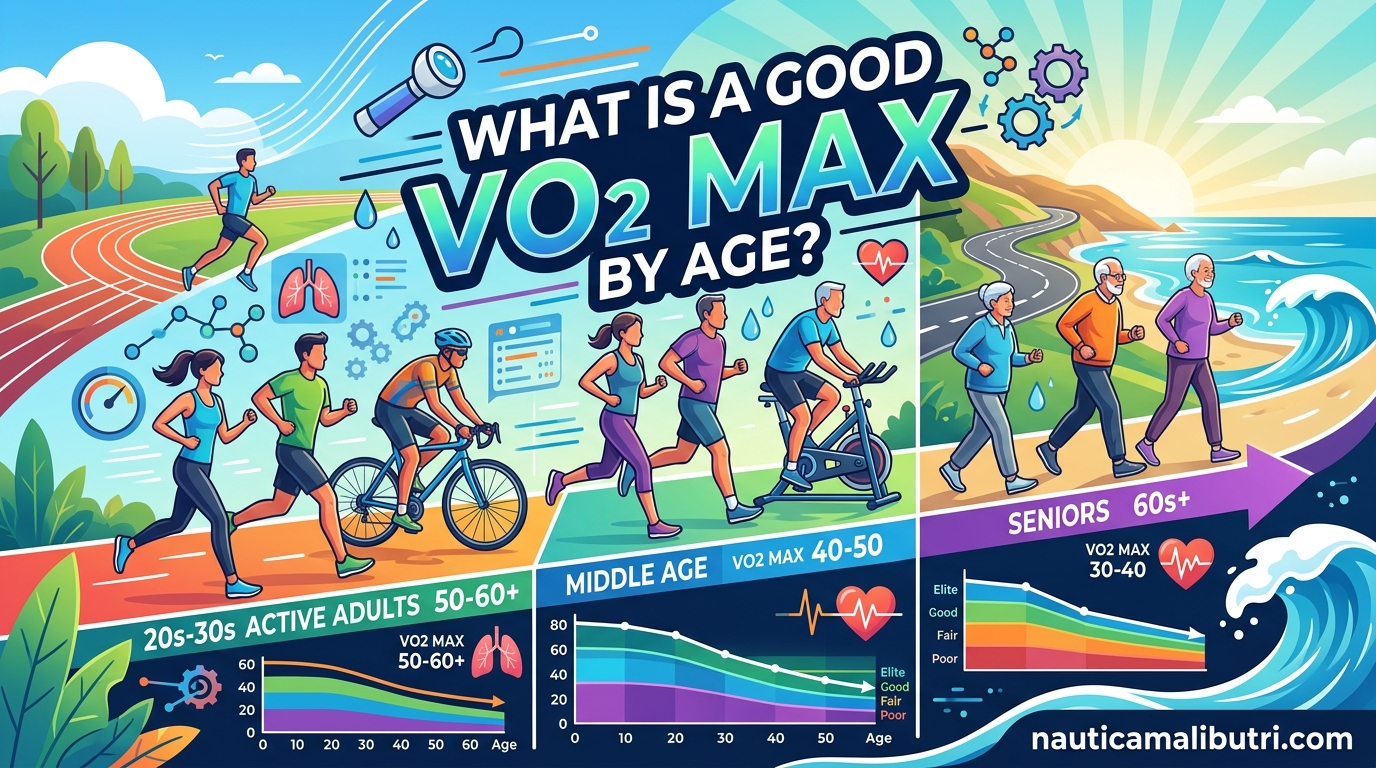
Understanding what is a good VO2 max by age can transform how you approach triathlon training. I have spent years tracking this metric across athletes from 25 to 65, and the data tells a compelling story about cardiovascular fitness and endurance potential. Your VO2 max represents the maximum amount of oxygen your body can utilize during intense exercise, measured in milliliters per kilogram per minute (ml/kg/min).
Triathletes obsess over this number for good reason. It correlates strongly with race performance across all three disciplines. A higher VO2 max generally means you can sustain faster paces for longer durations. But the real question is not just about your absolute number. You need to understand what constitutes a good VO2 max relative to your age, gender, and training background.
In this guide, I will walk you through comprehensive age and gender classification tables. You will learn why these numbers matter specifically for triathlon training. I will also share practical strategies for testing and improving your aerobic capacity based on real-world experience with hundreds of athletes.
Table of Contents
What Is VO2 Max and Why It Matters for Triathletes
VO2 max, or maximal oxygen uptake, measures your cardiorespiratory fitness capacity. It quantifies how efficiently your heart, lungs, and muscles work together to deliver and use oxygen during exercise. The “V” stands for volume, “O2” for oxygen, and “max” for maximum.
Your body produces energy aerobically by combining oxygen with carbohydrates and fats. During high-intensity efforts like a sprint triathlon finish or a steep climb on the bike, your oxygen demand spikes. VO2 max represents the ceiling of your aerobic power. Once you exceed this ceiling, you accumulate oxygen debt and fatigue accelerates.
For triathletes, VO2 max serves as a foundational metric that influences performance across swim, bike, and run segments. Runners typically achieve the highest VO2 max values in absolute terms. Cyclists often show strong numbers too, though bike-specific testing sometimes yields different results than treadmill testing. Swimmers present unique challenges since VO2 max testing in water requires specialized equipment.
The American Heart Association now recognizes VO2 max as a clinical vital sign. Research from Harvard Medical School and the Mayo Clinic consistently shows that higher VO2 max values correlate with reduced mortality risk and improved cardiovascular health. For athletes over 30, tracking this metric helps monitor age-related fitness changes and guides training adjustments.
VO2 Max Classifications by Age and Gender
The Cooper Institute developed the standard classification system that Garmin, Apple Watch, and most fitness platforms use today. These tables categorize VO2 max into five levels: Superior, Excellent, Good, Fair, and Poor. The classifications account for both age and gender since these factors significantly influence aerobic capacity.
I have found that triathletes should aim for at least the “Good” category to complete races comfortably. Those targeting age group podiums typically fall in the “Excellent” to “Superior” range. The tables below show the complete classification ranges based on Cooper Institute data.
VO2 Max Standards for Men by Age
| Age Range | Superior | Excellent | Good | Fair | Poor |
|---|---|---|---|---|---|
| 20-29 | 55.4+ | 51.5-55.4 | 45.3-51.4 | 39.4-45.2 | Below 39.4 |
| 30-39 | 54.0+ | 48.9-54.0 | 44.0-48.8 | 38.3-43.9 | Below 38.3 |
| 40-49 | 52.5+ | 46.8-52.5 | 41.0-46.7 | 35.2-40.9 | Below 35.2 |
| 50-59 | 48.7+ | 43.3-48.7 | 37.8-43.2 | 32.9-37.7 | Below 32.9 |
| 60-69 | 45.3+ | 39.5-45.3 | 34.7-39.4 | 29.9-34.6 | Below 29.9 |
| 70-79 | 41.0+ | 35.7-41.0 | 31.3-35.6 | 26.7-31.2 | Below 26.7 |
VO2 Max Standards for Women by Age
| Age Range | Superior | Excellent | Good | Fair | Poor |
|---|---|---|---|---|---|
| 20-29 | 49.6+ | 44.7-49.6 | 39.5-44.6 | 33.8-39.4 | Below 33.8 |
| 30-39 | 47.4+ | 42.4-47.4 | 37.6-42.3 | 32.3-37.5 | Below 32.3 |
| 40-49 | 45.2+ | 40.2-45.2 | 35.4-40.1 | 29.9-35.3 | Below 29.9 |
| 50-59 | 41.0+ | 36.6-41.0 | 32.3-36.5 | 27.6-32.2 | Below 27.6 |
| 60-69 | 37.8+ | 33.8-37.8 | 30.2-33.7 | 25.8-30.1 | Below 25.8 |
| 70-79 | 34.1+ | 30.7-34.1 | 27.3-30.6 | 23.3-27.2 | Below 23.3 |
Why VO2 Max Differs Between Men and Women
Men typically score 15-30% higher on VO2 max tests than women of the same age and fitness level. This difference stems from several physiological factors rather than training dedication or athletic potential.
Hemoglobin concentration plays a major role. Men generally have 10-15% more hemoglobin in their blood, which increases oxygen-carrying capacity. More hemoglobin means more oxygen delivered to working muscles per heartbeat. Women can partially close this gap through altitude training or sustained high-volume aerobic work, but the baseline difference remains.
Body composition also matters significantly. Men typically carry more lean muscle mass and less essential fat than women. Since VO2 max calculates per kilogram of body weight, having more metabolically active muscle tissue and less fat mass improves the ratio. This explains why two athletes with identical absolute oxygen consumption capacities can have different VO2 max scores if their body compositions differ.
Heart size and stroke volume contribute as well. Male hearts are generally larger, allowing greater blood volume pumped per beat. This increases maximal cardiac output, which directly limits VO2 max since oxygen delivery depends on blood flow. For triathletes, these differences mean women often benefit more from technique improvements that reduce drag in swimming and aerodynamics on the bike.
Triathlon-Specific VO2 Max Standards
General fitness standards only tell part of the story for triathletes. The demands of swimming, cycling, and running create unique VO2 max considerations. I have observed that successful triathletes typically maintain VO2 max values in the “Excellent” or “Superior” categories for their age and gender.
VO2 Max by Triathlon Distance
| Distance | Minimum Competitive | Age Group Podium | Elite Level |
|---|---|---|---|
| Sprint Triathlon | 40+ (M) / 35+ (F) | 50+ (M) / 42+ (F) | 65+ (M) / 55+ (F) |
| Olympic Distance | 45+ (M) / 38+ (F) | 55+ (M) / 48+ (F) | 72+ (M) / 60+ (F) |
| Half-Ironman (70.3) | 42+ (M) / 36+ (F) | 52+ (M) / 45+ (F) | 68+ (M) / 58+ (F) |
| Full Ironman (140.6) | 38+ (M) / 33+ (F) | 48+ (M) / 42+ (F) | 65+ (M) / 55+ (F) |
Notice how the demands shift with distance. Sprint and Olympic races require higher absolute VO2 max because you spend more time at intensities approaching your maximum. Ironman events emphasize fuel efficiency and aerobic endurance at slightly lower percentages of VO2 max. Many elite Ironman athletes actually have lower VO2 max values than elite Olympic distance specialists, yet they perform brilliantly at their chosen distance.
VO2 Max Across the Three Disciplines
Most triathletes achieve their highest VO2 max values while running. Running engages more total muscle mass and requires supporting your body weight against gravity. Elite male runners often exceed 80 ml/kg/min, with values above 85 ml/kg/min occurring in world-class athletes. Lance Armstrong reportedly measured around 84 ml/kg/min at his peak.
Cycling VO2 max values typically run 5-10% lower than running values for the same athlete. The seated position and lack of weight-bearing reduce overall oxygen demand. However, cycling power output correlates strongly with VO2 max, making it equally predictive of bike split performance.
Swimming presents the most complex measurement challenges. Water temperature, stroke efficiency, and the horizontal position all affect oxygen consumption. Most triathletes cannot achieve true VO2 max during swimming due to breath-holding and stroke mechanics. Pool swimming also poses challenges for wearable devices, which cannot track heart rate accurately underwater without specialized chest straps.
How VO2 Max Changes with Age
VO2 max declines with age regardless of training status. The average person loses approximately 10% per decade after age 30. This accelerates to 15% per decade after age 50 if training volume decreases. The forums consistently show concern about these declines, with many athletes worried when their numbers drop year over year.
The decline happens for several reasons. Maximum heart rate decreases predictably with age, reducing cardiac output. Muscle mass diminishes, particularly fast-twitch fibers. Blood vessels lose elasticity, and lung capacity decreases. These changes are inevitable, but training can dramatically slow the rate of decline.
| Age Decade | Sedentary Decline | Active Athlete Decline |
|---|---|---|
| 30s | 8-10% | 3-5% |
| 40s | 10-12% | 4-6% |
| 50s | 12-15% | 5-8% |
| 60s+ | 15-20% | 8-12% |
Active athletes maintain significantly more aerobic capacity than sedentary peers. A 50-year-old triathlete who trains consistently might have a higher VO2 max than a sedentary 30-year-old. This concept of “fitness age” resonates strongly in online communities. Many athletes report fitness ages 10-20 years younger than their chronological age based on their VO2 max values.
I have worked with athletes who improved their VO2 max well into their 50s and 60s through smart training. One athlete increased his VO2 max from 38 to 45 between ages 52 and 55 by adding structured interval work. Improvement is absolutely possible at any age, though the rate of adaptation slows compared to younger years.
How to Test Your VO2 Max
Accurate VO2 max testing gives you a baseline for tracking progress and setting realistic goals. Several methods exist, ranging from laboratory precision to convenient wearable estimates. Each approach has trade-offs between accuracy, cost, and convenience.
Lab Testing (Gold Standard)
Clinical VO2 max testing uses a metabolic cart to analyze your expired gases while you exercise to exhaustion. You wear a mask connected to analyzers that measure oxygen consumption and carbon dioxide production. The test typically involves running on a treadmill or cycling on a stationary bike with gradually increasing intensity until you reach your limit.
Lab testing costs between $100 and $300 depending on your location and facility. Many sports medicine clinics, university exercise science departments, and specialized fitness centers offer this service. The results include your exact VO2 max plus additional data like ventilatory thresholds and heart rate zones.
Wearable Device Estimates
Modern GPS watches from Garmin, Apple, and other brands estimate VO2 max using heart rate data combined with pace or power output. Garmin uses Firstbeat analytics based on Cooper Institute research and requires several hard efforts with reliable heart rate data before generating an estimate.
Wearable accuracy varies. Studies show estimates typically fall within 5-10% of lab-measured values for most users. Factors affecting accuracy include heart rate monitor quality, GPS precision, terrain consistency, and individual physiology. Some users see discrepancies of 15% or more, which generates significant forum discussion about device reliability.
One major limitation for triathletes involves swimming. Pool swimming cannot generate VO2 max estimates on most wearables because GPS does not work underwater and optical heart rate sensors fail when submerged. You will only get running and cycling VO2 max data from your watch, missing the swim-specific fitness component entirely.
Field Tests
The Cooper test provides a simple DIY alternative. Run as far as possible in 12 minutes, then plug your distance into a formula that estimates VO2 max. The Rockport walk test offers a lower-intensity option for beginners or those returning from injury. Walk one mile as fast as possible and use the time plus heart rate to calculate an estimate.
These field tests correlate reasonably well with lab results for general populations but may underestimate VO2 max for well-trained endurance athletes. If you choose field testing, perform the same test every 3-4 months under similar conditions to track trends rather than focusing on absolute numbers.
How to Improve Your VO2 Max
VO2 max responds to training at any age, though the rate of improvement varies. Beginners often see dramatic gains in their first year of structured training. Experienced athletes must work harder for smaller improvements, but even modest gains translate to meaningful race performance.
High-Intensity Interval Training (HIIT)
Intervals at 90-95% of VO2 max provide the most direct stimulus for improvement. Classic protocols include 4-6 repetitions of 3-5 minutes at hard effort with equal recovery. Another effective approach involves 30-second all-out efforts followed by 30 seconds of rest, repeated 10-20 times.
I recommend incorporating one VO2 max session weekly during build phases of training. These workouts are demanding and should be separated by at least 48 hours from other hard efforts. Focus on running intervals initially since running yields the highest VO2 max values and transfers well to cycling fitness.
Zone 2 Base Training
Ironically, the best way to raise your maximum aerobic capacity involves substantial time below that maximum. Zone 2 training at 60-70% of maximum heart rate builds mitochondrial density, capillary networks, and aerobic enzyme activity. These adaptations create the foundation that allows you to express your VO2 max potential during high-intensity efforts.
Elite triathletes spend 70-80% of their training volume in Zone 2. Amateur athletes often under-invest in this intensity because it feels too easy. Resist the urge to go harder on easy days. Accumulating aerobic volume provides the physiological base that makes interval training effective.
Progressive Overload and Timeline
Expect 4-12 weeks of consistent training before seeing measurable VO2 max changes. Beginners might improve 10-20% in their first year. Intermediate athletes typically see 3-8% gains annually with good programming. Advanced athletes fight for 1-3% improvements and may require years of dedicated work.
Training volume and intensity must increase gradually to avoid injury or burnout. Increase weekly volume by no more than 10% per week. After three hard weeks, schedule an easier recovery week. This cyclical approach allows adaptation while managing fatigue.
Frequently Asked Questions
What is a good VO2 max for age 70?
For men age 70-79, a VO2 max above 31.3 ml/kg/min rates as Good, while above 41.0 rates as Superior. For women in the same age range, above 27.3 ml/kg/min is Good and above 34.1 is Superior. Active triathletes in their 70s often maintain values in the 35-45 range for men and 30-38 range for women, significantly outperforming their sedentary peers.
What should my VO2 max be for my age?
Your VO2 max should ideally place you in the Good category or higher for your age and gender. For a 40-year-old man, this means at least 41.0 ml/kg/min. For a 40-year-old woman, aim for at least 35.4 ml/kg/min. Triathletes should target the Excellent category (46.8+ for men, 40.2+ for women at age 40) for competitive racing.
What VO2 max is considered fit?
A VO2 max in the Good category or higher generally indicates good cardiovascular fitness. For most adults, this means above 35 ml/kg/min for men and above 30 ml/kg/min for women. Values above 50 ml/kg/min for men or 42 ml/kg/min for women indicate excellent fitness regardless of age. The fitness category ratings from the Cooper Institute provide age-adjusted benchmarks.
What was Lance Armstrong’s VO2 max?
Lance Armstrong reportedly had a VO2 max of approximately 84 ml/kg/min at his peak cycling fitness. This value places him among the highest ever recorded for endurance athletes. For context, elite male triathletes typically range from 70-85 ml/kg/min, while elite female triathletes range from 60-72 ml/kg/min. Armstrong’s high VO2 max contributed to his exceptional aerobic capacity during the Tour de France.
Can you improve VO2 max after 40?
Yes, you can absolutely improve VO2 max after 40. While the rate of improvement slows compared to younger years, consistent training produces gains at any age. Athletes in their 40s, 50s, and even 60s regularly increase their VO2 max through structured interval training and increased aerobic volume. The key is progressive overload, adequate recovery, and patience, as adaptations take 4-12 weeks to manifest measurably.
How accurate is Garmin VO2 max?
Garmin VO2 max estimates typically fall within 5-10% of laboratory-measured values for most users. Accuracy improves with consistent hard efforts and reliable heart rate data. Factors affecting accuracy include heart rate monitor quality (chest straps outperform wrist sensors), GPS precision, terrain consistency, and individual physiology. Some users experience larger discrepancies, so treat the number as a trend indicator rather than absolute truth.
Conclusion: Using VO2 Max to Guide Your Triathlon Journey
Understanding what is a good VO2 max by age gives you a powerful tool for training decisions and goal setting. The age and gender classification tables provide context for interpreting your numbers. Remember that these classifications represent ranges, not rigid requirements. A 45-year-old triathlete with a VO2 max of 50 ml/kg/min sits in the Excellent category for men, indicating strong aerobic capacity for racing.
Use VO2 max as one metric among many. Combine it with lactate threshold data, power output, pacing, and race results to build a complete fitness picture. Track trends over months and years rather than obsessing over daily fluctuations. Your wearable might show variation based on sleep, stress, or recovery status.
The most important takeaway is that VO2 max remains trainable throughout life. Whether you are 30 or 60, structured training can improve your aerobic capacity and race performance. Start with a baseline test, set realistic goals based on your age category, and commit to the work required. The payoff comes not just in numbers, but in stronger finishes and the satisfaction of knowing your cardiovascular engine runs at peak efficiency. 2026 is the year to unlock your aerobic potential.