
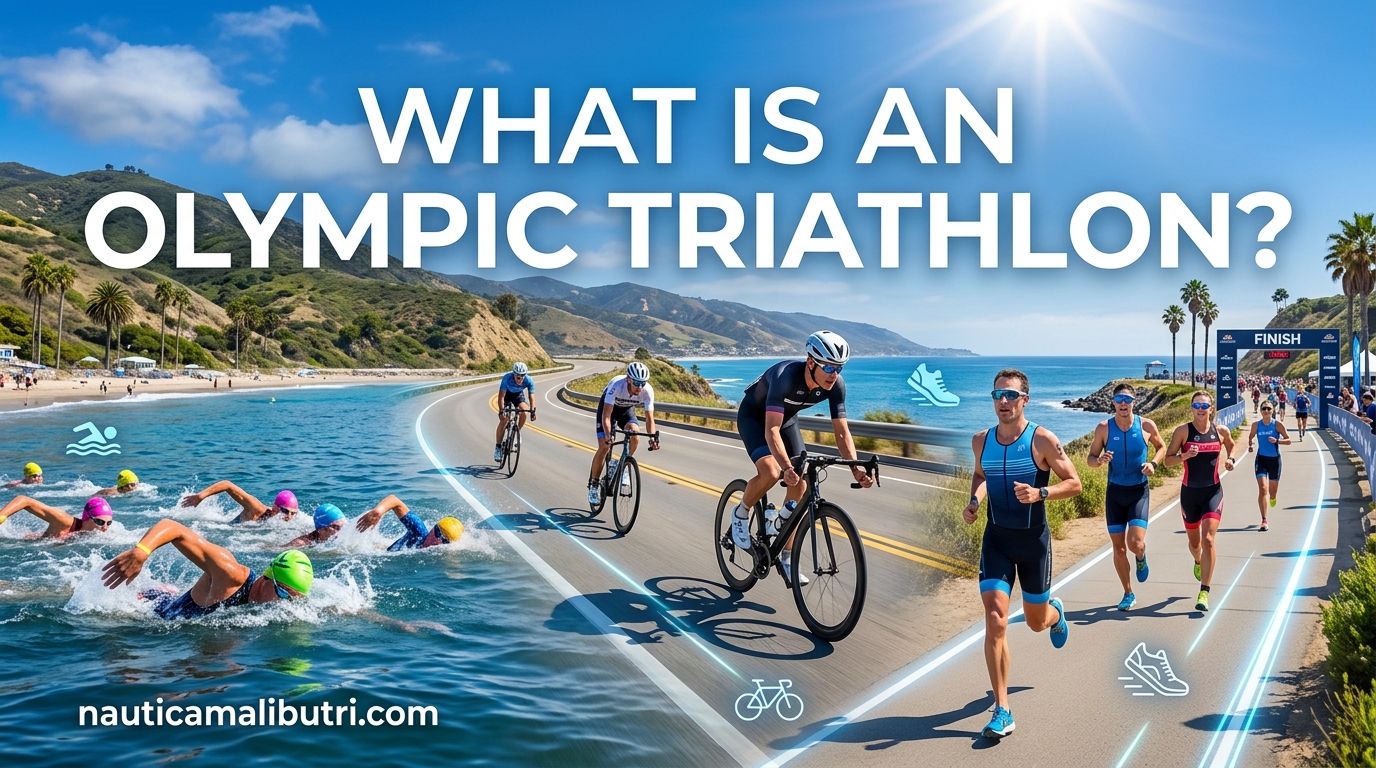
An Olympic triathlon is a multisport endurance event that combines three sequential disciplines into one continuous race: swimming, cycling, and running. The standard Olympic distance consists of a 1.5km swim, followed by a 40km bike ride, and finishing with a 10km run. That adds up to 51.5km total, or roughly 32 miles of racing.
If you have ever watched triathlon at the Summer Olympics since Sydney 2000, you have seen athletes push through this exact format. The Olympic distance has become the benchmark for the sport, recognized by World Triathlon as the standard competition format worldwide.
Our team has guided hundreds of athletes through their first Olympic triathlon over the past decade. I remember standing at the finish line in Malibu watching beginners cross with tears of joy after months of preparation. Whether you are curious about the sport or planning your first race, understanding what an Olympic triathlon involves is your first step toward the finish line.
Table of Contents
What is an Olympic Triathlon
An Olympic triathlon is a standardized multisport race format governed by World Triathlon, the sport’s international federation. Athletes compete sequentially through three disciplines without breaks, though transition periods between each leg are counted in overall race time.
The Olympic distance strikes a balance between accessibility and challenge. Unlike the Ironman, which requires 140.6 miles of racing, or the Sprint distance, which wraps up in under an hour for elites, the Olympic format takes most athletes between 2 and 3 hours to complete. This makes it achievable for committed beginners while still providing a serious test for experienced competitors.
The race format debuted as an Olympic sport at the 2000 Sydney Games, featuring separate men’s and women’s individual events. Over two decades later, it remains one of the most-watched endurance sports during the Summer Olympics, with the mixed relay format added to create even more excitement.
Olympic Triathlon Distances
Knowing the exact distances helps you prepare both mentally and physically for race day. Here is the complete breakdown:
- Swim: 1.5km (0.93 miles) – typically in open water like lakes, rivers, or ocean
- Bike: 40km (25 miles) – road cycling on paved surfaces
- Run: 10km (6.2 miles) – final leg on roads or trails
- Total: 51.5km (32 miles)
The swim leg often creates the most anxiety for beginners. Open water swimming differs dramatically from pool training. There are no walls to rest against, sighting requires lifting your head to spot buoys, and other athletes create turbulence around you. I recommend at least 4-6 open water practice sessions before your first race.
For age-group racers (non-elites), Olympic triathlons follow non-drafting rules on the bike leg. This means you must maintain a 7-12 meter gap behind the cyclist ahead of you, depending on the race. Drafting, or riding in the slipstream of another cyclist, is only allowed in elite and professional draft-legal events.
The transitions, called T1 (swim to bike) and T2 (bike to run), count toward your total time. Efficient transitions can save 2-5 minutes without requiring additional fitness. Practice your transition setup at home: lay out your gear, visualize each step, and rehearse the movements until they feel automatic.
The History of Olympic Triathlon
Triathlon made its Olympic debut on September 16, 2000, at the Sydney Games. Canada’s Simon Whitfield won the men’s event in a dramatic sprint finish, while Switzerland’s Brigitte McMahon took the women’s title the following day.
Before Olympic recognition, triathlon existed as an emerging sport with roots in 1970s California and Hawaii. The first recorded triathlon happened in San Diego in 1974. By the 1990s, the sport had grown enough to earn a place in the Olympic program through the International Triathlon Union, now World Triathlon.
The Paris 2024 Olympics showcased the latest evolution: the mixed relay. Teams of two men and two women each complete a shortened triathlon (300m swim, 8km bike, 2km run) before tagging the next teammate. This fast-paced format has brought new energy to Olympic triathlon and attracts different athletes than the individual events.
Olympic Triathlon vs Other Distances
Understanding where the Olympic distance fits in the triathlon spectrum helps you choose the right challenge. Here is how the major formats compare:
| Distance | Swim | Bike | Run | Total |
|---|---|---|---|---|
| Sprint | 750m | 20km | 5km | 25.75km |
| Olympic | 1.5km | 40km | 10km | 51.5km |
| Half Ironman | 1.9km | 90km | 21.1km | 113km |
| Ironman | 3.8km | 180km | 42.2km | 226km |
The Olympic distance is exactly double the Sprint format and sits at roughly half the Half Ironman distance. This middle ground makes it popular for athletes stepping up from Sprint races or preparing for longer events.
Typical finish times vary dramatically based on experience level. Elite men finish around 1 hour 45 minutes, while elite women typically finish around 1 hour 50 minutes. Age-group athletes range from 2 hours 10 minutes for competitive amateurs to 3 hours or more for first-timers. Your goal should be finishing strong, not chasing arbitrary time targets.
From forum discussions, I see the same question repeatedly: Is a marathon harder than an Olympic triathlon? The honest answer depends on your strengths. A marathon requires about 4 hours of continuous running for most people. An Olympic triathlon spreads the effort across three disciplines, which many find easier on the joints but more complex logistically.
Training for Your First Olympic Triathlon
Based on community feedback from triathlon forums and our own coaching experience, most athletes need 8-12 weeks of specific preparation for their first Olympic distance race. If you are starting from minimal fitness, plan for 5-6 months of base building first.
Experienced triathletes often train 10 hours per week during Olympic preparation. Beginners should start closer to 6-8 hours weekly, gradually building volume. The 80/20 method, recommended frequently in triathlon communities, suggests doing 80% of training at easy intensity and 20% hard. This approach reduces injury risk while building fitness effectively.
Here is a simple weekly structure that works for most beginners:
- Monday: Rest or easy swim technique session
- Tuesday: Bike intervals or hills (45-60 minutes)
- Wednesday: Run with some tempo sections (30-45 minutes)
- Thursday: Swim endurance focus (45-60 minutes)
- Friday: Rest or easy spin
- Saturday: Long bike (build to 50km+)
- Sunday: Brick session (bike followed immediately by run)
Equipment concerns come up constantly in beginner forums. You do not need a $5,000 triathlon bike for your first Olympic race. A road bike with clip-on aero bars works perfectly. Essential gear includes a wetsuit for cold water, a helmet (mandatory), running shoes you have trained in, and nutrition for the bike and run legs.
Practice your race day nutrition during training. Most athletes consume 200-300 calories per hour on the bike, then rely on gels or sports drinks during the 10km run. Never try new nutrition for the first time on race day. I have seen too many athletes suffer GI distress from untested products.
Transition practice deserves more attention than most beginners give it. Set up a transition area in your driveway or garage. Practice running in from your “swim,” stripping your wetsuit, putting on your helmet and bike shoes, then mounting. Reverse the process for T2. Do this ten times and you will save minutes on race day.
Common Questions About Olympic Triathlon
What are the Olympic triathlon distances?
An Olympic triathlon consists of three sequential disciplines: a 1.5km (0.93 mile) swim, followed by a 40km (25 mile) bike ride, and finishing with a 10km (6.2 mile) run. The total distance is 51.5km or approximately 32 miles.
What is the difference between an Ironman and an Olympic triathlon?
An Olympic triathlon covers 51.5km total (1.5km swim, 40km bike, 10km run) and takes most athletes 2-3 hours to complete. An Ironman is 226km total (3.8km swim, 180km bike, 42.2km run) and takes 8-17 hours. Olympic triathlons are non-drafting for age-groupers, while Ironman events are always non-drafting.
What’s harder, a marathon or an Olympic triathlon?
Both present different challenges. A marathon requires continuous running for 4+ hours, stressing the same muscle groups repeatedly. An Olympic triathlon spreads effort across swimming, cycling, and running, which reduces repetitive impact but requires managing three disciplines and two transitions. Most triathletes find the Olympic distance more manageable than a marathon.
How long does it take to train for an Olympic triathlon?
Athletes with a base fitness level need 8-12 weeks of specific Olympic distance training. Beginners starting from minimal fitness should plan 5-6 months, including 2-3 months of base building. Experienced triathletes typically train 10 hours per week, while beginners should start with 6-8 hours weekly and gradually increase volume.
What is a good time for an Olympic triathlon?
Elite men finish around 1 hour 45 minutes, elite women around 1 hour 50 minutes. Competitive age-group athletes typically finish between 2 hours 10 minutes and 2 hours 30 minutes. First-time finishers often complete the distance in 2 hours 45 minutes to 3 hours 15 minutes. A good time is any finish – this is an endurance achievement regardless of the clock.
Conclusion
An Olympic triathlon is a 51.5km multisport endurance challenge combining a 1.5km swim, 40km bike ride, and 10km run. The format has defined the sport since its Olympic debut in 2000 and remains the standard distance for serious triathlon competition worldwide.
Whether you are a beginner contemplating your first race or an athlete seeking a new challenge, the Olympic distance offers an achievable yet demanding goal. With 8-12 weeks of focused training, attention to transitions, and proper race day nutrition, you can cross that finish line with confidence.
The Nautica Malibu Triathlon has welcomed thousands of first-time Olympic distance finishers over the years. Start your training today, and you could join them at the finish line in 2026.