
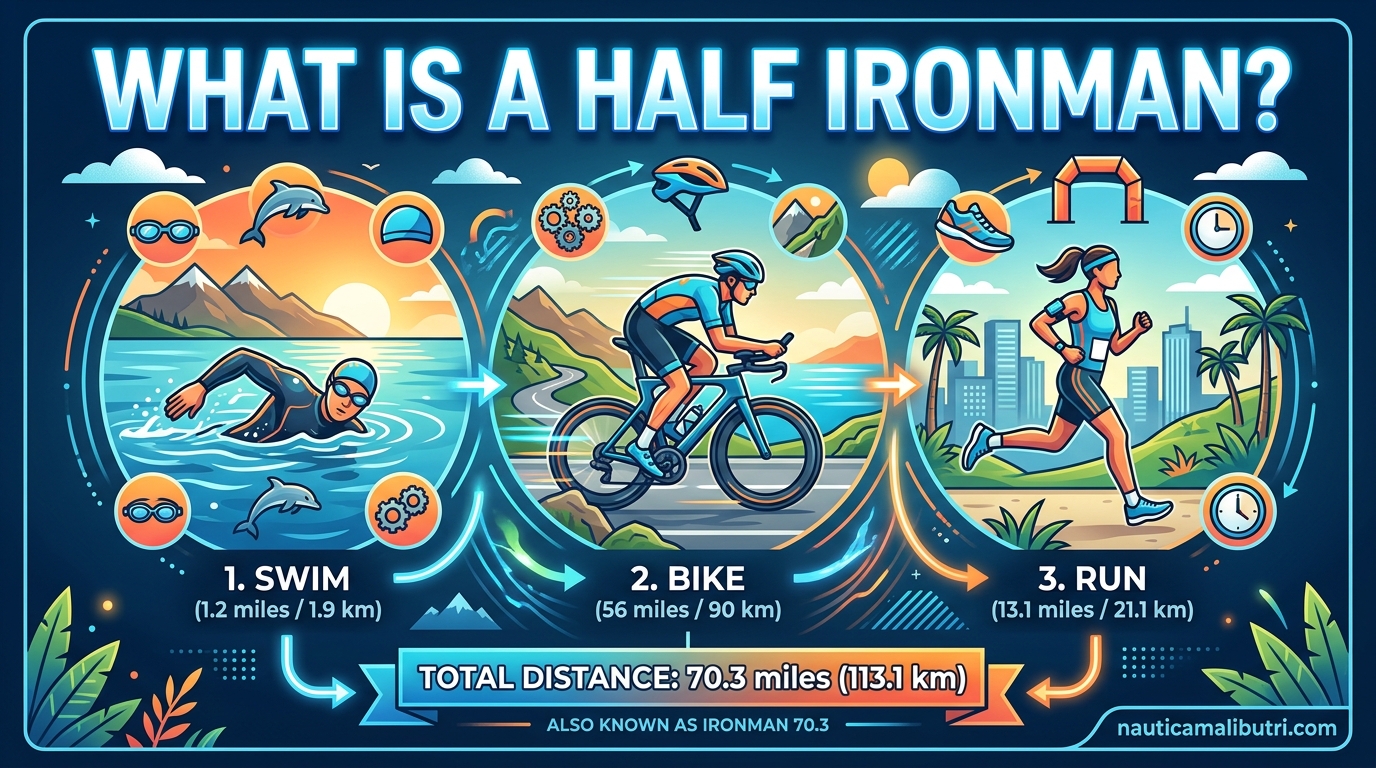
A half Ironman, also known as an Ironman 70.3, is a challenging triathlon distance that tests your endurance across three disciplines. The race covers a total of 70.3 miles (113 kilometers), making it exactly half the distance of a full Ironman triathlon.
If you are curious about what is a half Ironman and whether it is the right challenge for you, this guide breaks down everything you need to know. I have drawn from years of triathlon experience and insights from the racing community to give you practical, actionable information.
The 70.3 distance has exploded in popularity over the past decade. It offers a substantial endurance challenge without requiring the extreme time commitment of a full Ironman. For many athletes, it represents the sweet spot between achievable and aspirational.
Table of Contents
Understanding the Half Ironman Distance
The half Ironman distance breaks down into three equal legs, each testing different aspects of your fitness and mental toughness. Here is exactly what you will cover on race day:
- Swim: 1.2 miles (1.9 kilometers) in open water
- Bike: 56 miles (90 kilometers) on roads or mixed terrain
- Run: 13.1 miles (21.1 kilometers), which is a half marathon
The 70.3 designation comes from adding these three distances together in miles. This branding has become so recognizable that many athletes simply refer to the distance as “a 70.3” rather than saying “half Ironman.”
Most finishers complete the event in 5 to 8 hours, depending on fitness level, course difficulty, and race day conditions. Elite professionals can finish in under 4 hours, while the course cutoff time is typically 8 hours and 30 minutes from your wave start.
Half Ironman vs Full Ironman: Key Differences
Understanding how a half Ironman compares to a full Ironman helps put the challenge in perspective. The full Ironman distance doubles every leg of the race.
A full Ironman consists of a 2.4-mile swim, 112-mile bike ride, and 26.2-mile marathon run, totaling 140.6 miles. The half Ironman cuts each of these exactly in half, which is why many athletes view it as the logical stepping stone to the full distance.
The time commitment differs dramatically between the two. While a half Ironman requires 5 to 8 hours of racing, a full Ironman demands 8 to 17 hours of continuous effort. Most first-time full Ironman finishers are on course for 12 to 15 hours.
Training volume reflects this difference. Half Ironman training typically requires 10 to 15 hours per week during peak preparation. Full Ironman training often demands 15 to 20 hours weekly, with some athletes logging even more during build phases.
The mental challenge also scales differently. A half Ironman tests your endurance and pacing strategy, but you finish before deep fatigue sets in. A full Ironman pushes you into unknown territory where nutrition mistakes, pacing errors, or mental lapses can derail your race in the final hours.
Who Should Consider a Half Ironman?
The half Ironman attracts a diverse range of athletes, from first-time triathletes to experienced racers looking for a new challenge. Here is who typically thrives at this distance.
Athletes stepping up from sprint or Olympic distance triathlons often find the 70.3 to be the natural next progression. If you have completed a few shorter triathlons and want to test your limits without committing to full Ironman training, this distance fits perfectly.
Marathon runners and cyclists frequently gravitate toward half Ironman racing. Strong runners already have the engine for the 13.1-mile leg. Cyclists with endurance backgrounds often adapt quickly to the training volume, though they typically need work on swim technique and run durability.
Can a beginner do a half Ironman? Yes, but with important caveats. Most coaches recommend having a solid fitness base before starting a 70.3 training plan. You should be able to comfortably swim 1,000 meters, ride 2 hours, and run 45 minutes before beginning structured preparation.
The racing community generally agrees that 20 weeks is a typical training block for athletes with this base fitness. Attempting to shortcut this timeline often leads to injury, burnout, or a miserable race day experience.
Many athletes use the half Ironman as a stepping stone to the full Ironman distance. Racing a 70.3 gives you valuable experience with nutrition, pacing, and mental strategies that translate directly to the full distance.
What to Expect at Each Leg of the Race
Understanding what happens during each segment of a half Ironman helps you prepare mentally and physically. Here is what race day actually looks like.
The Swim: 1.2 Miles of Open Water
The swim leg begins with a mass start or wave start in open water, typically a lake, bay, or protected ocean area. You will be surrounded by hundreds of other athletes, all jockeying for position in the water.
Open water swimming differs dramatically from pool swimming. There are no walls to rest against, no lane lines to follow, and no clear water beneath you. Sighting, or lifting your head to see where you are going, becomes a critical skill that you must practice before race day.
The swim typically takes 35 to 50 minutes for most finishers. Strong swimmers might exit in under 30 minutes, while beginners could spend over an hour in the water. Wetsuits are usually allowed and provide buoyancy and warmth, though some warm-water races are wetsuit-illegal.
Transition 1 (T1): From Water to Bike
T1 is your first transition, moving from swim to bike. You will exit the water, strip off your wetsuit if wearing one, dry off quickly, and change into cycling gear. Most athletes spend 5 to 10 minutes in T1.
Efficient transitions save valuable time without requiring additional fitness. Practice your transition routine before race day so you can execute smoothly under adrenaline and fatigue. Lay out your gear logically and rehearse the sequence multiple times.
The Bike: 56 Miles of Pacing and Nutrition
The bike leg is where races are often won or lost through smart pacing. Fifty-six miles is a long ride, and going out too hard will destroy your run legs before you even start the final discipline.
Most athletes spend 2.5 to 3.5 hours on the bike. Drafting rules vary by race, but most Ironman-branded 70.3 events are non-drafting, meaning you must maintain a specified distance behind other riders. This creates a more individual time trial effort rather than a pack ride.
Nutrition becomes critical on the bike. You need to consume calories, electrolytes, and fluids steadily throughout the 56 miles. Most athletes aim for 60 to 90 grams of carbohydrates per hour, starting early and staying consistent. Racing community wisdom suggests eating more than you think you need, especially during heavy training periods.
The forum insights from experienced athletes emphasize riding conservatively during the bike leg. Saving just 5 percent of your energy on the bike often translates to 15 percent better performance on the run.
Transition 2 (T2): Bike to Run
T2 is typically faster than T1, lasting 2 to 4 minutes. You rack your bike, change into running shoes, grab your race belt and nutrition, and head out onto the run course.
Your legs will feel strange when you first start running. This heavy, uncoordinated feeling is normal and usually fades within the first mile. Brick workouts, or training sessions where you run immediately after biking, prepare you for this sensation and should be a staple of your training.
The Run: 13.1 Miles to the Finish
The half marathon run is where you find out whether your pacing and nutrition strategy worked. After 3 to 5 hours of racing, running 13.1 miles is a significant challenge regardless of your fitness level.
Most athletes complete the run in 1.5 to 2.5 hours. Aid stations appear every mile or so, offering water, sports drink, and often snacks like gels, bananas, or pretzels. Walking through aid stations to ensure proper hydration is a smart strategy that costs minimal time.
The final miles test your mental toughness. Having a mantra, breaking the distance into smaller chunks, or focusing on catching the next athlete ahead can help you maintain effort when your body wants to slow down.
Training Basics for Your First Half Ironman
A successful half Ironman requires structured training that builds your fitness progressively over several months. Here is what you need to know about preparing effectively.
The typical training block lasts 20 weeks for athletes with a reasonable fitness base. This timeline allows for gradual buildup, recovery weeks, and a final taper period before race day. Shorter timelines are possible for experienced athletes, but beginners should not compress the preparation.
Weekly training time averages 10 to 15 hours during peak weeks. This typically includes two swims, three to four bikes, three to four runs, and at least one brick workout where you practice the bike-to-run transition. Rest days are essential and should be treated as seriously as training days.
Swim technique matters more than swim volume. Many beginners make the mistake of swimming long, slow miles without addressing form flaws. Working with a coach or joining a masters swim program often yields bigger fitness gains than adding more yardage to solo sessions.
Brick workouts are essential for running after biking. Your first few attempts will feel awkward, but consistency teaches your body to transition between muscle groups efficiently. Even a 15-minute run after a long bike ride provides valuable adaptation.
Practice your race day nutrition during training. Your stomach handles food differently under exercise stress, and race day is not the time to experiment. Test your chosen gels, drinks, and solid foods during long workouts to ensure they sit well when you are working hard.
Transition practice is often overlooked but can save significant time and stress. Set up a mock transition area at home or your local track and rehearse your routine until it becomes automatic.
How Long Does a Half Ironman Take?
Finishing times for half Ironman races vary widely based on fitness level, course difficulty, and race day conditions. Understanding typical time ranges helps you set realistic expectations.
Most first-time finishers complete the distance in 5.5 to 7 hours. Breaking this down: the swim takes 35 to 50 minutes, the bike 2.5 to 3.5 hours, the run 1.75 to 2.5 hours, plus 5 to 15 minutes total in transitions. These ranges assume reasonable fitness and smart pacing.
Elite professional athletes finish in 3.5 to 4 hours, with the world record currently under 3 hours and 30 minutes on fast courses. Age group athletes competing for podium spots typically finish in 4 to 5 hours depending on their age category and the course.
Race cutoff times add pressure for slower athletes. Most Ironman 70.3 events have an overall cutoff of 8 hours and 30 minutes from your wave start. Individual leg cutoffs may also apply, typically 1 hour and 10 minutes for the swim and 5 hours for the bike.
What constitutes a good half Ironman time is relative to your experience and goals. For your first race, finishing strong and smiling is a success. As you gain experience, you can chase personal bests or age group podiums. The beauty of this sport is competing against yourself while sharing the course with athletes of all abilities.
Frequently Asked Questions
What is a half ironman distance?
A half Ironman, also called Ironman 70.3, is a triathlon covering 70.3 miles total. The distance breaks down to a 1.2-mile swim (1.9 km), 56-mile bike ride (90 km), and 13.1-mile run (21.1 km). Most athletes finish in 5 to 8 hours.
Can a beginner do a half ironman?
Yes, a beginner can complete a half Ironman with proper preparation. Most coaches recommend having a base fitness level where you can swim 1,000 meters, bike 2 hours, and run 45 minutes continuously. A typical training block lasts 20 weeks with 10 to 15 hours of weekly training during peak weeks.
Is a 70.3 considered an Ironman?
A 70.3 is officially called a half Ironman and is organized under the Ironman brand. While it carries the Ironman name, it is exactly half the distance of a full Ironman (140.6 miles). Finishing a 70.3 earns you the title of Ironman 70.3 finisher, distinct from full Ironman finishers who complete the 140.6-mile distance.
What is a lazy triathlon?
A lazy triathlon, also called a reverse triathlon or casual triathlon, is an informal event format that reduces distances or eliminates competitive elements. Some versions feature shorter distances, relay teams where friends split the legs, or aquathons that skip the bike portion entirely. These events focus on participation and fun rather than endurance testing.
Now you understand what is a half Ironman and what it takes to complete one. The 70.3 distance offers a rewarding challenge that pushes your limits without consuming your entire life with training.
If you are considering your first half Ironman, start by building your base fitness across all three disciplines. Give yourself adequate time to prepare, practice your nutrition and transitions, and approach race day with a smart pacing strategy. The finish line feeling of crossing after 70.3 miles of effort is worth every training session.
The triathlon community welcomes athletes of all abilities and experience levels. Whether you are chasing a podium spot or simply want to prove to yourself that you can finish, the half Ironman distance provides an achievable yet meaningful goal that will change how you see your own potential.