
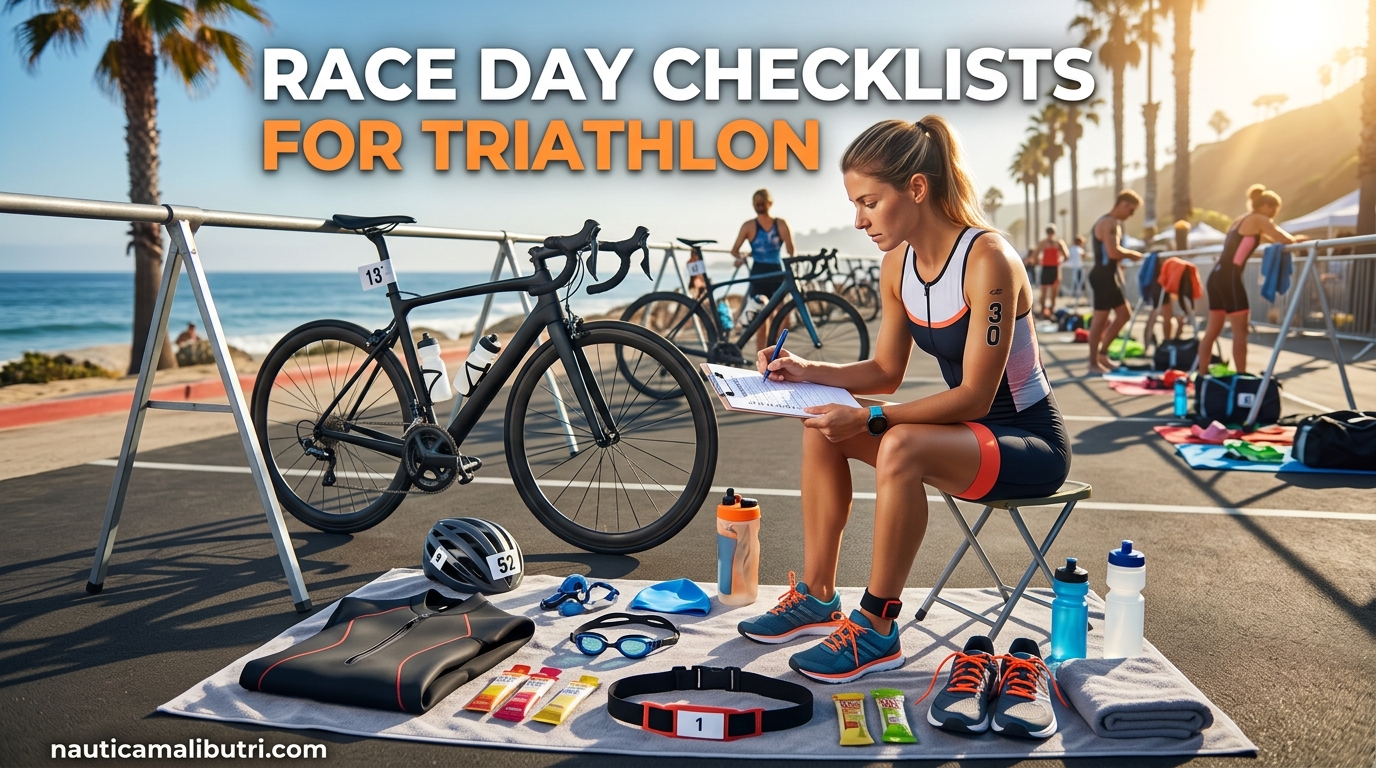
I have stood in the transition area at 5 AM, heart racing, suddenly realizing I forgot my bike shoes. That sinking feeling taught me the hard way why a race day checklist for triathlon is not just helpful, it is essential. After completing dozens of races and helping hundreds of first-timers at the Nautica Malibu Triathlon, I have refined this checklist to cover everything you need and nothing you do not.
This guide breaks down exactly what to pack for each discipline, how to structure your race morning, and the specific considerations for racing in Malibu. Whether you are tackling your first sprint triathlon or your tenth Ironman, having a systematic approach will eliminate stress and let you focus on your performance.
I will walk you through swim, bike, and run gear checklists, transition area setup, a detailed race day timeline, and beginner-specific tips. You will also find answers to the most common questions I hear from athletes at our local Malibu races.
Table of Contents
Race Day Checklists for Triathlon: The Complete Breakdown
Triathlon requires gear for three distinct disciplines plus transition management. Let us break it down by section so nothing gets missed.
Swim Gear Checklist
The swim is your first discipline, and missing even one item here can end your race before it starts. Here is what you need:
- Wetsuit – Required for most open water swims in Malibu. Check water temperature beforehand.
- Goggles – Bring two pairs. Nothing ruins a race faster than a broken strap or fogged lenses.
- Swim cap – Usually provided by race organizers, but bring your own backup.
- Tri-suit or swim skin – Wear this under your wetsuit for fast transitions.
- Timing chip – Attach to your ankle per race instructions. Never swim without it.
- Body Glide or anti-chafe balm – Apply to neck, shoulders, and ankles to prevent wetsuit rub.
- Anti-fog spray – For your goggles, applied before the race starts.
I always lay out my swim gear the night before in the order I will use it. Wetsuit goes on last, right before heading to the swim start. Keep your goggles around your neck until the last minute to avoid losing them in the pre-race chaos.
Bike Gear Checklist
The bike leg is where mechanical issues can derail your entire day. Pack these essentials:
- Bike – Obviously, but check it the night before. Pump tires, test brakes, spin wheels.
- Helmet – Required. Do not remove it until your bike is racked in transition.
- Cycling shoes – With cleats properly adjusted. Bring a backup pair if you have them.
- Sunglasses – Clear or light-tinted for early morning starts.
- Bike computer or GPS watch – For pacing, but not strictly required.
- Heart rate monitor – If you train with one, bring it.
- Spare tube – One is minimum, two is better for longer races.
- CO2 inflator – With at least two cartridges. Practice using it before race day.
- Tire levers – Two minimum for stubborn tire changes.
- Mini pump – Backup to CO2, or primary if you prefer.
- Multi-tool – With chain breaker if you have space.
- Chain lube – Quick application if it is dusty.
- Nutrition – Gels, bars, or electrolytes for the bike leg.
- Water bottles – Full and mounted on the bike.
Pro tip: attach your spare tube, CO2, and tire levers together with a rubber band or small bag. When you get a flat, everything is in one place and you are not fumbling around your transition area.
Run Gear Checklist
The final leg seems simple, but forgetting one key item can cost you minutes:
- Running shoes – Pre-laced with elastic laces if you use them. Check for wear.
- Moisture-wicking socks – Fresh pair in transition, never worn before the race.
- Race belt – With your bib number already attached.
- Hat or visor – Essential for Malibu races with morning sun exposure.
- Sunglasses – Different pair from bike if you prefer, or the same ones.
- Garmin or running watch – Charged and ready to go.
- Nutrition – Gel or electrolytes if you need them for the run.
I keep my run gear together in a small bag that sits at the front of my transition area. When I come in from the bike, I do not have to search for anything. Hat, race belt, and shoes go on in under 60 seconds.
Transition Area Essentials
Your transition zone is your command center. These items make it functional:
- Towel – Brightly colored so you can spot your rack easily.
- Bike pump – For pre-race tire top-off. Check pressure one last time.
- Extra water bottle – For rinsing feet, hands, or face.
- Baby wipes or wet wipes – For quick cleaning.
- Sunscreen – Apply before the swim, reapply after if needed.
- Safety pins – Backup for race belt or number attachment.
- Elastic laces – Pre-installed on running shoes.
- Chamois cream sample – For emergency reapplication on the bike.
- Small mat – If allowed, for organized gear layout.
Mark your territory. A bright towel, balloon, or distinctive bag helps you find your bike quickly when you are oxygen-deprived coming out of the water. I have seen athletes wander the transition rows for minutes because everything looks the same.
Miscellaneous Items
These are the things that do not fit in the other categories but can save your race:
- ID and race registration confirmation – Required for packet pickup.
- Cash – For parking, food vendors, or emergencies.
- Phone – Charged, but leave it in your gear bag during the race.
- Change of clothes – For after the finish line.
- Sandals or flip-flops – For walking around pre-race and post-race comfort.
- Post-race nutrition – Recovery drink or snack.
- Water bottle for pre-race – Stay hydrated before the start.
- Earplugs – If you are sensitive to pre-race noise.
- Warm layers – For before the race, especially at early morning Malibu starts.
Race Day Timeline: Hour by Hour
Knowing what to bring is only half the battle. Here is how to structure your race morning:
4 hours before start: Wake up, have a small familiar breakfast (bagel, banana, coffee). Nothing new on race day.
3.5 hours before: Finish eating. Continue sipping water but stop heavy fluid intake 2 hours before start.
3 hours before: Leave for the venue. Malibu traffic can be unpredictable, and parking fills fast.
2 hours before: Arrive, check in, pick up timing chip. Set up your transition area completely.
90 minutes before: Bike check, tire pressure confirmation, bathroom break. Walk the transition routes.
60 minutes before: Put on wetsuit if water is cold. Do a short warm-up jog or dynamic stretches.
30 minutes before: Final bathroom stop, apply body glide, put on swim cap and goggles.
15 minutes before: Get in the water if allowed, or get in the start corral. Stay calm, breathe.
I have seen too many athletes arrive stressed because they cut the timeline too close. Give yourself buffers. It is better to be ready early and relax than to rush and forget something critical.
Pre-Race Night Preparation
Your race day success starts the night before. Here is my pre-race ritual:
Pack your transition bag using the checklists above. Check every item off as it goes in the bag. Do not assume you will remember something in the morning.
Check your bike thoroughly. Spin the wheels, test brakes, verify your chain is lubed. Pump tires to race pressure. Put your bike in or on your car ready to go.
Lay out your race morning clothes. You will be groggy at 4 AM, so make decisions now. Include your race number if you have it.
Plan and prep breakfast. Set out your bagel, banana, and anything non-perishable. Know exactly what you will eat and when.
Set multiple alarms. I set three: my watch, my phone, and a backup phone. I also confirm my hotel wake-up call if I am staying nearby.
Review the course map. Know the swim exit location, bike mount and dismount lines, and run start direction. Visualize your transitions.
Get to bed early, but do not stress if you cannot sleep. Rest is good, but lying still with your eyes closed helps more than you think.
Beginner-Specific Tips: What You REALLY Need
First-year triathletes often overpack. Here is what you actually need versus what is nice to have:
Absolutely essential: Goggles, bike, helmet, cycling shoes, running shoes, race belt, timing chip. That is it. You can complete a triathlon with just those items.
Strongly recommended: Wetsuit (if water is cold), sunglasses, nutrition, spare tube and CO2. These prevent discomfort and mechanical DNFs.
Nice to have: Bike computer, heart rate monitor, anti-fog spray, transition mat. These optimize performance but are not required.
Keep your first race simple. Do not worry about shaving 30 seconds in transition with elastic laces if you have never practiced with them. Use what you trained with. Race day is not the time to experiment.
Anxiety is normal. I have seen elite athletes nervous before races. The checklist removes one source of stress. When you know you have everything, you can focus on racing.
Sprint vs Olympic vs Ironman: Gear Variations
Not all triathlons require the same preparation. Here is how your checklist changes:
Sprint triathlon (750m swim, 20km bike, 5km run): Minimal nutrition needed. One gel or bottle on the bike is usually sufficient. Transition setup is simple. Mechanical support is often available on course.
Olympic distance (1.5km swim, 40km bike, 8km run): Plan for two nutrition sources on the bike and one on the run. Bring a full spare tube and CO2 setup. Transition organization becomes more important as fatigue sets in.
Half-Ironman / 70.3 (1.9km swim, 90km bike, 21.1km run): Full nutrition strategy required. Multiple bottles, gels, and possibly salt tabs. Consider a special needs bag if the race offers them. Bike mechanical self-sufficiency is critical.
Full Ironman (3.8km swim, 180km bike, 42.2km run): Extensive nutrition planning, multiple clothing options for weather changes, detailed transition organization. You need to be completely self-sufficient mechanically.
For Malibu races, most athletes compete in sprint or Olympic distances. The ocean swim and coastal bike course make these distances challenging enough without stepping up to Ironman preparation.
Common Mistakes to Avoid
After years of racing and spectating, I have seen patterns in what goes wrong. Learn from these mistakes:
Forgetting the timing chip is a classic error. Put it on first thing when you arrive at transition. Attach it to your ankle and do not remove it until after you cross the finish line.
Not practicing transitions leads to fumbling. Set up your backyard and run through T1 and T2 multiple times before race day. Know exactly what goes on in what order.
Trying new gear on race day is asking for trouble. That includes nutrition. Use only what you have trained with. Blisters and GI distress from new shoes or gels can ruin months of preparation.
Arriving late creates a cascade of stress. Traffic around Malibu can be brutal on race mornings. Plan to arrive early and relax rather than rush.
Skipping the bathroom line pre-race often leads to mid-race emergencies. The line looks long, but it moves fast. Get in it.
Not knowing the course layout causes navigation errors. Walk through transition. Know which row your bike is in. Memorize the swim exit to bike mount route.
Malibu-Specific Race Day Considerations
Racing at the Nautica Malibu Triathlon has unique factors you should prepare for:
The ocean swim can be chilly even in summer. Check the water temperature forecast and pack your wetsuit accordingly. The Pacific in Malibu often runs 65-68 degrees Fahrenheit, which is wetsuit-legal and recommended for most athletes.
Morning fog is common along the coast. Bring clear or yellow-tinted sunglasses, not just dark ones. Visibility can be low on the bike course until the sun burns through.
Parking fills extremely fast at Zuma Beach. Arrive by 5:30 AM for a 7:00 AM start, or use the shuttle if offered. Traffic on PCH backs up for miles on race morning.
Sand gets everywhere at Zuma Beach. Pack extra towels and wet wipes. Rinse your feet before putting on socks and shoes to avoid friction blisters.
The bike course has rolling hills and can be windy. Check your brakes and practice climbing and descending before race day. The Pacific Coast Highway exposure means wind gusts are real.
Sun exposure is intense even on cloudy days. Apply sunscreen before the swim and reapply after T1 if you are prone to burning. The Malibu sun reflects off the water and sand.
Transition Area Setup Tips
How you organize your transition area directly impacts your race time. Here is how to set up efficiently:
Arrive early to get a good rack position. In most races, rack position is first-come, first-served or by age group. The end of the rack is fastest for getting your bike in and out.
Lay your towel to mark your territory. Place your bike shoes toward the front (handlebars) and your run gear toward the back (seat). This creates a natural flow.
Clip your bike shoes into the pedals if you are comfortable with flying mounts. Otherwise, place them on the towel with socks inside, ready to step into.
Put your helmet upside down on your handlebars with straps open. Sunglasses go inside the helmet. This is your T1 grab station.
Position your running shoes at the back of the towel with race belt and hat on top. Roll down the socks and place them inside the shoes for quick entry.
Keep nutrition in a small bag or container that is easy to grab. Do not fumble with individual wrappers in transition.
Walk the route from swim exit to your bike, and from bike return to run exit. Count the number of rows or use landmarks. When you are breathing hard, landmarks matter more than numbers.
Post-Race Recovery Essentials
The checklist does not end at the finish line. Pack these items for after your race:
Bring a complete change of clothes including dry shoes. Wet tri-suits get uncomfortable fast, and Malibu can be breezy post-race.
Pack a recovery drink or chocolate milk for immediate post-finish consumption. Your body needs carbohydrates and protein within 30 minutes.
Include basic first aid: bandages for blisters, pain relievers, and any personal medications.
Bring cash for food vendors or the post-race party. Many events have great food but no card readers.
Keep your phone accessible for photos and finding your support crew. Malibu races have beautiful backdrops worth capturing.
Pack a light jacket or warm layer. Your body temperature drops quickly after you stop racing, and the beach breeze can be chilly.
Do not forget your ID to retrieve your bike and gear bag from transition if required.
How to prepare for triathlon race day?
Start by packing your gear the night before using a comprehensive checklist. Wake up 3-4 hours before your start time for a light breakfast. Arrive at the venue 2 hours early to set up your transition area. Follow a structured timeline including bike check, warm-up, and final preparations before the swim start.
What do you REALLY need as a first year triathlete?
The absolute essentials are goggles, bike, helmet, cycling shoes, running shoes, race belt, and timing chip. A wetsuit is strongly recommended for open water swims. Focus on the basics and avoid over-complicating your first race with gadgets you have not trained with.
How early should I arrive at a triathlon?
Arrive 2 hours before your scheduled start time. This gives you buffer for parking, packet pickup, transition setup, bike check, bathroom stops, and warm-up. For popular races like the Nautica Malibu Triathlon, consider arriving even earlier due to traffic and limited parking.
What should I eat before a triathlon race?
Eat a familiar breakfast 3-4 hours before your start. Good options include a bagel with peanut butter, banana, oatmeal, or toast with honey. Avoid high fiber and high fat foods. Stop eating 2-3 hours before start time and stick to sipping water.
How do I set up my triathlon transition area?
Lay a bright towel to mark your spot. Place bike shoes at the front of your towel and run shoes at the back. Put your helmet upside down on your handlebars with sunglasses inside. Keep nutrition in an accessible container. Walk the routes from swim-to-bike and bike-to-run so you know exactly where to go.
What is the 90 second rule in triathlon?
The 90 second rule is an informal guideline suggesting you should be able to complete each transition in under 90 seconds. While not a strict rule, it is a good target for efficient transition practice. Focus on economy of motion rather than rushing.
What is the 2 2 2 2 method triathlon?
The 2 2 2 2 method refers to a nutrition strategy of consuming 2 units (calories, gels, or sips) every 20 minutes during a race. This helps maintain consistent energy levels without overloading the digestive system. Adapt the units based on your individual needs and race distance.
Final Thoughts on Race Day Checklists for Triathlon
A comprehensive race day checklist for triathlon transforms chaos into confidence. After years of racing and coaching athletes at the Nautica Malibu Triathlon, I can tell you that preparation is the difference between a stress-free morning and a frantic scramble.
Start with the essentials: swim gear, bike gear, run gear, and transition items. Follow the timeline, arrive early, and keep it simple. Remember that your first triathlon is about finishing strong and falling in love with the sport, not having the fanciest equipment.
Print this checklist, check items off as you pack, and review it the night before. When race morning arrives, you will be calm, collected, and ready to focus on what matters: swimming, biking, running, and crossing that finish line with a smile.
I will see you at Zuma Beach. Good luck, trust your training, and enjoy every moment of your race day.