
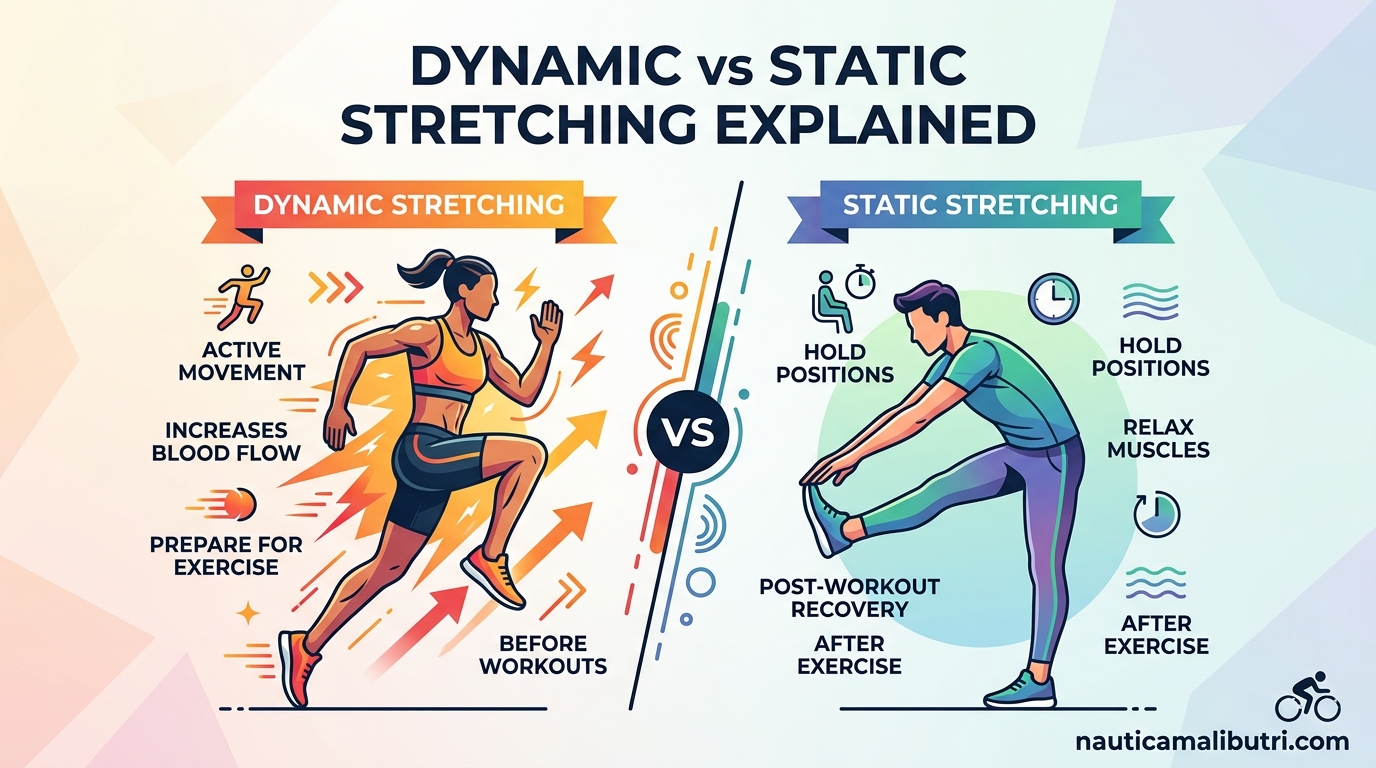
Understanding dynamic vs static stretching can transform how you prepare for training and recover from demanding workouts. As triathletes, we face a unique challenge: our bodies must seamlessly transition between three distinct disciplines, each placing different demands on our muscles and joints. The stretching choices you make before a swim session, during transition areas, or after a brick workout directly impact your performance, injury risk, and overall athletic longevity.
Through years of coaching athletes at every level, I have seen how proper stretching protocols separate consistent performers from those sidelined by preventable injuries. Many triathletes arrive at the start line with tight hip flexors from cycling, limited shoulder mobility for swimming, or calves that seize up mid-run. These issues rarely stem from inadequate fitness. They come from missing the fundamental preparation that dynamic and static stretching provide when applied correctly.
This guide explains dynamic vs static stretching in practical terms tailored specifically for multi-sport athletes. You will learn exactly when to use each type, how to implement discipline-specific routines, and why the transition from swim to bike to run requires a unique approach to muscle preparation. Whether you are preparing for your first sprint triathlon or targeting a full Ironman, these principles apply to every session you complete.
Table of Contents
What Is Dynamic Stretching?
Dynamic stretching involves active, controlled movements that take your joints through their full range of motion. Unlike holding a position, dynamic stretching requires continuous motion that mimics the activity you are about to perform. Your muscles activate, blood flow increases, and your nervous system prepares for the specific movement patterns ahead.
The key characteristic of dynamic stretching is movement. You are never holding still. Instead, you perform controlled motions like leg swings, arm circles, walking lunges, or torso rotations that gradually increase in range and intensity. Each repetition builds upon the last, warming tissues and improving mobility simultaneously.
Research consistently supports dynamic stretching before exercise. A 2019 study published in the Journal of Strength and Conditioning Research found that dynamic stretching improves power output, reaction time, and muscular endurance compared to static stretching before activity. The mechanism is straightforward: movement increases muscle temperature, enhances blood circulation, and activates the neuromuscular connections you need for athletic performance.
For triathletes, dynamic stretching serves as the bridge between rest and readiness. Your body transitions from a resting state to one prepared for swimming, cycling, or running through deliberate, progressive movement. The specificity matters greatly. Shoulder circles prepare you for the catch and pull of swimming. Hip openers ready your body for the cycling position. Leg swings activate the running mechanics your muscles will soon demand.
What Is Static Stretching?
Static stretching involves moving into a position and holding it for a set duration, typically 15 to 60 seconds. During static stretching, you elongate a specific muscle or muscle group to its point of tension, then maintain that position without movement. The goal is gradual lengthening of muscle fibers and improvement in overall flexibility.
The defining feature of static stretching is the hold. You move into a stretch position, perhaps a seated forward fold for hamstrings or a standing quad stretch, and you stay there. Your breathing remains steady. The stretch intensity should feel moderate, never painful. Over the hold duration, you may feel the muscle release slightly, allowing for a deeper stretch.
Static stretching produces different physiological effects than dynamic movement. The sustained elongation stimulates Golgi tendon organs, which are proprioceptive sensors that promote muscle relaxation. This relaxation response is beneficial for recovery and flexibility development but can temporarily reduce power output if performed immediately before explosive activity.
For triathletes, static stretching belongs primarily in the post-workout and recovery phases of training. After completing a session, your muscles are warm, pliable, and receptive to lengthening. This is when static stretching can improve your range of motion, reduce muscle tension, and promote circulation for recovery. Many elite triathletes maintain a 15-minute evening static stretching routine to address the accumulated tightness from training three disciplines daily.
Dynamic vs Static Stretching: Key Differences
The distinction between dynamic and static stretching extends beyond movement versus holding. These two approaches serve fundamentally different purposes in your training regimen. Understanding when and why to use each type separates effective triathletes from those who stretch without purpose.
| Characteristic | Dynamic Stretching | Static Stretching |
|---|---|---|
| Movement Pattern | Active, continuous motion through full range | Hold position without movement |
| Duration | 10-12 repetitions per movement | 15-60 seconds per stretch |
| Muscle State | Activates and engages muscles | Relaxes and lengthens muscles |
| Primary Timing | Before exercise, during warm-up | After exercise, during cool-down |
| Physiological Effect | Increases temperature, blood flow, activation | Increases flexibility, promotes relaxation |
| Performance Impact | Enhances power output and readiness | May temporarily reduce explosive power |
| Best For Triathlon | Pre-race, T1/T2 transitions, warm-ups | Post-race, evening recovery, rest days |
The most practical way to remember this distinction comes from the fundamental nature of each approach. Dynamic stretching prepares your body for action. Static stretching helps your body recover and adapt. Both have essential roles in triathlon training, but they belong at different points in your schedule.
Consider your muscle fibers as rubber bands. A cold rubber band snaps when stretched too far. A warmed rubber band stretches and returns to shape effortlessly. Dynamic stretching warms the rubber band. Static stretching, when done cold, risks the snap. When done warm, it improves the band’s overall stretch capacity.
When to Use Each Type of Stretching
Before Exercise: Dynamic Only
Your pre-workout routine should consist exclusively of dynamic stretching. Whether you are heading to the pool for a swim set, mounting your bike for interval training, or lacing up for a tempo run, dynamic movements prepare your body without compromising performance.
The timing is straightforward. Complete 5 to 10 minutes of dynamic stretching immediately before your main activity. Start with general movements like arm swings and leg circles, then progress to discipline-specific patterns. A swimmer might finish with shoulder activation sequences. A cyclist could emphasize hip flexor mobility. A runner should include walking lunges and calf raises.
After Exercise: Static Preferred
Post-workout is the ideal time for static stretching. Your muscles are warm, blood flow is elevated, and tissues are most receptive to lengthening. Hold each stretch for 30 to 45 seconds, focusing on the muscle groups you just trained.
For triathletes, post-workout static stretching addresses discipline-specific tightness. After swimming, focus on chest and shoulder stretches to counteract the forward-flexed position. After cycling, prioritize hip flexors and hamstrings that shorten in the aero position. After running, target calves, quads, and hip rotators that work hardest during impact.
Transition Areas: Quick Dynamic
Triathlon presents a unique scenario: transition areas between disciplines. You have minimal time between swim-to-bike (T1) and bike-to-run (T2). These moments require quick, efficient preparation.
In T1, after exiting the water and removing your wetsuit, spend 60 to 90 seconds on dynamic movements before mounting your bike. Ankle circles, hip openers, and a few walking lunges prepare your lower body for the cycling motion. In T2, after racking your bike, perform similar quick movements targeting the running muscles: leg swings, high knees, and calf pumps.
Evening and Recovery Days: Static Focus
Many experienced triathletes maintain a dedicated static stretching routine in the evening, separate from training sessions. This practice addresses the accumulated tightness from training three disciplines while promoting relaxation before sleep.
A 15-minute evening routine might include hamstring stretches on a strap, seated spinal twists, hip flexor stretches in a low lunge, and calf stretches against a wall. The key is consistency rather than intensity. Gentle, sustained stretching every evening produces better results than aggressive occasional sessions.
Triathlon-Specific Stretching Guidance
Triathlon demands more than generic fitness preparation. Your body must excel at swimming, cycling, and running, often on the same day. Each discipline creates specific muscular demands, tightness patterns, and mobility requirements. Generic stretching advice fails to address these multi-sport realities.
Swim-Specific Dynamic Preparation
Swimming requires exceptional shoulder mobility and core rotation. The overhead reach of each stroke demands flexible latissimus dorsi, teres minor, and pectoral muscles. Limited shoulder mobility forces compensatory movements that strain your neck and lower back.
Before swimming, prioritize dynamic shoulder movements. Large arm circles, both forward and backward, gradually increase range of motion. Torso rotations with arm sweeps mimic the rotational demands of freestyle. Scapular push-ups activate the shoulder stabilizers that protect against rotator cuff strain. Open water swimmers should add neck rotations and ankle flexibility work to prepare for sighting and varied kick patterns.
If you are transitioning directly from bike to swim during a brick session, add extra hip flexor and hamstring activation. The shortened cycling position tightens these muscles, which then limit your ability to maintain a horizontal body position in the water.
Cycling-Specific Considerations
The cycling position, particularly in aero bars, creates unique postural challenges. Your hip flexors remain in a shortened position for extended periods. Your hamstrings work in a limited range of motion. Your lower back stabilizes while rounded forward.
Before cycling, dynamic hip openers are essential. Walking lunges with rotation, leg swings across your body, and high-knee marches activate the hip complex. These movements counteract the seated position you are about to assume. For time-trial or triathlon bike setups, add thoracic spine rotations to prepare your upper back for the aero position.
After long rides, static stretching must address the specific tightness cycling creates. The hip flexor stretch in a low lunge with posterior pelvic tilt targets the psoas and iliacus muscles that shorten during riding. Supine hamstring stretches with a strap address the posterior chain without stressing the lower back.
Run-Specific Dynamic Activation
Running demands elastic energy return from muscles and tendons. Cold, unstretched tissues do not store and release energy efficiently. Dynamic stretching before running activates the stretch-shortening cycle that makes running economical.
Before running, emphasize dynamic movements that mimic running mechanics. Walking lunges with an overhead reach activate hip flexors while lengthening them simultaneously. Leg swings forward and back, then across the body, mobilize the hips in multiple planes. Calf raises and ankle circles prepare the foot and lower leg for impact. High knees and butt kicks progressively increase neuromuscular activation.
Triathletes face a specific running challenge: starting a run with bike-fatigued legs. The T2 transition requires extra attention to dynamic preparation. After dismounting your bike, spend 90 seconds on leg swings, walking lunges, and gentle jogging strides before settling into your race pace. This prevents the heavy-leg sensation that plagues many triathletes in the first mile of the run.
Brick Workout Protocols
Brick workouts, where you combine two disciplines in one session, require thoughtful stretching transitions. The most common brick is bike-to-run, though swim-to-bike bricks are also valuable for practicing T1.
For bike-to-run bricks, complete your normal post-ride static stretching immediately after the cycling portion. Focus on hip flexors, hamstrings, and calves. Then, before starting your run, perform a dedicated dynamic warm-up even though you just exercised. The movement patterns differ enough that cycling-specific warm tissues need running-specific preparation. This two-phase approach, static after bike and dynamic before run, optimizes your brick session.
Swim-to-bike bricks require different considerations. After swimming, your shoulders are warm but your lower body may be cold from minimal kick propulsion. A quick lower-body dynamic routine before mounting your bike ensures your legs are ready for the demands of pedaling.
Transition Area Quick Routines
Race day transitions demand efficiency. You have seconds, not minutes, to prepare your body for the next discipline. These quick routines prioritize the highest-impact movements.
T1 routine after wetsuit removal: 10 ankle circles each direction, 5 walking lunges each leg with arm reach overhead, 5 high knees in place, 5 butt kicks in place. Total time: 60 to 75 seconds. Mount your bike and spin easy for the first 2 minutes rather than attacking immediately.
T2 routine after racking your bike: 10 leg swings each leg forward and back, 10 calf raises, 5 walking lunges each leg, 30 seconds gentle jogging in place. Total time: 90 seconds. Start your run conservatively, allowing your running legs to fully engage.
Dynamic Stretching Examples for Triathletes
These dynamic exercises specifically address the movement patterns triathletes need for swimming, cycling, and running. Perform 10 to 12 repetitions of each movement, progressing gradually to full range of motion.
Swim Preparation Movements
Arm circles: Stand with feet shoulder-width apart. Make large circles with straight arms, 10 forward and 10 backward. Gradually increase circle size with each repetition.
Torso rotations with arm sweep: Stand with arms extended at shoulder height. Rotate your torso side to side, allowing your arms to swing loosely. The momentum should come from core rotation, not arm movement.
Scapular push-ups: In a plank position on hands and toes, keep arms straight while sinking and raising your chest by moving your shoulder blades together and apart. This activates serratus anterior and stabilizes the shoulder girdle.
Thread the needle: On hands and knees, reach one arm under your body and through the space between your supporting arm and knee. Rotate your torso to look behind you. Alternate sides.
Cycling and Running Preparation
Walking lunges with rotation: Step forward into a lunge, then rotate your torso toward your front leg by reaching the opposite arm overhead. Step through into the next lunge. This combines hip flexor lengthening with thoracic rotation.
Leg swings: Stand on one leg, holding a wall or fence for balance. Swing the other leg forward and back like a pendulum, gradually increasing range. Complete 10 swings, then switch to side-to-side swings across your body.
High knees with marching emphasis: March in place bringing knees toward chest. Focus on upright posture and full hip flexion. Add arm motion to increase coordination demands.
Butt kicks with upright posture: Jog in place bringing heels toward your glutes. Keep your torso tall and avoid leaning forward. This activates the hamstrings in a functional running pattern.
Calf raises with hold at top: Rise onto the balls of both feet, hold for one second at maximum height, then lower slowly. Progress to single-leg calf raises as strength improves.
Full-Body Activation Sequence
Inchworms: From standing, hinge forward to touch the floor, then walk your hands forward to a plank position. Perform one push-up, then walk your hands back to your feet and stand. This activates shoulders, core, and posterior chain simultaneously.
World’s greatest stretch: Step forward into a lunge, place the hand opposite your front leg inside your foot, then rotate your torso reaching that arm to the sky. Step through and repeat on the other side. This is a comprehensive dynamic stretch for hips, thoracic spine, and shoulders.
Static Stretching Examples for Triathletes
These static stretches target the muscle groups most affected by triathlon training. Hold each stretch for 30 to 45 seconds, breathing steadily throughout. Perform these after training or as part of an evening recovery routine.
Swim-Specific Static Stretches
Doorway chest stretch: Stand in a doorway with your forearm against the frame, elbow at shoulder height. Step through the doorway until you feel a stretch across your chest and anterior shoulder. This counteracts the forward-flexed swimming posture.
Latissimus dorsi stretch: Reach both arms overhead, grasp your left wrist with your right hand, and lean to the left, creating a side bend. You should feel the stretch along the left side of your torso. Hold, then switch sides.
Posterior shoulder stretch: Bring your right arm across your chest. Use your left hand to gently pull the right arm closer to your body. Keep your shoulder blades down and back. Hold, then switch arms.
Cycling-Specific Static Stretches
Hip flexor stretch in low lunge: Step your right foot forward into a lunge, left knee on the floor. Tuck your pelvis under by drawing your navel toward your spine. You should feel the stretch in the front of your left hip. Squeeze your left glute to increase the stretch. Hold, then switch sides.
Supine hamstring stretch with strap: Lie on your back with a strap or towel around the ball of your right foot. Extend your right leg toward the ceiling while keeping your left leg flat on the floor. Gently pull the strap to increase hamstring lengthening without rounding your back.
Figure-four glute stretch: Lie on your back, cross your right ankle over your left knee, then reach through and pull your left thigh toward your chest. You should feel this in your right glute and outer hip. Hold, then switch sides.
Run-Specific Static Stretches
Standing calf stretch against wall: Face a wall with your hands on the wall at shoulder height. Step your right foot back, heel flat on the floor, knee straight. Lean forward until you feel the stretch in your right calf. Hold, then switch sides. Repeat with the back knee slightly bent to target the soleus muscle.
Standing quad stretch: Stand on your left leg, bend your right knee and grasp your right ankle with your right hand. Gently pull your heel toward your glutes while keeping your knees together and your pelvis neutral. Hold, then switch legs.
Seated spinal twist: Sit on the floor with both legs extended. Bend your right knee and cross your right foot over your left thigh. Place your left elbow outside your right knee and rotate your torso to the right. This stretches the outer hip and rotates the spine. Hold, then switch sides.
Evening Recovery Sequence
Complete this 15-minute routine before bed to address accumulated training tightness. Start with the cycling-specific hip flexor stretch, then move to the supine hamstring stretch. Add the figure-four glute stretch and doorway chest stretch. Finish with legs up the wall position for 5 minutes to promote circulation recovery.
Benefits of Each Stretching Type
Benefits of Dynamic Stretching
Dynamic stretching offers immediate performance benefits that matter for triathletes. The active movements increase muscle temperature, enhancing the pliability of tissues and reducing resistance to movement. Warmer muscles contract more forcefully and relax more quickly, improving both power and efficiency.
Blood circulation improves significantly during dynamic stretching. Your cardiovascular system responds to the movement demands, delivering oxygen and nutrients to working tissues. This enhanced circulation removes metabolic byproducts and prepares your body for the metabolic demands ahead.
Neuromuscular activation is perhaps the most important benefit for triathletes. Dynamic stretching wakes up the communication pathways between your brain and muscles. This improved neuromuscular coordination translates to better movement patterns, reduced injury risk, and more efficient technique in all three disciplines.
The range of motion improvements from dynamic stretching are functional and specific. Unlike static stretching, which may increase flexibility beyond your active control, dynamic stretching improves the range you can actively use while swimming, cycling, or running.
Benefits of Static Stretching
Static stretching excels at developing long-term flexibility. By holding positions that lengthen muscles, you stimulate tissue adaptation that increases your range of motion permanently. For triathletes, improved flexibility means more aerodynamic positions on the bike, longer swimming strokes, and reduced risk of muscle strains during running.
Recovery promotion is another key benefit. The relaxation response triggered by sustained stretching activates the parasympathetic nervous system. This shift from sympathetic activation to recovery mode supports the healing processes your body needs between training sessions.
Static stretching reduces muscle tension and promotes relaxation. Many triathletes carry tension in their shoulders from swimming, lower back from cycling, and calves from running. Targeted static stretching releases this tension, improving comfort and sleep quality.
For injury rehabilitation and prevention, static stretching maintains tissue length and prevents the adaptive shortening that occurs with repetitive training. Hip flexors tighten from cycling. Hamstrings shorten from running. Chest muscles contract from swimming. Static stretching counteracts these patterns before they become problematic.
Common Mistakes to Avoid
Many triathletes make stretching errors that limit benefits or increase injury risk. Performing static stretching before high-intensity workouts can temporarily reduce power output for up to two hours. Save your static work for after training or separate flexibility sessions.
Bouncing during stretches, known as ballistic stretching, triggers the stretch reflex and can cause muscle strains. All stretching should be smooth and controlled. Move gradually into positions, respect your current limits, and avoid forcing range of motion.
Holding your breath during stretches creates tension and raises blood pressure. Breathe steadily and deeply throughout each stretch. Exhaling as you move deeper into a position often allows greater range of motion.
Finally, neglecting discipline-specific needs is a common error. Generic stretching routines fail to address the unique demands of swimming, cycling, and running. Your stretching should match your training focus, preparing the muscles you are about to use and recovering the muscles you just trained.
Frequently Asked Questions
What is the main difference between dynamic and static stretching?
Dynamic stretching involves active movements that take joints through their full range of motion, while static stretching requires holding a position for 15-60 seconds without movement. The key distinction is movement-based versus hold-based stretching. Dynamic stretching activates muscles and increases temperature before activity, whereas static stretching lengthens muscles and promotes relaxation after exercise.
Why is static stretching not recommended before exercise?
Static stretching before exercise can temporarily reduce muscular power output and performance for up to two hours. The sustained lengthening stimulates muscle relaxation responses that decrease explosive strength and reaction time. For triathletes preparing to swim, bike, or run, this performance reduction makes static stretching unsuitable as a warm-up method. Dynamic stretching is the preferred pre-exercise approach.
Will stretching help with delayed onset muscle soreness (DOMS)?
Static stretching after exercise has limited impact on reducing DOMS. Research indicates that stretching does not significantly prevent the muscle fiber micro-damage that causes soreness. However, gentle movement and light dynamic stretching on recovery days may improve circulation and reduce stiffness associated with DOMS. For managing soreness, proper nutrition, sleep, and gradual training progression are more effective than stretching alone.
Should I stretch during triathlon transitions?
Yes, but use dynamic stretching only during transitions. In T1 and T2, perform quick dynamic movements like leg swings, ankle circles, and walking lunges for 60-90 seconds. This prepares your muscles for the next discipline without the time investment or performance reduction of static stretching. Save static stretching for after you finish the race or during evening recovery sessions.
How long should I hold static stretches?
Hold static stretches for 30 to 60 seconds per muscle group. Research suggests this duration allows sufficient time for the muscle spindle reflex to diminish and the Golgi tendon organ to promote relaxation. For major muscle groups used in triathlon like hip flexors, hamstrings, and calves, aim for the longer end of this range. Breathe steadily throughout each hold and avoid bouncing or forcing the position.
Conclusion
Dynamic vs static stretching is not a competition where one approach wins. Both serve essential, complementary roles in triathlon training. Dynamic stretching prepares your body for the specific demands of swimming, cycling, and running. Static stretching develops the flexibility and promotes the recovery needed to train consistently across three disciplines.
The practical application is straightforward: dynamic before, static after. Use dynamic movements to activate your muscles and prepare your nervous system before every swim, bike, and run session. Employ static stretching to lengthen tissues and promote recovery after training or during dedicated flexibility sessions.
For triathletes, the discipline-specific applications matter most. Shoulder mobility for swimming, hip flexibility for cycling, and elastic preparation for running each require thoughtful stretching choices. Your transition area routines can make the difference between a smooth race and one spent fighting tight, unprepared muscles.
As you plan your training for 2026, integrate these stretching principles into every session. The consistency of proper preparation and recovery separates athletes who reach their start lines ready to perform from those dealing with preventable tightness and strain. Your body adapts to the demands you place upon it. Make stretching a non-negotiable part of those demands, and your performance will reflect the investment.