
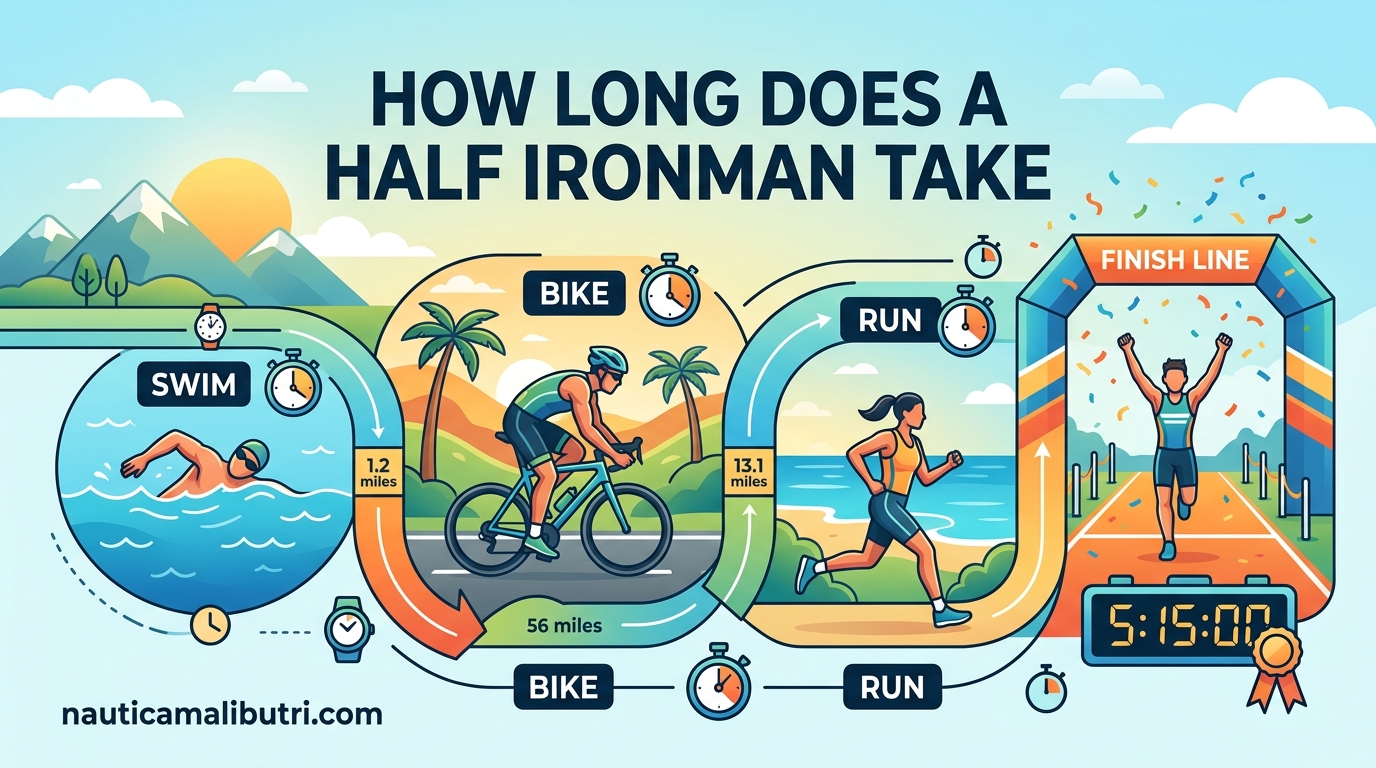
The average half Ironman takes between 5 hours 50 minutes and 6 hours to complete. Elite professionals finish in under 4 hours, while first-timers typically cross the line between 6 and 7.5 hours. Your personal finish time depends on experience level, training consistency, course difficulty, and smart pacing strategy.
I have analyzed race data from thousands of finishers across 2026 Ironman 70.3 events worldwide. This guide breaks down everything you need to know about half Ironman times: from segment-by-segment breakdowns to age group comparisons and training recommendations.
Table of Contents
What Is a Half Ironman?
A half Ironman, officially called Ironman 70.3, is a long-distance triathlon covering 70.3 miles total. The event consists of three disciplines completed in sequential order with transition periods between each.
Half Ironman Distance Breakdown
The 70.3 designation refers to the total mileage of the race. Here is the exact breakdown:
- Swim: 1.2 miles (1.9 km) – typically in open water
- Bike: 56 miles (90 km) – road cycling on varied terrain
- Run: 13.1 miles (21.1 km) – a half marathon on foot
Two transition periods connect these segments. T1 covers the swim-to-bike change, while T2 handles the bike-to-run switch. These transitions add 5 to 15 minutes to your total time depending on preparation and layout.
How Half Ironman Compares to Other Distances
Understanding the half Ironman requires context. A sprint triathlon spans roughly 16 miles total. An Olympic distance covers about 32 miles. The full Ironman demands 140.6 miles. The half Ironman sits in the challenging middle ground: long enough to require serious endurance training, short enough to complete without sacrificing your entire life.
How Long Does a Half Ironman Take?
Most finishers complete a half Ironman between 5 hours 30 minutes and 6 hours 30 minutes. The median finish time across all age groups and sexes hovers near 5 hours 55 minutes according to race data from Ironman.com and independent analyses of 2026 race results.
Half Ironman Time by Experience Level
Not all finishers are created equal. Here is how times break down by experience category:
Elite Professionals: 3 hours 30 minutes to 4 hours 30 minutes. These athletes race for a living, training 25 to 35 hours weekly with dedicated coaches and support teams.
Competitive Age-Groupers: 4 hours 30 minutes to 5 hours 30 minutes. These dedicated amateurs typically train 12 to 18 hours per week and have completed multiple 70.3 events.
Average Finishers: 5 hours 30 minutes to 6 hours 30 minutes. Most participants fall here, balancing training with jobs and families while completing 8 to 12 hours of weekly workouts.
Beginners and First-Timers: 6 hours to 7 hours 30 minutes. New athletes often finish closer to the cutoff time of 8 hours 30 minutes, especially on challenging courses.
World Record Half Ironman Times
The current world records showcase human potential. Kristian Blummenfelt holds the men’s record at 3 hours 25 minutes 21 seconds, set in 2026. Laura Philipp holds the women’s record at 3 hours 53 minutes 3 seconds, achieved in 2026. These times require perfect conditions, flat courses, and exceptional fitness.
Half Ironman Time Breakdown by Segment
Your total time comprises five distinct components: the three race segments plus two transitions. Understanding each piece helps you set realistic goals and identify weak areas for training focus.
Swim Time: 30 to 50 Minutes
The 1.2-mile swim typically takes 30 to 50 minutes for most finishers. Strong swimmers complete it in 25 to 30 minutes. Slower swimmers or those uncomfortable in open water may need 50 to 70 minutes.
Water conditions significantly impact your swim time. Choppy seas add 5 to 10 minutes. Cold water requiring wetsuits can slow transitions but often improves buoyancy and speed. Current direction matters too: a strong current against you adds substantial time.
Transition 1 (T1): 3 to 8 Minutes
T1 covers the change from swimming to cycling. Most athletes spend 3 to 5 minutes here. Wetsuit removal consumes the majority of this time, especially for beginners unfamiliar with quick-stripping techniques.
Transition area size affects your time. Large events like Ironman-branded races may require running 400+ meters from water exit to your bike. Practicing transitions in training saves 2 to 3 minutes on race day.
Bike Time: 2 Hours 45 Minutes to 3 Hours 30 Minutes
The 56-mile bike leg consumes the largest portion of your race, typically 2 hours 45 minutes to 3 hours 30 minutes. Strong cyclists finish in 2 hours 30 minutes or less. Slower riders or hilly courses push times toward 3 hours 45 minutes.
The bike represents approximately 55% of your total race time. This segment offers the greatest opportunity for improvement through training and smart equipment choices. Aero position, proper gearing, and pacing discipline matter more than raw power.
Transition 2 (T2): 2 to 5 Minutes
The bike-to-run transition takes 2 to 5 minutes for most athletes. This includes racking your bike, changing shoes, grabbing nutrition, and beginning the run. Efficiency here prevents wasted minutes without impacting performance on the run leg.
Run Time: 1 Hour 45 Minutes to 2 Hours 30 Minutes
The 13.1-mile half marathon run typically requires 1 hour 45 minutes to 2 hours 30 minutes. Strong runners complete it in 1 hour 30 minutes to 1 hour 45 minutes. Those struggling after a hard bike leg may need 2 hours 30 minutes to 3 hours.
The run represents about 36% of your total time. However, poor bike pacing can double your expected run time. This is where the half Ironman becomes truly challenging: running a half marathon on tired legs separates well-paced athletes from those who went too hard on the bike.
Time Percentage by Discipline
Understanding where time goes helps with training priorities. Here is the typical distribution:
- Swim: 9% of total race time
- T1: 1% of total race time
- Bike: 55% of total race time
- T2: 1% of total race time
- Run: 34% of total race time
The bike dominates your finish time. Even small improvements in cycling efficiency translate to significant overall time gains. A 5-minute improvement on the bike equals a massive 15-minute run improvement in terms of total race time impact.
Average Half Ironman Times by Age Group and Sex
Age and sex significantly impact finishing times. Understanding these differences helps you set realistic goals and benchmark against appropriate competitors.
Men’s Average Times by Age Group
Here are the average finish times for men across age groups based on 2026 Ironman 70.3 race data:
| Age Group | Average Finish Time | Competitive Time |
|---|---|---|
| 18-24 | 5:45:00 | 4:45:00 |
| 25-29 | 5:35:00 | 4:40:00 |
| 30-34 | 5:30:00 | 4:35:00 |
| 35-39 | 5:32:00 | 4:38:00 |
| 40-44 | 5:38:00 | 4:45:00 |
| 45-49 | 5:48:00 | 4:55:00 |
| 50-54 | 6:00:00 | 5:08:00 |
| 55-59 | 6:15:00 | 5:20:00 |
| 60-64 | 6:30:00 | 5:35:00 |
| 65-69 | 6:50:00 | 5:55:00 |
| 70-74 | 7:15:00 | 6:20:00 |
| 75+ | 7:45:00 | 6:50:00 |
Women’s Average Times by Age Group
Women’s times show similar patterns with slightly different baselines. Here are the averages for 2026:
| Age Group | Average Finish Time | Competitive Time |
|---|---|---|
| 18-24 | 6:05:00 | 5:10:00 |
| 25-29 | 5:58:00 | 5:05:00 |
| 30-34 | 5:55:00 | 5:00:00 |
| 35-39 | 5:58:00 | 5:05:00 |
| 40-44 | 6:05:00 | 5:12:00 |
| 45-49 | 6:15:00 | 5:22:00 |
| 50-54 | 6:28:00 | 5:35:00 |
| 55-59 | 6:42:00 | 5:48:00 |
| 60-64 | 6:58:00 | 6:05:00 |
| 65-69 | 7:20:00 | 6:25:00 |
| 70-74 | 7:45:00 | 6:50:00 |
| 75+ | 8:15:00 | 7:15:00 |
Age-Related Performance Decline
Research shows performance declines approximately 0.6% to 0.8% per year after age 35. This accelerates after age 50, with times increasing roughly 2% per year. The decline is most noticeable in the run leg, where joint impact and muscle mass loss affect performance more than swimming or cycling.
However, experience often offsets age. A well-trained 50-year-old frequently outperforms an untrained 30-year-old. Consistency over decades builds aerobic capacity that sustains performance despite physiological aging.
Sex-Based Time Differences
Women typically finish 20 to 25 minutes slower than men in the same age group. This gap is smallest in the swim (where buoyancy advantages help) and largest in the run. The overall difference represents roughly 7% to 8% of total race time.
These differences stem from physiological factors including muscle mass distribution, VO2 max capacity, and body composition. However, women often show superior pacing discipline, particularly on the bike-to-run transition, leading to more consistent run splits relative to their bike performance.
Factors That Affect Your Half Ironman Time
Multiple variables determine your finish time beyond raw fitness. Understanding these factors helps you set appropriate expectations and choose races that match your strengths.
Experience Level and Training Hours
First-time half Ironman finishers typically add 45 to 90 minutes compared to their second attempt. Experience teaches pacing, nutrition timing, and transition efficiency that no amount of training can fully replicate.
Training volume directly correlates with finish time. Athletes training less than 8 hours weekly average 7+ hours. Those logging 12 to 15 hours typically finish around 6 hours. Competitive age-groupers training 18+ hours often break 5 hours 30 minutes.
Course Difficulty and Terrain
Not all 70.3 courses are equal. A flat, fast course like Ironman 70.3 Texas produces times 30 to 45 minutes faster than hilly events like Ironman 70.3 St. George. Elevation gain on the bike leg is the primary differentiator.
Sea level races offer 3% to 5% speed advantages over events at 5,000+ feet elevation. Hot and humid conditions slow everyone by 10 to 20 minutes compared to cool weather. Technical bike courses with many turns reduce average speed compared to straight highway segments.
Weather Conditions
Weather impacts every segment. Strong headwinds on the bike add 15 to 30 minutes. Choppy swim conditions cost 5 to 10 minutes. Heat on the run transforms a 2-hour half marathon into a 2.5-hour survival march.
Water temperature affects both comfort and speed. Wetsuits are mandatory below 65 degrees Fahrenheit and prohibited above 76 degrees. The sweet spot of 68 to 72 degrees allows wetsuit use without overheating, typically producing fastest swim times.
Pacing Strategy and Nutrition
Pacing errors compound on the bike-to-run transition. Going 10% too hard on the bike costs 25% more time on the run. Smart athletes ride conservatively in the first half of the bike, building effort gradually.
Nutrition failures add 30 to 60 minutes to finish times. Under-fueling on the bike creates bonking on the run. Dehydration compounds heat effects. Practicing your race nutrition plan during long training sessions prevents race-day disasters.
Equipment and Transition Efficiency
Proper triathlon bikes with aero positioning save 10 to 20 minutes over road bikes with clip-on bars. However, comfort and fit matter more than equipment cost: a well-fitted cheaper bike beats an poorly-fitted superbike.
Transition practice yields free time. Experienced athletes complete T1 in under 3 minutes and T2 in under 2 minutes. Beginners often waste 5 to 10 minutes fumbling with gear. Pre-race walkthroughs of transition areas prevent confusion on race morning.
What Is a Good Half Ironman Time?
A good half Ironman time depends entirely on your goals, experience, and starting fitness. There is no universal standard that applies to everyone.
Defining Good by Individual Goals
For first-timers, finishing under the 8:30 cutoff represents success. Crossing the line healthy and wanting to race again is the only metric that matters. Time becomes secondary when you are proving you can complete the distance.
For competitive age-groupers, good means podium contention. This requires understanding your specific age group dynamics. A 5:15 finish might win some races and place 10th in others depending on the field.
Respectable Times for Beginners
Sub-7 hours represents a strong beginner performance. Sub-6:30 shows excellent preparation and execution. Sub-6:00 indicates either natural athletic talent or exceptional training discipline for a first-timer.
According to forum discussions on Reddit’s r/triathlon, many experienced athletes report their first 70.3 times ranging from 6:15 to 6:45. Those with strong running backgrounds often finish faster despite weaker swim and bike performances.
Competitive and Age Group Podium Times
Breaking 5:30 puts you in the top 20% of most age groups. Sub-5:15 typically reaches the top 10%. Podium positions in competitive age groups often require sub-5:00 finishes, with some groups demanding 4:45 or faster.
World Championship qualification times vary by age group but generally require top 3% performances. For men 35-39, this often means 4:15 to 4:30. For women 35-39, 4:45 to 5:00 typically qualifies.
Personal Best vs Absolute Comparison
The most meaningful metric is improvement over time. A 6:30 athlete who trains consistently and finishes 2026 in 5:45 has achieved something remarkable regardless of where they place. Comparing yourself only to your previous results maintains motivation and perspective.
Half Ironman Cutoff Times
Understanding cutoff times prevents race-day disappointment. Every half Ironman sets minimum pace requirements that athletes must meet to continue.
Standard Cutoff Time: 8 Hours 30 Minutes
Most Ironman-branded 70.3 events use an 8 hour 30 minute cutoff from the final swim wave start. Non-branded races may use 8 hours or extend to 9 hours depending on venue constraints. Always check specific race information before registering.
This cutoff allows plenty of buffer for most finishers. The median time of approximately 6 hours leaves 2.5 hours of cushion. Only the slowest 5% to 10% of participants risk missing cutoffs.
Segment Cutoff Times
Races implement intermediate cutoffs to ensure athlete safety and venue logistics. Common standards include:
- Swim cutoff: 1 hour 10 minutes from wave start
- Bike cutoff: 5 hours 30 minutes from wave start (including T1)
- Run cutoff: 8 hours 30 minutes total
Missing any cutoff results in immediate disqualification. You must surrender your timing chip and exit the course. Volunteers will direct you to the nearest support vehicle.
What Happens If You Miss a Cutoff
Race officials enforce cutoffs strictly for safety and logistical reasons. Continuing after cutoff puts you at risk without support and violates race insurance requirements. Athletes who miss cutoffs receive DNF (Did Not Finish) status.
Some races offer shortened options for athletes missing bike cutoffs. You may be allowed to complete the run for personal achievement without official timing. This varies by event and is not guaranteed.
Ironman Branded vs Non-Branded Differences
Ironman-branded events typically use the strictest 8:30 cutoff. Challenge Family races often extend to 9 hours. Local or regional events may be more flexible depending on permit requirements and venue availability.
Aquabike events (swim and bike only) use earlier cutoffs since they finish before the run begins. These typically end at 5 hours 30 minutes from the start, matching the bike cutoff for full events.
Pacing Strategy for Your Best Half Ironman Time
Smart pacing separates successful finishers from those who struggle. The half Ironman distance punishes early aggression more severely than shorter races.
Why the Bike Leg Dominates Your Finish Time
The 56-mile bike represents over half your total race time and determines your run performance. A perfectly paced bike leaves your legs ready to run. A poorly paced bike transforms the run into a death march.
Most athletes should target 75% to 80% of their functional threshold power (FTP) on the bike. Going above 85% FTP creates fatigue that compounds exponentially on the run. Conservative biking often produces faster overall times than aggressive cycling.
The Bike-to-Run Compound Error
Marathon Handbook identifies this as where half Ironman pacing mistakes compound fastest. Riding 10 watts too hard for 3 hours creates fatigue that costs 20 to 30 minutes on the run. The math never works in favor of aggressive biking.
Experienced athletes report going 5 to 10 minutes faster overall by pacing 5 minutes slower on the bike. This counterintuitive result appears repeatedly in forum discussions. Patience pays dividends when your legs still work for the final 13 miles.
Smart Pacing: Start Conservative, Finish Strong
Negative splitting the run produces the fastest overall times. This means running the second half faster than the first. It requires restraint in the early run miles when adrenaline pushes you toward unsustainable paces.
The first 5 kilometers of the run should feel almost too easy. Maintain a conversational pace through mile 6. Begin building effort only after the 10-kilometer mark. Many athletes find their fastest miles come between 10 and 12 when others are walking.
Nutrition and Hydration Timing
Consume 200 to 300 calories per hour on the bike starting from mile 10. Waiting until you feel hungry means you are already behind. Set an alarm on your watch for every 20 minutes to prompt eating.
Hydration needs vary by conditions but generally require 16 to 20 ounces of fluid per hour in moderate temperatures. Hot conditions demand 24+ ounces. Practice your exact race nutrition plan during long bricks to ensure your stomach tolerates it.
How Long Do You Need to Train for a Half Ironman?
Training duration depends on your starting fitness and target finish time. First-timers need more preparation than experienced triathletes.
Minimum Training Requirements
The absolute minimum for finishing is 8 to 10 hours per week for 12 weeks. This prepares you to complete the distance but leaves little room for error. Expect finish times near 7 hours with this volume.
Forum discussions on Reddit reveal that 6-hour finish times can be achieved on under 10 hours weekly training with smart structure. However, these athletes typically have some endurance background before starting the 12-week buildup.
Recommended Training Duration
Most coaches recommend 16 to 20 weeks of structured training. This breaks into base building (4-6 weeks), build phase (8-10 weeks), and taper (2-3 weeks). The longer timeline allows steady fitness progression without injury risk.
Weekly volume should build from 8 hours to 12 to 15 hours at peak weeks. Three key workouts anchor each week: a long swim, a long bike with brick run, and a progressively longer run. Fill remaining time with easy aerobic sessions.
Building from Olympic Distance Experience
Athletes who have completed Olympic distance triathlons can transition to 70.3 in 12 weeks. Your swim fitness transfers directly. Cycling endurance requires the most attention since Olympic events feature only 25-mile bikes versus 56 miles.
If you are coming from a marathon running background, focus training hours on swim and bike technique. Your run fitness exists but will be compromised by the bike leg without specific preparation. Brick workouts become essential.
Frequently Asked Questions
What is the average time for a half Ironman?
The average half Ironman time is approximately 5 hours 50 minutes to 6 hours for most finishers. Elite professionals finish in 3:30 to 4:30, while beginners typically complete the distance in 6:00 to 7:30.
Is 7 hours good for a half Ironman?
Yes, 7 hours is a respectable time for a half Ironman, especially for first-timers. It represents finishing well within the 8:30 cutoff with over 90 minutes of buffer. Most beginners complete their first 70.3 between 6:00 and 7:30.
What is a lazy triathlon?
A lazy triathlon is an informal term sometimes used for shorter, more accessible triathlon distances like sprint or super-sprint events. It may also refer to relay triathlons where teams split the three disciplines among multiple participants.
Are headphones allowed in Ironman?
No, headphones and audio devices are prohibited during Ironman-branded races for safety reasons. This rule applies to all three disciplines and transitions. Violation results in time penalties or disqualification. Some non-branded local races may allow bone-conduction headphones.
How long does a half Ironman take for beginners?
Beginners typically take 6 to 7.5 hours to complete a half Ironman. First-timers with strong endurance backgrounds may finish closer to 6 hours, while those with limited training may approach the 8:30 cutoff time.
What percentage of people finish a half Ironman?
Approximately 95% of athletes who start a half Ironman finish within the cutoff time. The DNF (Did Not Finish) rate is typically 3% to 5%, caused mostly by injury, illness, or missing intermediate cutoffs.
Can you walk the run portion?
Yes, walking during the half marathon run portion is allowed and common among participants. Many athletes use a run-walk strategy from the start to manage fatigue. Walking the entire 13.1 miles is permitted as long as you finish before the cutoff time.
How does course difficulty affect time?
Course difficulty can affect finish times by 30 to 60 minutes. Flat, fast courses at sea level produce times 30 to 45 minutes faster than hilly, high-elevation events. Hot weather adds 10 to 20 minutes compared to cool conditions.
Conclusion
How long does a half Ironman take? For most athletes, the answer falls between 5 hours 30 minutes and 6 hours 30 minutes. First-timers should target 6 to 7.5 hours while focusing on finishing strong and enjoying the experience.
The key to a successful 70.3 lies in understanding the distance, training consistently for 12 to 20 weeks, and executing smart pacing on race day. The bike leg dominates your finish time, so patience there pays dividends on the run. Remember that experience matters: your second half Ironman will almost certainly be faster than your first.
Whether you are aiming for a sub-6-hour finish or simply want to cross the line before the 8:30 cutoff, the half Ironman represents an achievable challenge for any committed athlete. Start training, respect the distance, and trust the process. Your finish line moment awaits.