
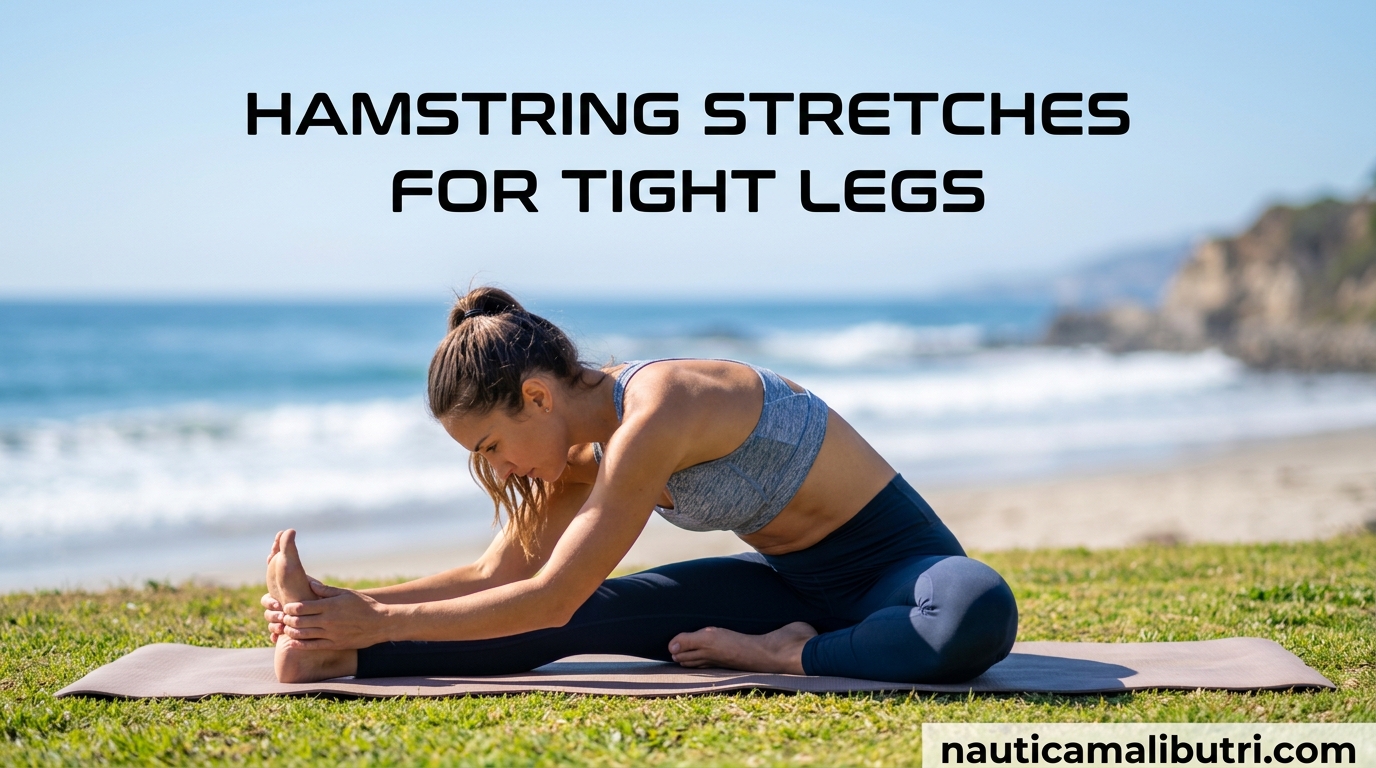
I used to finish my long runs feeling like my hamstrings were made of steel cables. After months of ignoring the tightness, my running form suffered, my cycling power dropped, and I started getting that dull ache in my lower back that every triathlete dreads. That was three years ago, before I committed to a consistent hamstring stretching routine that changed everything.
The truth is, hamstring stretches for tight legs are not just about touching your toes. For triathletes, they are essential maintenance work that keeps you injury-free across all three disciplines. Here are the 8 best hamstring stretches that have helped me and hundreds of athletes I’ve coached improve flexibility, reduce pain, and perform better in 2026:
1. Seated Forward Fold – The classic baseline stretch you can do anywhere
2. Single Leg Hamstring Stretch – Targeted stretch with built-in modifications
3. 90/90 Hamstring Stretch – Physical therapist favorite for controlled lengthening
4. Wall Hamstring Stretch – Passive stretch perfect for recovery days
5. Leg Swings – Dynamic warm-up movement for pre-workout activation
6. Walking Inchworms – Full posterior chain mobilization
7. Standing Dynamic Toe Touches – Controlled dynamic movement
8. PNF Contract-Relax Stretching – Advanced technique for stubborn tightness
Table of Contents
Why Hamstrings Get Tight (Especially for Triathletes)
Before diving into the stretches, you need to understand why your hamstrings are screaming at you in the first place. For triathletes, the problem is usually a perfect storm of training demands.
Cycling puts your hips in a flexed position for hours at a time. That constant hip flexion shortens the front of your body and puts your hamstrings in a lengthened, stressed position. Add the anterior pelvic tilt most of us adopt in the aero position, and your hamstrings are working overtime just to stabilize your pedal stroke.
Then you run. Running requires your hamstrings to act as both shock absorbers and propulsive muscles. Every foot strike puts an eccentric load on these muscles as they lengthen to control your forward momentum. If they are already tight from cycling, that loading pattern becomes a recipe for strain.
Swimming seems like it would spare your hamstrings, but poor kick mechanics and tight hip flexors from the other two sports affect your body position in the water. When your hip flexors are tight, your hamstrings compensate, creating a chain of tension that runs through your entire posterior chain.
And if you sit at a desk for work, you are adding fuel to the fire. Hours of sitting keep your hip flexors short and your glutes deactivated, forcing your hamstrings to pick up the slack for every movement. That is why so many triathletes complain of tight hammies despite regular stretching.
Understanding Your Hamstrings (The Quick Version)
Your hamstrings are not just one muscle. They are a group of three muscles running down the back of your thigh: the biceps femoris on the outside, and the semitendinosus and semimembranosus on the inside. Together, they extend from your sitting bones (ischial tuberosity) to just below your knee.
Because these muscles cross both your hip and knee joints, they affect movement at both. Tight hamstrings limit your hip hinge, which is essential for proper running form and cycling posture. They also pull on your pelvis, which can contribute to lower back pain and affect your reach in swimming.
For triathletes, healthy hamstrings mean better running economy, more power on the bike, and less strain on your lower back during long sessions. Understanding this connection helps you prioritize stretching as performance work, not just recovery fluff.
Static Hamstring Stretches for Daily Flexibility
Static stretches are what most people picture when they think of stretching. You move into a position and hold it. These are best done after workouts or as a standalone flexibility session, not before intense activity.
1. Seated Forward Fold (Classic Baseline Stretch)
This is the stretch everyone knows, but most people do it wrong. Sit on the floor with both legs extended straight in front of you. Flex your feet so your toes point up toward the ceiling. This engages your quadriceps and protects your knees.
From here, hinge at your hips and reach forward toward your toes. Do not round your back to reach farther. The moment your spine starts to curve, you have stopped stretching your hamstrings and started stressing your lumbar spine. Keep your back straight, even if that means you only reach your shins.
Hold this position for 30 to 60 seconds. Breathe deeply. If you cannot reach your feet, use a strap, towel, or belt around the arches of your feet and gently pull yourself forward. For beginners, keeping a slight bend in the knees makes this more accessible and reduces strain.
2. Single Leg Hamstring Stretch (Targeted and Gentle)
This variation lets you focus on one leg at a time and is excellent if you have an imbalance (most of us do). Sit on the floor with your left leg extended straight and your right leg bent so the sole of your foot rests against your inner left thigh.
Turn your torso slightly to face your extended leg. Hinge forward from your hips, keeping your back straight, and reach toward your left foot. Hold for 30 to 60 seconds, then switch sides. This position isolates the stretch to one hamstring and reduces the intensity compared to the bilateral version.
The bent knee of your non-working leg removes tension from that side, letting you focus completely on the target muscle. Many athletes find they can go deeper in this position than the standard forward fold. If you feel the stretch behind your knee rather than in the belly of your hamstring, bend your extended knee slightly until you feel the shift up into the muscle.
3. 90/90 Hamstring Stretch (Physical Therapist Favorite)
This is the stretch physical therapists prescribe most often because it gives you maximum control over the intensity. Lie on your back with both knees bent and feet flat on the floor. Lift your right leg and grasp it behind the thigh with both hands.
Extend your right leg toward the ceiling until you feel a gentle stretch in your hamstring. The goal is to get your leg to roughly 90 degrees, but do not force it. If you cannot hold the position comfortably, use a strap around your foot and hold the ends with your hands.
Hold for 30 to 60 seconds, then switch legs. The beauty of this stretch is that your hands do the work, not your back. You can micro-adjust the angle to find exactly where your hamstring needs the stretch most. This makes it ideal for people with lower back sensitivity who cannot tolerate seated forward folds.
4. Wall Hamstring Stretch (Zero Effort, Maximum Results)
This is my go-to stretch for recovery days when I want to relax completely while still working on flexibility. Lie on your back near a wall or doorframe. Extend one leg up the wall while the other stays flat on the floor or bent with the foot resting on the ground.
Scoot your hips close enough to the wall that you feel a gentle stretch in the back of your elevated leg. Do not force your leg straight if it wants to bend. Let gravity do the work. Hold for 60 to 90 seconds per leg, breathing slowly and relaxing into the position.
The wall provides support so your muscles can truly relax instead of fighting to maintain the position. I often do this stretch while reading or scrolling through training data on my phone. It is the lowest-effort, highest-return stretch in this entire guide.
Dynamic Hamstring Stretches for Warm-Up
Dynamic stretching involves controlled movement through a range of motion. These stretches are perfect for pre-workout warm-ups because they increase blood flow, activate your nervous system, and prepare your muscles for activity without the performance-dampening effects of long static holds.
5. Leg Swings (Front-to-Back)
Stand next to a wall or fence for support. Swing your inside leg forward and backward like a pendulum. Keep the movement controlled, not ballistic. Start with small swings and gradually increase the range as your hamstrings warm up.
Do 15 to 20 swings per leg before a run or bike session. The key is to engage your core and maintain good posture throughout. Do not let your back arch as your leg swings behind you. These leg swings dynamically lengthen your hamstrings while teaching your nervous system that this range of motion is safe, which is exactly what you need before a workout.
6. Walking Inchworms
Stand with your feet hip-width apart. Hinge at your hips and walk your hands out into a plank position. Then walk your hands back to your feet and stand up. That is one rep.
Do 8 to 10 reps before training. This movement stretches your hamstrings during the initial hinge and then engages your entire posterior chain as you hold the plank. It is a full-body warm-up that pays special attention to the back of your legs. Move slowly and feel the stretch each time you fold forward.
7. Standing Dynamic Toe Touches
Stand tall and extend one leg straight out in front of you with your heel on the ground and toes pointing up. Hinge forward and reach toward that foot with both hands. Only go as far as you can while keeping your back straight.
Return to standing and repeat on the other side. Alternate legs for 10 to 12 reps total. This is essentially a dynamic version of the standing hamstring stretch. The movement increases blood flow and gradually expands your range of motion without the sustained hold that can temporarily reduce power output before a workout.
Advanced Techniques for Stubborn Tightness
If you have been stretching consistently for weeks and your hamstrings still feel like guitar strings, these advanced techniques may be what you need. They work on the neurological component of tightness, not just the muscular tissue.
PNF Stretching (Contract-Relax Method)
Proprioceptive Neuromuscular Facilitation, or PNF, sounds complicated but is actually simple. You stretch the muscle, contract it against resistance, then relax and stretch deeper. The contraction fatigues the muscle spindle reflex that normally prevents overstretching.
Here is how to do it for your hamstrings. Lie on your back and place a strap around the arch of one foot. Pull the leg toward your chest until you feel a stretch. Hold for 10 seconds. Then push your heel away from you against the strap resistance for 5 seconds, as if you were trying to lower your leg but the strap prevents it.
Relax completely and gently pull the leg closer to your chest. You should be able to go deeper. Hold this new position for 20 to 30 seconds. Repeat the contract-relax cycle 2 to 3 times per leg. I use this technique after hard workouts when I need maximum flexibility gains in minimum time.
Towel/Strap-Assisted Stretches
A simple towel or yoga strap can transform your stretching game by giving you leverage without compromising form. For the seated forward fold, loop the towel around the arches of your feet and hold the ends with both hands.
Use the towel to gently pull yourself forward, keeping your back straight. The towel lets you create tension without rounding your spine to grab your toes. This is especially helpful for beginners who cannot yet reach their feet. You can apply the same principle to the 90/90 stretch, using the towel to pull your extended leg closer to your chest.
Triathlon-Specific Stretching Routines
Here is where this guide differs from generic fitness content. Triathletes have unique needs based on the swim-bike-run demands and the time constraints of training three sports. These routines are designed to fit into your training schedule and address sport-specific issues.
Pre-Swim Activation (2 Minutes)
Before swimming, you need to wake up your hamstrings without overstretching them. Do 10 leg swings per leg to increase blood flow. Follow with 5 slow inchworms to activate your posterior chain. Finish with 5 bodyweight squats to fire up your glutes, which support proper hamstring function.
This routine takes two minutes and prepares your legs for the kick without the static stretching that can reduce your propulsion in the water. The goal is activation, not relaxation.
Bike-to-Run Transition Stretches (Brick Workouts)
The bike-to-run transition is where most triathlon injuries happen. Your hamstrings are used to the circular pedaling motion, then suddenly need to handle the linear demands of running. A quick dynamic routine can save your race.
After racking your bike, do 10 leg swings per side before you start running. This retrains your nervous system for the different movement pattern. If you have time, add 5 walking inchworms to fully transition your muscles. These two exercises take 90 seconds and can prevent the hamstring cramps that derail so many triathletes off the bike.
Post-Workout Recovery Routine (5 Minutes)
This is your daily bread and butter for flexibility gains. After every workout, spend 5 minutes on these three stretches. Hold the seated forward fold for 60 seconds. Do the 90/90 stretch for 60 seconds per leg. Finish with the wall stretch for 90 seconds per leg while you scroll through your training data or catch your breath.
That is 5 minutes total. Do this consistently after every session and you will see real hamstring flexibility improvements within 4 to 6 weeks. Skip it, and you are leaving performance on the table and inviting injury.
Safety Tips and Common Mistakes to Avoid
More stretching is not always better. Here is what I have learned from years of working with athletes and from my own mistakes.
When NOT to Stretch
Never stretch a cold muscle. That is how you pull something. Always do a light warm-up first, even if it is just 5 minutes of easy walking. Do not do long static holds before intense workouts or races. Save those for after training or as a separate flexibility session.
If you feel pain, sharp or shooting sensations, stop immediately. A stretch should feel like a gentle pull, not agony. Pain is your body telling you something is wrong. Listen to it.
Proper Breathing
Breathing is the secret weapon of effective stretching. Never hold your breath. Breathe slowly and deeply, exhaling as you move into the stretch. Each exhale lets you sink a little deeper as your muscles relax. Shallow breathing keeps your nervous system on alert, preventing the full relaxation that allows tissues to lengthen.
Duration Guidelines
For static stretches, 30 seconds is the minimum effective dose. 60 seconds is better. Anything over 2 minutes yields diminishing returns and can stress the tissue. For dynamic stretches, 10 to 20 controlled repetitions is the sweet spot. PNF stretches should take about 60 to 90 seconds per leg including the contraction phases.
Avoiding Overstretching
The biggest mistake I see is athletes trying to force flexibility. They bounce, strain, and contort themselves to touch their toes. This triggers the stretch reflex, making your muscles tighten up defensively. It also risks injury. Go to the point of gentle tension, then hold. Consistency over weeks and months beats intensity every time.
Frequently Asked Questions
How to loosen severely tight hamstrings?
Severely tight hamstrings require a multi-approach strategy. Start with daily static stretching holding each position for 60 seconds, focus on the 90/90 stretch for controlled lengthening, add PNF stretching to address neurological tightness, and strengthen your glutes since weak glutes often cause hamstring overuse. Expect to see noticeable improvement in 6 to 8 weeks with consistent daily practice.
How long does it take to loosen hamstrings?
With consistent stretching of 5 to 10 minutes daily, most people notice initial improvements in hamstring flexibility within 2 to 4 weeks. Significant changes in range of motion typically take 6 to 12 weeks. Chronic tightness that has developed over years may require 3 to 6 months of dedicated work. Consistency matters more than intensity.
Is it okay to stretch a tight hamstring?
Yes, it is safe to stretch a tight hamstring as long as you follow proper guidelines. Warm up first with light movement, use static stretching after workouts not before, hold stretches for 30 to 60 seconds without bouncing, and stop if you feel sharp or shooting pain. If tightness persists despite regular stretching, consult a physical therapist as the issue may be neurological or related to hip mechanics.
Can tight hamstrings cause back pain?
Yes, tight hamstrings commonly contribute to lower back pain. When hamstrings are tight, they pull on the pelvis causing a posterior pelvic tilt. This flattens the natural curve of the lower back and puts excess stress on the lumbar spine. Improving hamstring flexibility often alleviates associated back discomfort, especially for athletes and people who sit for long periods.
How long does it take to stretch out really tight hamstrings?
Transforming severely tight hamstrings into reasonably flexible ones typically takes 3 to 6 months of daily work. The timeline depends on your starting point, consistency, and whether you address contributing factors like glute strength and hip flexor tightness. Expect phase one results (less daily tightness) in 2 to 4 weeks, phase two (improved range of motion) in 6 to 12 weeks, and phase three (touching toes with straight legs) in 3 to 6 months.
Final Thoughts: Consistency Beats Intensity
Hamstring stretches for tight legs are not a quick fix. They are a long-term investment in your athletic performance and injury prevention. After coaching hundreds of triathletes through 2026 training cycles, I can tell you that the ones who succeed are not the ones who do the most extreme stretches. They are the ones who show up daily and do the work, even when it is just 5 minutes.
Start with the seated forward fold and the 90/90 stretch. Add the wall stretch for passive recovery days. Use leg swings and inchworms before workouts. Progress to PNF stretching when you need a breakthrough. And always remember that stretching is just one piece of the puzzle. Strengthen your glutes, address your hip flexors, and fix your desk posture if you want truly lasting results.
Your hamstrings carry you through every run, stabilize every pedal stroke, and support your position in the water. Treat them well with regular hamstring stretches for tight legs, and they will reward you with faster splits, fewer injuries, and a more enjoyable triathlon journey. Start today with just one stretch. Your future self will thank you at your next race.