
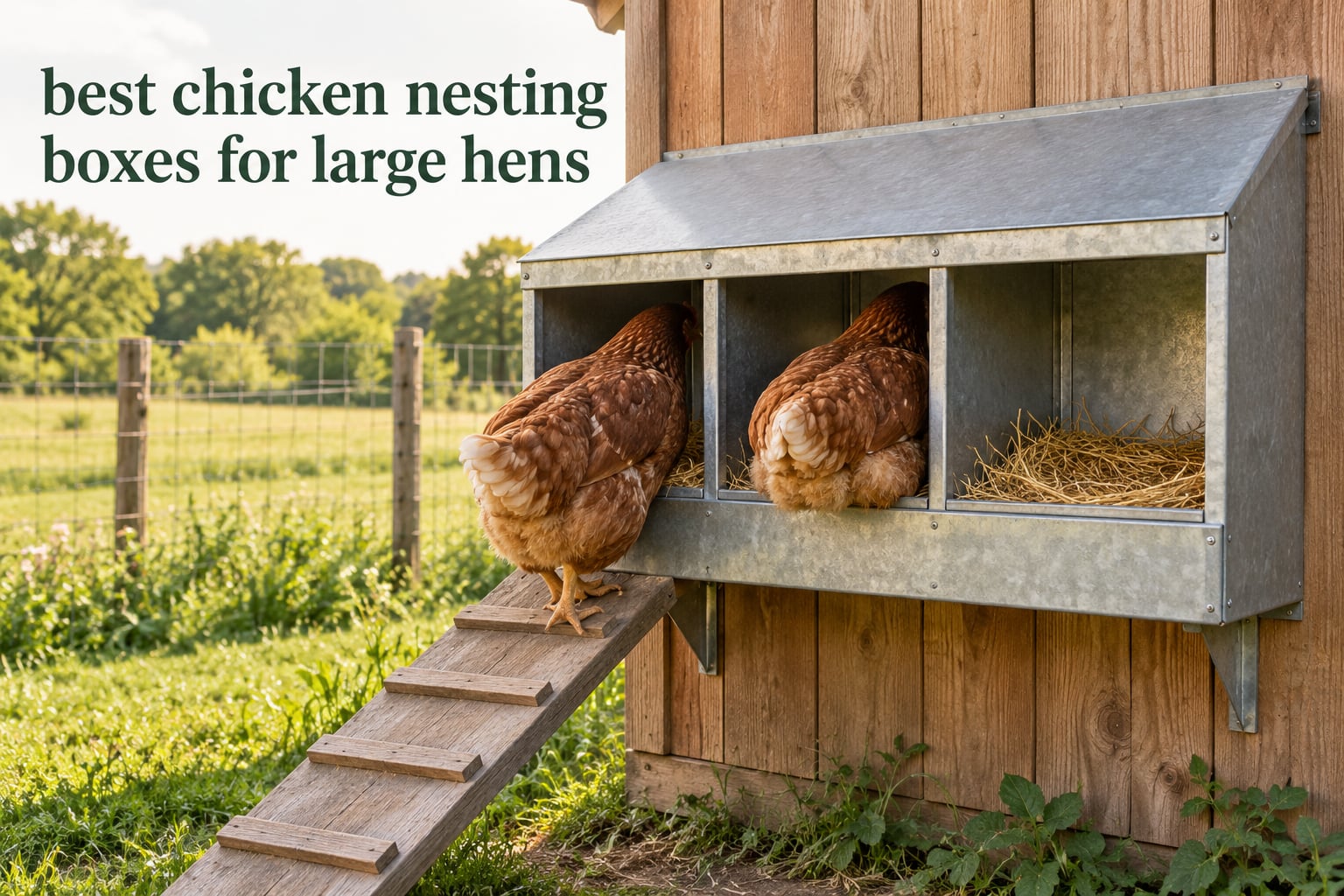
Large breeds such as Jersey Giants, Brahmas, Cochins and big Orpingtons need a 14 x 14 x 14 inch nesting box, not the standard 12 x 12 x 12. Give them a wide, low entrance, and plan on one box for every four to five hens with a minimum of two boxes in the coop. Get those two numbers right and everything else on this list is a preference.
We compared 12 chicken nesting boxes built for large hens, weighing compartment depth, entrance width, how eggs are collected, and what owners actually say after a season of use. This is our guide to the best chicken nesting boxes for large hens in 2026, covering roll-out metal banks, molded plastic boxes and solid wood units.
Two failure modes cause most frustration. The first is size: a 9-inch wide bay that suits a 5-pound Leghorn makes a 10-pound Orpington turn sideways and give up. The second is egg damage, because a flock that discovers cracked eggs quickly learns to eat them. Every pick below handles at least one of those two problems well.
If you are still sizing the coop itself, our predator-proof chicken coop guide for large flocks covers housing that can carry the weight of a 14-inch bank on one wall.
Table of Contents
Why Large Hens Need a Different Nesting Box
A standard 12 x 12 x 12 inch box is sized for a 4 to 6 pound layer. Heavy breeds carry more mass through the door, need more floor room to turn around, and push bedding out with their backs faster. A hen that has to crouch and shuffle to reach the back wall lays fewer eggs in that box and more on the coop floor.
Here is the fit test we use, by breed:
Jersey Giant, Brahma (9 to 14 lb): 14 x 14 x 14 minimum, entrance at least 12 inches wide, front lip under 6 inches.
Cochin (8 to 12 lb): 14 x 14 x 14, wide entrance, and a low perch because heavy birds jump poorly.
Orpington, Australorp, Sussex (7 to 10 lb): 13 x 13 x 13 is workable, 14 inches is better.
Plymouth Rock, Wyandotte (6 to 8 lb): standard 12 x 12 x 12 works with a wide entrance.
Leghorn, Australorp bantam (under 5 lb): standard 12 x 12 x 12 is fine.
Three rules follow from that. Measure the entrance, not just the interior, because a 14-inch interior with a 9-inch door is still a 9-inch door. Mount the box so the floor is level or sloped forward only, or eggs and bedding both go everywhere. And add a lip at the front of the nest floor about 2 inches high, which keeps a heavy hen’s egg from rolling out when she stands up.
Capacity works differently for heavy birds too. They sit rather than scratch, so they are calmer in a nest than a flighty small breed. One well-sized box comfortably covers four to five large hens, and going wider on the box is a better use of wall space than adding a second shallow box.
Top 3 Chicken Nesting Boxes for Large Hens in 2026

Brower 2-Tier 6-Hole Steel Nest Box
- Galvanized steel
- 6 compartments
- 30 to 40 hen capacity
- Folding perches stop broodiness
- Sloped roof and side vents

Little Giant Plastic Nesting Box
- Impact-resistant polyethylene
- Roomy enough for 5 lb Brahmas
- Open back deters red mites
- Wipes down in seconds

Miller 4-Pack Large Plastic Boxes
- Large compartments fit all breeds
- Covered lid stops roosting
- 4 boxes spread out the flock
- Highest rating in the group
All 12 Chicken Nesting Boxes at a Glance in 2026
| Product | Specifications | Action |
|---|---|---|
| Brower 2-Tier 6-Hole Galvanized Steel Nest Box |
|
Check Latest Price |
| Little Giant Single Plastic Nesting Box |
|
Check Latest Price |
 ZenxyHoC Two-Tier 6-Compartment Roll-Out Box ZenxyHoC Two-Tier 6-Compartment Roll-Out Box |
|
Check Latest Price |
 Eggluuz 6-Compartment Roll-Out Nest Box Eggluuz 6-Compartment Roll-Out Nest Box |
|
Check Latest Price |
| Miller 4-Pack Large Plastic Nesting Boxes |
|
Check Latest Price |
 Kinchoix 3-Hole Metal Nesting Box Kinchoix 3-Hole Metal Nesting Box |
|
Check Latest Price |
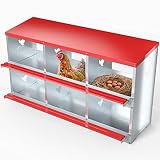 Kinchoix 6-Compartment Metal Nest Box Kinchoix 6-Compartment Metal Nest Box |
|
Check Latest Price |
 Bavlesfuire 3-Compartment Wooden Nest Box Bavlesfuire 3-Compartment Wooden Nest Box |
|
Check Latest Price |
 ZeenArt 4-Compartment Wooden Nest Box ZeenArt 4-Compartment Wooden Nest Box |
|
Check Latest Price |
 Tiflev 4-Hole Orange Roll-Away Nest Box Tiflev 4-Hole Orange Roll-Away Nest Box |
|
Check Latest Price |
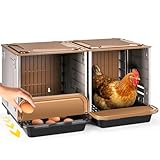 AugFir 2-Compartment Extra Large Nest Box AugFir 2-Compartment Extra Large Nest Box |
|
Check Latest Price |
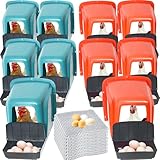 HOLOLIJO 10-Pack Roll-Out Nest Boxes HOLOLIJO 10-Pack Roll-Out Nest Boxes |
|
Check Latest Price |
1. Brower 2-Tier 6-Hole Galvanized Steel Nest Box for Large Hens
- Deep private compartments that large fowl turn around in
- Galvanized steel resists rust and corrosion
- Folding perches block access to break broodiness
- Sloped roof and side vents shed rain
- Runs for years of daily coop service
- Raw sheet metal edges are sharp during assembly
- Perch wood can arrive unfinished or warped
- Perch hardware loosens over time
This is the box we keep coming back to for heavy birds. The compartments run deep enough that a 10-pound hen can walk in, turn a full circle and settle without scraping the back wall, which is exactly what smaller galvanized banks get wrong. At 37 x 33 x 24.5 inches it holds six nests across two tiers and is rated for 30 to 40 hens.
Owners across more than 1.5k reviews consistently point at the same three things: the steel does not rot, the fold-down perches make cleaning fast, and the hens adopted the boxes quickly. The folding double-bolted perches are the underrated part. Swing them up and you can power-wash the whole interior, or clip them shut at night to break a broody hen’s habit of sleeping in the nest and fouling it.
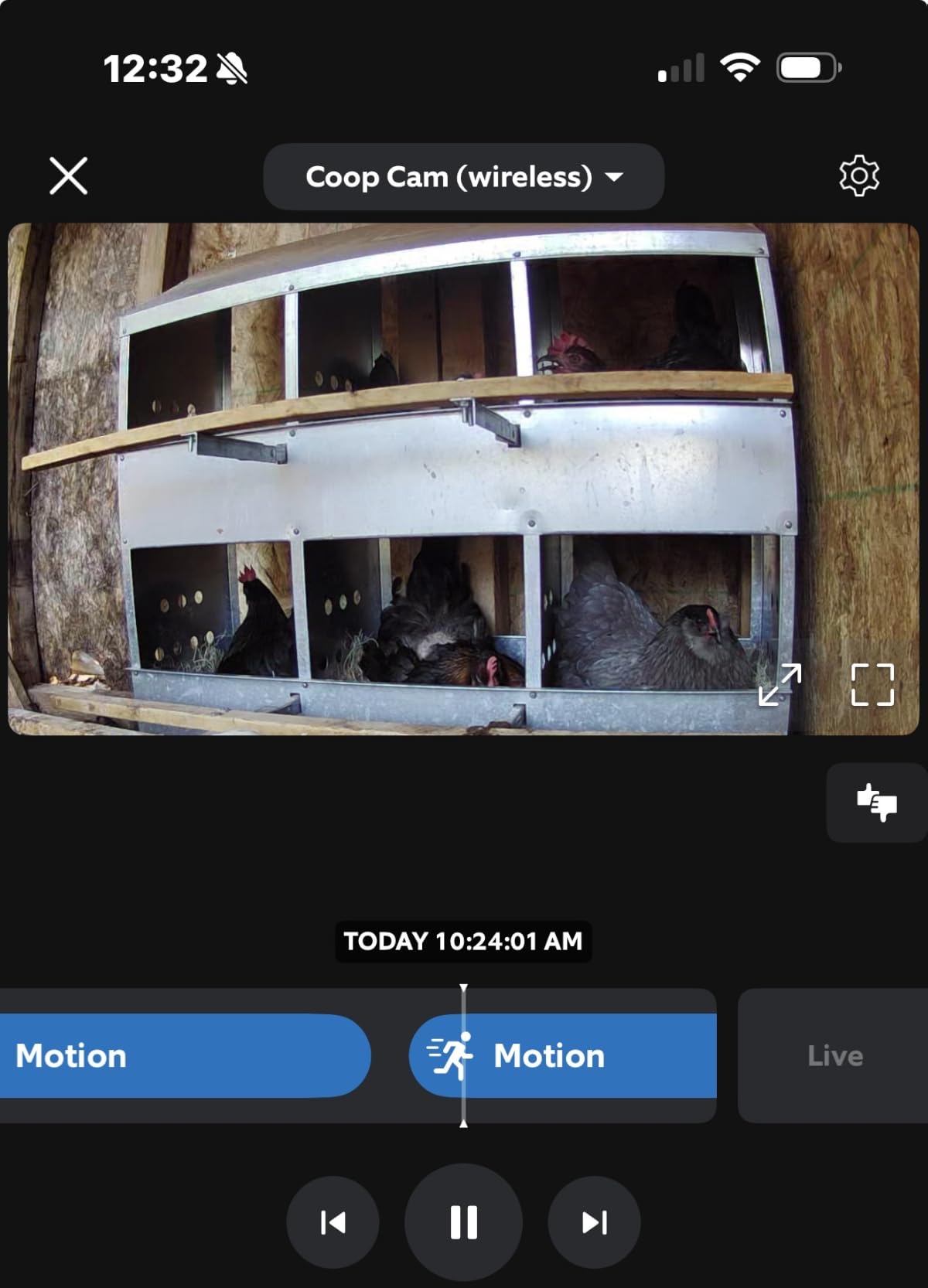
Build quality is genuinely heavy. The removable tray bottoms come out for sanitizing, the side ventilation and sloped roof keep the interior dry and discourage birds from sleeping on top, and owners report the frame is strong enough to hang feeders from. Assembly takes 30 to 45 minutes with a screwdriver and wrench, and all hardware is included.
Who this box suits
This is the pick for a flock of 12 to 40 large hens on a fixed coop, especially if you have Brahmas, Cochins or Orpingtons that need room to turn. The deep compartments and the 30 to 40 hen capacity mean you can cover a whole wall in one bank instead of bolting up six shallow single boxes.
What to watch for
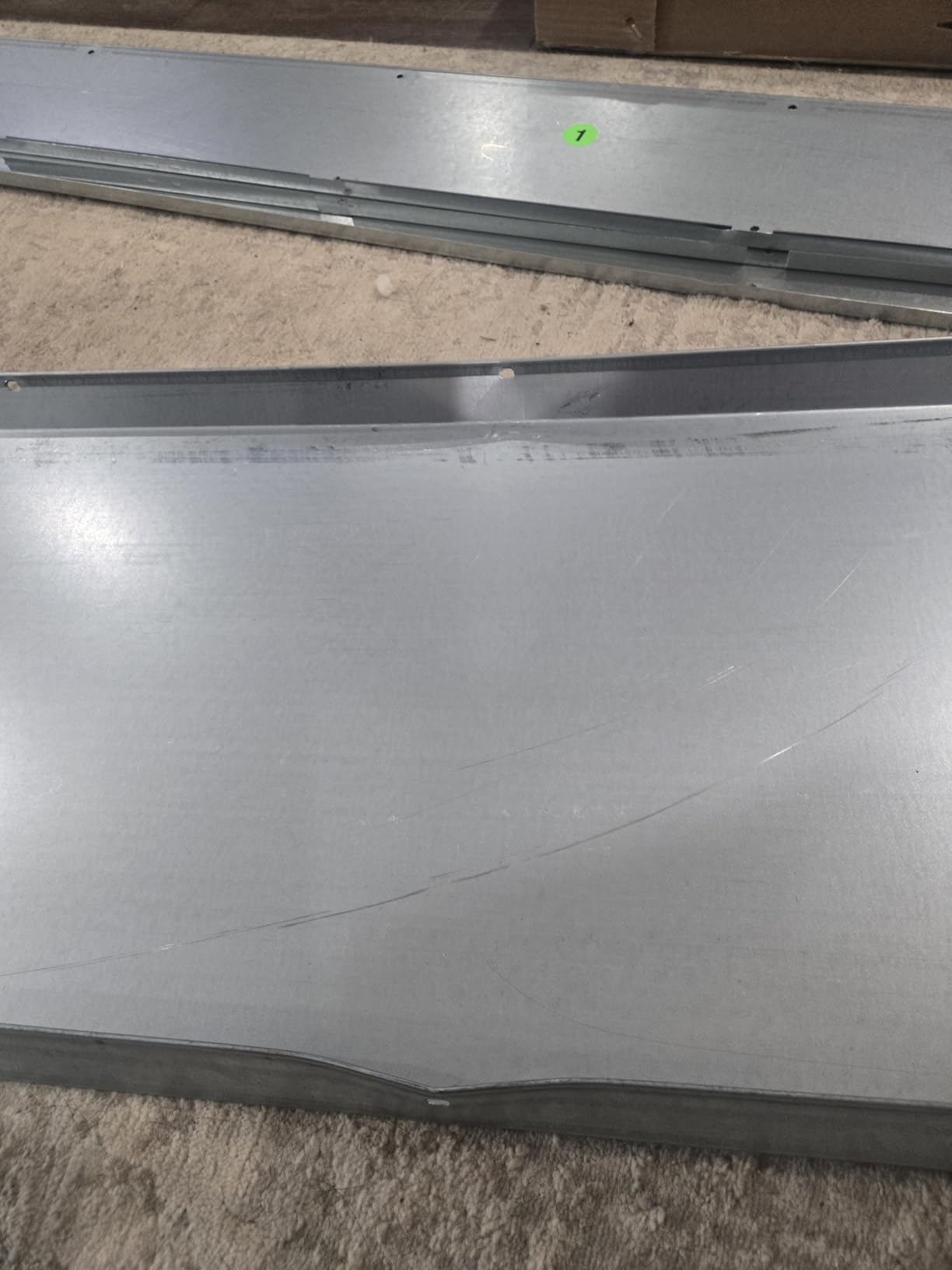
The most repeated complaint is sharp unrolled sheet metal edges and corners during assembly, so wear gloves. Perch wood can arrive unfinished with splinters and one bar may be warped, and the perch bolts need re-tightening every few months. Plan on a two-person lift, because it is heavy once assembled.
2. Little Giant Single Plastic Nesting Box for Large Hens
Little Giant Single Plastic Nesting Box Chicken Nest Box with Perch (Item No. 163620)
- Impact-resistant polyethylene never rusts or rots
- Smooth surface wipes down and sanitizes fast
- Open back prevents red mite buildup
- Roomy enough for a 5 lb Brahma
- Stacks for storage between seasons
- Interior depth is shallow so bedding kicks out
- No back panel so eggs can roll out the rear
- Mounting screws not included
One unit, one hen, no compromise on the inside dimensions. At 26.5 x 15.9 x 19.8 inches this plastic box gives a large hen more usable floor area than most three-hole galvanized banks, and owners regularly report 5-pound Brahmas fitting in and turning around comfortably.
Cleaning is where plastic wins outright. The smooth polyethylene wipes down in seconds, will not rust or absorb moisture, and stays warmer in cold weather than sheet metal. The open back gives airflow and denies red mites a closed seam to hide in, which matters in humid climates. You can mount singles side by side on 16-inch on-center studs or stack them vertically.
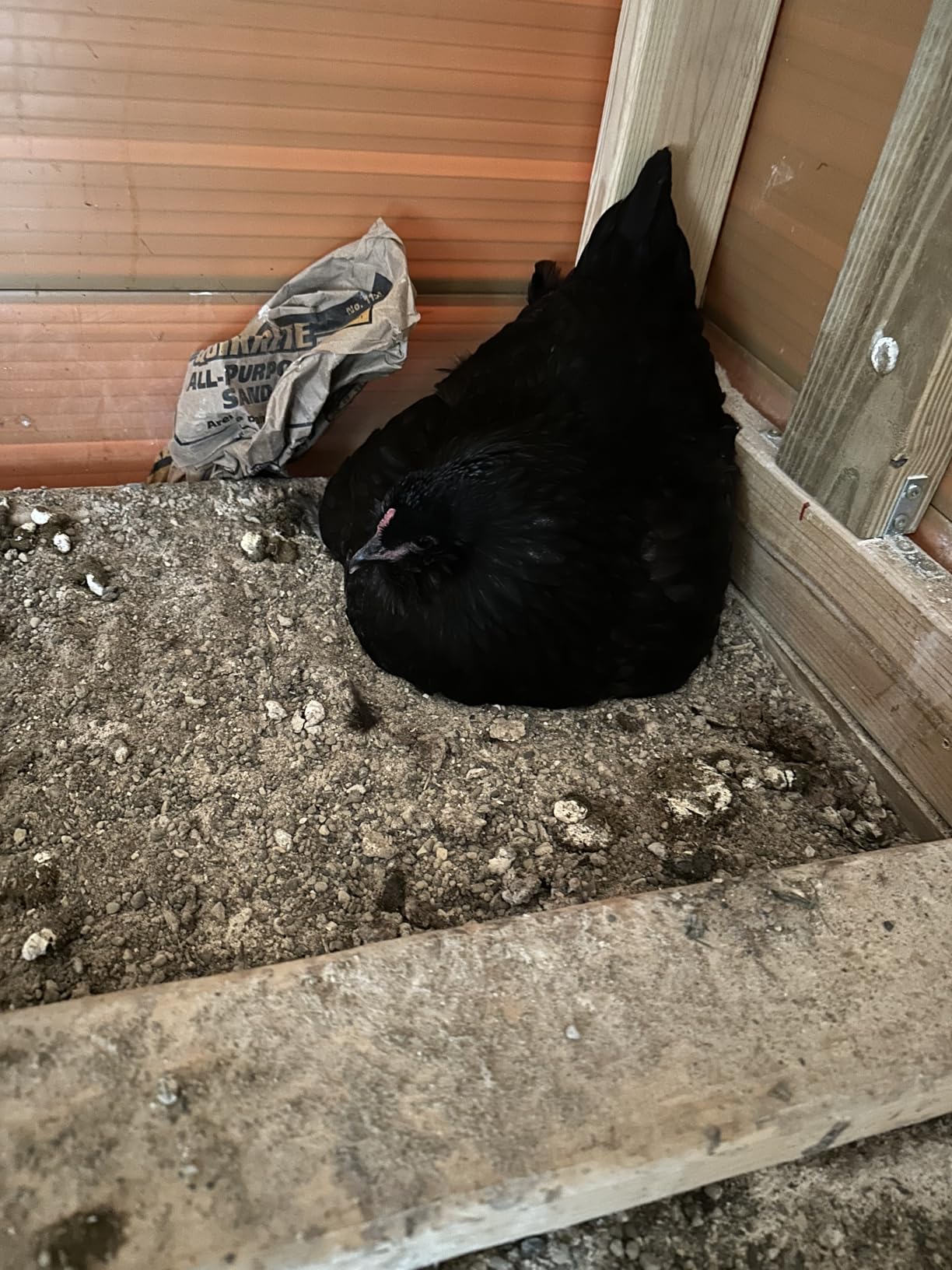
The trade-offs are all about depth and backing. The interior measured from the entrance hole to the laying floor is shallow, so bedding is kicked out within days and eggs can end up on bare plastic, which means more frequent re-bedding. There is no back panel, so add chicken wire or a plywood backing behind it or eggs roll out the rear.
Who this box suits
Choose this for a small flock of two to six large hens, a mobile or movable coop, or anyone who sanitizes on a schedule and wants the fastest wipe-down in the category. Buy two or three so hens are not fighting over one favorite spot, because a single box tends to draw the whole flock.
What to watch for
Two things catch people out. The perch bracket is short, so mounting the box too high makes it hard for a heavier bird to reach the entrance, and the mounting screws are not included in the package, so pick those up before the birds arrive. Budget time for weekly re-bedding.
3. ZenxyHoC Two-Tier 6-Compartment Roll-Out Box for Large Hens
- Slanted floor sends eggs to a protected tray
- Stopped egg eating for multiple owners
- Trays detach individually for washing
- Side vents control heat
- Perch folds up as an overnight gate
- Compartments run small for very large breeds
- Tiny fiddly screws and weak instructions
- Red paint chips after about a year
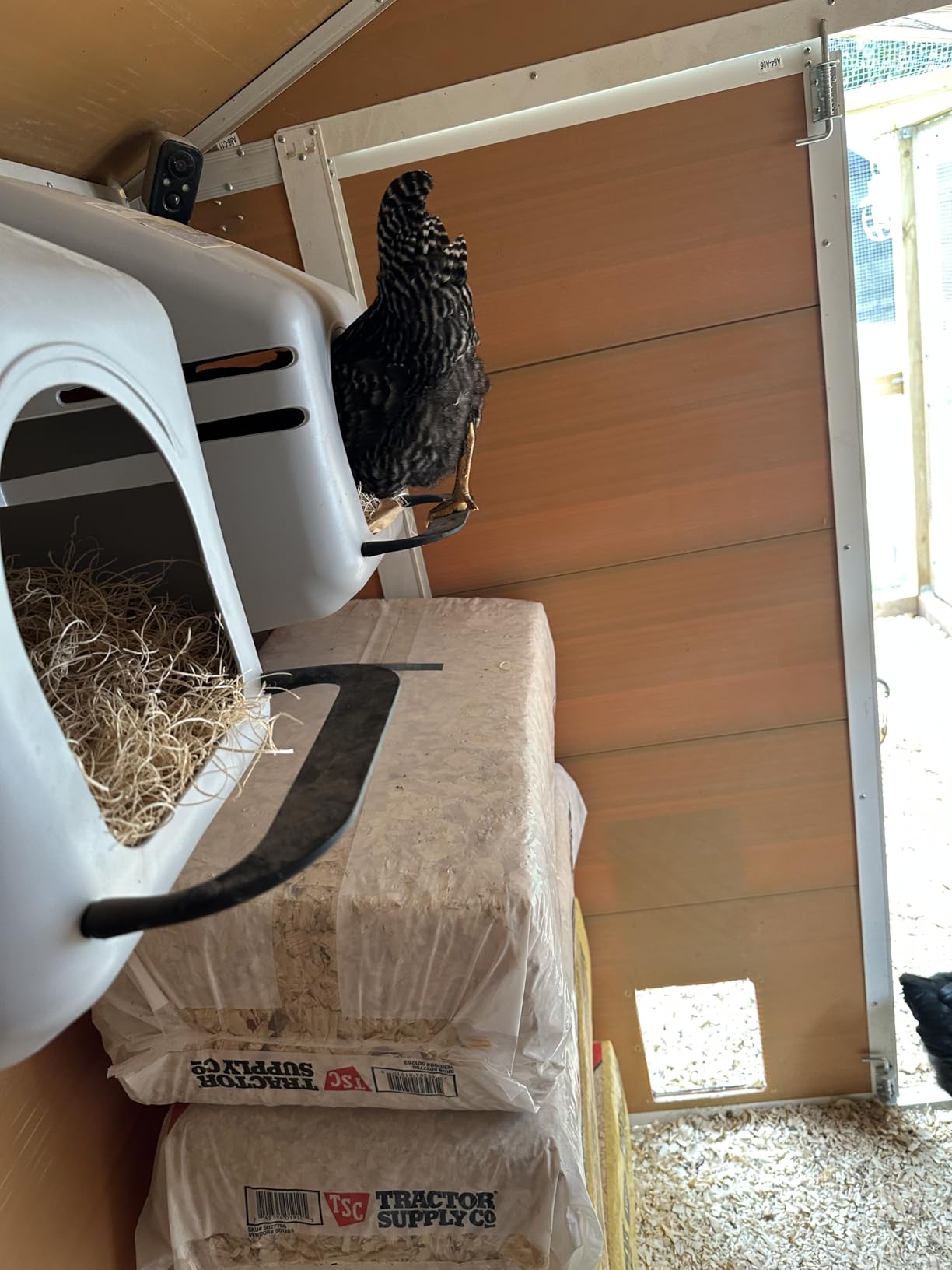
The roll-away mechanism is the whole point here. Eggs leave the slanted floor and land in a protected tray behind a flap, out of reach of the hen, and several owners in the 700-review pool report that egg eating and dirty eggs stopped almost as soon as it went in. For a flock that has already learned to crack and eat eggs, that is the fix that matters.
Each of the six compartments has its own detachable collection tray, so you can pull and wash one without disturbing the rest. Side ventilation holes keep the interior cool and drier in summer, and the foldable swing perch doubles as a night gate to stop roosting and droppings. The vertical two-tier layout saves coop floor space at 30 x 20 x 30 inches.
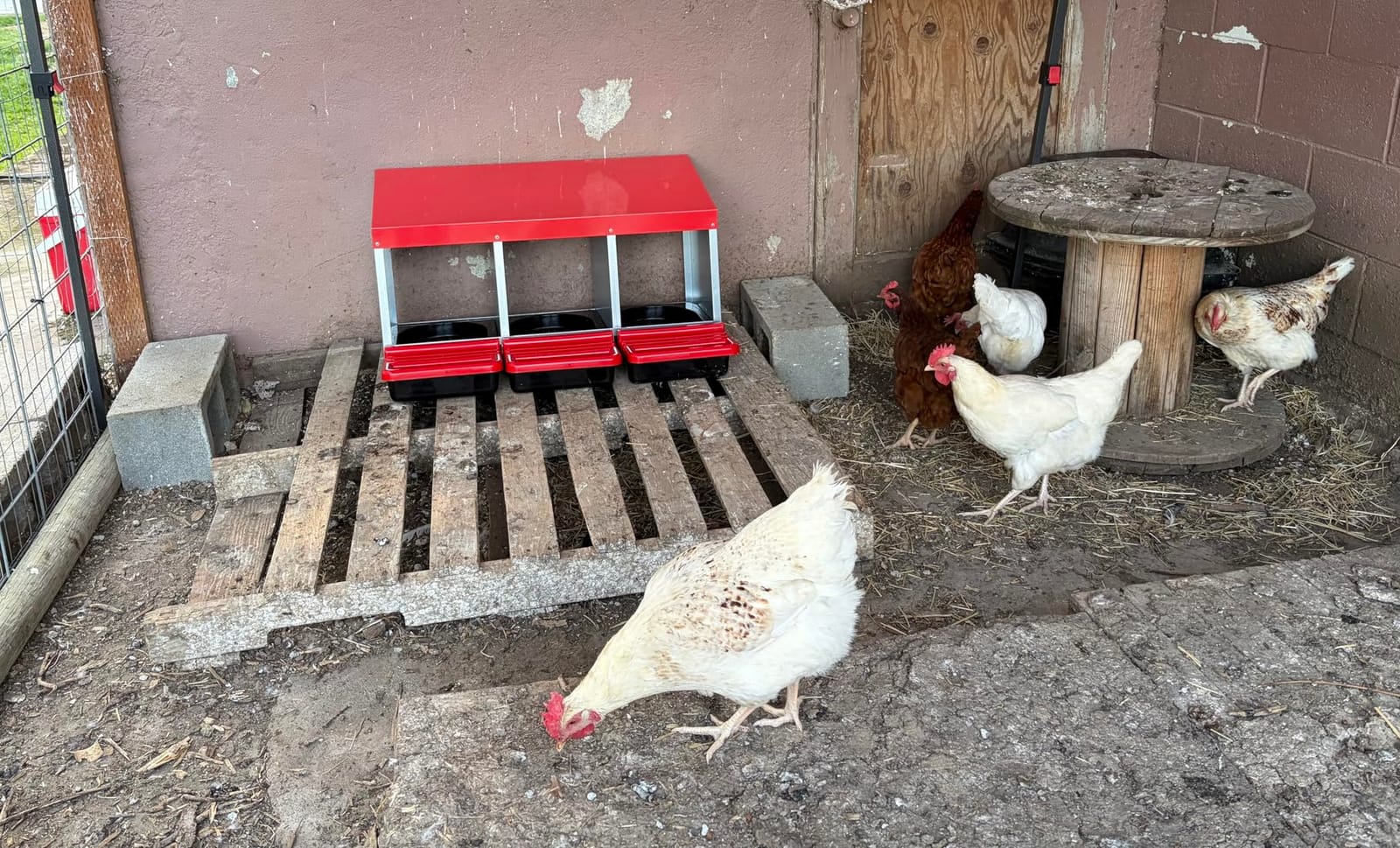
The honest limitation is size. Owners with Jersey Giants and big Cochins report the compartments give big birds only a tight fit, so this works best for medium-to-large hens around 6 to 8 pounds rather than the 10-pound-plus end of the scale. Reviewers also mention tiny fiddly screws, weak printed instructions, and red paint that chips after about a year, plus one report of a load-bearing plastic part cracking and unresponsive seller support.
Who this box suits
This is the box for an egg-eating problem flock, or anyone selling eggs at a market who cannot afford cracked or soiled product. It also suits a small-to-medium flock of medium-large hens in a warm climate where the side vents and metal build are worth more than maximum compartment room.
What to watch for
Do not add thick nesting pads, because bedding on the sloped floor blocks the roll path and eggs stop rolling. Inspect the plastic structural parts before mounting, and check paint condition if you plan to keep it more than a couple of seasons. Set aside real time for assembly, since the hardware is small and the instructions are thin.
4. Eggluuz 6-Compartment Roll-Out Nest Box for Large Hens
Eggluuz Chicken Nesting Box, 6 Compartments Egg Laying Nests Boxes for Hens
- Slight floor inclination rolls eggs clear of the hen
- Plastic trays unscrew and rinse clean
- Perforated bottoms drain water and debris
- Key-holed tabs make mounting simple
- All screws and nuts included
- Roll path needs the floor kept clear of debris
- Plastic trays can crack in freezing weather
- Key-hang tabs need solid backing material
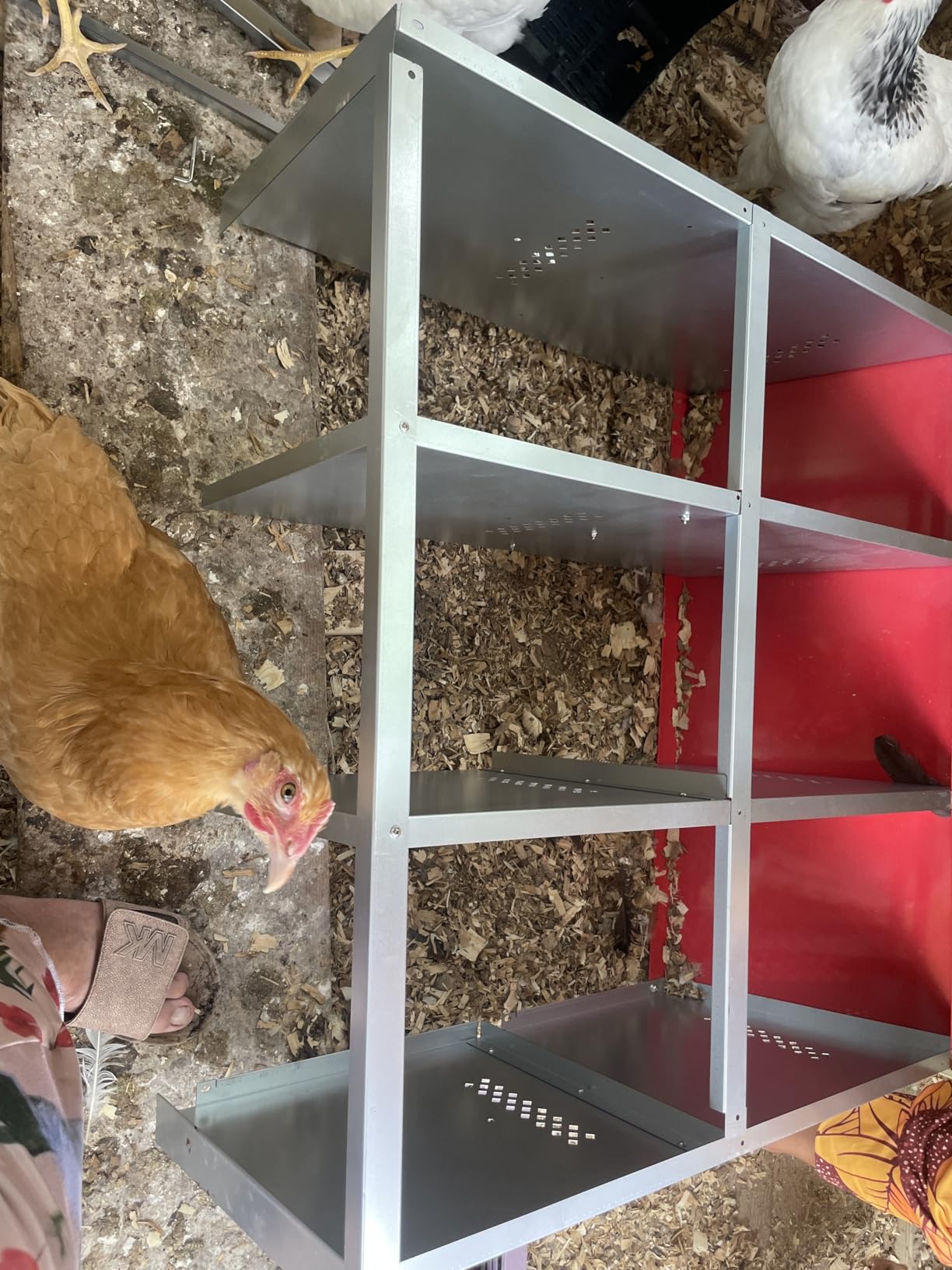
This is the roll-out box with the simplest tray system in the group. The galvanized steel sides and roof tolerate weather without complaint, while the rust-proof plastic trays unscrew completely and rinse out, and their perforated bottoms drain water and debris so the collection channel does not turn into a swamp in wet weather.
The floor inclination is described as slight, which is exactly right for a large hen. Too steep and a heavy bird loses her footing, too shallow and the egg stays put. Owners like that everything needed arrives in the box, screws, nuts and clear instructions included, and that the key-shaped hanging holes make mounting and later disassembly a two-minute job.
Where it needs attention is the roll path. Keep bedding and feathers clear of the inclined floor or eggs will sit where they land instead of reaching the tray, and take the plastic trays into a warm shed before a hard freeze, since cold and impact can crack them. Mount into a plywood panel or solid wall so the key-hang tabs have something to bite into.
Who this box suits
This fits a flock of roughly 10 to 20 medium-to-large hens that wants clean eggs and a washable system without moving to a premium brand. The roomy six-compartment layout gives each hen her own spot, which cuts the competition over a single favorite nest, and the removable trays make a weekly cleanout genuinely quick.
What to watch for
Keep the plastic trays as the wear items to inspect each season, since they are the part that can crack rather than the steel frame. There is no back panel, so on a non-solid wall you need a plywood backing. And measure the mounting wall first, because the key-hang tabs need a flat surface rather than bare framing.
5. Miller 4-Pack of Large Plastic Nesting Boxes for Large Hens
4 PACK of LARGE WALL Mount EGG NESTING NEST BOXES with PERCH for CHICKEN COOP HEN HOUSE POULTRY
- Large compartments that comfortably fit Brahmas
- Highest average rating in the roundup
- Washable covered surface resists rust and rot
- Perch and lid deter roosting on top
- Four compartments spread the flock out
- Mounting hardware may need to be bought separately
- Boxes must be mounted level and at bird height
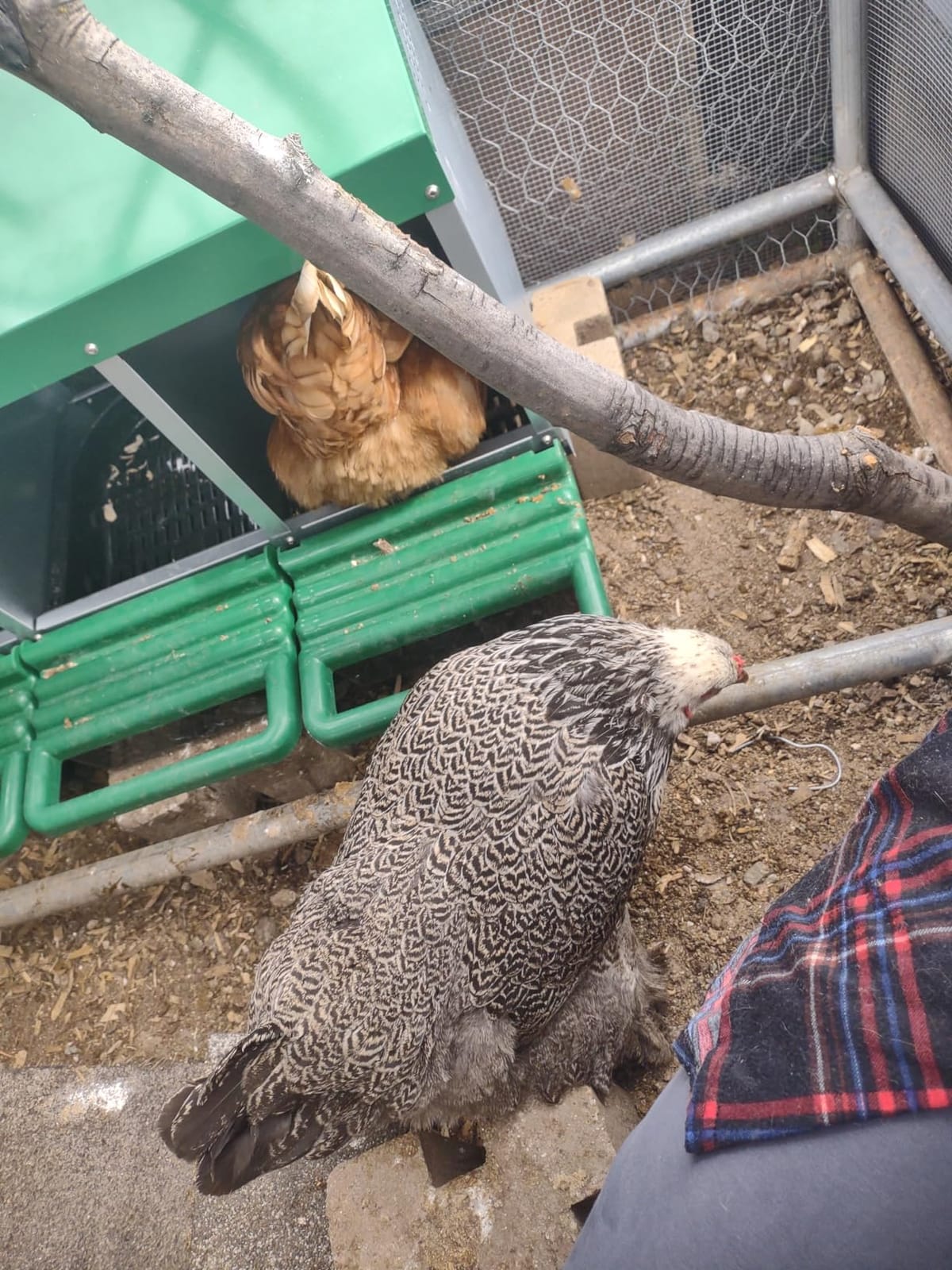
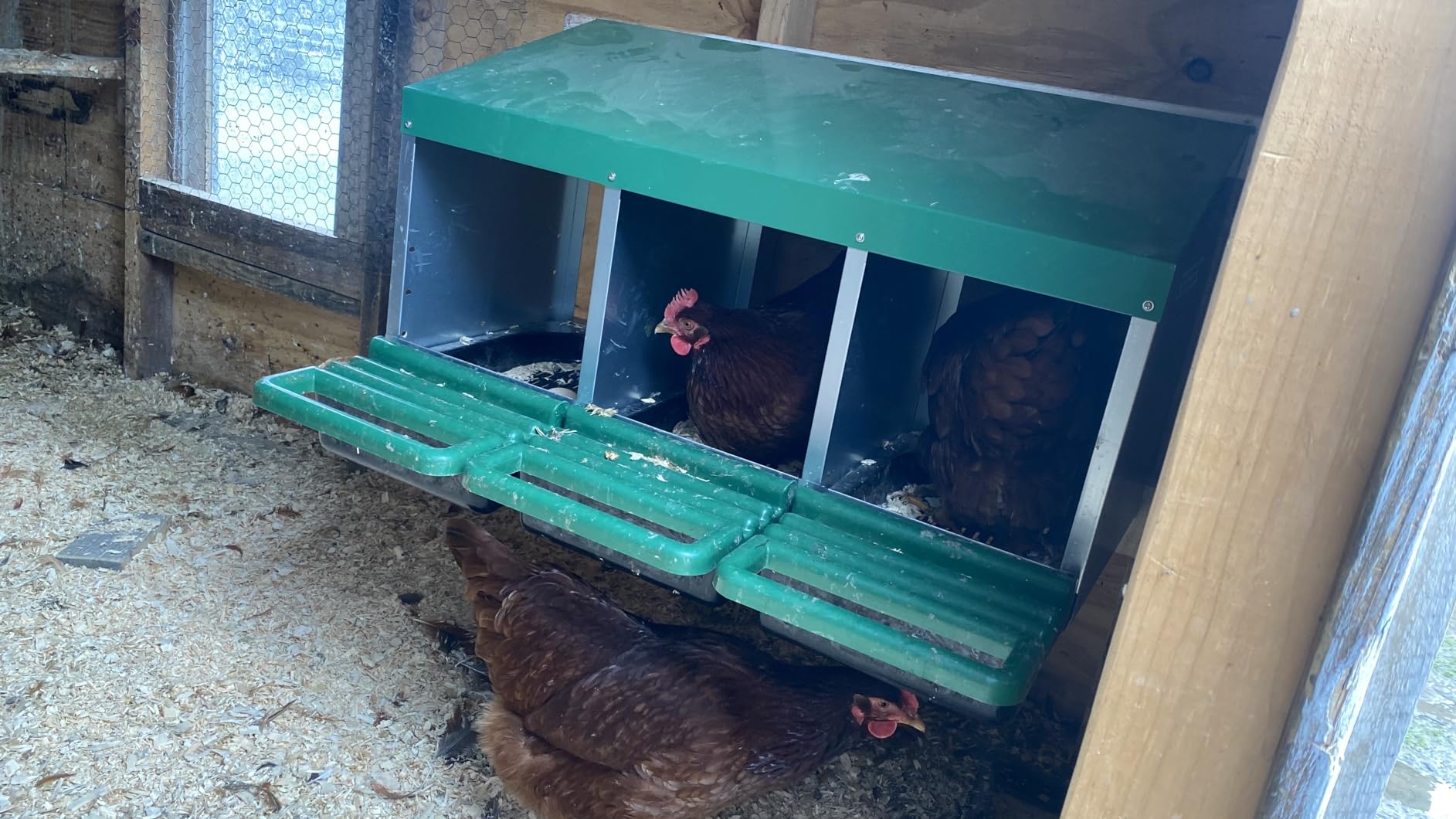
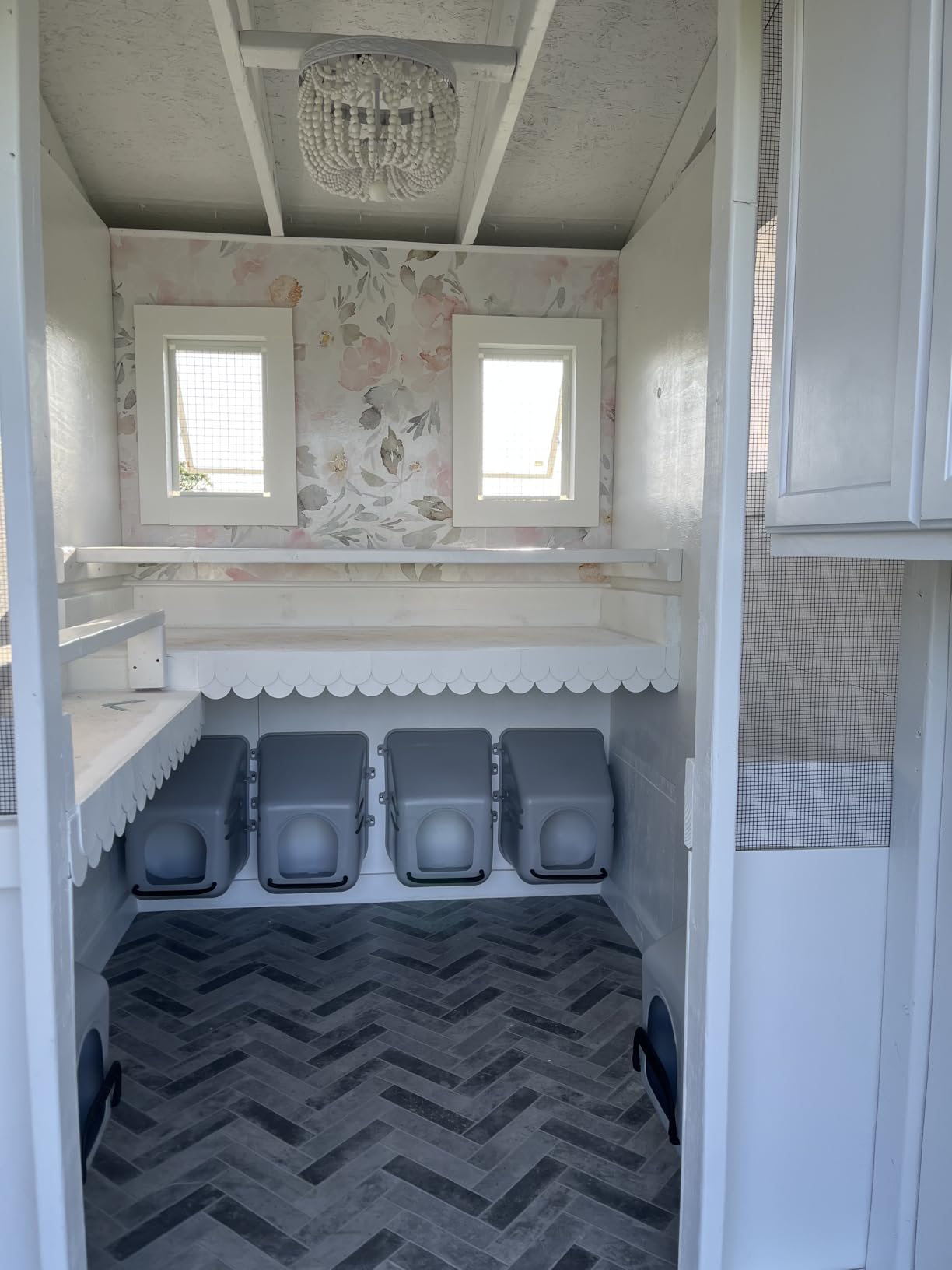
This four-pack carries the highest average rating of anything we looked at, and the reason is simple: the compartments are genuinely large and the plastic is genuinely easy to sanitize. Owners running Brahmas and other big breeds report the birds fit in and settle down without turning sideways, and the washable surface makes mite control a wipe-down rather than a scrub.
Supplying four boxes rather than one is the underrated benefit for a heavy flock. Big hens are territorial about favorite spots, and crowding around one nest leads to eggs stepped on and cracked. Spreading capacity across the coop wall at 16-inch on-center stud spacing gives you four separate private nests, and that cuts crowding and egg damage directly.
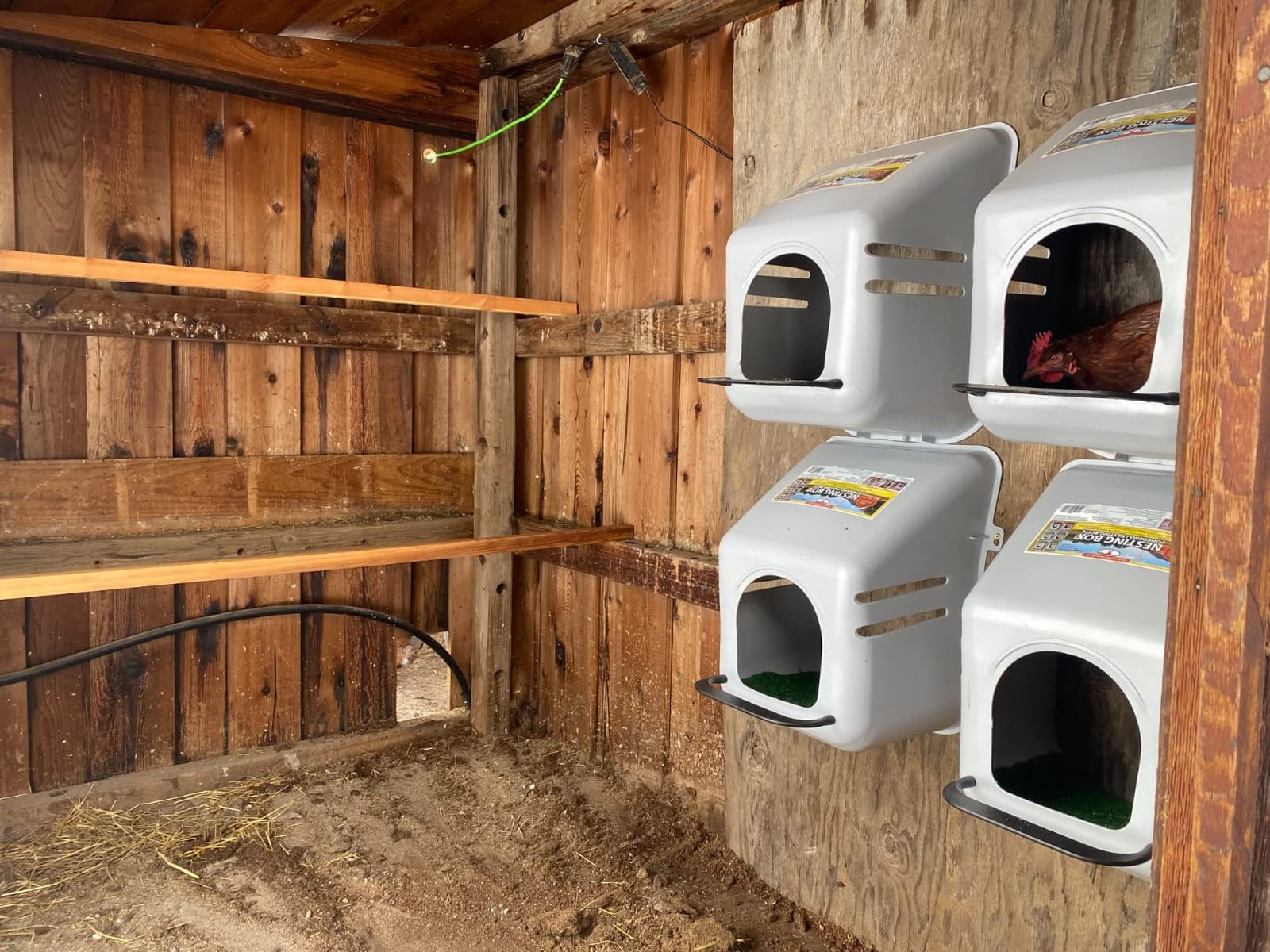
Two practical notes. The covered design with a perch works because birds stay off the lids, so what lands on top stays clean, but you still need to mount the boxes level and at a height a heavy bird can reach, or she will use the floor underneath. And the mounting hardware is not guaranteed in the package, so confirm what you have before the hens arrive.
Who this box suits
Best for a flock of 8 to 16 large hens in a standard stud-framed coop, especially first-time owners who want plastic they can hose off. It is also light and stackable, so it is easy to move when you reconfigure the coop.
What to watch for
Mount them at 18 to 24 inches off the floor and always below the roost bar, or hens will sleep in them. Buy your own screws and a small pack of extra nest pads, since plastic boxes lose bedding faster than wood. And keep an eye on spacing so four boxes do not create a wall that blocks airflow across the coop.
6. Kinchoix 3-Hole Metal Nesting Box for Large Hens
- Sturdy steel an aggressive hen is unlikely to damage
- Rounded edges protect hens and hands
- Sloped roof sheds rainwater
- Boxes splice together into a larger bank
- Hens often lay within 30 minutes
- Bays are narrow and shallow for big breeds
- Shallow bays hold little bedding
- Unlabeled parts and sharp sheet metal burrs
Three galvanized bays at 29.5 x 13.4 x 14.8 inches, each with a 2.36 inch foot bar for the hen to grip on the way in. The build is the selling point: sturdy steel, rounded edges that protect both the bird and your hands, and a sloped roof that keeps water out during rainy spells. The whole thing rinses clean with a pressure washer.
Adoption speed is the surprise. Owners repeatedly report hens laying within about half an hour of installation, and some flocks preferred these metal boxes over their wooden ones. The 2.36 inch foot bar gives a heavy bird something to grip that a smooth plastic lip does not, and the mounting holes are sized for an 18 to 20 inch mounting height out of the box.
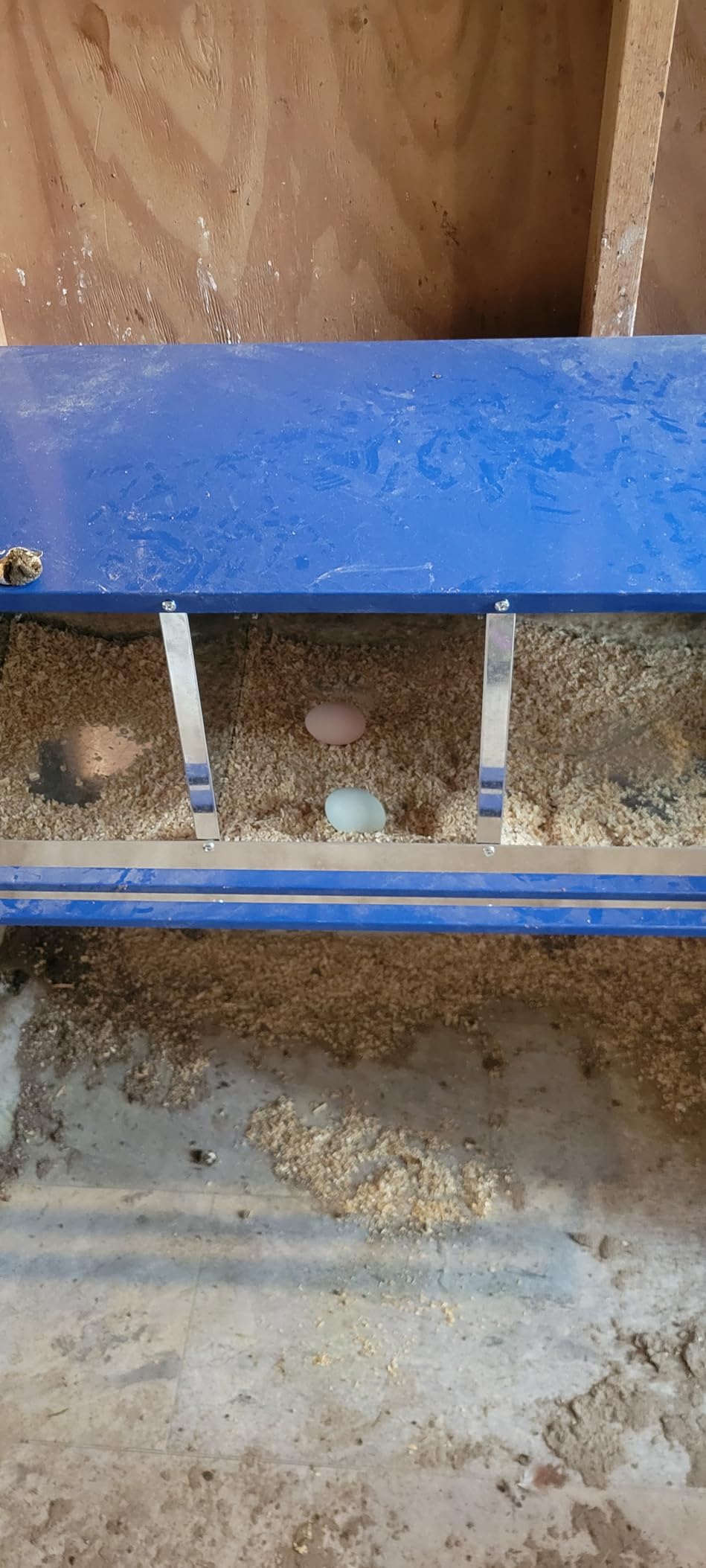
Where large hens fall short is the bay geometry. Each hole measures about 9.8 x 11.8 inches, and standard hens have been reported to struggle to enter and turn around, nesting underneath the unit instead. The bays are also shallow, so bedding is kicked out fast and cleaning comes more often. Parts arrive unlabeled, so work out the assembly order from the instructions, and expect sharp sheet metal burrs and screws with soft heads.
Who this box suits
It fits a small flock of three to eight medium-large hens that want a durable, pressure-washable nest on a modest budget. If you are building a bank, the 3, 6, 8 and 10-compartment variants splice together, and the box type stays the same as the flock grows.
What to watch for
Do not put Orpingtons or Cochins in the 3-hole version as your only nest. Fit a front lip or a piece of wood across the entrance base so eggs do not roll out, wear gloves for assembly, and expect to re-bed more often than with a deep plastic unit.
7. Kinchoix 6-Compartment Metal Nest Box for Large Hens
- All-metal build with no plastic parts to crack
- Assembles fast with screws hitting pre-drilled holes
- Chicken-shaped side perforations add ventilation
- Hose-rinseable for routine sanitation
- Red finish resists visual grime
- Front-to-back and top-to-bottom depth is shallow
- Roosting rail is too shallow for easy traversal
- Weak instructions and occasional bent panels
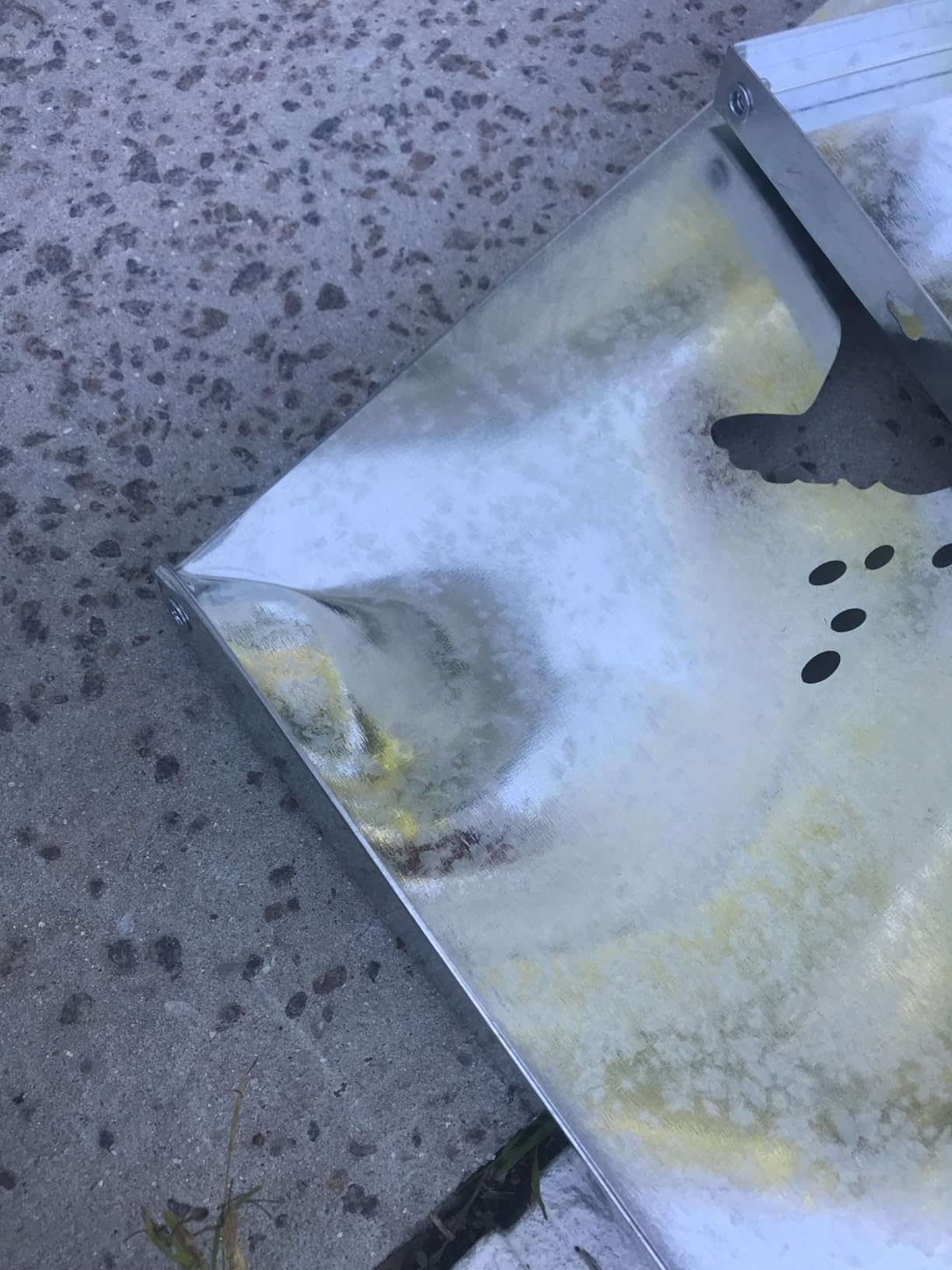
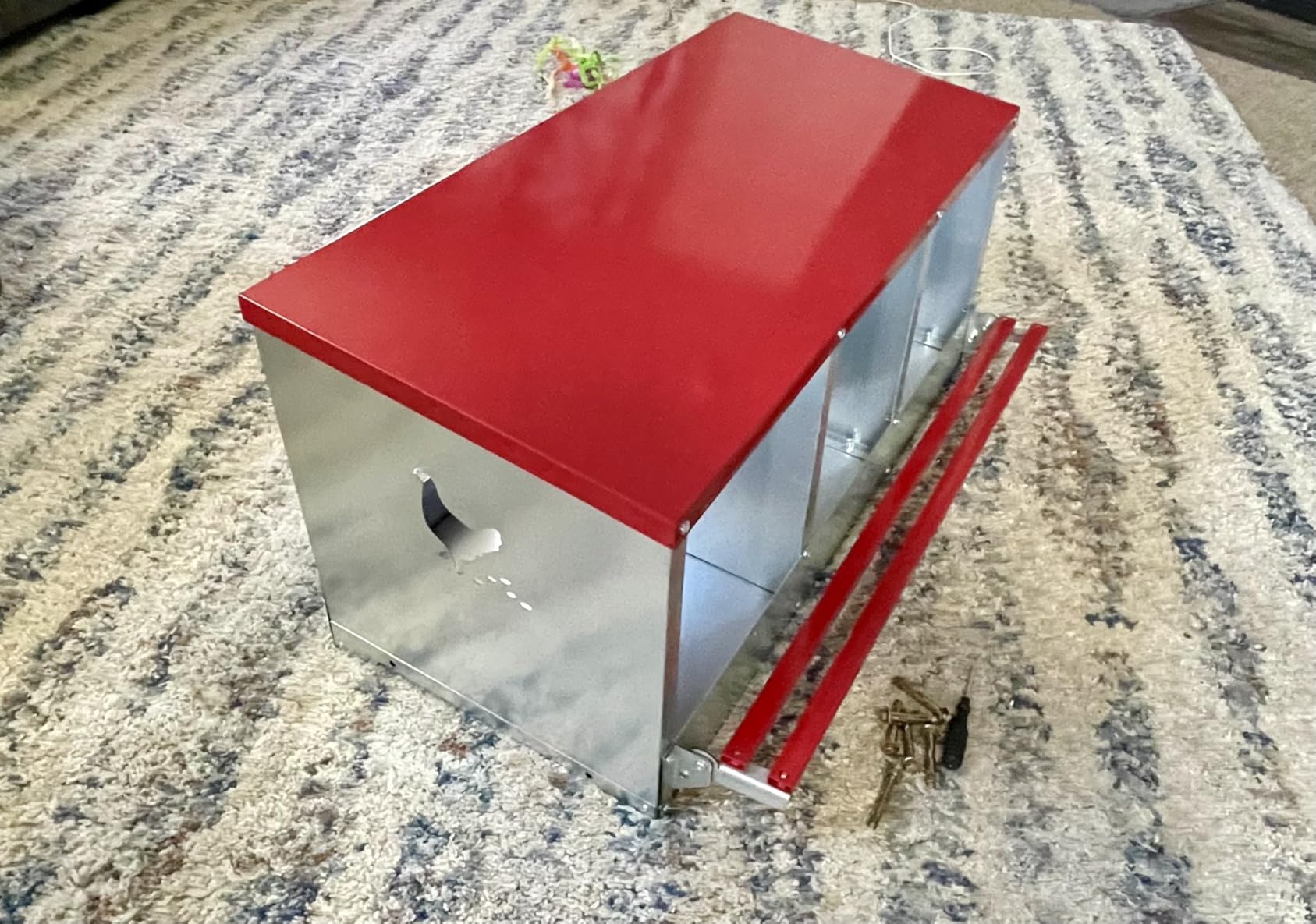
Six compartments of solid alloy steel in a red finish, and the reason to like it is simplicity. There is no plastic anywhere to crack in cold weather, and the pre-installed screw holes mean assembly takes about 20 minutes even for someone who has never built a nest bank. The chicken-shaped side perforations add airflow and a bit of character to an otherwise plain wall.
Because it is wall-mounted, eggs never touch the coop floor, which removes two of the most common causes of loss: trampling and floor soiling. Owners like the hose-rinse routine and report satisfaction across flock sizes, with the larger opening variant working better for bigger hens than the small one.
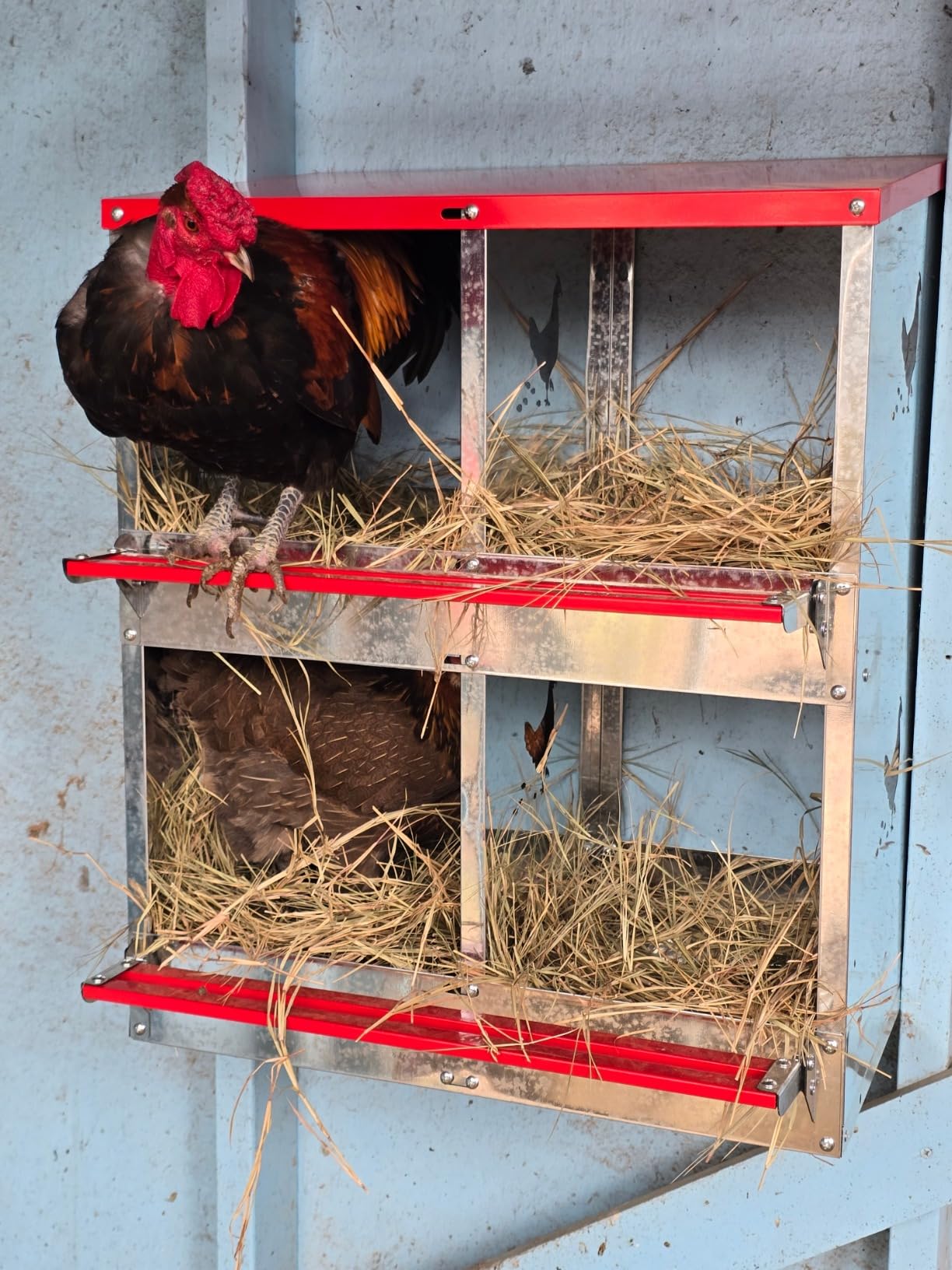
The complaints are about depth, not durability. The front-to-back and top-to-bottom interior is shallow enough that bedding gets kicked out and eggs break on bare metal, and the roosting rail is too shallow for a heavy bird to traverse comfortably, which matters more for a Jersey Giant than for a Leghorn. Some units have arrived with bent or mismatched parts, and the instructions are the weakest part of the package. A minority of hens simply ignore these nests in favor of a larger box.
Who this box suits
It suits a flock of 10 to 20 medium-to-large hens that values a fast hose-down over deep bedding retention, and it is a good choice if your coop sees hard freezes, since there is no plastic to shatter. Backing the unit with a plywood panel and adding a low front lip improves both egg retention and the rail issue.
What to watch for
Inspect every panel for bends before assembly, because a bent frame will not sit square and the eggs will not roll. Print out your own step order before you start. And measure the interior against your heaviest hen before ordering more than one, since depth is the compromise here.
8. Bavlesfuire 3-Compartment Wooden Nest Box for Large Hens
- Solid wood regulates temperature better than metal
- Roomy compartments that suit a large hen
- Perches and baffles retain straw and shield eggs
- Light enough to carry and reposition alone
- Tools
- instructions and video included
- Wood is more porous and needs deeper cleaning
- Panels may need sealing in wet climates
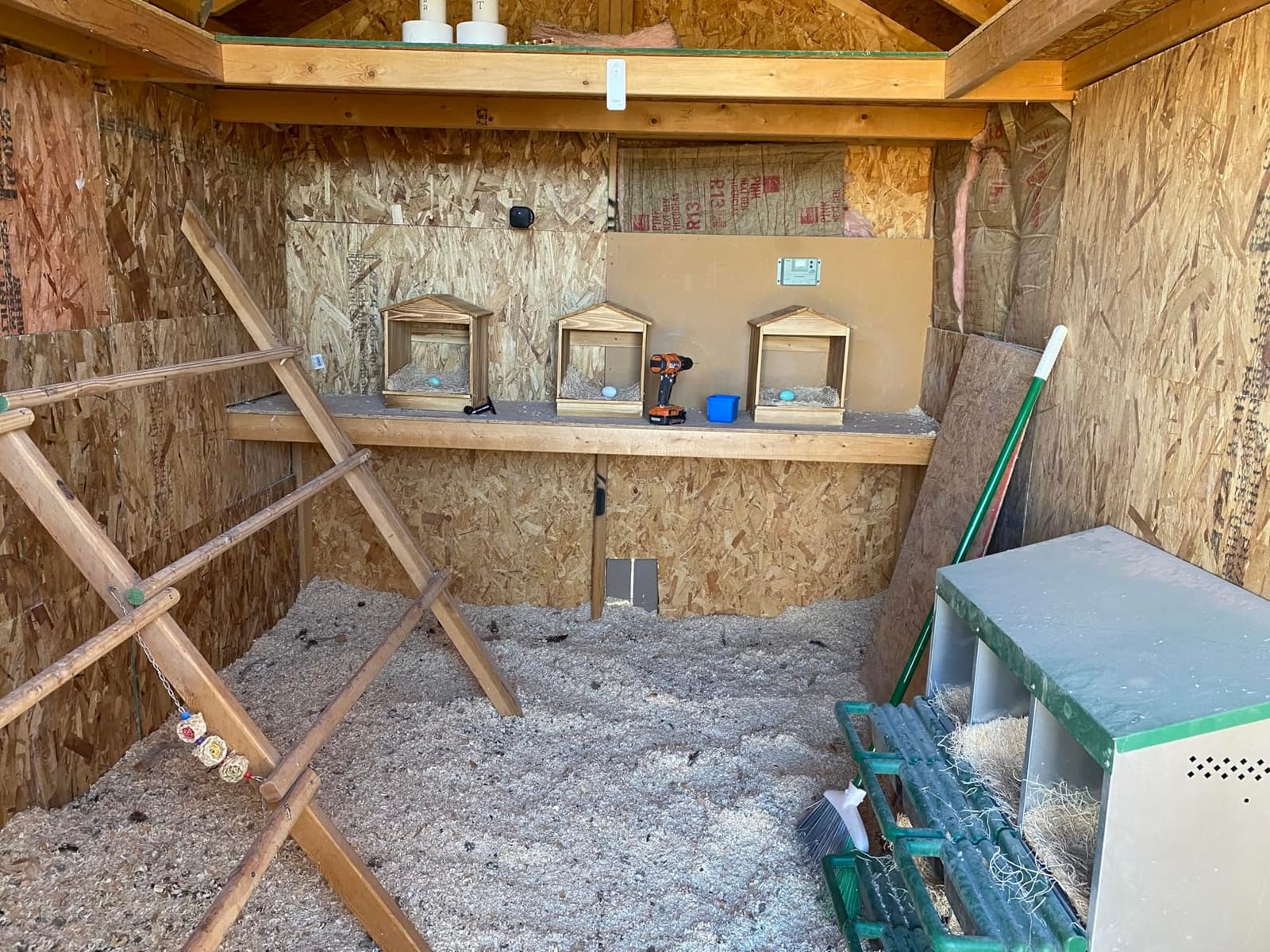
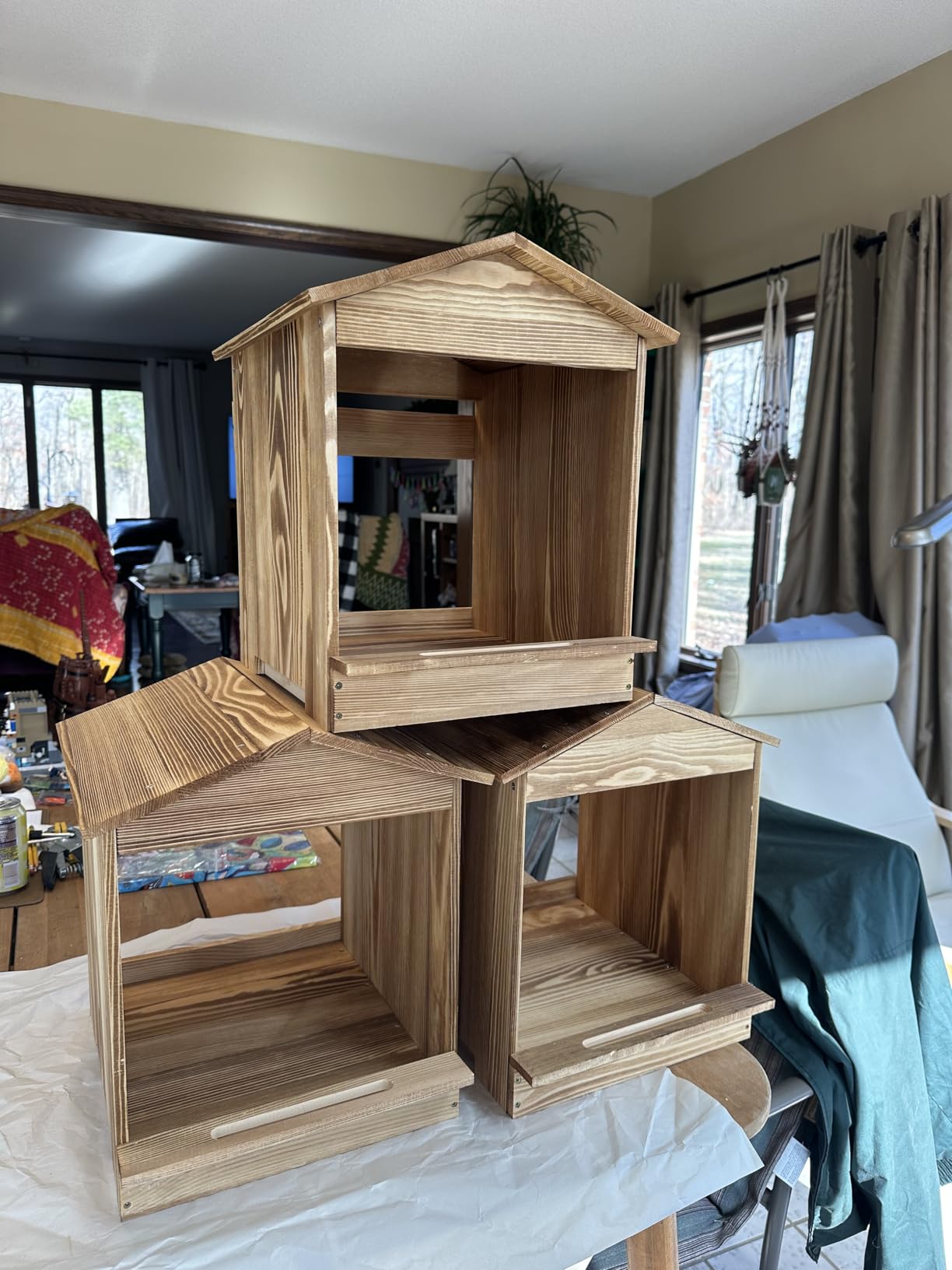
Wood is the answer in hot climates. Solid wood does not conduct heat the way sheet metal does, and owners in this group specifically call out the temperature advantage in summer. The three compartments at roughly 11.4 by 15 by 12 inches give a large hen room to settle in, which is more than a lot of metal banks manage.
The perches and baffles are the details that separate this from a basic wooden crate. They hold straw in place instead of letting a heavy hen rake it onto the floor, and they shield eggs from being pushed out when she turns. At about 15 pounds it is light enough for one person to carry to a different wall, and the package includes tools plus written and video installation guidance.
The honest trade-off is porosity. Wood holds moisture and gives mites a hiding place that plastic and metal simply do not, so cleaning after a mite outbreak is a real chore rather than a wipe. If your climate is wet, seal the finished panels with an exterior wood sealer before mounting, otherwise the box will darken and soften over a few seasons of rain.
Who this box suits
This is the pick for a hot, dry climate, a decorative or visible-coop setup where raw sheet metal looks out of place, and a flock of four to eight large hens kept by someone who prefers natural materials. It also suits anyone who wants a nest they can move as the flock changes.
What to watch for
Seal the wood before or right after the first wet season, not later. Deep clean more often than you would a plastic box, and consider a removable washable pad on the floor so the porous surface underneath never sees bedding directly. Keep it mounted flush to the wall so nothing pushes eggs out the back.
9. ZeenArt 4-Compartment Wooden Nest Box for Large Hens
- Sturdy solid wood that is light enough to move
- Perches and baffles hold straw in
- Weatherproof construction for outdoor use
- Clear instructions and quick assembly
- Four compartments suit a small flock
- Low rear board lets bedding and eggs get pushed out
- No front retaining bar for straw
- Tight for the very largest breeds
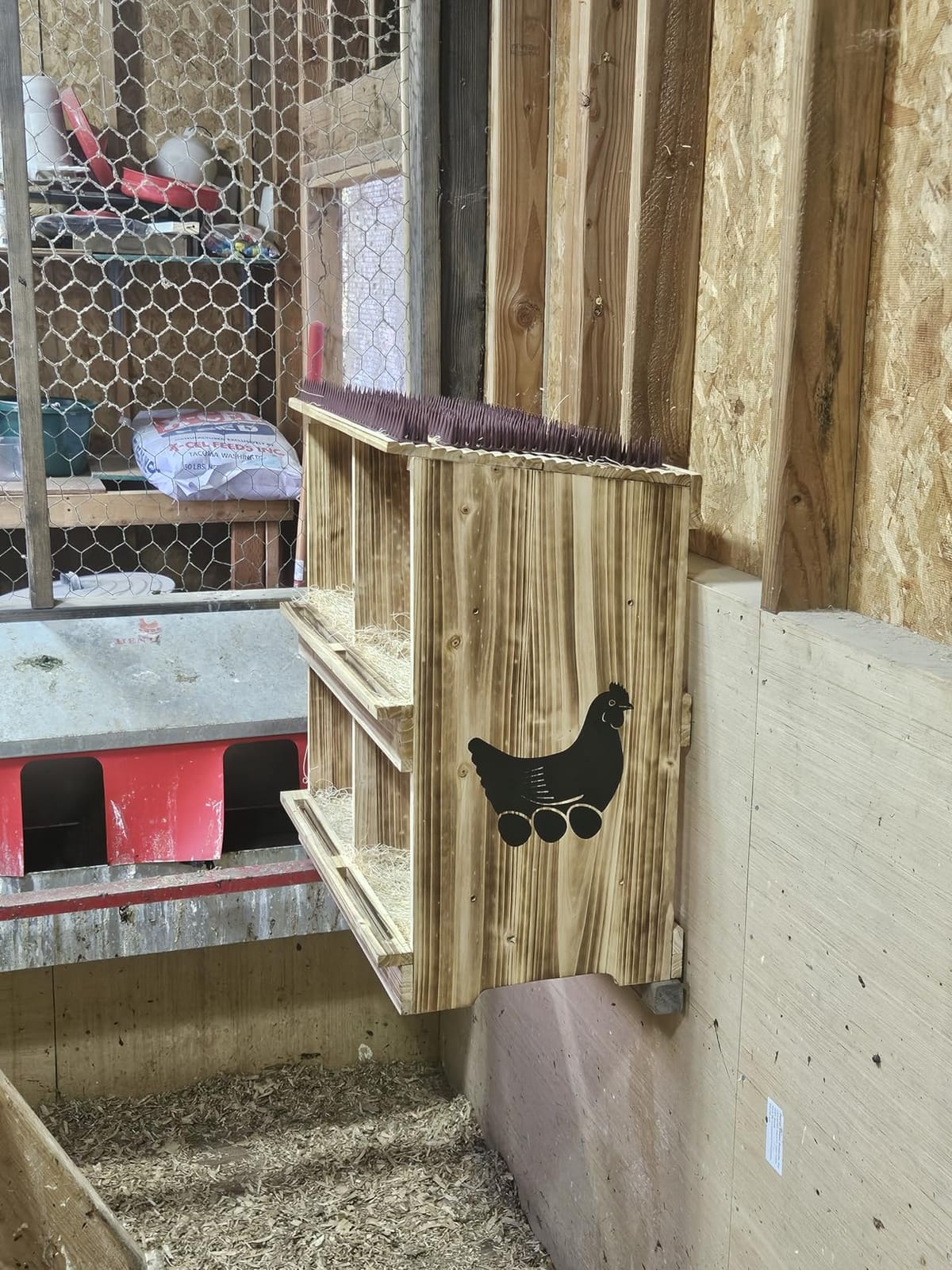
Four wooden compartments in a footprint that suits a modest coop, and the solid wood build is light enough to lift and reposition by hand. Owners like the natural scent, the clear instructions, and the fact that many hens start using the boxes within days of assembly.
Perches and baffles do real work here too, keeping nesting straw inside the compartment and shielding eggs from damage, and the airflow through the interior keeps nests dry and cooler than a sealed box. For a first flock of four to ten hens, four separate compartments means less fighting over one nest from the start.
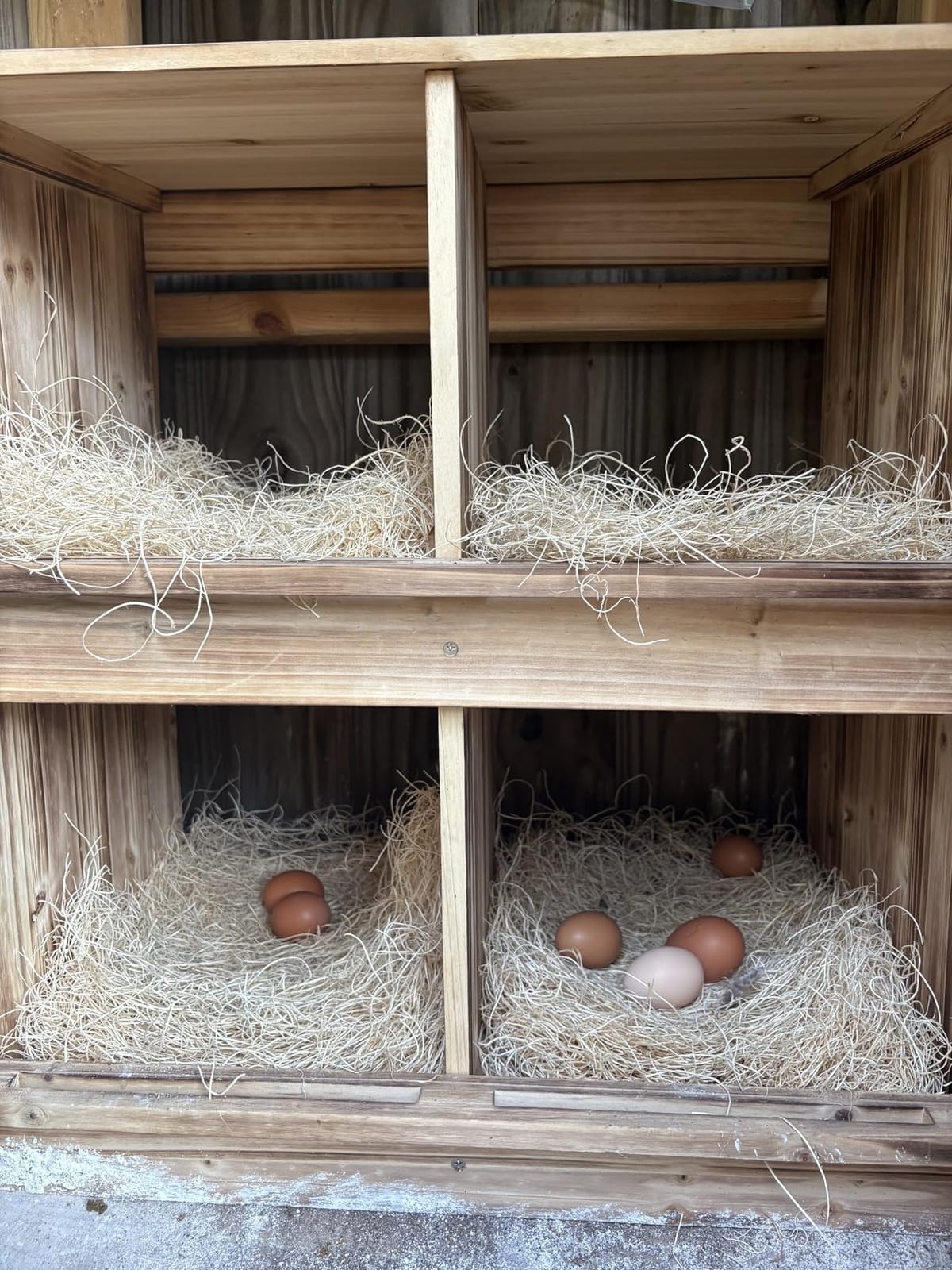
Two design details trip up large-hen keepers. The rear board is low, so if the box is not mounted flush to the wall, bedding and eggs get pushed out the back, and there is no front retaining bar, so straw spills and eggs can roll. Compartments also run tight for the heaviest birds, with owners specifically mentioning Australorps finding them cramped. Some shipments have arrived without the promised wood screws, and the wood needs sealing to stay weatherproof over time.
Who this box suits
Good for a first flock, a small backyard setup, or anyone who wants a natural-looking nest that is easy to move between coops. It also suits a warm climate where wood insulation beats metal, as long as you seal the panels and mount it properly.
What to watch for
Push the box tight against the coop wall and add your own front lip strip, which fixes both the loose bedding and the rolling eggs. Check the hardware bag against the parts list on arrival. And if your hens are 9 pounds or more, look at a box with a taller back and more floor depth instead.
10. Tiflev 4-Hole Orange Roll-Away Nest Box for Large Hens
Chicken Nesting Boxes, Roll Away Nest Box for Egg Collector, 4 Holes Orange
- Roll-away channel sharply cut broken and dirty eggs
- Powder-coated galvanized steel that is not flimsy
- Large breeds such as Buff Orpingtons fit comfortably
- Pull-out trays on both tiers
- Sloped roof stops young birds fouling
- Instructions are largely useless
- No back panel so plywood backing is needed
- Slightly sharp metal in places
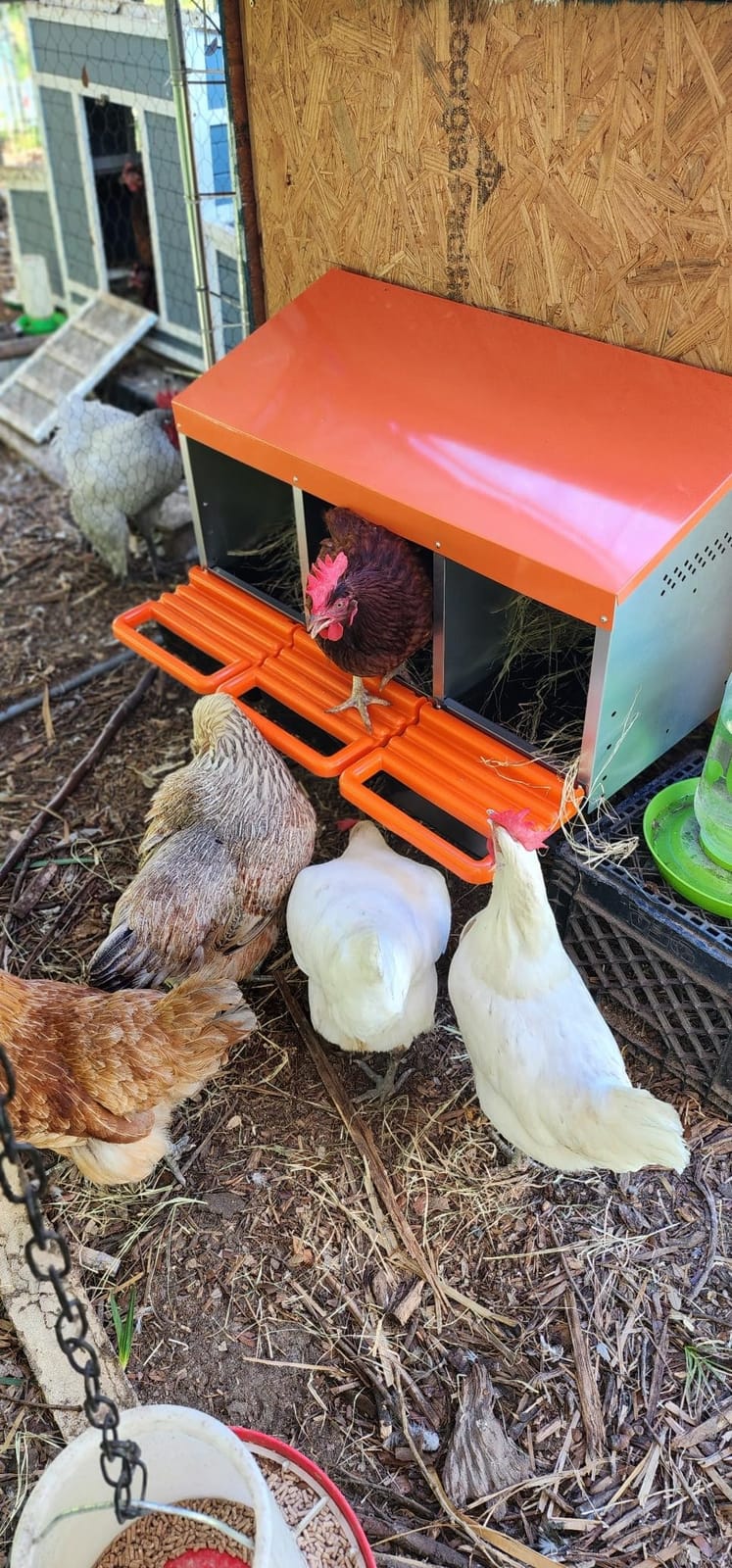
Owners with hens that already ate eggs report the problem stopped almost overnight once the roll-away channel went in, because the egg leaves the nest the moment it is laid and ends up behind a cover where no bird can reach it.
The build backs that up, and the egg-saving effect shows up in real flocks. Powder-coated galvanized steel is described as sturdy rather than flimsy, the boxes arrive shrink-wrapped, and the double-decker layout of two tiers by two compartments saves floor space at 21 x 20 x 30 inches. Pull-out metal trays on both levels make bedding changes and rinsing fast, and a dummy egg is included to encourage first use.
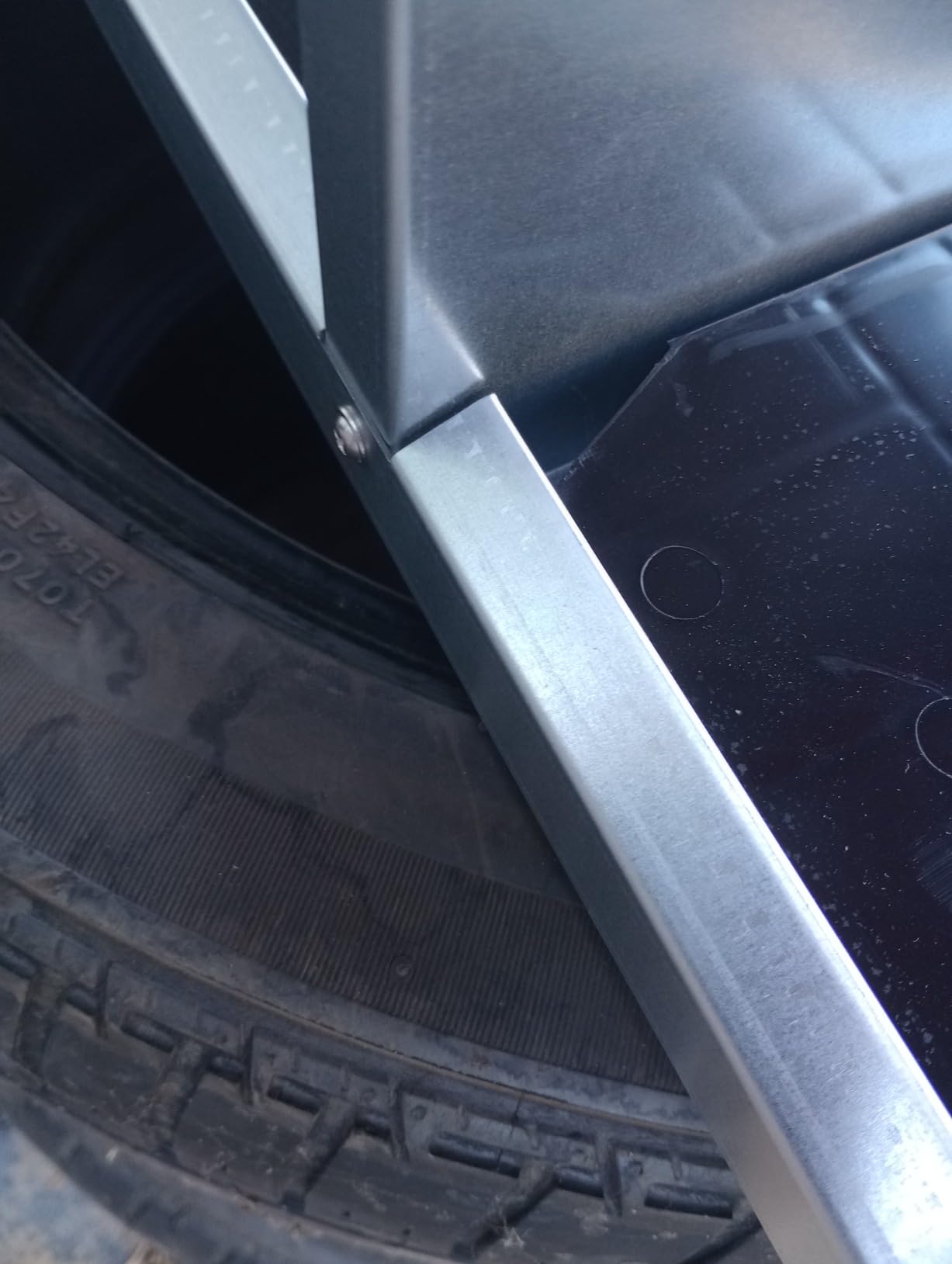
Buff Orpingtons and Australorps are specifically reported as fitting the nests comfortably, which is a good sign for heavy birds. The weak point is documentation: instructions are largely useless and one side documents a different product entirely. There is also no back panel, so a plywood backing is required on a non-wood wall, and the metal is slightly sharp in places. The orange trays can tip forward unless pushed back until they click.
Who this box suits
It suits a flock of six to twelve large hens where broken eggs are the main loss, and it works well in a small coop because the vertical layout saves floor area. The pull-out trays also make it a good match for anyone who does a full bedding change weekly.
What to watch for
Wall mounting height is not flexible here, since the tilt only works at the correct height for eggs to roll. Add a plywood back panel before mounting and set the level using a spirit level. Until the trays click into place, expect to push them back every few days.
11. AugFir 2-Compartment Extra Large Nest Box for Large Hens
- Extra-large compartments built for medium to large hens
- Sloped roll-away floor prevents crushing and pecking
- Lid opens from outside for collection
- Vents and base drainage keep it dry
- Stackable and drill-free mountable
- Plastic can crack in freezing or impact conditions
- Stacking many boxes needs secure anchoring
If your hens are genuinely large, this is the box whose dimensions were designed around them. The extra-large compartments are intended for medium-to-large hens, and the sloped roll-away floor moves eggs into a front collection area under a lid, so an egg is never left under a heavy bird that might shift her weight onto it.
The lid opens from the outside, so you collect eggs without reaching into a dark nest where a broody hen is waiting. Built-in vents and drainage holes in the base keep the interior dry and fresh, and at 8.51 pounds the whole unit is easy to move when you reconfigure the coop. Installation is unusually flexible: wall mount it, set it drill-free, run it horizontally or vertically, and stack compartments as your flock grows.
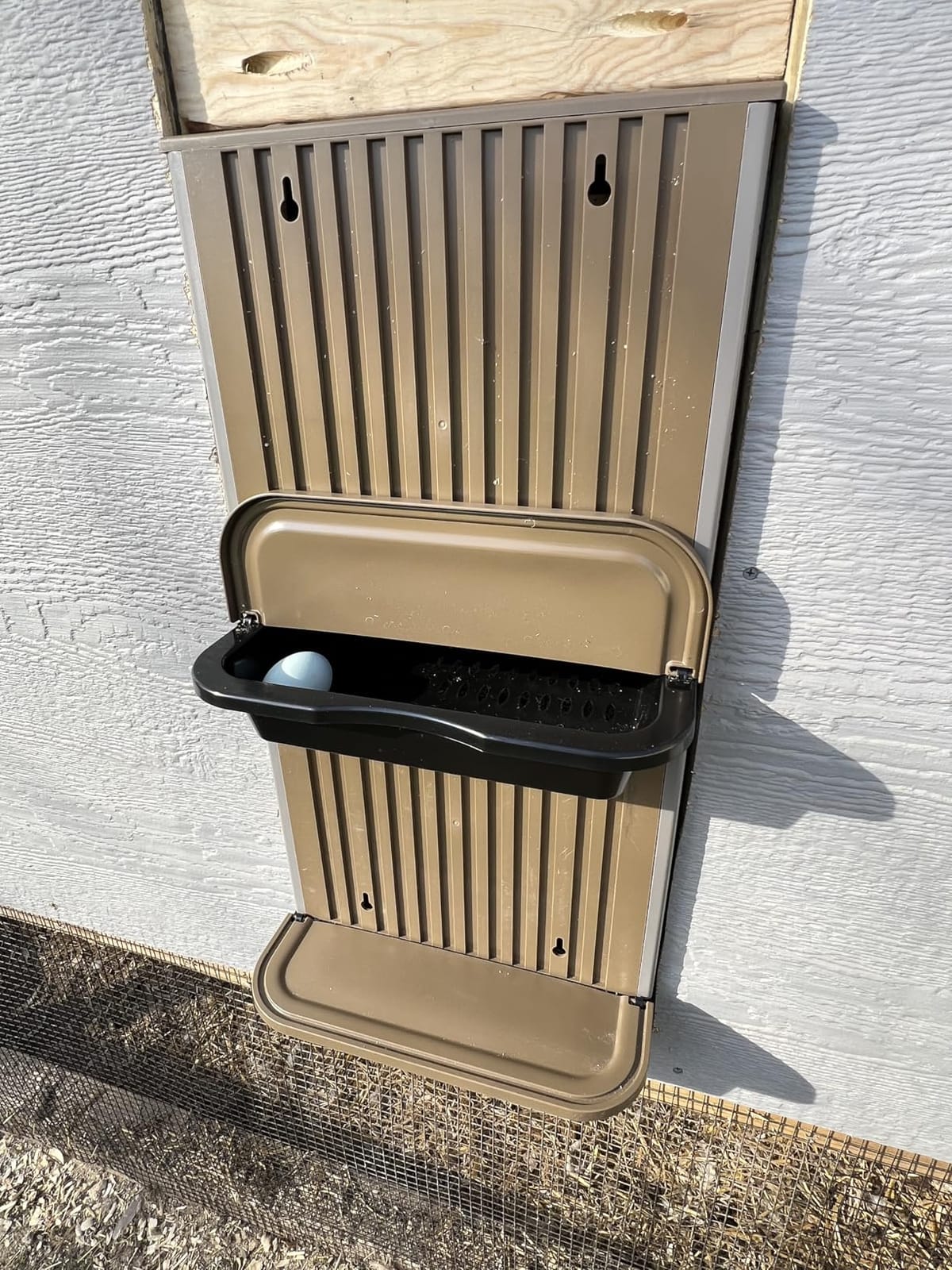
Plastic is the compromise, and it matters in cold climates. All-weather plastic will not rust, but it can crack in freezing or impact conditions, and owners note that stacking many boxes needs secure wall anchoring. Keep it out of direct winter wind and check the base drainage holes stay clear of bedding, because trapped water plus plastic is how a unit cracks.
Who this box suits
This suits a small flock of two to six very large hens, including Jersey Giant and Brahma keepers who have found standard bays too tight. It is also a good pick for anyone with a movable coop, since the drill-free placement option means you can move the nest without tools when you move the birds.
What to watch for
Do not stack more than a few units without bolting each one to the wall, and bring the boxes into a sheltered building during a hard freeze rather than leaving them on an exposed wall. Keep bedding thin so the roll path stays clear. And if your birds are 12 pounds or more, pair this with a wider mounting area so two boxes do not end up sharing one corner.
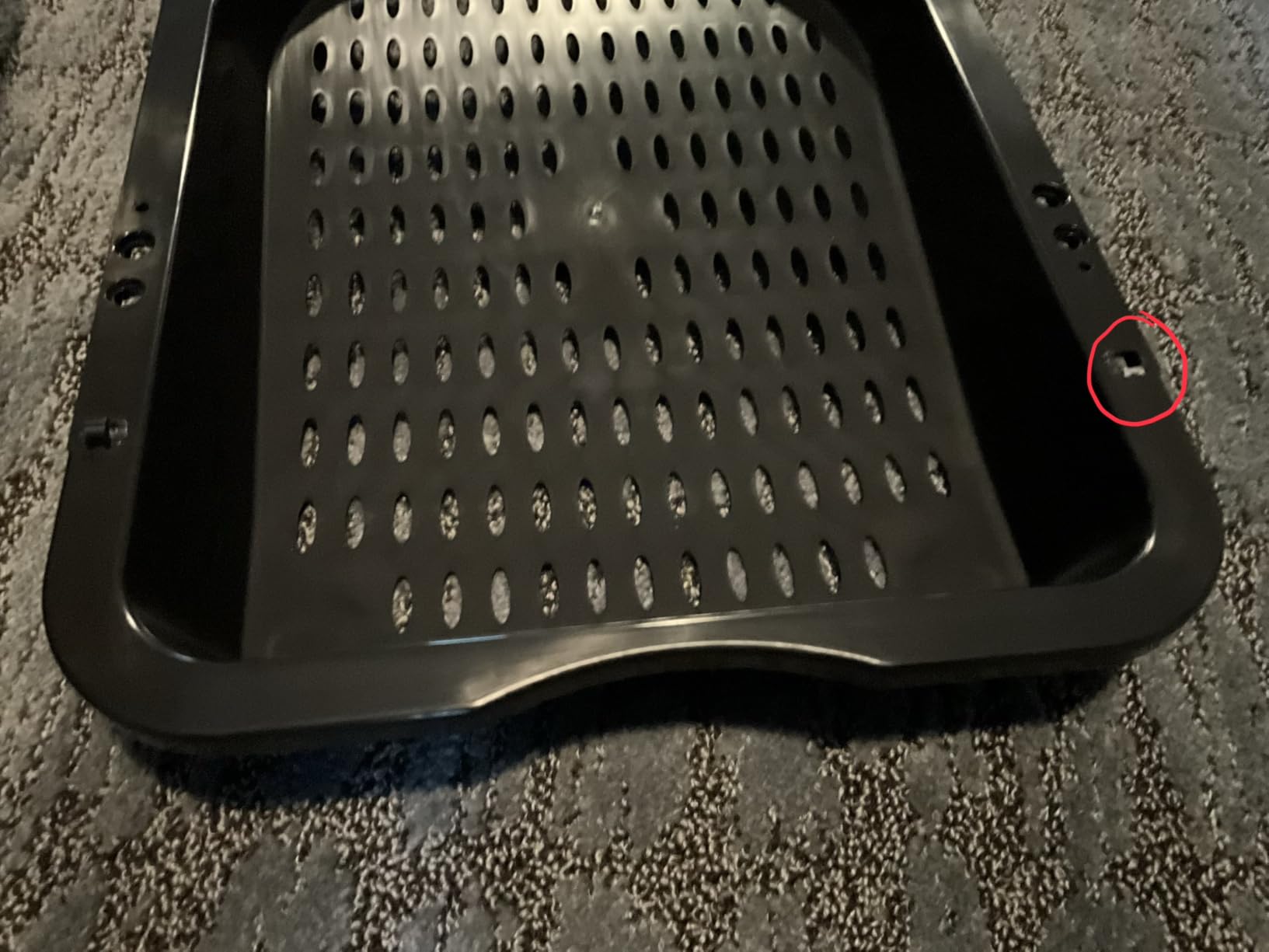
12. HOLOLIJO 10-Pack of Roll-Out Nest Boxes for Large Hens
HOLOLIJO 10‑Pack Chicken Nesting Boxes, Roll‑Out Egg Collection Chicken Laying Boxes, Large Waterproof Durable Nest Boxes Easy to Install for Chicken Coop
- Ten nests give a big flock one box each
- Roll-away front stopped egg eating for owners
- Sloped roof keeps hens off the boxes
- Ramps guide hens in after laying
- Bundled nest pads are reusable
- Included mats block the roll path unless reversed
- Flaps over the egg channel fall off easily
- Boxes flex until fully screwed to a wall
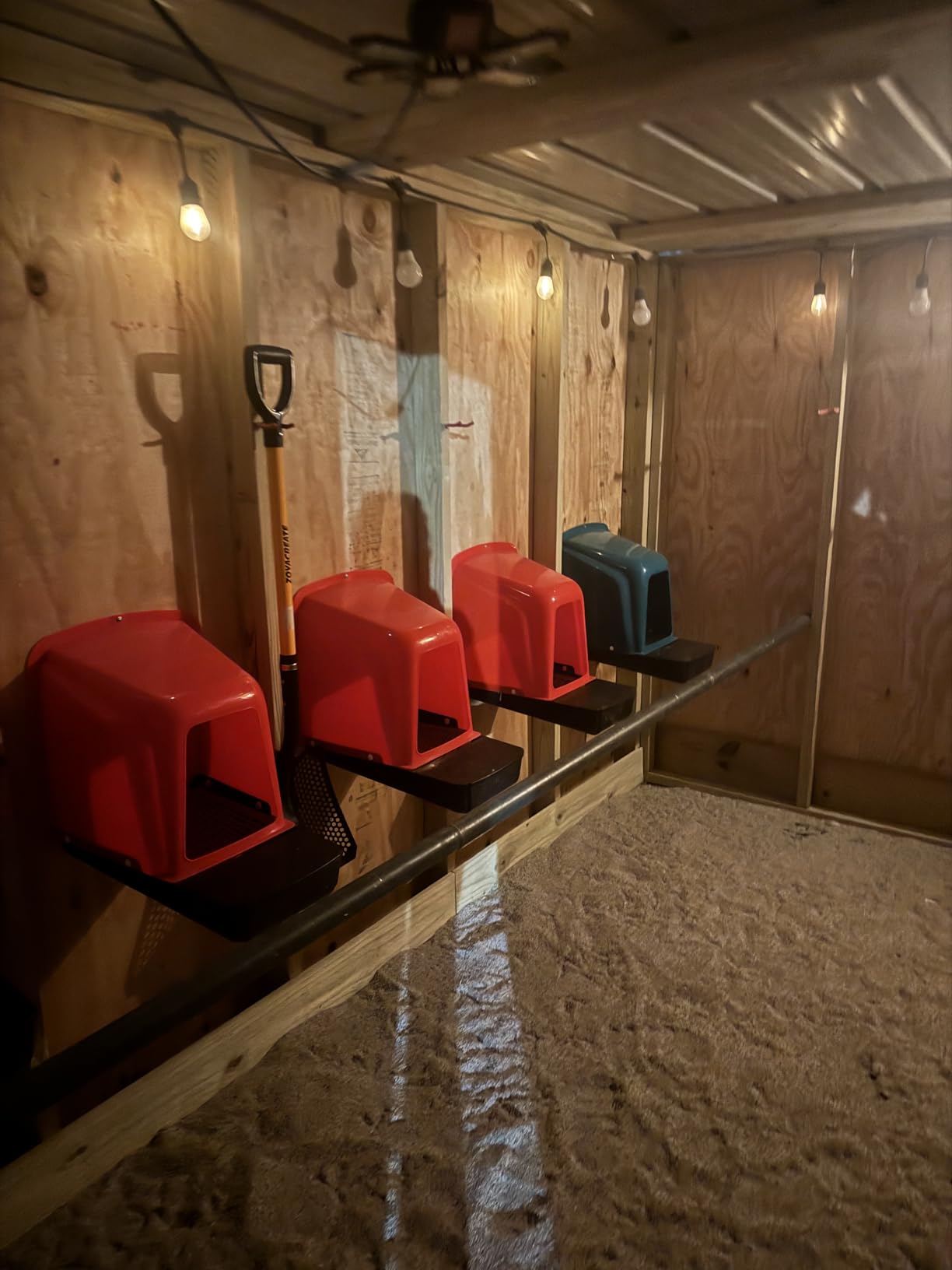
A package of ten boxes changes flock dynamics more than any other pick here. When every hen has her own nest, they stop piling into a single favorite and trampling each other’s eggs, and the roll-away front means the surviving eggs are still clean and unconsumed. Owners with problem layers report collections jumping noticeably after installing them.
The entry ramp is a nice touch for heavy birds, guiding a hen up and in after laying rather than leaving her to jump a lip, and the trays are secured with screws rated to carry hen weight. The sloped roof keeps hens from roosting and fouling the boxes, and the 10 bundled nest pads filter dirt and can be rinsed and reused. ABS plastic will not rust, rot or corrode.
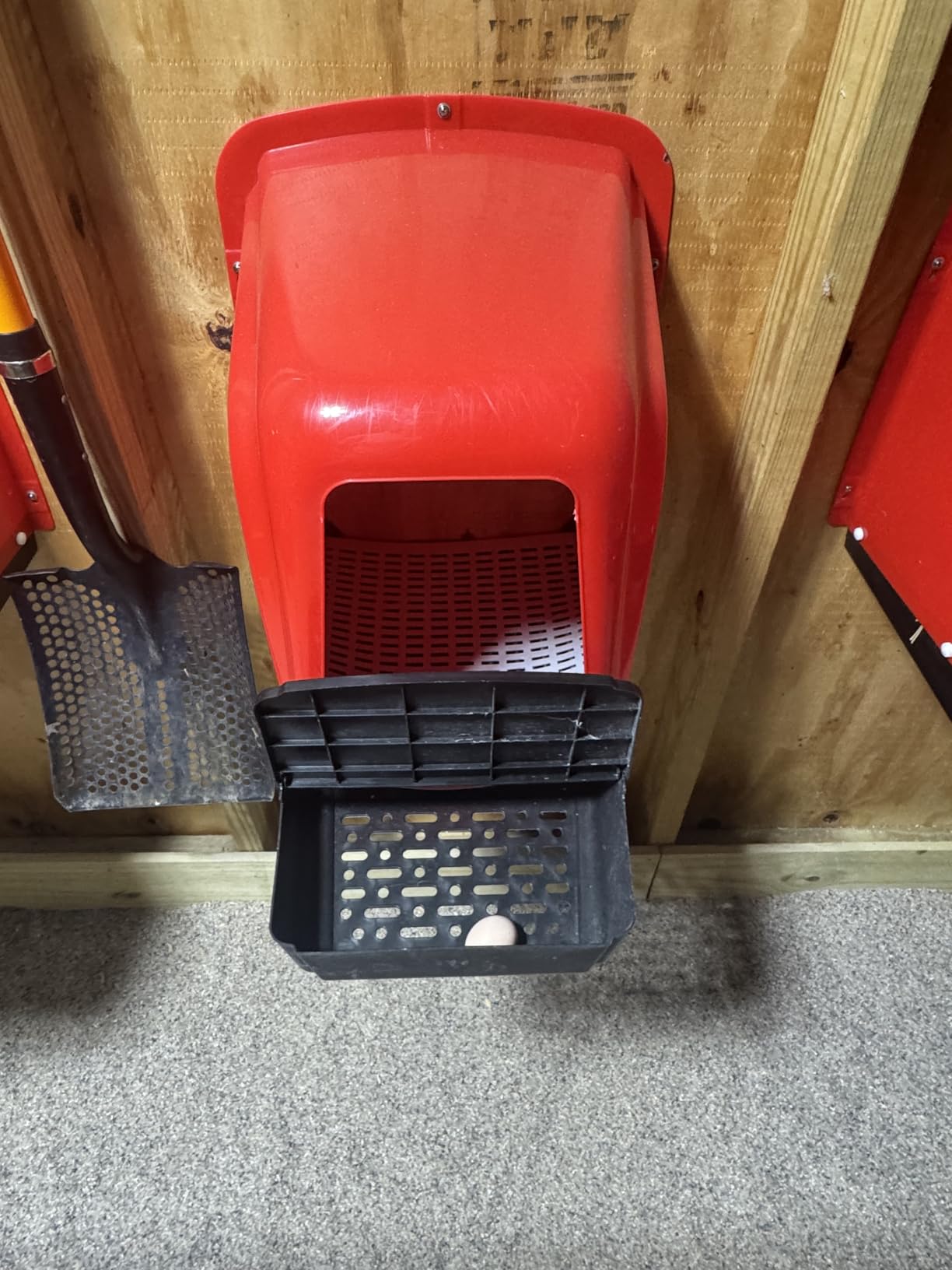
Three real caveats. The included rubber mats will block the roll path unless you fit them smooth side up, the plastic flaps covering the egg channel fall off easily, and the boxes feel flimsy until every tray is screwed to a wall or a plywood backing. There are no printed instructions, so plan on working from a video guide, and expect to push the pads back down when they slide.
Who this box suits
This is the pick for a flock of 20 to 30 hens where crowding in the nest is the actual problem, and for first-time owners who would rather install ten boxes once than keep adding single units every year. It also suits anyone moving from DIY wooden boxes after a mite year and wanting a surface that can be wiped clean.
What to watch for
Mount the whole bank on a solid plywood panel rather than bare studs, since ten mounted boxes on framing will flex. Fit the pads smooth side up or remove them from the collection channel. And check the cover flaps after the first week, because they pop loose and it is easier to secure them early than to hunt them later.
How Many Nesting Boxes Your Flock Needs
One box per four to five hens is the working rule, and two is the floor no matter how small the flock. For six hens you want two boxes, for 12 hens you want three, and for 20 hens you want four to five. Those three numbers answer the questions we see most often about box counts, and they hold for large breeds as well as small ones.
Large hens crowd a little less than flighty small breeds because they settle rather than scratch, so you can lean toward the wider end of that range. What you should not do is stretch a single box for 15 hens and call it capacity. A nest is only private when one hen owns it at a time, and any hen that shares will either fight for the spot or lay on the floor beside it.
Count compartments, not advertised flock numbers. A 30 to 40 hen capacity claim on a six-hole bank means six nests serving 30 to 40 birds, which works because each nest is used in rotation. Any figure that treats capacity as simultaneous occupancy is the number most likely to mislead you. If the coop itself is still on your list, start with our large flock coop roundup so the box count has somewhere sensible to go.
Where and How to Mount the Box for Big Hens
Mount 18 to 24 inches off the coop floor and always below the roost bar. Hens instinctively roost high, so a box above the roosting bar is a bed rather than a nest and will fill with droppings. If your roost bar is low, raise it rather than lowering the nests.
Keep the floor level or sloped forward only, which matters most for roll-out boxes, since a backward or sideways tilt stops eggs rolling and defeats the whole design. Use a spirit level before you drill. For a multi-hole metal bank carrying 10-pound hens, back the unit with a plywood panel screwed to the studs rather than hanging it on two screws, and use the mounting holes at 18 to 20 inches where the manufacturer provides them. Housing that gives you a solid wall to work with is covered in our guide to predator-proof coops for large flocks.
One trick owners recommend for a new box is to raise the roost bar at night and lower it in the morning for the first week. Hens follow the roost, not the nest, so moving the bar resets where they sleep and pushes them toward the box during daylight laying hours.
Roll-Out Boxes and Why Large Flocks Love Them
Roll-out boxes earn their extra cost on a large flock because they remove the two most common egg losses at once: trampling and egg eating. The floor is sloped so the egg rolls into a covered tray the hen cannot reach, which means a broken egg never teaches the flock that eggs are food. That behavioral change tends to matter more than the extra outlay.
There is one real downside. A roll-out box suppresses broodiness, because a hen cannot settle onto a clutch she cannot reach, so if you plan to hatch eggs this season, leave at least one conventional nest in the coop. Owners also report fewer egg-eating incidents and noticeably cleaner eggs, which is the main reason flock owners keep them past the first season.
Bedding, Cleaning and Mite Prevention
Fill each box with 2 to 3 inches of straw or pine shavings, and use more than you think for large hens because a heavy bird rakes bedding out with her back faster than a small one. An excelsior-style nesting pad laid under the bedding gives you something washable to lift out, and it makes a full change in seconds rather than minutes.
Avoid cedar, which is aromatic enough to discourage nesting in some coops. On wood boxes, seal the panels and clean deeper than feels necessary, because unsealed wood holds moisture and gives mites somewhere to breed that plastic and metal never will. Plastic and galvanized boxes can be hosed or pressure-washed, and a weekly swap of the bedding plus a monthly tray wash keeps mite pressure low.
Collect eggs daily, not every other day, whatever the box type. A clean egg from a roll-out tray still gets stepped on if two heavy hens share a nest, and it is also the fastest way to spot a mite infestation early, since you will see them on the eggs before you see them in the box.
Getting Big Hens to Actually Use the Box
Start by putting decoy eggs in the box. Two ceramic or plastic fake eggs signal that the nest is the right place to lay, and for large hens it is the fastest single trick. Some owners add a golf ball for the same reason.
Then close the room down. If hens are laying on the floor or under the roost, block off the favorite floor spot for a few days so the box becomes the only option. Add a curtain or a flap of dark fabric over the entrance if the box is too bright, since hens want a dark secluded corner, and finally keep the bedding deep and the box dry, because a damp or drafty nest gets abandoned for a worse one.
Give it three days before you change anything. Most flocks reported here started using a new box within a day, and those that took longer had a brightness or draft problem rather than a sizing problem.
Frequently Asked Questions
What is the ideal nest box size for large chickens?
Large breeds such as Jersey Giants, Brahmas and Cochins need a 14 x 14 x 14 inch box, while standard breeds are fine with 12 x 12 x 12 inches. Entrance width matters as much as interior size, so look for at least 12 inches of opening and a front lip under 6 inches so a heavy hen can step in and turn around.
How many nesting boxes should you have for 6 hens?
Two boxes for six hens. The working rule is one box for every four to five hens with a minimum of two boxes in any coop, and two nests also stops hens from fighting over a single favorite spot.
Is 3 nesting boxes enough for 12 chickens?
Yes, three boxes is the right number for 12 hens, which works out to one box for every four hens. That gives each nest enough privacy that a hen is not sharing while she lays, which is the main reason egg damage happens.
Are roll away nest boxes worth the cost?
For a large flock they usually are, because the sloped floor moves eggs into a covered tray the hen cannot reach, which cuts trampling, soiling and egg eating at once. The trade-off is that roll-out boxes suppress broodiness, so leave one conventional nest in the coop if you plan to hatch eggs.
Do large hens need bigger nesting boxes?
Yes. A 10-pound Orpington or Cochin needs roughly 14 inches of interior width and depth to walk in and turn around, where a 12 inch box makes her crouch and shuffle. The most common sign of an undersized box is hens nesting on the floor beside it instead of inside it.
Conclusion: The Best Chicken Nesting Boxes for Large Hens
For most flocks of large hens, the Brower 2-Tier 6-Hole galvanized steel box is the best chicken nesting box you can buy, because its deep compartments let a heavy hen turn around and its folding perches make cleaning fast. If you keep three to six very large birds, the Miller 4-Pack of large plastic boxes gives the highest rated, easiest-to-sanitize option, and the Little Giant single plastic box is the pick when cleaning speed matters more than anything else.
Where eggs are being lost to cracking or pecking, a roll-out design is the answer, and the Eggluuz and Tiflev four-hole models both put eggs behind a cover the hen cannot reach. Whatever you choose, size it at 14 x 14 x 14 for birds over 8 pounds, mount it 18 to 24 inches off the floor and below the roost, and give them one box per four to five hens. Those three numbers decide more than the brand name does.