
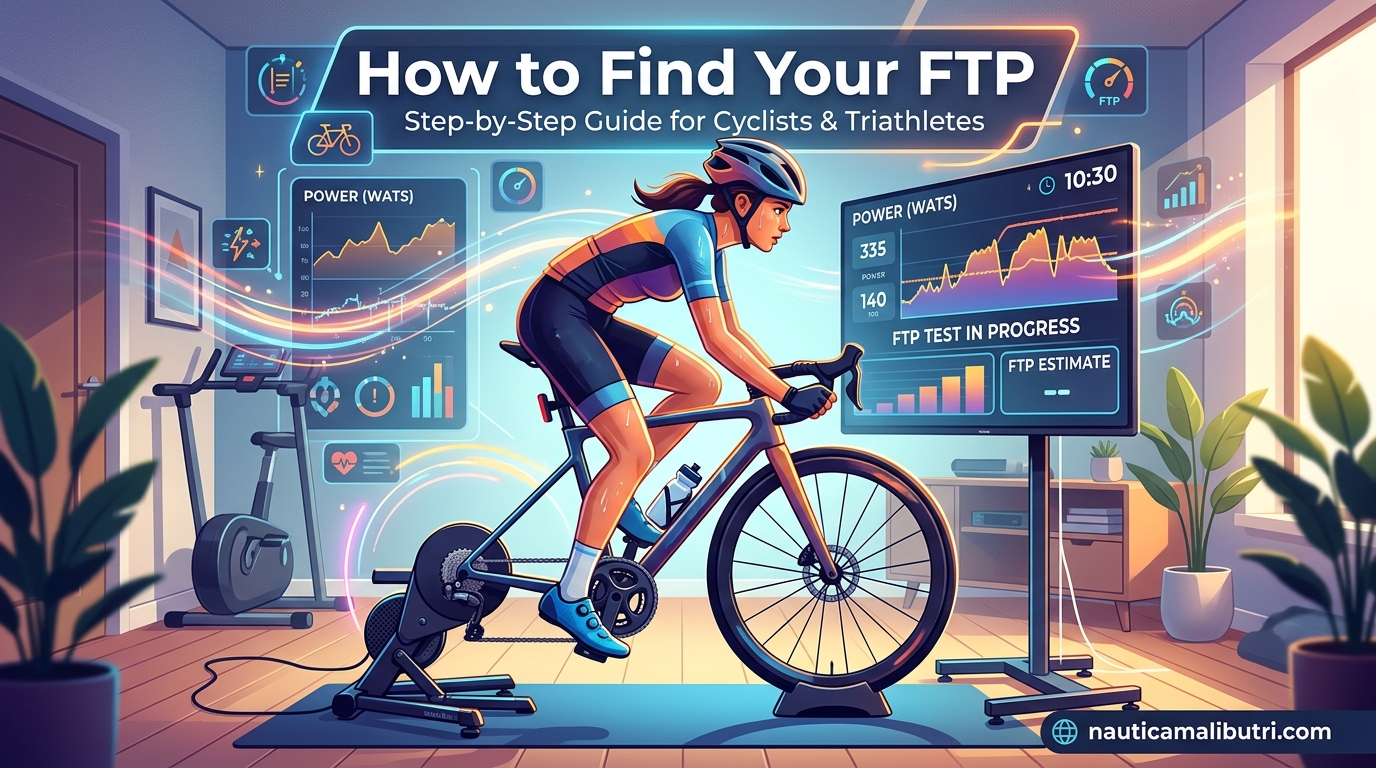
Knowing your Functional Threshold Power (FTP) is the single most important step for any cyclist who wants to train with purpose. I remember the first time I attempted an FTP test. I had been riding for months without any real direction, and my progress had stalled completely. That first number changed everything for me. It gave me a baseline, a way to measure improvement, and most importantly, it helped me train at the right intensity.
In this guide, I will walk you through exactly how to find your FTP using the three most common testing methods. Whether you have a smart trainer, a power meter on your bike, or you are just getting started with indoor cycling apps like Zwift or TrainerRoad, you will learn the exact steps to get an accurate FTP value. We will cover the 20-minute test, the ramp test, and the 8-minute protocol. I will also share calculation formulas, benchmarks to compare yourself against, and tips for handling the mental side of these tough efforts.
By the end of this article, you will know exactly how to find your FTP and how to use that number to set up your training zones.
Table of Contents
What Is FTP (Functional Threshold Power)?
FTP stands for Functional Threshold Power. It represents the highest average power output you can sustain for approximately one hour, measured in watts. Think of it as your aerobic ceiling. When you ride below FTP, your body can clear lactate as fast as it produces it. Go above FTP, and lactate accumulates, eventually forcing you to slow down.
The concept comes from Dr. Andy Coggan, who developed FTP as a practical alternative to lab-based lactate threshold testing. Instead of blood samples and expensive equipment, cyclists could now get a meaningful fitness marker with just a power meter and a hard effort. This changed how amateur athletes train forever.
Your FTP number is personal. Two cyclists might have completely different FTP values but similar race performances because of differences in body weight. That is why experienced riders often talk about watts per kilogram (W/kg). A 70kg cyclist with a 280W FTP has a 4.0 W/kg ratio. A 90kg cyclist with the same 280W FTP has a 3.1 W/kg ratio. The lighter rider will climb faster, even though their raw power is identical.
For triathletes specifically, FTP matters because the bike leg is where you spend the most time in most races. Knowing your threshold helps you pace properly so you have enough left for the run. Go too hard on the bike, and your run splits will suffer. Go too easy, and you leave time on the table.
How to Find Your FTP: Testing Methods Explained
There are three primary ways to find your FTP. Each has advantages and disadvantages depending on your experience level, equipment, and mental approach to hard efforts.
- The 20-Minute Test: The gold standard used by most training platforms. Requires good pacing skills but produces consistent results.
- The Ramp Test: Easiest mentally because it is over quickly. Good for beginners but can overestimate for some athletes.
- The 8-Minute Test: A middle ground option. Two hard 8-minute efforts with recovery between.
I recommend starting with the 20-minute test if you have any racing or time trial experience. The ramp test works better if you are new to structured training or find long efforts intimidating. Let us look at each method in detail.
The 20-Minute FTP Test (Most Popular Method)
The 20-minute FTP test is the most widely used protocol. It is the default test in TrainingPeaks, TrainerRoad, and Zwift for good reason. When done correctly, it provides consistent, repeatable results.
Here is the complete procedure I follow when testing athletes:
Step 1: Proper Warm-up
Start with 15 to 20 minutes of easy riding. Include two hard 1-minute efforts with full recovery between. These open your legs and prepare your cardiovascular system. The warm-up matters more than most people think. Skip it, and your test result will be lower than your true capability.
Step 2: The 20-Minute Effort
After a 5-minute easy spin to recover from the warm-up efforts, start your 20-minute timer. Your goal is the highest average power you can sustain for the full 20 minutes. This requires pacing discipline. Start too hard, and you will fade. Start too easy, and you will leave watts on the table.
Step 3: Mental Management
FTP tests are mentally tough. You will want to quit at the 10-minute mark. Expect this. Break the effort into four 5-minute chunks. Focus only on the chunk you are in. Do not think about how much time remains. I tell athletes to focus on their breathing and pedal stroke, not the clock.
Step 4: Cool Down
Spin easy for 10 to 15 minutes after finishing. Record your average power for the 20-minute effort. You will need this number for the calculation.
Pacing Tips from Real Experience
The most common mistake in 20-minute tests is going out too hard. If you can sprint at the end, you paced wrong. A properly executed test should feel like you gave everything, with nothing left for a sprint finish. Aim for a steady power graph, not a big spike at the start followed by a fade.
If you have previous test data, aim for roughly 5% higher average power than your last test. If this is your first time, start conservatively. You can always increase effort in the final 5 minutes if you feel good.
The Ramp FTP Test (Beginner-Friendly Option)
The ramp test has become extremely popular because it removes the pacing challenge. You do not have to guess your effort level. You just keep going until you cannot continue.
Here is how it works:
Step 1: Warm-up
Start with 10 to 15 minutes of easy spinning. The ramp test warm-up is shorter because the test itself gradually builds intensity.
Step 2: The Ramp Protocol
The test starts at a low power level, typically around 100 watts or 50% of your estimated FTP. Every minute, the target power increases by a set amount, usually 20 watts for men or 10 to 15 watts for women. Your job is simple: keep pedaling and match the target power each minute.
Continue until you cannot maintain the required power. When you reach failure, stop pedaling. The test is over.
Step 3: Record Your Best 1-Minute Power
Note the highest 1-minute average power you achieved during the test. This is your maximum minute power, and you will use it for the FTP calculation.
Pros and Cons of the Ramp Test
The biggest advantage is mental. You do not pace. You simply survive as long as possible. This makes it less intimidating for beginners. Most people find the ramp test easier to complete than a 20-minute sustained effort.
However, the ramp test has limitations. It relies heavily on your VO2 max and anaerobic capacity. Athletes with strong sprint abilities sometimes get inflated FTP results because they can push through the final minutes with anaerobic energy. For these riders, the ramp test may overestimate sustainable threshold power by 5 to 10%.
Despite this limitation, the ramp test works well for most recreational cyclists and triathletes. The ease of use and mental accessibility outweigh the small accuracy trade-off for many people.
The 8-Minute FTP Test (Quick Alternative)
The 8-minute test offers a middle ground between the 20-minute and ramp protocols. It is shorter than the 20-minute test but requires more pacing skill than the ramp test.
Here is the procedure:
Step 1: Warm-up
Complete a 15-minute warm-up with two hard 1-minute efforts. Recovery should be full between efforts.
Step 2: First 8-Minute Effort
Ride as hard as you can sustain for 8 minutes. This requires pacing judgment. Go out too hard, and you will blow up. Start too easy, and your average will suffer.
Step 3: Recovery
Spin easy for 10 minutes. Full recovery is essential for the second effort to be valid.
Step 4: Second 8-Minute Effort
Complete another 8-minute maximal effort. Try to match or slightly exceed your first effort average.
Step 5: Cool Down
Spin easy for 10 minutes. Record the average power from both 8-minute efforts.
When to Use the 8-Minute Test
I recommend the 8-minute test for athletes who have good pacing skills but struggle mentally with 20-minute sustained efforts. The break between efforts makes it more manageable for some people.
The 8-minute test also works well if you have limited time or are testing outdoors where traffic and terrain make a steady 20-minute effort difficult to execute.
FTP Calculation Formulas for Each Test
Once you complete your test, you need to calculate your actual FTP. Each test protocol uses a different multiplier to estimate your threshold power. Here are the exact formulas:
20-Minute Test Formula
Multiply your average 20-minute power by 0.95.
Example: If your average was 250 watts, your FTP is 250 x 0.95 = 238 watts.
The 0.95 multiplier accounts for the fact that most athletes can sustain about 5% more power for 20 minutes than they can for a full hour. This is the most established formula and the one used by TrainingPeaks.
Ramp Test Formula
Multiply your best 1-minute power from the test by 0.75.
Example: If your highest 1-minute average was 300 watts, your FTP is 300 x 0.75 = 225 watts.
This formula was developed by researchers studying the relationship between maximal aerobic power and sustainable threshold effort. Most training platforms apply this calculation automatically.
8-Minute Test Formula
Take the average of your two 8-minute efforts, then multiply by 0.90.
Example: If you averaged 260 watts on the first effort and 255 watts on the second, your average is 257.5 watts. Your FTP is 257.5 x 0.90 = 232 watts.
The 0.90 multiplier is less aggressive than the 20-minute formula because 8-minute efforts are shorter and involve more anaerobic contribution.
Common Calculation Mistakes
The most frequent error is using the wrong multiplier. Double-check which test protocol you followed before calculating. Another mistake is using normalized power instead of average power. Always use average power for FTP tests. Normalized power accounts for variability and can inflate your result incorrectly.
What Is a Good FTP? Benchmarks by Category
Once you have your FTP number, you naturally want to know how it compares. Here are realistic benchmarks based on data from thousands of cyclists.
FTP Benchmarks by Cyclist Type (Male)
| Cyclist Category | FTP Watts | W/kg (70kg) |
|---|---|---|
| Recreational | 150-200 | 2.1-2.9 |
| Enthusiast | 200-250 | 2.9-3.6 |
| Competitive Amateur | 250-300 | 3.6-4.3 |
| Elite Amateur | 300-350 | 4.3-5.0 |
| Professional | 350+ | 5.0+ |
FTP Benchmarks by Cyclist Type (Female)
| Cyclist Category | FTP Watts | W/kg (60kg) |
|---|---|---|
| Recreational | 120-160 | 2.0-2.7 |
| Enthusiast | 160-200 | 2.7-3.3 |
| Competitive Amateur | 200-240 | 3.3-4.0 |
| Elite Amateur | 240-290 | 4.0-4.8 |
| Professional | 290+ | 4.8+ |
Is an FTP of 200 Watts Good?
An FTP of 200 watts puts you in the enthusiast category for most male cyclists. For a 70kg male, this represents 2.9 W/kg, which is solid recreational fitness. You can complete century rides comfortably and hang with group rides at a moderate pace.
For women, 200 watts is quite strong. A 60kg female with 200 watts FTP has 3.3 W/kg, placing her well into the enthusiast category and competitive with many amateur riders.
Is an FTP of 250 Watts Good?
A 250-watt FTP is excellent for recreational cyclists and competitive at the amateur level. A 70kg cyclist at 250 watts has 3.6 W/kg, which would place you mid-pack in most local road races. This is a target many dedicated cyclists work toward.
Professional cyclists typically maintain 5.0+ W/kg for FTP, but these numbers come from full-time training. Do not compare yourself to professionals. Compare yourself to your past self.
Age and FTP Considerations
FTP naturally declines with age, but the drop is gradual. Most cyclists see peak FTP in their late 20s to early 30s. By age 50, you might expect 10 to 15% lower FTP than your lifetime peak. However, consistent training can maintain strong performance well into your 60s and beyond.
The key is tracking your own progress over time, not comparing raw numbers to others. A 200-watt FTP might be a massive achievement for one person and a starting point for another.
Setting Your Training Zones from FTP
Your FTP serves one primary purpose: setting accurate training zones. These zones let you target specific physiological adaptations with your workouts.
Here is the standard Coggan power zone model used by most training platforms:
| Zone | Name | % of FTP | Purpose |
|---|---|---|---|
| 1 | Active Recovery | Less than 55% | Recovery, easy spinning |
| 2 | Endurance | 56-75% | Aerobic base building |
| 3 | Tempo | 76-90% | Sustained power, sweet spot |
| 4 | Threshold | 91-105% | FTP improvement |
| 5 | VO2 Max | 106-120% | Aerobic capacity |
| 6 | Anaerobic | 121-150% | Neuromuscular power |
| 7 | Neuromuscular | Greater than 150% | Sprint power |
Example training zones for a cyclist with 250-watt FTP:
- Zone 1 (Recovery): Less than 138 watts
- Zone 2 (Endurance): 140-188 watts
- Zone 3 (Tempo): 190-225 watts
- Zone 4 (Threshold): 228-263 watts
- Zone 5 (VO2 Max): 265-300 watts
- Zone 6 (Anaerobic): 303-375 watts
- Zone 7 (Neuromuscular): Greater than 375 watts
What Is the 80% Rule in Cycling?
The 80% rule refers to the principle that roughly 80% of your training should be done at low intensity (Zones 1-2), with only 20% at moderate to high intensity (Zones 3-7). This polarized approach has been shown to produce better results than mixing intensities randomly.
Knowing your FTP ensures you actually ride easy on easy days. Many cyclists train too hard on recovery rides, accumulating fatigue without gaining fitness.
When and How Often to Retest Your FTP
Your FTP is not static. It changes with training, rest, and lifestyle factors. Testing too frequently creates unnecessary stress. Testing too rarely means your zones become inaccurate.
How Often Should You Test?
I recommend retesting every 4 to 6 weeks during focused training blocks. This timeline aligns with typical training plan progressions. If you are in a maintenance phase or off-season, testing every 8 to 12 weeks is sufficient.
Testing more frequently than every 3 weeks rarely shows meaningful changes and creates mental fatigue. The exception is if you are using AI FTP detection features in apps like TrainerRoad, which estimate changes based on your workout data without formal testing.
Signs Your FTP Has Changed
Watch for these indicators that your zones need updating:
- Threshold intervals feel easy, and you can hold conversations in Zone 4
- You cannot complete prescribed workouts despite good sleep and nutrition
- Your heart rate at Zone 2 power has dropped significantly
- You have completed 3 or more weeks of consistent structured training
Testing Consistency Tips
For comparable results, control as many variables as possible. Test at the same time of day, in similar temperatures, with the same equipment. Use the same test protocol each time. Indoor testing on a smart trainer provides the most consistent conditions because you eliminate wind, traffic, and terrain variables.
If you must test outdoors, choose a quiet road with minimal traffic and consistent grade. Avoid testing into a headwind or on a hot day.
How to Improve Your FTP Over Time
FTP improvement requires consistent, targeted training. Random riding will not move the needle significantly. You need structured workouts that stress your threshold system.
Threshold Intervals
The most effective way to improve FTP is riding at or slightly below threshold. Typical workouts include 2×20 minutes at FTP, 3×15 minutes at 95% FTP, or 4×10 minutes at 100% FTP. Start with shorter intervals and build duration as your fitness improves.
Sweet Spot Training
Sweet spot refers to the upper end of Zone 3, roughly 88-93% of FTP. This intensity provides strong aerobic stimulus without the recovery cost of full threshold work. Many athletes see FTP gains from consistent sweet spot training, especially during base building phases.
Endurance Base
Do not neglect Zone 2 riding. A strong aerobic base supports higher intensities. Elite cyclists often complete 15 to 20 hours weekly of Zone 2 riding during base periods.
Realistic Improvement Timeline
FTP gains come gradually. A 5 to 10% improvement over a 12-week training block is excellent progress for an experienced cyclist. Beginners might see faster initial gains of 15 to 20% as their bodies adapt to structured training.
I have seen athletes improve from 267W to 369W over two years of consistent structured training. That represents a 38% increase through progressive overload and smart recovery. These improvements are possible but require patience and consistency.
Factors That Influence FTP
Beyond training, several lifestyle factors affect your FTP:
- Sleep: Poor sleep reduces performance by 5 to 10%
- Nutrition: Chronic under-fueling limits adaptation
- Stress: Life stress affects recovery capacity
- Hydration: Dehydration significantly impacts power output
- Weight: Maintaining or losing weight affects W/kg ratio
Frequently Asked Questions About FTP
What should my FTP be by age?
FTP varies significantly by age. Most cyclists reach peak FTP in their late 20s to early 30s. By age 40, you might see a 5-10% reduction from peak. By 50, expect 10-15% lower than your lifetime best. However, consistent training can maintain strong FTP well into your 60s and 70s. A fit 60-year-old cyclist can still achieve 3.0+ W/kg, which exceeds many recreational riders half their age. Focus on comparing yourself to your own past performance rather than age-group averages.
Is an FTP of 200w good?
An FTP of 200 watts is solid for most recreational cyclists. For a 70kg male, this equals 2.9 W/kg, placing you in the enthusiast category. You can complete century rides comfortably and participate in group rides. For a 60kg female, 200 watts equals 3.3 W/kg, which is competitive at the amateur level. While 200 watts would not win professional races, it represents meaningful fitness that supports an active cycling lifestyle.
Is FTP of 140 watts good?
An FTP of 140 watts is a starting point for many beginner cyclists. For a 70kg rider, this equals 2.0 W/kg, which is typical for someone new to structured training. There is nothing wrong with starting here. Many cyclists begin around this level and progress to 200+ watts within their first year of consistent training. The important thing is using this number to set appropriate training zones and track improvement over time.
Is a 250 watt FTP good?
A 250-watt FTP is excellent for recreational cyclists and competitive at the amateur level. A 70kg cyclist with 250 watts achieves 3.6 W/kg, which would place mid-pack in local road races. This represents a target many dedicated cyclists work toward over several years of training. At 250 watts, you can ride with fast group rides, complete challenging climbs, and perform well in gran fondo events. For women, 250 watts at 60kg equals 4.2 W/kg, placing you in the elite amateur category.
What is a good FTP by age?
Good FTP varies more by training history than age alone. However, fit cyclists in their 30s typically achieve 3.5-4.0 W/kg. In their 40s, 3.0-3.5 W/kg represents strong fitness. In their 50s, 2.5-3.0 W/kg is respectable. Cyclists in their 60s and beyond maintaining 2.5+ W/kg are performing well above average for their age group. These ranges assume consistent recreational training, not elite competition.
What was Lance Armstrong’s FTP?
Lance Armstrong reportedly maintained an FTP around 450-495 watts during his competitive years. At his racing weight of approximately 70kg, this represented 6.4-7.1 W/kg. These numbers placed him among the most aerobically gifted athletes in cycling history. For context, this is roughly 40% higher than a strong amateur cyclist and 25% above most professional cyclists. While interesting as a reference point, these elite numbers should not serve as goals for recreational riders.
What is the 80% rule in cycling?
The 80% rule states that approximately 80% of training should occur at low intensity (Zones 1-2), with only 20% at moderate to high intensity. This polarized approach maximizes aerobic development while limiting fatigue accumulation. Many amateur cyclists violate this rule by riding too hard on easy days, accumulating junk miles that do not build fitness but prevent full recovery. Following the 80% rule requires discipline to ride truly easy on recovery days, which is where knowing your accurate FTP becomes essential.
How do I calculate my FTP from a 20 minute test?
To calculate FTP from a 20-minute test, multiply your average 20-minute power by 0.95. For example, if you averaged 250 watts during the test, your FTP would be 250 x 0.95 = 238 watts. The 0.95 multiplier accounts for the fact that most athletes can sustain about 5% more power for 20 minutes than they could hold for a full hour. Always use average power, not normalized power, for this calculation.
What FTP test is most accurate?
The 20-minute test is generally considered most accurate for experienced cyclists who can pace properly. It directly measures sustained aerobic power with minimal anaerobic contribution. The ramp test can overestimate FTP for athletes with strong anaerobic capacity. The 8-minute test falls between these two in accuracy. For beginners, the ramp test often produces more consistent results because it removes pacing variables. The best test is the one you can complete consistently every 4-6 weeks.
How often should I test my FTP?
Test your FTP every 4 to 6 weeks during focused training blocks. This timeline allows meaningful fitness changes to accumulate without creating excessive mental stress from frequent testing. During maintenance phases or off-season, testing every 8 to 12 weeks is sufficient. Avoid testing more frequently than every 3 weeks, as fitness changes slowly and frequent testing creates unnecessary anxiety. Some training apps offer AI FTP estimation that updates continuously without formal testing.
Conclusion
Learning how to find your FTP is the foundation of effective cycling training. Whether you choose the 20-minute test, the ramp test, or the 8-minute protocol, the key is consistency. Use the same method each time, control your variables, and retest every 4 to 6 weeks during training blocks.
Remember that FTP is a tool, not a score to obsess over. It helps you train at the right intensity, track your progress, and pace your efforts in races. Your number will change over time as you gain fitness. Focus on the trend, not any single test result.
If you are new to power-based training, start with the ramp test for your first attempt. It is less intimidating and removes the pacing challenge. As you gain experience, consider adding the 20-minute test to your routine for comparison. Now that you know how to find your FTP, you can set accurate training zones and start training with purpose. Your next step is simple: pick a test, schedule it for this week, and discover your number.