
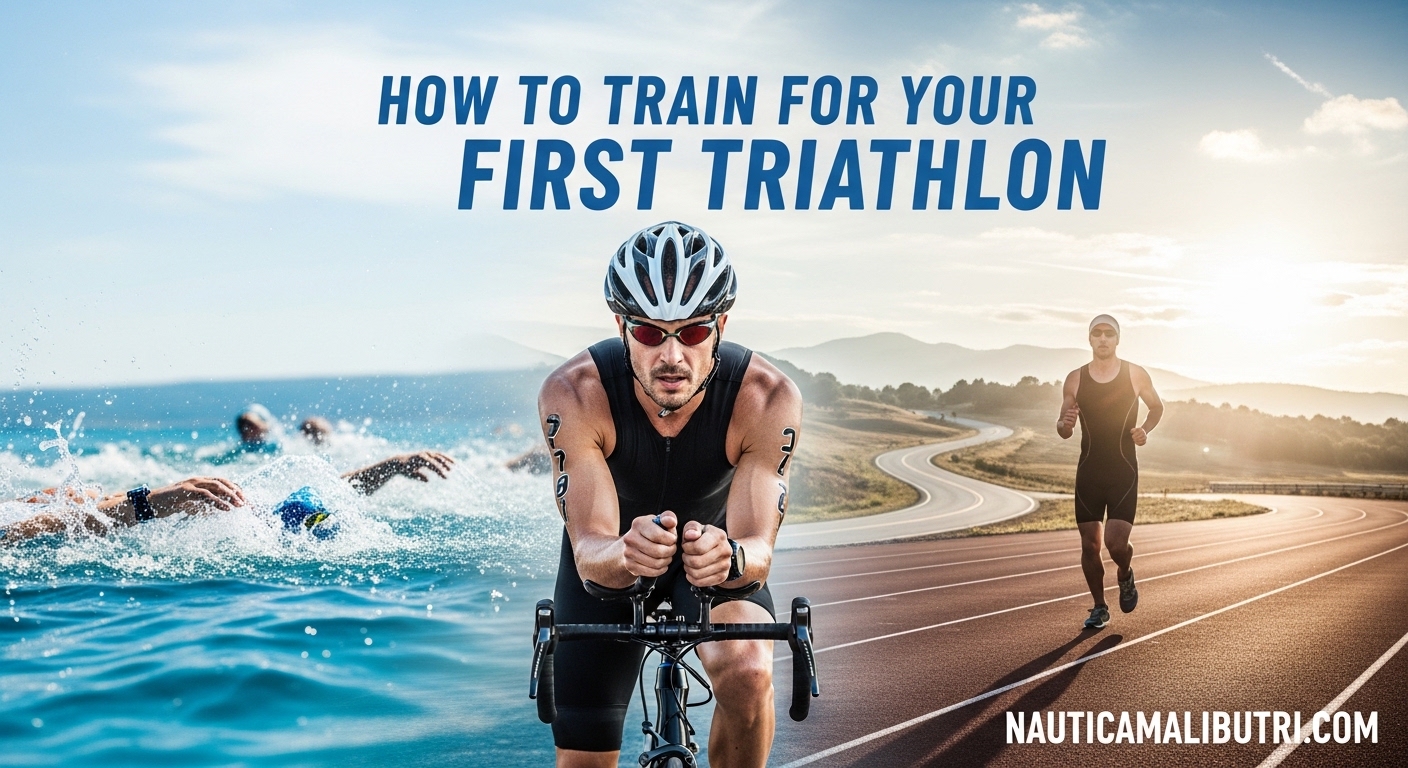
Can I really do this? That was the question running through my mind six years ago when I signed up for my first sprint triathlon. I was a decent runner but had not swum laps since high school, and my bike was a dusty mountain bike from college. Eight weeks later, I crossed a finish line and became a triathlete. If I can do it, so can you.
Learning how to train for your first triathlon does not require elite athletic genes or expensive gear. You need a simple plan, consistent effort, and the willingness to try something new. This guide gives you everything I wish I had known before my first race, from picking the right distance to crossing the finish line with a smile.
We will use the Nautica Malibu Triathlon as our reference example throughout. It is one of the most beginner-friendly races in the country, with a beach start, ocean swim, scenic bike course, and flat run along the Pacific Coast Highway.
Table of Contents
Understanding Triathlon Distances
Start with a sprint distance for your first triathlon. It is challenging enough to feel like a real accomplishment but short enough that you can finish strong and enjoy the experience.
Here is how the standard distances break down:
| Distance | Swim | Bike | Run | Total Time (Beginner) |
|---|---|---|---|---|
| Sprint | 0.5 miles (750m) | 12 miles (20km) | 3.1 miles (5km) | 1:15 – 2:00 |
| Olympic | 0.9 miles (1.5km) | 24 miles (40km) | 6.2 miles (10km) | 2:30 – 3:30 |
| Half (70.3) | 1.2 miles (1.9km) | 56 miles (90km) | 13.1 miles (21km) | 5:00 – 7:00 |
| Full (Ironman) | 2.4 miles (3.8km) | 112 miles (180km) | 26.2 miles (42km) | 10:00 – 16:00 |
The sprint distance is the perfect entry point. You can train for it in 8 to 12 weeks with 4 to 7 hours of training per week. The Nautica Malibu Triathlon offers both sprint and Olympic distances, so you can choose based on your current fitness level.
A good sprint triathlon time for beginners falls between 1 hour 15 minutes and 2 hours. Do not worry about speed for your first race. Finishing upright and smiling is the only goal that matters.
How Long Does It Take to Train for Your First Triathlon?
Plan for 12 weeks minimum if you are starting from moderate fitness. Active athletes who already run or cycle regularly can prepare in 8 weeks. Complete beginners should consider 16 weeks to build fitness gradually and avoid injury.
Here are the three training timeline options:
- 8-Week Plan: For active runners or cyclists with a solid fitness base. Requires 6 to 7 hours weekly. Jump straight into triathlon-specific training and brick workouts.
- 12-Week Plan: The sweet spot for most beginners. Requires 4 to 6 hours weekly. Builds base fitness in weeks 1-4, adds intensity in weeks 5-8, and peaks in weeks 9-11 with a taper in week 12.
- 16-Week Plan: For complete beginners or anyone returning from injury. Requires 3 to 5 hours weekly. Starts with building aerobic fitness, gradually adds structure, and finishes strong.
Yes, you can train for a triathlon in 3 months (12 weeks). That is exactly what most beginners do, and it works beautifully. You will go from wondering if you can finish to knowing you will finish.
Consistency beats intensity every time. Four moderate workouts per week for 12 weeks will get you to the start line ready and confident.
Sample Training Week for Beginners
Here is what a typical week looks like during the middle phase of a 12-week sprint triathlon training plan:
| Day | Workout | Duration | Focus |
|---|---|---|---|
| Monday | Rest or gentle yoga | 30 min | Recovery |
| Tuesday | Swim practice | 30-45 min | Technique and endurance |
| Wednesday | Run workout | 30-40 min | Building run fitness |
| Thursday | Bike ride | 45-60 min | Endurance building |
| Friday | Rest day | – | Physical and mental recovery |
| Saturday | Brick workout (Bike + Run) | 60-75 min | Race simulation |
| Sunday | Open water swim or long bike | 45-90 min | Building confidence |
Total weekly training time comes to about 4 to 6 hours. Most people train 5 to 6 days per week with 1 to 2 full rest days. Rest is when your body gets stronger, so do not skip it.
The Three Disciplines: Swim, Bike, Run
Each discipline has its own challenges for beginners. Let us break down what you need to know for each leg of your first triathlon.
Swim Training: Conquering Your Biggest Fear
The swim is where most first-triathletes feel the most anxiety. That is completely normal. Water is an unfamiliar environment, and the idea of swimming in a group can feel intimidating.
Start in a pool. Build your endurance until you can swim 500 meters without stopping. That is more than the 750 meters you will swim in a sprint triathlon, so you will have plenty of confidence on race day.
Open water swimming is different from the pool. There are no lane lines or walls to rest against. You cannot see the bottom, which bothers some people. The water might be cold, choppy, or have currents. If your race is in open water (like the ocean swim at the Nautica Malibu Triathlon), you need to practice in similar conditions at least 3 to 4 times before race day.
Sighting is the technique of looking forward while swimming to stay on course. In a pool, you follow the lane line. In open water, you lift your head every 6 to 10 strokes to spot the buoys marking the course. Practice this in the pool by lifting your eyes forward without lifting your whole head.
Wetsuits provide buoyancy and warmth. If the water temperature is below 78 degrees Fahrenheit, wetsuits are usually allowed and most beginners wear them. You do not need to buy one for your first race. Most triathlon shops offer wetsuit rentals for $40 to $80 per weekend.
Bike Training: Building Endurance on Two Wheels
You do not need a fancy triathlon bike for your first race. Your current bike will almost certainly work fine.
Here is the truth about bikes for first-triathletes: a mountain bike with smooth tires will get you to the finish line. A road bike is more efficient and comfortable for longer distances. Either one works. I finished top 5 in my age group at my first triathlon on a 10-year-old mountain bike I borrowed from a friend.
If you are buying a bike for triathlon training, a road bike is the most versatile choice. You can use it for training rides, group rides, and road racing. Triathlon bikes are great for competitive athletes but overkill for beginners.
Focus on building your aerobic base during bike training. Most of your rides should feel easy. You should be able to hold a conversation while riding. This builds endurance without burning you out.
Cadence refers to how fast you pedal, measured in revolutions per minute (RPM). Aim for a comfortable cadence between 80 and 90 RPM. This is easier on your knees and more efficient than grinding slowly in a hard gear.
For the Nautica Malibu Triathlon bike course, practice some hill climbing. The course has gentle rollers that require you to shift gears and adjust effort. Nothing too steep, but enough that you will want some hill practice before race day.
Run Training: Finishing Strong
The run is where you will spend the least training time but where your race is often made or broken. Pacing is everything.
Most beginners start the run too fast. Your legs will feel weird after cycling. This is the famous “jelly legs” feeling you get from the bike-to-run transition. Start slower than you think you should. Your legs will wake up after a few minutes, and then you can settle into your race pace.
Brick workouts are the secret to a strong run finish. A brick is simply a bike ride followed immediately by a run. Even a 10-minute run after your bike ride teaches your body how to transition between disciplines. Do one brick workout per week during your training.
Build your running distance gradually. If you can run 2 miles comfortably by race day, you can run 3.1 miles on race day with the adrenaline of competition carrying you. The run-walk method works great for beginners. Run for 4 minutes, walk for 1 minute, repeat.
Brick Workouts: Mastering the Bike-to-Run Transition
A brick workout is training for the bike-to-run transition. You bike, then you run, with no long break in between. The name comes from the sensation that your legs feel like bricks when you start running.
Here is a simple brick session for beginners:
- Warm up with 15 minutes easy cycling
- Ride 30 minutes at moderate effort (you could talk but would rather not)
- Immediately transition to running shoes
- Run 10 minutes easy, focusing on form over speed
- Cool down with walking and stretching
The physiological reason your legs feel heavy is that your blood has been pooling in your cycling muscles. When you start running, your body needs a minute to redirect blood flow to your running muscles. That weird feeling passes quickly if you start slow and let your body adjust.
Do one brick workout per week for the final 6 weeks of your training. Start with short runs of 10 minutes and build to 20 minutes. This teaches your body the transition and builds mental confidence that you can run after biking.
Transitions (T1 and T2): Save Minutes with Practice
Transitions are the fourth discipline of triathlon. T1 is the swim-to-bike transition. T2 is the bike-to-run transition. Efficient transitions can save you 2 to 5 minutes without making you any fitter.
T1: Swim to Bike
- Exit the water and find your bike rack
- Remove wetsuit (if wearing one) down to waist while walking
- At your bike, remove wetsuit completely
- Dry feet quickly, put on socks (optional but recommended for beginners)
- Put on cycling shoes or running shoes (if using them for bike)
- Put on helmet (mandatory) and sunglasses
- Grab bike and run to mount line
- Mount bike after the designated line
T2: Bike to Run
- Dismount bike before the dismount line
- Run bike to your rack spot
- Rack bike
- Remove helmet
- Put on running shoes (elastic laces save time)
- Grab race belt with number and hat if desired
- Run out of transition to start the run course
Practice transitions at home. Lay out a towel in your driveway or living room. Walk through T1 and T2 until the movements feel automatic. Time yourself and aim to get faster through repetition, not rushing.
Organize your transition area simply. You do not have much space on the rack. Place a small towel on the ground under your bike. Put your bike shoes, helmet, sunglasses, running shoes, and race belt on the towel in the order you will need them.
Essential Gear: What You Actually Need
You can complete your first triathlon for under $500 in gear, and much less if you already own a bike and running shoes. Do not let gear shopping become a barrier to starting.
Here is the minimal essential list:
- Swim: Goggles ($15-30), wetsuit rental if needed ($40-80), swimsuit or tri suit
- Bike: Any functional bike, helmet (mandatory, $30+), sunglasses (optional), water bottle cage
- Run: Running shoes you have broken in ($100+), race belt ($10) for your number
- Transition: Small towel, bag to carry everything
A tri suit is a single garment you wear for all three disciplines. It has thin padding for the bike that does not hold water for the swim. Tri suits are convenient but not essential. You can wear a swimsuit for the swim, pull on bike shorts for the bike, and switch to running shorts for the run. Most beginners use what they have.
Elastic laces in your running shoes save precious seconds in T2. You slip your feet in without tying. They cost $10 and are worth every penny.
Rent or borrow before buying expensive gear. Wetsuit rentals are common. Many bike shops rent road bikes. Ask triathlon friends if you can borrow equipment for your first race.
Fueling Your Training and Race Day
Nutrition can make or break your race day experience. Getting it wrong means stomach cramps, bonking, or worse. Getting it right means steady energy from start to finish.
For a sprint triathlon lasting under 2 hours, your fueling is simple. Eat a normal breakfast 2 to 3 hours before the start. Something you have eaten before long workouts. Oatmeal, toast with peanut butter, banana, and coffee work well for most people.
During the race, you mostly need water. Put water bottles on your bike and take sips every 10 to 15 minutes. If it is hot or you are racing longer than 90 minutes, add an electrolyte drink or take an energy gel halfway through the bike leg.
Practice your race day fueling during training. Never try something new on race day. Eat the same breakfast before your long brick workouts. Use the same sports drink or gels you plan to use in the race. Your stomach needs training too.
Avoid overeating the night before. The classic pasta dinner can leave you feeling heavy and bloated. Eat a normal dinner you know your stomach handles well. Get to bed early and wake up hungry for breakfast.
Race Day: From Packet Pickup to Finish Line
Race weekend is exciting and nerve-wracking. Knowing what to expect helps you stay calm and focused.
Packet Pickup and Bike Check
Most races have packet pickup the day before. You will get your race bib number, timing chip, swim cap, and race information. Some races also require bike check-in the day before. You rack your bike in transition and leave it overnight.
At the Nautica Malibu Triathlon, packet pickup is typically Saturday at the race site. You can check your bike into transition Saturday evening or Sunday morning. Walk through the transition area so you know where your bike rack is and where the swim exit, bike mount line, bike dismount line, and run exit are located.
Race Morning
Wake up 3 hours before your start time. Eat your practiced breakfast. Arrive at the race site 90 minutes before your wave start. This gives you time to park, set up transition, use the bathroom, warm up, and calm your nerves.
Body marking happens in transition. Volunteers write your race number on your arms and age on your calf. Set up your transition area neatly. Pump your bike tires. Put your helmet and sunglasses on the handlebars. Lay out your running shoes with race belt on the towel.
Do a short warm-up. Ten minutes easy jogging or swimming helps calm nerves and prepares your body. Stay hydrated but do not overdo it.
The Swim Start
Races start in waves based on age group or gender. Listen for your wave announcement. The Nautica Malibu Triathlon uses a beach start. You run into the water from the beach and start swimming when it gets deep enough.
Start at the back or side of your wave if you are nervous. This avoids the chaos of faster swimmers around you. Start slow and find your rhythm. The first 200 meters are the hardest. Your heart rate spikes from the adrenaline. Focus on breathing steadily.
If you panic, roll onto your back and float for a few seconds. Breathe. You are allowed to rest by holding onto a kayak or buoy if needed. You will not be disqualified. Do what you need to do to stay calm and continue.
The Bike and Run
On the bike, stick to your pacing plan. It is easy to go out too hard with fresh legs and adrenaline. Ride at an effort you could maintain for twice the distance. On the hills at Malibu, shift to an easier gear and spin up them. Save your legs for the run.
When you enter transition for T2, dismount before the line. Volunteers will shout reminders. Rack your bike, helmet off, shoes on, and go. The first mile of the run will feel strange. Your legs will feel heavy. Start slow, let them wake up, then settle into your rhythm.
Finish strong. As you approach the finish line, enjoy the moment. You are about to become a triathlete. Smile for the camera. Raise your arms. You earned this.
Malibu-Specific Tips for the Nautica Malibu Triathlon
The Nautica Malibu Triathlon is one of the best first-triathlons you can choose. The course is beautiful, the atmosphere is supportive, and the event is professionally organized. Here are some specific tips for this race.
The beach start means you will run into the ocean from Zuma Beach. The sand can be soft and tiring. Jog to the water edge, then start dolphin diving when the water is waist deep. This is faster than running through deep sand.
The ocean swim at Malibu is typically calm in September but practice in open water beforehand anyway. The water temperature is usually in the mid-60s, making wetsuits legal and recommended. The course is a simple out-and-back with large buoys.
The bike course follows Pacific Coast Highway with rolling hills. Nothing is steep, but you will want some hill practice in training. The scenery is spectacular, so remember to look around and enjoy it.
The run is mostly flat along the beach path. There is little shade, so if it is sunny, the heat can sneak up on you. Pace conservatively and use the aid stations.
After you finish, celebrate in Malibu. The post-race festival is on the beach with food, drinks, and live music. Take photos with the Malibu Pier in the background. You just completed a triathlon in one of the most beautiful places on Earth.
Frequently Asked Questions
How long does it take to train for your first triathlon?
Plan for 8 to 12 weeks to train for a sprint triathlon. Active athletes with a running or cycling background can prepare in 8 weeks. Beginners starting from scratch should plan for 12 to 16 weeks. You will need 4 to 7 hours of training per week. Yes, you can train for a triathlon in 3 months with consistent effort.
What is a good triathlon time for a beginner?
For a sprint triathlon (half-mile swim, 12-mile bike, 3.1-mile run), beginner finish times typically range from 1 hour 15 minutes to 2 hours. For an Olympic distance, expect 2 hours 30 minutes to 3 hours 30 minutes. Focus on finishing and enjoying the experience rather than comparing your time to others.
Can you train for a triathlon in 3 months?
Yes, 3 months (12 weeks) is the standard training timeline for a first sprint triathlon. This gives you enough time to build fitness in all three disciplines, practice transitions, and gain confidence. You will train 4 to 6 days per week for 4 to 7 hours total. Consistency matters more than intensity.
How many times a week should I train for a triathlon?
Train 5 to 6 days per week for a sprint triathlon. A typical week includes two swims, two bikes, two runs, and one brick workout (bike followed by run). You should take at least one full rest day for recovery. Total weekly training time ranges from 4 to 7 hours for beginners.
Can a beginner do a triathlon?
Absolutely. Triathlons are designed for all fitness levels and ages. Sprint triathlons are specifically beginner-friendly, with distances that are achievable with 8 to 12 weeks of training. The triathlon community is welcoming and supportive. You do not need to be an elite athlete. If you can swim a few laps, ride a bike, and jog a mile, you can become a triathlete.
What distance should my first triathlon be?
Choose a sprint distance for your first triathlon. It consists of a 750-meter swim (0.5 miles), 20-kilometer bike (12 miles), and 5-kilometer run (3.1 miles). This distance is challenging but achievable for beginners and lets you finish strong with a smile. Save Olympic, half-Ironman, and full Ironman distances for after you have completed your first sprint.
Can I use a mountain bike for my first triathlon?
Yes, you can absolutely use a mountain bike for your first triathlon. Many beginners do. A mountain bike with smooth tires will get you to the finish line just fine. Road bikes are more efficient but not required. Ride what you have or can borrow for your first race. Upgrade later if you fall in love with the sport.
Do I need a wetsuit for my first triathlon?
You need a wetsuit if the water temperature is below 78 degrees Fahrenheit and you want to wear one for warmth and buoyancy. Wetsuits help you float and swim faster. You do not need to buy one. Most triathlon shops rent wetsuits for $40 to $80 per weekend. Practice swimming in your wetsuit before race day.
Conclusion
Learning how to train for your first triathlon is simpler than you think. Pick a sprint distance. Commit to 12 weeks of consistent training. Practice your transitions. Show up on race day with a positive attitude. You will cross that finish line and earn the title of triathlete.
The Nautica Malibu Triathlon is the perfect place to make your debut. The beach start, ocean swim, scenic bike course along Pacific Coast Highway, and flat beach run create an unforgettable first-triathlon experience. The 2026 race season is the ideal time to start your triathlon journey.
You do not need to be special or gifted. You just need to start. Sign up for a race today. Your future triathlete self will thank you.