
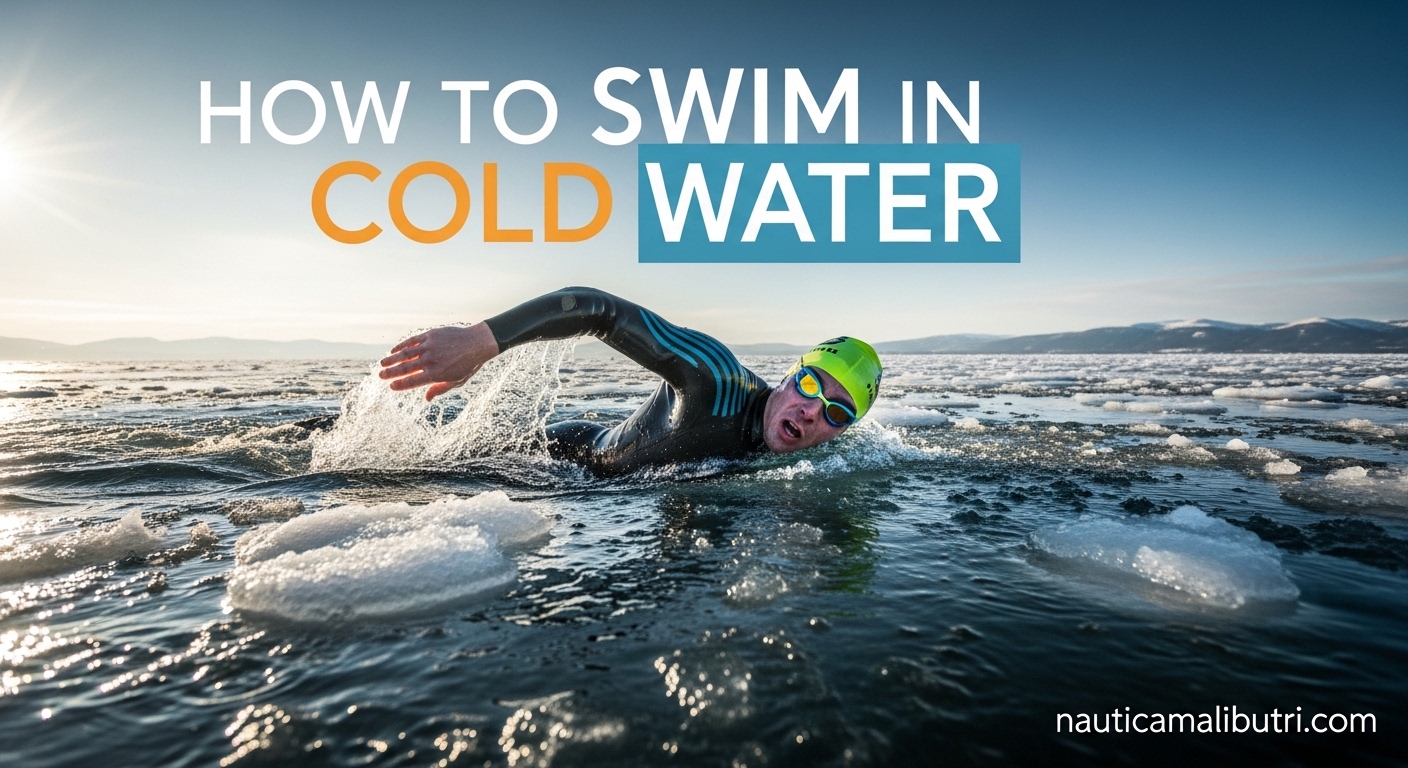
That first plunge into cold water hits different. Your chest tightens. Your breath catches. Every instinct screams to get out. I remember my first cold water swim like it was yesterday: 58-degree water at Zuma Beach, heart racing, hyperventilating, wondering if I had made a terrible mistake.
But I kept at it. Within a few weeks, what felt shocking became manageable. Within months, it became enjoyable. Learning how to swim in cold water changed my entire approach to open water swimming and triathlon.
This guide shares everything I have learned from years of cold water swimming, including the science behind cold water shock, step-by-step techniques for safe entry, acclimatization strategies, and safety guidelines that could save your life. Whether you are preparing for your first triathlon or looking to extend your open water season into winter, these proven methods will help you handle cold water confidently.
Table of Contents
What Is Cold Water Swimming
Cold water swimming means immersing yourself in outdoor water temperatures that trigger a cold-shock response. Most swimmers define cold water as anything below 60°F (15°C), though your personal threshold depends on acclimatization and body composition.
This is not pool swimming with heated water. Cold water swimming takes place in lakes, rivers, oceans, and reservoirs where temperatures fluctuate with the seasons. In California, our Pacific waters rarely exceed 65°F even in summer, making cold water skills essential for year-round open water training.
The practice ranges from brief winter dips of just a few minutes to extended swims lasting an hour or more. What separates cold water swimming from regular swimming is the physiological stress your body endures and adapts to. Your body treats cold water as a stressor, triggering a cascade of hormonal and cardiovascular responses that, with repetition, build remarkable resilience.
Understanding Cold Water Shock Response
Cold water shock represents your body’s immediate, involuntary reaction to sudden cold water immersion. When your skin contacts cold water, temperature receptors trigger a sympathetic nervous system response that peaks within the first 30 seconds and can last 2-3 minutes.
The primary symptoms include involuntary gasping, rapid breathing (hyperventilation), increased heart rate, and vasoconstriction (narrowing of blood vessels in your extremities). Your body does this to protect your core organs by reducing blood flow to your skin and limbs.
This response is automatic and powerful. Research from the Outdoor Swimming Society shows that cold water shock causes 60% of open water drowning incidents, not hypothermia as many assume. The initial gasp reflex can cause you to inhale water if your face is submerged. The hyperventilation makes controlling your breathing nearly impossible without training.
Understanding this response matters because it explains why cold water swimming feels so intense at first and why the same water feels manageable after acclimatization. Your body literally rewires its stress response through repeated exposure.
The Science Behind Vasoconstriction
Vasoconstriction is your body’s emergency preservation mode. Blood vessels near your skin surface constrict, forcing blood inward to protect your heart, lungs, and brain. This is why your fingers and toes go numb first.
The process raises your blood pressure temporarily. For healthy individuals, this is a normal stress response. However, anyone with cardiovascular conditions should consult a physician before attempting cold water swimming.
Hormesis: Why Cold Stress Makes You Stronger
Hormesis describes the biological principle that moderate stress triggers adaptation and improved function. Cold water swimming applies hormesis to your cardiovascular system, immune function, and mental resilience.
When you repeatedly expose yourself to cold water in controlled doses, your body upregulates stress-response pathways. You produce more brown adipose tissue for heat generation. Your noradrenaline response becomes more efficient. Your mental tolerance for discomfort expands.
Dr. Mark Harper, an anesthesiologist who has studied cold water immersion extensively, notes that this controlled stress response mirrors the benefits seen in intermittent fasting and high-intensity interval training. Short, intense stress followed by recovery creates adaptation.
How to Swim in Cold Water: Step-by-Step Guide
These nine steps will take you from standing on shore to swimming comfortably in cold water. Follow them in order, especially as a beginner.
Step 1: Check Conditions Before You Arrive
Know the water temperature before you leave home. Many locations post current readings online. Plan your duration based on temperature: under 50°F means 5-10 minutes maximum for beginners, 50-60°F allows 15-30 minutes.
Check weather conditions including wind, which dramatically increases heat loss when you exit. Avoid swimming alone in cold water, especially as a beginner.
Step 2: Warm Up On Shore
Do 5-10 minutes of dynamic movement before entering. Jumping jacks, arm circles, and light jogging raise your core temperature and prepare your cardiovascular system. This makes the cold shock less severe.
Avoid static stretching, which can lower your core temperature. Save stretching for after your swim when you are warm again.
Step 3: Wade In Slowly to Waist Depth
Walk into the water gradually rather than diving in. Let your legs adapt while your upper body stays warm. Stop at waist depth and wait for the initial shock response to pass.
This usually takes 30-60 seconds. You will feel your breathing start to normalize. Focus on exhaling slowly. This prevents hyperventilation and gives you a task to concentrate on.
Step 4: Splash Your Face and Neck
Before full immersion, splash cold water on your face, neck, and wrists. These areas have high concentrations of temperature receptors. Pre-cooling them reduces the shock when you submerge.
Many experienced swimmers do this 10-15 times while standing in waist-deep water. It triggers the mammalian dive reflex, which slows your heart rate and helps control breathing.
Step 5: Control Your Breathing Before Submerging
Take three deliberate breaths: in through your nose, out through your mouth, each lasting 4-5 seconds. This activates your parasympathetic nervous system, countering the fight-or-flight response.
If you feel panic rising, pause. Do not proceed until your breathing feels manageable. Panic in cold water is dangerous.
Step 6: Duck Under Deliberately
Once your breathing is controlled, duck under the surface quickly and completely. Prolonged partial immersion actually feels worse than full immersion because your body cannot decide which temperature state to adapt to.
Stay under for 3-5 seconds. Let the water reach your neck and shoulders. When you surface, continue breathing slowly and steadily.
Step 7: Start Swimming Immediately
Do not stand around in shallow water. Start swimming right away. Movement generates heat and distracts you from the cold sensation.
Begin with a stroke you are comfortable with. Many swimmers prefer breaststroke initially because it keeps your face out of water while you adapt. Switch to freestyle once you feel settled.
Step 8: Focus on Exhalation, Not Inhalation
Your body will want to gasp and take short, shallow breaths. Counter this by emphasizing slow, complete exhalations. Blow bubbles underwater steadily. Your body will naturally inhale when it needs to.
This technique prevents hyperventilation and reduces the feeling of breathlessness that cold water triggers.
Step 9: Monitor Your Body and Exit Before You Need To
Set a timer before you enter. Beginners should exit while they still feel comfortable, not when they start feeling cold. The after-drop effect means you will get colder after exiting.
Watch for numbness in your fingers, difficulty speaking, or loss of coordination. These indicate you have stayed in too long.
Acclimatization: Training Your Body for Cold Water
Acclimatization is the gradual process of teaching your body to handle cold water more efficiently. With consistent exposure, your cold shock response diminishes significantly within 4-6 weeks.
The key is frequency, not duration. Swimming in cold water twice a week for 10 minutes produces better acclimatization than one long swim per month. Your body needs repeated signals that cold water is a regular stressor worth adapting to.
Start with water temperatures that feel challenging but manageable, typically 65-70°F for beginners. As you adapt, gradually work toward colder temperatures. Most experienced cold water swimmers can comfortably handle 50-55°F with proper acclimatization.
The Gradual Progression Method
Week 1-2: Focus on entry technique. Enter the water, practice breathing control, swim 5-10 minutes, exit. Do not worry about distance or speed.
Week 3-4: Extend to 15-20 minutes. Practice different strokes. Begin working on sighting and navigation if training for triathlon.
Month 2-3: Gradually lower your temperature threshold. Seek out slightly cooler locations or swim later in the season as temperatures drop.
Month 4+: You will have established baseline cold water tolerance. Continue regular exposure to maintain adaptation.
Cold Showers as Supplementary Training
On days you cannot swim, take cold showers to maintain acclimatization. Start with 30 seconds of cold at the end of your normal shower. Gradually increase duration and reduce water temperature over weeks.
While not a complete substitute for cold water swimming, cold showers maintain your body’s cold stress response pathways and make pool-to-open-water transitions easier.
Essential Gear for Cold Water Swimming
The right gear extends your comfortable swimming temperature range significantly. Here is what you need by temperature category.
Water Temperature 60-70°F
At these temperatures, many experienced swimmers go without wetsuits. However, beginners should consider a sleeveless wetsuit or swim skin for insulation.
Essential: Neoprene swim cap (prevents significant heat loss through your head), regular swim goggles, earplugs (prevent cold water from entering ear canals and causing dizziness).
Water Temperature 50-60°F
This is the range where proper gear becomes essential. A full sleeve wetsuit with 3-5mm thickness provides insulation while allowing swimming mobility.
Recommended additions: Neoprene gloves (2-3mm), neoprene booties or socks, thermal swim cap or double cap (wear a silicone cap under a neoprene cap).
Water Temperature Under 50°F
Serious cold water swimming requires serious gear. Use a 5mm+ wetsuit designed for cold water. Some swimmers switch to drysuits for ice swimming.
Mandatory safety gear: Bright colored swim cap for visibility, tow float with dry bag for storing clothes, whistle attached to your cap or tow float, changing robe or warm clothes waiting on shore.
Gear Explanations
Neoprene caps reduce heat loss through your head by 60% compared to standard silicone caps. Your scalp has extensive blood flow close to the surface, making it a major heat exit point.
Earplugs prevent caloric reflex, where cold water in your ear canals triggers dizziness and disorientation. This is especially important for open water navigation.
Tow floats increase your visibility to boats and rescue services while providing flotation if you need to rest. The dry bag compartment keeps your keys and phone safe.
Cold Water Swimming Safety Guidelines
Safety must be your top priority in cold water. These guidelines protect you from the two main dangers: cold water shock during entry and hypothermia during extended swims.
Never Swim Alone
This is the most important safety rule. A swim buddy can call for help, provide warmth, or assist you if you experience cold incapacitation. Even experienced cold water swimmers follow this rule.
If you must swim alone, choose populated beaches with lifeguards. Tell someone exactly where you are swimming and when you will return. Carry a whistle to signal for help.
Know the Signs of Hypothermia
Hypothermia occurs when your core body temperature drops below 95°F. Early signs include shivering, numb fingers, and mild confusion. Moderate hypothermia brings slurred speech, drowsiness, and impaired coordination. Severe hypothermia causes loss of consciousness.
In water under 60°F, hypothermia can develop in 30-60 minutes depending on your body fat and insulation. Exit the water at the first sign of numbness or reduced coordination.
Duration Guidelines by Experience Level
Beginners: 1 minute per degree Fahrenheit. At 55°F, swim 10-15 minutes maximum.
Intermediate swimmers: 2 minutes per degree with proper gear. At 55°F, swim 20-25 minutes.
Experienced acclimatized swimmers: Use judgment based on how you feel, but generally do not exceed 45 minutes in water under 55°F.
These are maximums, not targets. Exit when you feel ready.
Understanding After-Drop
After-drop is the continued cooling of your core after exiting cold water. When you stop swimming, the cold blood from your extremities circulates back to your core, potentially dropping your core temperature further.
This is why you often feel colder 10-15 minutes after exiting than you did in the water. It is also why getting dressed quickly matters.
Exit strategy: Stand up slowly to avoid blood pressure drops. Dry off immediately, especially your hair. Put on warm, dry clothes starting with your core. Do not take a hot shower immediately; let your body rewarm gradually.
Emergency Procedures
If you experience cold incapacitation (inability to coordinate movements), adopt the HELP position: arms crossed over chest, knees drawn up, minimizing heat loss.
If you see someone struggling in cold water, call emergency services before attempting rescue. Cold water affects rescuers too. Throw flotation devices rather than entering the water if possible.
Triathlon-Specific Cold Water Tips
Triathlon race day adds additional challenges to cold water swimming. You cannot simply exit when you feel ready; you must complete the course. These strategies help you perform in cold water races.
Pre-race acclimatization: Arrive early enough to splash water on your face and neck before the start. Many athletes miss this step and pay for it in the first 200 meters.
Start line breathing: Position yourself according to your cold tolerance. If you know you hyperventilate, start toward the back to avoid the underwater melee. Give yourself space to control your breathing.
First 200 meters: Expect to feel terrible. Everyone does. Focus on steady exhalation and short, controlled strokes. The shock passes within 2-3 minutes if you do not panic.
Sighting strategy: Cold water often means foggy goggles and reduced visibility. Practice sighting in training so it is automatic on race day. Lift your eyes just enough to spot buoys.
USAT rules: USA Triathlon allows wetsuits in water up to 78°F. Above that, wetsuits are illegal for age group awards. Below 60°F, wetsuits become essential for most athletes.
Health Benefits of Cold Water Swimming
Beyond the challenge and the thrill, cold water swimming offers measurable health benefits backed by growing research.
Mental health improvement: Regular cold water swimmers report reduced anxiety and depression symptoms. The cold triggers a massive endorphin release and increases noradrenaline levels by up to 500%, elevating mood for hours after swimming.
Immune function: Studies show cold water swimmers experience fewer upper respiratory infections. The stress response appears to strengthen immune surveillance without causing chronic inflammation.
Cardiovascular health: Repeated cold exposure improves circulation and may reduce cardiovascular risk factors. The vascular training strengthens blood vessel responsiveness.
Metabolic benefits: Cold exposure activates brown fat, a metabolically active tissue that generates heat. Regular cold water swimmers show increased brown fat activity.
Stress resilience: Perhaps most valuable for triathletes, cold water swimming builds psychological resilience. You learn to remain calm under physical stress, a skill that transfers directly to race day pressure.
Frequently Asked Questions
How to swim in cold water for beginners?
Start gradually by splashing your face and neck with cold water before full immersion. Walk in slowly to waist depth, wait for your breathing to normalize, then duck under completely. Focus on slow exhalation to prevent hyperventilation. Begin with 5-10 minute sessions in 65-70°F water and gradually work toward colder temperatures as you acclimatize.
How long can you stay in cold water?
Beginners should follow the 1 minute per degree rule: at 55°F water, swim 10-15 minutes maximum. Intermediate swimmers can extend to 2 minutes per degree with proper wetsuit and gear. Experienced acclimatized swimmers can go longer but should exit at the first sign of numbness or reduced coordination. Always exit before you feel uncomfortably cold.
What temperature is considered cold water swimming?
Cold water swimming generally refers to water below 60°F (15°C). Water between 60-70°F feels cool but manageable for most swimmers. 50-60°F is seriously cold and requires acclimatization. Below 50°F is extreme cold water swimming territory requiring full gear and significant experience. Individual tolerance varies based on body composition and acclimatization level.
Do you need a wetsuit for cold water swimming?
Below 60°F, a wetsuit is highly recommended for most swimmers. Between 60-70°F, experienced swimmers may go without, but beginners should wear a sleeveless wetsuit or swim skin. Below 50°F, a full 5mm wetsuit becomes essential. Wetsuits provide insulation, buoyancy, and protection while allowing swimming movement. They significantly extend your comfortable swimming temperature range.
How do you prevent cold water shock?
Prevent cold water shock by entering gradually rather than jumping in, splashing your face and neck before full immersion, and controlling your breathing. Take 3-5 slow breaths before submerging. Focus on steady exhalation once in the water. Warm up on shore before entering. With regular exposure, your body adapts and the shock response diminishes significantly within 4-6 weeks.
What is after-drop in cold water swimming?
After-drop is the continued cooling of your core body temperature after exiting cold water. When you stop swimming, cold blood from your extremities circulates back to your core, potentially dropping your core temperature further 10-15 minutes after exiting. This is why you often feel colder after getting out than you did in the water. Combat after-drop by drying off immediately and putting on warm clothes starting with your core.
Can you swim alone in cold water?
Swimming alone in cold water is not recommended, especially for beginners. Cold water shock, hypothermia, and cold incapacitation can strike suddenly. If you must swim alone, choose populated beaches with lifeguards, tell someone your exact location and return time, carry a whistle, and stay close to shore. Never swim alone in water under 55°F unless you are highly experienced and have safety protocols in place.
How long does it take to acclimatize to cold water?
Most swimmers notice significant improvement in cold tolerance within 4-6 weeks of regular exposure. The key is frequency: swimming in cold water twice weekly produces better results than occasional long swims. Cold showers between swims can help maintain adaptation. Individual factors like body fat percentage affect acclimatization speed. Thinner swimmers often adapt faster physiologically but may need more insulation.
Conclusion
Learning how to swim in cold water opens up year-round open water training and prepares you for challenging triathlon conditions. The initial shock you feel is normal, temporary, and manageable with proper technique.
Start gradually. Focus on breathing control. Never swim alone. With consistent practice, what feels shocking today becomes your new normal within weeks. The mental and physical resilience you build will serve you in races and in life.
Remember: cold water swimming is a skill, not a suffering contest. Respect the water, know your limits, and enjoy the unique feeling of swimming through the cold. Your first winter swim might just become your favorite.