
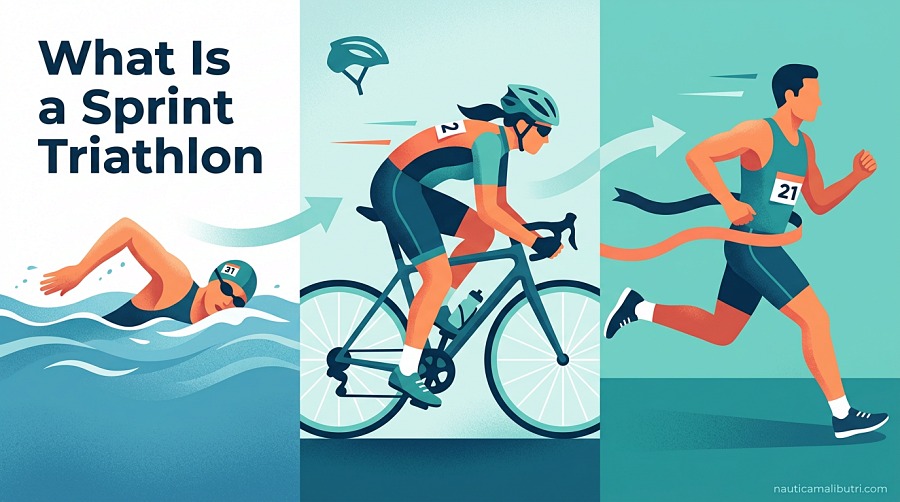
I still remember the morning of my first sprint triathlon — standing on a chilly lake shore in a borrowed wetsuit, completely convinced I was about to embarrass myself in front of 300 strangers. Two hours later I was at the finish line, grinning like an idiot, already googling my next race. That’s the magic of this distance: it’s just hard enough to feel like an achievement, and just short enough to actually be doable.
If you’re trying to figure out what a sprint triathlon actually is — and whether you can pull one off — this guide answers every question I had back then, plus the dozens I figured out the hard way.
Table of Contents
What Is a Sprint Triathlon? (Quick Answer)
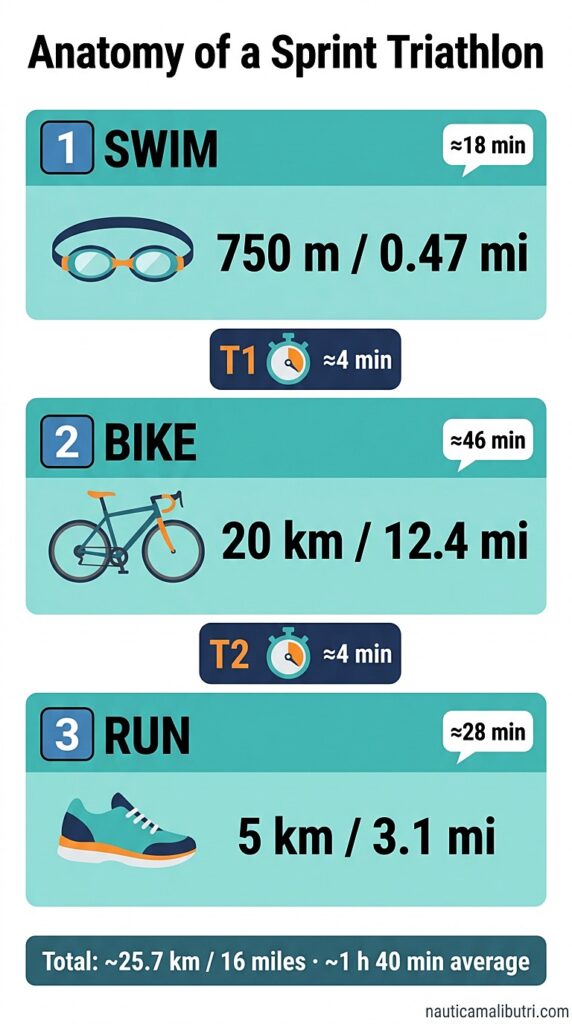
A sprint triathlon is a short-distance multisport race made up of a 750-meter (0.47 mile) swim, a 20-kilometer (12.4 mile) bike ride, and a 5-kilometer (3.1 mile) run, completed back-to-back without stopping. It’s the most popular triathlon distance in the U.S. and the standard entry point into the sport, taking most beginners about 1.5 to 2 hours to finish.
It’s called a “sprint” only because of how it compares to longer triathlons like the Olympic and Ironman distances — not because anyone is actually sprinting for two hours straight.
Sprint Triathlon Distances at a Glance
| Leg | Distance (Metric) | Distance (Imperial) | Average split (age-group) |
|---|---|---|---|
| Swim | 750 m | 0.47 mi (≈820 yds) | ~18 minutes |
| Bike | 20 km | 12.4 mi | ~46 minutes |
| Run | 5 km | 3.1 mi | ~28 minutes |
| Transitions (T1 + T2) | — | — | ~8 minutes |
| Total | ~25.75 km | ~16 miles | ~1 hr 40 min |
How a Sprint Triathlon Actually Unfolds
You’ll arrive early, check in, and set up a small space (called your “transition area”) next to a bike rack. The race itself flows in this order:
- Swim — usually in open water (lake, sea, or river), occasionally in a pool for entry-level events.
- Transition 1 (T1) — run from the water to your bike, strip your wetsuit, helmet on, ride out.
- Bike — a marked road or closed-loop course.
- Transition 2 (T2) — rack the bike, swap to running shoes, head out.
- Run — usually a flat-to-rolling 5K to the finish line.
You wear the same outfit (a “tri suit” or just shorts and a top) the whole way through. No costume changes.
Why Sprint Triathlons Are So Popular
Sprint is the most-raced triathlon distance in America by a large margin. According to data summarized on the Triathlon entry on Wikipedia, USA Triathlon sanctioned 839 sprint events in 2022 — more than every other distance combined. Three reasons drive that popularity:
- Training fits real life. Four to six hours per week for 8–12 weeks is enough for most beginners to finish strong.
- You don’t need fancy gear. A working bike, a helmet, goggles, and running shoes will get you across the line.
- The fear factor is low. A 750m swim is roughly 30 lengths of a standard 25m pool — intimidating, but very manageable.
It’s also not “just” a beginner race. Even at the elite level, sprint distance shows up at the World Triathlon Championship Series and as the basis for the Olympic mixed relay format introduced at the Tokyo 2020 Games.
Sprint Triathlon vs. Other Triathlon Distances
People constantly mix up sprint with super sprint or Olympic distance. Here’s the clean comparison:
| Distance | Swim | Bike | Run | Total | Typical finish (age-grouper) |
|---|---|---|---|---|---|
| Super Sprint | 400 m | 10 km | 2.5 km | ~12.9 km | 45–75 min |
| Sprint | 750 m | 20 km | 5 km | ~25.75 km | 1 hr 30 min – 2 hrs |
| Olympic | 1.5 km | 40 km | 10 km | 51.5 km | ~3 hrs |
| Half Ironman (70.3) | 1.9 km | 90 km | 21.1 km | ~113 km | 5–7 hrs |
| Full Ironman (140.6) | 3.8 km | 180 km | 42.2 km | ~226 km | 12–14 hrs |
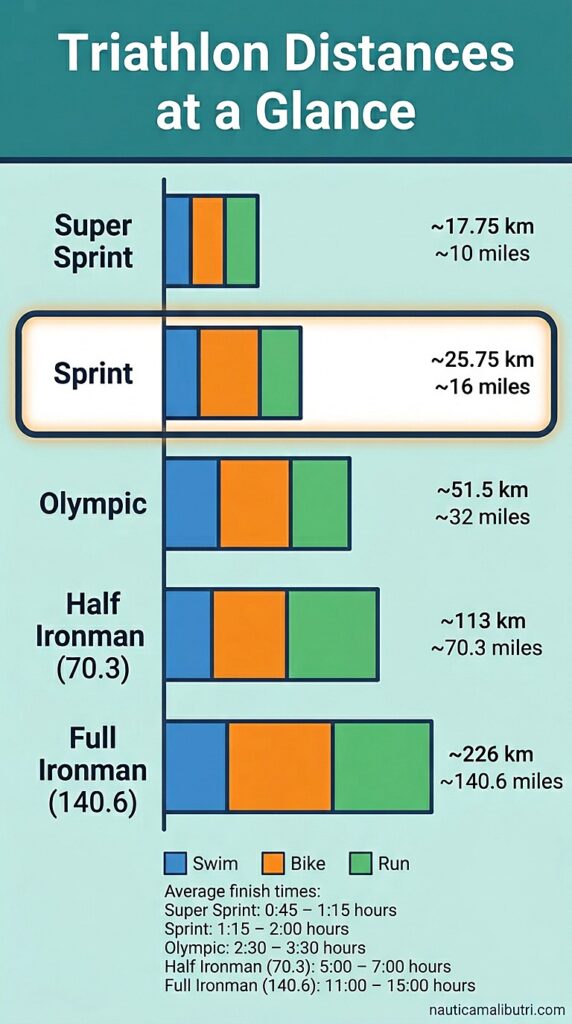
If sprint feels too long, super sprint is a friendlier on-ramp — it’s often raced in a pool, which removes the open-water nerves entirely. If sprint feels too short, Olympic is exactly double in every leg.
How Long Does a Sprint Triathlon Take?
Finish times depend on fitness, course profile, and weather. Here’s a realistic spread based on race-result averages:
| Athlete level | Total finish time |
|---|---|
| Elite men (drafting allowed) | Under 50 minutes |
| Elite women | 53–58 minutes |
| Competitive age-grouper | 1 hr 5 min – 1 hr 20 min |
| Average age-grouper | 1 hr 30 min – 1 hr 40 min |
| First-timer / beginner | 1 hr 45 min – 2 hrs+ |
For perspective, France’s Vincent Luis set what’s widely cited as the fastest sprint-distance time at the WTCS Hamburg event in 2020, finishing in 49:13 — a frankly absurd pace that includes a 5K run at near-elite road race speed after a hard swim and bike.
If you’re aiming at your first race, finishing under 2 hours is a great goal. Under 1:30 is genuinely competitive for an age-grouper.
How Hard Is a Sprint Triathlon, Really?
Honest answer: hard enough to respect, but not hard enough to fear. The most common surprise for first-timers isn’t fitness — it’s the weird sensation of running on “jelly legs” right after the bike, and how chaotic the first 200m of an open-water swim can feel when 50 people start churning the water at once.
The three challenges that actually trip people up:
- Open-water swimming. Pool fitness doesn’t fully transfer. You’ll want at least 2–3 open-water swims before race day.
- Brick workouts. A “brick” is a bike-then-run session. The first time you try it, your legs feel like cement — the second time, much less so. Three or four bricks during training is enough.
- Pacing. Going too hard on the swim leaves you cooked for the bike. Going too hard on the bike means a death-march 5K. The fastest sprint times come from athletes who pace evenly across all three legs.
Sprint Triathlon Training Plan: How to Get Ready
Most reputable plans run 8 to 12 weeks for first-timers. Triathlete magazine’s classic 8-week beginner sprint plan is a solid free starting point if you’re already comfortable swimming 100 yards, biking 20 minutes, and running 10 minutes non-stop.
A Sample Weekly Structure (12-Week Plan)
| Day | Workout |
|---|---|
| Monday | Rest or 30-min easy spin |
| Tuesday | Swim — technique + intervals (30–45 min) |
| Wednesday | Run — easy, 25–40 min |
| Thursday | Swim — endurance (30–45 min) |
| Friday | Strength / mobility — 30 min |
| Saturday | Bike — long ride, 45–90 min (add 15-min run “brick” in weeks 5+) |
| Sunday | Run — long, 30–50 min |
What Each Discipline Needs
- Swim: Two sessions a week. Focus on technique first, distance second. Get into open water at least twice before race day, ideally in your wetsuit.
- Bike: One long ride and one shorter intensity session. You don’t need a tri bike — a road bike, hybrid, or even a mountain bike will finish a sprint.
- Run: Two runs a week. Keep them mostly easy. Add one short tempo or interval session once you have a base.
- Bricks: A 30–45 min bike followed immediately by a 10–15 min run. Do these every 2 weeks in the back half of your plan.
- Strength: Two 20–30 min sessions weekly. Core, glutes, and posterior chain pay off the most.
Total Time Commitment
Roughly 4–6 hours per week in early weeks, building to 6–8 hours in peak weeks. Compared to half-marathon training, that’s barely more time — and you get a far better whole-body workout.
Gear Checklist for Sprint Triathlon Race Day
You don’t need a $5,000 setup. You need the items below, and that’s it. I split it into “must-have” and “nice-to-have” because every list online conflates the two and intimidates newbies into spending $800.
Must-Have
- Swim: goggles (bring a backup pair), swim cap (usually provided by the race), wetsuit if water is below ~78°F / 25.5°C
- Bike: any working bike, certified helmet (CPSC, EN1078, or equivalent), water bottle, spare tube + CO2 or mini-pump
- Run: running shoes, race bib (worn on a race belt), socks if you wear them
- Universal: tri suit or quick-dry shorts + top, towel for the transition area, race belt, sunscreen, ID, race confirmation
Nice-to-Have
- Elastic shoelaces (saves 30+ seconds in T2)
- Body Glide / anti-chafe balm
- GPS sports watch
- Cycling shoes with clipless pedals
- Sunglasses
- Small portable pump
- Plastic bag (in case it rains on your gear)
A helmet is non-negotiable — across every governing body, you must have it strapped on before you touch your bike in transition. Forgetting that rule is the single most common penalty new triathletes pick up.
Sprint Triathlon Rules You Should Actually Know
World Triathlon is the global governing body, and most races (USA Triathlon, British Triathlon, etc.) follow its competition rules with minor regional tweaks. The rules that actually matter on race day:
- Helmet on before unracking the bike, off only after racking it again. Penalty otherwise.
- No drafting in non-elite sprint races. You generally need to keep a 12-meter gap from the cyclist ahead and have 25 seconds to overtake. The current penalty for a sprint-distance drafting violation is 30 seconds.
- Wetsuits are allowed up to 5 mm thick, mandatory in cold water, banned in warm water (typically above 24°C / 76°F for age-groupers).
- No headphones on the bike or run. No exceptions.
- No outside assistance — anything you need, you carry.
- Bib number visible on the run (front, on a race belt).
- No riding in the transition area. Mount your bike only after crossing the marked “mount line.”
World Triathlon updated its rule book ahead of the 2025 season, and a key change for elites was that sprint-distance results now earn the same ranking points as longer races — putting sprint racing on equal footing in the world rankings.
Common Mistakes First-Timers Make (And How to Avoid Them)
- Skipping open-water swim practice. Pool swimming alone won’t prepare you. Do at least two open-water sessions.
- Going too hard on the swim. Finish the swim with energy in the tank — it’s the shortest leg time-wise.
- Forgetting to eat breakfast. Eat 2–3 hours before the start. Stick to familiar foods.
- New gear on race day. Never. Test everything in training first.
- Setting up transition messy. Lay your gear out in the order you’ll use it. Helmet on top of your bars with straps open. Sunglasses inside the helmet. Shoes ready.
- Mounting the bike inside transition. You’ll get a penalty. Walk to the mount line, then ride.
- Stopping the watch at T1. The clock runs continuously from start to finish — including transitions.
Sprint Triathlon Cost: What You’ll Actually Spend
Sprint racing is one of the more affordable endurance events you can take up — if you don’t get sucked into the gear vortex.
| Item | Realistic spend |
|---|---|
| Race entry fee | $75–$175 (USA), £40–£90 (UK), branded events more |
| Used road bike | $300–$700 |
| Helmet | $40–$80 |
| Goggles + cap | $25 |
| Tri suit | $80–$150 (or skip — wear shorts + dry-fit shirt) |
| Wetsuit (if needed) | $150–$400 used, or rent for ~$40 |
| Running shoes | $90–$140 |
| First-race total (budget) | ~$600–$900 all-in |
Lots of races offer “GO TRI” or “first-timer” categories with reduced fees. Borrowing a bike for your first race is completely normal — every triathlon club has someone willing to lend one out.
Pro Tips From the Race Course
A few things I wish someone had told me before my first sprint:
- Walk the transition area twice before the race starts. Count the rows from the swim entry to your bike. You will get disoriented coming out of the water.
- Sight every six strokes during the swim. Look up briefly — you’ll swim 50% straighter than you think you’re swimming.
- Don’t go all-out on the bike for the first 5 minutes. Your heart rate is already through the roof from the swim. Spin easy until your breathing settles.
- Practice taking your wetsuit off. Yes, really. Pull it down to your waist while running into transition. It’s awkward and oddly takes practice.
- Smile at the finish line photographer. You paid for that race photo; make it count.
Who Should Sign Up for a Sprint Triathlon?
You’re a great fit if you:
- Already do at least one of swim/bike/run regularly
- Can dedicate ~5 hours per week for 2–3 months
- Want a fitness goal that’s achievable in a single season
- Like cross-training and dislike running-only events
You might want to start with super sprint instead if:
- You can’t yet swim 100m freestyle continuously
- The thought of open water makes you panic
- You only have 4 weeks before race day
Either way, sprint and super sprint distances both belong to the broader “short-course” triathlon category that, according to USA Triathlon, draws hundreds of thousands of participants annually across all 50 states.
Sprint Triathlon FAQ
How long does a sprint triathlon take?
Most age-group athletes finish a sprint triathlon in 1 hour 30 minutes to 2 hours. Elites finish in under an hour. Beginners should aim for under 2 hours; competitive amateurs target 1:15 or faster.
Is a sprint triathlon good for beginners?
Yes — sprint is the standard recommended entry distance into triathlon. The training load is realistic (4–6 hours per week), the race itself is short enough to be non-intimidating, and almost every region holds beginner-friendly events with on-course support.
Can you walk in a sprint triathlon?
Yes. There’s no rule requiring you to run the run leg. Most beginner races allow walking, and many first-timers walk part of the 5K. As long as you finish under the cutoff time (usually 2.5–3 hours for a sprint), you’ll get an official finish.
How long is a sprint triathlon swim?
The swim is 750 meters, which equals 820 yards or about 0.47 miles. In a 25-meter pool, that’s 30 lengths. In a 25-yard pool, the closest equivalent is 800 yards (32 lengths). Pool-based sprint events sometimes shorten this to 400m–500m.
Do I need a wetsuit for a sprint triathlon?
Only if the water is cold. World Triathlon rules generally require wetsuits below ~16°C (60°F) for shorter races and prohibit them above ~22–24°C (72–76°F) for age-groupers. Most race websites announce wetsuit eligibility 24–48 hours before the event. If your race is wetsuit-legal and you’re a slower swimmer, wear one — it adds buoyancy and saves real energy.
What kind of bike do I need for a sprint triathlon?
Any roadworthy bike with a helmet. A road bike is ideal, but a hybrid, gravel bike, or even a mountain bike (with slick tires) will finish a sprint comfortably. Don’t buy a triathlon-specific bike for your first race — borrow, rent, or use what you have.
How many calories do you burn in a sprint triathlon?
A typical 70-kg (155-lb) athlete burns roughly 800–1,200 calories during a sprint triathlon, depending on intensity, course, and finish time. Burn rate breakdown: swimming ~400 kcal/hour, cycling ~500–700 kcal/hour, running ~600–800 kcal/hour.
What’s the difference between a sprint and a super sprint triathlon?
A super sprint is roughly half a sprint: 400m swim, 10km bike, 2.5km run. It’s often held in a pool (typically 16 lengths of a 25m pool) which removes open-water anxiety, making it the friendliest possible introduction to triathlon.
Can I do a sprint triathlon with no swimming background?
Yes, but you need 8–12 weeks of focused swim training. Most adults can build from “I can barely swim 25m” to “I can finish 750m” in three months with twice-weekly pool sessions and a focus on technique. If you can’t yet float comfortably, take 2–3 swim lessons first — it’s the single best money you’ll spend on triathlon training.
Are sprint triathlon distances always exactly the same?
The “official” distances are 750m / 20km / 5km, but many local races vary slightly. Pool sprints often shorten the swim to 400–500m. Some events round the bike to 12 miles or 25km. As long as the race is roughly in that ballpark, it’s marketed as a sprint. Always check the actual distances on the race website before registering.
Is sprint triathlon harder than a 10K run?
Different kind of hard. Cardiovascular load is similar to a hard 10K. But the multisport demands — especially open-water swimming and the “brick” effect when running off the bike — add complexity that pure runners don’t experience. Most runners new to tri find the swim harder than the run, even if their swim distance is technically shorter.
Your Next Steps
- Pick a race 10–12 weeks out. Look at findarace.com, USAT’s race finder, or your national federation’s calendar.
- Get on a structured plan. A free plan from Triathlete or 220 Triathlon will absolutely get you across the line.
- Find your local tri club. Almost every city has one, and it instantly cuts the learning curve in half.
- Bookmark this guide. Come back during taper week — there’s a reason every line in the gear checklist is there.
Sprint triathlon is one of those rare goals that’s genuinely transformative without being unrealistic. Twelve weeks from now, you could be standing at a finish line with a medal around your neck, already plotting your next race. Honestly? That’s exactly how it tends to go.
Save or bookmark this guide for race week — the gear checklist and rules section are exactly what you’ll want to re-read the night before your first start line.