
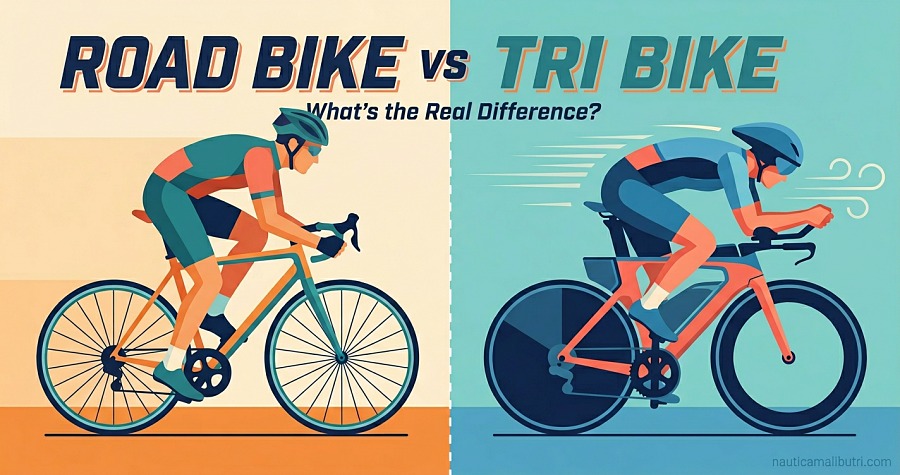
A triathlon bike and a road bike look like cousins from across a transition zone. Get closer and they’re built for two completely different jobs. A tri bike is a one-trick weapon — go as fast as humanly possible in a straight line while saving your legs for the run. A road bike is a do-everything machine — climb, descend, sprint, corner, ride with friends, and yes, race a triathlon if you want to. This guide breaks down every meaningful difference (frame geometry, aero gains, gearing, wheels, handling, cost, and the rules that decide which one you can even legally use), with real wind-tunnel data and current USA Triathlon regulations as of September 2026.
Table of Contents
Tri Bike vs Road Bike: Quick-Glance Comparison
| Feature | Road Bike | Triathlon (TT) Bike |
|---|---|---|
| Seat tube angle | ~72° | 75–78° |
| Handlebars | Drop bars | Base bar + aero extensions |
| Position | More upright, multi-position | Locked aero tuck |
| Frame tubing | Thinner, lighter | Thicker, aero-shaped |
| Frame weight | Lighter (UCI min 6.8 kg/15 lbs) | Heavier, often 8.5–9.5 kg |
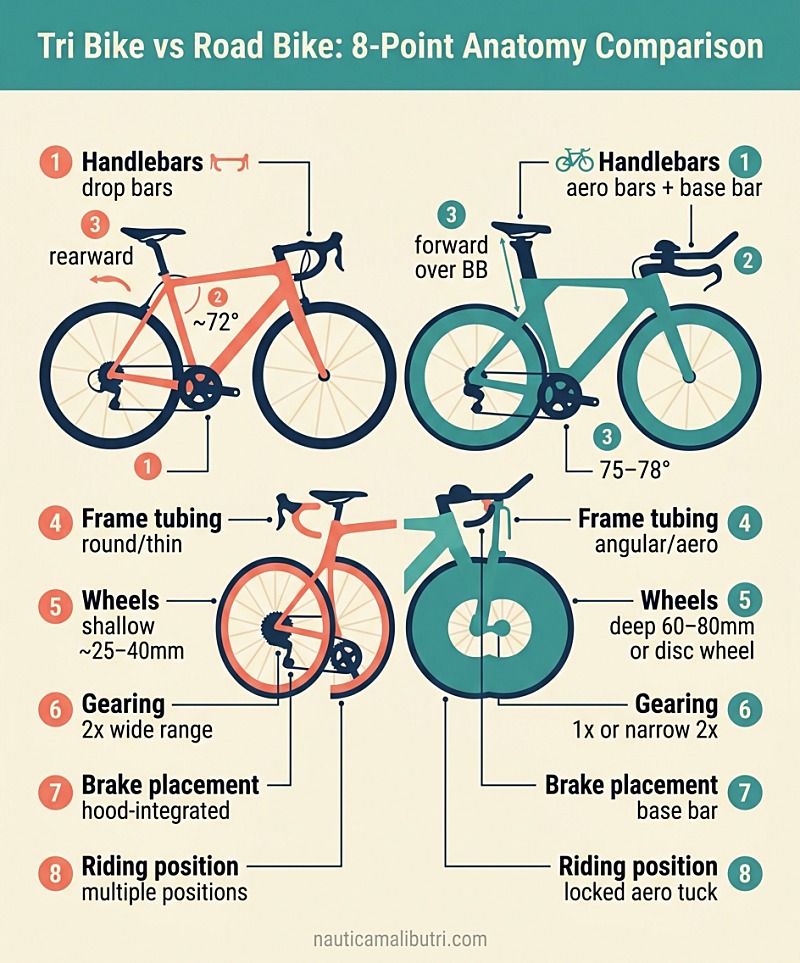
| Wheels | 25–40 mm deep typically | 60–80 mm or disc rear |
| Gearing | Wide-range 2x | Narrower 2x or 1x |
| Best at | Climbing, cornering, group rides | Flat, straight, solo speed |
| Allowed in draft-legal races | ✅ Yes | ❌ No |
| Entry price (carbon) | ~$1,500–$3,000 | ~$2,000–$3,500 |
Why The Two Bikes Even Exist
Drag is the whole story. When you’re moving forward on a bike, roughly 80–85% of the resistance fighting you is aerodynamic drag from your body, not the bike itself. Shrink the body — narrower hands, lower torso, flatter back — and you go faster at the same wattage. Everything else flows from that one fact.
A road bike puts you in a relatively upright, comfortable, controllable position with multiple hand options. A triathlon bike forces you into a locked-in aero tuck where your forearms rest on pads and your torso flattens out. The tri bike trades comfort and handling for a smaller frontal area.
The reason road cycling never fully embraced this aero tuck? Drafting. In road races, riders sit in the wake of the cyclist in front and roll about 30% easier. The peloton handles drag for you, so handling, sprinting, and cornering matter more than solo aero. In most triathlons, drafting is illegal, so you fight the wind alone — and a tri bike’s geometry becomes a serious weapon.
1. Frame Geometry — The Single Biggest Difference
Forget the handlebars for a second. The most important difference is invisible to a beginner: the seat tube angle.
- Road bike: Seat tube angle around 72° (sometimes 73°). This pushes the saddle rearward of the bottom bracket, opening up your hip angle and giving you a more upright, comfortable, climbing-friendly position.
- Tri bike: Seat tube angle of 75° to 78° (some go even steeper). This rotates the rider forward so the saddle sits almost directly above the bottom bracket.
Why does this matter? Muscle conservation. When your hips rotate forward into the aero position, you load your quadriceps more and unload your hamstrings and glutes. Your hamstrings are your prime running mover — keeping them fresh during the bike leg means you start the run with legs that haven’t been hammered by hours of pulling on the pedals. This is why pros call the tri bike position “biomechanically run-friendly.”
Tri bikes also use a longer reach (top-tube length) and a lower stack (head-tube height), stretching your torso flatter to shrink your frontal area further.
2. Handlebars and the Cockpit
This is the difference any non-cyclist will spot from across a parking lot.
- Road bike uses curved drop bars with three usable hand positions: the tops (near the stem, upright, best for climbing), the hoods (on the rubber covers around the brake levers — the default cruising position), and the drops (low and aggressive, used for sprints, descents, and headwinds). Brake and shift levers are integrated into the hoods, so braking is always one finger away.
- Tri bike uses a base bar with bull horns plus aero extensions (also called “tri bars” or “TT bars”) that jut forward. Forearm pads support your weight, and shifters typically sit at the very tips of the extensions. Brake levers live on the base bar — meaning to brake hard or steer technically, you have to come out of the aero position first.
That cockpit difference is also why most group rides — and many bike clubs — won’t let you join on a tri bike. Slow reaction time and shifted weight balance make tri bikes genuinely dangerous in a tight pack.
3. Wheels — Aero vs All-Round
Both bikes share the same wheel diameter (700c), but rim depth tells you everything about the bike’s purpose.
| Wheel type | Depth | Found on | Best for |
|---|---|---|---|
| Climbing wheels | <30 mm | Lightweight road bikes | Hills, low weight |
| All-round road | 30–50 mm | Most road bikes | Versatility |
| Aero road | 45–65 mm | Aero road bikes & some tri | Flat speed |
| Deep tri | 60–80 mm | Most tri bikes | Straight-line speed |
| Disc rear | Full depth | Tri/TT bikes | Pure aero gain |
A common mistake: assuming a disc wheel is always faster. Disc wheels only outpace deep carbon wheels above roughly 30–35 km/h. Below that speed, they’re heavier, slower to spin up, and brutal in crosswinds. They also struggle on courses with sharp corners because of slow re-acceleration. For most age-group triathletes, a deep 60–80 mm carbon front and an 80 mm or disc rear is the sweet spot.
4. Gearing
Tri bike gearing is built for flat or rolling terrain at sustained high speed. You’ll commonly see:
- Tighter cassettes (e.g., 11–28 instead of 11–34) to keep cadence steady at race pace.
- 1x setups (single front chainring) on flat-course tri bikes — fewer parts, less drag, less chain drop risk.
Road bike drivetrains are wider-range and almost always 2x (two front chainrings), with cassettes that climb to 11–32 or 11–34. That extra granny gear is what lets you grind up a 12% mountain pass without your quads exploding.
5. Frame Weight and Material
Road bikes are obsessed with grams because climbs reward low weight. The UCI’s minimum bike weight for sanctioned road races is 6.8 kg (15 lbs) under Article 1.3.019 of UCI technical regulations, so top-end road race bikes hover right at that floor.
Tri bikes don’t care about that limit because triathlon isn’t governed by the UCI. This is huge. Engineers can build wildly aerodynamic, non-traditional shapes — beam bikes, integrated hydration reservoirs, wing-shaped down tubes — that would be illegal in a Tour de France stage. The trade-off? Tri bikes are usually heavier, often 8.5–9.5 kg (19–21 lbs) once loaded with hydration, storage, and deep wheels.
On most flat triathlon courses, the aero gains from that heavier-but-slipperier shape easily beat the weight penalty. On a mountainous course, the math flips.
6. How Much Faster Is a Tri Bike, Really?
Here’s where it stops being theory. Wind-tunnel testing by the Global Triathlon Network found that an athlete saves between 37–49 watts at 30 km/h (18.5 mph) and a staggering 114–150 watts at 45 km/h (28 mph) by switching from a road bike to a properly fitted tri bike — purely from aerodynamics.
Translated into race time savings for a typical 200-watt age-group athlete:
| Race distance | Approx. time saved on a tri bike |
|---|---|
| Sprint (20 km bike) | 2:00–2:30 |
| Olympic (40 km) | 4:00–5:00 |
| Half-Ironman / 70.3 (90 km) | 8:30–9:00 |
| Full Ironman (180 km) | ~17 minutes |
That’s a podium-defining gap in nearly any age group. Slower athletes save fewer watts (less air to push through) but spend more hours on course, so the total time saved is similar.
7. When the Road Bike Actually Wins
It’s not always lopsided. There are real scenarios where a road bike beats a tri bike, even on race day.
- Steep, technical, mountainous courses. When the road tilts up past about 6–8% and your speed drops below roughly 17–18 km/h, the aero benefit of the tuck disappears. At those speeds, the upright position lets you generate more power and breathe more freely. Add in technical descents with sharp corners, and a road bike’s superior handling becomes a safety upgrade, not a luxury.
- The rider can’t hold the aero position. A tri bike is only fast if you stay tucked. If you sit up every five minutes because your back, neck, or hip flexors are screaming, you’ve paid for a Ferrari to drive in third gear. New triathletes routinely abandon aero on long bike legs and hand back every watt the bike was supposed to save.
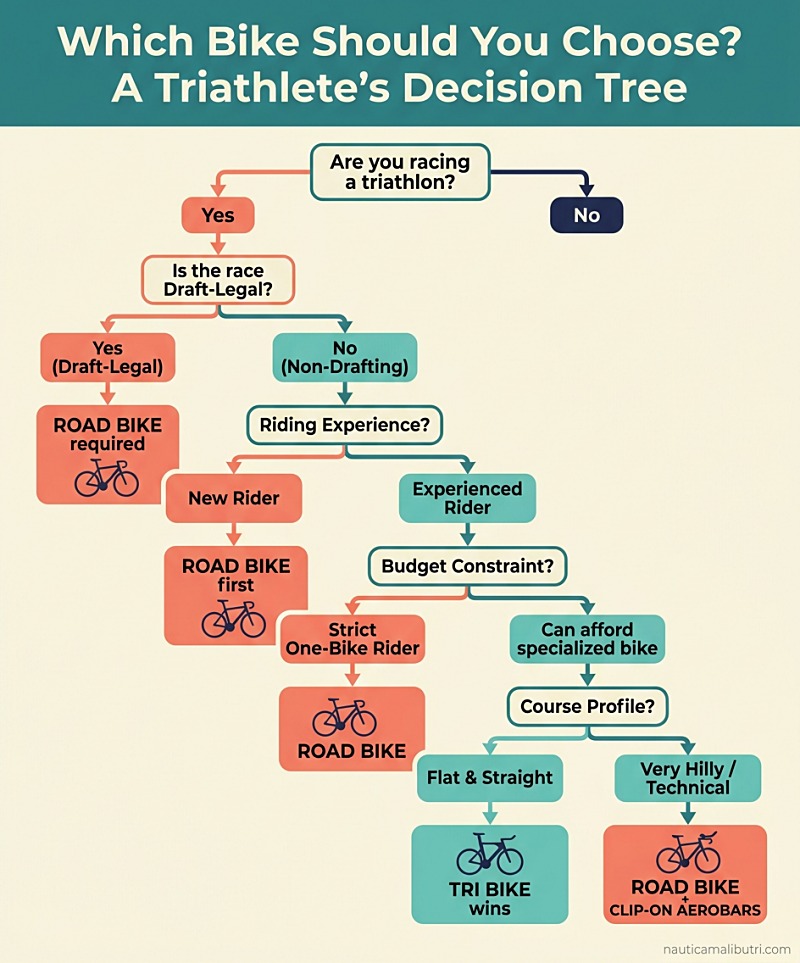
- Draft-legal races. Per USA Triathlon multisport rules, draft-legal events (most Olympic-distance elite races, age-group draft-legal nationals, and the Olympic Games) only allow traditional drop handlebars — clip-on aero bars are banned. Tri bikes are simply not legal equipment.
8. The Drafting Rules That Decide Which Bike You Can Use
This is the part most beginner guides skip. The rules drive the bike choice.
Non-drafting races (most age-group sprint, Olympic, Ironman 70.3, and full Ironman events): you can ride either bike, but a tri bike is the optimal tool. USA Triathlon, aligned with World Triathlon since 2023, enforces a 10-meter draft zone in sprint and Olympic distances and a 12-meter draft zone in anything longer. You have 20 seconds to pass in the shorter zone, 25 seconds in the longer one. Drafting penalties run from 1 minute (sprint) up to 5 minutes (long course).
Draft-legal races (Olympic-distance elite racing, age-group draft-legal nationals, super-sprint formats): you must ride a road bike with drop bars, no aero extensions allowed.
Even at the legal 12-meter following distance, research suggests you still pick up about a 9% drafting benefit — proof that drafting rules exist precisely because the advantage is too big to ignore.
9. Cost
Tri bikes generally cost more than equivalent-spec road bikes because the frames are more complex and made in lower volumes. Realistic 2026 price brackets:
| Tier | Road bike (carbon) | Tri bike (carbon) |
|---|---|---|
| Entry-level | $1,500–$3,000 | $2,000–$3,500 |
| Mid-range | $3,000–$6,000 | $4,000–$7,000 |
| High-end | $6,000–$12,000+ | $8,000–$15,000+ |
| Superbike | $12,000+ | $15,000–$20,000+ |
Add bike-fit costs of $200–$500. A proper tri-specific fit is non-negotiable — a tri bike fitted poorly is slower than a road bike fitted well.
Decision Framework: Which Should You Buy?
One sentence answer: If this is your first bike or first season, buy a road bike. If you’re committed to non-drafting triathlon, race regularly, and your bike splits are holding you back, buy a tri bike.
Buy a road bike if any of these are true:
- It’s your first triathlon, ever.
- You ride hilly, technical, or mountainous routes.
- You enjoy group rides and want a bike that fits in.
- You only have budget or garage space for one bike.
- You race occasionally and don’t chase podium finishes.
- You haven’t done a professional bike fit yet.
Buy a tri bike if all of these are true:
- You race non-drafting events at least 3–4 times a year.
- Your courses are mostly flat to rolling.
- You can hold an aero tuck for the full duration of your race distance.
- You’ll book a tri-specific bike fit after purchase.
- You already own a road bike for training and group riding.
Hybrid path most pros recommend: start on a road bike, train on it for a season, add clip-on aero bars (around $150) for your second season, then graduate to a dedicated tri bike when you’re racing seriously and consistently holding aero. Norwegian star Gustav Iden famously won the 2019 Ironman 70.3 World Championship in Nice — on a road bike with clip-on aerobars — because the course was that hilly. The tools follow the course, not the other way around.
Common Mistakes Beginners Make
- Buying a tri bike before learning to ride. Bike-handling skills come first. A tri bike rewards a confident rider and punishes an unsure one.
- Skipping the bike fit. A $4,000 tri bike with a bad fit is slower than a $2,000 road bike with a great one. Aero gains evaporate the moment you sit up because your back hurts.
- Going all-disc-wheel for a sprint triathlon. If you average under 30 km/h, the disc is hurting you, not helping.
- Riding a tri bike on group rides. Other cyclists won’t ride near you, and frankly, they shouldn’t have to.
- Ignoring the course. A flat Ironman in Florida and a mountainous Ironman in Lanzarote ask for different bikes — or at least different setups.
- Underestimating the position. The aero position is a skill, not a setting. Spend hours holding it in training before you race in it.
Pro Tips From the Wind Tunnel
- The bike isn’t aero — you are. Roughly 80–85% of total drag comes from your body. A perfectly fitted road bike with clip-on aerobars and a tucked rider will beat a tri bike with a poorly positioned rider every time.
- Sit up on climbs above 6%. Below ~17–18 km/h, the power gain from sitting up beats the aero loss.
- Tire and tube choice matters more than wheel depth at amateur speeds. Low rolling resistance tires with latex tubes can save 5–15 watts essentially for free.
- A TT helmet adds about as much speed as a deep front wheel — for a fraction of the cost.
- Practice eating, drinking, and shifting in aero. If you have to come up out of the position to grab a bottle, the rest of the setup is undermined.
Frequently Asked Questions
Can you do a triathlon on a road bike?
Absolutely. In fact, most first-time triathletes do. A standard road bike (or even a hybrid or mountain bike at your first sprint race) is perfectly legal in any non-drafting triathlon, and a road bike is mandatory in draft-legal races. The bike leg is timed by the rider, not the rig.
Are triathlon bikes faster than road bikes?
In a non-drafting, flat-to-rolling race, yes — by 2 to 17 minutes depending on race distance, based on wind-tunnel watt savings. On steep, technical, or mountainous courses, the gap shrinks dramatically and a road bike can actually be faster. The bike’s advantage also vanishes if the rider can’t hold the aero position.
What’s the difference between a tri bike and a TT bike?
Mechanically, they’re nearly identical. A time-trial (TT) bike is built within UCI rules for road-cycling time trials and has restrictions on geometry, fairings, and saddle position. A triathlon bike is a TT bike unshackled — triathlon isn’t governed by the UCI, so designers can use steeper seat angles, integrated hydration reservoirs, beam frames, and other illegal-in-the-Tour features. Most consumer brands sell one model marketed as both.
Can I add aero bars to my road bike?
Yes — clip-on aerobars typically cost $100–$250 and bolt onto the tops of standard drop bars. They don’t fully replicate a tri bike (handling stays road-bike-like and the seat angle is wrong for true aero), but they capture a meaningful chunk of the watt savings. Get a basic bike fit afterwards so your saddle and stem are adjusted for the new position.
How much does a triathlon bike cost?
Carbon entry-level tri bikes run roughly $2,000–$3,500 in 2026. Mid-range carbon with electronic shifting and disc brakes lands at $4,000–$7,000. High-end superbikes with integrated hydration, deep wheels, and power meters start around $8,000 and run up to $20,000+. Used certified pre-owned tri bikes are excellent value if budget is tight.
Is a tri bike worth it for beginners?
Generally no, for three reasons. First, you’ll likely want a road bike anyway for training rides and group cycling. Second, tri bikes are harder to handle and you’ll spend the first season being slower on them than you’d be on a road bike. Third, if you discover triathlon isn’t for you, a road bike has resale liquidity a tri bike doesn’t.
What size triathlon bike do I need?
It depends on rider height, torso length, hip flexibility, and arm reach — not just height. Manufacturer size charts (Felt, Canyon, Cervélo, Quintana Roo all publish them) are a starting point, but a professional bike fit before purchase is genuinely worth $200. Tri bike fit is far more position-sensitive than road bike fit.
Can I use my tri bike for casual riding?
Technically yes, but you’ll regret it. The aero position is exhausting at low speeds, the handling is twitchy, and braking from the extensions is slow. Most owners use a tri bike strictly for solo training intervals and races, and keep a road bike for everything else.
The Bottom Line
A road bike is the right answer for nearly every new triathlete, every hilly course, every cyclist who values versatility, and every one-bike rider. A tri bike is the right answer when you’re racing flat, non-drafting triathlons regularly, you can hold an aero tuck for hours, and you’re chasing minutes you can’t find anywhere else. Most serious triathletes eventually own one of each — the road bike for 90% of training and the tri bike for race day. Start on a road bike, train your aero position, and let your race calendar tell you when it’s time to upgrade.
Save this page — bookmark it before your next bike purchase or race-day decision. The right bike depends on your race, your course, and your skill, and the answer can change as your training does.