
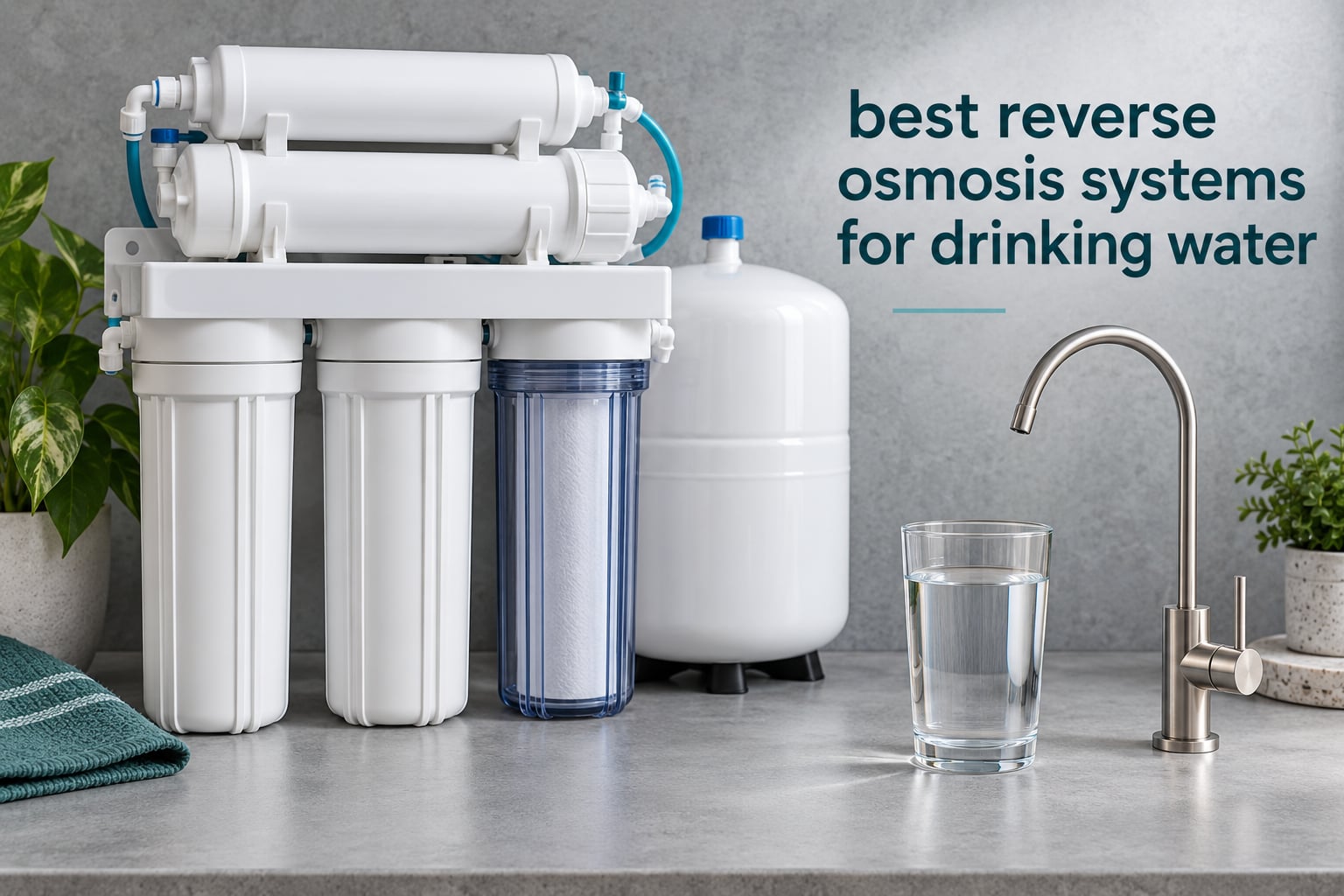
The best reverse osmosis systems for drinking water in 2026 range from compact plastic units that fit beside a garbage can to full-size tankless systems rated at 800 GPD, and picking between them comes down to three things: how much water you drink per day, what is in your supply water, and how much cabinet space you can give up. Our overall pick, the iSpring RCC7AK-BN, wins because it carries NSF/ANSI 58 certification for the complete system, adds an alkaline pH+ stage that removes the acidic edge most owners complain about, and has the largest verified ownership history of any unit we reviewed.
A reverse osmosis system pushes tap water under pressure through pre-filters that trap sediment and chlorine, then through a semi-permeable membrane that blocks dissolved contaminants and sends them down the drain line. A final carbon or remineralization stage polishes the taste, and purified water comes out of a dedicated faucet for drinking, cooking and ice. It is the only common household treatment certified under NSF/ANSI 58 to reduce a broad list of dissolved contaminants including lead, fluoride, nitrates, arsenic, PFAS and total dissolved solids.
Not everyone needs one. If your only complaint is chlorine taste and odor, a carbon block filter does the same job for a fraction of the money and produces no wastewater. If you are on municipal water that already tests clean and you dislike flat-tasting water, a dual-cartridge filter may suit you better. If a test report shows lead, fluoride above limits, nitrates, or PFAS, reverse osmosis is the right tool. Our guide covers 12 systems across under-sink tank, tankless and countertop formats, and every claim below comes from the manufacturer specification sheets and from what owners report after living with the unit.
We are not affiliated with any of these brands. Some links below are affiliate links, and we may earn a commission when you buy through them. That compensation does not change a single ranking on this page. This guide was last updated in October 2026, and we re-check specifications and review volumes each time a system is added or revised.
Table of Contents
Top 3 Best Reverse Osmosis Picks for 2026

iSpring RCC7AK-BN
- 75 GPD
- 6 stages with alkaline pH+ stage
- NSF/ANSI 58 certified
- no electricity
All 12 Best Reverse Osmosis Systems at a Glance in 2026
| Product | Specifications | Action |
|---|---|---|
| iSpring RCC7AK-BN 75 GPD 6-Stage Alkaline |
|
Check Latest Price |
 APEC ROES-50 50 GPD 5-Stage APEC ROES-50 50 GPD 5-Stage |
|
Check Latest Price |
 Waterdrop G3P600 600 GPD Tankless Waterdrop G3P600 600 GPD Tankless |
|
Check Latest Price |
 SimPure Y7P-BW Countertop UV SimPure Y7P-BW Countertop UV |
|
Check Latest Price |
 Bluevua RO100ROPOT Countertop Bluevua RO100ROPOT Countertop |
|
Check Latest Price |
 Waterdrop G2 400 GPD Tankless Waterdrop G2 400 GPD Tankless |
|
Check Latest Price |
 FS-TFC 100 GPD 5-Stage FS-TFC 100 GPD 5-Stage |
|
Check Latest Price |
 iSpring RCC7P-AK 6-Stage with Pump iSpring RCC7P-AK 6-Stage with Pump |
|
Check Latest Price |
 iSpring RO500AK-ORB 500 GPD Tankless iSpring RO500AK-ORB 500 GPD Tankless |
|
Check Latest Price |
 Waterdrop G3P800 800 GPD Tankless Waterdrop G3P800 800 GPD Tankless |
|
Check Latest Price |
 DREO Countertop RO DREO Countertop RO |
|
Check Latest Price |
 GeekPure RO6-AF 75 GPD 6-Stage GeekPure RO6-AF 75 GPD 6-Stage |
|
Check Latest Price |
1. iSpring RCC7AK-BN Review: Best Overall Under-Sink Reverse Osmosis System
- Complete-system NSF/ANSI 58 certification
- Transparent first-stage housing shows sediment load
- Alkaline pH+ stage cuts the acidic taste
- Patented top-mounted faucet fastener
- Filter sets at 6
- 12
- 24 and 36 months
- Storage tank claims cabinet space
- 70 psi requirement can limit output
- Filter sets are a recurring cost
The iSpring RCC7AK-BN is the system we recommend to most households, and the reason is not the spec sheet, it is the combination of spec sheet and track record. It holds NSF/ANSI 58 certification as a complete system, runs 75 GPD on a 6-stage train ending in an alkaline pH+ remineralization cartridge, and needs no electricity at all. Over 21000 verified owners have rated it, which is more verified ownership history than any other unit in this roundup.
That review volume matters for a practical reason. When a system has this many owners, the failure modes are well documented rather than anecdotal, and the pattern here is unusually consistent. Owners single out the transparent first-stage housing, which lets you see sediment and carbon turning brown instead of guessing when to swap a cartridge. The alkaline stage is the second most common point of satisfaction, because it lifts the pH of standard RO output and removes the flat, faintly sour note that drives some people back to bottled water.
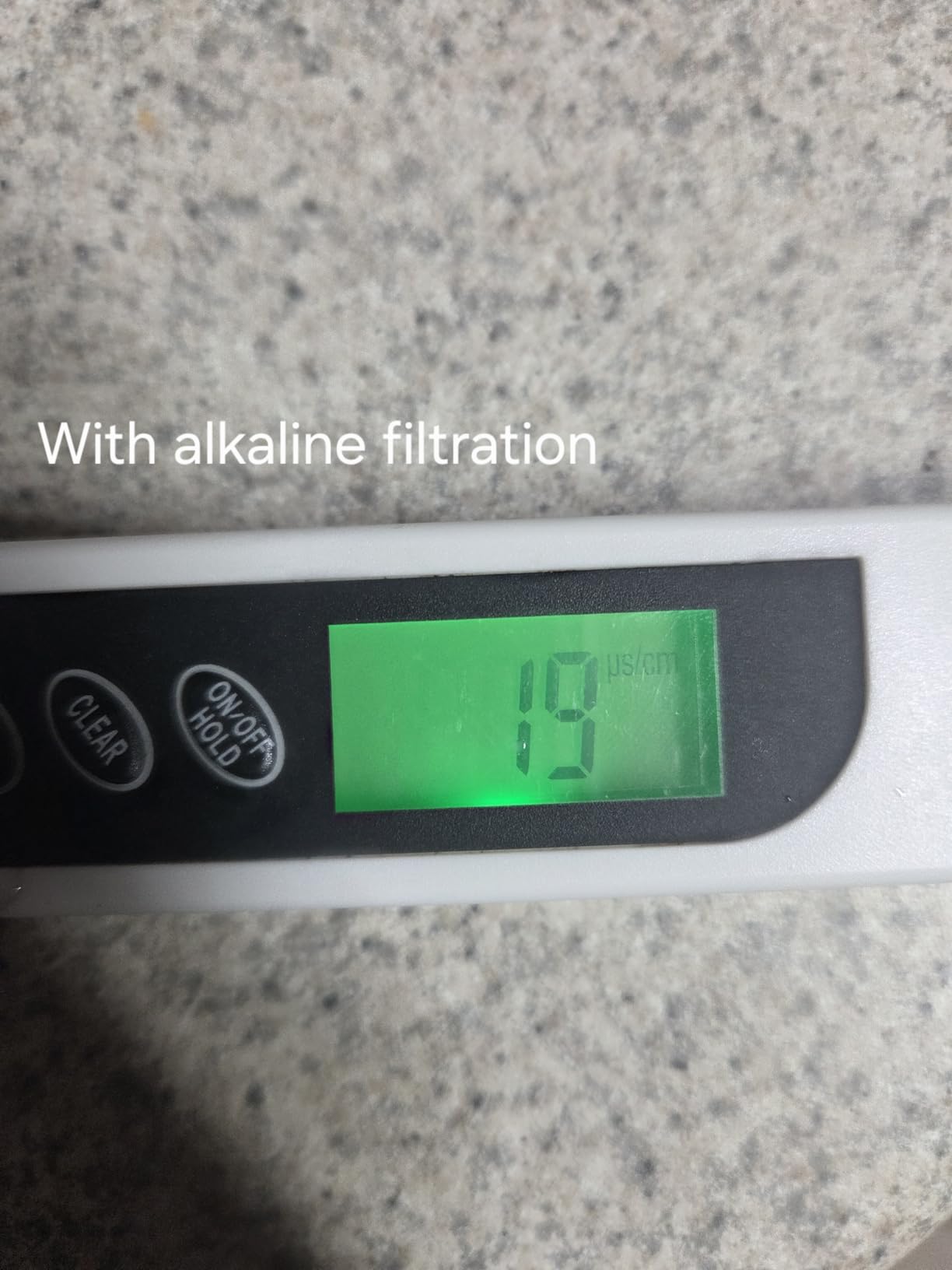
The listed reduction numbers are specific and worth reading carefully. The manufacturer states TDS reduction of 93 to 98 percent, PFAS of 96 to 99 percent, chlorine of 95 to 99 percent, lead above 98.9 percent, fluoride above 97.4 percent, barium above 98.4 percent, and asbestos above 99.7 percent. The system handles feed water up to 750 ppm TDS and 40 to 100 degrees F, and its stated operating pressure is 70 psi.
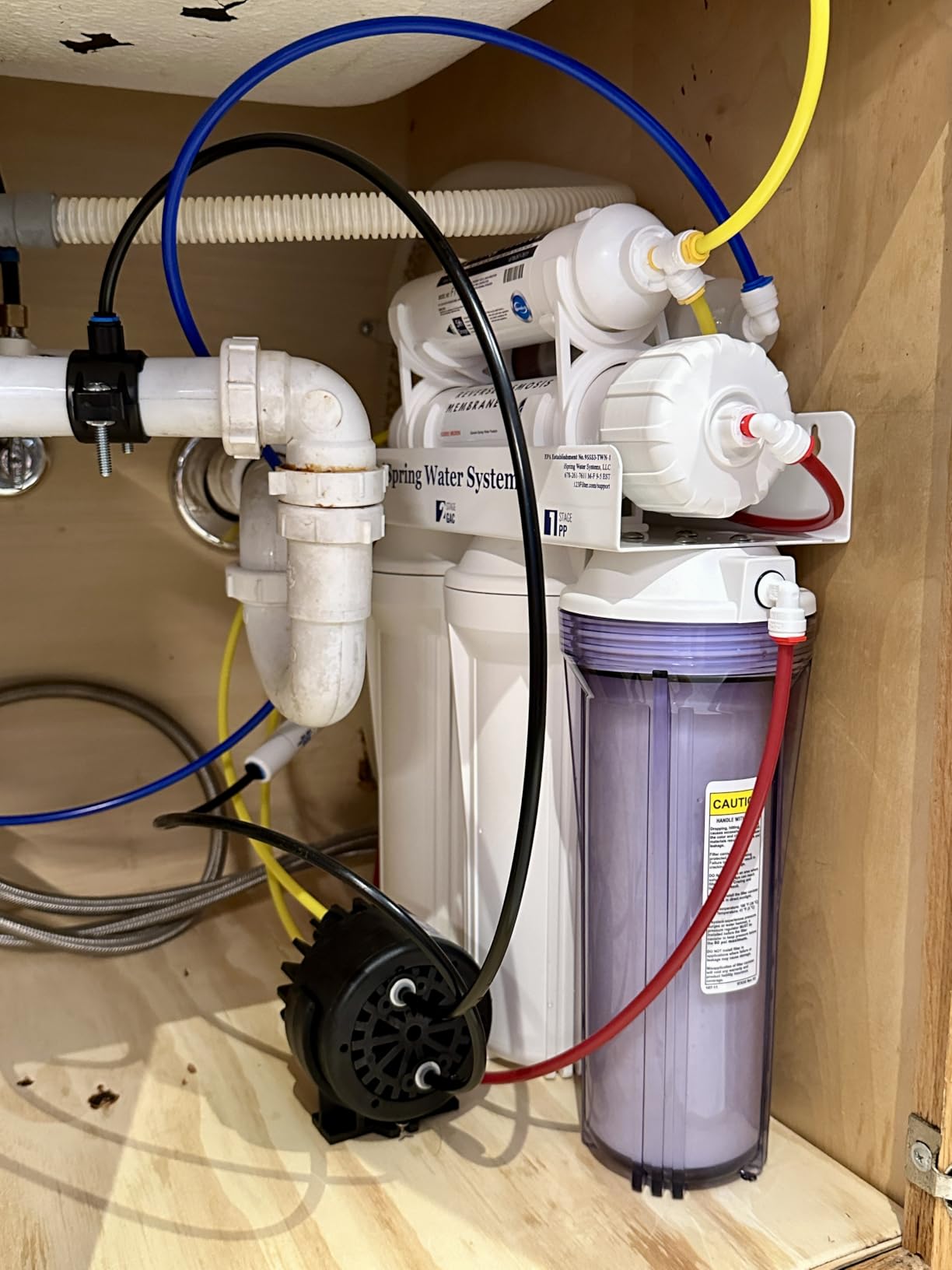
Installation is where the patented design earns its place. The top-mounted faucet fastener means you can assemble the whole unit from above rather than lying under the cabinet, and the housing uses quick-fitting connections with a step-by-step manual. Lifetime technical support is handled out of Atlanta, and replacement filters are the F4AK at 6 months, the F9K at one year, the F19K75 at two years and the F28K75 at three years, so you can match cartridge cost to how hard your water actually is.
Who the iSpring RCC7AK-BN suits
This is the pick for a family of three or four on municipal water who wants certified filtration without touching a power outlet. If your cold water line sits at or above 70 psi and you have a standard under-sink cabinet, everything about this system lines up. It also handles feed TDS up to 750 ppm, which covers most municipal supplies and moderately mineral-hard groundwater.
It is also the right choice for anyone who finds standard RO water unpalatable, because the sixth alkaline stage is the difference between water that tastes like a chemistry experiment and water most people will drink straight from the tap. Owners running under-sink ice makers and refrigerator dispensers report the same benefit, since the taste carries through to the ice.
Where the iSpring RCC7AK-BN falls short
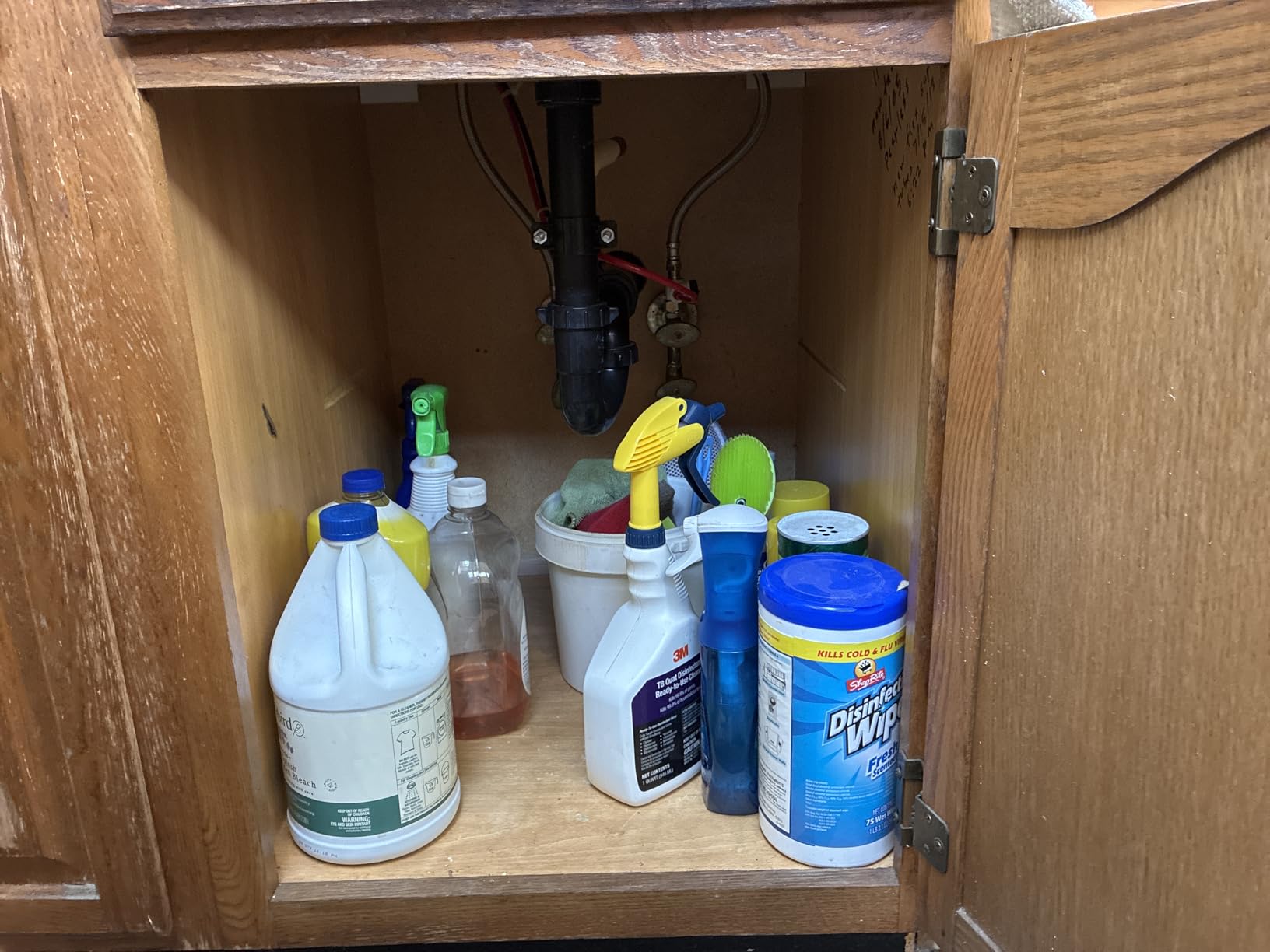
The storage tank is the main compromise. A tank-based system needs room for both the vertical filter housings and a pressurized tank, and in a narrow cabinet that can mean relocating cleaning supplies. Tankless units such as the Waterdrop G3P600 or the iSpring RO500AK-ORB reclaim that space because they make water on demand instead of filling a vessel in advance.
The 70 psi operating pressure is worth checking before you buy. Homes with older supply lines or a pressure regulator set low can see noticeably reduced output from a non-pumped design, and the fix is either a pump model like the iSpring RCC7P-AK or a plumber’s look at your line pressure. Filter replacement is also a permanent line item, and owners who skip prefilter changes on schedule see membrane life shorten as a direct result.
2. APEC ROES-50 Review: Best Value 5-Stage System
- Standard 10 inch parts available from third-party retailers
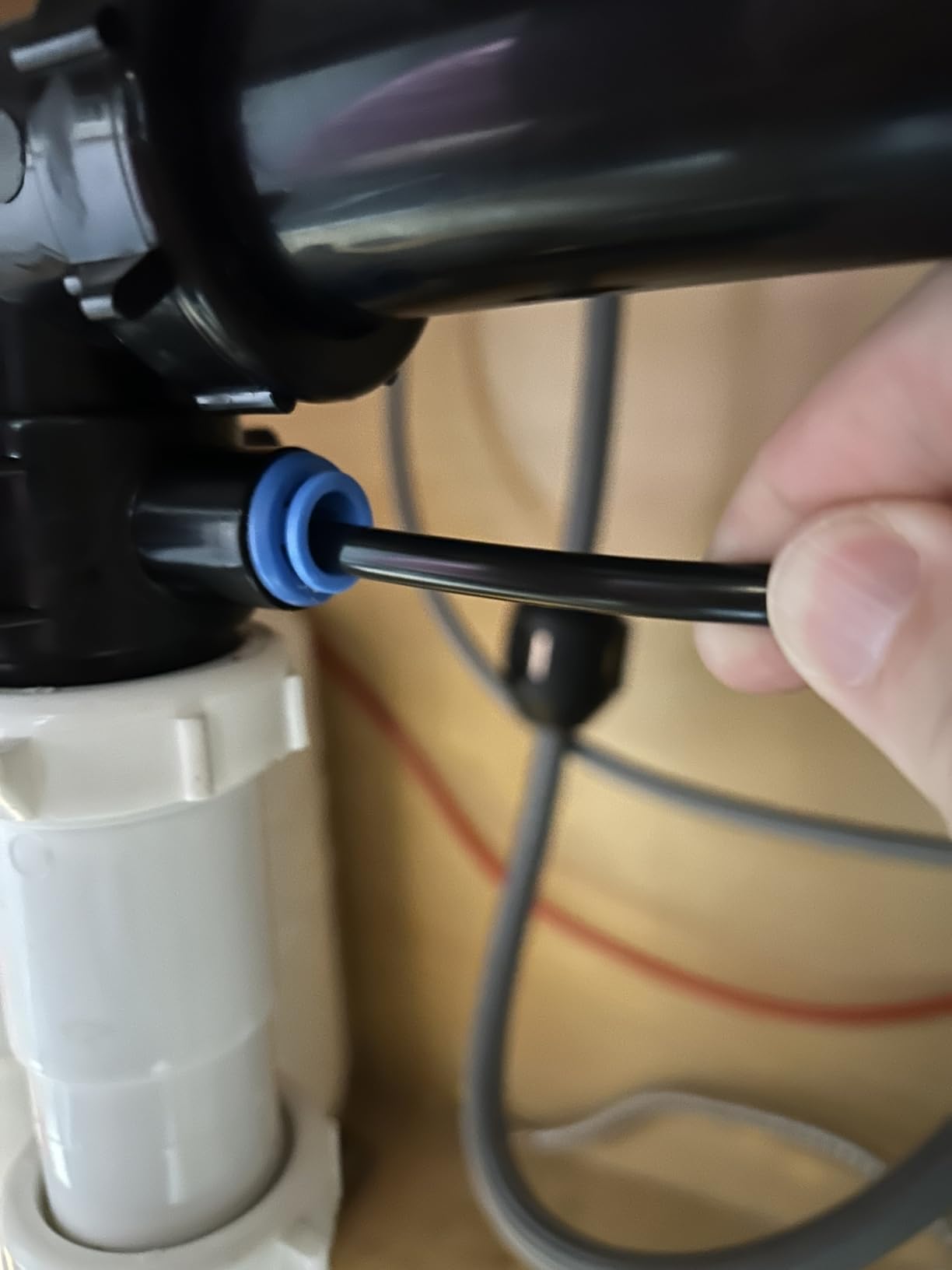
- Push-to-connect tubing stays leak-free over years
- Owners report systems lasting a decade
- TDS commonly drops from 100+ ppm to under 10 ppm
- Color-coded tubing simplifies DIY setup
- Faucet is non-air-gap
- Housing caps can crack if overtightened
- 5 gallon tank yields only about 2-3 gallons per fill
The APEC ROES-50 is the value pick because of one feature no amount of marketing can copy: it uses industry-standard 10-inch filter housings, so every cartridge and spare part is available from hardware stores and third-party retailers years from now. Owners who bought this system early in its run report units still going strong after a decade, and that is largely a parts-availability story rather than an engineering story.
Filtration is a conventional five-stage train rated at 50 GPD, handling feed water up to 2000 ppm TDS across a 40 to 85 psi operating range. The listed removal claims cover arsenic, chlorine, lead, fluoride and heavy metals across more than 1000 impurities, and the unit is certified to both NSF 372 and NSF 58. Independent TDS readings reported by owners typically move from 100-plus ppm tap water to under 10 ppm, which is the single most reassuring number you can get from a home system.
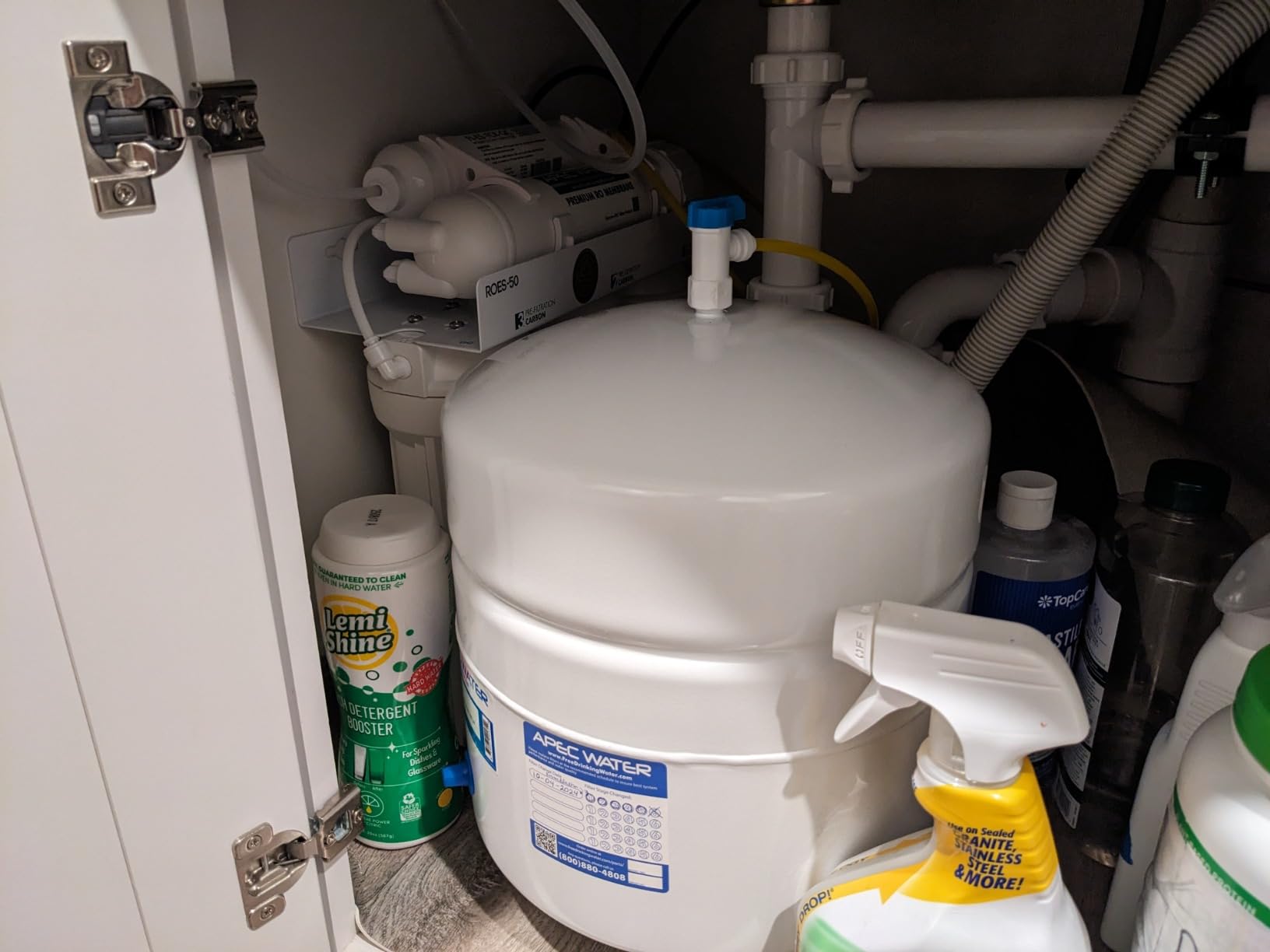
Everything needed arrives in the box, including the Filter-Max-ES50 cartridge set, a brushed nickel faucet, the water tank, an installation kit and instructions. The quick-connect fittings with color-coded tubing are the reason installation is usually a one-evening job, and owners repeatedly report those connections staying dry across multiple filter changes and multiple years. APEC also builds and tests in-house, and their support is widely reported as responsive on parts questions.
Flow is the honest limitation here. This is a non-pumped design, so production depends on your line pressure, and once the five-gallon tank empties the faucet runs at roughly 0.03 gpm, which is a trickle. Plan around that by keeping the tank full for cooking and ice, and by accepting a slower refill if you are the sort of household that empties it in one go.
Who the APEC ROES-50 suits
This is the right pick if your main priorities are certification, long-term parts availability and a low purchase price. It suits a couple or a one-to-three-person household on municipal water, and it handles a wide pressure band, which makes it forgiving in homes where line pressure varies. It is also the system to choose if you are the kind of owner who will actually change filters on a schedule, since the standard housings make the job five minutes with a spanner wrench.
Choose it over pricier units when you do not need a smart faucet, an alkaline stage or app tracking. Those features cost money and add failure points, and on a system like this the money is better saved toward a five-year cartridge budget. If you want the same standard-parts philosophy with a booster pump added, the iSpring RCC7P-AK covers the low-pressure case.
Where the APEC ROES-50 falls short
The included faucet is non-air-gap, meaning there is no physical air gap between the filtered water and the drain. For most municipal supplies that is a minor concern, but if you have any reason to suspect backflow contamination, add a separate air gap device or a dual dishwasher and RO air gap fitting. It is a five-dollar part and an hour of work that removes the question entirely.
Two other recurring complaints are worth knowing. Filter housing caps can crack if overtightened during a change, and a cracked cap under the sink is a slow leak that does damage before you notice it, so tighten to snug rather than to maximum. And the five-gallon tank does not deliver five gallons of usable water, because pressure in the tank means you get roughly 2 to 3 gallons before the refill starts.
3. Waterdrop G3P600 Review: Best Tankless System for Speed
Waterdrop G3P600 Tankless Reverse Osmosis Water Filter System, 600 GPD
- Tankless design frees about 70% of cabinet space
- Front-facing filters change in about 3 seconds
- 2:1 drain ratio cuts wastewater sharply
- Owners report TDS dropping from 358 ppm to single digits
- Smart faucet tracks filter status
- Needs a live outlet under the sink
- Replacement filters cost more than competing brands
- Built-in TDS display can read inaccurately
- First flow after idle needs a flush
The Waterdrop G3P600 is the tankless system to beat in this category, and the single most repeated owner report about it is speed. It fills an 8 oz cup in roughly 8 seconds at a listed 0.42 gpm, with no storage tank to empty and no slow recovery phase. Owners of this generation of Waterdrop units describe the same experience: fast flow, a solid TDS drop, and fluoride no longer an issue in their drinking water.
It is certified across NSF/ANSI 58 for TDS reduction, NSF/ANSI 372 for lead-free materials and NSF/ANSI 42 for chlorine taste and odor, and the eight-stage train is third-party tested by SGS. Throughput is rated at 600 GPD with feed water up to 1500 ppm TDS, which is a high ceiling for a household system. The 2:1 pure-to-drain ratio means roughly two gallons of purified water for every gallon sent to the drain, a large improvement over the three-to-five gallon waste of older tank designs.
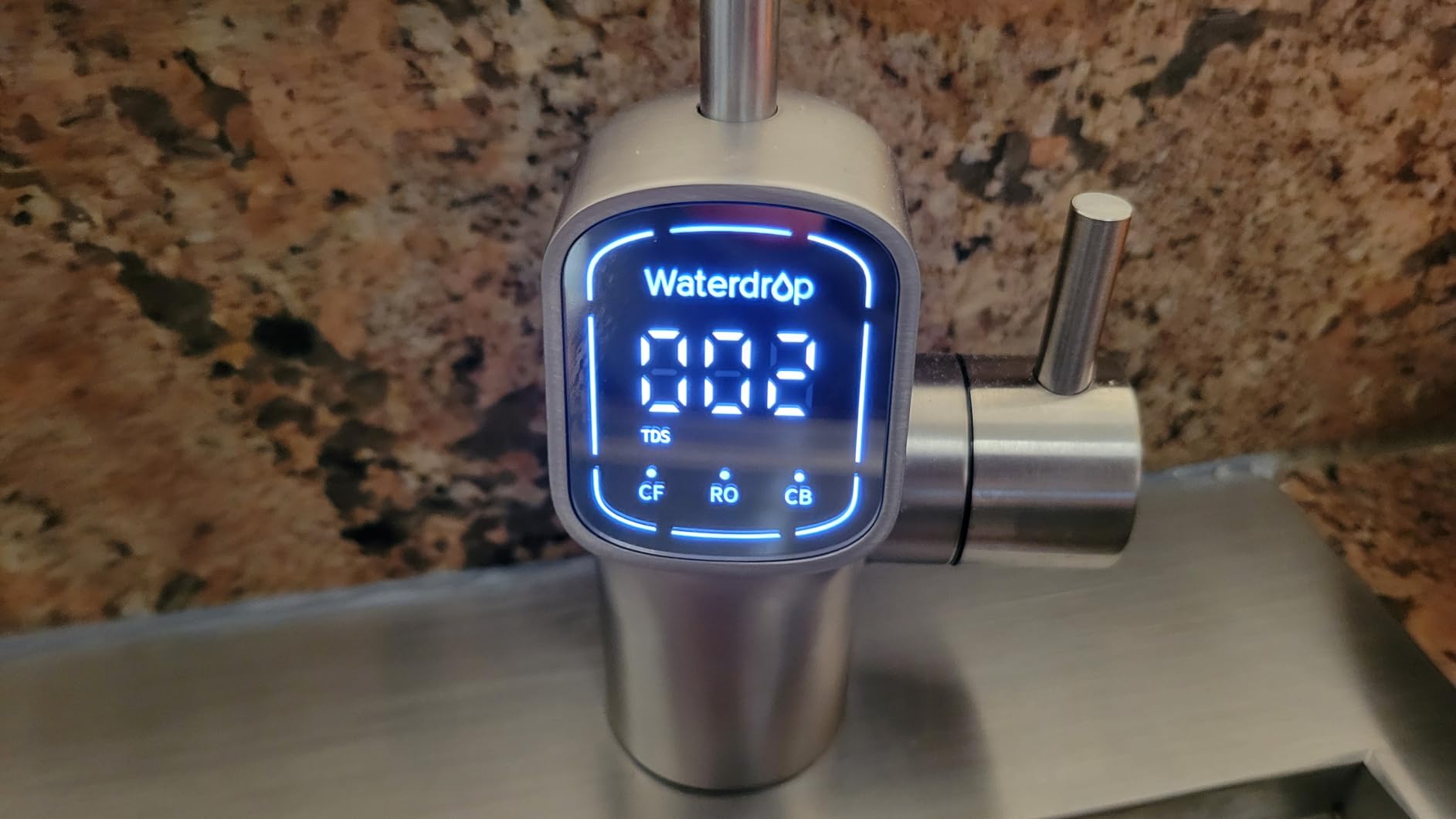
The physical design is what makes the cartridge claims believable. Filters sit front-facing and twist-and-pull, so a change takes about three seconds without moving the unit or crawling under the cabinet, and the integrated layout is claimed to free about 70 percent of under-sink space. The faucet carries a display that tracks both TDS and individual filter status, which removes the guesswork budget models leave entirely to the owner.
Owners measuring independently report TDS readings dropping from city water around 358 ppm to single digits, an order-of-magnitude reduction, and customer service is repeatedly described as responsive, including shipping replacement units with new filters. The system is rated at 87 psi operating pressure, works from 41 to 100 degrees F, and carries a one-year manufacturer and seller combined warranty.
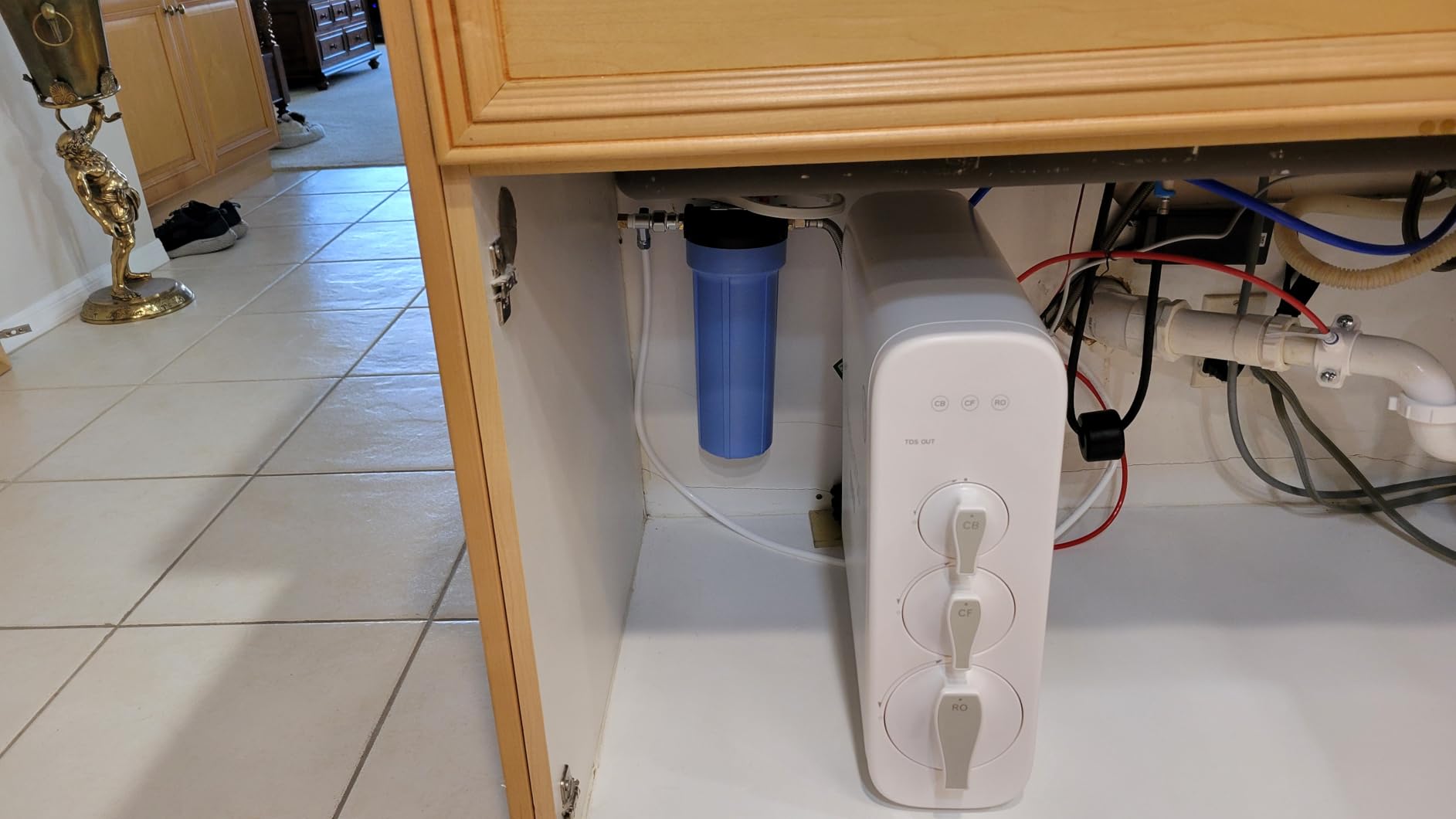
Who the Waterdrop G3P600 suits
This suits a household that wants on-demand flow without giving up a large storage tank, especially a family that empties a five-gallon tank in a day. It is a good fit for apartments and condos where cabinet space is tight, and for anyone who wants a dedicated drinking faucet that does not slow to a trickle when the tank runs dry.
It also works well when you want to feed a refrigerator or an ice maker, because the pressure stays consistent rather than dropping as a tank empties. If you have a filtration train in mind beyond the membrane, our guide to UV disinfection for well water covers what a UV stage adds and where it fits in a treatment order.
Where the Waterdrop G3P600 falls short
It requires an always-live electrical outlet under the sink, which rules out some older cabinets and some rentals where you cannot add an outlet. That single requirement eliminates the system for a meaningful share of buyers, and it is worth checking before anything else. The Smart faucet also depends on that power, so an outlet failure means no filtered water rather than merely a dark display.
Filter pricing is the other recurring reservation. Owners report noticeably higher cartridge costs than with standard-housing systems, and because the cartridges are proprietary to this design, there is no third-party substitute. The built-in TDS display has also been reported to read inaccurately in some situations, so verify with your own handheld meter if the number matters to you. Finally, the waste line fitting is designed for 1.5 inch pipe, and a 2 inch drain needs an adapter.
4. SimPure Y7P-BW Review: Best Countertop System with a UV Stage
- No plumbing or counter drilling required
- UV stage adds a final sanitizing pass
- Owners on well water report 849 ppm down to about 30 ppm
- Glass pitcher avoids storing water in plastic
- Narrow footprint suits tight counters
- Internal reservoir is hard to clean and can taste stale
- Manual calls for descaling every 2-4 weeks
- 5 L tank refills often
- Dispenses room temperature water only
The SimPure Y7P-BW is the pick when you cannot or will not touch plumbing and you want more than a carbon filter. It is a plug-in countertop unit with four stages of 0.0001 micron reverse osmosis filtration plus a UV purification stage, tested by SGS against the NSF/ANSI 58 standard. The UV pass is what separates it from most portable RO units, and the manufacturer claims no chemicals and no by-products as a result.
Efficiency is its quiet strength. The listed 4:1 pure-to-drain ratio is the best of any countertop unit in this roundup, and dispense flow is around 418 GPD, roughly 15 seconds per cup, with a 1.3 gallon internal reservoir. The included filter set covers 528 gallons of purified water with a 6 month change interval, and the unit supports feed water up to 500 ppm TDS.
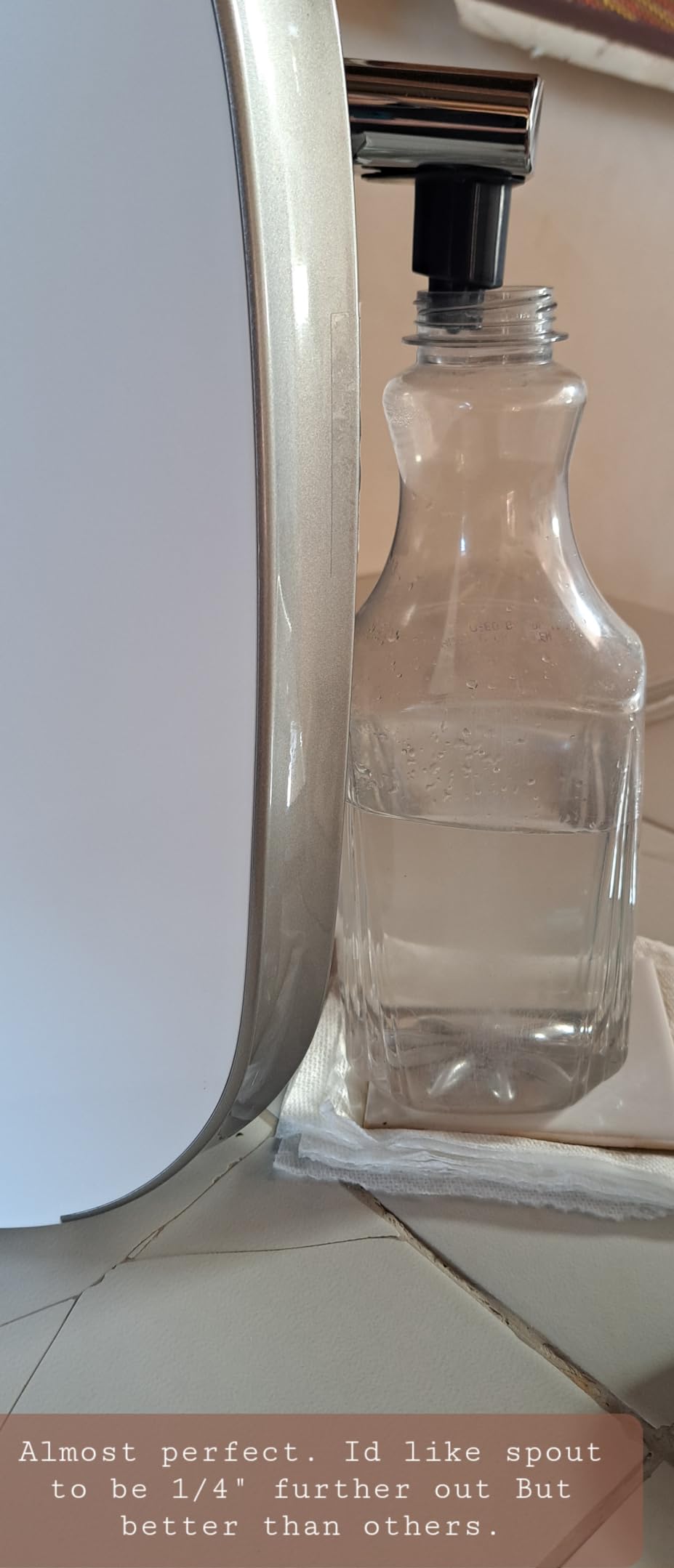
Owner results on difficult water are the most impressive reports in the review set. Buyers running this unit on well water post drops from 849 ppm to roughly 30 ppm, which is a far larger starting load than most municipal supplies present. The glass dispensing pitcher is also a real design win, because it keeps purified water out of a plastic container that can off-gaste over a month of storage.
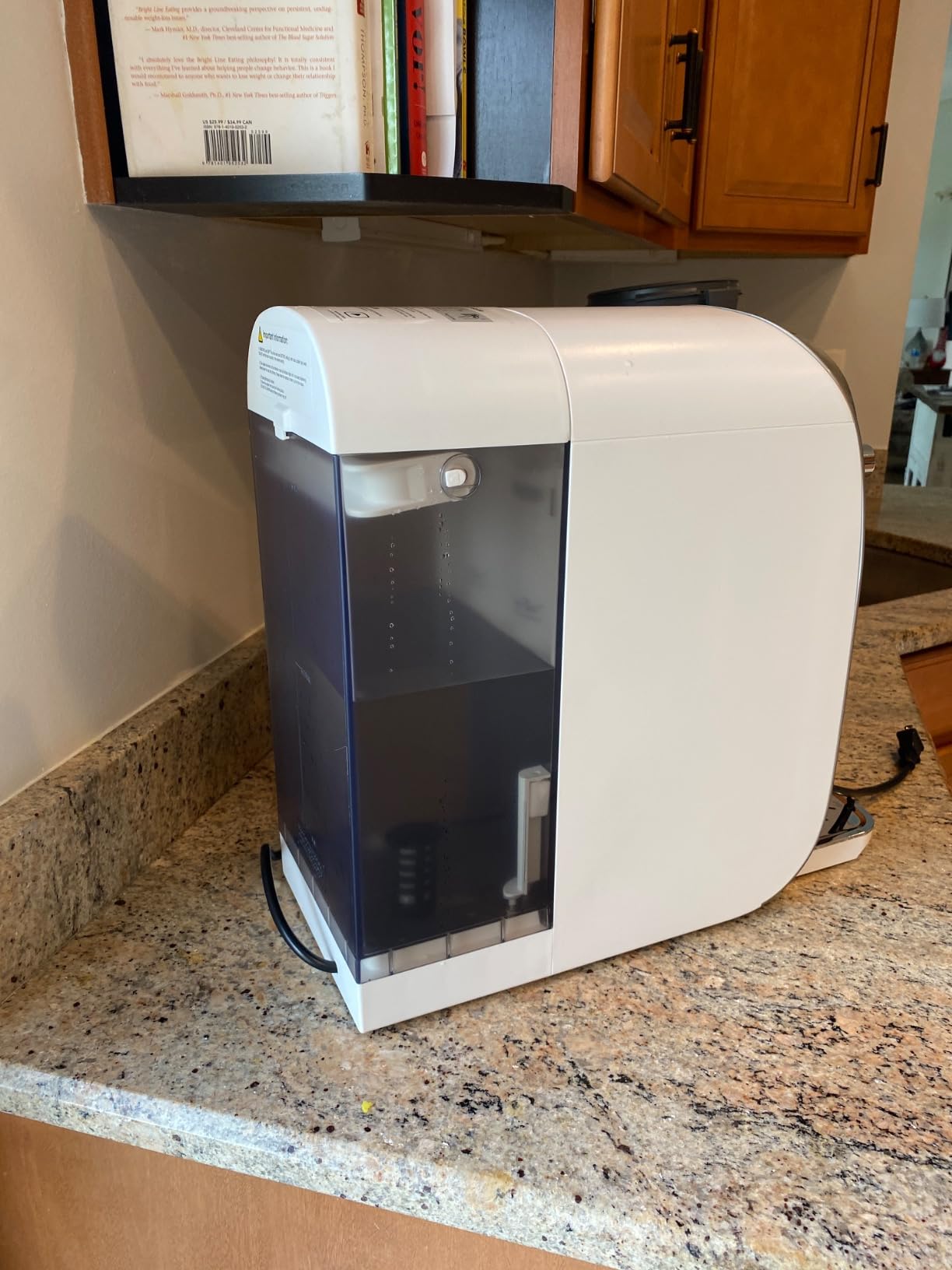
Support comes from a Seattle company that has served US customers since 2006, and the unit carries a one-year manufacturer warranty. It weighs 13 pounds and measures 17.3 by 7.5 by 17 inches, so it needs a genuine rectangle of counter rather than a sliver beside the toaster.
Who the SimPure Y7P-BW suits
This is the right choice for renters, for anyone in a house with no under-sink space worth using, and for households on a private well who want an immediate improvement before committing to a permanent treatment train. The UV stage also makes sense for anyone who wants a final sanitizing pass, particularly if a storage vessel sits in the chain and you worry about biofilm.
Pick it over the other countertop units here if your water is genuinely hard or your well TDS is high, because that is where the multi-stage RO plus UV combination earns its cost. If your supply is soft municipal water and you are only chasing taste, a countertop carbon unit would be lighter and cheaper.
Where the SimPure Y7P-BW falls short
This unit has the lowest average rating in the roundup at 4.2, with an 11 percent one-star share, and the detailed critical reviews explain the split. The internal plastic reservoir is not easily user-cleanable, and owners report the water starting to taste stale after about a month. The manual also prescribes frequent tank cleaning and descaling cycles on a two-to-four week rhythm that is not obvious at the point of purchase.
Practical limits are the small 5 liter tank, which means frequent refills for a heavy drinking household, and a slow, audible run during filter changes. It dispenses room temperature water only, with no hot or cold option. If you want a countertop unit that runs quieter and holds a larger buffer, the Bluevua below is the alternative.
5. Bluevua RO100ROPOT Review: Best Countertop System for Renters
- Glass carafe avoids secondary plastic contamination
- 12-24 month filter life cuts replacement frequency
- Remineralization stage stops the flat taste
- No plumbing or drilling
- 5 kg unit with automatic standby
- Higher purchase price than comparable countertop purifiers
- Needs a power source at the dispensing point
- Remineralization cartridge adds a step to the change cycle
The Bluevua RO100ROPOT is the countertop unit we recommend to most renters. At 4.6 stars across roughly 3700 reviews, it sits at the top of the countertop category, and the reasons owners cite are unusually specific: a borosilicate glass carafe, a 2:1 drain ratio, and filter intervals of 12 to 24 months that are far longer than the six-month norm for this format.
Filtration is a five-stage RO train that includes a dedicated remineralization filter, with claimed removal of 99.9 percent of contaminants and WQA and NSF certification language for the system. It handles feed water up to 1000 ppm TDS, which is a higher ceiling than most portable units, and the filter life monitor on the front tracks both service intervals and water quality so you are not guessing when a cartridge is spent.
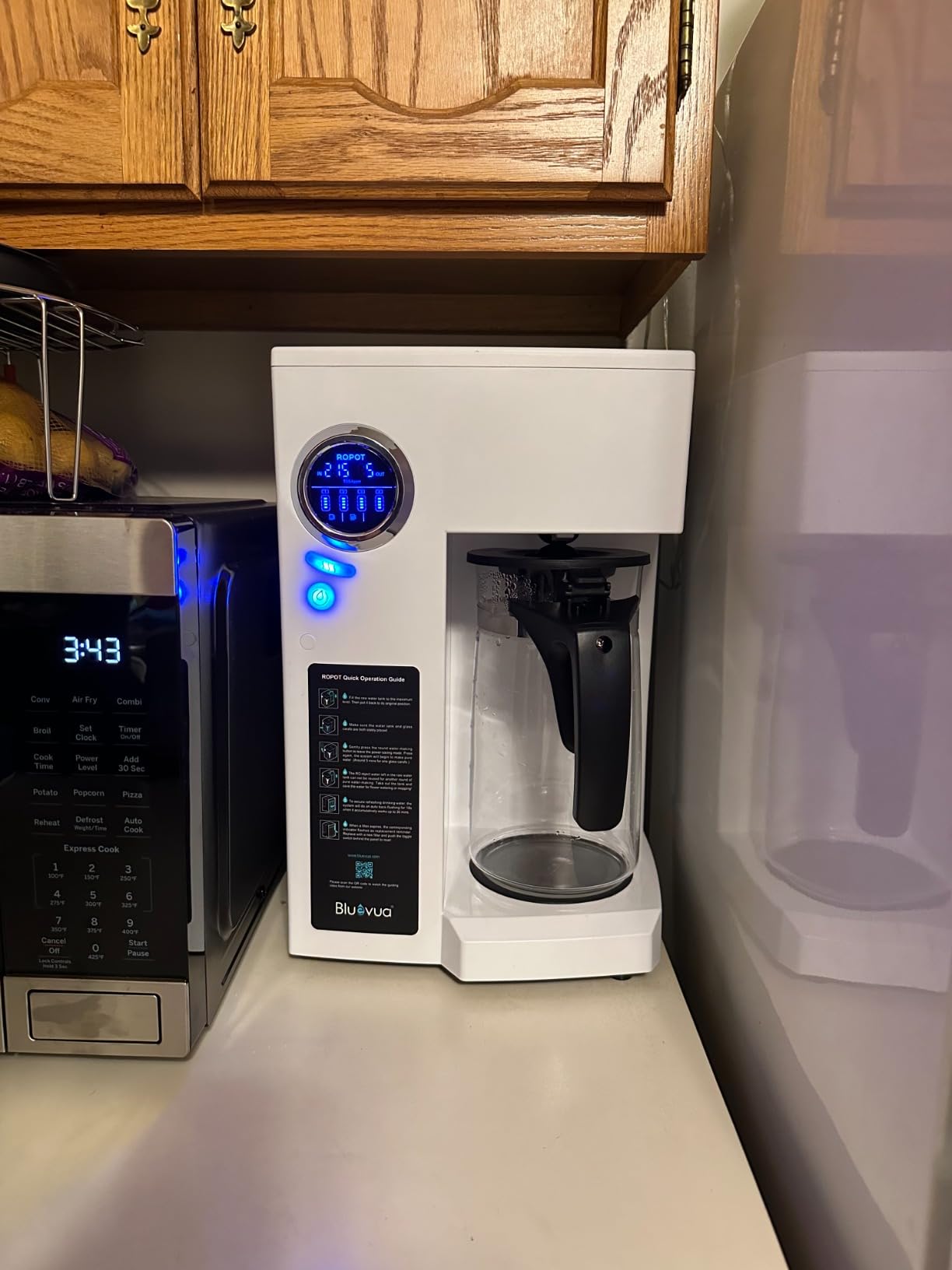
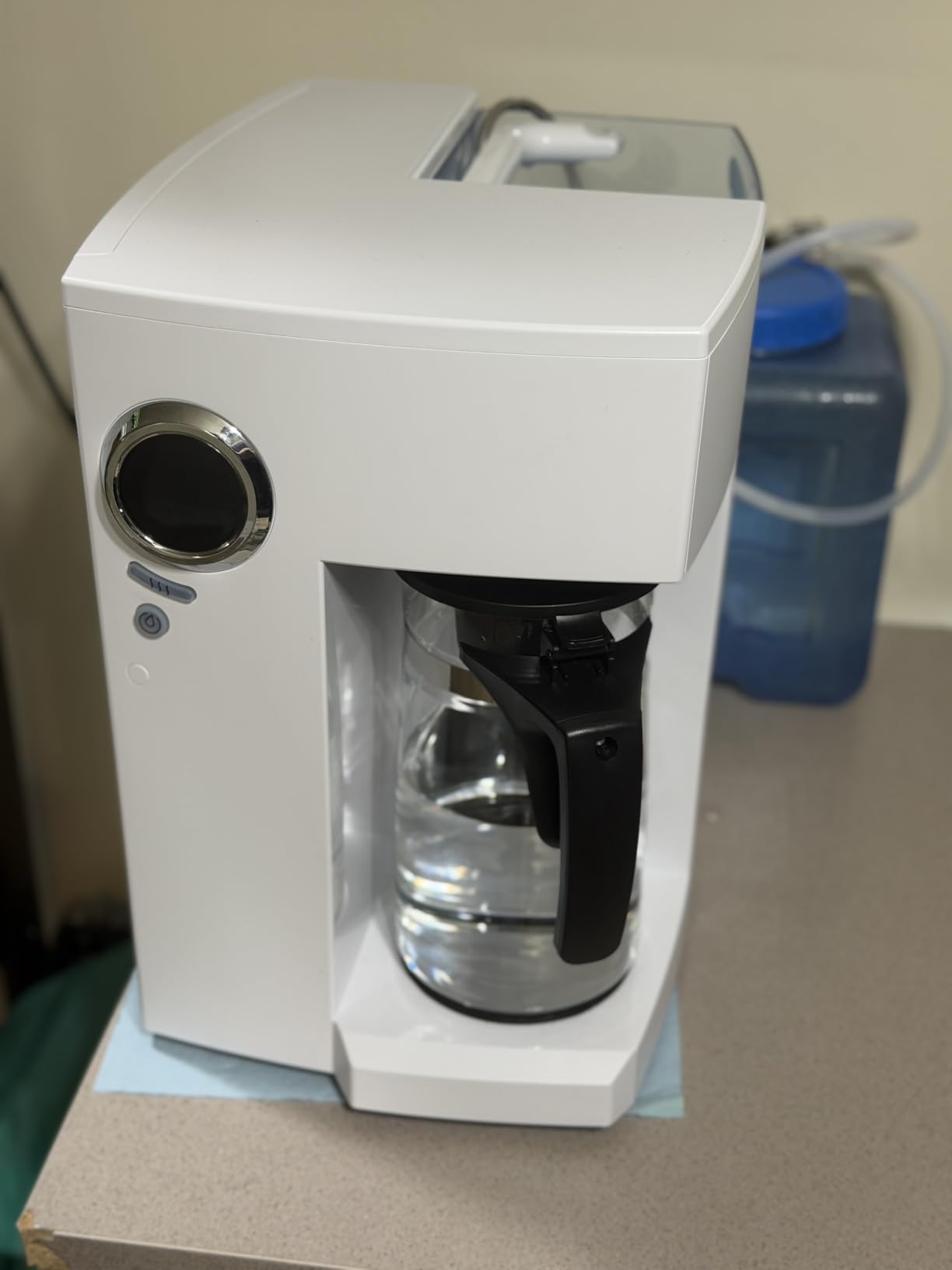
Two design choices separate it from the pack. The glass carafe removes purified water from a plastic container entirely, which matters over a month of daily use. And the automatic power-saving standby mode, paired with the 2:1 pure-to-drain ratio, keeps both the electricity and the water cost of a countertop unit down closer to under-sink levels than most rivals manage.
The box includes the glass carafe, a power adapter, a cleaning brush, a user guide, four filters and a mineral filter, and the unit carries a one-year limited manufacturer warranty on registration. It weighs 5 kg and measures 10.9 by 15.4 by 14.3 inches, one of the smaller footprints here. The company also positions the unit as ClimatePartner certified, which matters if you care about packaging waste.
Who the Bluevua RO100ROPOT suits
This fits renters, shared apartments and any kitchen where drilling a faucet hole is not an option. It also suits households that hate the flat taste of standard RO output, because the remineralization stage puts minerals back and lifts the flavor profile without pushing the pH as far as an alkaline cartridge does.
For households that drink a lot of water, the long filter interval is the decisive factor. If you would otherwise be replacing cartridges twice a year, paying more up front for a unit that stretches that to a year or more changes the ownership math completely, especially alongside a 2:1 drain ratio.
Where the Bluevua RO100ROPOT falls short
The purchase price is higher than comparable countertop purifiers, and that gap only pays off if you actually use the long filter intervals. Buyers who move frequently, or who plan to use the unit for a year and give it back, may not recover the difference. It also requires a power source at the dispensing location, which is a cable across the counter rather than an under-sink outlet.
Adding a remineralization cartridge means one more element in the replacement cycle, and owners who buy only the main RO cartridge by mistake will notice the taste change quickly. Budget for the full kit on each change rather than the cheapest cartridge in the catalog.
6. Waterdrop G2 Review: Best Compact Tankless Unit
Waterdrop G2 Reverse Osmosis System, 400 GPD Tankless RO Water Filtration
- Tankless design saves more than 70% of cabinet space
- 1:1 drain ratio cuts waste sharply
- Integrated water and electrical circuits cut leak points
- Airtight housing lowers operating noise
- Three-second twist-and-pull filter changes
- Maximum supported feed TDS is only 300 ppm
- Needs under-sink electricity and counter drilling
- Mechanical faucet has no TDS or filter-life readout
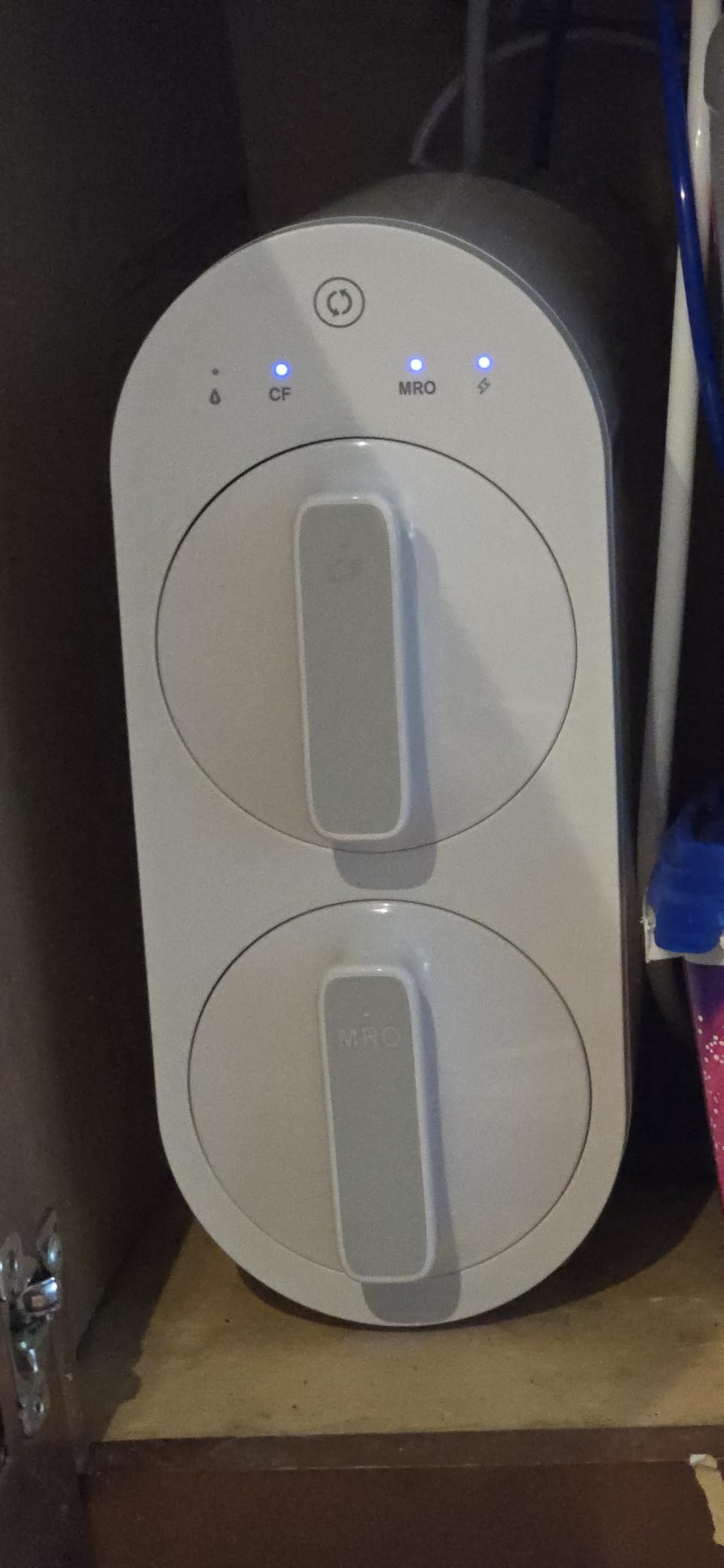
The Waterdrop G2 is the entry point into tankless design, and for many buyers it is the most sensible one. It is positioned a step below the G3 series and the trade-offs are visible immediately in the spec sheet, but the core advantages of tankless ownership are all here: no storage tank, a small footprint, and fast on-demand production at 400 GPD with a cup in about 12 seconds.
The filtration is a seven-stage composite-filter design rated to reduce total dissolved minerals, arsenic, lead, mercury, fluoride and cadmium, and the system carries NSF/ANSI 372 certification for lead-free materials. Be clear about what that means, because it is the certification trap we flagged earlier: 372 confirms materials, so look to the reduction claims and lab testing for filtration performance rather than treating the 372 badge as a filtration seal.
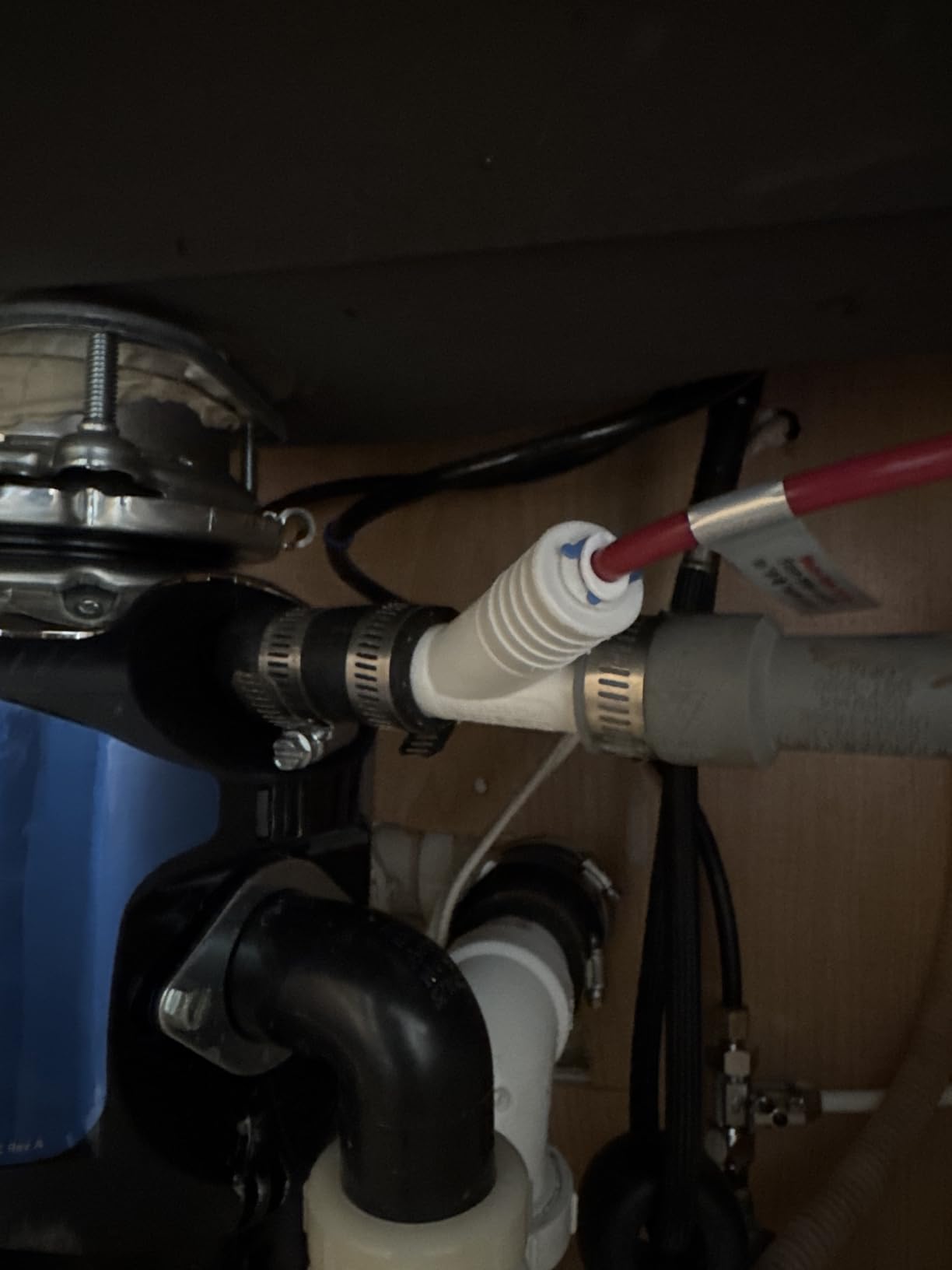
The engineering details owners appreciate are about noise and leaks. Integrated water and electrical circuits reduce the number of connection points inside the housing, and an airtight casing keeps operating noise down, which matters in a kitchen where the unit sits a few feet from where you sit. Filters still use the three-second twist-and-pull change, and installation is claimed at under 30 minutes with drilling and an outlet required.
Feed water support tops out at 300 ppm TDS, which is the specification to check first. That is comfortable for municipal supplies in most regions and tight for mineral-heavy groundwater, and the G3 series raises the ceiling considerably. Operating temperature is 41 to 100 degrees F, and the warranty is one year manufacturer and seller combined.
Who the Waterdrop G2 suits
This is the pick for a small kitchen, a condo or an office break room where cabinet volume is the binding constraint and you still want real RO rather than a carbon-only filter. It is a good match for households on municipal water with moderate TDS who want low water waste without paying for the top of the range.
It also makes sense as a first tankless system, because the change from a tank design is the main experience upgrade and you get that here at a lower entry point. If you already know you want the smart faucet and the higher TDS ceiling, step up to the G3P600 rather than planning around this ceiling later.
Where the Waterdrop G2 falls short
The 300 ppm input TDS limit is the real constraint. If you are on a well or on a municipal supply with heavy mineral content, this unit will be working at the edge of its range from day one, and membrane life shortens as feed load rises. Check your TDS before ordering, not after.
It needs under-sink electricity and a drilled faucet hole, so it is not a renter option. The mechanical faucet is also a step back from the G3 series, with no TDS reading and no filter-life tracking, which means you will be estimating cartridge timing on your own. On a system this compact, buying the G3 series when you have the cabinet space and the outlet is usually the better decision.
7. FS-TFC 100 GPD Review: Best Budget Under-Sink System
- Lowest purchase price in the roundup with four spare filters in the box
- Compact 11.5 inch footprint fits tight cabinets
- Runs without electricity so it works in an RV
- Owners report good flow even feeding other appliances
- 2 year warranty with lifetime support
- Connector fittings reported low quality and leak-prone
- No remineralization stage so water tastes plain
- Condensation forms on the lower housings
- Supplied brackets described as flimsy
The FS-TFC 100 GPD is the cheapest way to get certified-looking reverse osmosis into a home, and for some buyers that is exactly the right trade. It is a five-stage system rated at 100 GPD with an 18 L/h full flow rate measured at 60 psi, a 200 ml cup in about 5 seconds, and a stated 99.999 percent reduction claim across more than 1000 contaminants. Four replacement filters ship in the box, which covers close to a year of changes.
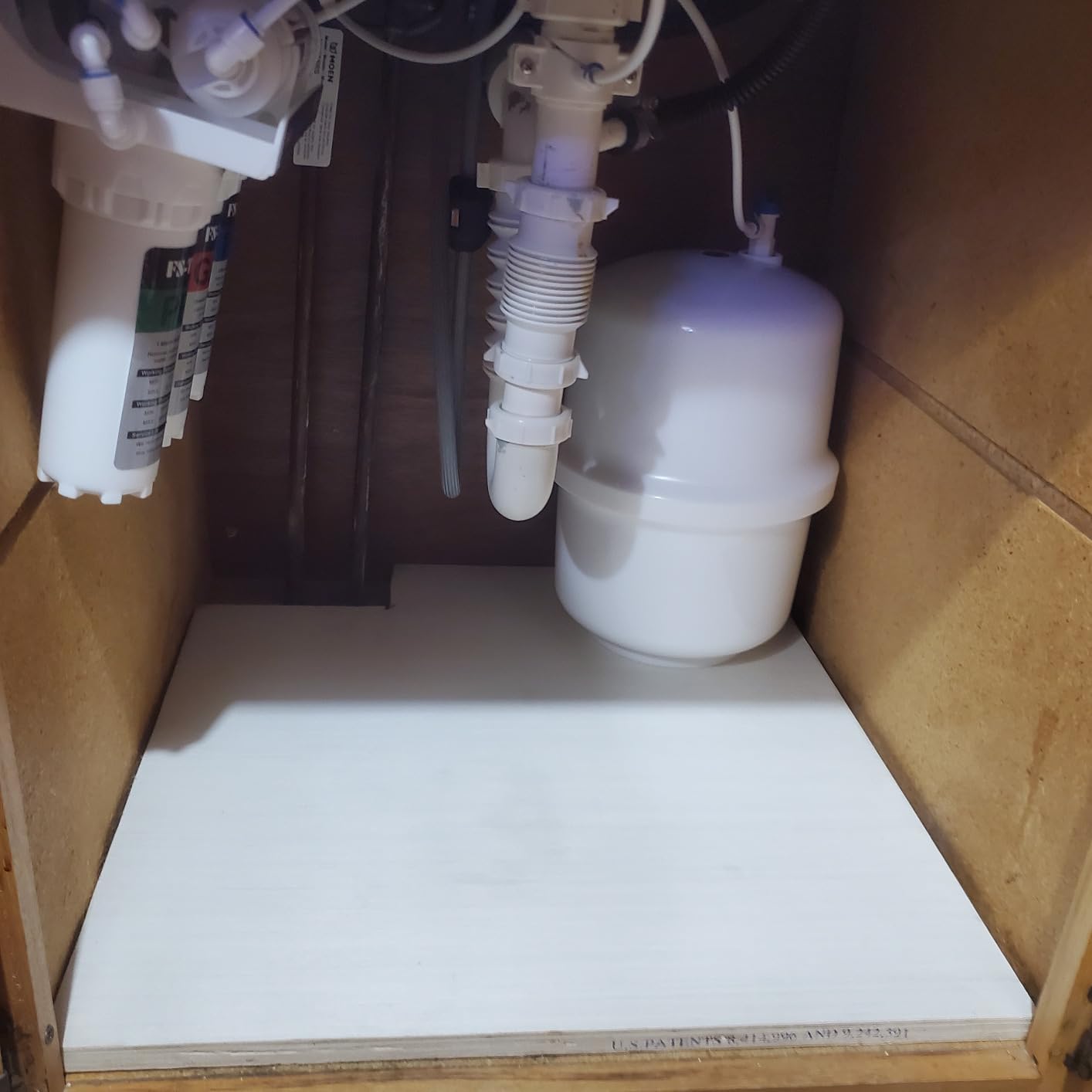
It needs no electricity, which makes it one of the few systems here that can travel. Owners who install it in an RV report ample flow, sometimes enough to feed other appliances, and the 11.5 by 5 by 11.5 inch footprint is small enough for a tight cabinet. The two-year manufacturer warranty with lifetime technical support is the longest warranty among the budget tier.
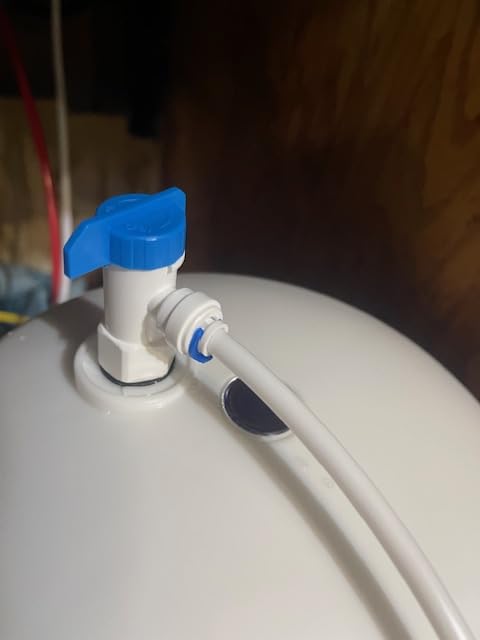
Its rating is 4.2 with the widest spread in the roundup, 68 percent five-star against 11 percent one-star, and that spread is entirely explained by hardware. Satisfied buyers point to the low annual filter cost and the bundled spares. Critical reviews concentrate on connector quality, condensation forming on the bottom three filter housings, and the gap between the advertised 1:1 drain ratio and what they actually measured.
That drain ratio point deserves emphasis. The unit advertises 1:1, and several owners who measured drainage without adding an optional permeate pump report closer to 1:3 in real use. That is the difference between roughly one gallon and roughly three gallons of wastewater per gallon purified, and it is exactly the kind of figure that never appears in a retail listing.
Who the FS-TFC 100 GPD suits
This suits a first-time buyer on a strict budget, a student or rental where a low purchase price matters more than finish quality, and an RV or boat owner who needs filtration without a household supply. The four included filters mean you can run a full year before your first purchase, which removes the most common reason new owners abandon a system.
It is also a reasonable second system, for a wet bar, a basement utility sink or an office where you want RO without touching the main kitchen plumbing. At 100 GPD the throughput is ample for any of those secondary uses.
Where the FS-TFC 100 GPD falls short
Hardware is the limitation. Owners report the connector fittings as low quality and prone to leaking, and the supplied mounting brackets as flimsy, both of which translate into under-sink water damage over a few years. Condensation forming on the lower filter housings is cosmetic, but it is also a hint that the housings are running cold and wet in a closed cabinet.
There is no remineralization stage, so the water tastes like plain RO, which is the most common reason people go looking for a different system after a year. And the drain ratio question is real, so if you are water-conscious or on a metered supply, budget for the permeate pump option or look at a system with a verified 2:1 ratio.
8. iSpring RCC7P-AK Review: Best for Hard Water
- Booster pump sustains output in low-pressure homes
- Highest average rating in this roundup
- Alkaline stage removes the acidic taste of standard 5-stage output
- Cuts wastewater relative to non-pumped models
- Transparent first-stage housing
- Booster pump needs a nearby under-sink outlet
- 20 pound unit is heavier than non-pumped systems
- Higher purchase price than basic 5-stage systems
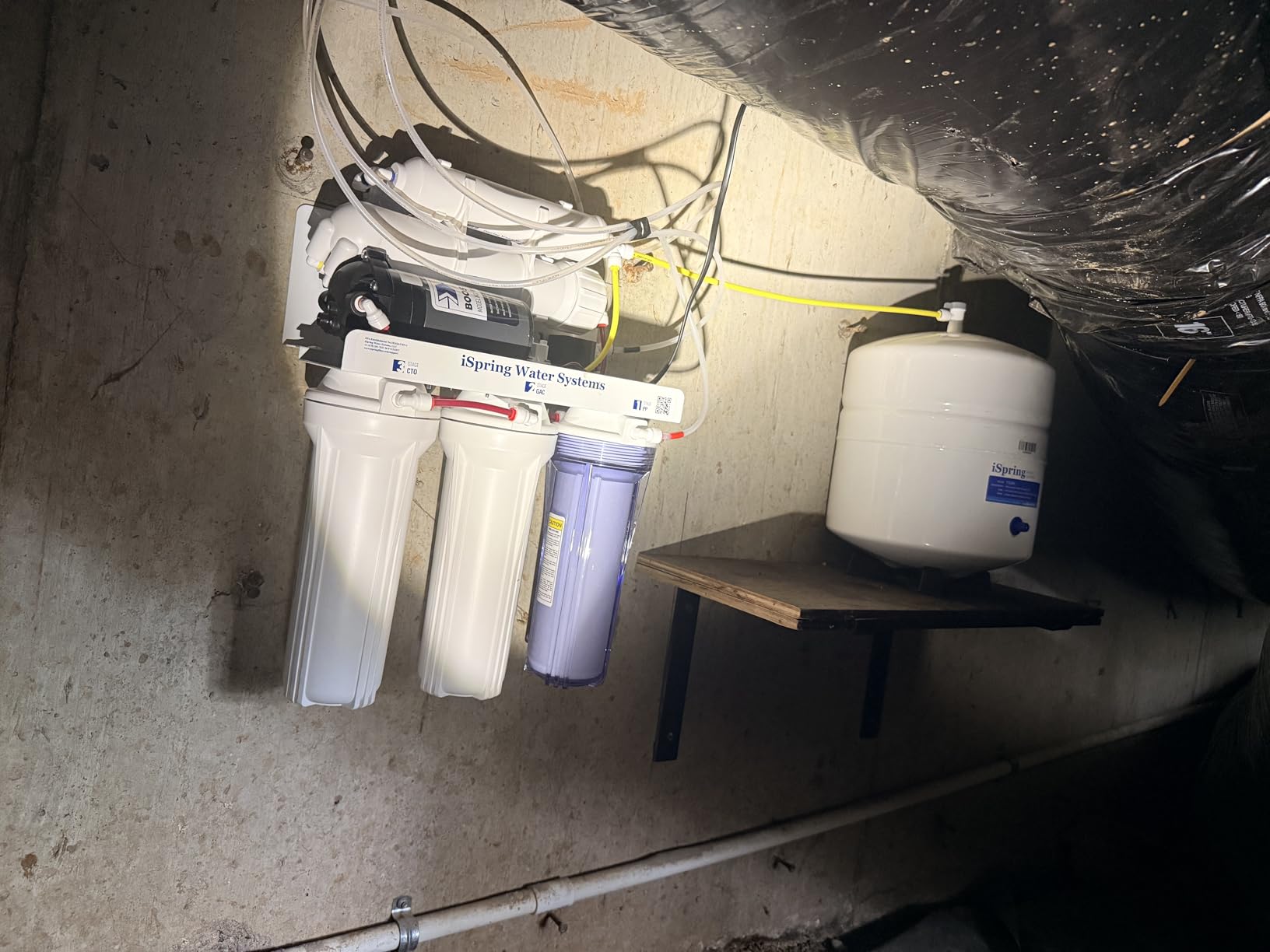
The iSpring RCC7P-AK is the hard-water answer in this roundup, and the reason is the integrated electric booster pump. Hard water and low line pressure travel together in older homes, and a pump is what keeps the membrane fed at working pressure instead of starving. Owners report this design resolving the low-pressure complaints that send people looking for a different system entirely.
It rates 4.7 stars, the highest average in the set, with 88 percent five-star and only 4 percent one-star ratings. Filtration is a six-stage train rated at 75 GPD with a stated reduction of up to 99 percent across more than 1000 contaminants, including lead at 98 percent, chlorine, fluoride, arsenic and PFAS. Feed water support runs to 2000 ppm TDS, the highest ceiling of any non-tankless unit here.
The sixth stage is an alkaline remineralization cartridge that restores minerals and balances pH, which is what separates the taste from a standard five-stage output. Owners repeatedly cite that taste difference as the satisfaction driver alongside the pump. The transparent first-stage housing lets you watch filter condition, and the universal 100-240V 50/60Hz power adapter means it works outside US and Canadian voltage, which matters for anyone with an international kitchen.
Unlike the RCC7AK-BN, this model draws power, and it weighs 20 pounds. It measures 15 by 8 by 18 inches, and the one-year limited manufacturer warranty applies on registration, alongside lifetime technical support from the same Atlanta operation.
Who the iSpring RCC7P-AK suits
This is the pick for hard water households, and specifically for homes where line pressure sits at the low end or where hardness is high enough to scale a membrane quickly. If you have measured water above roughly 300 ppm of hardness, a booster pump like this is the practical step that keeps filter life from collapsing, and it costs far less than adding a whole-house softener.
It is also right for anyone who wants alkaline remineralization without giving up the simple, repairable design of a tank-based system. The 2000 ppm feed TDS ceiling gives you real headroom, and standard replacement cartridges are available on a 6, 12, 24 and 36 month schedule depending on how hard your supply runs.
Where the iSpring RCC7P-AK falls short
It needs a nearby electrical outlet under the sink, and if you do not have one you are looking at an electrician rather than a weekend project. At 20 pounds it is also a heavier unit to maneuver into a tight cabinet, and the purchase price sits above basic five-stage systems because the pump is real hardware.
Note what a pump does not do. It raises pressure and cuts wastewater, but it does not remove hardness, so scaling risk on the membrane and downstream faucet components remains. Above roughly 300 ppm hardness, a softener feeding this system is the combination water treatment professionals describe, and if your goal is protecting your whole house rather than your drinking glass, our dosing pump guide covers the equipment that handles chemical feed upstream of a membrane.
9. iSpring RO500AK-ORB Review: Best for High Flow and Low Water Waste
iSpring RO500AK-ORB RO System, NSF/ANSI 58 Certified, 500 GPD with Alkaline
- Complete-system NSF/ANSI 58 certification
- 10-second cup fill at 0.4 GPM
- Auto-flush after 24 hours idle protects the membrane
- Front-panel lights and buzzer alert on filter changes
- Tankless body saves up to 70% of space
- Highest purchase price in the roundup
- Requires under-sink electrical access
- 28 pound unit is among the heaviest
- Replacement cartridges add recurring cost
The iSpring RO500AK-ORB is the high-flow pick, and its headline number is 0.4 GPM of real flow at the faucet. That is roughly five times what a conventional tank system delivers once the tank empties, and it is what makes this unit workable for a large household, for a refrigerator and ice maker, or for a house where nobody wants to wait for a refill.
It is certified to NSF/ANSI 58 as a complete system rather than component by component, which is the certification scope we weight most heavily. The 0.0001 micron membrane carries a stated reduction of up to 99 percent for lead, PFAS, TDS, chromium, radium, fluoride, arsenic and chlorine, and the 2:1 pure-to-waste ratio is claimed to save up to 400 percent water against a traditional design.
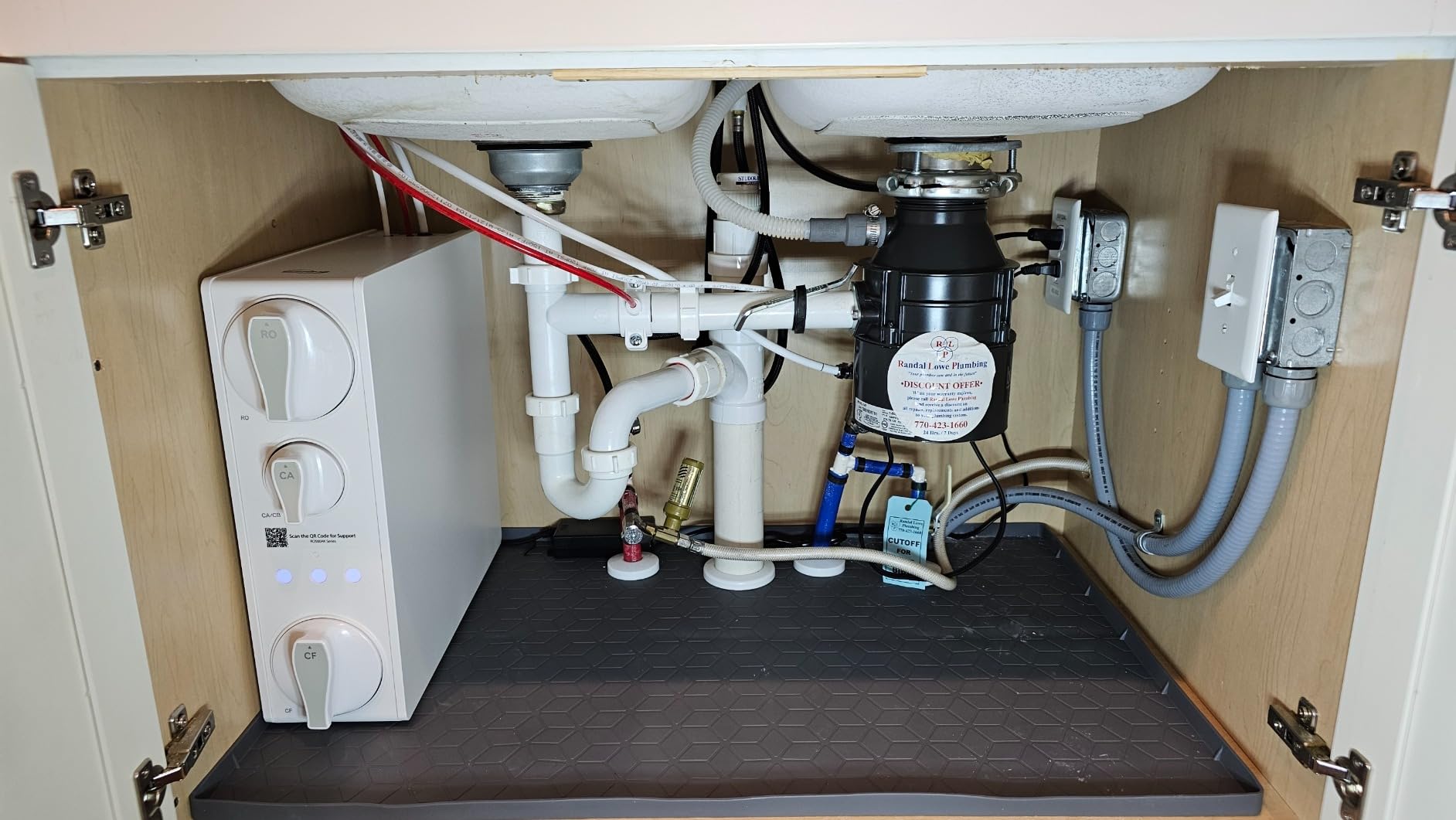
Two features separate it from faster rivals. The auto-flush cycle runs after 24 hours of non-use, which keeps the membrane wet and is directly relevant to the stale first-draw water that tankless systems otherwise show after a weekend away. And the front panel uses indicator lights with a buzzer for filter-change alerts, which is a real answer to the recurring forum complaint that budget models leave owners guessing until the water tastes wrong.
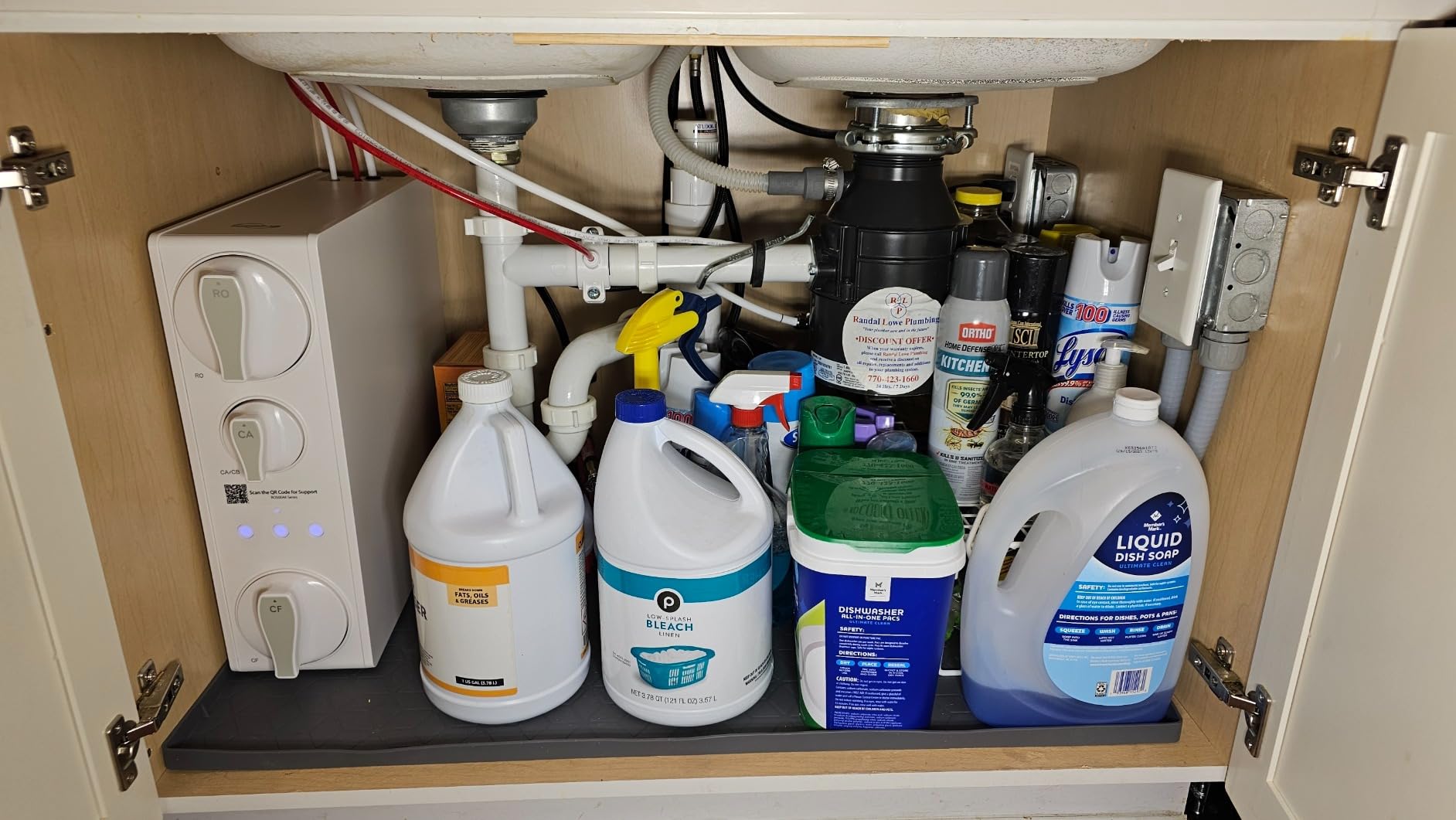
The body measures 16.13 by 5.13 by 16.25 inches and saves up to 70 percent of under-sink space. Quick-connect fittings support both 1/2 inch and 3/8 inch connections, and the box includes the faucet, manual, tubing, a feed water adapter, drain saddle and power supply. Replacement filters are the FCF500, MRO500, FCA500 and F7-RO500AK.
Who the iSpring RO500AK-ORB suits
This suits large households, families who cook a lot, and anyone feeding an ice maker or a refrigerator dispenser. The auto-flush makes it a good fit for households that travel, since a system that sits unused for weeks is exactly the one that develops an unpleasant first cup. The audible filter alerts also suit owners who do not want to track dates in a calendar.
Choose it over the Waterdrop G3P800 if you want the complete-system NSF/ANSI 58 listing and the auto-flush behavior rather than the highest throughput number. Both deliver fast flow, and the difference in daily use is smaller than the difference in price.
Where the iSpring RO500AK-ORB falls short
It carries the highest purchase price in this roundup, and combined with proprietary cartridges that puts the five-year ownership cost at the top of the field too. The 28 pound weight is among the heaviest units listed, which matters in a shallow cabinet. It also requires under-sink electrical access, so the same renters and older cabinets are excluded.
The 2:1 ratio is good rather than excellent, so it is not the pick if water conservation is your primary motivation. The buzzer alerts will also annoy some households, and on a system this size the maintenance interval is not long enough to make the alerts feel optional. If your budget does not stretch this far, the Waterdrop G3P600 gets you tankless speed for considerably less.
10. Waterdrop G3P800 Review: Best for High Household Volume
Waterdrop G3P800 Tankless Reverse Osmosis Water Filter System, 800 GPD
- Highest throughput here at 800 GPD with a 5-second cup fill
- 10-stage train is the deepest among the certified tankless units
- NSF/ANSI 42
- 53
- 58 and 372 certification
- Very quiet operation in a small footprint
- Works well feeding a refrigerator and ice maker
- Highest purchase price alongside the iSpring RO500AK-ORB
- Replacement filters are among the most expensive
- Requires under-sink electricity
- 500 ppm feed TDS ceiling
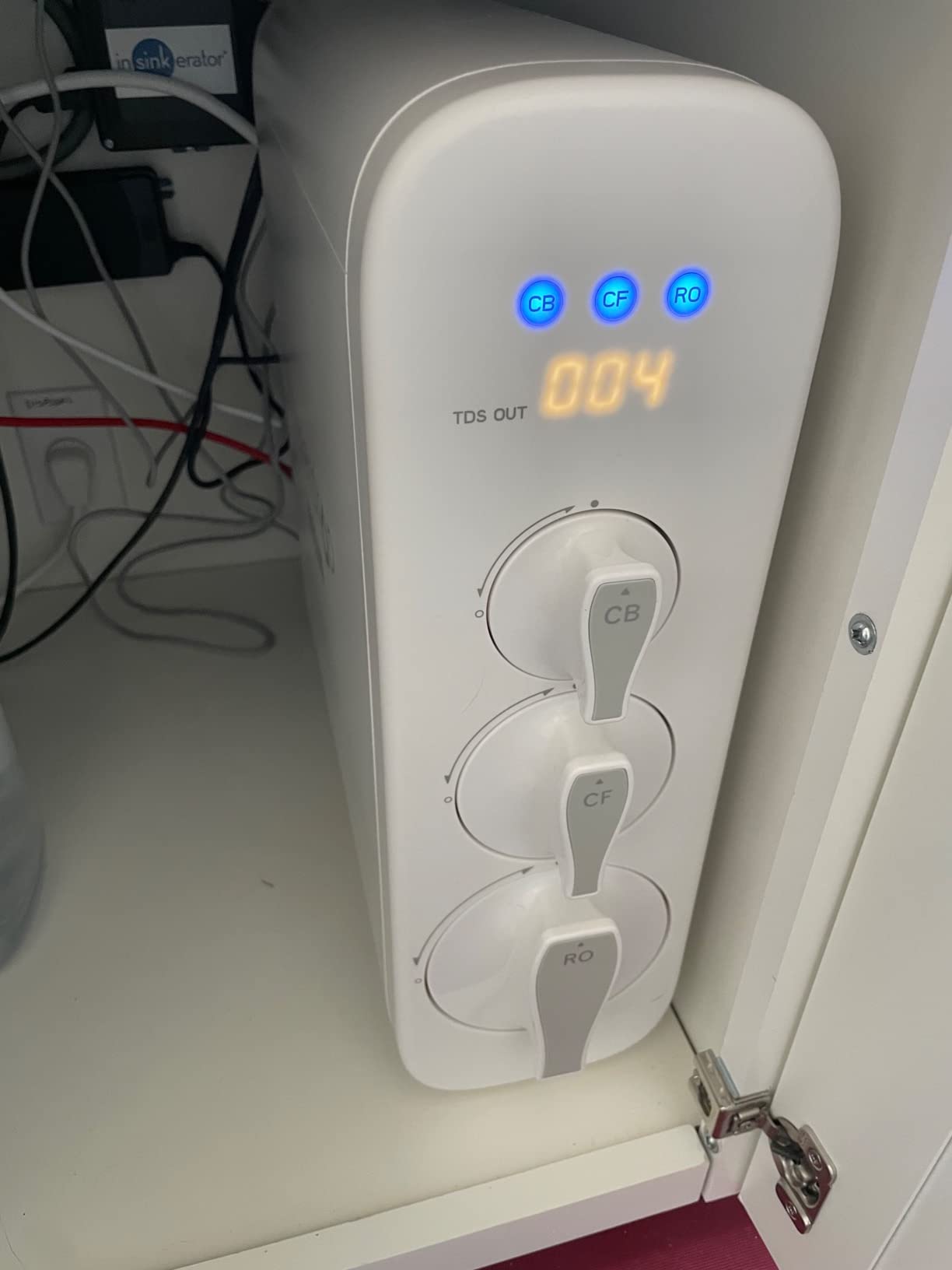
The Waterdrop G3P800 is the throughput leader, rated at 800 GPD with a cup fill in about 5 seconds, and it is the system we would look at for a busy household or a home where an ice maker and a refrigerator dispenser both run off the same purified line. It also carries the most complete certification set here, with NSF/ANSI 42, 53 and 58 plus NSF/ANSI 372 lead-free material certification, and the ten-stage train is third-party tested by SGS.
Its review volume is the largest among the tankless units in this roundup, above 5200 ratings, and it holds the top position in its retail category. Independent reviewers confirm TDS readings dropping into single digits, and the consistent praise is for quiet operation and a small footprint that fits beside a garbage can in a crowded cabinet.
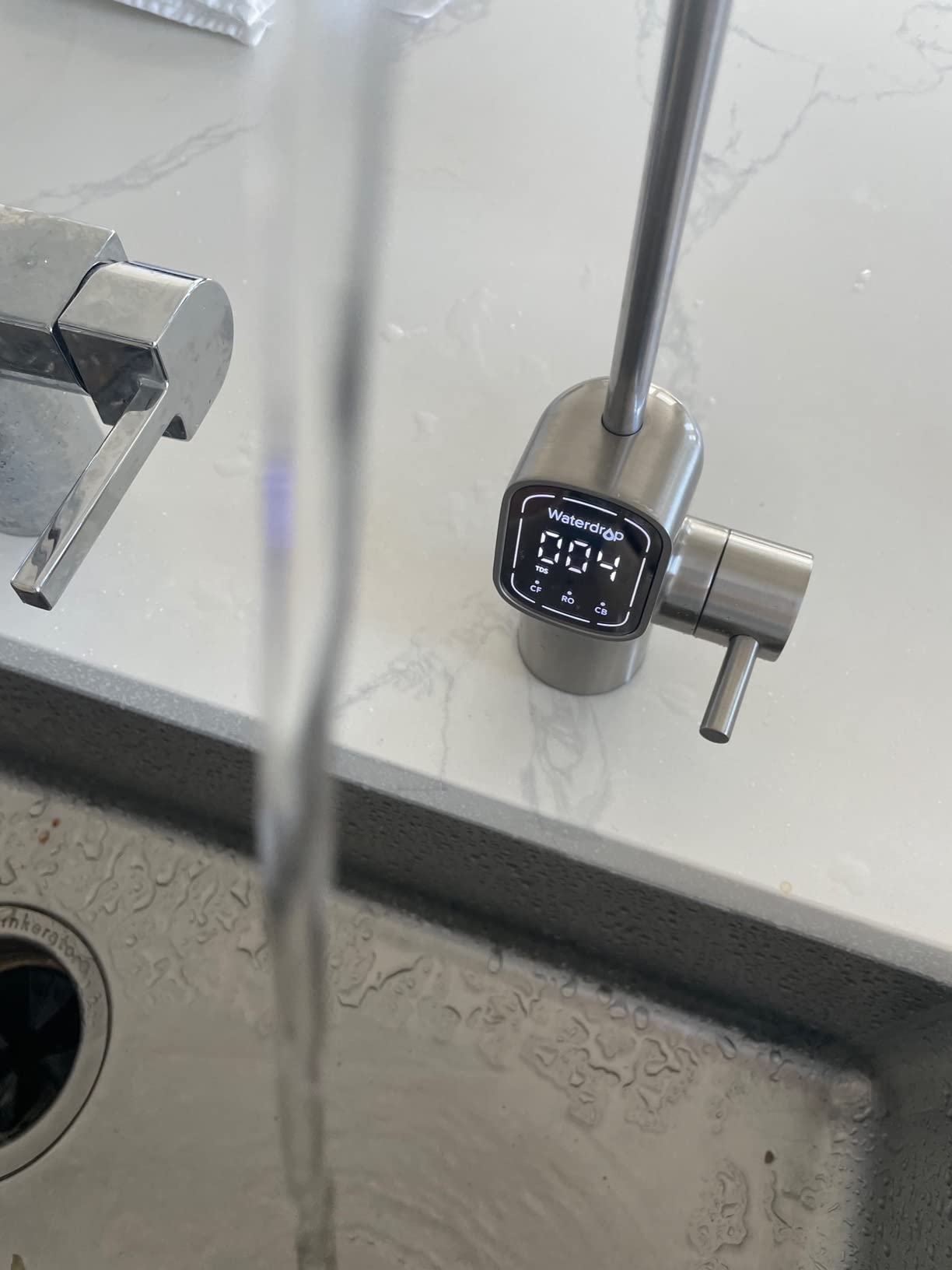
The smart faucet has an LED indicator rated by the manufacturer at a 50-year lifespan that activates automatically when water flows, showing TDS level and water quality without any button press. The stated 3:1 pure-to-drain ratio is less efficient than the 2:1 units in this roundup, which is a fair trade for the extra throughput, and it handles feed water up to 500 ppm TDS.
Because there is no storage tank, there is no stagnant vessel in the system, and owners specifically note that this removes the bacteria-growth question that comes with tank-based designs. That is a meaningful advantage for anyone who has had a storage tank go a year without being drained properly.
Who the Waterdrop G3P800 suits
This fits a family of four or five, a household with heavy cooking demand, and anyone running a refrigerator and ice maker off the RO line, where owners report improved dispenser pressure compared with a tank system. It is also a good choice for anyone who wants a deep filtration train with certification at every stage rather than the shortest train that meets the standard.
Pick it when the glass and ice matter more than the electricity bill. The 3:1 ratio costs more water than a 2:1 design, so on a metered supply where water conservation is a household priority, a 2:1 unit is the more responsible choice.
Where the Waterdrop G3P800 falls short
It shares the top of the price range with the iSpring RO500AK-ORB, and its replacement filters are among the most expensive in the category, which is the reservation several owners say they would weigh more heavily buying again. Some buyers pre-order cartridges in bulk because replacements can be on backorder, so plan the change schedule ahead.
The 500 ppm maximum input TDS limits use with harder well or untreated sources, so this is a municipal-water system more than a well-water one. It also requires under-sink electricity, and the unit ships without the tank that some buyers expect, so verify your cabinet depth before ordering.
11. DREO Countertop RO Review: Best for First-Time Buyers
- Lowest countertop price in the roundup
- Two autofill pitchers included for storing filtered water
- Built-in TDS meter and filter-life indicator on a touch interface
- No plumbing
- drilling or installation required
- Self-cleaning cycle cuts manual maintenance
- Smallest review base here at 870 ratings
- 3:1 drain ratio is less efficient than the 2:1 units
- 5 L tank needs frequent refills
- Newer design with less long-term history
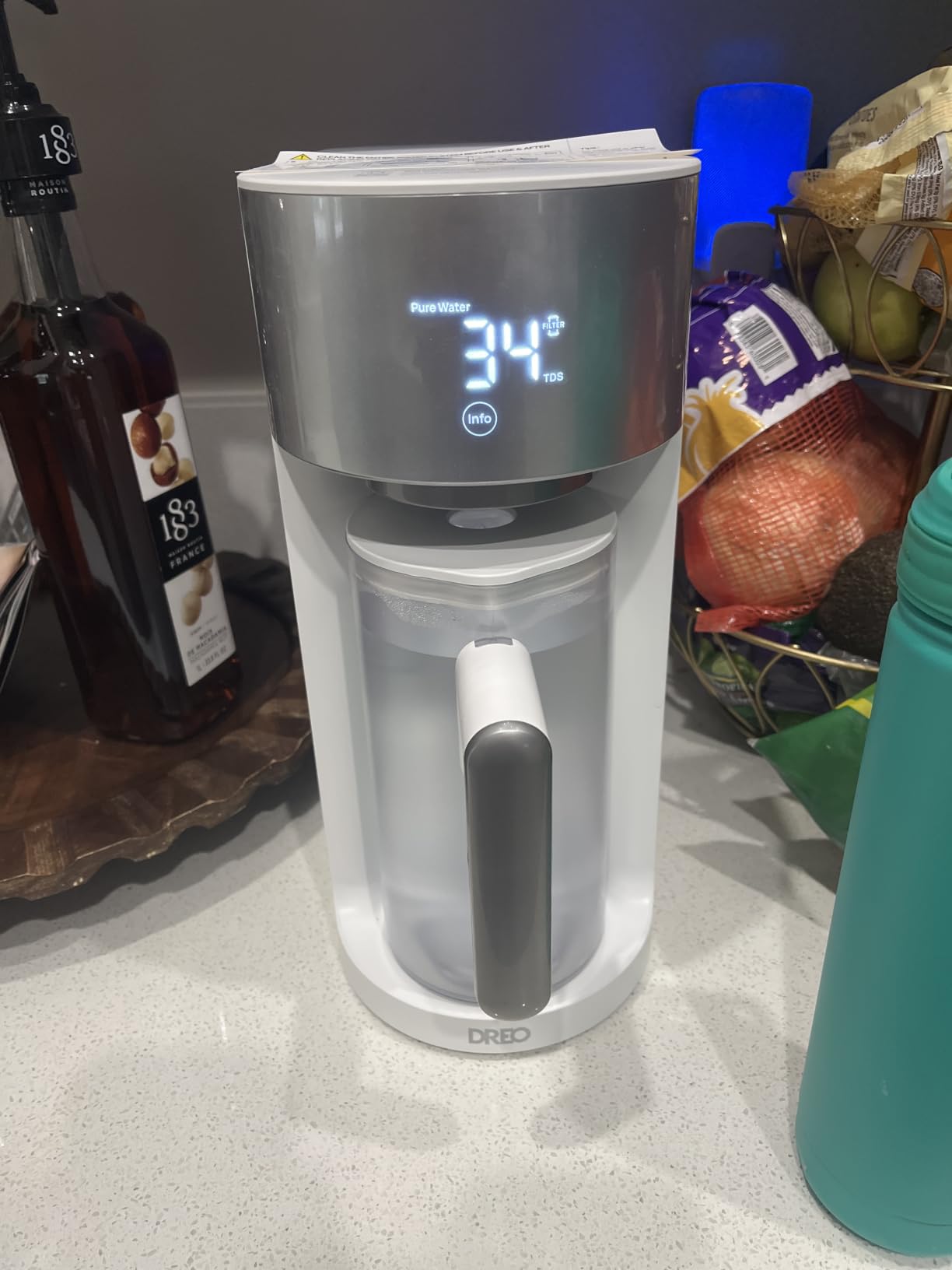
The DREO countertop RO is the newest design in this roundup and the easiest entry point, and its appeal is that it removes every decision from the first purchase. You unbox it, fill the 5 liter tank, and it runs. There is no faucet drilling, no drain line, no under-sink outlet and no installation manual to work through, which makes it the shortest path to drinking RO water for anyone who has never owned a filtration system.
The filtration is a seven-in-one RO configuration tested by SGS against NSF/ANSI 58 standards, with a claimed 99.9 percent removal of contaminants including PFOA, PFOS, chlorine and fluoride. The pure-to-drain ratio is 3:1, dispense water sits in a 5 liter tank, and the unit weighs 10.8 pounds. Touch controls give you a built-in TDS meter, a filter-life indicator and a self-cleaning cycle that handles routine maintenance without disassembly.
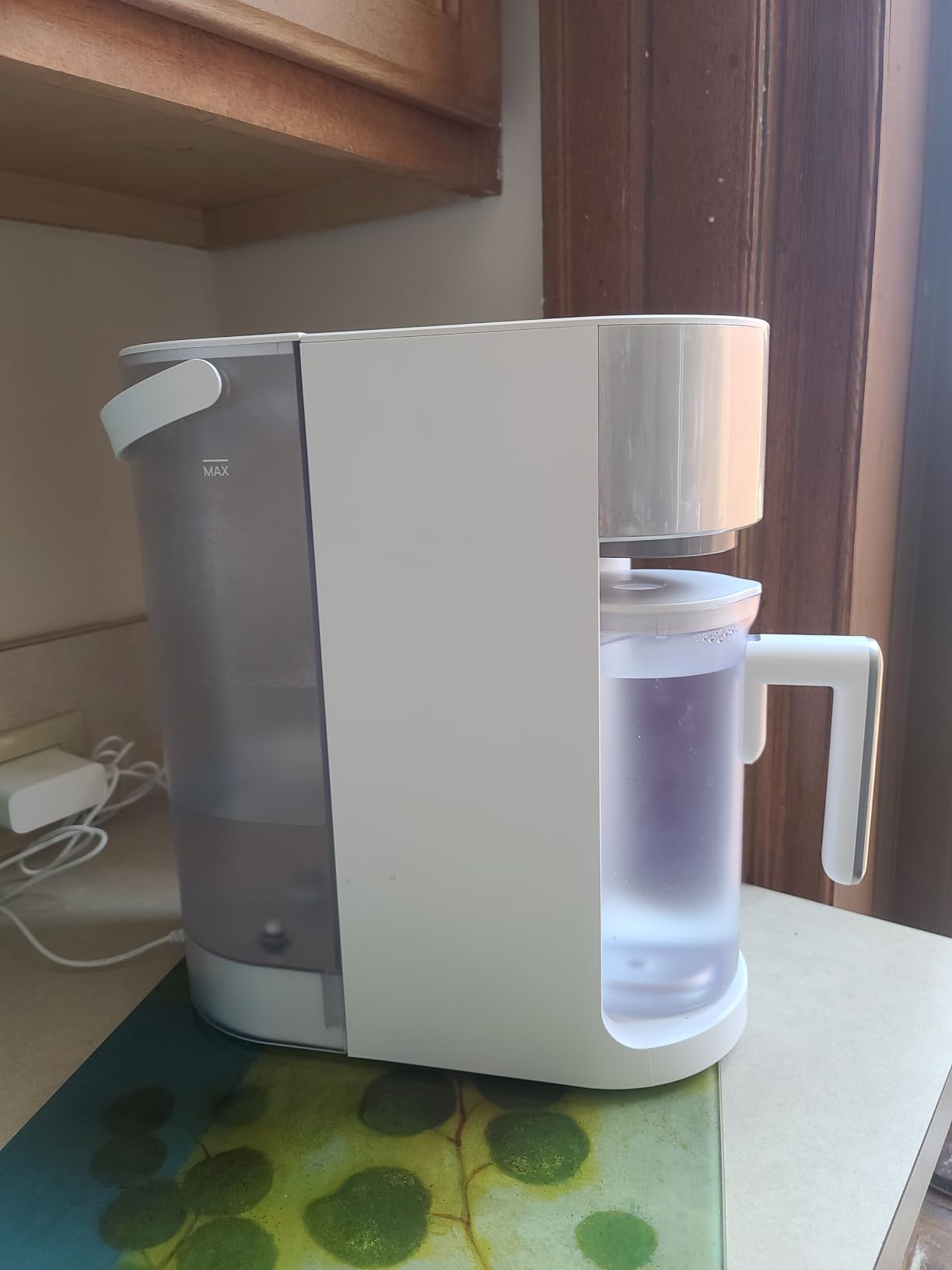
Two autofill pitchers are included, which solves the storage problem that most countertop units create. Instead of leaving purified water sitting in a manufacturer-supplied container, you fill or transfer into your own pitcher and put the remaining water back in the tank, which is better for taste and better for the small reservoir staying clean.
At 4.4 stars with 73 percent five-star ratings, satisfaction tracks with the price point, and the unit ranks first in its retail category, which suggests strong early traction. Its rank is not a quality judgment, it is a visibility one, and it is listed here because the hardware is genuinely capable rather than because it has a long service record.
Who the DREO Countertop RO suits
This is the pick for a first-time buyer, a renter, a dorm or an office break room, and for anyone who wants to test whether they actually prefer drinking RO water before committing to a permanent under-sink install. The self-cleaning cycle and filter-life indicator mean you do not need to learn filter maintenance before you can use it.
It is also useful as a secondary system in a home that already has under-sink filtration, since it can produce purified water for a second location without any plumbing. For larger-volume needs, our commercial filtration guide covers the throughput requirements once you move past a countertop unit.
Where the DREO Countertop RO falls short
With 870 ratings it has the smallest review base in this roundup, and the design is a recent introduction, so long-term durability is simply not yet documented. That is the honest reason to treat it as a lower-confidence pick despite the good hardware and the category rank. A system with a decade of field data is a different kind of bet.
The 3:1 drain ratio is less water-efficient than the 2:1 countertop units here, and the 5 liter tank means frequent refills for a heavy drinking household. It also runs on mains power with a cord across the counter. If you want the same install-free format with a longer filter interval and a glass carafe, the Bluevua is the more established choice.
12. GeekPure RO6-AF Review: Best Under-Sink Alkaline System on a Budget
Geekpure 6 Stage Reverse Osmosis RO Drinking Water Filter System-75 GPD
- Alkaline stage raises pH to 7.5-8.5 for better taste
- No electricity so only feed pressure is required
- Lowest cost among under-sink alkaline systems here
- NSF certificated membrane
- fittings and tank
- Accepts a wide 40-100 psi pressure range
- 2.8 gallon tank is smaller than the 5 gallon tanks on rivals
- 25 pound listed weight is heavy for the size
- Needs 40 psi minimum so low-pressure homes need a pump
- First two tanks of production must be flushed
The GeekPure RO6-AF does one thing better than most of the under-sink units at the lower end of the price range, and that thing is taste. The sixth-stage alkaline pH+ filter raises output from a starting pH of 5 to 6.5 up to 7.5 to 8.5 and adds calcium, magnesium, sodium and potassium ions back into the water. For buyers who reject standard RO output as flat or sour, that single stage is often the whole difference.
The system runs at 75 GPD with a 2.8 gallon storage tank, needs no electricity at all, and accepts a wide 40 to 100 psi feed pressure range with up to 1000 ppm feed TDS. The membrane, tubing, quick push fittings and storage tank are all NSF certificated, and the stated filter life is 1 year with the RO membrane lasting 2 to 3 years.
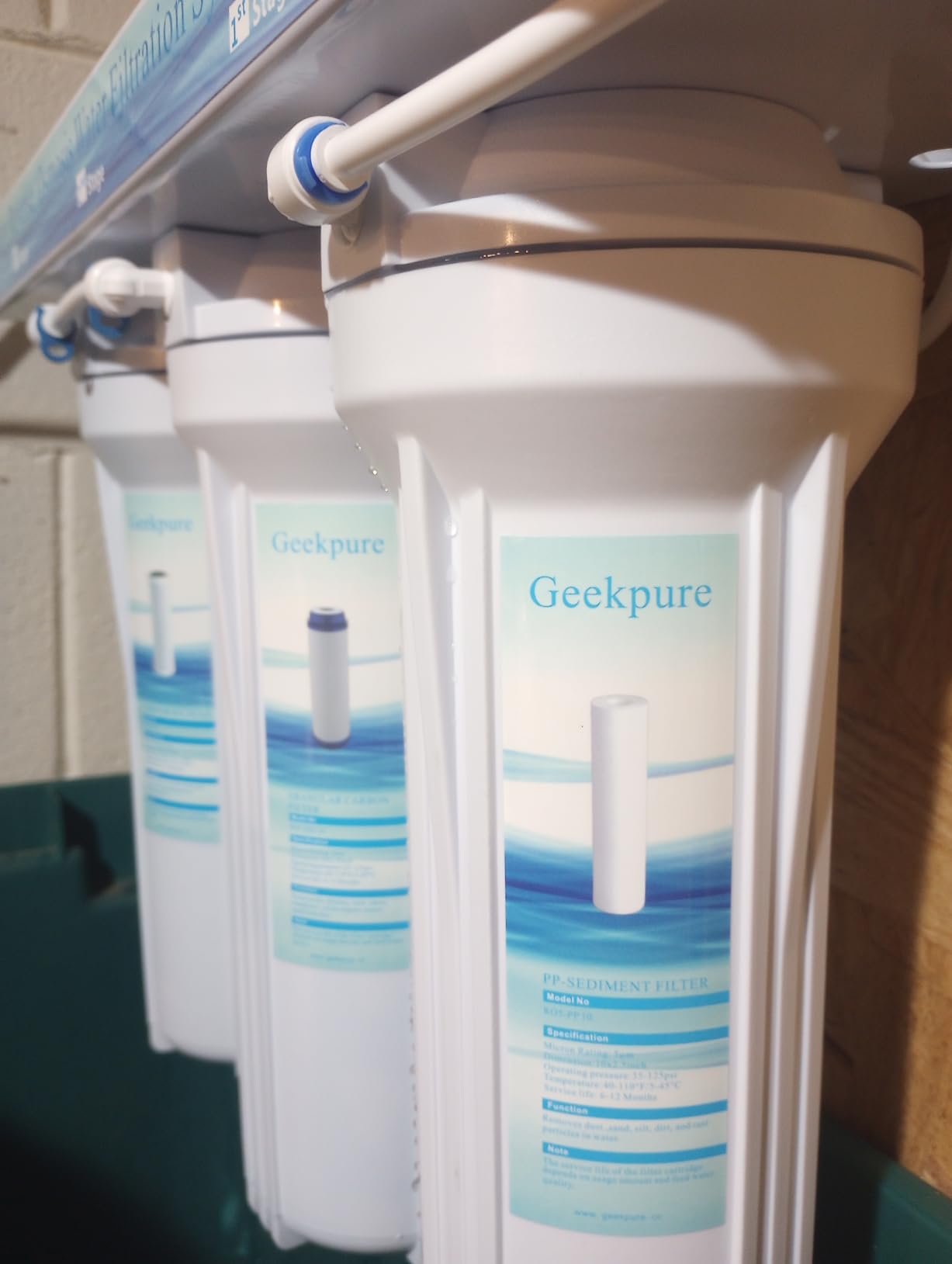
Owners confirm the pH claim, reporting noticeably better tasting water than a standard five-stage unit at a lower purchase price, with 81 percent five-star ratings. Color-coded tubing and quick push fittings make the DIY install straightforward, and the 1 year warranty sits alongside 24/7 technical support from a manufacturer with more than 20 years in the category.
It weighs 25 pounds, which is heavy for a unit this size, and the small tank is the practical limit. The first two tanks of production must be flushed and discarded after installation, which is normal for RO but is a step that catches out first-time owners who drink the first glass immediately.
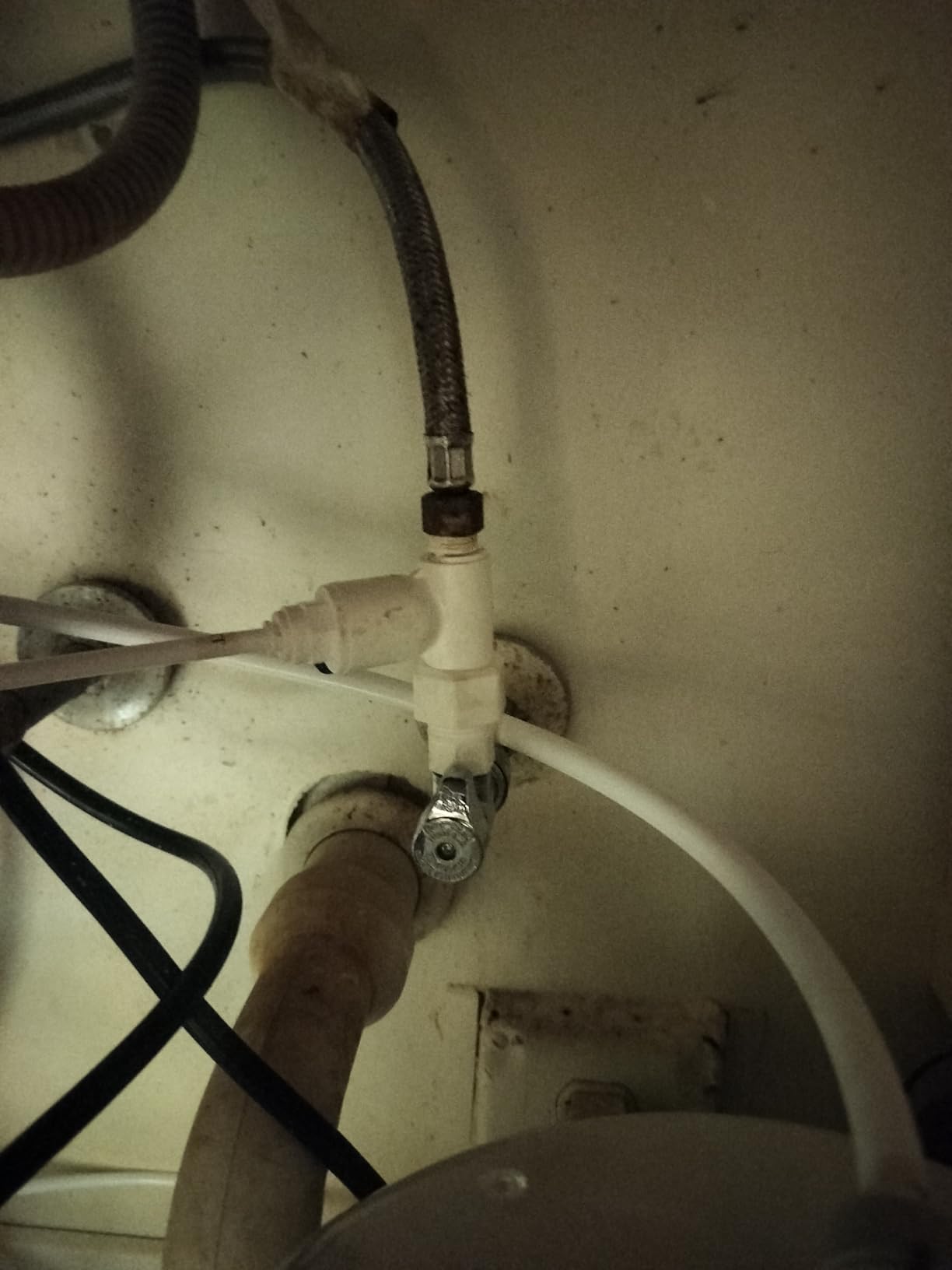
Who the GeekPure RO6-AF suits
This suits a couple or a small household on soft or moderately hard municipal water who wants alkaline output and standard repairable components at a low purchase price. The no-electricity design means it installs anywhere with a cold line, a drain and a drilled hole, with no outlet to add. It also suits anyone who prefers push fittings over wrapped Teflon tape and push-to-connect tubing.
It is the budget route to an alkaline sixth stage. If you also need a pump for low pressure, the iSpring RCC7P-AK is the same idea with the pump already built in, and it is the better buy if you know you have a pressure problem.
Where the GeekPure RO6-AF falls short
The 2.8 gallon tank is smaller than the five-gallon tanks on most competitors, so usable water per fill is lower and recovery is quicker. At 636 ratings it also has the smallest established-brand review base in the group, which means fewer years of field data behind the claims. The 25 pound listed weight is high relative to the footprint, so check cabinet depth and shelf strength before ordering.
It needs at least 40 psi of feed pressure, and in a low-pressure home output will suffer without a booster pump. Combined with the small tank and the flush-then-discard requirement on day one, this is a unit built for a specific home rather than a general recommendation. If you want the alkaline stage with more capacity, the iSpring RCC7AK-BN costs more and delivers 75 GPD into a full-size tank.
How to Choose a Reverse Osmosis System: 7 Steps
Step one is to test your water before you buy anything. A mail-in lab panel that covers total dissolved solids, hardness, iron, manganese, nitrate, lead and PFAS will tell you in a week whether reverse osmosis is even the right tool. It also sets your expectation for recovery rate, because a system producing one gallon from four gallons of feed water is a different proposition on a well than it is on city water.
Step two is to read certification language precisely. NSF/ANSI 58 certifies contaminant reduction and is the one that matters for filtration. NSF/ANSI 372 certifies lead-free materials only, so a system with a 372 badge and no 58 listing may remove very little. NSF/ANSI 42 covers aesthetic chlorine taste and odor, and NSF/ANSI 53 covers health-related contaminants in a carbon context. A complete-system 58 listing is stronger evidence than a component claim, and that distinction is where most buyers get misled.
Step three is to check feed pressure and temperature, because non-pumped systems depend on both. Most need somewhere between 40 and 85 psi and perform at their rated GPD near 60 psi. If your pressure is marginal, buy a system with a booster pump from the start rather than adding one later, and note that pump-equipped units also waste less water.
Step four is to count stages, and to read the list rather than the number. A six-stage system that ends in an alkaline pH+ cartridge gives you better taste than a five-stage system without one, while a five-stage system with a larger sediment pre-filter may protect the membrane longer on well water. The stage count matters less than what each stage does and in what order.
Step five is to budget filter cost, not purchase price. Cartridges for a standard-housing system run far cheaper than proprietary tankless cartridges, and that difference compounds every year. Ask the manufacturer for the change interval on each cartridge and the price of a full kit, then multiply by five. A system that costs less up front and more every year can be the more expensive system over a decade.
Step six is to match the format to your cabinet and your household. A tank-based system needs vertical space for three housings plus a pressurized tank. A tankless system needs width for a single body, an electrical outlet and room to swing the filter cartridges forward. A countertop system needs a counter rectangle and a power socket, and nothing else. If you are feeding an ice maker, choose on flow and pressure rather than capacity.
Step seven is to decide whether you need a plumber. All of these systems need a cold water feed, a drain line and a drilled faucet hole, and a tankless or pump-equipped model also needs an under-sink outlet. If you do not have an outlet and cannot add one without opening a wall, choose a no-electricity model such as the iSpring RCC7AK-BN, the APEC ROES-50, the FS-TFC or the GeekPure. Installation on those is a genuine weekend job, while adding a new electrical outlet is not.
City Water, Well Water and Hard Water: What Changes
On municipal water, your job is mostly about certification and taste. Lead reduction matters where service lines are old, chlorine is aesthetic rather than a health concern, and fluoride is a genuine addition. Any of the NSF/ANSI 58 systems on this list will handle it, so decide on flow, footprint and cartridge cost. The iSpring RCC7AK-BN is the default here.
On well water, you need pretreatment before the membrane, and this is where most online buying guides go quiet. Iron, manganese and sediment will foul a prefilter and then the membrane itself, so a sediment stage and an iron filter ahead of the RO unit is not optional. A booster pump is also common, since well pressures are often lower and less consistent than municipal supply. Of the systems here, the iSpring RCC7P-AK is built for this, and the SimPure Y7P-BW is the realistic entry point if you are not ready to plumb anything yet.
On hard water, the community rule of thumb is a hardness threshold rather than a brand recommendation. Below roughly 300 ppm, a booster pump and a well-maintained prefilter are usually enough. Above that, softening the feed water is what protects the membrane, and forum consensus across the water treatment communities is to feed a softener into the RO system rather than fight scaling with membrane changes. The pump in the iSpring RCC7P-AK raises pressure and cuts wastewater, but it does not remove hardness.
Two habits matter more than any brand choice. Flush the first two tanks after installation and after any filter change, because carbon fines and membrane debris taste bad and a first glass taken straight after a swap is the fastest way to decide you made a mistake. And if a tankless system sits unused over a weekend, run the tap for 20 to 30 seconds before filling a glass, because water sitting in the membrane lines picks up dissolved solids and comes out tasting stale.
What Reverse Osmosis Does Not Remove
RO is not a universal solvent, and the honest version of a buying guide says so. Boron is poorly rejected by standard polyamide membranes, and some short-chain PFAS species are more difficult to remove than the long-chain compounds that dominate current testing. A system certified for PFAS reduction on its specifications sheet has been tested against listed substances, not against every compound in the family. Viruses are also outside the scope of a residential membrane, which removes dissolved solids rather than inactivating biological organisms.
It also does not soften water. Hardness is a dissolved mineral load, and while RO reduces the total dissolved solids number, the resulting water is not treated water and will not stop scale on your pipes, heater or glassware. If scale is the problem you are solving, you want a softener upstream, not an RO system at the drinking glass.
And if chlorine taste and odor are your only complaint, reverse osmosis is over-engineered. A carbon block filter under the sink or at the faucet removes chlorine taste for a fraction of the cost, wastes no water, and keeps the minerals that make municipal water taste the way it does. Test first, then buy the smallest thing that solves your actual problem.
Frequently Asked Questions
Is there a downside to drinking reverse osmosis water?
The main downside is that RO strips out dissolved minerals along with contaminants, so the water tastes flat and contains almost no calcium or magnesium. It also sends three to five gallons to the drain for each gallon purified on older tank systems, and the membrane needs scheduled replacement. For most people the taste is the deciding factor, which is why a remineralization or alkaline stage matters.
Is RO water hard on the kidneys?
There is no good evidence that drinking RO water is hard on healthy kidneys. Concern usually comes from the low mineral content, since calcium and magnesium contribute to daily intake, and some people notice they urinate more when they drink very mineral-free water. A remineralization stage restores those minerals and removes most of the objection for anyone who drinks large volumes.
What is the best reverse osmosis system for hard water?
Above roughly 300 ppm hardness, feed a water softener into the RO system, because no membrane stops downstream scale. Below that threshold, a booster pump and a maintained sediment prefilter are usually enough. Of the systems we reviewed, the iSpring RCC7P-AK is the best fit for hard water because the integrated pump holds pressure and cuts waste, though it does not remove hardness itself.
Which reverse osmosis system is best for well water?
Well water needs pretreatment: a sediment stage and an iron filter ahead of the membrane, plus usually a booster pump for pressure. The iSpring RCC7P-AK has the pump built in, and the iSpring RO500AK-ORB adds automatic flushing and 0.4 GPM flow. If you cannot plumb anything yet, the SimPure Y7P-BW countertop unit is a reasonable starting point, with owners reporting drops from 849 ppm to about 30 ppm.
Why does my reverse osmosis water taste bad?
Three causes account for nearly all taste complaints. After installation or a filter change, flush the first two tanks, because carbon fines taste bitter. If a tankless system sat unused, run the tap for 20 to 30 seconds before drinking, since water sitting in the lines picks up dissolved solids. If the taste stays flat in daily use, add a remineralization or alkaline filter to put minerals back.
Is there something better than reverse osmosis?
For a broad list of dissolved contaminants including lead, fluoride, nitrates, arsenic and PFAS, nothing common to households matches the removal of an NSF/ANSI 58 certified RO system. For chlorine taste and odor alone, a carbon block filter does the same job for far less money and with no wastewater. For scale and hardness, a softener is the right tool, and for biological contaminants, UV is what you want.
The Verdict: Which Reverse Osmosis System Should You Buy in 2026
The iSpring RCC7AK-BN is the best reverse osmosis system for drinking water for most households in 2026, because complete-system NSF/ANSI 58 certification, a 75 GPD six-stage train and an alkaline pH+ stage solve the two complaints owners raise most, poor certification clarity and flat taste. It needs no electricity, uses widely available replacement filters and has the deepest verified ownership record in this roundup.
Buy the APEC ROES-50 instead if parts availability and a low purchase price matter most. Buy the Waterdrop G3P600 if you want tankless speed and a 2:1 drain ratio and can add an under-sink outlet. Buy the iSpring RCC7P-AK if you are on hard water or low line pressure. And buy the Bluevua RO100ROPOT or the SimPure Y7P-BW if you are renting and cannot touch plumbing.
Test your water first, read NSF/ANSI 58 as the certification that matters rather than NSF/ANSI 372, and buy the smallest system that solves the problem you actually have. Our picks are updated in October 2026, and we revise the ranking whenever specifications or owner-reported results change.