
Standing at the water’s edge on race morning, you zip up your wetsuit and wonder: how does a wetsuit work to keep you warm and fast in those cold open waters? I have completed over a dozen triathlons in water temperatures ranging from 58°F to 78°F, and understanding the mechanics behind your wetsuit has made the difference between a comfortable swim and a shivering, miserable slog.
A wetsuit is not just a rubber suit that keeps water out. It is a sophisticated piece of thermal engineering that uses neoprene foam, trapped water layers, and precise construction to create an insulating barrier between your body and the cold. For triathletes, this technology does more than prevent hypothermia. It provides buoyancy that improves your body position, reduces drag, and can shave minutes off your swim split.
In this guide, I will break down exactly how wetsuits work from a scientific perspective. We will explore the neoprene material, the trapped water layer mechanism, why fit matters so much, and how triathlon-specific wetsuits differ from surf suits. By the end, you will understand not just the what, but the why behind your most important piece of swim gear.
Table of Contents
The Science of Wetsuit Insulation
Water conducts heat away from your body approximately 25 times faster than air. This means that without protection, you lose body heat rapidly in cold water, even when the air temperature feels comfortable. In triathlon swims, this heat loss can lead to hypothermia, reduced performance, and even dangerous situations.
The second law of thermodynamics tells us that heat naturally flows from warmer objects to cooler ones. Your body, maintaining a core temperature around 98.6°F (37°C), constantly tries to warm the cold water surrounding you. Without insulation, your metabolic systems cannot keep up with this heat transfer, and your core temperature drops.
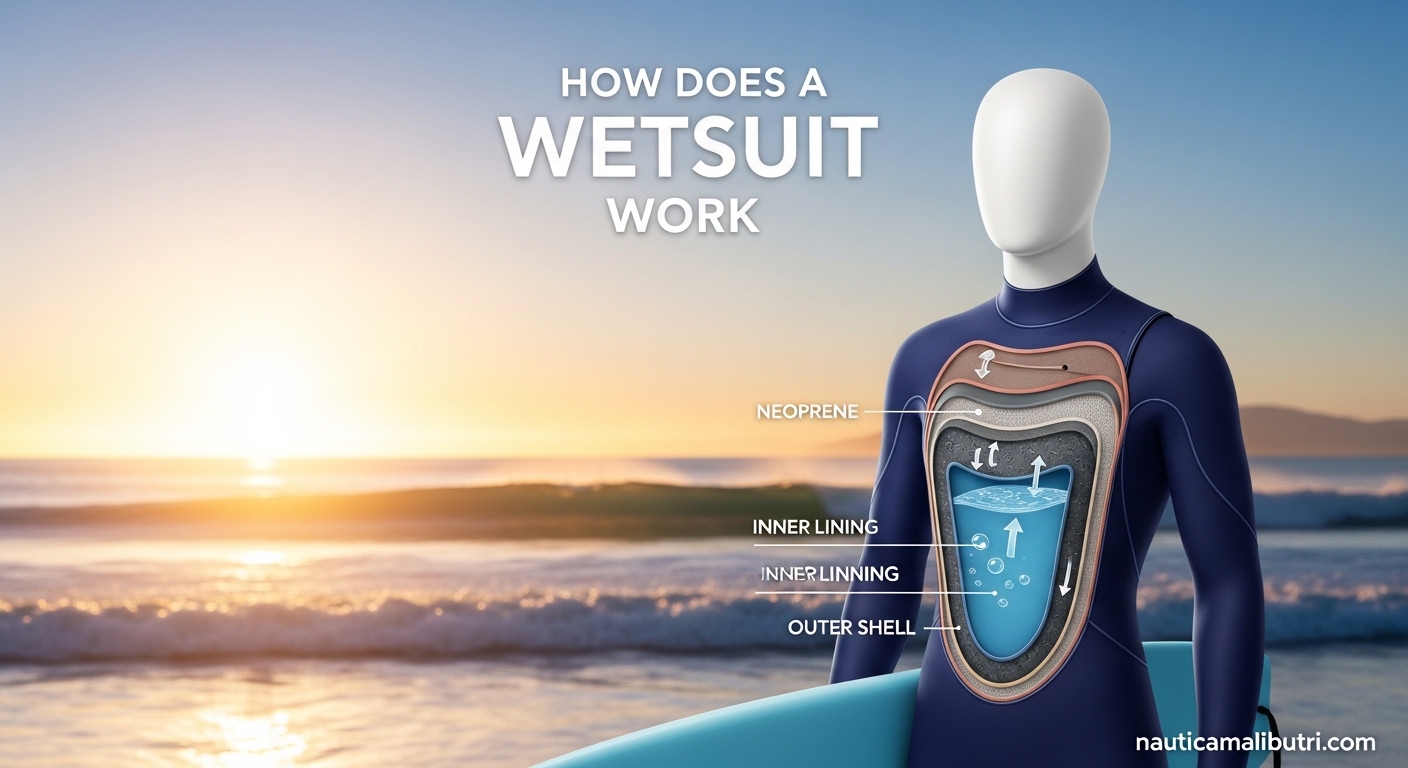
Wetsuits work by interrupting this heat transfer through three mechanisms. First, the neoprene material itself provides thermal resistance. Second, a thin layer of water gets trapped between your skin and the suit, which your body warms to skin temperature. Third, the tight fit of the suit prevents cold water from circulating in and replacing that warmed water.
Newton’s law of cooling applies directly to swimming without a wetsuit. The greater the temperature difference between your body and the water, the faster you lose heat. A wetsuit reduces this temperature gradient by creating a microclimate of warmer water and insulating foam next to your skin.
For triathletes, understanding this science matters because it helps you choose the right wetsuit thickness for race day conditions. Wearing too thin a suit in cold water means you cannot generate enough body heat to warm the trapped water layer. Wearing too thick a suit in warmer water leads to overheating and restricted movement.
Neoprene: The Magic Material
Neoprene is the heart of every wetsuit. Chemically known as polychloroprene, this synthetic rubber was developed by DuPont scientists in the 1930s and revolutionized water sports forever. The material starts as chloroprene monomers that undergo polymerization to create long molecular chains with unique thermal properties.
The magic happens during the manufacturing process called gas blowing. Liquid neoprene is whipped with nitrogen gas to create millions of tiny bubbles suspended in the rubber matrix. These nitrogen-filled pockets give neoprene its distinctive cellular structure and remarkable insulating abilities.
Why nitrogen? Nitrogen gas has low thermal conductivity, meaning heat does not pass through it easily. When your body heat tries to escape into cold water, it must first conduct through the neoprene material. The nitrogen bubbles act as barriers, slowing this heat transfer dramatically compared to solid rubber alone.
Modern neoprene comes in different grades and compositions. Limestone-based neoprene offers improved warmth and reduced environmental impact compared to petroleum-based alternatives. Some high-end triathlon wetsuits now incorporate graphene-infused linings that further enhance thermal retention and reduce friction in the water.
The cellular structure of neoprene also provides buoyancy. Those nitrogen bubbles displace water, creating upward lift that helps keep you at the surface. For triathletes, this buoyancy is a game-changer. It reduces the energy you spend staying horizontal and allows you to focus power on forward propulsion instead of fighting gravity.
Flexibility matters too. Not all neoprene is created equal. High-quality triathlon wetsuits use varying cell densities throughout the suit. The chest and torso might use thicker, more insulating neoprene, while the shoulders use thinner, more flexible material to allow unrestricted stroke range. This multi-thickness construction balances warmth with mobility.
The Trapped Water Layer Mechanism
Here is the concept that confuses many first-time wetsuit wearers: wetsuits are not waterproof. Water enters the suit through the neck, wrists, and any gaps in the fit. This is by design, not by failure.
When you first enter the water, a thin layer of water seeps between your skin and the neoprene. Your body immediately begins warming this water to approximately skin temperature, around 91°F (33°C) for your extremities. Once warmed, this water becomes an insulating layer itself.
The key is that this warmed water stays trapped. A properly fitting wetsuit limits water circulation inside the suit. The neoprene presses against your skin at the wrists and ankles, creating seals that prevent cold water from constantly flushing in and displacing the warm layer.
Think of it like a thermos. The outer neoprene is like the plastic shell. The trapped water layer is like the vacuum insulation inside. Your body heat warms this middle layer once, and the suit keeps it there, reducing how much new cold water your body must heat repeatedly.
Without a wetsuit, you are constantly trying to warm an infinite supply of new cold water flowing past your skin. With a wetsuit, you warm a small, fixed amount of water once, and that warmed water helps insulate you from the surrounding cold. This is why even a thin wetsuit makes such a dramatic difference in comfort and safety.
The trapped water layer also provides a surprising benefit for triathletes: it adds to the suit’s buoyancy. Water is less dense than your body, so having that layer inside the suit adds to the overall lift effect. Combined with the nitrogen bubbles in the neoprene, a wetsuit can provide significant flotation assistance during your swim leg.
Why Fit Matters: Preventing Flushing
Flushing is the enemy of wetsuit warmth. This term describes what happens when cold water circulates freely inside your wetsuit, constantly replacing the warm water layer your body worked hard to heat. Even the highest quality neoprene cannot keep you warm if flushing occurs.
Imagine wearing a jacket with gaping holes in it during a windstorm. The jacket material might be warm, but the wind keeps blowing cold air inside, negating any benefit. Flushing works the same way. Gaps at the wrists, ankles, neck, or torso allow cold water to stream in and out, carrying away your body heat.
A proper wetsuit fit should feel almost uncomfortably tight when dry. The neoprene stretches when wet, so what feels snug on land will feel more comfortable in water. The suit should touch your skin at all major seal points without gaps or wrinkles. You should not be able to easily slide your hand between the suit and your skin at the wrists or ankles.
Seam construction plays a huge role in preventing leaks. The best triathlon wetsuits use glued and blind-stitched seams, abbreviated as GBS. This technique involves gluing the neoprene edges together, then stitching halfway through without penetrating the outer surface. The result is a watertight seam that maintains flexibility.
Some premium wetsuits add fluid-seam welds or liquid taping over the seams. This creates a rubbery coating that seals the stitching completely, further reducing any chance of water penetration. For triathletes, these sealed seams matter because even small leaks can add up to significant heat loss during a long swim.
Shoulder fit deserves special attention for triathletes. You need enough tightness to prevent water entry, but not so much that your stroke becomes restricted. High-quality triathlon wetsuits use stretchier neoprene in the shoulder panels and sometimes include catch panels that help you feel the water better during your pull.
Wetsuit Thickness Decoded
Wetsuit thickness is measured in millimeters and expressed as ratios like 3/2mm, 4/3mm, or 5/4mm. The first number represents the thickness of the torso and core panels, where warmth matters most. The second number represents the limbs, where flexibility takes priority over maximum insulation.
A 3/2mm wetsuit uses 3mm neoprene on the chest and back, and 2mm neoprene on the arms and legs. This is the thinnest practical suit for triathlon and works best in water temperatures from 65°F to 78°F (18°C to 25°C). It provides minimal buoyancy assistance but maximum shoulder mobility.
Stepping up to a 4/3mm suit gives you 4mm on the core and 3mm on the limbs. This is the most common thickness for triathlon racing in water temperatures from 55°F to 70°F (13°C to 21°C). It offers a strong balance of warmth and flexibility, suitable for most spring and fall races.
The 5/4mm and thicker suits are designed for cold water swimming below 60°F (15°C). These provide maximum thermal protection but noticeably restrict movement. For triathlon, these are rarely necessary unless you are racing in early spring in northern climates. Most triathletes find 4/3mm sufficient for all but the coldest swims.
Here is a practical temperature guide for triathletes: above 78°F, wetsuits are typically not allowed in most triathlon races per USAT rules. From 65°F to 78°F, a sleeveless or 3/2mm full suit works well. From 55°F to 65°F, a 4/3mm full suit is ideal. Below 55°F, consider a 5/4mm suit or potentially skipping the race if you are cold-sensitive.
Remember that these guidelines assume normal swim durations of 20-60 minutes for sprint to half-Ironman distances. Longer swims or particularly cold-sensitive athletes might want to go one thickness warmer. The key is maintaining comfort without sacrificing the shoulder mobility you need for an efficient stroke.
How Triathlon Wetsuits Work Differently
Not all wetsuits are created equal. Surf wetsuits and triathlon wetsuits serve different purposes and use different construction approaches. Understanding these differences helps you choose the right suit for race day.
Surf wetsuits prioritize warmth above all else. They use thicker neoprene throughout, more aggressive seam sealing, and designs that accommodate the constant paddling motion of surfing. The buoyancy is incidental, not engineered.
Triathlon wetsuits prioritize hydrodynamics and shoulder mobility. The neoprene is often smoother and coated to reduce drag. The shoulder panels use ultra-flexible material that allows a full range of motion for freestyle swimming. The buoyancy is strategically placed, with more lift in the legs to help weaker swimmers maintain better body position.
The buoyancy physics deserve deeper explanation. Human bodies naturally sink in water because we are denser than water. Your legs, with their higher muscle and bone content, tend to sink faster than your upper body. This creates drag as your body angles downward through the water.
A triathlon wetsuit addresses this by placing thicker, more buoyant neoprene in the lower body. The 5mm chest panels common in tri suits help float your hips and legs toward the surface. This creates a more horizontal, streamlined position that reduces drag and lets you swim faster with less energy.
For weaker swimmers, this buoyancy assistance is transformative. I have seen athletes drop 2-3 minutes off their 750m sprint swim times simply by switching from a surf wetsuit to a proper triathlon wetsuit. The better body position reduces the energy wasted fighting gravity and lets you focus on forward motion.
Stronger swimmers still benefit, though less dramatically. Even elite triathletes gain some time from the reduced drag and improved position. The difference might be smaller, perhaps 30-60 seconds over an Olympic distance swim, but in a sport measured in seconds, that matters.
Wetsuit Removal for T2 Transition
The swim leg ends, and now you face T2 transition. Getting out of your wetsuit quickly can save precious seconds on your overall time. Here is how to do it efficiently.
Step 1: As you exit the water and run toward transition, unzip the back of your wetsuit completely. Reach behind your neck and pull the zipper cord all the way down. This creates an opening for air and water to escape.
Step 2: Pull the suit down to your waist while running. Grab the shoulders and peel the arms off one at a time. Tuck the arms inside the suit so they do not flap around as you run.
Step 3: At your bike rack, roll the suit down past your hips. Step on the legs with your feet and pull your body upward, sliding out of the suit like removing a pair of tights. Practice this motion before race day.
Step 4: For women specifically, many find it easier to remove a wetsuit by sitting on the ground and pulling the legs off while seated. This gives better leverage and prevents the suit from sticking to wet skin. Some races provide wetsuit strippers, volunteers who help pull your suit off as you exit the water.
Practice your wetsuit removal during training swims. A smooth T2 exit can save 30-60 seconds over fumbling with a stuck suit. In my first race, my wetsuit removal took nearly 2 minutes because I had not practiced. Now I can be out of my suit and on my bike in under 45 seconds.
Caring for Your Wetsuit
Proper care extends your wetsuit’s lifespan and maintains its insulating properties. Neoprene is durable but sensitive to certain conditions that can degrade its cellular structure.
Always rinse your wetsuit in fresh water after each use. Salt and chlorine are corrosive to neoprene over time. Rinse inside and out, paying attention to the zipper and seams. Do not use hot water, as excessive heat can damage the nitrogen bubbles that provide insulation.
Dry your wetsuit away from direct sunlight. UV radiation breaks down neoprene and causes fading and stiffness. Hang the suit on a wide-shouldered hanger or lay it flat. Never use a narrow wire hanger that can crease the shoulders.
Store your wetsuit hanging or loosely folded. Do not store it compressed under heavy objects, as this can crush the nitrogen bubbles and reduce buoyancy. A well-cared-for triathlon wetsuit should last 2-3 seasons of regular racing before the neoprene compresses and loses effectiveness.
Avoid petroleum-based products like standard lubricants or some sunscreens, which can degrade neoprene. Use only wetsuit-safe lubricants on your neck and wrists to prevent chafing. If your suit develops an odor, use a specialized neoprene cleaner rather than harsh detergents.
Frequently Asked Questions
Do wetsuits actually keep you warm?
Yes, wetsuits keep you warm by combining neoprene insulation with a thin trapped water layer that your body heats to skin temperature. The nitrogen bubbles in neoprene slow heat transfer, while the tight fit prevents cold water from flushing in and replacing the warmed water layer. In water below 65°F, a proper wetsuit can maintain your core temperature for hours, preventing hypothermia.
How do you take off a wetsuit if you’re a girl?
Women can remove a wetsuit efficiently by first unzipping the back completely while running from the water. Pull the arms and shoulders down to your waist as you move toward transition. At your bike, either stand and step out while pulling upward, or sit on the ground for better leverage to peel the legs off. Many races offer wetsuit stripper volunteers who help pull the suit off quickly at the swim exit.
What do you do if you have to pee in a wetsuit?
Urinating in a wetsuit is common and generally harmless. The urine mixes with the trapped water layer and flushes out when you exit. Rinse your suit thoroughly afterward to prevent odor buildup. Some athletes use the warmth as temporary comfort in cold water. For longer races, consider this when hydrating pre-race.
Do girls wear anything under a wetsuit?
Women typically wear either a triathlon suit, sports bra and shorts, or swim bottoms under a wetsuit. The key is wearing something that stays comfortable when wet and transitions easily to the bike leg. Many triathletes wear their full tri suit under the wetsuit so they are ready to bike immediately after T2. Avoid cotton, which stays wet and cold.
Final Thoughts
Understanding how does a wetsuit work transforms you from a passive gear user into an informed athlete who can make smart equipment choices. The science is straightforward: neoprene traps heat, a thin water layer warms to your body temperature, and proper fit prevents flushing.
For triathletes, these principles matter even more because wetsuits provide benefits beyond warmth. The buoyancy assistance, hydrodynamic design, and shoulder flexibility of a proper triathlon wetsuit can significantly improve your swim performance. Combine that knowledge with proper care and efficient T2 removal, and your wetsuit becomes a genuine race advantage.
As you prepare for your next race in 2026, remember that the best wetsuit is the one that fits properly, matches the water temperature, and lets you swim with confidence. Now that you understand the mechanics, you can choose wisely and swim stronger.