
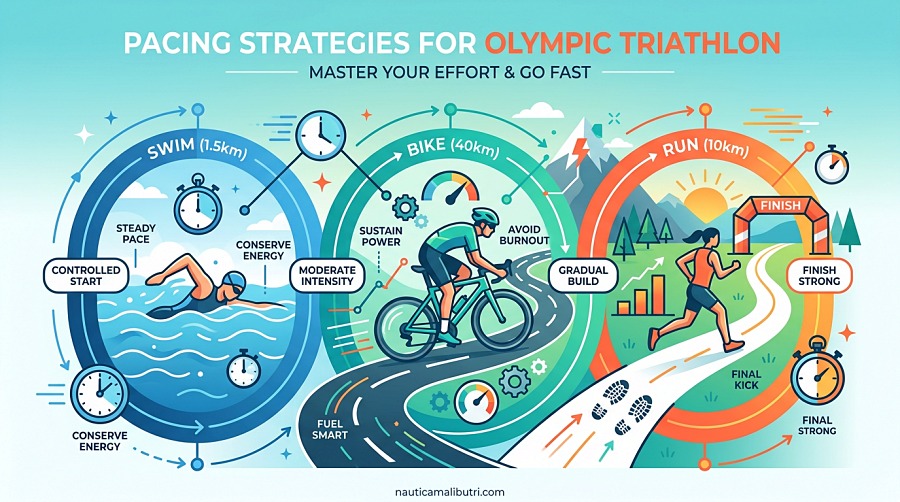
The race is won on the bike and lost on the run. I learned this the hard way during my first Olympic distance triathlon when I hammered the bike leg only to shuffle through the final 5 kilometers of the run. Olympic triathlon pacing strategies matter because this 2-3 hour effort punishes poor decisions with compound interest.
An Olympic triathlon consists of a 1500-meter swim, 40-kilometer bike, and 10-kilometer run. Success requires distributing your effort across all three disciplines while accounting for the unique demands of each leg. In this guide, I will share proven pacing strategies for Olympic triathlon that have helped me and hundreds of athletes I have coached cross the finish line strong.
Whether you are attempting your first Olympic distance race or looking to break the 3-hour barrier, these strategies will help you race smarter. We will cover swim starts, bike power targets, run progression, and the transitions that often make or break your day.
Table of Contents
How to Pacing Strategies for Olympic Triathlon: The Core Principle
Even pacing means maintaining a consistent effort level throughout the entire race rather than starting fast and fading. The goal is to cross the finish line having used your full capacity without leaving anything in the tank early or having energy left over.
Most triathletes make the mistake of treating each discipline as a separate all-out effort. The swim becomes a sprint, the bike a time trial, and the run a survival shuffle. Proper pacing strategies for Olympic triathlon treat the race as one continuous effort with three distinct phases.
Swim Pacing: Start Controlled, Stay Relaxed
The swim sets the tone for your entire race. Going out too hard creates oxygen debt that takes precious minutes to repay, leaving you depleted before you even touch the bike.
Controlled Starts Save Races
Begin the swim at a sustainable pace you can hold for the full 1500 meters. The first 200 meters should feel almost too easy. Resist the urge to sprint with the leaders unless you are a front-pack swimmer with specific positioning goals.
Anxiety spikes heart rate and oxygen consumption. Focus on long exhales and smooth stroke rhythm from the first arm entry. Many athletes report that backing off just 5% in the opening minutes actually improves their overall swim split because they avoid the mid-race slowdown that plagues aggressive starters.
Settle Into a Sustainable Rhythm
After the initial controlled start, find your cruising gear. This should feel like a moderate effort you could sustain for 30 minutes or more. Target an RPE (Rate of Perceived Exertion) of 5-6 out of 10, where 10 is maximum effort.
If you are wearing a wetsuit, remember that the added buoyancy reduces energy cost. Many athletes can swim 5-10 seconds per 100 meters faster in a wetsuit at the same effort level. Use this efficiency advantage to swim easier, not faster.
Drafting Strategies
Swimming in the draft zone behind another athlete reduces energy expenditure by 10-30%. Look for feet just ahead of you and settle in. Do not sprint to catch a faster swimmer. Instead, find someone moving at your target pace and match their rhythm.
Sight every 6-10 strokes to swim straight. Poor navigation adds significant distance to your 1500 meters. I have seen GPS files showing 1700+ meter swims due to zigzagging. Efficient swimming is the first pacing win.
Bike Pacing: Your Race Is Decided Here
The bike leg is where Olympic triathlons are won and lost. Over-biking is the single most common pacing mistake, and it destroys run performance with mathematical certainty. The 40 kilometers demands restraint that feels wrong in the moment but pays dividends later.
The Golden Rule: 85-95% of FTP
If you train with power, aim for 85-95% of your Functional Threshold Power (FTP) for the bike leg. FTP represents the maximum power you can hold for one hour. Racing at 90% of this value for 60-90 minutes is challenging but sustainable.
Beginners should target the lower end (85%), while experienced athletes with strong run backgrounds can push toward 95%. Err on the side of conservative if you are unsure. A slightly under-biked athlete runs well. An over-biked athlete shuffles home.
Steady Effort Wins Races
Avoid surges and spikes in power output. Hills tempt you to push harder to maintain speed, but this costs dearly. Accept slower speeds on climbs while maintaining consistent power. Recover on descents rather than hammering.
Normalized Power (NP) should stay close to your Average Power. A large gap between these numbers indicates too much variability in your effort. Smooth pedaling and consistent output preserve glycogen stores for the run.
Heart Rate and Cardiac Drift
Without a power meter, use heart rate as a secondary guide. Expect cardiac drift, where heart rate gradually rises even at constant effort due to dehydration and fatigue. Start in low Zone 3, knowing you will drift toward high Zone 3 or Zone 4 by the end.
If your heart rate spikes early, you are going too hard. Back off immediately. A rising heart rate in the first 20 minutes predicts a suffer-fest on the run. Use RPE as your primary guide if heart rate seems unreliable.
Aero Position and Efficiency
Maintain your aero position as much as comfort allows. Every time you sit up, you lose speed and increase drag. Practice holding aero in training so your race position feels natural. Comfort equals speed over 40 kilometers.
Run Pacing: Patience First, Speed Later
The run is where proper pacing strategies for Olympic triathlon reveal their true value. A well-paced swim and bike set up a strong 10 kilometers. Poor discipline in the first two legs creates a survival shuffle instead of a race.
Start Conservative
The first mile should feel almost too easy. Your legs will feel heavy coming off the bike regardless of how well you paced. This is normal. Do not panic and do not try to run your way out of it with speed.
Target 30-45 seconds per mile slower than your open 10k race pace for the first 2-3 miles. If you are a 50-minute 10k runner (8:00/mile), start at 8:30-8:45 pace. This feels slow, but you will thank yourself at mile 5.
Progressive Pacing Strategy
Think of the 10k as three segments: miles 1-3 (settle), miles 4-6 (hold), miles 7-10 (build). The first segment establishes rhythm. The middle segment maintains steady effort. The final segment allows you to increase pace if you have managed your energy well.
Many triathletes run the exact opposite: fast early, crash late. Be the patient athlete who passes people in the final 5k rather than the one being passed. Negative splitting the run (second half faster than first) is the gold standard of Olympic triathlon pacing.
RPE Targets by Run Segment
Miles 1-3 should feel like RPE 4-5 out of 10. You should be able to hold a conversation, though you probably will not want to. Miles 4-6 bump to RPE 6, moderately hard but controlled. Miles 7-10 can increase to RPE 7-8 if you have paced correctly.
If you reach mile 8 and feel terrible, you went too hard on the bike. Make a note for next time. Every Olympic triathlon teaches you something about your pacing limits. File away the lessons for your next race.
Transition Strategies: T1 and T2
Transitions are part of your pacing strategy, not breaks from it. Rushing through T1 and T2 spikes heart rate and creates stress that affects the next discipline. Smooth, practiced transitions save more time than frantic sprinting.
T1: Reset, Do Not Rush
Coming out of the water, your heart rate is elevated and your breathing is rapid. Use the run to transition as active recovery. Focus on deep breathing and bringing your heart rate down before mounting your bike.
Practice your T1 sequence until it is automatic: wetsuit off, helmet on, sunglasses on, grab bike, run to mount line. Having a set order prevents forgotten items and reduces decision fatigue when your brain is oxygen-deprived.
T2: Controlled Transition to the Run
Rack your bike, remove your helmet, and slip on your running shoes in one fluid sequence. Some athletes benefit from 10-15 seconds of walking to reset before starting the run. This brief pause often produces a better overall run split than rushing out and running poorly.
Put your race belt on while running if possible. Start jogging easily and build to target pace over the first quarter mile. Your legs will feel like jelly. This passes within 5-10 minutes if you do not panic and force the pace.
Warm-Up Protocol for Olympic Triathlon
A proper warm-up prepares your body for race effort without depleting energy stores. Aim for 15-20 minutes of easy activity starting 30-40 minutes before your wave starts. The goal is to elevate heart rate and activate muscles, not to tire yourself.
Start with 10 minutes of easy jogging to raise core temperature. Follow with 5-10 strides of 30 seconds each at race pace to activate fast-twitch fibers. If possible, get in the water for 5-10 minutes of easy swimming to familiarize yourself with conditions and wake up your stroke muscles.
Complete any dynamic stretching 10 minutes before start time. Then conserve energy. Find shade, stay hydrated, and visualize your pacing plan. The warm-up sets the stage, but the race is where your training and strategy come together.
Effort-Based Pacing: RPE and Heart Rate Zones
Technology helps, but learning to pace by feel is essential. RPE (Rate of Perceived Exertion) on a 1-10 scale provides immediate feedback regardless of terrain, weather, or device malfunctions. Train with RPE regularly so you recognize your target efforts.
Heart Rate Zone Targets
Zone 2 (60-70% max HR) is your easy conversational pace. Zone 3 (70-80%) is moderate, sustainable effort. Zone 4 (80-90%) is hard, above threshold. For Olympic triathlon, swim in Zone 3, bike mostly in Zone 3 with brief Zone 4 moments on hills, and run from Zone 3 into Zone 4.
Maximum heart rate varies by individual. The standard formula (220 minus age) provides only a rough estimate. Testing in training yields more accurate zones. Use heart rate as a guardrail, not a target. RPE remains your primary guide.
Perceived Effort by Discipline
Swim RPE should feel sustainable and rhythmic, around 5-6/10. Bike RPE is controlled and steady, 6-7/10, with moments of 7-8 on climbs. Run RPE progresses from 4-5/10 early to 7-8/10 late. If any discipline feels like 9-10/10 before the final kilometers, you have over-paced.
Nutrition and Pacing Connection
Fueling and pacing are inseparable. Under-fueled athletes cannot maintain target paces regardless of fitness. Bonking (running out of glycogen) forces dramatic slowdowns that no amount of mental toughness can overcome.
Consume 200-300 calories per hour starting early on the bike. This means eating in the first 30 minutes, not waiting until you feel hungry. Liquid calories from sports drinks are easiest to digest at race effort. Solid foods work for some athletes but require practice.
Hydration affects pacing too. Dehydration increases heart rate and perceived effort. Drink to thirst on the bike, typically one bottle over 40 kilometers unless conditions are extreme. Practice your exact race nutrition strategy in training brick workouts so your body knows what to expect.
Common Pacing Mistakes to Avoid
Learning from others saves you from painful lessons. These are the most common pacing errors I see at every Olympic triathlon:
- Swim sprint start: Going out too hard creates oxygen debt that haunts you for an hour. Start controlled and build.
- Bike time trial mode: Treating the 40k like a standalone bike race destroys your run. Race the triathlon, not the bike leg.
- Surging on hills: Power spikes cost more than steady effort. Maintain consistent power and accept slower hill speeds.
- Run start too fast: Legs feel weird off the bike. This passes. Do not try to run through it with speed.
- Ignoring cardiac drift: Rising heart rate early predicts disaster later. Back off at the first warning signs.
Practical Pacing Checklist
Use this checklist to prepare your pacing plan before race day:
Determine your FTP and calculate 85-95% target power for the bike. Identify your open 10k pace and plan to start 30-45 seconds per mile slower. Practice your race nutrition during brick workouts. Know your target RPE for each discipline. Study the course profile and identify where to push and where to hold back.
Write your targets on a piece of tape on your bike stem or race belt. Memory fails when adrenaline spikes. Having your numbers visible keeps you honest when enthusiasm tempts you to override good judgment.
FAQ: Pacing Strategies for Olympic Triathlon
How do you pace an Olympic triathlon?
Pace an Olympic triathlon by starting controlled in the swim at RPE 5-6, riding the bike at 85-95% of your FTP with steady effort, and running 30-45 seconds per mile slower than your open 10k pace for the first half before building to the finish.
What is the best pacing strategy for Olympic distance triathlon?
The best strategy is even pacing: distributing effort consistently across all three disciplines rather than starting fast and fading. Focus on controlled swim starts, restrained bike efforts, and patient run beginnings that allow you to finish strong.
How hard should you pace an Olympic triathlon?
Olympic triathlon should feel moderately hard but controlled throughout. Target RPE 5-6 for the swim, 6-7 for the bike, and 4-5 building to 7-8 for the run. If you feel like you are sprinting early, you are going too hard.
What is even pacing in triathlon?
Even pacing means maintaining consistent effort across the entire race rather than varying speed dramatically. The goal is to cross the finish line having used your full capacity without blowing up early or having energy left unused.
How to pace your first Olympic distance triathlon?
For your first Olympic triathlon, be conservative. Start the swim easy to manage anxiety, bike at 85% of FTP or lower, and run the first half at a conversational pace. Finishing strong builds confidence for your next race.
Conclusion: Master Your Olympic Triathlon Pacing
Pacing strategies for Olympic triathlon separate finishers from racers. The athletes who master even effort distribution across the 1500-meter swim, 40-kilometer bike, and 10-kilometer run are the ones who cross the finish line smiling and looking forward to their next race.
Remember the core principles: controlled swim starts, steady bike efforts at 85-95% FTP, and patient run beginnings that build to strong finishes. Practice these strategies in brick workouts before race day so your body recognizes the sensations and your mind trusts the process.
Your next Olympic triathlon is an opportunity to execute what you have trained. Trust your preparation, stick to your pacing plan, and enjoy the satisfaction of racing smart from start to finish. See you at the finish line.