
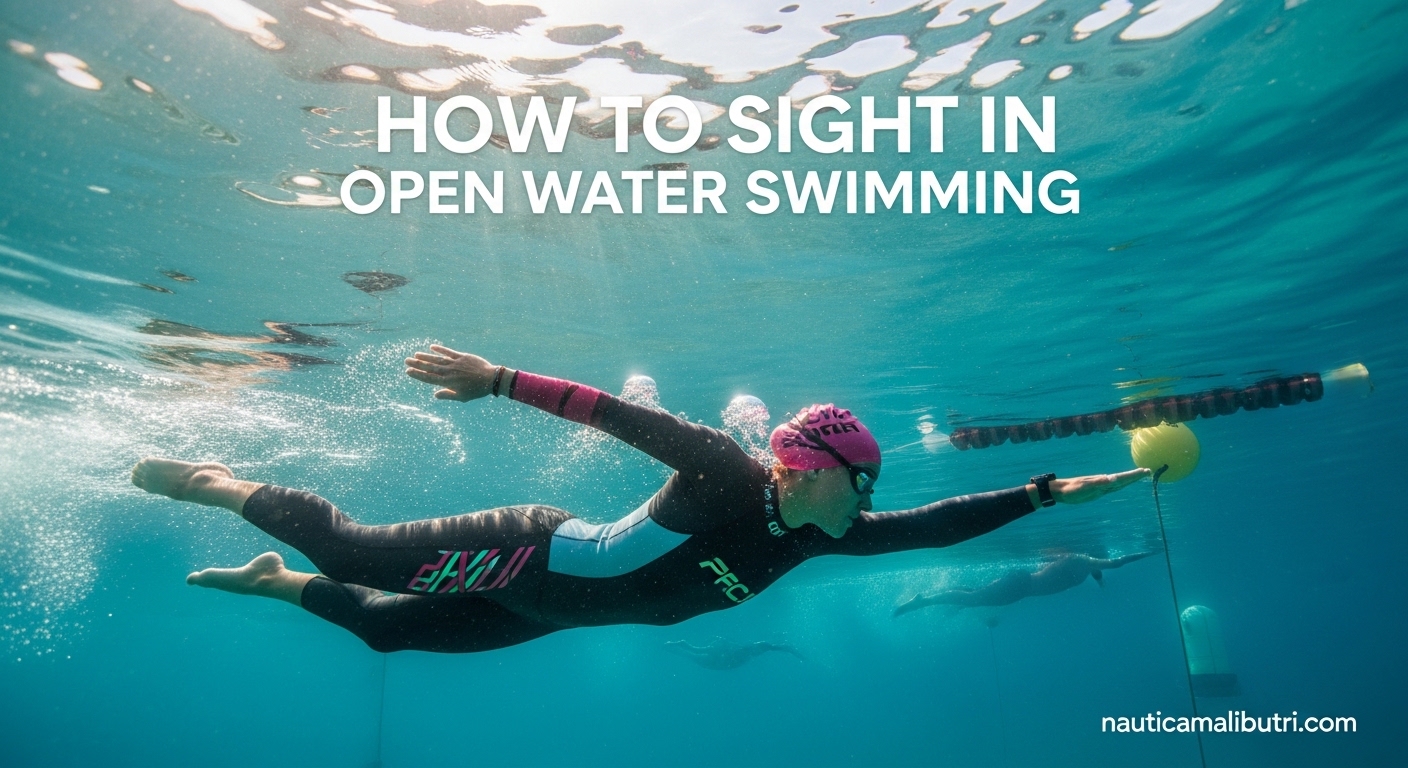
Nothing is more frustrating than swimming what feels like a straight line, only to discover you have drifted 50 yards off course. I have been there, fighting through waves and thinking I was heading toward the buoy, when a quick check revealed I was swimming parallel to the beach instead of toward it. Learning how to sight in open water swimming transformed my race performance and cut precious minutes off my splits.
Sighting is the technique of lifting your eyes briefly above the water surface to check your direction while maintaining forward momentum. Unlike pool swimming where lane lines guide you, open water swimming requires you to become your own navigation system. Without proper sighting, you add distance to every swim, waste energy fighting currents you could have avoided, and risk missing turn buoys entirely.
In this guide, I will walk you through the crocodile eyes technique that elite triathletes use, how often you should sight based on conditions, and specific drills to practice before your next race. Whether you are preparing for your first sprint triathlon or aiming for a personal best at Ironman, mastering this skill is essential.
Table of Contents
What Is Sighting and Why It Matters
Sighting is the act of looking forward while swimming to verify you are on course toward your target. In a pool, black lines on the bottom and lane ropes keep you swimming straight without conscious effort. Take those away, and most swimmers naturally veer to one side due to stroke imbalances they never knew they had.
Studies show that swimmers without sighting can drift 10% or more off a straight line over distance. Over a 1.5-kilometer Olympic triathlon swim, that could mean swimming 150 extra meters. At a modest two-minute-per-100-meter pace, that adds three minutes to your swim time before you even reach transition.
Good sighting technique does more than keep you on course. It helps you read the water, identify the best lines around buoys, and spot other swimmers to draft behind. For triathlon swim sighting specifically, it is the difference between a calm, controlled start and the panic of realizing you are lost in a sea of whitecaps.
The key is learning to sight without destroying your stroke rhythm or body position. Lift your head wrong and your hips drop, creating drag that slows you down. Look too long and you lose momentum. The goal is a quick, efficient glance that gives you just enough information to adjust while maintaining forward speed.
The Crocodile Eyes Technique
The crocodile eyes swimming technique is the foundation of efficient open water sighting. Named for how crocodiles float with just their eyes above water, this method minimizes drag by keeping your mouth and nose submerged while only your eyes peek above the surface.
Step 1: Time It With Your Stroke
As your leading arm enters the water and extends forward, you enter what swimmers call the catch phase. This is the moment to begin your sighting motion. Press down slightly with that extended hand while it is underwater. This pressure helps stabilize your body and provides leverage to lift your head without sinking your hips.
Step 2: Lift Only Your Eyes
Instead of lifting your whole head like you are trying to breathe forward, tuck your chin slightly and raise just your eyes above the waterline. Your mouth should remain in the water or just at the surface. This keeps your body horizontal and prevents the dreaded hip drop that kills momentum.
Step 3: Take a Snapshot
Do not stare at your target. Glance, identify your direction, and immediately return your head to the neutral swimming position. Think of it like taking a quick photo with your eyes. One second or less is the goal. Any longer and you start losing speed and disrupting your stroke timing.
Step 4: Breathe on the Next Stroke
Here is where many beginners struggle. You sight on one stroke, then breathe to the side on the next stroke. Do not try to sight and breathe simultaneously. That forces your head too high and throws off your entire body position. Sight forward, then rotate to breathe normally on the following stroke.
I practiced this pattern for weeks in the pool before my first open water race. Sight on the left arm entry, breathe to the right on recovery. Once it becomes automatic, you barely notice the interruption to your rhythm. Your stroke rate stays consistent, and your breathing remains unaffected.
How Often Should You Sight
The most common question I hear from new triathletes is how frequently to sight. The answer depends on several factors, but here is a general guideline to start with.
Beginners should sight every 4 to 6 strokes. This might feel excessive at first, but it prevents significant drift before correction. As you develop a straighter stroke and better feel for the water, you can extend this to every 6 to 10 strokes.
Advanced swimmers in calm conditions might sight every 8 to 12 strokes. Experienced open water swimmers with balanced strokes and good proprioception can maintain straight lines longer. However, even elites sight regularly in races to navigate around buoys and other swimmers.
Conditions matter significantly. In choppy water or strong currents, sight more frequently, every 4 to 6 strokes regardless of skill level. You are fighting forces that push you off course constantly. Calm lake swimming might allow longer gaps between sightings, but I still recommend at least every 10 strokes to catch drift early.
Race strategy also plays a role. I sight more frequently in the first few hundred meters of a race when the pack is dense and directions change constantly. Once I find clear water and establish a rhythm, I can sight less often. Near turns and the finish, I increase frequency again to nail my line.
Sighting in Different Conditions
Calm water is the easiest environment for learning sighting technique. Mirror-flat lakes let you spot buoys from far away, and minimal chop means you can lift your eyes briefly without waves splashing your face. Practice your crocodile eyes technique here first before moving to more challenging conditions.
Choppy Water Adjustments
Waves change everything. When swimming into chop, time your sighting for the moment you rise on a swell. This natural lift helps you see over the wave in front of you without fighting it. If you sight while in a trough between waves, you stare at a wall of water and see nothing.
Swimming with waves behind you requires a different approach. You might need to lift slightly higher to see past the swell directly behind you. Be quick about it. The wave motion helps and hinders, lifting you up but also demanding faster sighting to catch the right moment.
Limited Visibility
Fog, glare, and low light reduce visibility significantly. In these conditions, rely more on your two-landmark navigation technique, which I will explain shortly. Accept that you might only see your target for a second when the swell cooperates. Sight more frequently to compensate for the reduced information each glance provides.
Wetsuit Considerations
A thick wetsuit changes your body position significantly. The buoyancy lifts your legs and hips higher than normal swimming, which actually helps prevent the hip drop that plagues sighting. However, the restricted shoulder mobility in some suits can make the head lift feel awkward.
Practice sighting in your race wetsuit before race day. The extra buoyancy means you might be able to lift slightly higher without the usual drag penalty. Your high hips provide a more stable platform. Just be aware that shoulder restriction might require a slightly modified arm position during the catch phase.
Using Landmarks for Navigation
Buoys are small targets that disappear easily in chop. Smart open water swimmers use larger, more permanent landmarks for navigation. The two-landmark method is a game-changer for swimming straight without constant sighting.
Choose two fixed objects that line up with your destination. The first should be relatively close, perhaps a tree, building, or pier structure just beyond the swim course. The second should be distant, maybe a mountain peak, tower, or distinctive building on the horizon. When these two objects align, you are on course.
Check your alignment every few sightings rather than searching for the buoy each time. This reduces mental fatigue and keeps you swimming straighter between sightings. If the near object drifts left of the far one, you are drifting right, and vice versa. Correct gradually rather than making sharp turns.
In races, scout the course beforehand if possible. Identify landmarks for each leg of the swim. Note how they align from the start line, from each turn buoy, and from the swim exit. I write these on my arm with a Sharpie before the race so I do not forget under pressure.
Common Sighting Mistakes to Avoid
After coaching dozens of triathletes through their first open water experiences, I see the same errors repeatedly. Here are the mistakes that cost you time and energy.
Lifting your entire head. This is the big one. When you crane your neck to look forward, your hips drop immediately, creating a parachute of drag behind you. Swim a few strokes like this and you have lost all momentum. Keep your chin tucked and eyes only above the surface.
Looking too long. Treat sighting like a snapshot, not a movie. One second maximum. If you did not see your target, sight again on the next stroke. Staring for two or three seconds while trying to identify a distant buoy kills your speed and disrupts your stroke rhythm.
Inconsistent frequency. Some swimmers sight obsessively for 50 strokes, then forget for the next 100. This yo-yo approach means you drift significantly during the gaps. Set a rhythm and stick to it. Count strokes if needed to maintain consistency.
Sighting and breathing together. Trying to look forward and breathe in the same motion forces your head too high and twists your body unnaturally. Separate these actions. Sight on one stroke, breathe on the next. It feels slower at first but maintains better form.
Poor landmark selection. Choosing a moving target like a boat, other swimmers, or a cloud leads to disaster. Always pick fixed objects. If your landmark is a boat, make sure it is anchored. Other swimmers are rarely swimming the exact line you want.
Sighting Drills to Practice in the Pool
You do not need open water to practice sighting. These pool drills build the muscle memory and technique you need for race day.
Tarzan Drill
Swim freestyle with your head held completely out of the water, looking forward the entire time. This builds neck and back strength for sighting while teaching you to maintain hip position while lifted. It is exhausting, so start with 25-meter repeats and build up.
The Tarzan drill also shows you how much drag a high head position creates. You will feel yourself slow down dramatically. This feedback helps you find the minimal lift of proper crocodile eyes technique. Alternate Tarzan drill with normal swimming to feel the difference.
Lane Line Sighting
Practice your sighting rhythm while swimming along the lane line. Lift your eyes every 4 to 6 strokes to confirm you are still next to the line. If you find yourself crossing it, your stroke is pulling you offline. This drill reveals stroke imbalances that open water exposes.
Alligator Eyes Drill
Swim normally, but every 6 strokes lift only your eyes above water while keeping your mouth submerged. Hold for just one stroke cycle, then return to normal position. Focus on not dropping your hips during the lift. This is the pure crocodile eyes technique practiced repeatedly.
Integration Sets
Do 4 x 100 meters where you sight every 4 strokes on the first 25, every 6 on the second, every 8 on the third, and every 10 on the fourth. Notice how straight you swim with frequent sighting versus extended gaps. Most swimmers will weave significantly on the final 25.
Practice these drills at least once a week during the month before your first open water race or triathlon. The pool is your controlled laboratory to perfect technique before adding the variables of waves, currents, and other swimmers.
Advanced Sighting Tips
Once you have mastered the basics, these advanced techniques help in race situations.
Sighting on your breathing side. Some swimmers modify the standard technique to sight and breathe simultaneously to one side. As your leading arm extends, rotate your head with your body to sight, then continue the rotation to breathe. This only works if your target happens to be on your breathing side, but it is efficient when it aligns.
Sighting in the pack. Drafting behind other swimmers reduces your visibility. Lift slightly higher to see over the swimmers in front of you. Accept that you might need to sight more frequently in a dense pack since you cannot see the buoys as easily.
Reading the field. Experienced racers sight partially to check their position relative to other swimmers. If everyone around you is heading in a different direction, question your navigation. The pack usually finds the best line, though not always.
Race day warm-up. Always get in the water before the start if rules allow. Swim to the first buoy and back, practicing your sighting on the actual course. Identify your landmarks from water level, not from the shore. Things look different when your eyes are six inches above the surface.
FAQ
How often should I sight in open water swimming?
Beginners should sight every 4 to 6 strokes. Intermediate and advanced swimmers can extend this to every 6 to 10 strokes in calm conditions. In choppy water, strong currents, or dense race packs, return to every 4 to 6 strokes regardless of skill level.
What is the 80/20 rule in swimming?
The 80/20 rule, also called the Pareto principle applied to swimming, suggests that 80% of your swimming improvements come from 20% of your training. For most triathletes, this means focusing the majority of training time on technique work and aerobic base building rather than high-intensity speed work.
Should I breathe and sight at the same time?
No, breathe and sight on separate strokes. Sight forward on one stroke, then rotate to breathe on the next stroke. Trying to do both simultaneously forces your head too high, drops your hips, and disrupts your stroke rhythm significantly.
Why do I swim crooked in open water?
Most swimmers have slight stroke imbalances that lane lines correct automatically in pools. In open water, these imbalances cause gradual drifting. Common causes include uneven pull strength, breathing only to one side, and uneven body rotation. Regular sighting corrects this drift before it becomes significant.
What is the 25/10 rule in swimming?
The 25/10 rule refers to a drill format where you swim 25 meters focusing intensely on technique, then swim 10 meters easy to recover. This pattern helps build technique endurance without fatigue overwhelming your form. It is commonly used for sighting practice and stroke correction work.
Is sea swimming good for arthritis?
Sea swimming can benefit arthritis sufferers due to the combination of low-impact exercise and the anti-inflammatory effects of cold water. The buoyancy of salt water reduces joint stress while the cold may reduce inflammation. However, always consult a doctor before starting cold water swimming for arthritis management.
Conclusion
Learning how to sight in open water swimming takes practice, but the payoff is immediate and significant. The crocodile eyes technique, sighting every 4 to 6 strokes, and using fixed landmarks will keep you swimming straight and fast. Start in the pool with drills, then practice in calm open water before tackling race conditions.
Remember that even elite triathletes work on their sighting constantly. It is a skill that degrades without practice and improves with consistent attention. Add sighting drills to your weekly routine, and you will approach your next race with confidence knowing you will swim the shortest possible distance from start to finish.