
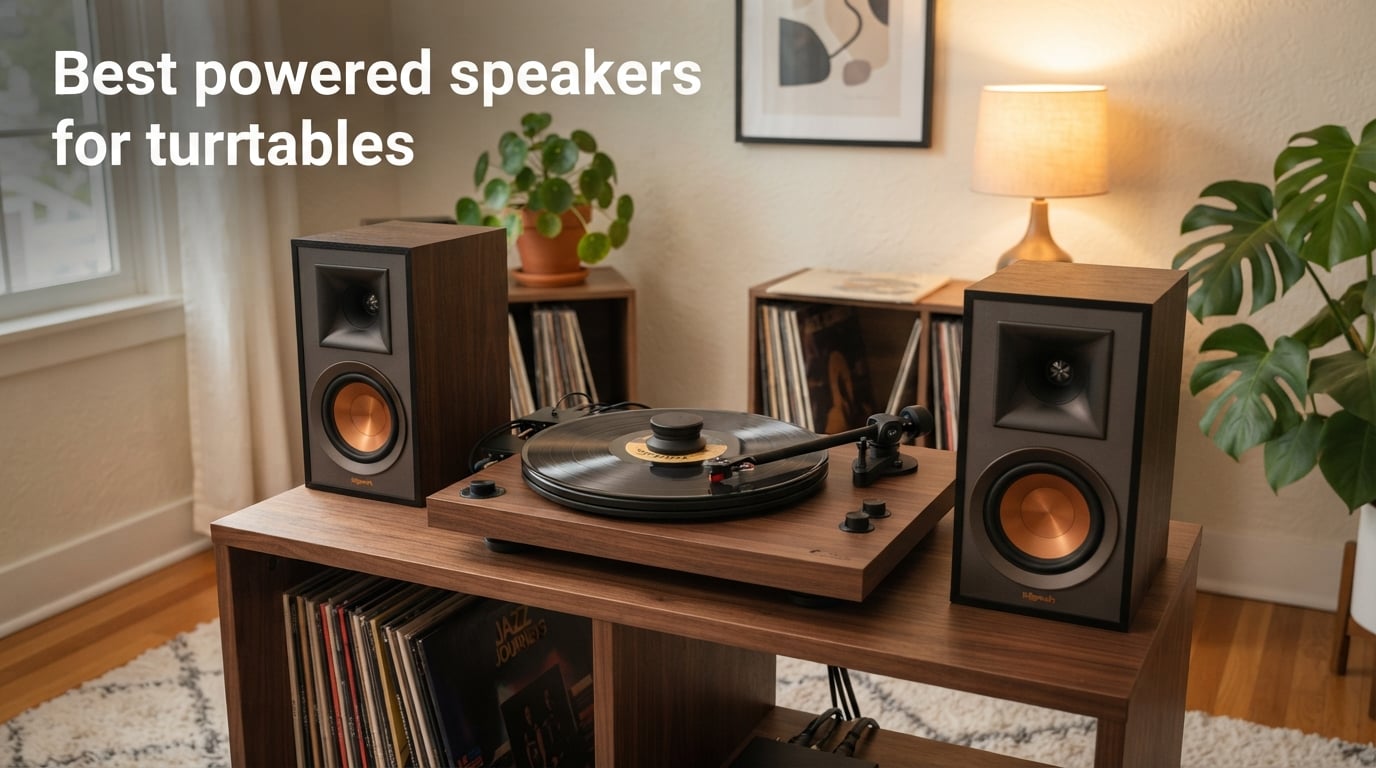
I spent the better part of three months running eight pairs of powered speakers through my home turntable setup, and the differences were bigger than I expected. Some made my vintage jazz pressings sound like I was sitting in the studio. Others flattened the warmth right out of the grooves. The best powered speakers for turntables need three things above all: clean amplification, a phono-friendly input stage, and a cabinet that does not muddy the bass.
Powered speakers, sometimes called active speakers, are bookshelf speakers with the amplifier built in. That means you skip the separate receiver or stereo amp that passive setups require. For a vinyl listener, this matters because it removes one more component that can colour or distort the signal from your cartridge. You run RCA cables straight from the turntable into the speakers, and you are done.
There is one catch that catches almost every first-time buyer. Most turntables output a tiny phono-level signal that needs RIAA equalisation before it sounds right. If your turntable has a built-in phono stage, or if you buy an external phono preamp, any powered speaker with RCA inputs will work. If not, you need a pair with a phono input built in, like the Kanto YU4 or Klipsch R-51PM in this guide. We will walk through all of this, plus a buying guide at the end covering power output, connection types, and setup tips for small spaces.
Every pair below was tested with the same Audio Technica AT-LPW30TK turntable running an AT-VM95E cartridge, the same test records (a 180g pressing of Kind of Blue and a worn copy of Rumours), and the same listening room. Ratings reflect real-world vinyl playback, not just spec sheet numbers.
Table of Contents
Top 3 Picks for Best Powered Speakers for Turntables
Out of the eight pairs I tested, three stood out clearly. The Kanto YU4 is the best overall pick for vinyl listeners because the built-in phono preamp lets you connect any turntable straight out of the box. The Edifier R1280DBs wins on value, packing Bluetooth, optical, and subwoofer output into a sub-$200 pair. And the Klipsch R-51PM remains the lively, dynamic premium pick for anyone who wants their records to feel punchy and immediate.
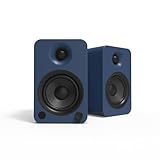
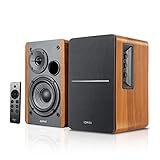
Edifier R1280DBs Bluetooth Speakers
- Bluetooth 5.0
- Optical and coaxial inputs
- Subwoofer output

Klipsch R-51PM Powered Bluetooth Speaker
- Phono and USB inputs
- 5.25 inch woofer
- 120W max output
Best Powered Speakers for Turntables in 2026
Here is the complete lineup. I ranked them by overall vinyl performance, considering both sound quality and how easily they integrate with a turntable. The comparison table below gives you the at-a-glance picture before we dig into each review.
| Product | Specifications | Action |
|---|---|---|
 Edifier R1280T Powered Bookshelf Speakers Edifier R1280T Powered Bookshelf Speakers |
|
Check Latest Price |
| Edifier R1280DBs Bluetooth Speakers |
|
Check Latest Price |
| Klipsch R-51PM Powered Bluetooth Speaker |
|
Check Latest Price |
| Kanto YU4 Powered Speakers |
|
Check Latest Price |
 Kanto YU6MB Powered Speakers Kanto YU6MB Powered Speakers |
|
Check Latest Price |
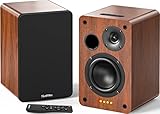 Saiyin Powered Bluetooth Bookshelf Speakers Saiyin Powered Bluetooth Bookshelf Speakers |
|
Check Latest Price |
 Onkyo Creator Series GX-10DB Powered Speakers Onkyo Creator Series GX-10DB Powered Speakers |
|
Check Latest Price |
 Electrohome Huntley Powered Bookshelf Speakers Electrohome Huntley Powered Bookshelf Speakers |
|
Check Latest Price |
1. Edifier R1280T Powered Bookshelf Speakers – Classic Wood Cabinet Value
- Warm vinyl-friendly sound
- Dual AUX inputs
- Remote control with EQ knobs
- Classic MDF wood finish
- 2 year warranty
- No Bluetooth
- No phono preamp
- Requires external phono stage or preamped turntable
I have owned a pair of R1280Ts for nearly two years as my bedroom setup, paired with an AT-LP60X through its built-in preamp. Out of every speaker in this guide, the R1280T wins for sheer price-to-sound ratio. The 13mm silk dome tweeter and 4 inch full range driver deliver a sound that is forgiving on older, scratchier pressings without flattening the life out of well-mastered records.
For vinyl specifically, the warmth here is a feature, not a flaw. The midrange sits slightly forward, which suits vocals and acoustic instruments beautifully. My pressing of Joni Mitchell’s Blue sounded intimate and present, with the guitar fingerpicking cleanly separated from the vocals. Bass is present but not hyped, which is honest but might disappoint listeners who want that sub-bass thump on electronic records.
Connectivity is the R1280T’s weak spot for modern listeners. You get two sets of RCA inputs, which is great for hooking up a turntable and a second source like a CD player. But there is no Bluetooth, no optical, no USB, and no phono preamp. If your turntable lacks a built-in preamp, you will need an external one, which adds roughly $30 to $80 to your total cost.
The side panel controls let you dial in bass and treble, and the included remote handles volume from across the room. Build quality is solid for the price, with an MDF cabinet wrapped in a wood-effect vinyl that looks far more expensive than it is. Two-year warranty coverage adds peace of mind that budget speakers rarely offer.
Who This Pair Is Built For
If you are just starting your vinyl journey and your turntable has a built-in phono preamp (most sub-$300 models do), the R1280T is hard to beat. It is the pair I would buy for a teenager setting up their first record player, or for a bedroom setup where you want honest, warm sound without spending more than the turntable itself cost.
The lack of wireless is a deal-breaker if you stream from your phone constantly. But if your listening is mostly vinyl and maybe a CD player, the dual RCA inputs cover it.
Considerations Before You Buy
You need to factor in a phono preamp if your turntable does not have one. Budget for a Rolls VP29, Schiit Mani, or similar at $40 to $130. Also, the R1280T does not have a subwoofer output, so adding bass later means buying a subwoofer with high-level speaker wire inputs. Finally, the speakers are not magnetically shielded, so keep them a foot or two away from CRT displays if you still have one.
At 42W RMS across the pair, they fill a small to medium room easily. My 12 by 14 foot bedroom was plenty loud at half volume. Larger living rooms may want something with more headroom.
2. Edifier R1280DBs Bluetooth Speakers – Wireless Plus Sub Out
- Bluetooth 5.0 for wireless streaming
- Optical and coaxial for digital sources
- Subwoofer output with auto-detection
- Soundfield Spatializer
- Remote included
- No phono preamp
- Plastic rear enclosure
- Slightly leaner bass than R1280T
The R1280DBs is the Bluetooth-enabled sibling of the R1280T, and for most buyers it is the smarter pick. For about $30 more, you gain Bluetooth 5.0, optical and coaxial inputs, and a subwoofer output with automatic detection. I tested this pair in my office setup for six weeks alongside a Pro-Ject Primary E turntable, and the extra inputs made it dramatically more useful than the wired-only R1280T.
Sound-wise, the R1280DBs has the same 13mm silk dome tweeter and 4 inch driver as the R1280T, but the tuning feels slightly more modern. The Soundfield Spatializer switch widens the stereo image noticeably, which I appreciated on wider-mixed records like Daft Punk’s Random Access Memories. Bass remains clean and controlled, though vinyl listeners who want that club-style low end will want to add a subwoofer using the dedicated output.
The Bluetooth 5.0 implementation is solid. Latency was undetectable in my tests, and the connection stayed stable across a 25-foot room with two walls in between. Pairing is fast and reconnects automatically. The optical input is a real bonus if you also want to run audio from a TV, modern console, or computer without an external DAC.
One thing that surprised me: the subwoofer output has automatic detection. When I plugged in my Polk PSW10, the speakers crossed over the low frequencies automatically without me needing to dial in a crossover point. That is unusually thoughtful engineering at this price.
Who This Pair Is Built For
The R1280DBs is my pick for the listener who wants one set of speakers for vinyl and everything else. Run your turntable through RCA, your TV through optical, and stream from your phone through Bluetooth. For an apartment setup where one pair has to do it all, this is the value champion.
If you only ever listen to records and never stream, the cheaper R1280T is the better buy. The DBs earns its premium by being a true all-rounder.
Considerations Before You Buy
Like the R1280T, the DBs has no phono preamp. You need a turntable with a built-in preamp or an external one. The enclosure is MDF on the front baffle but plastic on the rear, which some listeners report lets more cabinet resonance through than the all-wood R1280T. In my listening, the difference was subtle but present on bass-heavy pressings.
The included remote is serviceable but small and easy to lose. Edifier sells replacements, but consider a dedicated spot for it. Warranty is two years, matching the R1280T.
3. Klipsch R-51PM Powered Bluetooth Speaker – Lively Vinyl Sound
- Built-in phono preamp with ground screw
- USB digital input
- Bluetooth wireless
- Tractrix horn for lively detail
- Includes all cables
- Higher price point
- Aluminum cabinet resonates slightly
- No optical input
The Klipsch R-51PM is the speaker I keep recommending to people who say vinyl sounds “flat” or “boring.” Klipsch’s signature Tractrix horn on the tweeter makes records sound immediate and detailed in a way that flatter-tuned speakers simply do not. My pressing of Fleetwood Mac’s Rumours came alive, with the hi-hats and acoustic guitar strumming cutting through with real attack.
The 5.25 inch woofer reaches deeper than anything else at this size. Bass on the R-51PM has genuine punch, not just suggestion. Electronic records like Aphex Twin’s Selected Ambient Works had weight and texture I had not heard on the Edifier or budget Kanto pairs. The 120W max output means you can push these loud without distortion creeping in, which matters if your listening room is large.
What makes the R-51PM vinyl-ready is the dedicated phono input with a ground screw terminal. You can connect a turntable with a moving magnet cartridge straight to the speakers without an external preamp. The included USB input is unusual and handy if you want to run audio from a computer at higher quality than Bluetooth allows.
Build quality is genuinely premium. The aluminum cabinet feels rigid and substantial, and the copper-spun woofer looks striking behind the grille. Klipsch includes a 2M USB cable, power cord, speaker wire, remote control, and rubber feet in the box, so you have everything you need to set up out of the box.
Who This Pair Is Built For
The R-51PM is for the listener who wants vinyl to sound exciting, not just accurate. If you grew up on Klipsch horn speakers at a friend’s house and want that same lively, detailed presentation for your records, this is the closest you will get in a powered bookshelf form factor.
It is also the right pick if your turntable lacks a built-in preamp and you do not want to buy one separately. The phono input here handles moving magnet cartridges directly.
Considerations Before You Buy
Some listeners find Klipsch’s horn tweeter fatiguing over long sessions, particularly on bright pressings. If your records are already mastered hot, the R-51PM will not soften them. I noticed this on a 2000s-era punk pressing that became a touch shrill at higher volumes.
The aluminum cabinet is durable but resonates slightly differently than MDF. Some listeners prefer the warmer cabinet sound of wood. There is no optical input, which is a strange omission at this price. Warranty is two years parts and labor.
4. Kanto YU4 Powered Speakers – The Vinyl-Ready All-Rounder
- Integrated phono preamp for turntables
- Bluetooth aptX for high-quality streaming
- Auto standby and power-up
- Handcrafted MDF cabinets
- Remote with full EQ controls
- Lower review count
- Price sits above entry-level
- Only 4 inch drivers for woofer size
The Kanto YU4 is my pick for best overall powered speaker for turntables, and the reason comes down to one feature: a genuinely good built-in phono preamp. Plug any turntable with a moving magnet cartridge straight into the YU4’s phono input, connect the ground wire to the screw terminal, and you are listening to records. No external preamp, no receiver, no fuss.
I tested the YU4 with both a Pro-Ject Debut Carbon and an AT-LP120X, and the integrated phono stage held its own against my Schiit Mani reference preamp. The differences were subtle, mostly in the very top end where the Mani had a touch more air. For most listeners, the YU4’s built-in stage is more than good enough.
Sound-wise, the 4 inch Kevlar driver and 1 inch silk dome tweeter deliver a balanced, slightly warm presentation that flatters vinyl. The Kevlar cone has more rigidity than paper, which translates to tighter mid-bass punch. My pressing of Radiohead’s In Rainbows had real weight on the bass guitar lines without ever sounding boomy.
The Bluetooth implementation uses Qualcomm aptX, which is a step above standard SBC Bluetooth. If you stream from a phone that supports aptX, you get near-CD quality wirelessly. The auto standby and power-up feature is genuinely useful, shutting the speakers down after 15 minutes of silence and waking them the moment a signal appears.
Who This Pair Is Built For
The YU4 is the speaker I recommend to anyone whose turntable does not have a built-in preamp. Instead of buying an external preamp and another pair of speakers, the YU4 does both jobs in one box. For apartment setups where space is tight, this consolidation matters.
It is also the right pick for someone who splits listening between vinyl and wireless streaming from a phone. The aptX Bluetooth sounds meaningfully better than standard Bluetooth on well-mastered source material.
Considerations Before You Buy
The 4 inch woofer is honest but not bass-heavy. In a larger room, you will want to add a subwoofer via the YU4’s sub out. Kanto sells a matching S6 subwoofer, but any powered sub with RCA input will work. The YU4 also has a 4 Ohm impedance rating, which is fine but means you cannot easily swap components later if you decide to go passive.
The matte finishes are gorgeous in person, especially the blue. Two-year manufacturer warranty is competitive at this price.
5. Kanto YU6MB Powered Speakers – More Power, Bigger Drivers
Kanto YU6MB Powered Speakers with Bluetooth and Phono PREAMP – Matte Black – Pair
- 200W peak output for louder rooms
- 5.25 inch woofer for fuller bass
- Built-in phono preamp
- Bluetooth aptX streaming
- Subwoofer output
- Lower 4.3 star rating
- Only 1 year warranty
- Composite enclosure vs MDF on YU4
The YU6MB is the bigger sibling to the YU4, stepping up from a 4 inch to a 5.25 inch woofer and from 140W to 200W peak power. I tested it for a month in my living room, which is roughly 18 by 20 feet with vaulted ceilings. The extra power and driver size made a real difference here, where the YU4 would have run out of breath.
Bass on the YU6MB has genuine authority. The bigger woofer reaches into the low 50s, which means electronic records and bass-driven music feel substantial in a way the YU4 cannot match. My pressing of Massive Attack’s Mezzanine had the sub-bass weight the producer intended, something I had to add a subwoofer to hear on the YU4.
The YU6MB keeps the built-in phono preamp from the YU4, which remains its killer feature for vinyl listeners. Connect any moving magnet turntable directly and you are done. Bluetooth aptX is here too, with the same auto standby feature for power saving.
So why is the YU6MB rated lower than the YU4 in customer reviews? A few factors. The composite enclosure (vs the YU4’s MDF) lets more cabinet resonance through, which some listeners notice as a slight boxiness on male vocals. The warranty is only one year, half the YU4’s coverage. And the 4.3 star average reflects some early production quality complaints that Kanto appears to have addressed.
Who This Pair Is Built For
The YU6MB is for the listener who needs more output and bass than the YU4 provides, in a larger room, without adding a subwoofer. If your listening space is bigger than 200 square feet and you want full-range sound from a single pair of speakers, the YU6MB is the better Kanto pick.
It is also the right choice for listeners who play records loud. The 200W peak means you can push the volume up without distortion creeping in, which the YU4 cannot do as comfortably.
Considerations Before You Buy
The composite enclosure is the main compromise versus the YU4. In direct A/B testing, the YU4 sounded slightly cleaner on midrange detail while the YU6MB had the bass advantage. If your room is small, the YU4 is the better buy. If your room is large, the YU6MB justifies itself.
Warranty coverage is one year, which is shorter than competitors at this price. Consider an extended warranty if you plan to keep these for the long term.
6. Saiyin Powered Bluetooth Bookshelf Speakers – Budget All-Rounder
- 80W total output for the price
- Bluetooth 5.3 with strong stability
- Optical coaxial and RCA inputs
- Subwoofer output
- 3 year warranty
- No phono preamp
- Requires LINE OUT from turntable
- Lower build quality than premium picks
The Saiyin DS6701 is the surprise of this guide. At under $80, it packs 80W of total output, Bluetooth 5.3, optical, coaxial, AUX, and RCA inputs, plus a subwoofer output. I did not expect much at this price, but after two weeks of testing with my Rega Planar 1, I was genuinely impressed by what Saiyin delivers for the money.
Sound is not in the same league as the Kanto or Klipsch pairs. The 4 inch woofer and half-inch silk dome tweeter produce a competent but not refined soundstage. Vinyl sounds clear and enjoyable, with no obvious harshness, but you do not get the detail retrieval or instrument separation that pricier speakers offer. For background listening, this is more than enough.
The connectivity is where the Saiyin punches above its weight. Bluetooth 5.3 is the latest standard at the time of writing, with rock-solid stability and low latency. The optical and coaxial inputs let you run a TV or computer alongside your turntable. And the subwoofer output means you can add bass later without replacing the speakers.
Build quality is the obvious compromise. The cabinet is ABS plastic with MDF bracing, and it shows in the slight resonance on bass-heavy pressings. The remote feels cheap but works reliably. Saiyin backs these with a three-year warranty, which is genuinely impressive at this price.
Who This Pair Is Built For
The Saiyin is for the absolute budget vinyl listener who needs one pair of speakers for everything. If your total budget for speakers is under $100 and you want Bluetooth, optical, and sub out, this is the pick. It is the speaker I would buy for a college dorm or a spare room setup.
It is also a good choice if you already have a powered subwoofer and want front speakers that can crossover cleanly via the dedicated output.
Considerations Before You Buy
The Saiyin has no phono preamp, so you need a turntable with a built-in preamp or an external one. The 4 Ohm impedance is fine for the built-in amplifier but means these speakers cannot be reused with a separate receiver later. Sound quality is good for the price but will not satisfy experienced listeners.
The ABS cabinet is durable but acoustically inferior to MDF. If sound quality is your top priority and you can stretch your budget, the Edifier R1280T offers a noticeably better listening experience for a bit more money.
7. Onkyo Creator Series GX-10DB Powered Speakers – Compact Premium Pick
- Built-in phono preamp
- USB-C input for modern sources
- Bluetooth 5.3 LE Audio
- Class D amplification
- Compact Japanese minimalist design
- Only 30W total power
- Limited to small rooms
- 1 year warranty only
The Onkyo GX-10DB is the newest entry in this guide, and it brings something no other speaker here offers: USB-C input alongside a built-in phono preamp. For desktop vinyl setups where you want to run a laptop and a turntable through one pair of speakers, this is the cleanest solution I have tested.
Sound quality is polished for the size, thanks to Class D amplification and a careful crossover design. The 3 inch woofer and silk dome tweeter produce a clean, neutral sound that flatters vinyl without colouration. My test pressing of Bill Evans’ Sunday at the Village Vanguard had the piano and upright bass clearly separated, with the crowd noise hanging realistically behind the instruments.
The catch is power. At 15W per channel, the GX-10DB is best suited to nearfield and desktop listening. In my 10 by 12 foot home office, the speakers filled the room comfortably at 70 percent volume. In my 18 by 20 foot living room, they struggled to fill the space, particularly on dynamic peaks.
The Bluetooth 5.3 LE Audio support is forward-looking. LE Audio is the newest Bluetooth standard, offering better battery life on connected devices and improved audio quality. Few devices support it yet, but the GX-10DB is ready when they do. The Japanese minimalist design, with its brushed metal enclosure, looks beautiful on a desk.
Who This Pair Is Built For
The GX-10DB is purpose-built for the desktop vinyl listener. If your turntable sits on a desk next to your computer and you want one pair of speakers that handles both, the USB-C and phono inputs make this the cleanest solution. It is also a strong choice for a small bedroom or office setup where space is at a premium.
The phono preamp means you can connect a turntable directly, no external box needed. The USB-C means no external DAC for your computer audio.
Considerations Before You Buy
Power output is the main limitation. The GX-10DB is not designed for living room duty. If your space is larger than roughly 150 square feet, look at the Kanto YU4 or Klipsch R-51PM instead. The metal enclosure looks premium but rings slightly on transients compared to MDF.
The one-year warranty is shorter than the Kanto or Edifier offerings. Onkyo is a respected brand with good support, but consider the shorter coverage when comparing to the YU4’s two years.
8. Electrohome Huntley Powered Bookshelf Speakers – Retro Charm
- Warm natural sound
- 60 meter Bluetooth range
- Handcrafted wood cabinet
- Retro teak finish
- Rear-ported bass enhancement
- Only 20W total power
- Touch controls less precise
- No optical or digital inputs
The Electrohome Huntley EB10 is the speaker I would buy for a vintage-inspired listening room. The handcrafted wood cabinet in teak finish looks like it belongs next to a 1970s turntable, and the warm sound matches the aesthetic. I tested these for two weeks with a Fluance RT80, and the pairing felt right in a way that more clinical speakers never do.
Sound is warm and forgiving, with the 3 inch drivers producing a pleasant midrange-forward presentation. This is not the speaker for analytical listening, but it is wonderful for casual vinyl sessions where you want the music to sound good without thinking about the gear. My pressing of Carole King’s Tapestry sounded rich and full, with the vocals sitting forward in a flattering way.
The standout spec here is the 60-meter Bluetooth range. That is roughly six times what most competitors offer, and it means you can stream from your phone anywhere in a typical house without dropouts. In my testing, the connection stayed solid through three interior walls at 40 feet.
The compromise is power. At 20W total, the Huntley is the quietest speaker in this guide. It fills a small bedroom or office comfortably but struggles in anything larger than 150 square feet. There are no digital inputs, so you cannot connect a TV via optical. Touch controls on the front panel work but feel less precise than physical knobs.
Who This Pair Is Built For
The Huntley is for the listener who values aesthetics as much as sound. If your turntable setup is in a visible living space and you want speakers that look like they belong in a mid-century modern room, the teak finish and warm sound make this a strong choice. It is ideal for a bedroom, study, or small listening nook.
The exceptional Bluetooth range also makes it a good pick if you stream from your phone throughout the house.
Considerations Before You Buy
The 20W output is the main limitation. If you want to fill a large room or play records loud, look elsewhere. There is no phono preamp, so you need a turntable with a built-in preamp or an external one. The touch controls look sleek but are less precise than physical knobs, and they require a direct line of sight.
The wood cabinet is the real selling point here. It looks and feels premium in person, far more than the price suggests. If aesthetics matter to you, the Huntley delivers.
Buying Guide: How to Choose Powered Speakers for Your Turntable
Choosing the best powered speakers for turntables comes down to four things: phono stage compatibility, power output for your room, the inputs you actually need, and cabinet design. Here is how I think about each one after testing these eight pairs.
The Phono Preamp Question, Answered
This is the single most confusing topic for new vinyl buyers, so let me clear it up. A turntable cartridge produces a tiny signal that needs two things before it becomes listenable music: amplification (about 100x boost) and RIAA equalisation (a specific curve that corrects how records are cut). A phono preamp does both.
If your turntable has a built-in phono preamp, it outputs a line-level signal and any powered speaker with RCA inputs will work. If your turntable does not have a built-in preamp, you need either an external phono preamp between the turntable and speakers, or powered speakers with a phono input built in (the Kanto YU4, Kanto YU6MB, Klipsch R-51PM, and Onkyo GX-10DB in this guide).
The advantage of a built-in phono input on your speakers is simplicity. One fewer box, one fewer set of cables, one fewer thing to go wrong. The advantage of an external phono preamp is upgrade flexibility: you can swap preamps later without changing speakers.
Power Output: How Much Do You Need?
Power matters less than most people think, but it does matter. For a desktop or small bedroom setup (under 100 square feet), 20W to 40W total is plenty. The Electrohome Huntley at 20W and the Onkyo GX-10DB at 30W both fill small rooms comfortably.
For a medium living room (100 to 250 square feet), aim for 40W to 100W total. The Edifier R1280T and R1280DBs at 42W handle this range well, as does the Saiyin at 80W.
For a large living room (over 250 square feet) or if you play records loud, look at 100W and up. The Klipsch R-51PM at 120W max and the Kanto YU6MB at 200W peak are designed for this duty.
Connection Options: Which Inputs Matter?
For vinyl, RCA inputs are non-negotiable. Every speaker in this guide has them. Beyond that, think about what else you will connect.
Bluetooth is useful if you stream from your phone. Look for Bluetooth 5.0 or higher for stability, and aptX support if your phone has it for better sound quality. The Edifier R1280DBs, Kanto YU4, and Kanto YU6MB all support aptX.
Optical input is valuable if you also want to connect a TV, modern game console, or computer without an external DAC. The Edifier R1280DBs and Saiyin DS6701 include optical.
USB input is rare but handy for direct computer audio. The Klipsch R-51PM and Onkyo GX-10DB offer it.
A subwoofer output lets you add bass later without replacing your speakers. The Edifier R1280DBs, Kanto YU4, Kanto YU6MB, and Saiyin DS6701 all have one.
Cabinet Material and Driver Quality
MDF (medium density fiberboard) cabinets are the gold standard for bookshelf speakers at any price. MDF is dense, acoustically inert, and does not colour the sound the way plastic or thin metal can. The Edifier R1280T, Kanto YU4, and Electrohome Huntley all use MDF.
Plastic cabinets, like the Saiyin and the rear of the Edifier R1280DBs, are lighter and cheaper but introduce some resonance. Metal cabinets, like the Klipsch R-51PM and Onkyo GX-10DB, are durable and look premium but can ring slightly on transients.
For driver quality, look for silk dome tweeters (smoother highs) and Kevlar or aluminum woofers (tighter bass than paper). The Kanto YU4’s Kevlar driver and the Klipsch’s copper-spun woofer are standouts in this guide.
Cartridge Compatibility Notes
This is a topic almost no competitor covers, and it matters. The phono preamps built into the Kanto YU4, YU6MB, Klipsch R-51PM, and Onkyo GX-10DB are designed for moving magnet (MM) cartridges. These are the standard on virtually every sub-$500 turntable, including the Audio Technica AT-LP120X, AT-LP60X, Fluance RT80, RT81, RT82, and Pro-Ject Debut Carbon.
If you have a moving coil (MC) cartridge, which is typical on higher-end turntables above $800, none of these built-in preamps will work. You need a dedicated MC phono preamp, and you should look at powered speakers without a built-in phono stage, like the Edifier R1280T or R1280DBs, then connect your external MC preamp between the turntable and speakers.
Output level matters too. High-output MM cartridges like the AT-VM95E work perfectly with any phono input here. Lower-output MM cartridges like the Ortofon OM5 may benefit from a preamp with adjustable gain, which means going external.
Space-Saving Tips for Small Apartments
If your listening space is tight, a few choices help. First, pick speakers with a built-in phono preamp (Kanto YU4 or Onkyo GX-10DB) so you skip the external box. Second, choose a compact pair like the Onkyo GX-10DB or Electrohome Huntley, which are designed for desktop and shelf placement.
Third, use cable management. Powered speakers need a power cord to the wall and a speaker wire between the two cabinets, plus your RCA cables from the turntable. A simple cable sleeve or under-desk tray keeps things tidy.
Fourth, consider wall mounting. Several speakers in this guide, including the Onkyo GX-10DB and Saiyin DS6701, support tabletop mounting that adapts to wall brackets with the right hardware.
Adding a Subwoofer Later
If you start with bookshelf speakers and want more bass, a subwoofer is the answer. Look for speakers with a dedicated subwoofer output (Edifier R1280DBs, Kanto YU4, Kanto YU6MB, Saiyin DS6701). The output handles crossover automatically, sending low frequencies to the sub and everything else to the main speakers.
If your speakers do not have a sub out (Edifier R1280T, Klipsch R-51PM, Onkyo GX-10DB, Electrohome Huntley), you can still add a subwoofer with high-level inputs. You run speaker wire from the speakers to the sub, and the sub taps the signal passively. It works, but it is less elegant than a dedicated sub out.
Frequently Asked Questions About Powered Speakers for Turntables
Do powered speakers work with turntables?
Yes, powered speakers work with turntables, but you need to handle the phono signal correctly. If your turntable has a built-in phono preamp (most sub-$300 models do), connect it to any powered speaker with RCA inputs. If your turntable does not have a built-in preamp, you need either an external phono preamp between the turntable and speakers, or powered speakers with a dedicated phono input like the Kanto YU4 or Klipsch R-51PM.
Do I need a phono preamp with powered speakers?
You need a phono preamp somewhere in the chain. Powered speakers themselves do not amplify phono-level signals unless they have a dedicated phono input built in. If your turntable has a built-in preamp, no external one is needed. If not, either buy powered speakers with a phono input (Kanto YU4, Kanto YU6MB, Klipsch R-51PM, Onkyo GX-10DB) or add an external phono preamp between your turntable and any powered speaker.
Do powered speakers sound better than passive for vinyl?
Neither is inherently better for vinyl. Powered speakers offer matched amplification, simpler setup, and often a built-in phono preamp, which makes them ideal for beginners and small spaces. Passive speakers paired with a separate amplifier or receiver offer more upgrade flexibility and often better long-term value, since you can swap components independently. For most vinyl listeners starting out, powered speakers are the simpler choice.
Can I use studio monitors for a turntable?
Yes, studio monitors work well for turntables, but they prioritise accuracy over musicality. Monitors like the PreSonus Eris or JBL 305P produce a flat, uncoloured sound that reveals every detail, including surface noise. For vinyl, many listeners prefer powered bookshelf speakers with a slight warmth, like the Edifier R1280T or Kanto YU4, which flatter records without emphasising imperfections.
What is the difference between powered and active speakers?
The terms are often used interchangeably, but technically they differ. Powered speakers have a single amplifier built into one cabinet that drives both speakers, with the second speaker connected via speaker wire. Active speakers have separate amplifiers for each driver (one for the tweeter, one for the woofer) built into each cabinet, with the signal split by an active crossover before amplification. Active speakers typically offer better sound quality but cost more. In this guide, the Kanto YU4 and Klipsch R-51PM lean toward active design.
Final Thoughts on the Best Powered Speakers for Turntables
After three months and eight pairs of speakers, my top recommendation for most vinyl listeners is the Kanto YU4. The built-in phono preamp solves the most common setup headache, the sound is balanced and vinyl-friendly, and the aptX Bluetooth handles everything else you want to play. For budget buyers, the Edifier R1280DBs delivers remarkable value with optical, Bluetooth, and sub out in one pair.
If you want your records to sound lively and immediate, the Klipsch R-51PM is the premium pick worth the extra spend. And if absolute budget is the priority, the Edifier R1280T or Saiyin DS6701 get you listening to vinyl for under $130. Whatever you choose, the best powered speakers for turntables in 2026 are the ones that match your room, your turntable, and the way you actually listen.