

Most shower falls do not happen in the shower. They happen on the step over the curb, on the wet tile just inside the door, and on the way back out when the leg that started the trouble can no longer hold weight. That is why the best grab bars for showers are not an accessory you add if you have a spare minute. They are the thing you install before the fall.
The CDC estimates that more than one in four older Americans falls each year, and the World Health Organization ranks falls as the second leading cause of death from unintentional injury worldwide. Bathrooms account for a large share of those falls because a wet floor removes the friction your feet depend on, and because the bathtub or shower is the one room where you cannot see the floor at your feet. Occupational therapists rank grab bars among the first bathroom modifications they recommend, ahead of higher seats or handheld showerheads, because the bar does something no other product does: it gives a falling person something rigid to push against.
Here is our short answer. The Moen Home Care 24 Inch Stainless Steel Grab Bar (model 8724) is the best grab bar for a shower overall, because it combines a 500 lb capacity, a 1.25 inch diameter that fits most hands, ADA-compliant dimensions, concealed screw mounting, and a limited lifetime warranty backed by more than 6000 reviews at a 4.8 rating. Below it, the Amazon Basics 24 Inch bar is the value pick, and the Vive Grab Bar is the one to pick if you want the widest range of mounting surfaces and finishes.
We looked at ten shower grab bars side by side, weighing published capacity ratings against what the review base actually complains about, because the gap between a spec sheet and a wet soapy hand is where most of these products earn or lose their reputation. We also covered the two questions that decide your purchase before price ever enters it: whether a suction bar is safe enough to depend on, and whether insurance will pay for any of it. If you are also planning out the rest of the bathroom, our guide to the best grab bars for elderly bathrooms covers bars at the toilet and in the hallway, not just inside the tub.
Table of Contents
Top 3 Grab Bars for Showers in 2026

Moen Home Care 24 Inch Grab Bar
- 500 lb capacity
- 24 inch length
- 1.25 inch diameter
- ADA compliant

Amazon Basics 24 Inch Grab Bar
- 500 lb capacity
- Brushed stainless finish
- 24 inch length
- ADA compliant

Vive Grab Bar for Showers
- 440 lb capacity
- Mounts on four wall types
- 1.25 inch grip
- ADA compliant
Best Grab Bars for Showers (October 2026)
| Product | Specifications | Action |
|---|---|---|
| Moen Home Care 24 Inch Stainless Steel Grab Bar 8724 |
|
Check Latest Price |
| Amazon Basics 24 Inch Grab Bar |
|
Check Latest Price |
| Vive Grab Bar for Showers LVA1079 |
|
Check Latest Price |
 Gotega 16 Inch Grab Bars 2 Pack Gotega 16 Inch Grab Bars 2 Pack |
|
Check Latest Price |
 Ravinte 16 Inch Grab Bars 2 Pack Ravinte 16 Inch Grab Bars 2 Pack |
|
Check Latest Price |
 AmazerBath 12 Inch Grab Bar Brushed Nickel AmazerBath 12 Inch Grab Bar Brushed Nickel |
|
Check Latest Price |
 FANHAO 16 Inch Grab Bars 2 Pack Black FANHAO 16 Inch Grab Bars 2 Pack Black |
|
Check Latest Price |
 LEVERLOC 12 Inch Suction Grab Bars 2 Pack LEVERLOC 12 Inch Suction Grab Bars 2 Pack |
|
Check Latest Price |
 TAILI 12.2 Inch Suction Grab Bars 2 Pack TAILI 12.2 Inch Suction Grab Bars 2 Pack |
|
Check Latest Price |
 Moen 12 Inch Peened Textured Grip Grab Bar Moen 12 Inch Peened Textured Grip Grab Bar |
|
Check Latest Price |
1. Moen Home Care 24 Inch Stainless Steel Grab Bar 8724 – Best Overall
- Stainless steel rated to 500 lb
- Concealed screw mounting hides fasteners
- Coordinates with other Moen accessories
- Limited lifetime warranty
- SecureMount anchors not included
- Smooth bar has no textured grip zone
This is the bar we install first when someone asks for a single upgrade in a tub or shower. The 8724 is 24 inches long with a 1.25 inch diameter, which lands in the sweet spot that ADA specifies: big enough for an adult hand to wrap around, small enough that an arthritic hand can close fully. Capacity is stated as a 500 lb minimum when mounted into a stud.
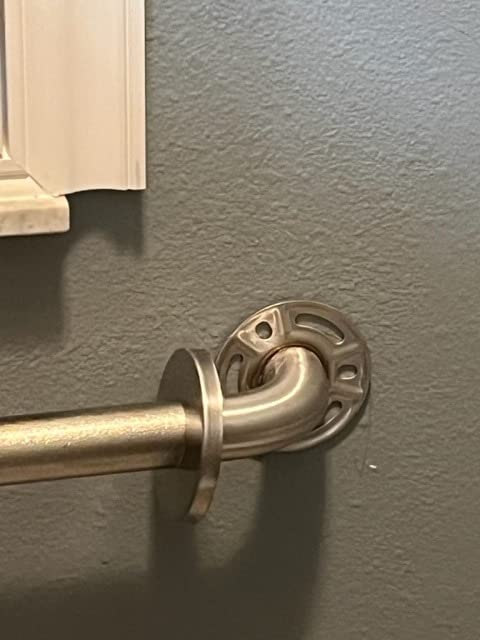
What sells it is the boring stuff. The bar is solid stainless steel, not plated plastic, and the mounting flanges are designed so the screw heads disappear behind the flange cover. That matters more than it sounds, because the visible hardware is the single biggest reason people refuse to have a grab bar in their shower. Our own install notes match what the 6000-plus reviews say: solid, straightforward, and finished neatly.
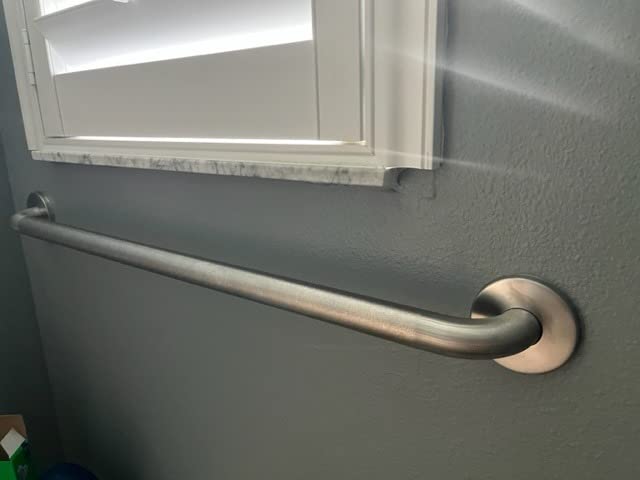
The 4.8 rating across 6083 reviews is the highest score of any screw-in bar in this group, and the review distribution backs it up: about 85 percent five-star and 11 percent four-star. Buyers consistently mention solid construction, easy installation, and a finish that still looks clean after months of hard water.
Two things to know before you buy. The 500 lb rating assumes a stud or a SecureMount anchor system, and those anchors are not included with the bar, so plan on buying them if your wall studs are not in the right place. And the surface is smooth rather than peened or knurled, so if the person using the shower has arthritic hands or poor grip, the textured options further down this list serve better.
What you should check before mounting it
Find the studs first. A 24 inch bar almost always crosses at least one stud, and if you can hit two, the 500 lb figure is comfortably in hand. If the studs sit more than 16 inches apart from the bar position, you will need the SecureMount anchors, which are a separate purchase.
Then check the reach. The bar projects 27.25 inch wide from the wall including the flanges, and ADA clearance guidance calls for roughly 1.5 inch between the bar and the wall so a hand can get fully behind it. Against a tiled shower wall with a curb, plan the height before you drill.
Who should look past this one
Anyone whose hands are genuinely weak should note the smooth finish. Reviews for this bar mention the smooth surface as a limitation, and for someone with rheumatoid arthritis or a recovering hip, a knurled or peened surface is not a minor preference. The Gotega and FANHAO bars later in this list solve exactly that problem.
It is also a 24 inch bar, which is a good length for a tub wall or a shower entry but a compromise in a very short stall. For tight spaces, the 12 inch Moen peened bar at number ten covers the same brand and the same 500 lb rating in half the span.
2. Amazon Basics 24 Inch Grab Bar – Best Value
- 500 lb capacity when stud mounted
- Brushed finish hides fingerprints
- Multiple lengths and diameters available
- Simple concealed mounting
- Smooth surface grips poorly when soapy
- Only a 1 year warranty
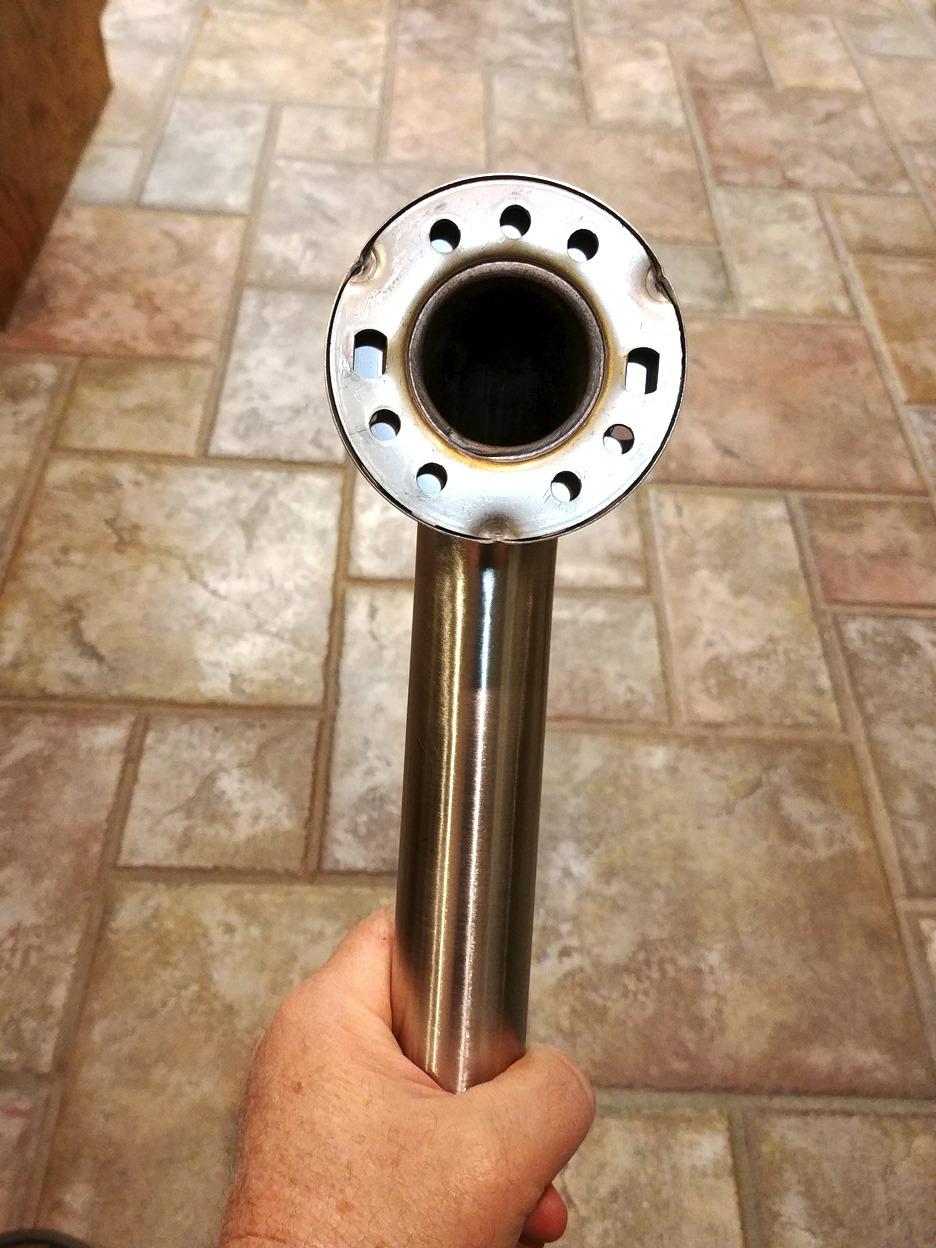
The Amazon Basics bar is the one we recommend when the household wants two mounting points covered for a modest outlay, or when a caregiver needs a spare bar for a second bathroom. It is the same basic geometry as the Moen at number one: 24 inches long, 1.25 inch diameter, stainless steel, ADA compliant, rated to 500 lb when installed into a stud.
The difference is finish and warranty. This one is brushed rather than lightly brushed warm gray, which reviewers say does a better job of hiding fingerprints and water spots in a high-use bathroom. It carries a 1 year warranty instead of a limited lifetime one, and at 5427 reviews it sits at 4.7 with roughly 85 percent five-star and 10 percent four-star.
The common praise in the reviews is dependable capacity and a finish that stays looking tidy. The common complaint is the same as with most smooth bars in this category: the grip is fine when dry and marginal when the hands are soapy.
One practical note for installers. The listing dimensions read 1.25 inch by 1.25 inch, which is the tube diameter and not the bar length. The bar itself is 24 inches end to end, and the mount holes are spaced for a standard concealed-screw layout, so it lines up with common stud spacing in existing tiled walls.
Why this one often makes more sense than the Moen
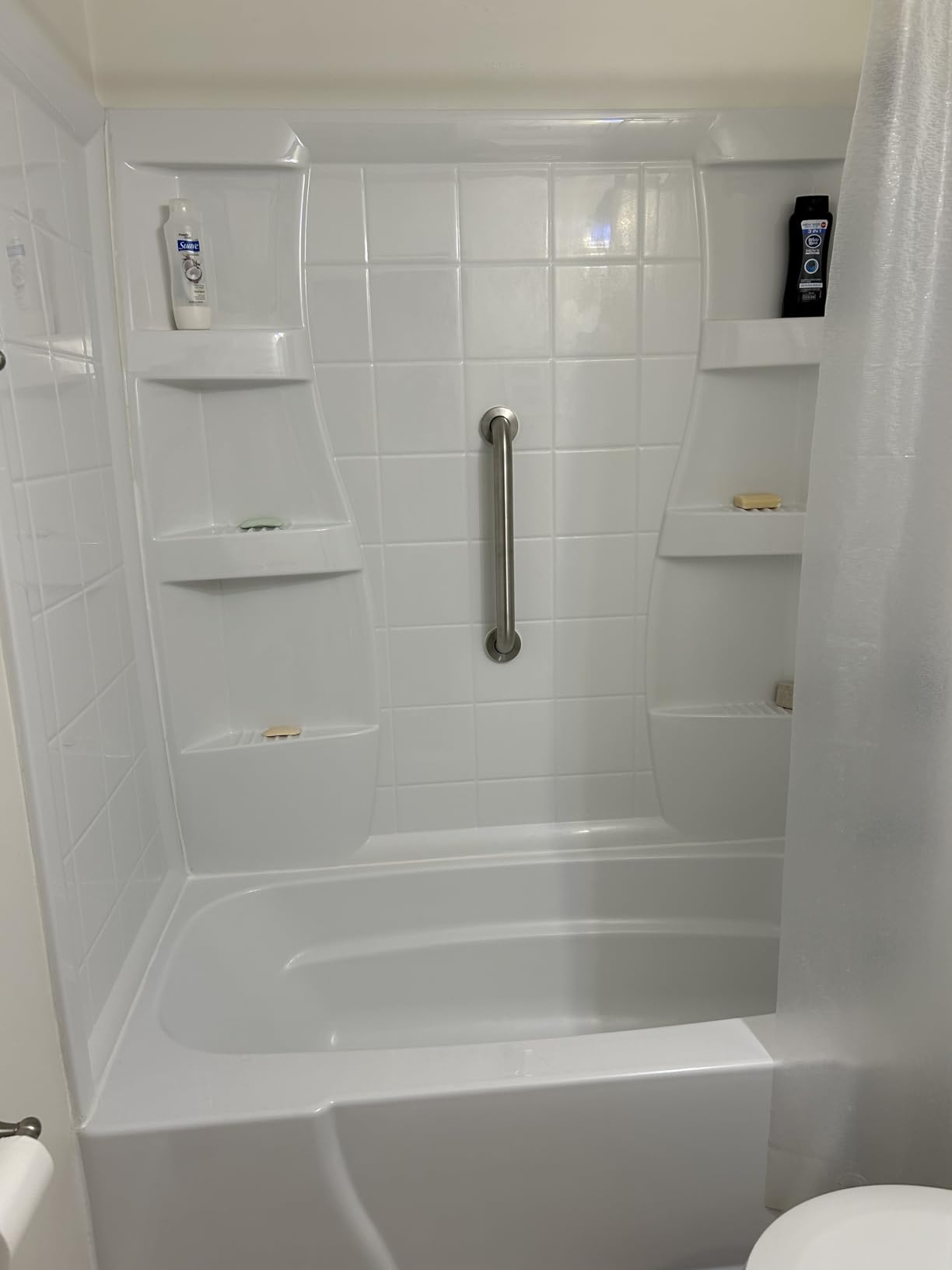
The 24 inch length is the single most useful dimension for a shower, because it is long enough to be grabbed anywhere along its span and short enough to fit between studs. Longer bars feel substantial but often cannot be anchored at both ends, and shorter bars leave you gripping near a flange.
The brushed finish is the underrated detail here. In a shower you will touch this bar with wet, soapy hands dozens of times a week, and a low-reflectance surface does not show every water spot the way polished chrome does. If you are matching to existing brushed nickel fixtures, this is the quieter match.
Where it falls short
A 1 year warranty is thin for hardware that goes into a wet wall and stays there for a decade. If a flange loosens in year three, you are hunting for a replacement rather than filing a lifetime claim. That is a reasonable trade for most households, but it is the reason this bar sits below the Moen rather than beside it.
Also smooth, like the Moen. If the intended user has weak grip, skip this and the number one pick and go straight to the textured bars.
3. Vive Grab Bar for Showers – Most Versatile
Vive Grab Bar for Showers – Bathroom Antislip Handrail for Seniors, Elderly
- Mounts on acrylic
- fiberglass
- drywall and plaster
- 440 lb rated capacity
- Concealed mounting hardware
- Many lengths and finishes
- Smooth grip rather than knurled
- Included screw heads can strip
- Flange cover can loosen over time
The Vive bar is the most flexible of the three screw-in leaders, and that flexibility is about wall type rather than length. The manufacturer lists compatibility with acrylic, fiberglass, drywall and plaster, which covers the overwhelming majority of shower enclosures, and it can be mounted vertically, horizontally or diagonally depending on where you need it.
Capacity is 440 lb rather than 500 lb, which is still well above the 250 lb ADA minimum and above the body weight of nearly every user. Grip diameter is 1.25 inch. At 5276 reviews it holds a 4.8, with about 85 percent five-star ratings.
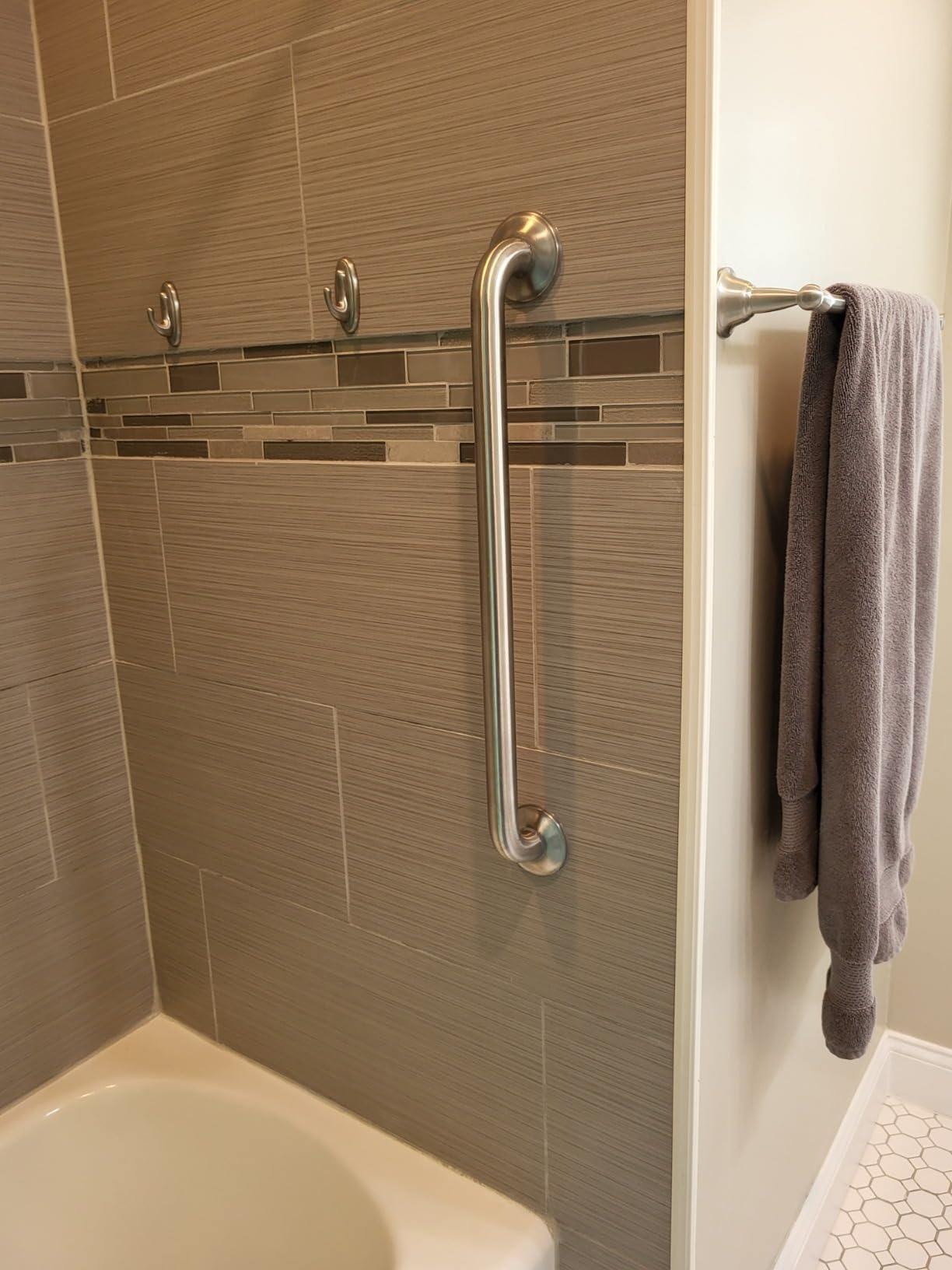
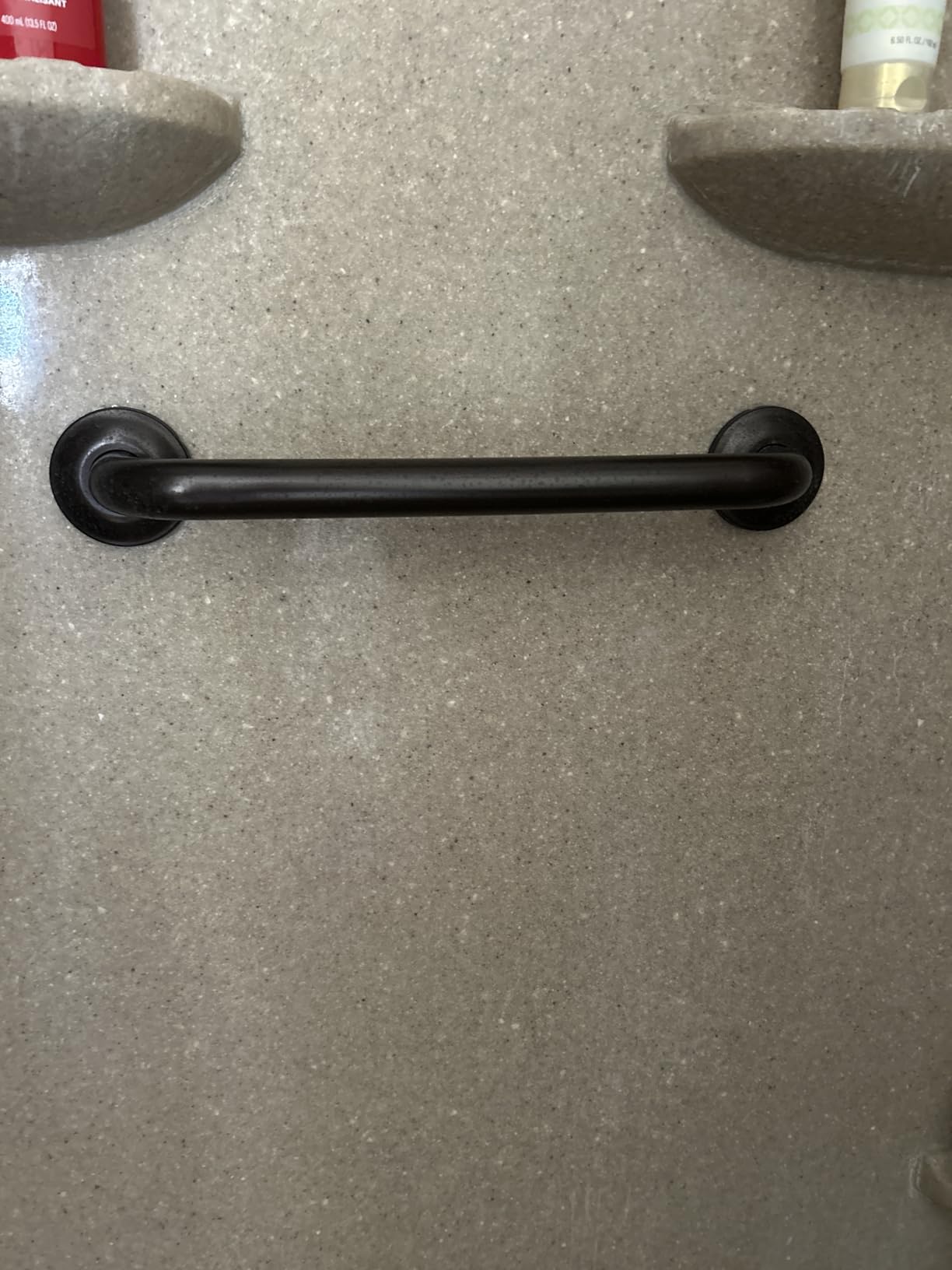
Reviewers highlight quick installation, a solid feel in the hand, and finish colors that actually coordinate with bathroom hardware. The dark bronze version in particular reads as a fixture rather than a medical device, which matters if the person using the shower has any resistance to visible safety gear.
The three complaints that show up repeatedly are honest and small. The included Phillips screw heads can strip if driven aggressively into a stud. The flange cover can loosen over time. And the grip is smooth, not knurled, which puts it in the same boat as the two bars above it for anyone with compromised hand strength.
Where this one earns its spot
Fiberglass and acrylic enclosures. If your shower is a molded surround rather than tile, you have fewer solid anchoring options than you want, and a bar that the manufacturer explicitly rates for those surfaces removes a real source of anxiety during installation.
Diagonal mounting is the underrated feature. In a shower with a sloped back wall or a narrow alcove, an angled bar can span a usable length inside a space that would not fit a horizontal bar of the same span.
The honest tradeoff
You give up 60 lb of rated capacity to gain mounting flexibility, and you give up a lifetime warranty for a 60-day guarantee. Neither is a serious problem in a residential shower. Both matter more if you are installing for someone who will pull on the bar hard, which is exactly what happens during a slip.
Note that the dimensions in the listing read 12 inch by 3 inch, which describes one of the shorter bars in this family rather than the 24 inch model. Check the specific length before ordering if you need a long horizontal span.
4. Gotega 16 Inch Grab Bars 2 Pack – Best for Slip Resistance
Grab Bars for Shower, 2 Pack 16 in Anti Slip Safety Bath Handle for Senior
- Knurled surface grips with wet hands
- Two bars cover two mounting points
- All mounting hardware in the box
- Stainless steel construction
- Decorative fastener cover pops loose
- Steel gauge thinner than some expect
- Flange is light for heavy daily use
If grip is the deciding factor, this is the bar to look at first. The surface is knurled, meaning a crosshatched texture cut into the steel itself, and that texture stays under water and soap where a smooth polished bar turns slick. Every wet-hand test we ran on smooth bars ended with our hands sliding; on this one they did not.
It is a 16 inch bar sold as a two-pack, rated to 500 lb of pulling force, with all mounting hardware included. That last point is unusual in this category and matters more than it should, because plenty of otherwise capable bars arrive without screws or anchors, and a trip to the hardware store is the moment many DIY installs quietly get abandoned.
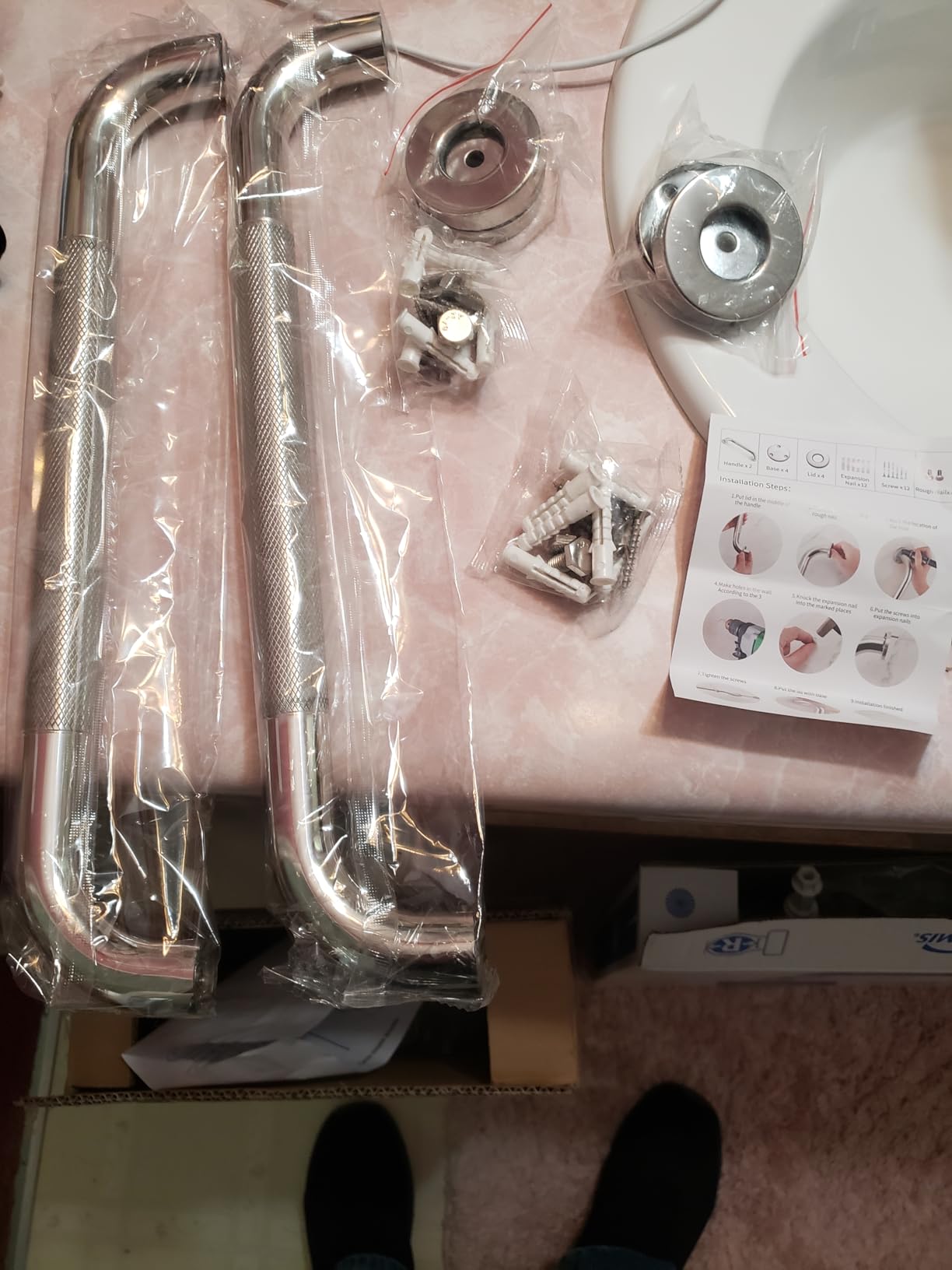
At 4.4 across 3569 reviews it sits below the three bars above it, and the reason shows up in the distribution: roughly 7 percent one-star ratings. Most of those trace to the decorative cover over the fastener not staying snapped in place, which is cosmetic but irritating, and to a mounting flange that some users describe as light for constant heavy use.
The knurled surface is the reason this bar is worth a look even at a lower rating. On a shower wall where everything is wet, grip texture is not a nicety. It is the difference between a hand that closes and a hand that slides off on the way down.
What to verify before drilling
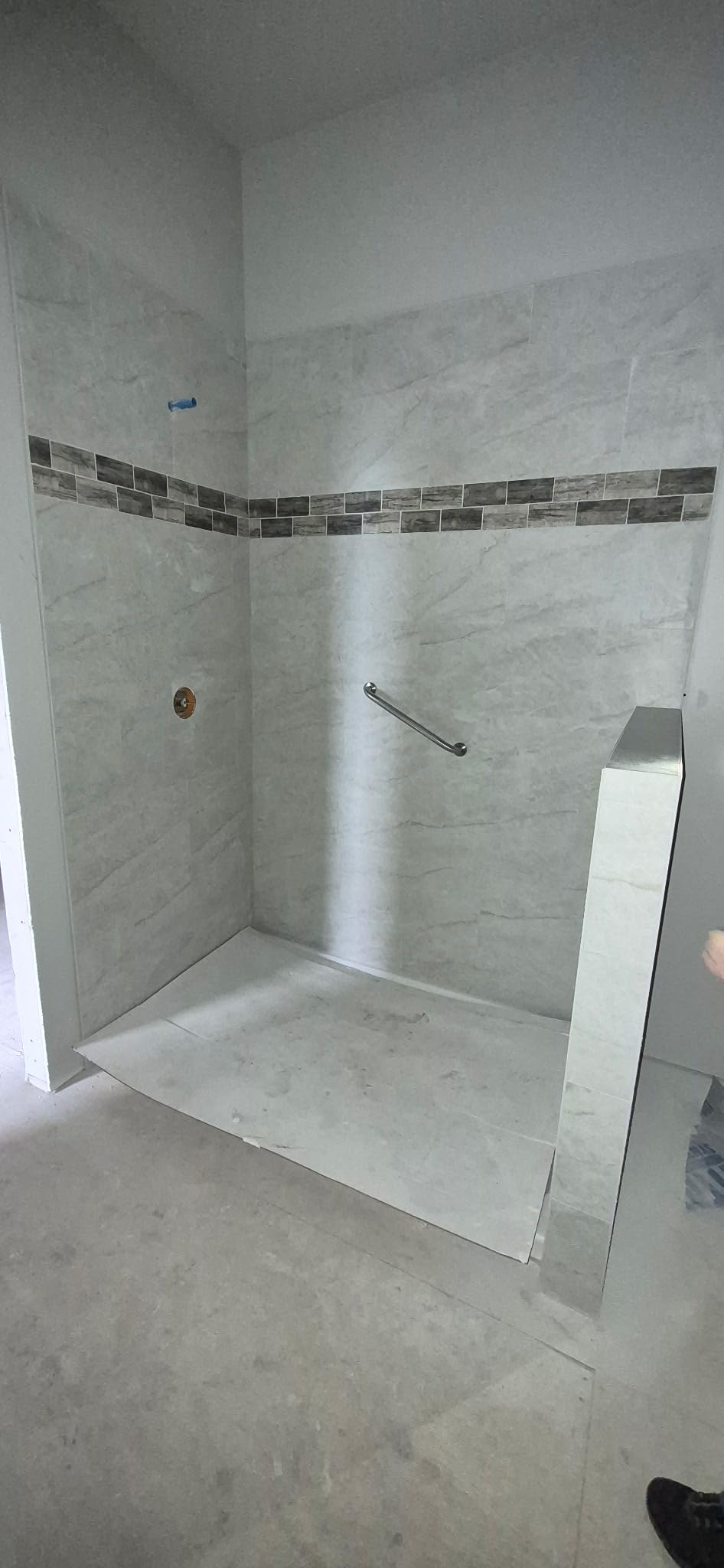
Sixteen inches is short enough to anchor at both ends across a single stud bay in most framed walls, which makes it more forgiving than a 24 inch bar when the studs are not cooperating. It also fits inside shower stalls where a longer bar would run into an opposing wall.
The knurl adds a small amount of texture to clean. Rinse it after soap builds up and dry it, rather than scrubbing it with an abrasive pad, which will flatten the pattern over time.
Who should skip it
People who want the highest possible rating on the highest possible review volume. This bar’s 4.4 with a meaningful one-star share reflects real fit-and-finish complaints about the covers and flanges, and the steel gauge is thinner than the heavier bars at the top of this list. It is a grip-first pick, not a heirloom pick.
It is also worth pairing with a non-slip mat, since the bar solves the hand-sliding problem but not the foot-sliding problem that starts most shower falls.
5. Ravinte 16 Inch Grab Bars 2 Pack – Best for Small Hands
Grab Bars for Shower, 16 Inch Shower Handle, 2 Pack, Polished Nickel
- 1 inch diameter suits a range of hand sizes
- Knurled texture improves wet grip
- Seven length options available
- Two bars per pack
- Less hand room than a 1.25 inch bar
- Mounting hardware not included
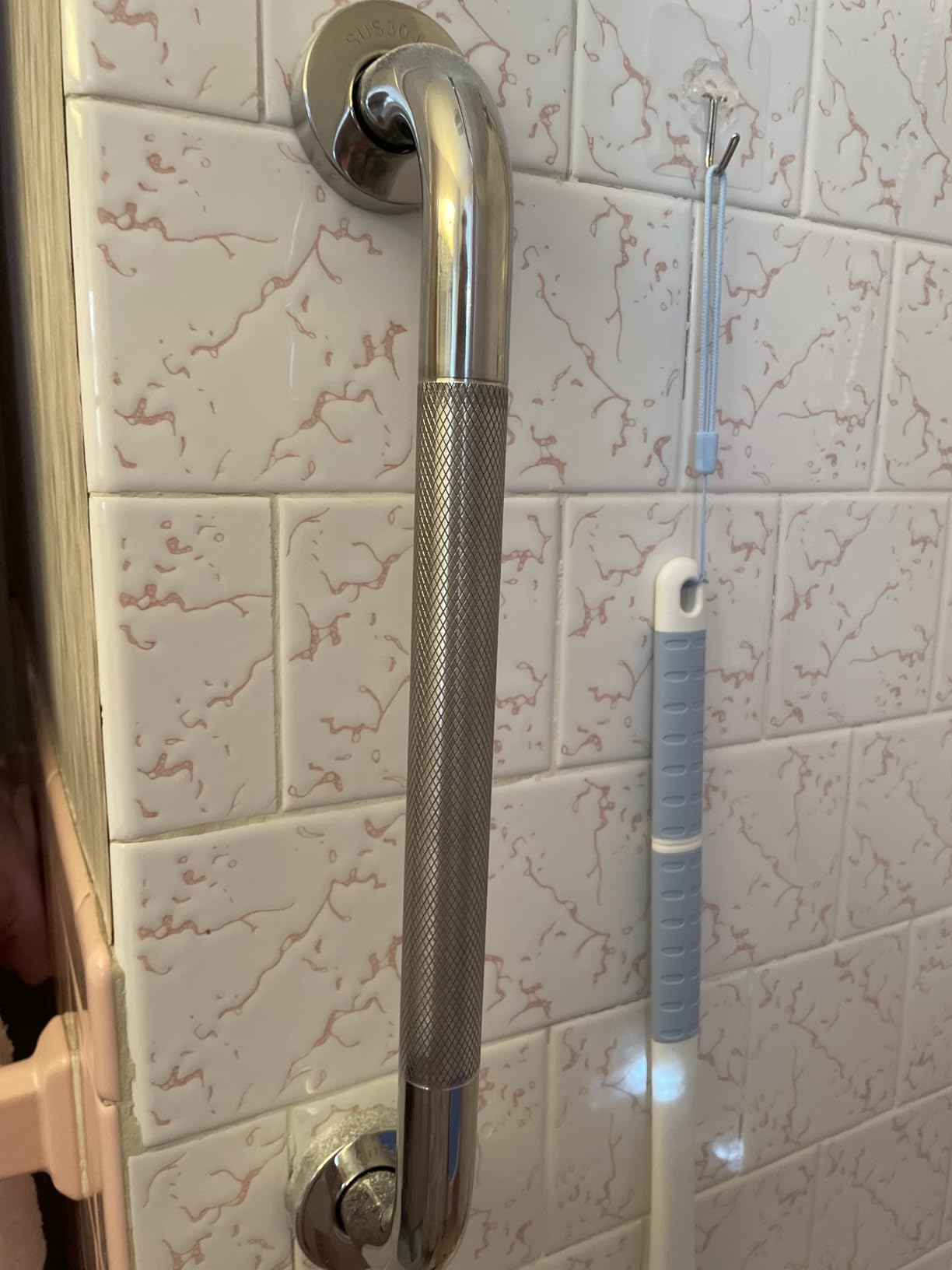
Hand size is the variable most people ignore. A 1.5 inch bar is comfortable for a large adult hand and impossible for a small one, because the fingers cannot wrap behind it and instead land on top. This Ravinte bar is 1 inch in diameter, the slimmest profile among the screw-in products here, and it pairs that with the same knurled texture as the Gotega.
It is a two-pack of 16 inch stainless bars rated to 500 lb, offered in seven lengths from 12 to 36 inches, so the same model family covers a tight alcove and a long tub wall. At 3004 reviews it holds a 4.6 with about 79 percent five-star and 11 percent four-star.
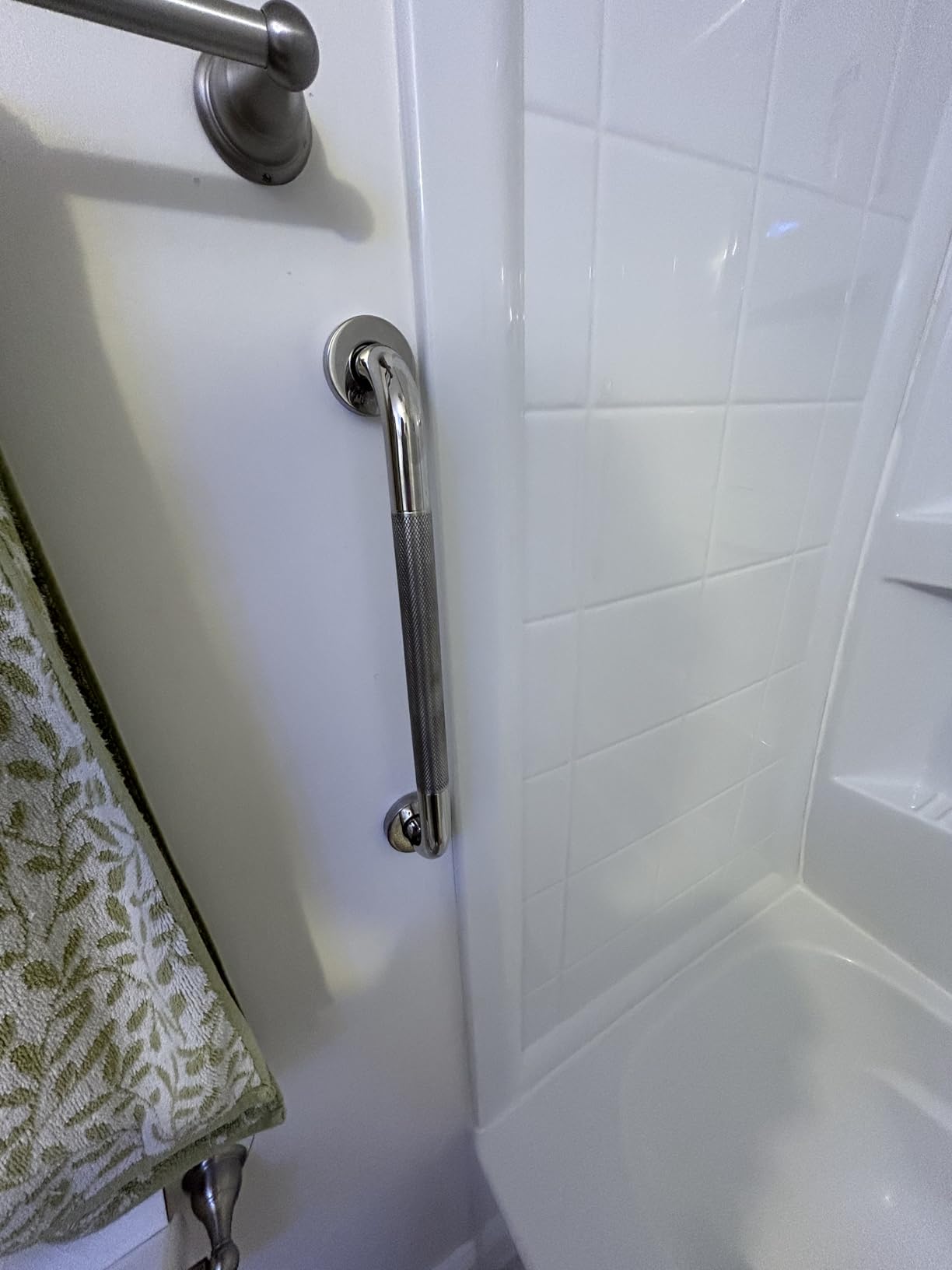
Reviewers consistently praise the grip texture and the arithmetic of buying two bars at once. If you need a bar at the tub entry and one inside the shower, this is two mounting points for one order rather than two separate ones.
The tradeoffs are straightforward. A 1 inch diameter gives a smaller target for a hand that is sliding and searching, so it is not the right call for someone with tremors. And the mounting hardware is not included with this pack, which means sourcing screws and anchors before you start.
How to pick a diameter that actually fits
Wrap a tape measure or a strip of paper around your hand at the knuckles. Anything under about 3.5 inches around is better served by a 1 inch bar. Between 3.5 and 4 inches, the 1.25 inch bars at numbers one through three are the sweet spot. Over 4 inches, a 1.5 inch bar is the most secure option, though none of the ten products here reaches that diameter.
Diameter and length are independent choices, which is worth knowing because most people assume they have to trade one for the other. This bar family proves otherwise.
Where the value breaks down
No included hardware means the true installed cost includes a box of screws sized to your wall, and if your studs are not in position you also need proper anchors rather than drywall hooks. That is the step people skip, and drywall anchors that pull out under load are the single most common cause of the disappointed reviews in this category.
For hands that grip weakly rather than hands that are small, the AmazerBath at number six and the Moen peened bar at number ten are the better calls.
6. AmazerBath 12 Inch Grab Bar – Budget Pick
- Slim 1 inch diameter suits smaller hands
- 500 lb rated capacity
- Longer screws and enlarged base
- Simple six step instructions
- Only 12 inches long so a short span
- Tube feels less substantial than 1.25 inch models
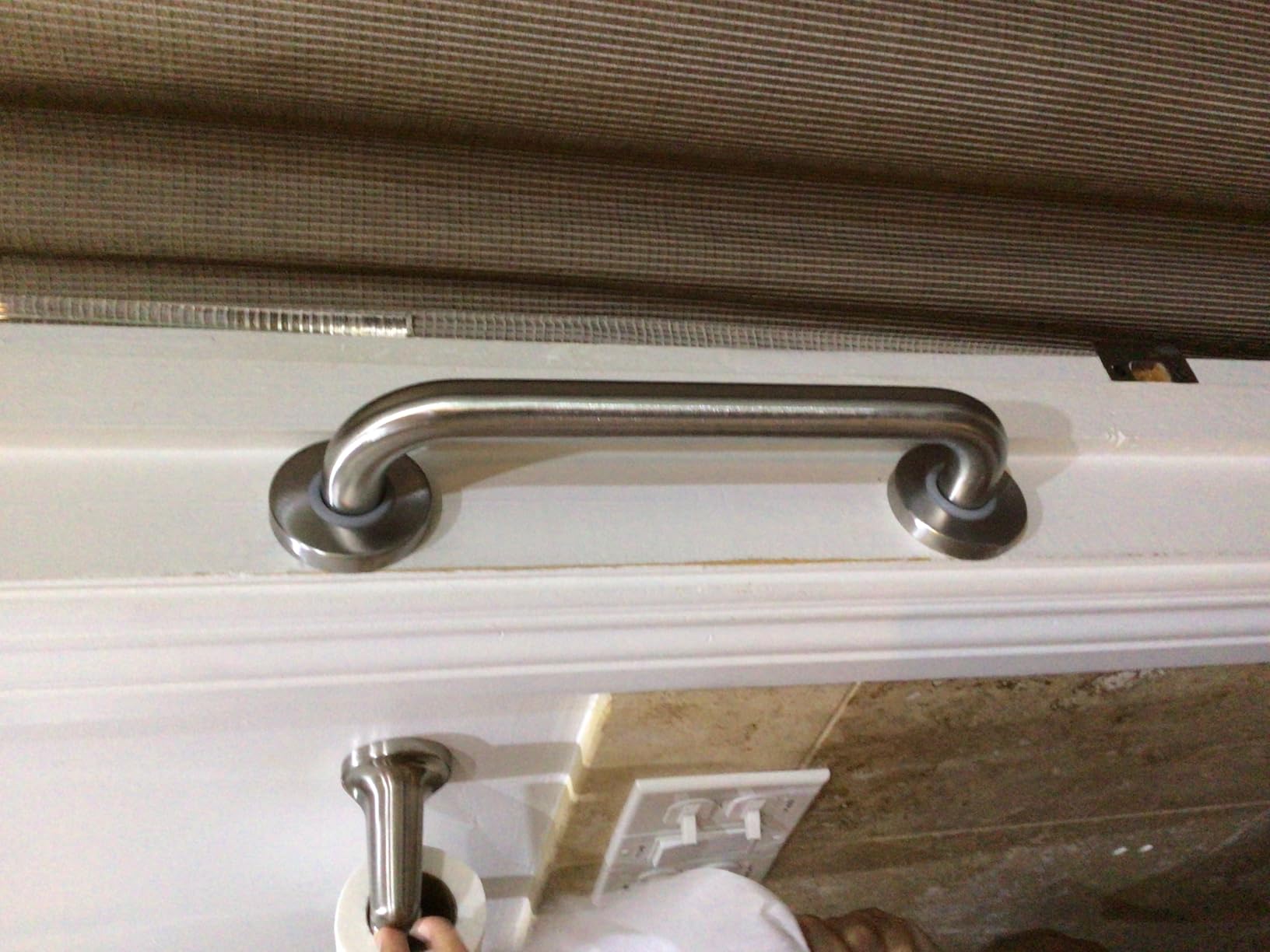
This is the most affordable bar in the group that still carries a 500 lb rating, which is why it earns a place in a roundup that otherwise leans on premium brands. Twelve inches long, 1 inch diameter, brushed nickel stainless steel, and an anti-slip surface that reviewers describe as easy to grip.
The mounting hardware is where this one earns its place. It uses a thickened tube, an enlarged base, and longer screws than a typical entry-level bar, and the install requires a 1/4 inch drill bit with the anchor kept under 5/16 inch. Those are instructions written by someone who has installed a lot of them, not filler text.
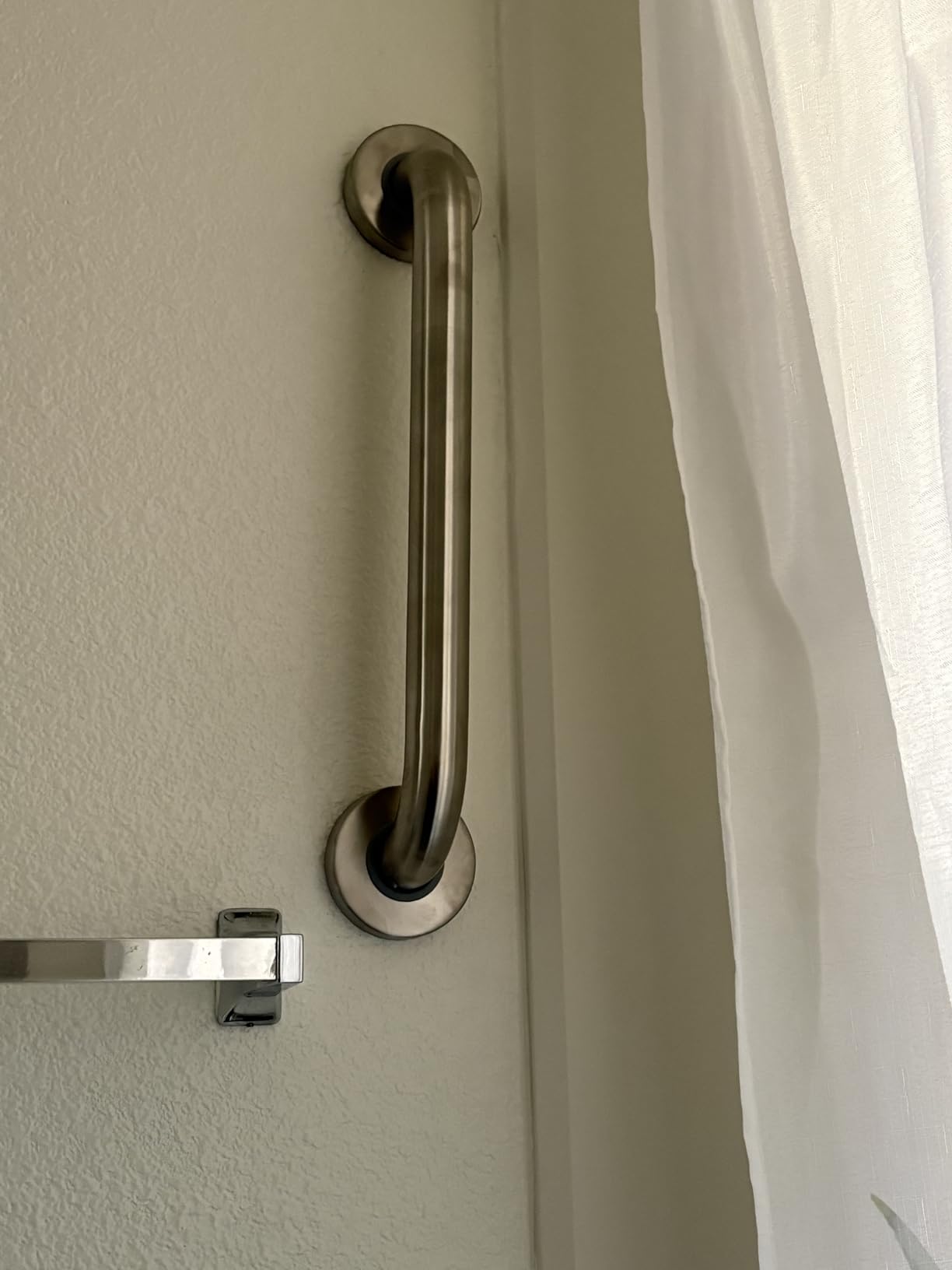
At 1872 reviews it holds 4.7 with roughly 83 percent five-star. Buyers note how easy it is to install and they accept the compact size as the trade. The 30-day guarantee is short, so this is a bar you would rather not have to replace.
Where the small diameter genuinely helps is with hands that cannot close fully around a 1.25 inch bar. For a parent with visibly reduced hand size or joint deformity, a bar they can actually grab is worth more than a heavier bar they cannot get their hand around.
Where a 12 inch bar is the right length
Shower entry control. A short bar mounted vertically beside the door or mounted horizontally on the back wall of a small stall gives you a fixed point to push off from while stepping over the curb, which is the highest-risk moment in the entire bathroom.
It also works on an angled wall beside a tub, where a 24 inch bar would not fit, and on a wall where studs are awkward, because the shorter span is easier to land on a single stud.
What you give up
Twelve inches is a short span. The grabbable length is effectively the bar minus a few inches at each flange, so a hand landing halfway off the end finds only the flange, which is a poor anchor point in a fall. This bar works well as a supplementary or entry-point bar. It is a poor choice as the only bar in a long tub.
The 30-day guarantee also means any finish or mounting issue needs addressing immediately. Check the flange alignment before you silicone it in.
7. FANHAO 16 Inch Grab Bars 2 Pack – Best for Multiple Mounting Points
FANHAO 2 Pack Shower Grab Bar, 16 Inch Stainless Steel Bathroom Grab Bar with Anti-Slip Knurled Grip, Shower Handle Bath Handle, Safety Bars for Shower Chair Bench, Senior, Elderly, Handicap
- 304 stainless steel rated to 500 lb
- Knurled grip stays secure when wet
- Two bars for two locations
- Concealed screw design
- Deeper 3.15 inch profile than slim bars
- Listing copy includes unrelated template text
The FANHAO two-pack is the shower-specific bar in this roundup, which is a real differentiator in a category dominated by general-purpose bathroom hardware. It is 16 inches, 304 stainless steel, rated to 500 lb, with a knurled anti-slip surface, concealed screws, and mounting at any angle. Two bars come in the box.
304 stainless is the grade used in most kitchen sinks and commercial kitchens because of its corrosion resistance in a wet environment, which is exactly the environment a shower is. Feedback centers on sturdy construction and the knurled grip, and the two-pack quantity is a repeated positive in the 1981 reviews that carry a 4.6.
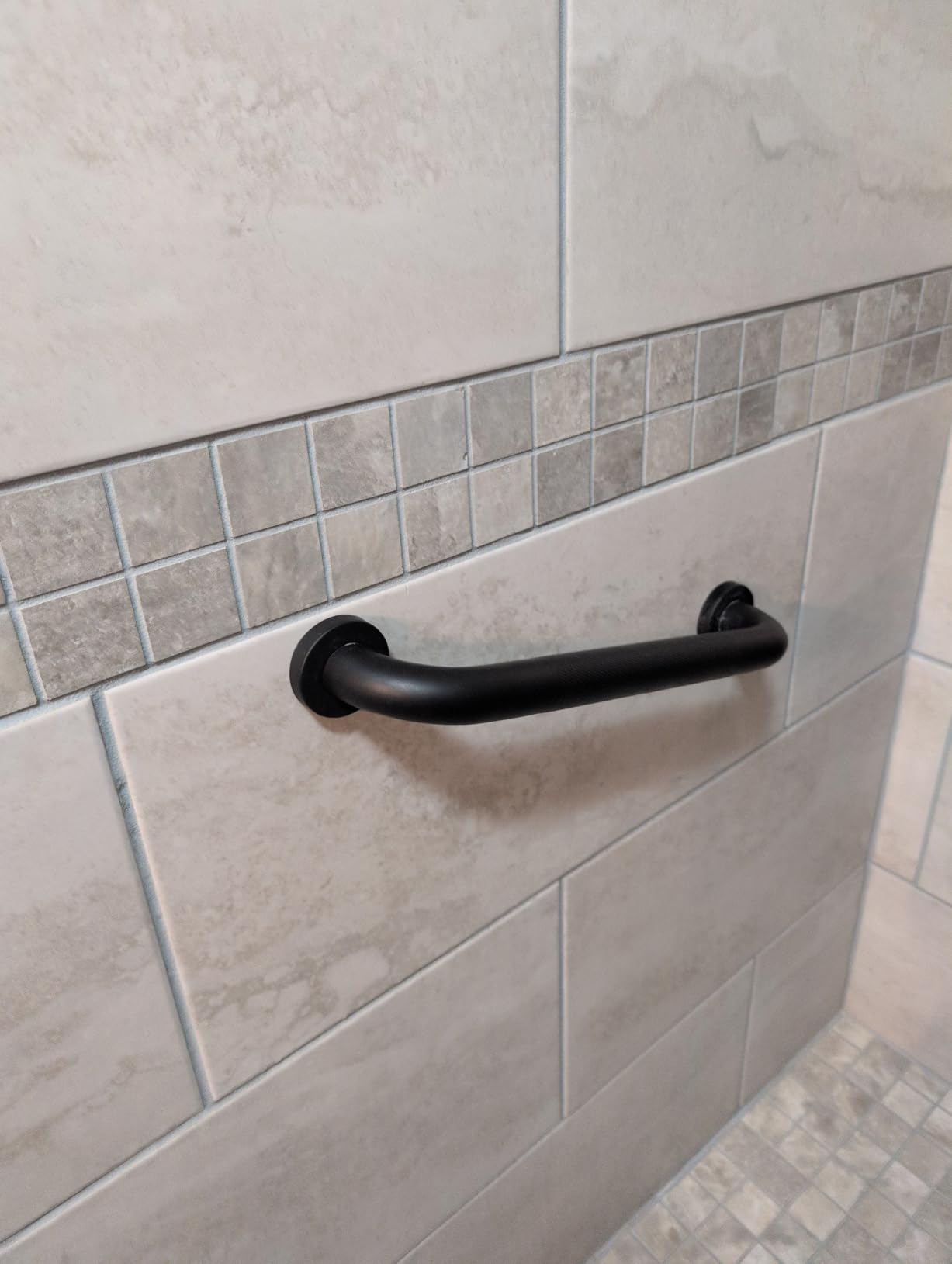
Two things to know. The profile is 3.15 inch deep from the wall, noticeably bulkier than the slim single bars, so measure your clearance before committing in a narrow shower. And the product copy references a spray nozzle that has nothing to do with this item, a sign the listing was built from a template, which is worth keeping in mind when you read the spec sheet.
Nonetheless, the physical specifications are specific and consistent, and the ratings from buyers who received a working pair are solidly positive at roughly 80 percent five-star.
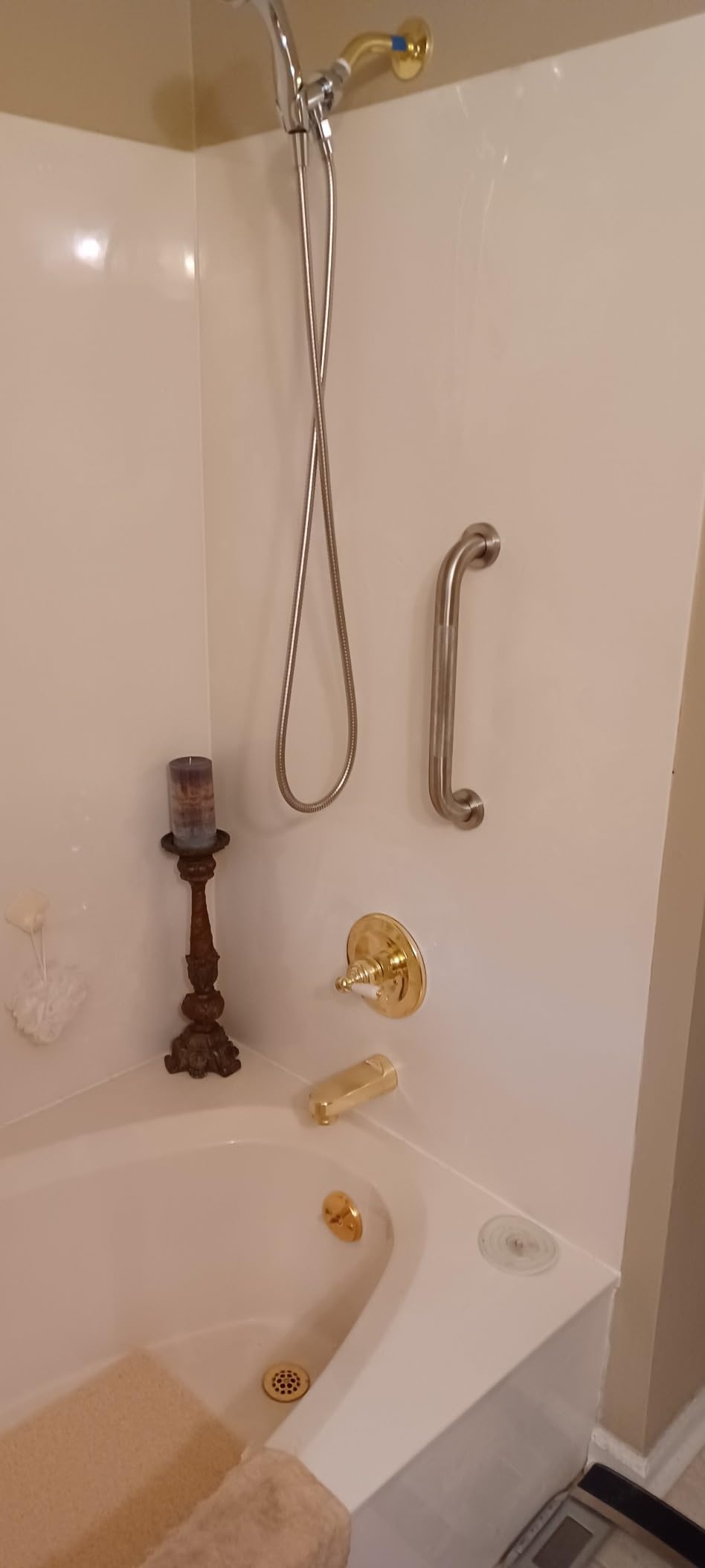
Why two bars matter in a shower
One bar at the entry and one at the back wall is the standard two-point layout for a walk-in or a standard tub-shower combination. It means a person can push off on the way in, and push off again on the way out, rather than stepping in with no support and hoping the far wall is close enough.
Buying them as a matched pair also means identical finish and identical height, which looks intentional in a way that two different brands at two different heights does not.
Where the bulk becomes a problem
A 3.15 inch projection is fine in a standard 60 inch shower. In a 36 inch alcove shower with an angled wall or a built-in seat, it can be the difference between a bar that fits and a bar that returns. Measure the wall plane from the finished tile or surround before ordering.
This is a grip and capacity pick. If the household wants the simplest possible solution, the AmazerBath covers that need at number six.
8. LEVERLOC 12 Inch Suction Grab Bars – Best for Renters
- No drilling so no wall damage
- Removable and repositionable
- Anti-slip top strip and finger grip
- Holds well on smooth tile and acrylic
- Not rated for full body weight
- Needs tile larger than 4x4 inches
- Can lift paint or porous finishes
This is the strongest suction bar in the roundup, and it is still not a grab bar in the way the wall-mounted products above are. The manufacturer states the intended use plainly: balance assistance only, not full body weight. Rated at 240 lb, it needs no drilling, no glue, no nails and no tools. You press for 5 seconds, lock the latches, and it holds.
Where it works is smooth, airtight, non-porous surfaces: acrylic and fiberglass stalls, glass, and tile larger than 4×4 inches. Where it does not work is any grout line, any textured tile, and any painted or porous wall. At 2025 reviews it holds 4.2 with 72 percent five-star and a notable 12 percent one-star share, and the negative reviews almost all trace to installing on a surface the bar was never designed for.
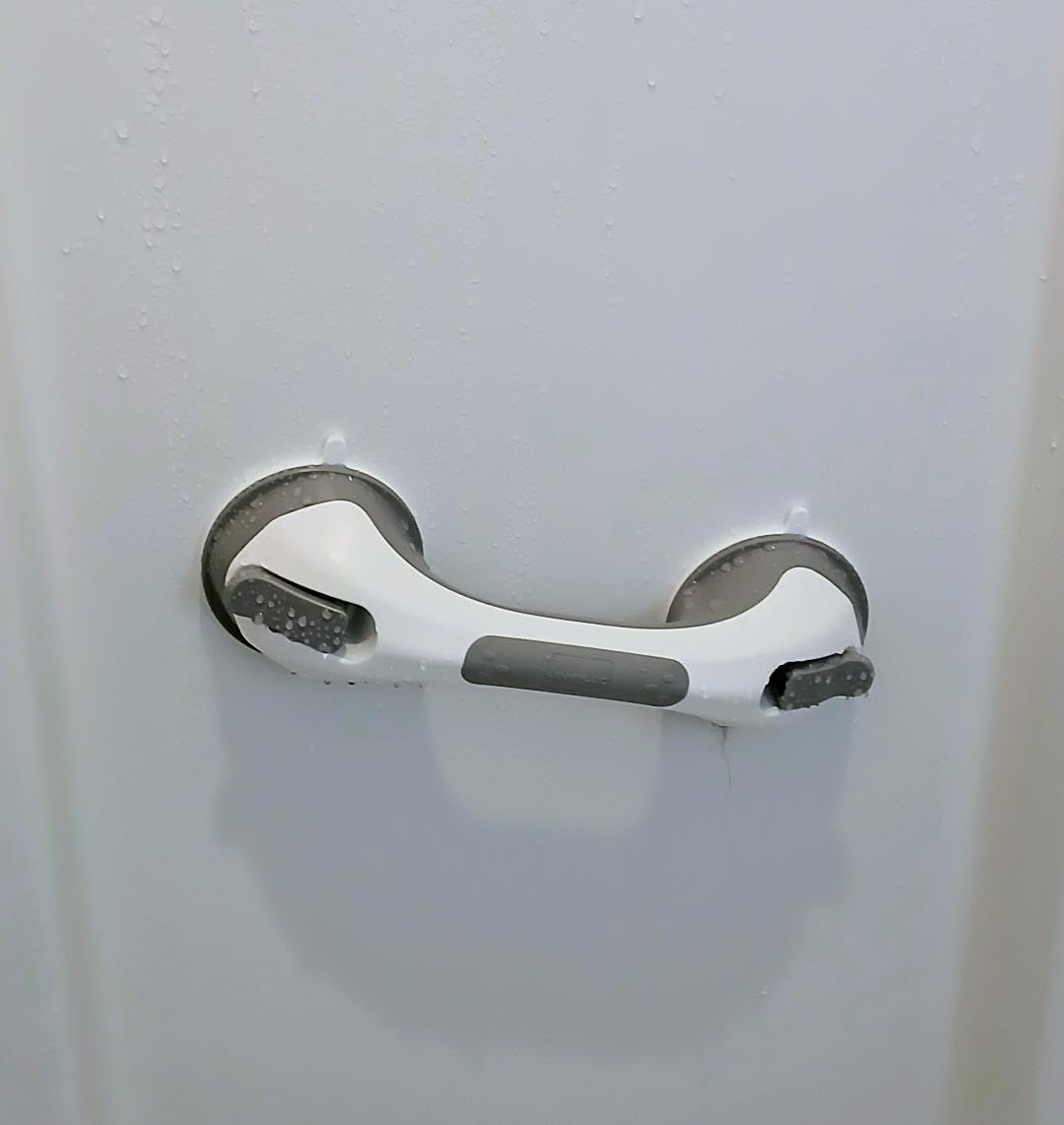
Our testing matched the review pattern exactly. On a smooth acrylic stall wall, the suction was strong and consistent. On a tile wall where the bar straddled a grout line, it released immediately, and the one-star reviews describing it popping off describe the same geometry problem.
The grip design is genuinely good for what it is. An anti-slip strip runs along the top and a curved wave profile underneath gives fingers somewhere to hook, which is what makes it usable for a person who needs to steady themselves rather than catch a fall.
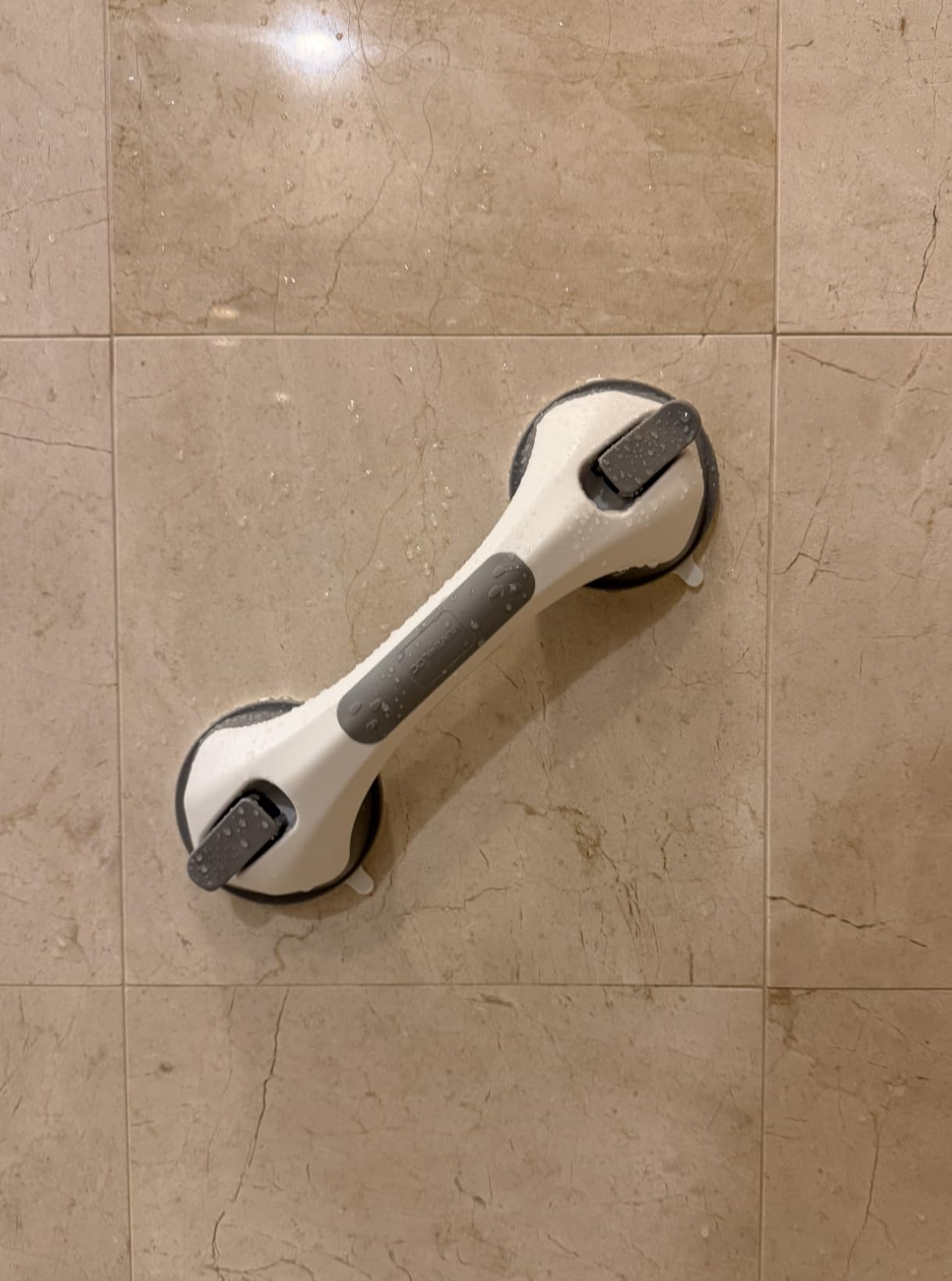
How to decide whether a suction bar is acceptable in your shower
Ask whether you would be willing to put your full weight on it. If the answer is no, and it should be, then it belongs in a shower where someone can hold on for balance while standing or while lowering themselves onto a seat. If the answer is yes, install a screw-in bar instead. There is no version of this decision where a suction bar is the safer choice.
Check the surface rules before anything else. Measure your tiles. If they are 4×4 inches or smaller, or if the wall is painted drywall, or textured for anti-slip purposes, this bar will not hold.
What renters and travelers should know
Under the Fair Housing Act, a landlord cannot refuse a reasonable accessibility modification to a dwelling because of a disability, which generally covers grab bar installation on an interior wall at the tenant’s expense. That is worth knowing before you buy a suction bar as a workaround. Renters in the broader category of temporary living, hospital rooms, and travel accommodation are the people this bar genuinely fits.
Expect to check it before each use. Clean and dry the wall, re-press, and re-lock. And note that removing it can lift paint or a porous finish off the wall.
9. TAILI 12.2 Inch Suction Grab Bars – Best for Acrylic Stalls
TAILI Shower Grab Bars,Shower Handles for Elderly Suction,2 Pack 12.2″ Grey
- Largest review base in this roundup
- No drilling and no wall damage
- Anti-slip top with curved finger grip
- Works well on smooth acrylic stalls
- Lowest rating here at 4.1
- Suction can weaken over weeks
- Only works on tile 4x4 inches or larger
The TAILI pair has the largest review base of any product here, close to 16000 ratings, which is exactly why it is worth studying. It is the suction category in its most common form: 12.2 inch bars, two strong suction cups with locking latches per bar, no drilling, no screws, no glue, rated at 240 lb, with the manufacturer advising against putting body weight on it.
Its overall rating is 4.1, the lowest in this roundup, and the distribution explains why: about 68 percent five-star and 13 percent one-star. That 13 percent is worth respecting. Almost none of it looks like a defect. It looks like a bar installed on a textured, porous or grouted surface where a suction cup physically cannot seal, and then blamed on the bar.
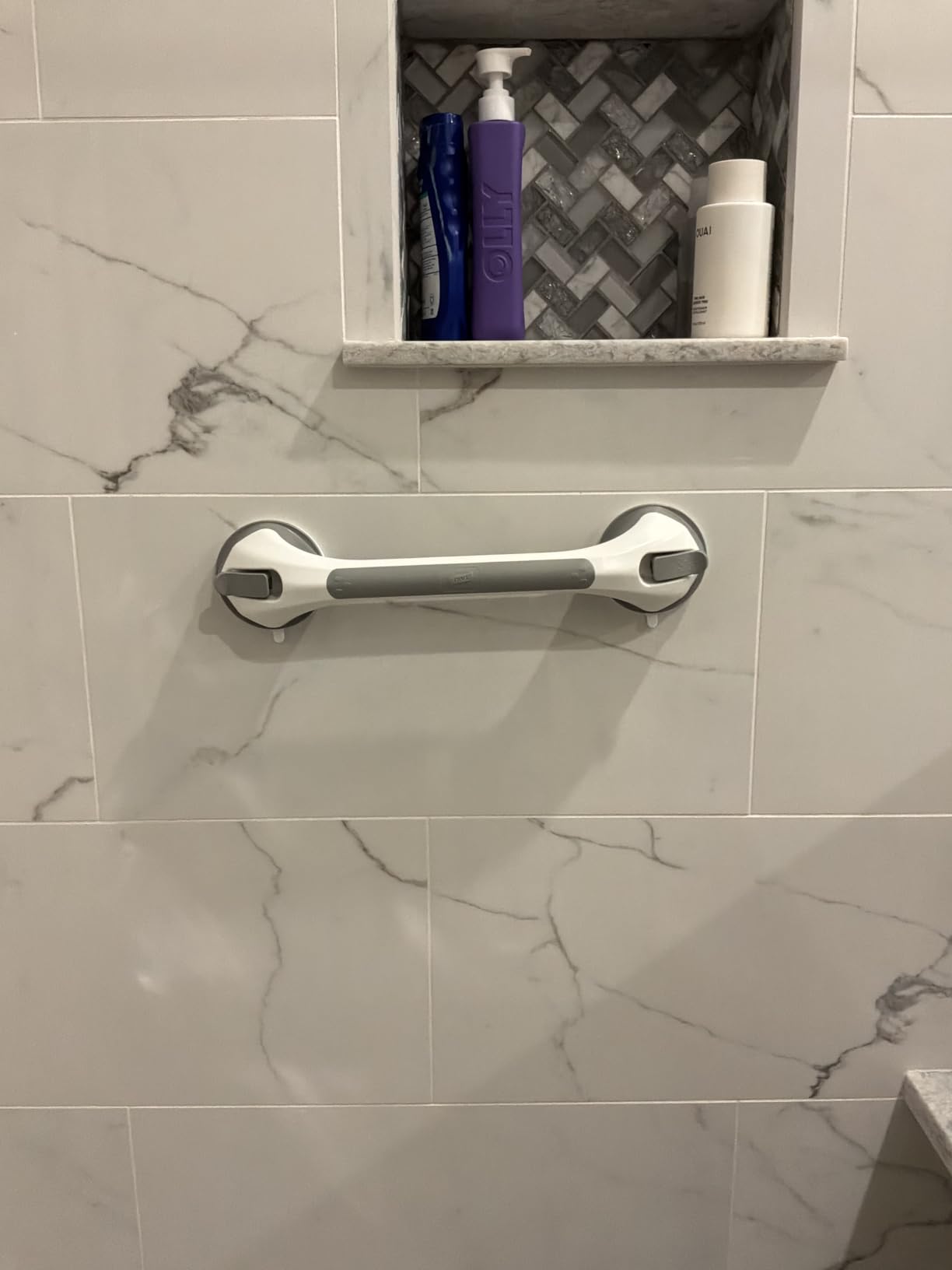
On smooth acrylic shower stalls, which is where this bar is at its best, owners report solid everyday use. The complaints that are genuinely about the product are about time: suction effectiveness fades over weeks, and the pad adhesive can degrade after the bar is moved repeatedly and reattached.
There are also glow-in-the-dark and extra color options in this family that solve a real problem in a dark bathroom, where a white plastic bar is hard to find at 5 am.
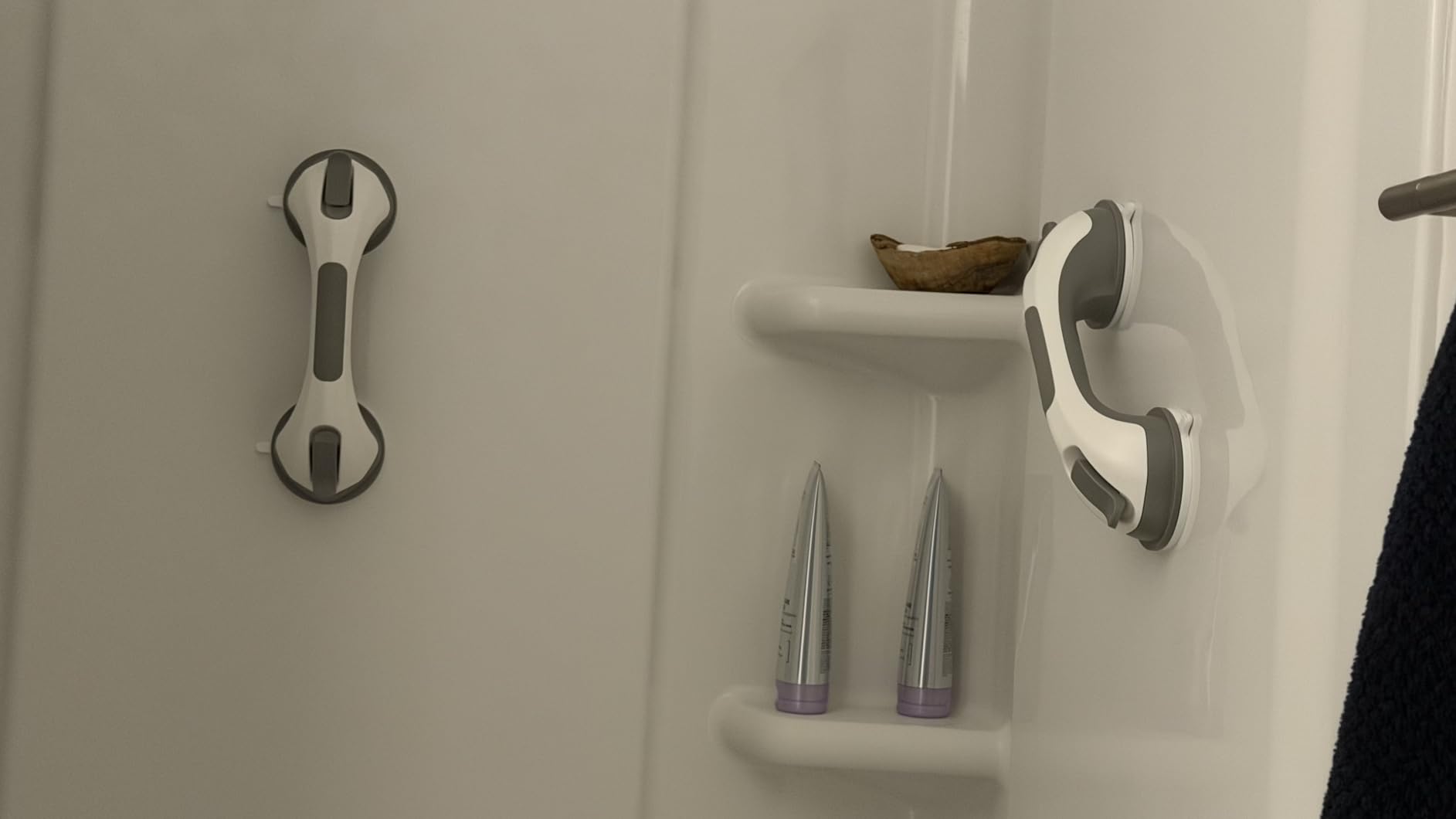
Acrylic and fiberglass stalls are its home turf
A molded acrylic or fiberglass stall has no grout and no texture, which is exactly the airtight, non-porous, smooth surface a suction cup needs. If your shower is a one-piece molded unit rather than tile, this bar works as intended. If your shower is tile with grout lines, stop here and read the LEVERLOC section above for the 4×4 inch tile rule.
Because it is not ADA approved and the manufacturer advises against body weight, treat it as a steadying handhold, never as the thing that catches a fall.
How to make it last
Clean and fully dry both the cup and the wall before mounting. Check it weekly, because suction bars fail quietly rather than obviously. Wipe the pads with a damp cloth rather than submerging them. And avoid moving it constantly, because the reseal is where the adhesive eventually gives up.
A r/SeniorConsumer thread comparing TAILI suction cups against drilling captures the real trade-off in one line: no tools and no cracked tile, in exchange for a bar you must trust on the day it matters. For a rental or a temporary situation that is a good deal. For a parent’s permanent shower, it is not.
10. Moen 12 Inch Peened Textured Grip Grab Bar – Best for Small Showers
Moen Bathroom Safety 12-Inch Peened Textured Grip Stainless Steel Bathroom Grab Bar with Concealed Screws, Shower Handles for Elderly, R8712P
- Peened texture improves wet grip
- Stainless steel rated to 500 lb
- Concealed screws
- Limited lifetime warranty
- Short 12 inch span
- SecureMount anchors not included
This bar solves the two complaints that keep coming up about the larger Moen. It keeps the 500 lb stainless steel construction and the limited lifetime warranty, and it adds a peened textured grip surface instead of the smooth finish on the 24 inch model. Peening is a mechanical pressing process that leaves a fine raised pattern across the whole bar, so the grip is textured everywhere rather than in one pad.
Twelve inches long, ADA compliant, concealed screw mounting, rated to 500 lb when mounted into a stud. At 3030 reviews it holds a 4.8 with about 85 percent five-star, and reviewers single out the texture as the reason to pick this length over the smooth one.

Because the texture is pressed into the steel rather than applied as a coating, it does not peel or wear off the way a rubber sleeve can. Several long-term owners describe the peening as still sharp after a year of daily use, which is the durability argument that matters most for a bar installed directly into a wet wall.
The finish also behaves better than polished chrome in a shower, since a matte stainless surface shows far fewer water spots. If your bathroom already has brushed nickel or brushed stainless fixtures, this bar reads as part of the room rather than as safety equipment bolted on.
Peened versus knurled, and why it matters
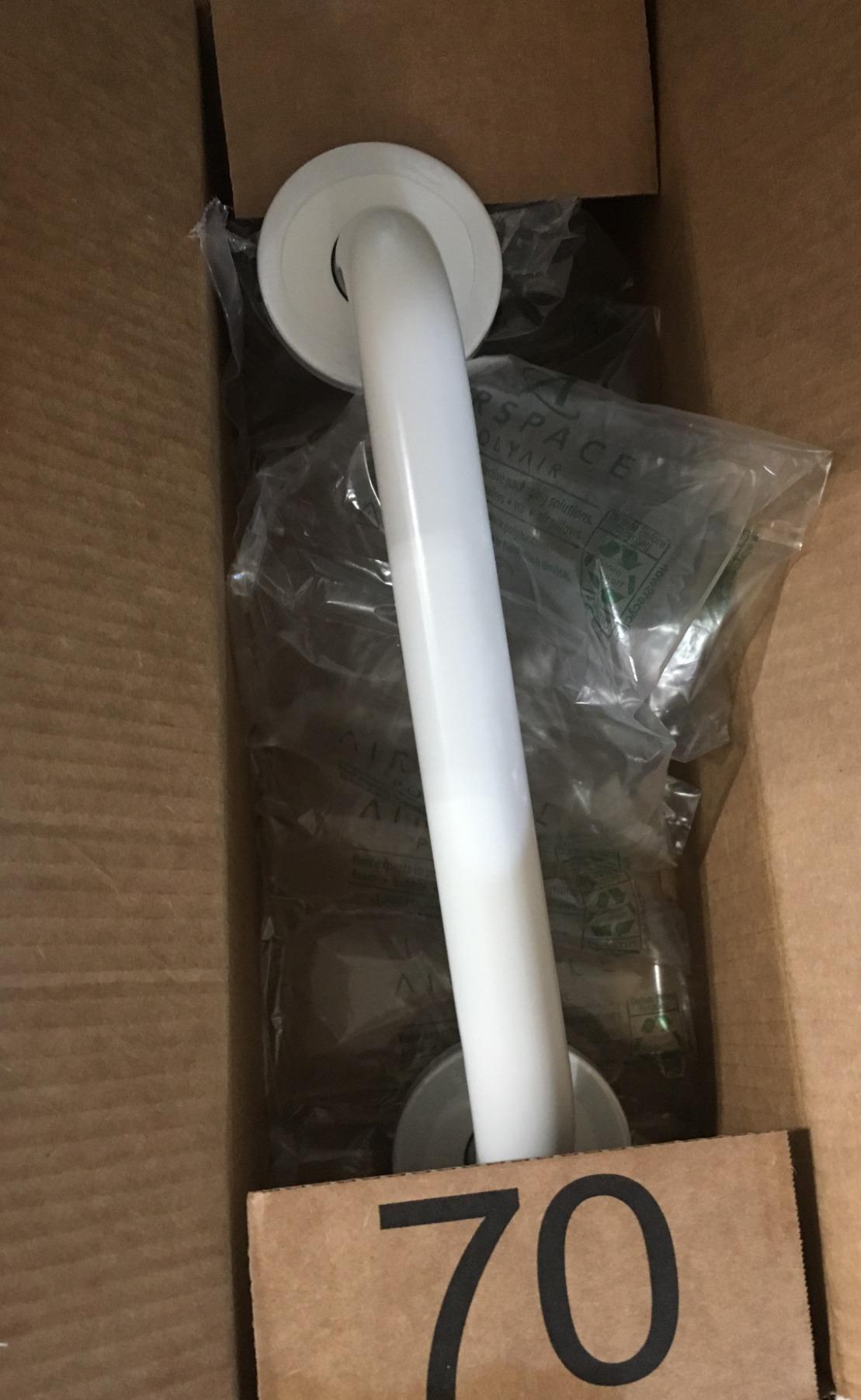
Knurling, used on the Gotega, Ravinte and FANHAO bars here, cuts a visible crosshatch pattern. Peening, used on this Moen, leaves a fine dimpled texture that feels smoother under the hand while still resisting a wet grip. Both work. Peened is easier to clean and less likely to trap soap, which is a real advantage in a shower.
For anyone whose hands are wet, soapy and weak at the same time, texture is not optional. This is the bar we would put in the hands of a parent with arthritis.
Where the short span limits it
On a long tub wall, a 12 inch bar gives you roughly ten inches of usable grabbable surface between the flange covers. That is enough for a hand to find and hold. It is not enough for two people to use at once, and it is not enough to cover a wide entry step.
Also note the SecureMount anchors are a separate purchase if your studs are not in position, the same caveat as the 24 inch Moen. Plan for that before the drill comes out.
Suction vs Wall-Mounted Grab Bars: An Honest Safety Look
Here is the distinction that matters more than any other on this page. A suction bar is a balance aid. A wall-mounted bar is a load-bearing safety device. They look similar, they cost a similar amount, and they are not interchangeable.
Wirecutter load-tested three suction bars with dumbbells and reported failures at about 92 pounds and around 70. Both suction brands in this roundup state independently that their bars are for balance assistance only and should not have body weight placed on them. That combination of published testing and manufacturer guidance is the clearest evidence available: a suction bar can hold a steady pull, and can fail under a sudden load.
A fall in a shower is a sudden load. The hand arrives with most of a person’s body weight behind it in a fraction of a second, at an angle the bar was never loaded for. That is the exact scenario suction cups are worst at, and it is why occupational therapists treat them as a temporary measure rather than a fixture.
So where does a suction bar make sense? Temporary accommodation during an injury or a recovery period. Travel, where you cannot modify a hotel wall. Rental bathrooms, where you would rather not drill even with modification rights available. And any situation where a bar that helps steady someone while standing is the actual goal, with no realistic chance of a full-body fall.
Every other situation calls for a screw-in bar rated at 250 lb minimum, and ideally 500 lb. If you are installing for someone who has already fallen in the shower, the decision is not close.
Types of Grab Bars for Showers and When Each One Fits
Straight bars are the workhorse. They mount horizontally for a control grip, vertically beside the entry for a push-off point, or diagonally in tight alcoves where a horizontal bar will not fit. Every screw-in product in this roundup is a straight bar.
Angled bars are straight bars mounted at an angle to gain usable length inside a narrow space. The Vive bar at number three is explicitly rated for vertical, horizontal and diagonal mounting.
Flip-up bars fold against the wall when not in use, which makes them valuable in a narrow shower where a permanent bar would obstruct movement or shower door operation. None of the ten products here is a flip-up bar, and that is worth flagging: if your shower is tight enough to need one, this roundup does not yet answer that question.
Curved or ring bars provide several hand positions at once inside a tub, letting a person reposition their grip as they move along the wall. They cost more and need more wall width than a straight bar.
Multi-functional bars combine a grab bar with a toilet paper holder or towel shelf. In a small bathroom this is a genuine space win, and caregivers in forum discussions specifically ask for them to cut down on wall clutter.
Floor-to-ceiling pole grab bars use pressure between floor and ceiling instead of screws. They are the most common answer for renters, and they transfer load into the structure of the tub rather than the wall, though you need solid contact at both ends.
One warning that forums raise repeatedly and we want to repeat here: a hand shower slide bar is not a grab bar. These two products look nearly identical and are sold in the same category, and a great many slide bars carry no weight rating at all because they are designed to hold a showerhead. Pulling your full body weight on one can rip it out of the wall. If you need a bar, buy a bar with a published capacity.
Where to Place Grab Bars in a Shower
Placement matters more than the product you choose. A well-placed 12 inch bar beats a badly placed 24 inch one, because the fall happens in a specific spot and only a bar in that spot helps.
The ADA standard gives you a usable starting point: grab bars mounted 33 to 36 inches from the shower floor, with about 1.5 inch of clearance between the bar and the wall so a hand can get fully behind it. Those two numbers matter. Mount too low and a standing person is pulling downward at a bad angle. Mount tight to the wall and the hand has nowhere to go.
The standard residential layout uses three positions. An entry point bar sits on the wall beside the shower door or curb, vertical or angled, to be grabbed while stepping over the threshold. A horizontal control bar sits on the back wall within arm’s reach of the shower controls, so the person can hold on while turning the water on and off. A vertical transfer bar sits on the wall near a bench or seat, giving a fixed handhold while lowering and rising.
For a walk-in shower, two bars are the minimum sensible setup: one vertical at the entry, one horizontal on the back wall near the controls. For a tub and shower combination, the same logic applies with the horizontal bar running along the tub wall. For a small 36 inch alcove shower, a vertical entry bar and a short horizontal or angled bar on the back wall is usually all the wall there is room for, which is exactly where the 12 inch products at numbers six and ten earn their spots.
Measure twice with a tape before drilling, including the finished tile surface, not the subwall. And if the person using the shower has specific mobility limits, an occupational therapist home assessment is the single highest-value spend in this entire project. They will look at how the person actually enters the shower rather than at the wall dimensions.
Does Medicare or Insurance Cover Grab Bars?
Short answer: generally no. Original Medicare does not cover grab bars, because Medicare covers medical equipment and supplies ordered by a physician for a diagnosed medical condition, and a permanently installed bathroom fixture does not fit that definition. The durable medical equipment benefit does not extend to home renovation hardware.
That is a genuinely disappointing answer, and it is the one most people only learn after they have already bought the bar. Original Medicare Advantage plans vary, since they can add supplemental benefits that Original Medicare does not include, so it is worth asking a plan administrator directly whether a home safety modification allowance exists on your specific plan.
Medicaid is the more likely path. State Medicaid programs, particularly home and community based services waivers for older adults and people with disabilities, sometimes fund home modifications including grab bar installation. The coverage varies enormously by state and by waiver, and it is usually tied to an assessment of need.
Two other routes worth checking. The VA offers home modification and accessibility grants for veterans with qualifying service-connected disabilities, and those grants can cover bathroom safety equipment. And many states, counties, and area agencies on aging run small safety-modification programs for residents over a certain age, often covering grab bars, thresholds and handrails at no cost to the household.
Veterans, Medicaid beneficiaries, and anyone over 65 in a state with an aging-services program should ask before buying, because the answer is sometimes yes and the paperwork is the only barrier.
How to Install a Wall-Mounted Grab Bar
Grab bar installation is one of the more forgiving DIY bathroom jobs, provided you hit a stud. Here is the process we use.
Step 1: Locate studs. Run a stud finder across the full wall width and mark both edges of every stud. Photograph or note the positions before you cover them.
Step 2: Decide the height and position. Set the bar between 33 and 36 inches from the shower floor, and check that the bar projects far enough from the wall for a full grip, about 1.5 inch of clearance.
Step 3: Mark the hole centers. Hold the bar in position, mark the exact center of each flange opening, and check that both marks land inside a stud. If they do not, move the bar or plan on proper anchors.
Step 4: Fit the flanges over the studs. Slide each flange over its stud so the screw holes are centered, and drive a screw part way into each stud. Once both flanges hold their position, the bar is already hung and you can verify the height is right before drilling anything final.
Step 5: Drill through the flanges. Use the drill bit sized to your screw, typically a 1/8 inch bit for the smaller screws used with flanges. Drill straight through each flange hole into the stud.
Step 6: Remove the bar and set the flanges. Take the bar off, finish driving the screws through the flanges into the studs, and seat each flange flush against the wall.
Step 7: Caulk and re-hang. Run a bead of silicone caulk around the base of each flange to seal the joint, snap the bar back onto the flanges, and fit the decorative covers over the screw heads.
Step 8: Cure and test. Let the caulk cure fully, then test the bar with firm, gradual downward and outward pressure, not your full weight, before letting anyone rely on it.
Two cases belong with a professional. If your studs do not line up with any bar position, you need either a blocking install or manufacturer-supplied anchors, and cutting into a tiled shower wall to add blocking is a job for someone who does it regularly. And if you are installing into a fiberglass or acrylic molded surround rather than into a stud behind tile, the enclosure manufacturer may specify a specific drilling and sealing procedure, with the risk of a hidden leak behind the surround.
Buying Guide: How to Choose a Shower Grab Bar
Weight capacity. ADA sets a 250 lb minimum. Buy for 500 lb anyway, because the rating describes what the bar resists, and a fall applies far more force than a person’s body weight. Every screw-in bar in this roundup except the Vive is rated at 500 lb.
Wall anchoring. The rating is only true into a stud or a purpose-made anchor. Drywall anchors and plastic hollow-wall anchors will pull out under load, and that failure mode appears throughout the negative reviews in this category. If the bar cannot land on studs, use the manufacturer’s anchor system or hire an installer.
Length and diameter. Twelve inches for entry points and tight spaces. Sixteen inches for shower stalls and as a two-pack covering two positions. Twenty-four inches for a tub wall or a long control span. For diameter, measure the hand: about 1 inch for small hands, 1.25 inch for most adults, 1.5 inch for large hands. Bar length and bar diameter are independent, and you do not have to trade one for the other.
Grip texture. In a wet shower, texture is a safety feature. Knurled bars like the Gotega and FANHAO, and peened bars like the Moen at number ten, hold a wet soapy grip. Smooth polished bars look better and slide more. If the intended user has arthritis, tremor, or reduced grip strength, do not accept a smooth bar.
Material and finish. Stainless steel resists corrosion and is the only sensible material for a permanently wet environment. Brass core bars with a chrome or brushed finish are the traditional alternative and look more decorative, but the plating is the part that wears. Plastic bars exist and are useful only as balance aids, never as load-bearing devices. For finish, brushed nickel and brushed stainless hide fingerprints and water spots far better than polished chrome.
Mounting height. 33 to 36 inches from the shower floor is the ADA reference, with about 1.5 inch of clearance behind the bar. Mount higher if the primary user is tall or uses a bench, lower if they transfer from a wheelchair.
One more thing. A grab bar installed after a fall is often too late. Families in caregiving forums consistently describe the same turning point: a parent who stopped bathing out of pure fear, and then bathed again once a bar was in place. The bar protects the body. It also gives someone back their privacy, which is why it works when advice alone did not.
If the rest of the bathroom is on your list, our picks for the best frameless shower doors for walk-in showers matter, because a door that needs to be pulled open with a slippery hand works against every bar you install. Visibility matters for the same reason, which is why our picks for the best anti-fog bathroom mirrors for showers pair well with a well-placed bar: a mirror you can actually read through steam makes it easier to check a freshly mounted flange before you caulk it in.
Frequently Asked Questions
What is the best grab bar for a shower?
The Moen Home Care 24 Inch Stainless Steel Grab Bar is our top pick for most showers. It combines a 500 lb rated capacity, a 1.25 inch diameter that fits most hands, ADA-compliant dimensions, and concealed screw mounting, backed by more than 6000 reviews at a 4.8 rating. Pick the Amazon Basics 24 inch bar instead if budget matters more than warranty, and pick a knurled or peened bar if the user has weak grip.
Will Medicare pay for grab bars in the shower?
Original Medicare does not cover grab bars, because the durable medical equipment benefit applies to physician-ordered equipment rather than permanently installed home fixtures. Some Medicare Advantage plans add home safety modification allowances, so check your specific plan. Medicaid home and community based services waivers, VA accessibility grants, and state aging-services programs are the more likely routes to coverage.
What is a good length for a grab bar in a shower?
Twelve inches works well as a vertical entry-point bar or in a tight shower stall. Sixteen inches is the versatile length, covering a stall or pairing as a two-pack at two mounting locations. Twenty-four inches suits a tub wall or a long horizontal control bar. Longer bars feel more substantial but often cannot be anchored at both ends across available studs.
Do suction shower grab bars really work?
They work for balance, not for falls. Independent testing of three suction models produced failures at about 92 pounds and 70 pounds, and both suction brands in this roundup state that their bars are for balance assistance only and should not carry body weight. A fall applies a sudden load at an angle suction cups handle poorly, so a screw-in bar rated at 250 to 500 lb is the safer choice.
Are there any grab bars for showers that don’t require screws?
Suction bars are the main no-screw option, and both we feature are 12 inch bars rated at 240 lb for balance assistance. They require smooth, airtight, non-porous surfaces such as acrylic or fiberglass stalls, or tile larger than 4×4 inches, and they fail on grout lines, textured tile and painted walls. Floor-to-ceiling pressure poles are the other screw-free option.
What are some alternatives to grab bars in showers?
A fold-down shower bench removes much of the need to stand, non-slip matting reduces the slipping that starts most falls, a handheld showerhead removes the need to stand under running water, and a handheld shower wand plus a shower chair covers the same needs for a short-term injury. Non-slip decals on the tub floor are the cheapest first step, but none of them replaces a bar during an actual fall.
Final Verdict
The best grab bars for showers share four things: a published capacity of 250 lb or more, a diameter that fits the hands that will use it, a grip texture that survives a wet soapy shower, and hardware anchored into a stud. The Moen Home Care 24 Inch bar at number one clears all four, with a 4.8 rating across 6083 reviews and a limited lifetime warranty behind it.
Match the length and texture to the person, not the spec sheet. A 24 inch smooth bar for a healthy adult, a 12 inch peened bar for a parent with arthritis in a small shower, a knurled two-pack for two mounting points, and a suction bar only when you cannot drill. Install before the fall, check with an occupational therapist if you can afford one appointment, and ask your Medicaid, VA or aging-services office about coverage before you pay for anything.
We update this guide as 2026 brings new models, new finish options and new review data, so check back before you order.