
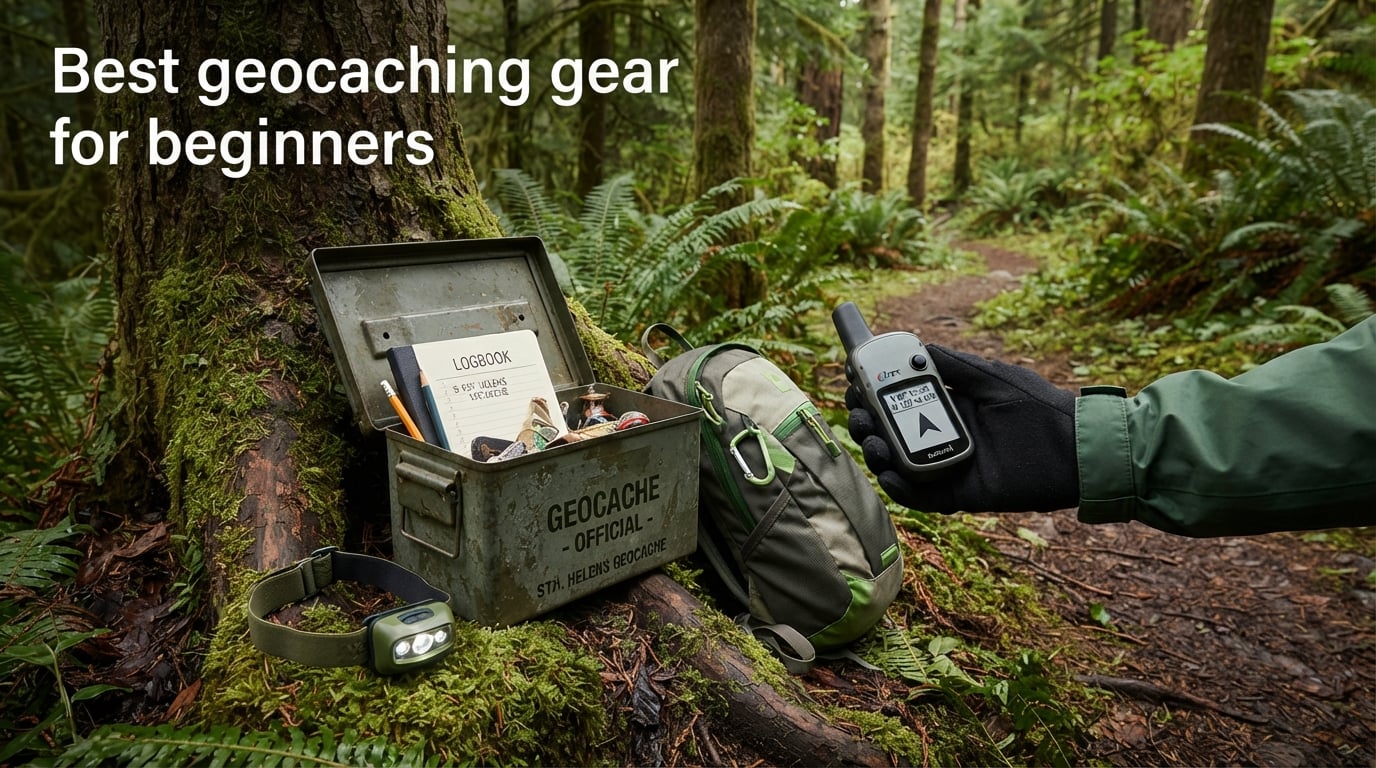
Geocaching is an outdoor treasure hunt: you follow coordinates to a hidden cache, sign its logbook, and put it back exactly where you found it. The best geocaching gear for beginners is not a giant survival pack; it is a small set of tools that helps you navigate, sign a tiny log, see into dark spaces, and get home with a charged phone.
Start with traditional caches rated difficulty 1–2 and terrain 1–2. Community advice consistently points new cachers there because the container and hiding style are usually less intimidating, while a DNF, or “did not find,” feels like a learning moment rather than a failed outing.
For a first trip, bring your phone with a geocaching app, a pen, water, and weather-appropriate clothing. Add a flashlight, portable power, and basic first aid when you leave sidewalks or plan to search near dusk; those are the items that answer the common beginner headaches of fading battery, dark hiding spots, and unexpected scrapes.
I built this list from the 12 analyzed products and their documented specifications, ratings, and buyer feedback. It covers tools to carry as a finder and two containers for people who want to understand the other side of the hobby before ever placing a cache.
Table of Contents
Top 3 Picks for Beginner Geocaching Gear Give You Navigation, Power, and Light
These three are the clearest upgrades for a beginner who wants dependable navigation beyond a phone, a backup power plan, and hands-free light. A pen is still non-negotiable, but these picks solve the situations that most often end an outing early.
The Best Geocaching Gear for Beginners in 2026 Starts with These 12 Items
The overview below includes every product reviewed in this guide. Think of it as a menu, not a demand to buy everything: choose the items that match your first few routes, then expand your geocaching kit when you know whether you prefer urban micros, wooded trails, or night searches.
| Product | Specifications | Action |
|---|---|---|
 Garmin eTrex SE Garmin eTrex SE |
|
Check Latest Price |
 ELECOM NESTOUT 10000mAh ELECOM NESTOUT 10000mAh |
|
Check Latest Price |
 Blukar Rechargeable Headlamp Blukar Rechargeable Headlamp |
|
Check Latest Price |
 RHINO RESCUE EDC First Aid Kit RHINO RESCUE EDC First Aid Kit |
|
Check Latest Price |
 PINSAI Rechargeable Headlamp PINSAI Rechargeable Headlamp |
|
Check Latest Price |
 Flying Horse Nano Containers Flying Horse Nano Containers |
|
Check Latest Price |
 Deemii Thermal Gloves Deemii Thermal Gloves |
|
Check Latest Price |
 NICRON D10 EDC Flashlight NICRON D10 EDC Flashlight |
|
Check Latest Price |
 Life360 Tile Tracker Life360 Tile Tracker |
|
Check Latest Price |
 PASIION EDC Flashlight PASIION EDC Flashlight |
|
Check Latest Price |
 Garmin eTrex Solar Garmin eTrex Solar |
|
Check Latest Price |
 canbeyond Branch Container canbeyond Branch Container |
|
Check Latest Price |
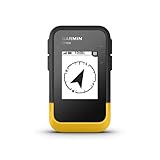
1. Garmin eTrex SE Is the Best Dedicated GPS for Beginner Trail Caches
- Sunlight-readable display
- Field-replaceable AA power
- Digital compass
- Automatic cache updates
- AA batteries not included
- North America maps
- Limited 28 MB storage
The eTrex SE is the strongest navigation-specific choice in this group because it gives a beginner a purpose-built device instead of asking a phone to do every job. Its 2.2-inch sunlight-readable screen, button controls, and digital compass are practical when glare, gloves, or a wet trail make a touchscreen annoying.
Garmin lists support for GPS, GLONASS, Galileo, BeiDou, and QZSS, plus Geocaching Live cache updates through the Garmin Explore app. That combination makes it a useful step up for people who expect their first traditional finds to lead into regular hiking caches.
The stated battery life is up to 168 hours in standard mode and up to 1,800 hours in expedition mode, using two replaceable AA batteries. I like that planning model for a long day: carry spare AAs and you are not tied to an outlet or a charging cable.
Buyer feedback is generally positive, with a 4.3 rating from 653 reviews, although the small 28 MB storage capacity and North America map coverage deserve attention. Some app-connected functions also need a compatible smartphone, so it complements a phone rather than replacing it in every situation.
A dedicated GPS works best for trail-first beginners
Choose the eTrex SE if you cache under tree cover, spend hours outdoors, or want batteries you can swap in the field. It is also a sensible family tool when one adult navigates while everyone else searches around ground zero.
A phone works better when you only cache around town
Skip the dedicated unit at first if your searches will stay in familiar parks and city blocks where charging is easy. Your phone app can be enough for simple traditional caches, provided you download offline information where available and bring power backup.
2. ELECOM NESTOUT Is the Best Power Backup for Phone-Based Geocaching
- Rugged IP67 shell
- 20W Power Delivery
- Two ports
- Drop-tested body
- Needs an 18W+ adapter for best recharge
- Tripod and lights excluded
A power bank matters because a geocaching app keeps the screen, location services, and mobile data busy. The NESTOUT has a listed 10,280 mAh capacity and 20W USB-C Power Delivery, making it the most direct answer for beginners who navigate with a phone.
Its IP67 rating means the body is rated for dust protection and immersion up to one meter for 30 minutes. That does not make a wet phone safe, but it does make the power source less fragile when your pouch gets caught in rain or set on damp ground.
The hard shell has a MIL-STD 810G 516.7 drop-test certification, and it has both USB-A and USB-C connections. Its listed weight is 241 grams, so I would put it in a small daypack rather than a trouser pocket.
The documented limitation is just as useful: ELECOM recommends an 18W or greater USB Power Delivery adapter for AC charging, and charging from a computer USB port can be slow or fail. Charge it at home, pack the correct cable for your phone, and check its indicator lights before leaving.
A rugged bank makes sense for long app-led outings
Pick this one for trail caching, full-day events, or trips where a dead phone would also remove your map and camera. It is particularly helpful for a beginner prone to reading hints, checking logs, and opening satellite imagery more often than an experienced cacher.
A small urban route may need only a charged phone
Leave it behind on a quick local loop when you can return to a charger and your phone battery is healthy. Battery backup is preparation, not a reason to stare at the app instead of reading the cache description and surroundings.
3. Blukar’s Rechargeable Headlamp Is the Best Hands-Free Light for New Cachers
- Flood and spotlight options
- Red light mode
- 90-degree adjustment
- USB-C charging
- Battery pack is built in
- Full charge takes five hours
A headlamp is easier to use than a handheld torch when both hands are busy with a container, a log strip, or a gate latch. The Blukar provides five modes, including red light, and its beam can shift between floodlight and spotlight coverage.
The head rotates through 90 degrees, which helps aim light at a low cache without crouching in an awkward position. It also has a rear red light, a useful visibility feature if you walk back along a path after dusk.
Blukar states 20-plus hours of runtime and an IPX6 waterproof rating. Those details fit a beginner who wants one light for evening searches, camping, and routine outdoor use rather than a specialized night-cache setup.
Its built-in lithium-ion battery is not removable and a full charge is listed at five hours. Charge before an outing and do not treat the claimed runtime as a reason to start a night route with a nearly empty unit.
Hands-free light is best for low, dark, and awkward cache locations
Take this headlamp on routes with culverts, wooded paths, or late finishes. Red light can also reduce glare while you read a paper log or check a map, though you should still respect park hours and local access rules.
Daytime sidewalk caching does not require a headlamp
Skip it for a short sunny urban hunt if space is limited. A light becomes more important when cache descriptions, terrain, or the return walk could put you in low light.
4. RHINO RESCUE EDC Kit Is the Best Compact First-Aid Addition to a Caching Bag
- Includes moleskin
- Antiseptic supplies
- Emergency blanket
- Small water-resistant pouch
- Limited supply quantity
- Designed for minor care
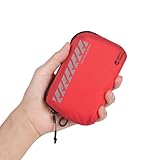
The RHINO RESCUE EDC kit is a compact safety layer for hikers and families who may meet scrapes, cuts, or blisters before finding a cache. Its list includes 42 emergency essentials, with moleskin, iodine swabs, BZK antiseptic pads, and an emergency blanket among the stated contents.
The pouch uses water-resistant nylon and a reflective label, both small but sensible details when it lives at the bottom of a daypack. The maker describes the contents as EMS-grade, but it is still a small kit intended for minor needs rather than a substitute for training or emergency services.
This is not flashy geocaching equipment, yet forum discussions repeatedly show why it belongs in a trail kit. A scratched hand, blister, or sudden chill can turn a casual search into an uncomfortable walk back if there is no basic response available.
The trade-off is capacity: a compact kit cannot carry the volume of supplies needed for a group or extended trip. Check the contents before each season and add personal items if you know you need them.
A small first-aid kit is best for trail and family outings
Bring this when a cache route includes brush, uneven ground, children, or a longer walk from the car. It pairs well with water, snacks, and a simple plan to stop rather than push on after an injury.
A first-aid kit cannot replace route judgment
Do not use a compact kit as permission to reach into unseen spaces or ignore unsafe terrain. Read attributes, respect private property, and walk away from a hiding place that seems hazardous.
5. PINSAI’s Rechargeable Headlamp Is the Best Long-Range Light Alternative
- Long stated beam distance
- Hand-wave control
- Phone charging
- SOS signal
- Plastic construction
- IPX4 rather than IPX6
PINSAI’s headlamp has a stated beam distance of up to 500 meters, a 4,000 mAh rechargeable battery, and a hand-wave sensor for on-and-off control. That feature can be handy after handling a damp cache container when you would rather not smear dirt across a switch.
It also lists a USB interface that can charge a mobile phone, four battery indicator lamps, and an SOS burst mode. I would treat those as useful contingencies, not a replacement for a separate, fully charged power bank on a longer outing.
The light tilts through 90 degrees, so it can point toward a logbook or along a path. The IPX4 rating is described as able to handle rain and weather exposure, but it is less resistant to direct water than the Blukar’s listed IPX6 rating.
At 5.12 ounces with a plastic body, it is a different kind of choice from a tiny pocket light. Review feedback praises brightness and the sensor, while some buyers raise durability concerns about the plastic construction.
Long-throw lighting is best for planned night searches
Consider this headlamp if darkness is part of the route and you want a strong forward beam with hands-free operation. It can also suit camping, fishing, and hiking, so it need not sit unused between caching trips.
Close-range searching needs controlled light more than distance
Do not assume a longer beam makes every cache easier to find. Around ground zero, a wider, lower setting and careful observation are often better than sweeping a bright light across vegetation or nearby homes.
6. Flying Horse Nano Containers Are the Best Way to Understand Tiny Cache Logs
- Rust-proof metal
- Four camouflage colors
- Magnetic log core
- Rite in the Rain logs
- Tweezers help extraction
- Nano format has very little space
This four-pack does not belong in every finder’s pocket, but it is a revealing piece of geocaching supplies for people interested in nano caches. Each metal container has a magnetic base, waterproof O-ring, compact 0.39 by 0.39 by 1.18 inch dimensions, and a log with a first-to-find slot.
Its magnetic core is designed to aid log extraction, yet buyer notes still make the core beginner lesson clear: tiny logs call for tweezers and patience. Carry a pen that writes small, and roll the log as you found it rather than cramming it back in loose.
The set includes two black, one silver, and one camo-green container, plus durable metal construction intended to resist rust. It gives a family a hands-on way to see how difficult a nano can be before one of these becomes a surprise DNF in the field.
A cache container is for placing only after you understand listing rules, land permission, and maintenance duties. Never hide an unlisted container as a “test” and assume other players will know what it is.
Nano containers teach the micro-cache skills beginners need
Use this set to practice extracting a log, keeping it dry, and replacing it without force. Those are useful habits for urban geocaching, where magnetic nanos can appear on metal surfaces and logs may be especially small.
Traditional caches are better for a first find
Choose an easy traditional cache before making nanos your main target. Traditional containers usually make it easier to learn the basic find-sign-return routine without turning the logbook into the whole challenge.
7. Deemii Thermal Gloves Are the Best Cold-Weather Layer for Cache Searches
- Touchscreen thumb and index
- Windproof layer
- Reflective logo
- Grip on palms
- Hand wash only
- Not for extreme cold
Gloves are one of the least glamorous beginner geocaching essentials, but they make a difference around cold, damp, or rough hiding spots. The Deemii pair uses 3M C40 Thinsulate insulation, a fleece lining, water-resistant and windproof construction, and silicone grip areas.
The touchscreen-compatible thumb and index finger are especially relevant when the coordinates are on your phone. You can check a hint or log a find without fully exposing your hands, although sensitivity can vary with phone screen protectors and fit.
Deemii lists warmth down to 23 degrees Fahrenheit and sizes from S through XXL. That temperature claim is a guide rather than a guarantee, as wind, moisture, activity level, and individual circulation change how warm any glove feels.
Reviews are favorable overall, with a 4.5 rating from 1,448 reviews, though feedback mentions sizing and reduced performance in extreme cold. Check the size guidance, and remember that the stated care instruction is hand wash only.
Touchscreen gloves are best for cool-weather phone navigation
Wear them on autumn and winter walks when you will open maps often and may need protection against cold metal or thorny-looking ground cover. Gloves can also create a pause before touching an unknown hiding place, which is good judgment.
Gloves should not be used to probe blind spaces
Even sturdy-looking gloves do not make it safe to reach into holes, pipes, or dense brush you cannot inspect. Use light, look first, and skip a cache location if animals, sharp objects, or unsafe access seem possible.
8. NICRON D10 Is the Best Pocket Light for Color Modes and Close Inspection
- Matchbox-scale body
- Multiple light colors
- 23-hour stated runtime
- One-meter drop test
- Nonstandard battery
- Heavier than some EDC lights
The NICRON D10 is a compact EDC flashlight with white, RGB, and 395 nm UV sources rather than a head-mounted beam. Its maximum listed output is 500 lumens, with a stated 72-meter beam distance and up to 23 hours of runtime depending on mode.
Red light is the most broadly useful color option here because it can preserve more night vision while you read a map or log. The green, blue, and UV modes are specialty options, so I would see them as extras rather than reasons to make a cache search more complicated.
The aluminum body is rated IP54 water-resistant and certified for a one-meter drop test. Its magnetic base can support hands-free positioning on a suitable metal surface, but never attach gear to a cache or alter a cache’s placement just to use a light.
USB-C charging is a welcome fit with modern phone cables, with a listed two-hour full charge. The product uses a nonstandard battery size, which is its practical limitation for people who prefer field-swappable power.
A pocket flashlight is best when a headlamp feels excessive
Choose the D10 for an urban pouch, a short evening walk, or close inspection of a dark recess. It also makes a compact backup when a group has one headlamp but wants a second source of light.
Color modes do not replace good cache etiquette
Use light only as much as needed and avoid shining it into homes, traffic, or wildlife areas. A light helps you inspect a location; it does not excuse searching after a park closes or disturbing the setting around a cache.
9. Life360 Tile Is the Best Locator for a Beginner’s Keys or Daypack
- Loud ring
- Three-year battery
- Find-phone feature
- Works with Life360
- Needs Bluetooth device
- Battery is not user replaceable
A Tile is not navigation gear, but it answers an easy-to-overlook beginner problem: misplacing keys, a pack, or a water bottle after setting down equipment while searching. The Life360 Tile has a stated 350-foot Bluetooth range and a 100-decibel ring to help locate a nearby item.
It works with iOS and Android through the Life360 app and has a listed three-year battery life. The app can also make a silenced phone ring, which could be helpful if you return from a search and cannot remember where you left it.
There is an SOS feature and Life360 family-tracking integration, but a Bluetooth tracker is not a wilderness emergency beacon. It depends on a smartphone or tablet and Bluetooth proximity for its core local finding function.
The battery is included but not user-replaceable, according to the product data. That means the Tile is most useful as a simple organizational extra, not a permanent substitute for checking that your important gear is packed before you leave.
A Bluetooth tracker is best for forgetful gear organization
Attach one to keys or put it in the pocket of a caching daypack if you often set things down at trailheads, picnic tables, or in a busy car. It can be particularly reassuring for families sorting several bags at the end of an outing.
A tracker does not guide you to a geocache
Do not confuse the Tile’s short Bluetooth range with GPS navigation. You still need a phone app or dedicated GPS, a clear route plan, and the awareness to know when a cache is not safely accessible.
10. PASIION’s EDC Flashlight Is the Best Multi-Mode Emergency Pocket Light
- 100m beam
- Red and blue signaling
- Dual magnetic mounting
- Battery indicator
- Water repellent only
- Nonstandard battery
The PASIION EDC flashlight adds a claimed 800-lumen beam that reaches 100 meters, 11 lighting modes, and USB-C charging. It is larger than the NICRON D10, but the combination of main beam, side light, red, blue, and strobe options gives a beginner more ways to manage visibility.
Its tail magnet and clip magnet are two separate mounting options, while the four-level battery indicator helps avoid packing it empty. A tungsten glass breaker and bottle opener are built in, though neither function should matter to normal geocaching.
The aluminum body is listed as water repellent, not fully waterproof. That distinction matters when you choose a light for a wet trail: protect it from sustained rain and do not submerge it.
Reviews average 4.3 from 741 ratings, with praise for the brightness and mode selection. The nonstandard battery is another reason to recharge before departing instead of expecting to buy a replacement during an outing.
Multi-mode light is best for a flexible car-to-trail kit
Choose this light if you want a brighter handheld option with a battery gauge and signaling choices for general outdoor use. The magnetic mount can be handy around a vehicle, but keep it away from a cache’s container and hiding hardware.
Simple controls are best when you are new to night caching
Eleven modes can take practice, so test the switches at home and learn how to return to the setting you want. In the field, simple, controlled lighting and awareness of your surroundings matter more than cycling through every mode.
11. Garmin eTrex Solar Is the Best Solar GPS Upgrade for Repeated Outdoor Caching
- Up to 200-hour stated battery
- High-contrast display
- Digital compass
- Wireless updates
- Limited 28 MB storage
- Touch controls may be awkward
The eTrex Solar is a specialist navigation upgrade for the beginner who already knows they will spend many days outside. Garmin states up to 200 hours without solar charging and unlimited battery life in sunny conditions, alongside a high-contrast 2.2-inch display designed for bright light.
It supports multi-band GPS, a digital compass, Bluetooth pairing with the Garmin Explore app, and Geocaching Live data with descriptions, logs, and hints. Those tools help when an app-only approach feels vulnerable to phone battery drain or poor visibility.
The IPX7 rating is valuable for wet-weather use, and the device is designed around outdoor navigation rather than messages and notifications. Its 28 MB storage remains limited, so it is important to understand the included map coverage and app relationship before committing to it.
Its 4.1 rating from 112 reviews is lower and based on fewer reviews than the eTrex SE. Feedback and specifications also identify the touchscreen as a potential weak point for some conditions, especially compared with physical buttons.
Solar-assisted GPS is best for frequent sunny outdoor trips
Consider the eTrex Solar if caching regularly overlaps with hiking, camping, and long days in open areas. It is an upgrade for durability and prolonged power planning, not a necessary purchase before your first few easy finds.
The eTrex SE is better when replaceable batteries matter most
Choose the eTrex SE instead if you prefer button controls and the certainty of carrying spare AAs. Both units offer Geocaching Live support, so the choice is more about your preferred power system and controls than basic cache access.
12. canbeyond’s Branch Container Is the Best Beginner Example of a Camouflaged Hide
canbeyond Geocache Containers,Tree Geocaching Containers,Geocaching Supplies Branch
- Realistic branch form
- Weather-resistant resin
- Spacious interior
- Useful teaching example
- Only 28 reviews
- Small storage capacity
This resin container is shaped like a branch and measures 3.9 by 2.7 by 1.6 inches. It provides a clear example of why a cache can be in plain sight yet still difficult to spot: good camouflage asks finders to observe the setting rather than grab at every natural object.
The listing describes waterproof performance, durable resin, and room for logs and small items. It is designed for gardens, forests, and roadsides, but that does not mean a beginner should place it anywhere those settings exist.
It has a 4.0 rating based on 28 reviews, a much smaller feedback pool than several items above. Its narrower record means I would view it as an introductory cache-container idea, not a proven default for a serious cache placement plan.
Every cache owner is responsible for permission, correct listing, maintenance, and a location that does not create damage or safety problems. A container is only one part of that responsibility; an approved, maintainable hide is what makes it fair for other players.
A camouflaged container is best for learning to search thoughtfully
Use the branch form as a reminder to compare shapes, textures, and placement at ground zero without disturbing the area. It can also help explain to children why a hard cache is not necessarily far away or buried.
New cachers should wait before placing their own hides
Find a range of caches first, learn what dry logs and respectful locations look like, and read the platform’s placement guidelines. Never bury a container, attach one where it could damage property, or leave unapproved items that other players might mistake for a live cache.
Start with a Phone, Pen, Light, and Power Before Adding Specialty Tools
The practical beginner geocaching kit has four core pieces: a phone with a geocaching app or a dedicated GPS, a pen, a light, and a way to keep the phone powered. Then add water, appropriate layers, and basic first aid as the route gets longer or rougher.
Always bring your own pen, even if the cache page says a pencil is inside. Logs become damp, pencils go missing, and micro-cache log strips leave very little room; a fine-tip pen that works reliably is one of the simplest ways to avoid finding a cache you cannot sign.
A smartphone is enough for easy caches near familiar places
For a first outing, use the app to select traditional caches with low difficulty and terrain ratings. Read the full description, recent logs, attributes, and hint before you leave; this is more helpful than staring at the distance number alone.
Download available information before a weak-service area, reduce screen brightness when possible, and carry a charged power bank for longer routes. A dedicated GPS becomes attractive when you cache under tree cover, in bright sun, or far from convenient charging.
One tool should solve one real problem in your route
Add tweezers after you encounter micro and nano logs, gloves when cold weather or rough vegetation calls for them, and a headlamp when daylight is uncertain. Do not pack every gadget for a short park loop, because a lighter bag makes it easier to focus on navigation and your surroundings.
For urban caching, prioritize a pen, phone power, and a discreet small light. For trail caching, add water, first aid, weather layers, offline navigation planning, and a clear turnaround time.
Good etiquette means leaving the cache and place as you found them
After a find, sign the log and return the container exactly to its original spot and orientation. Avoid exposing a cache where passersby can see it, do not move natural materials more than necessary, and take any trash you find out when it is safe to do so.
SWAG means trade items. Trade evenly or trade up, use clean family-safe items, and do not take an item without leaving something of equal or greater value; trackables are not SWAG, so log their movement and follow their stated mission instead of keeping them.
A DNF is useful information, not a reason to force a find
If you cannot find the cache, check the hint and recent activity, then leave a polite DNF log describing only what helps the owner. Do not tear apart a location, pry open objects, or keep searching after access conditions become unsafe.
Many experienced cachers recommend returning later with fresh eyes. A cache may be temporarily missing, your coordinates may be less precise near obstacles, or you may simply need more practice recognizing common hide styles.
These Beginner Geocaching Answers Cover the First Outing
Is geocaching still a thing in 2026?
Yes. Geocaching remains an active outdoor treasure-hunt hobby in 2026, with caches found through a smartphone app or GPS device. Beginners can start with an easy traditional cache, sign its physical log, and return the container exactly as found.
What is the hardest geocache to find?
The hardest cache varies by location and by its difficulty and terrain ratings. Puzzle, multi-stage, highly camouflaged, and difficult-terrain caches can all be challenging, so beginners should begin with low-rated traditional caches before trying advanced hides.
How do I start geocaching for beginners?
Create an account in a geocaching app, choose a nearby traditional cache with low difficulty and terrain ratings, read the description and hint, and navigate to ground zero. Bring a pen, sign the log if you find it, replace the cache exactly as found, then log the result in the app.
What is a booger in geocaching?
A booger is informal geocaching slang for an especially frustrating cache, often because it is hard to locate, retrieve, or solve. Treat it as a sign to slow down, review the cache details, and leave a respectful DNF rather than damaging the area.
A Small, Purposeful Kit Is Enough to Begin Geocaching
The best geocaching gear for beginners starts with an app-ready phone and pen, then adds only what your route demands. The Garmin eTrex SE is the clearest dedicated-navigation pick, the NESTOUT is the practical phone-power backup, and the Blukar headlamp provides hands-free light for darker searches.
Start with one nearby, low-rated traditional cache in 2026, read every line of its listing, and give yourself permission to log a DNF if it is not there. Each outing will show you whether your next useful addition is a power bank, gloves, a flashlight, or simply another pen.