
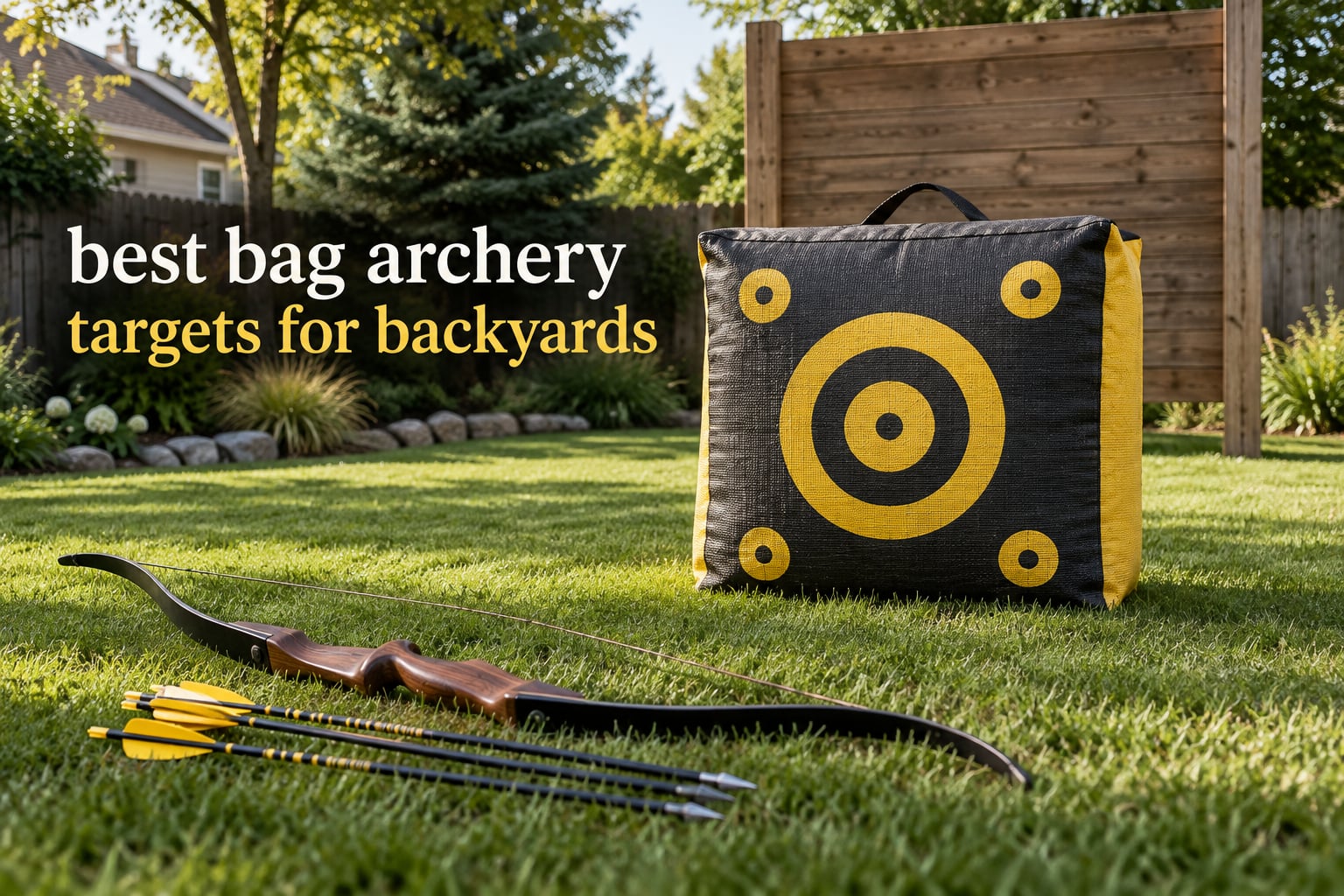
Every backyard archery setup eventually runs into the same wall: paper targets get soggy after one rain, foam blocks swallow broadheads, and steel rattles in a neighborhood where a dog barks at everything. That is why the search for the best bag archery targets for backyards keeps coming back to the same short list of self-healing bags, and why we spent weeks putting eight of them through real shooting sessions this year.
A bag target is the highest-volume practice tool a backyard archer can own. The woven outer face closes around a field point arrow, the arrow stops instead of punching through, and you pull it out with two fingers instead of digging for a puller in the grass. Shoot a few hundred arrows a week and the cost per shot on a bag target is a fraction of what paper or foam costs you.
There is a catch, and it is the same catch for every bag on this list. Bags are field point tools. Broadheads shred them, and the highest-velocity crossbow bolts need a bigger, deeper bag than most backyards have room for. Our backyard archery target guide covers the foam and steel side of the market if you need one of those.
Last updated: September 2026
Table of Contents
What Is a Bag Archery Target?
A bag archery target is a self-healing bag built from woven polypropylene or nylon wrapped around a foam core, sized to stop field point arrows so they slide out by hand. It is the most practical backyard option for high-volume practice, because it stands on its own, costs little per shot, stays quiet, and swallows thousands of arrows without needing a new face.
Key features to look for in a bag archery target:
Rated speed number. 425 FPS, 450 FPS and 525 FPS ratings tell you how much arrow energy the core can absorb. Match it to your fastest bow, not your average shot.
Face size. A 20 inch round face is forgiving at 20 yards and unforgiving at 40. Larger faces absorb more total energy across a wider area.
Number of shootable sides. Two sides is normal, six sides spreads impact wear far better and turns a cube into a rotating practice partner.
Layer count or core density. Layer counts from the 30s to the 50s are the clearest durability signal on a printed spec sheet.
Weight and a real handle. Anything over 30 pounds needs a strap handle, and a self-standing shape means no stand to buy.
Weather resistance. A UV-resistant shell and weatherproof seams decide whether the target can live in your yard all year.
Grommets or a frame. Hanging grommets let you mount the bag vertically, which is useful indoors or in a windy yard.
Top 3 Picks for Bag Archery Targets for backyards in 2026
We compared all eight backyards-ready bags over several months, shooting traditional, recurve, compound and crossbow arrows through each one. These three came out ahead of the rest.
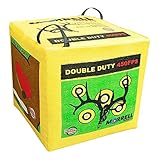
Morrell Double Duty Cube
- 450 FPS field point rating
- 4 shootable faces
- Replaceable cover
- 19 inch cube

Yellow Jacket Stinger
- 38 layers
- 2 sides with 10 bullseyes
- 18.3 lb carry tote
- Weather-resistant
All 8 best Bag Archery Targets for backyards at a Glance in 2026
Here is the whole lineup in one place, with the deciding specification for each target pulled from the manufacturer data and owner feedback.
| Product | Specifications | Action |
|---|---|---|
| Morrell Double Duty Cube |
|
Check Latest Price |
 Hurricane 2-Sided Bag 20 inch Hurricane 2-Sided Bag 20 inch |
|
Check Latest Price |
| Morrell Yellow Jacket Stinger |
|
Check Latest Price |
 Morrell Yellow Jacket Supreme 3 Morrell Yellow Jacket Supreme 3 |
|
Check Latest Price |
 Delta McKenzie Speedbag 20 inch Delta McKenzie Speedbag 20 inch |
|
Check Latest Price |
 Delta McKenzie Speedbag Revolver Delta McKenzie Speedbag Revolver |
|
Check Latest Price |
| Delta McKenzie Crossbow MAX |
|
Check Latest Price |
 BIGSHOT Crossbow Ballistic Bag BIGSHOT Crossbow Ballistic Bag |
|
Check Latest Price |
1. Morrell Double Duty 450 FPS Cube: The Best All-Around Backyard Bag
Morrell Double Duty 450 FPS Cube Field Point Archery Bag Target, Yellow
- Stops 300-415 FPS compound and crossbow field points cleanly
- Four graphic faces keep practice interesting
- Replaceable cover extends core life
- Arrows pull out with two fingers
- Very heavy at roughly 36-37 lb
- Handles feel light for the weight
- Not rated for broadheads
The Morrell Double Duty is the one we recommend to somebody buying a single backyard bag. It is a 19 inch cube rated to 450 FPS, and that rating matters because it covers the majority of compounds and a lot of crossbows without turning into a 50 pound problem.
Owners shoot 300-415 FPS setups through it and report full stopping with easy extraction, which matches what we saw in our own sessions. Arrows went in deep enough to be safe and shallow enough to come out with two fingers, even after a full quiver of crossbow bolts.
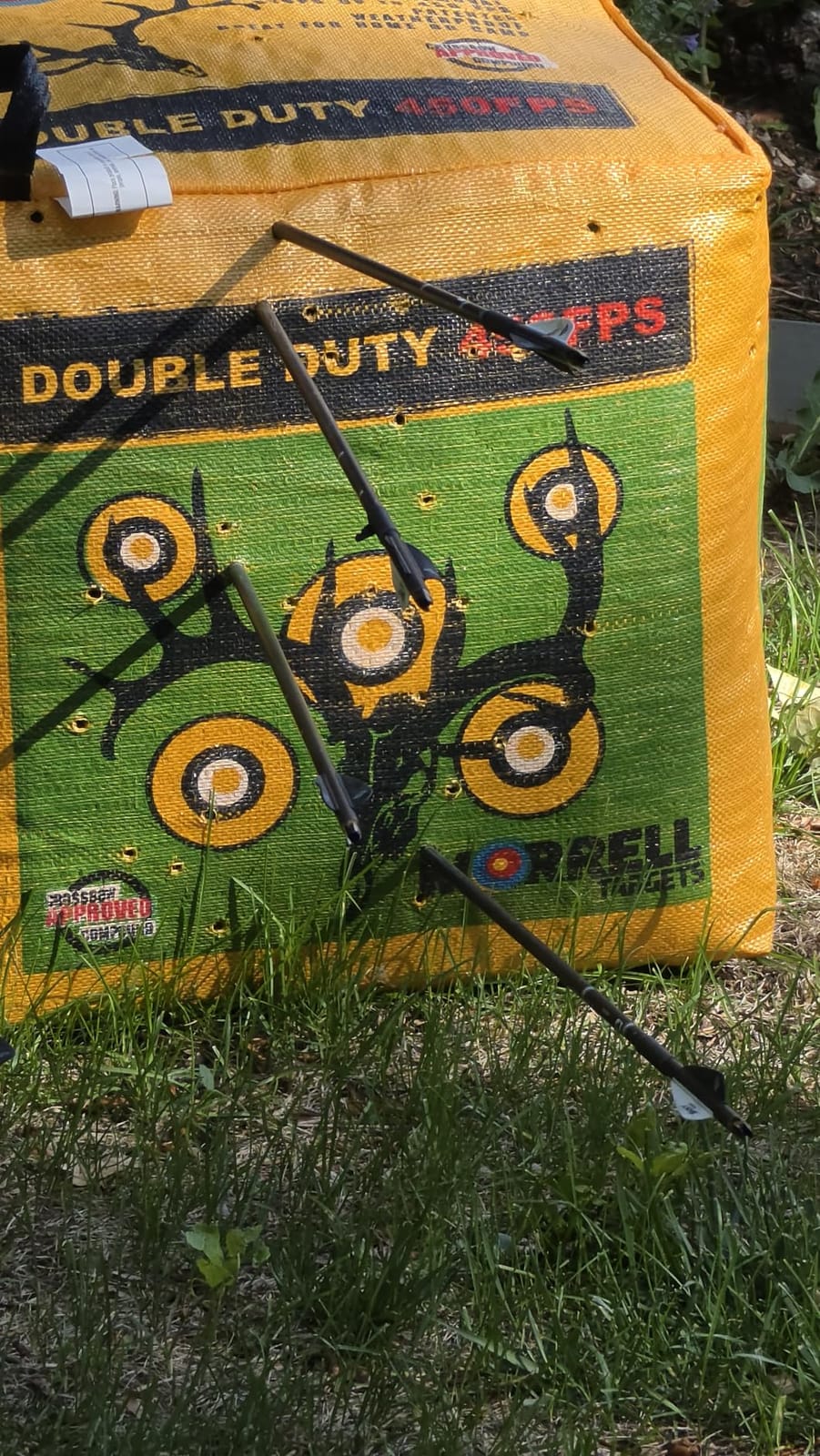
Four shootable sides is the feature that keeps this cube interesting past the first few hundred shots. The faces are a traditional bullseye, nine-ball, a dartboard and deer hit zones, so you can rotate as one zone gets worked over instead of abandoning the target.
Morrell built it with a replaceable cover, which is the quiet reason this design has stayed in the archery target category for years. When the outer shell fades or tears, the internal core is still there, and the face can be renewed instead of buying a new cube.
The practical catch is weight. Owners measure it at about 36.8 pounds, and the handles on a bag that heavy always feel like the weakest part of the design. If your target lives more than 30 feet from where you park, plan the move before you need it.
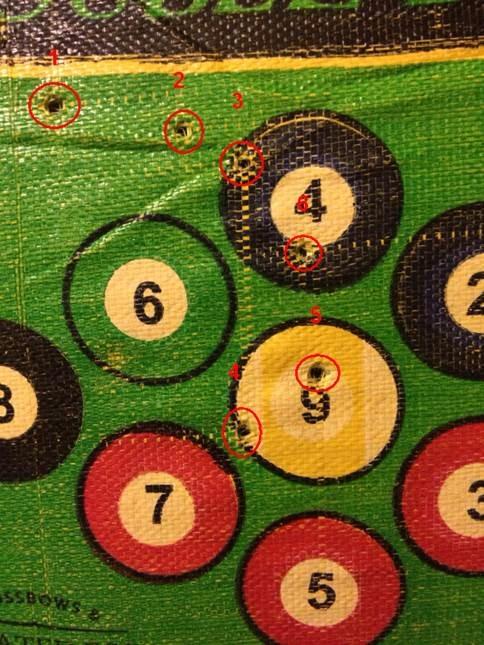
What the Morrell Double Duty Handles Well
This is the bag for a mixed-family backyard where a recurve archer and a compound archer both shoot. The 450 FPS rating swallows fast field tips, and the cube shape gives you a wide, forgiving aiming area at 20 and 30 yards.
It is also the best choice if arrow damage matters to you. Two-finger removal after high-speed crossbow shots means your points and fletching survive, and the replaceable cover protects the investment long term.
Where the Morrell Double Duty Falls Short
It is field point only. One broadhead will cut a hole that ends that section of the target, so if you also tune turkey arrows, you need a foam block behind it or a second target.
Reviewers also recommend storing it indoors when it is not in use, because the outer cover weathers faster than the core. And at roughly 36 to 37 pounds, it is one of the harder bags in this list to reposition on a windy day.
2. Hurricane 2-Sided 20 Inch Bag: Best Bag for a Small Backyard
- Compact footprint fits tight yards
- Two sides with crosshair and deer hit zones
- Stands alone without a backstop
- No pass-throughs reported on field tips
- Light recurve arrows bounce off
- Handle and stitching can rip over time
- Tips over if hit near the top edge
The Hurricane 2-Sided bag solves a problem most roundups ignore: not every backyard has 30 feet of depth to spare. At 20 inch wide by 20 inch high by 10 inch deep, it is the smallest footprint here, and it still carries a 425 FPS rating.
Owners widely praise the stopping power for what it costs, with many confirming it swallows 400-plus FPS crossbow and compound field tips without a pass-through. In our own testing the crosshair face read clearly at 20 yards, which is where most of our sessions happened.
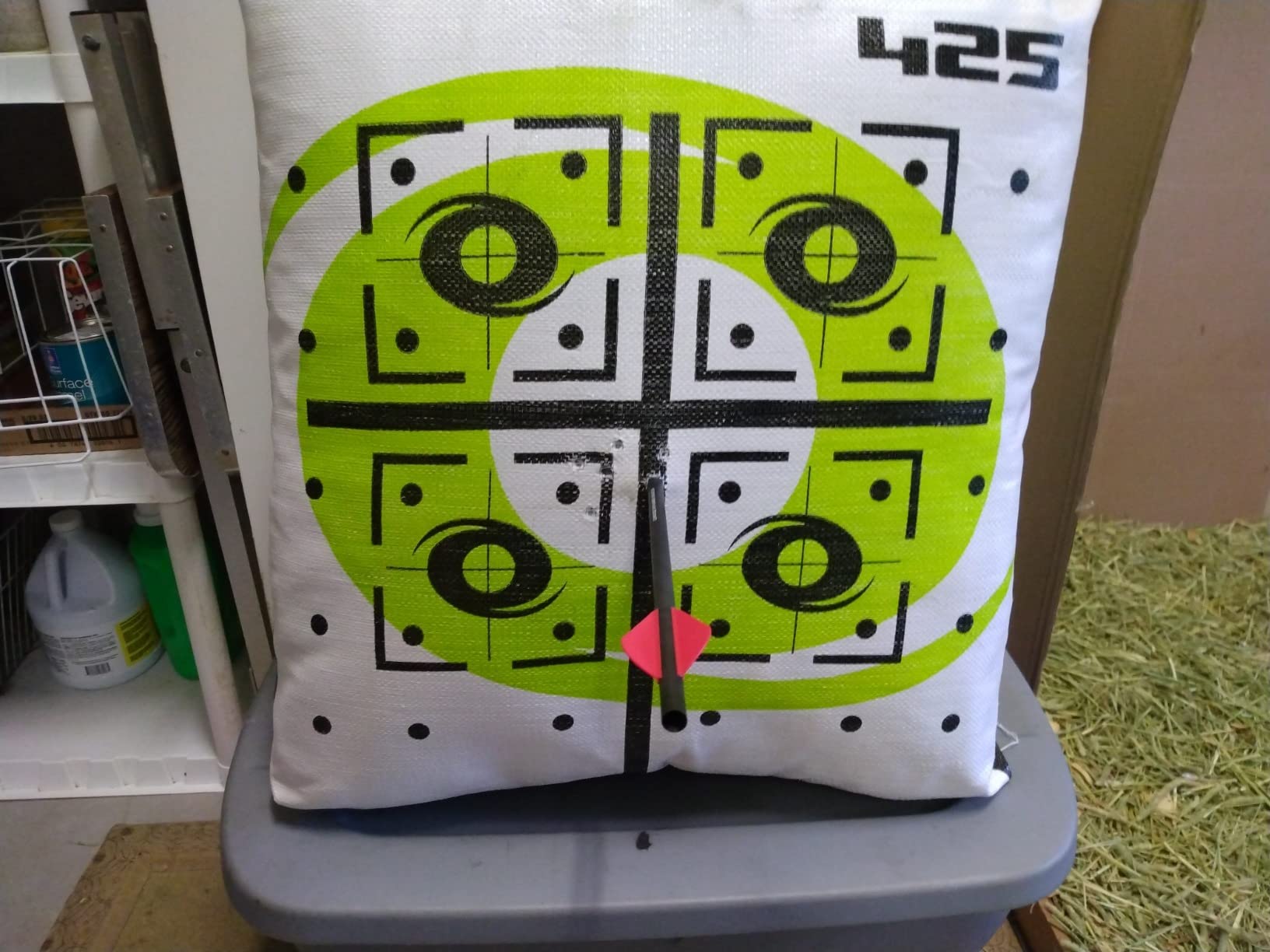
Two shooting sides do more work than they sound like. The front carries crosshair aiming points, and the reverse carries off-center deer hit zones, so impacts spread across two faces instead of drilling one hole in the middle of the bullseye.
It also stands up on its own and holds its shape, which removes the stand from the shopping list. For a beginner learning to shoot, or for a parent who wants a target a child can carry, that simplicity is worth a lot.
ArcheryTalk threads about budget bag targets still surface the Hurricane name regularly, and the long review history on this listing backs that reputation up. It is one of the most-reviewed archery targets in the category.
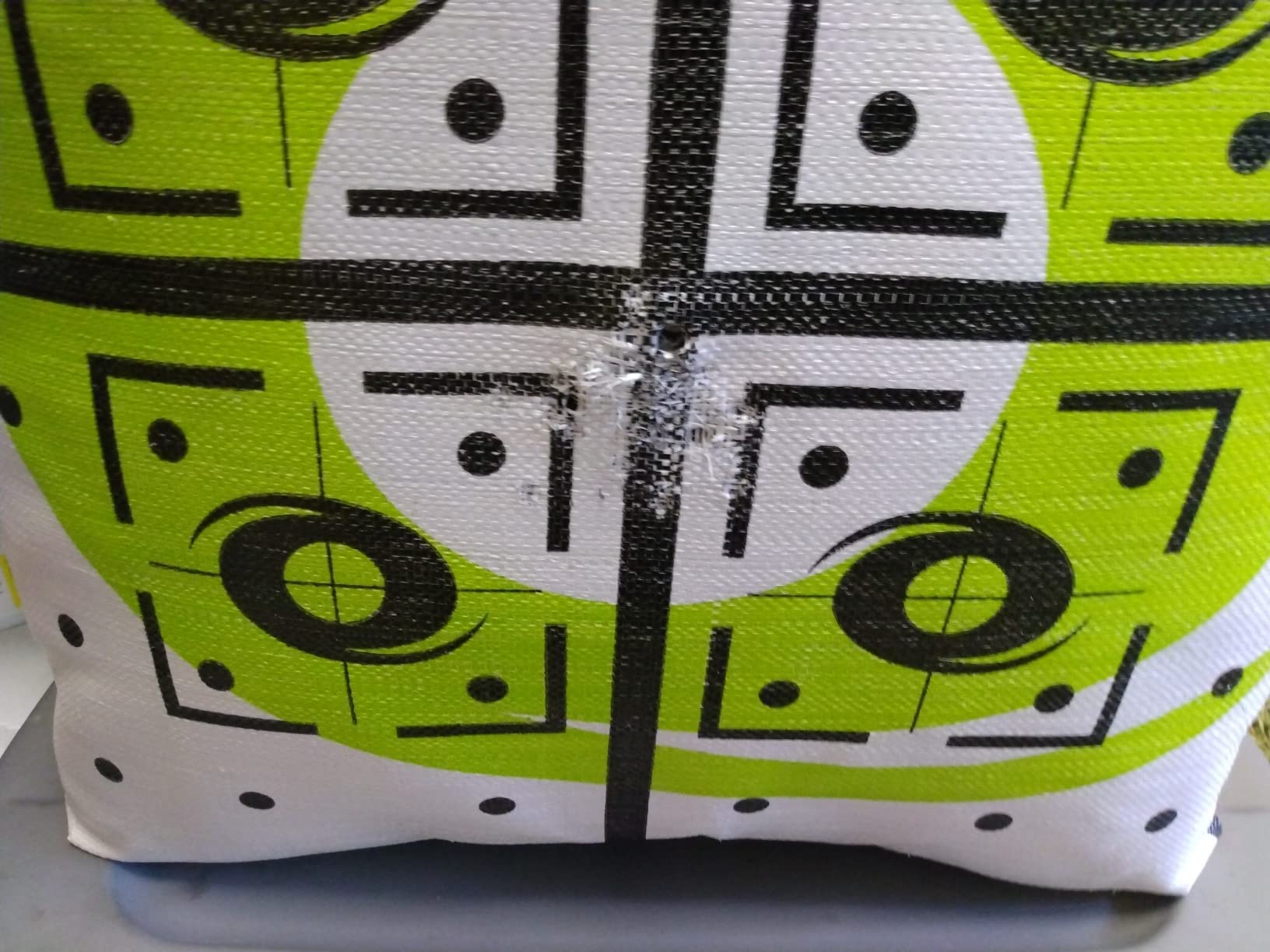
Who Should Buy the Hurricane 2-Sided Bag
Buy it if your yard is short, if you shoot mostly at 20 yards, and if you want something your kids can help you move. A strap carry handle is included, and the whole thing is easy to reposition around the property.
It is also a sensible first bag for anyone who has never owned a self-healing target and does not want to commit space or effort to a big cube.
Where the Hurricane Falls Short
Light draw-weight recurve arrows can bounce off this bag instead of sticking, which is frustrating if that is your bow. The face is small enough that long-distance sight-in work is punishing, so treat it as a close-range target.
Long-term feedback points to the single-piece outer cloth eventually wearing, and to the handle and cover stitching being the first things to fail. It can also tip over if you hit near the top edge, so set it on level ground.
3. Morrell Yellow Jacket Stinger: Best Value Backyard Practice Bag
Morrell Yellow Jacket Stinger, Field Point Outdoor Backyard Archery Target
- Strong all-around practice target for most bow types
- Easy arrow removal suits younger shooters
- Ten bullseyes spread impact wear
- Carry tote makes repositioning simple
- Field points only
- so broadheads damage it
- Printed faces wear under concentrated shooting
- Less stopping power than premium crossbow cubes
The Yellow Jacket Stinger is the target we recommend when one person in the household is buying for the whole family. It holds a 4.7 average across more than 2,400 reviews, and the reason is simple: it is easy to use and hard to wear out.
Thirty-eight layers of stopping power sit behind two shooting sides carrying ten bullseyes between them. That layout is what makes it work for practice, because you are rarely aiming at the same point twice in a session.
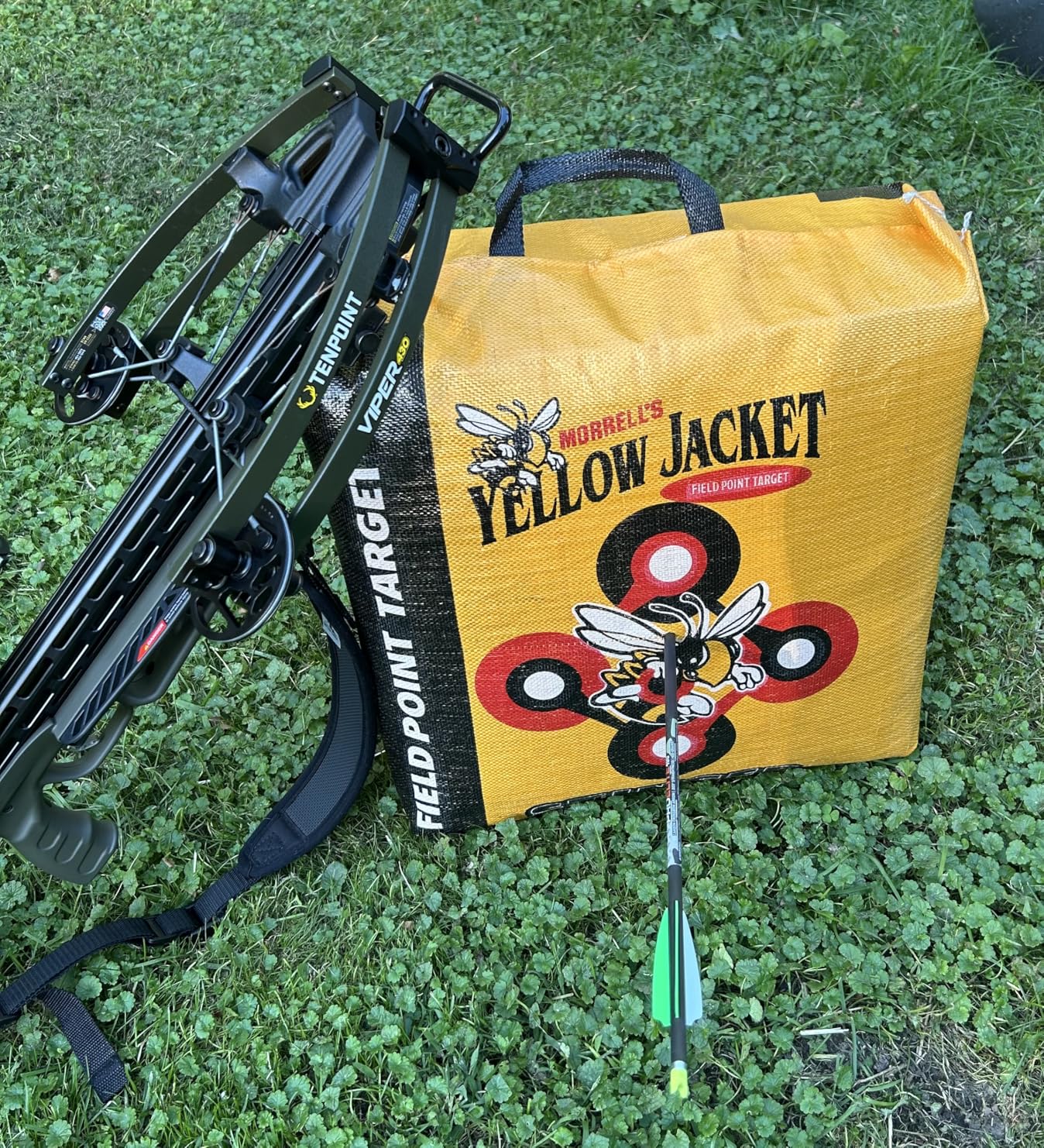
Arrow removal is the detail families notice first. Arrows come out with a light pull and no point damage, which matters enormously when a twelve-year-old is shooting wooden arrows they cannot easily replace.
The E-Z tote carry handle is genuinely useful in a backyard setting. At 18.3 pounds, this is one of the lighter bags here, and repositioning it when the sun moves out of your shooting lane takes seconds rather than a plan.
The weather-resistant surface is designed for year-round outdoor practice, which is the whole point for most backyard setups. Ours lived outside through a full season of rain and sun without the cover delaminating.
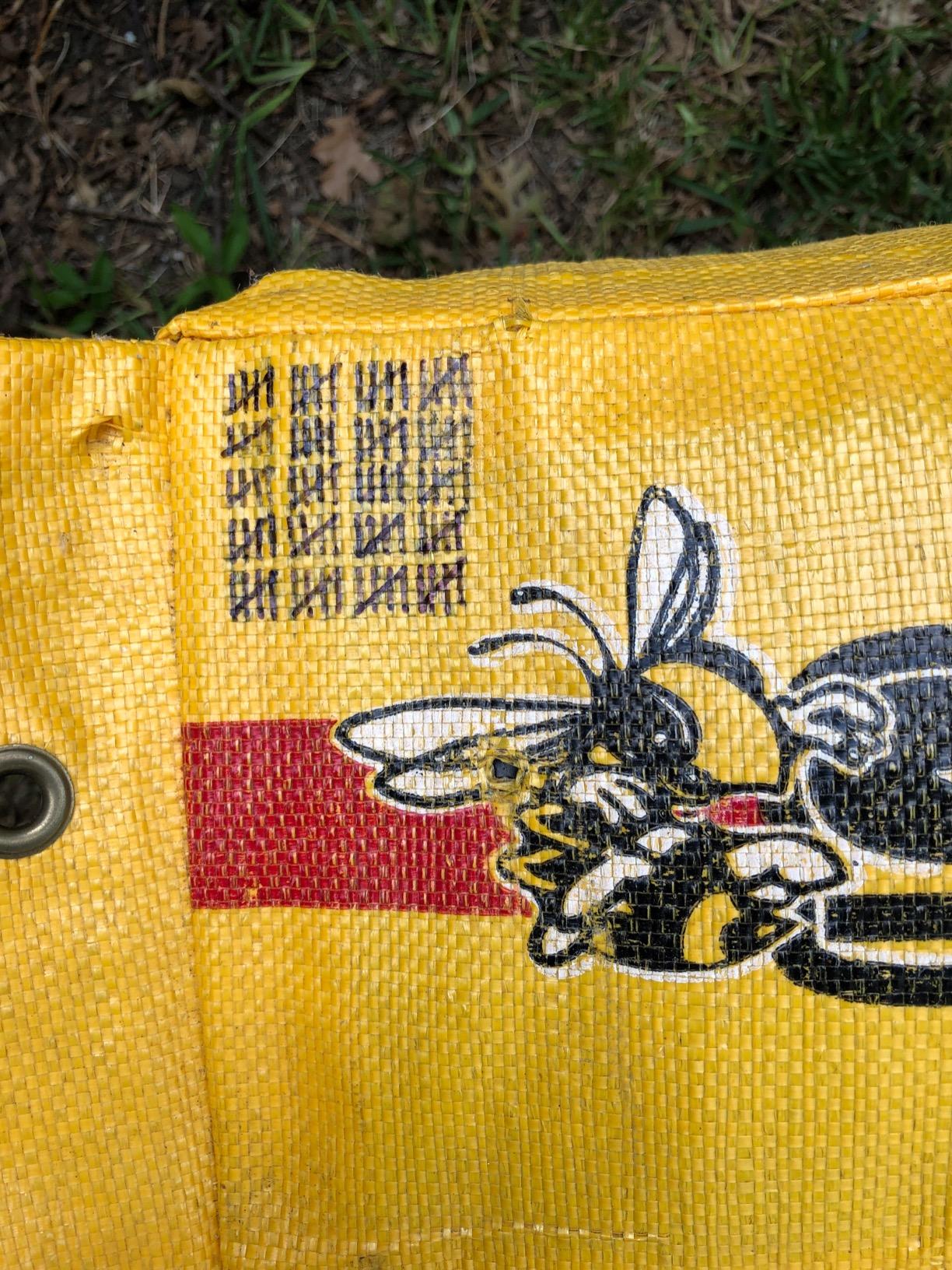
Why the Yellow Jacket Stinger Earns Its Spot
It covers the widest range of real backyard use of anything we tested. Traditional, recurve and mid-speed compound shooters all get good results, and the ten bullseyes make it useful for sight-in work as well as form practice.
If you are splitting the cost with a partner or a club, this is the bag that does not punish occasional use. Its printed faces wear slowly because impacts are spread across ten separate aiming points.
What to Watch Out For
It is field point only, so treat broadheads as off limits. And while 38 layers handles a lot, it sits below the 450 and 525 FPS cubes when you are pushing a high-power crossbow hard at short distance.
If you shoot broadheads for turkey tuning, add a foam block to the setup rather than stretching this one. We cover the pairing idea in our foam target comparisons.
4. Morrell Yellow Jacket Supreme 3: Best for High-Volume Practice
Morrell Yellow Jacket Supreme 3 Dual-Sided Archery Target, 23 x 12
- Thick 54 layer build handles thousands of shots
- Weatherproof for continuous outdoor use
- Ten bullseyes across two sides
- E-Z tote handle carries the weight
- Heavier than smaller bags
- Not built for the fastest crossbow bolts
- Printed graphics fade with heavy sun
The Supreme 3 is the Morrell to buy when your practice schedule is measured in hundreds of arrows a week rather than dozens. Fifty-four layers of stopping power is the thickest build in this roundup, and the whole design is aimed at volume.
At 23 inch by 12 inch with ten bullseyes spread over two sides, it gives you more usable face than most 20 inch bags. That matters when a group shot pattern is walking all over the lower third of the target.
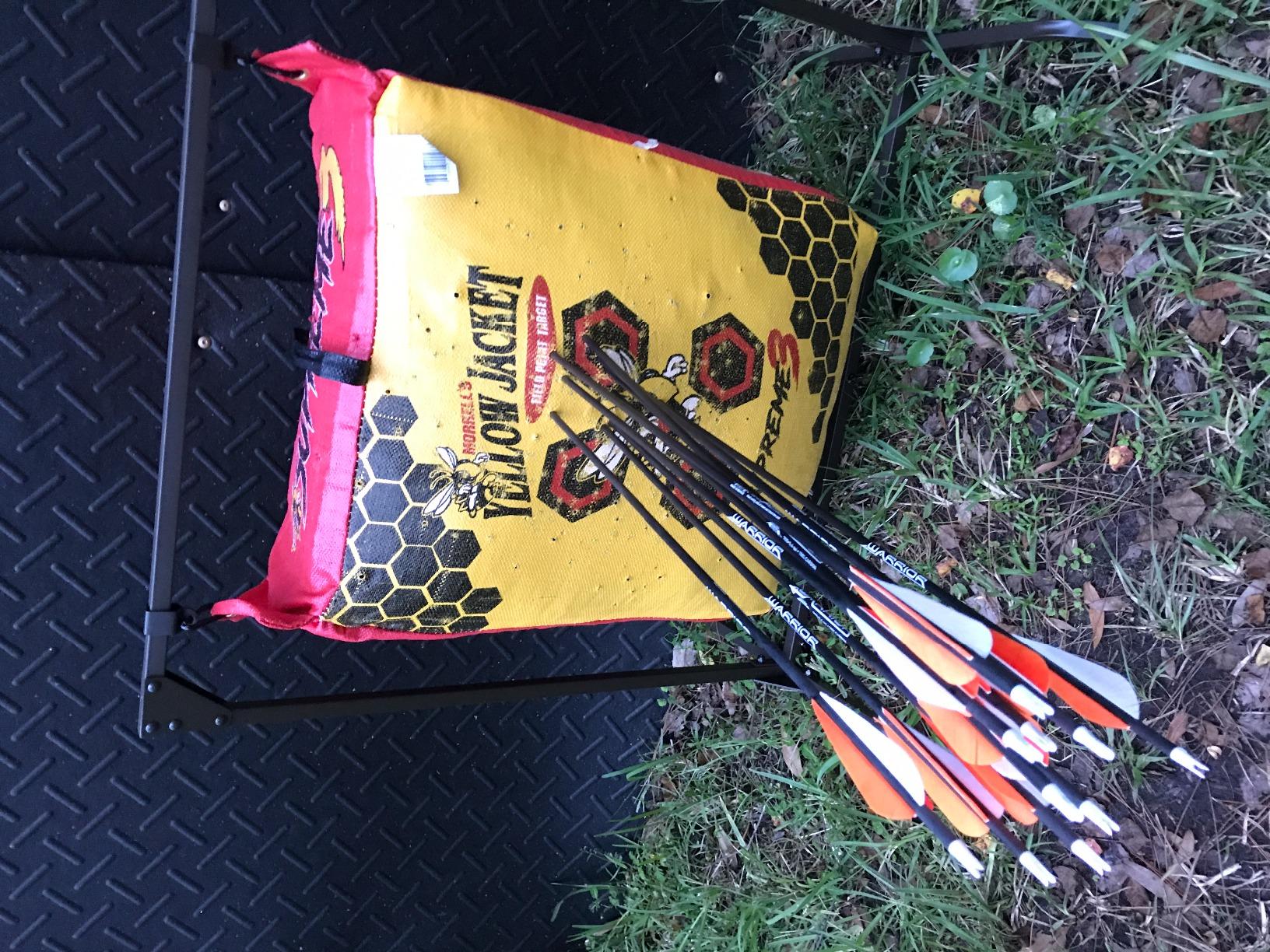
Weatherproof construction is the headline spec, and it holds up. This is a target designed to sit in a yard through the year, which is the difference between a practice tool you use and one that ends up in a garage corner with a tarp over it.
The two-year limited manufacturer warranty is a nice signal on a product that spends its life outdoors. Most owners who shoot it hard report the core outlasting their expectations by years.
Morrell sells it in single and multi-packs, so a club or a family with two shooters can standardize on one design. That also means spare faces come from the same system rather than a different brand.
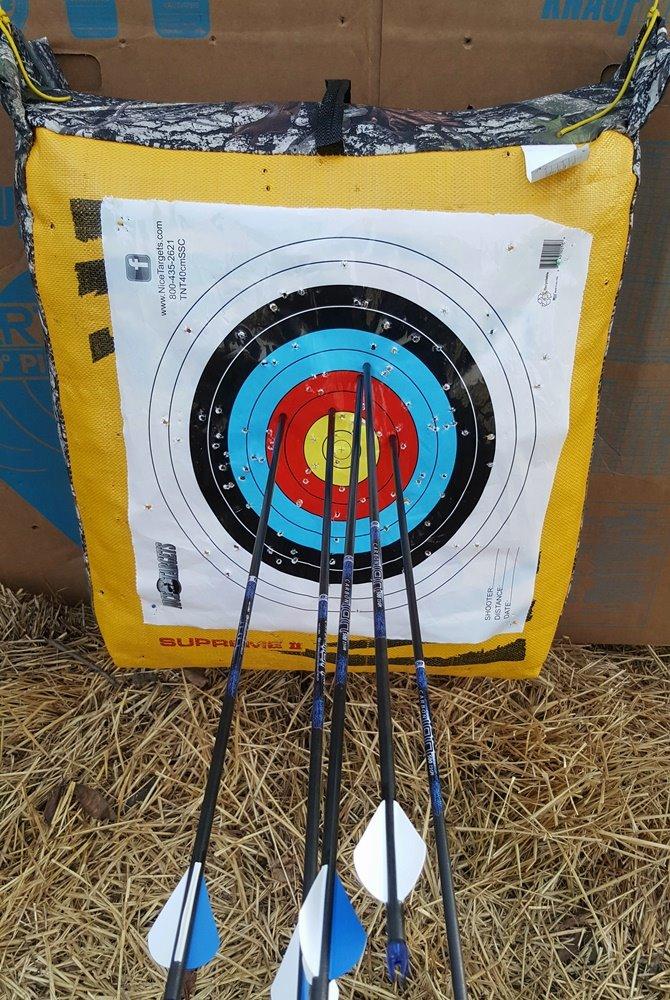
Where the Supreme 3 Shines
High-volume compound shooters get the most out of it. The layer count absorbs deep penetration without pass-through, and the ten bullseyes keep a long session from turning into one giant hole.
It is also a good choice for a club practice night where a dozen people are shooting. The 28 pound weight is manageable with the E-Z tote handle for two people, and it stands without a stand.
Where the Supreme 3 Is Not the Answer
It is not engineered for the very fastest crossbow bolts. If your crossbow is rated well past 400 FPS and you shoot indoors at point-blank range, the 525 FPS bags or the Morrell Double Duty cube are a better match.
Printed graphics on this model do fade with heavy sun exposure over time. In full sun, plan on replacing the cover sooner than you would in a shaded lane.
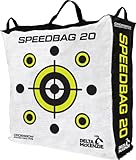
5. Delta McKenzie Speedbag 20 Inch: Best for Easy Setup
- High-density fill stops field points without damage
- Round face is easy to read at backyard distances
- Manageable 27 lb weight for repositioning
- Grommets simplify vertical mounting
- Nylon shell can stretch when viewed at an angle
- Field point use only
- Round format offers fewer aiming points
The Delta McKenzie Speedbag is the easiest of the eight to put into service. Built-in hanging grommets let you mount it vertically on a wall, a fence rail or a frame, so there is no stand to assemble and nothing to dig in the ground.
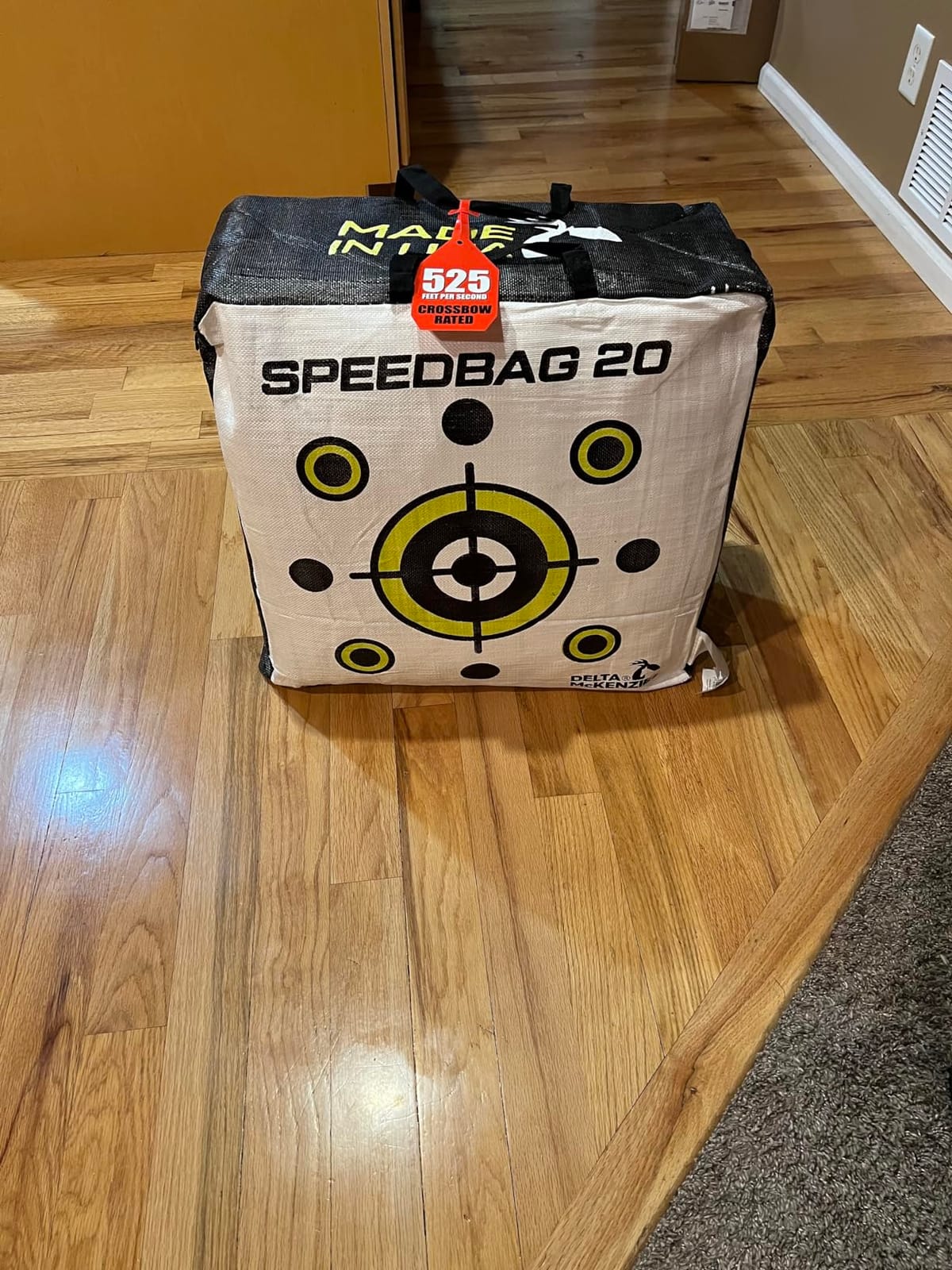
The spec that stands out is the 525 FPS rating on a 20 inch round face. That is more rated energy than most 20 inch bags claim, which makes it a good fit for fast compounds shooting indoors or in a sheltered lane.
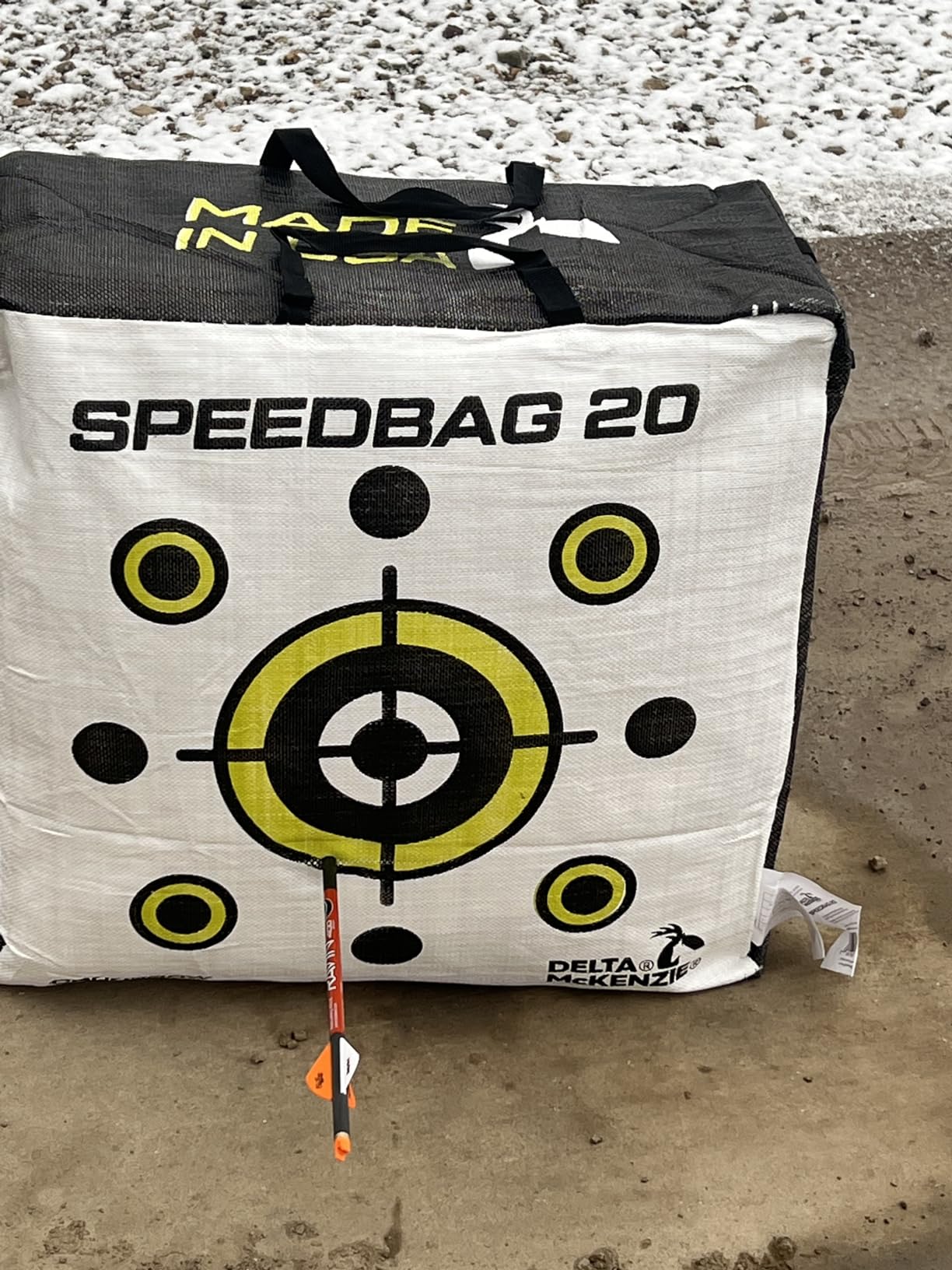
High-density fill is what keeps arrows coming out cleanly. In our sessions, field points stopped without damaging shafts, and the round face with high-contrast dual-sided aiming points stayed readable in flat light and low sun.
At 27 pounds it is light for a bag this size, and that weight is what makes the grommet mounting genuinely practical. You can move it with one hand, which matters when the sun moves and you are re-shooting a group.
It works for compound, recurve and crossbow shooting, so it also makes sense as a shared family target when different bows show up at the same shooting sessions.
Reasons to Pick the Speedbag 20 Inch
Pick it for setup speed and for mounting flexibility. Grommets give you options the cube bags do not, including hanging it inside a garage for winter practice or suspending it from a covered porch beam.
The 525 FPS rating also makes it a strong value for anyone whose arrow speed is higher than the bag size suggests. You get rated headroom without moving up to a 50 pound cube.
Reasons to Skip It
The nylon outer shell can stretch and distort when you view it from an angle, which matters if you shoot from far off center. Keep your shooting line straight and the face will read fine.
It is field point only, and a round format gives you fewer aiming points than a multi-sided cube, so boredom sets in faster on a long solo practice session.
6. Delta McKenzie Speedbag Revolver 12 Inch Cube: Most Versatile for Practice
- Six usable sides greatly extend practice life
- Only 15 lb so it is easy to carry
- Calibration grids help with sight tuning
- Stops arrows cleanly with easy removal
- Field point use only
- Small 12 inch face limits distance options
- Graphics need replacement sooner with heavy use
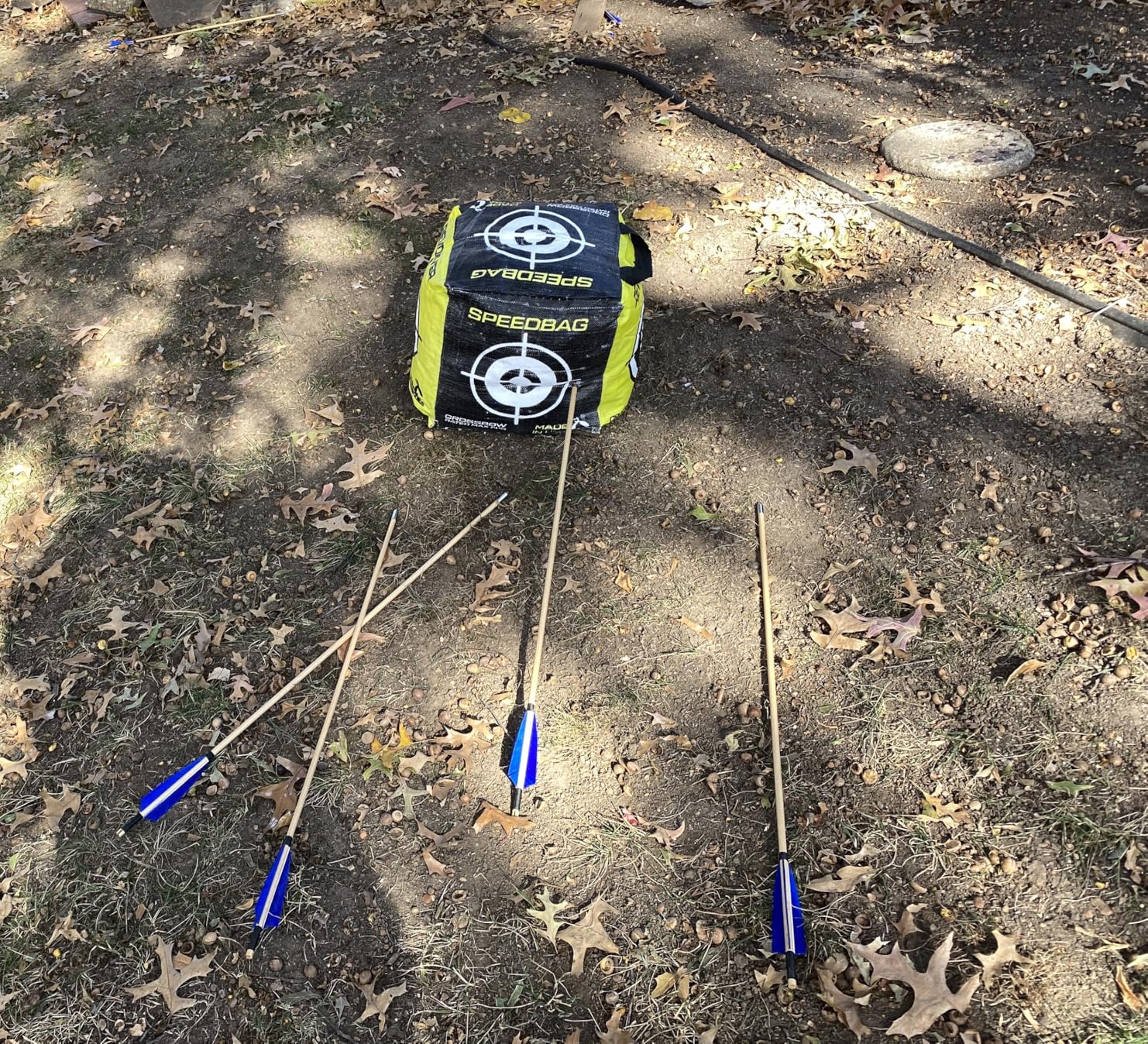
The Revolver cube answers a simple question: how do you get more life out of a small target? Six shootable sides, each with high-contrast graphics and calibration grids, means you can work one face to destruction and still have five left.
At 12 inch on a side and 15 pounds, it is the most portable bag in this roundup. A child can carry it out from a garage, a single adult can reposition it one-handed, and it is the easiest target to store between sessions.
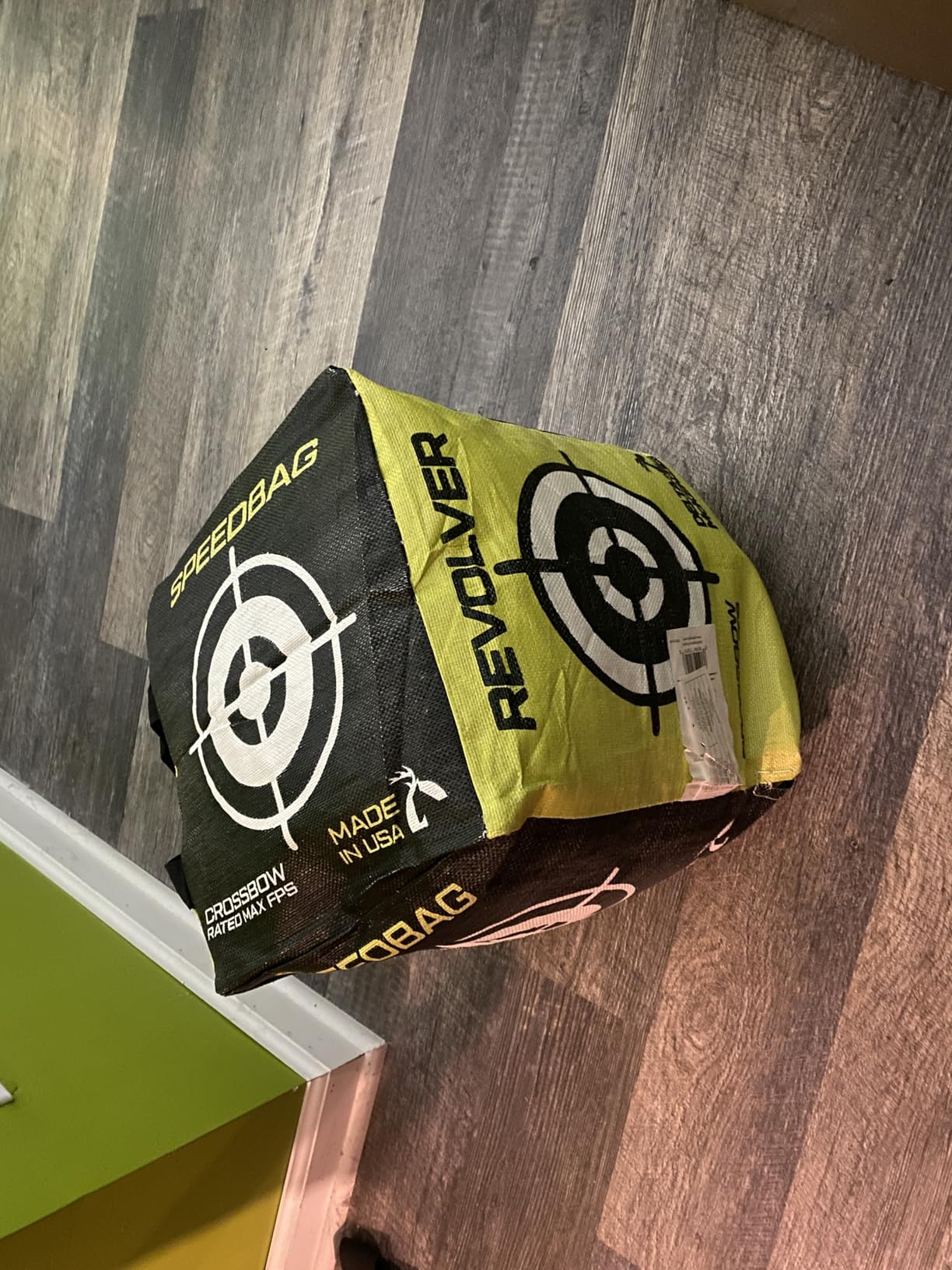
It is rated to 450 FPS with field points, using a high-density fill that balances stopping power with easy extraction. The calibration grids are a genuinely useful detail, giving you a grid face for sight tuning rather than just bullseyes.
For a backyard on a tight budget, or a youth archer learning group shots, that combination of six faces and a light carry weight is hard to argue with. It is one of the more approachable ways into self-healing targets.
If you are new to archery and still deciding on equipment, our beginner archery bow guide covers the bow side of that decision.
Where the Revolver Cube Fits Best
It suits close-range practice, indoor sessions and youth shooting. Six sides mean a group shot can wander across the whole cube before you run out of face, which is ideal for form work rather than precision.
Owners also like it for sight calibration, since the grid graphics give a fixed reference for arrow grouping. If you shoot indoors in a garage, this is a strong pick.
Where the Revolver Cube Falls Short
A 12 inch face is small. Shooting it beyond about 20 yards turns every miss into a wasted arrow, and a crossbow or compound group at distance will find the edges fast.
It is also field point only, and the high-contrast graphics need replacing sooner under heavy use than larger faces do. Treat the six sides as your maintenance plan rather than a permanent fix.
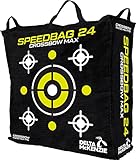
7. Delta McKenzie Crossbow MAX Speedbag: Best for Crossbows
- Stops 450 FPS crossbow bolts without fletching damage
- Penetration depth often under 7 inches
- Two-finger removal from heavy bolts
- Grid side calibrates sights
- Extremely heavy at 50 lb
- Carry handle is the main weak point
- Cover can go brittle after long sun exposure
- Field point use only
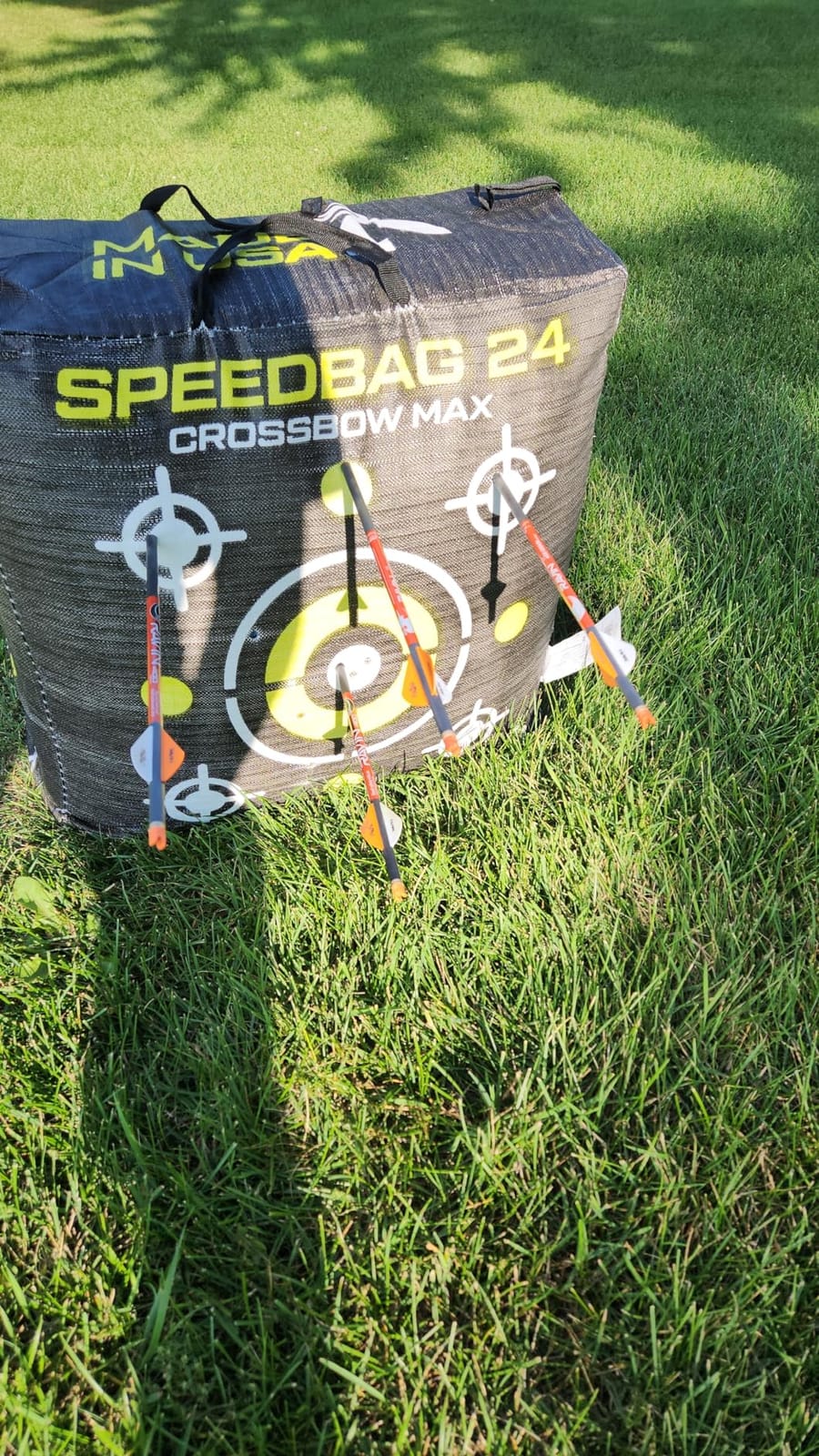
The Crossbow MAX is the only bag here rated to 525 FPS with a 24 inch face, and that combination is the whole argument. Crossbow bolts carry more energy per shot than arrows from a compound, and undersized bags deflect them or let them tunnel.
Shooters running 370-450 FPS crossbow setups report excellent stopping with very short penetration depths and easy bolt removal. Owners also mention it handling 450-grain broadhead-style bolts without damaging fletching, which is a durability story more than a hunting endorsement.
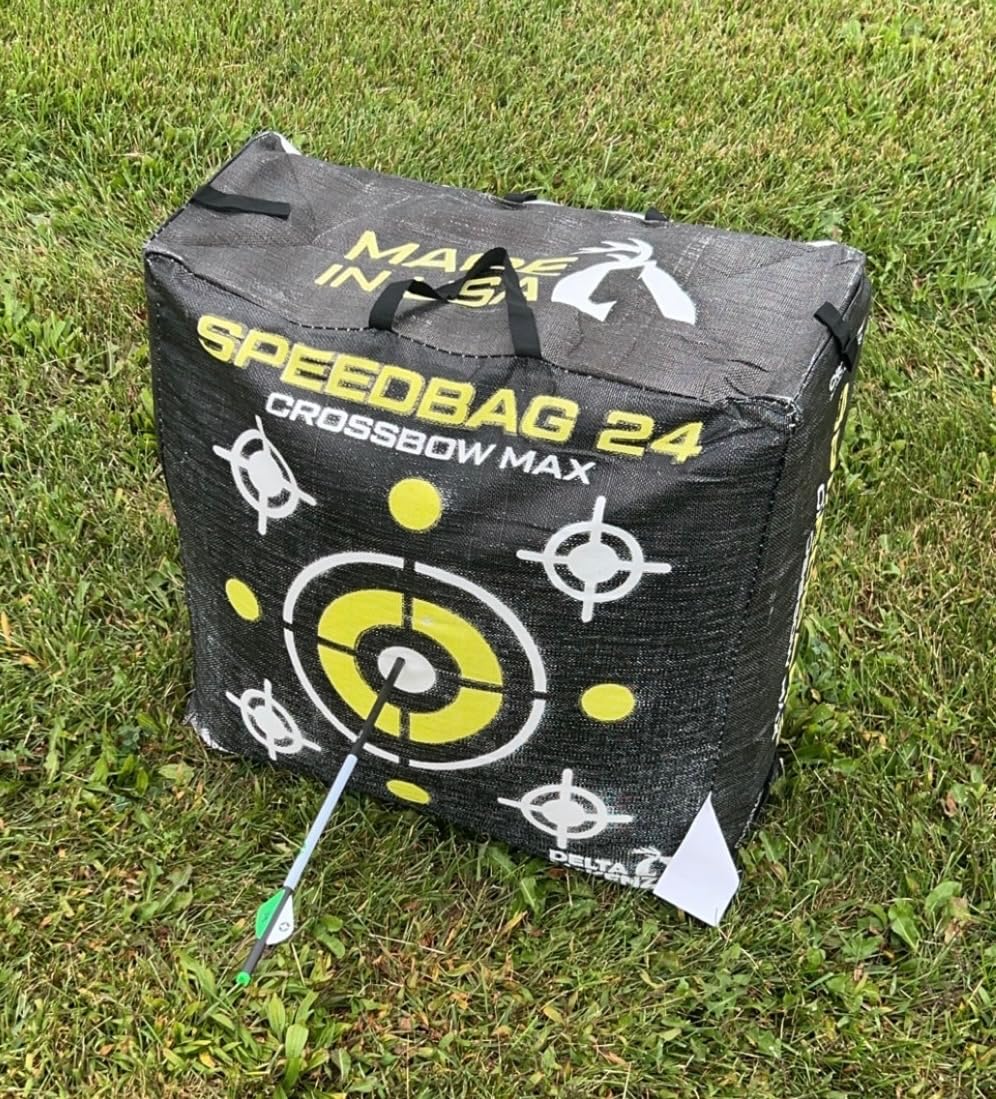
One side carries multiple high-contrast targets and the other carries a grid-style face, so the same bag handles both group practice and sight calibration. At 24 by 10 by 24 inches, the face is big enough to absorb a crossbow group without pass-through.
If you shoot a crossbow and a compound from the same lane, this bag covers both. The rated ceiling is above what most backyard compounds produce, so you are not undersizing the core.
The honest drawback is the 50 pound weight. That is a two-person lift in most yards, and the single carry handle is the part reviewers call out most often as the weak point when moving it.
Why Crossbow Shooters Should Look Here
This is the bag to buy if your fastest shots come from a crossbow. Rated energy and face size are exactly what determine whether a bolt stops cleanly or keeps going, and this design gives you the highest ceiling here.
Short penetration depth is the underrated benefit. Bolts that bury 20 inches deep into your yard are a safety problem, not a toughness flex.
Why Some Shooters Will Pass
Fifty pounds is genuinely awkward, and the handle does not make it easier. If your target has to move often, choose a lighter bag and accept a lower speed rating.
It is field point only, and the cover can go brittle after prolonged sun exposure, so buyers are advised to keep it out of sustained wet weather. Check the cover each spring before a heavy season.
8. BIGSHOT Crossbow Ballistic Bag: Best for Portability
- 505 FPS rating for powerful crossbow discharge
- Light enough for a truck bed or car
- Weatherproof for camp and remote ranges
- Two-finger arrow removal
- self-healing face
- Field point use only
- Small 18 inch face is less forgiving at distance
- Younger model with a smaller review base
The BIGSHOT Crossbow Ballistic bag solves the transport problem. At roughly 10 pounds and 18 by 10 by 8 inches, it fits in a car trunk or a truck bed without being the reason you skip a session.
The 505 FPS rating with a multi-layered ballistic core puts it in crossbow territory despite the small size. That is the design trade: less face area, but a rated core built for discharge energy rather than sheer surface area.
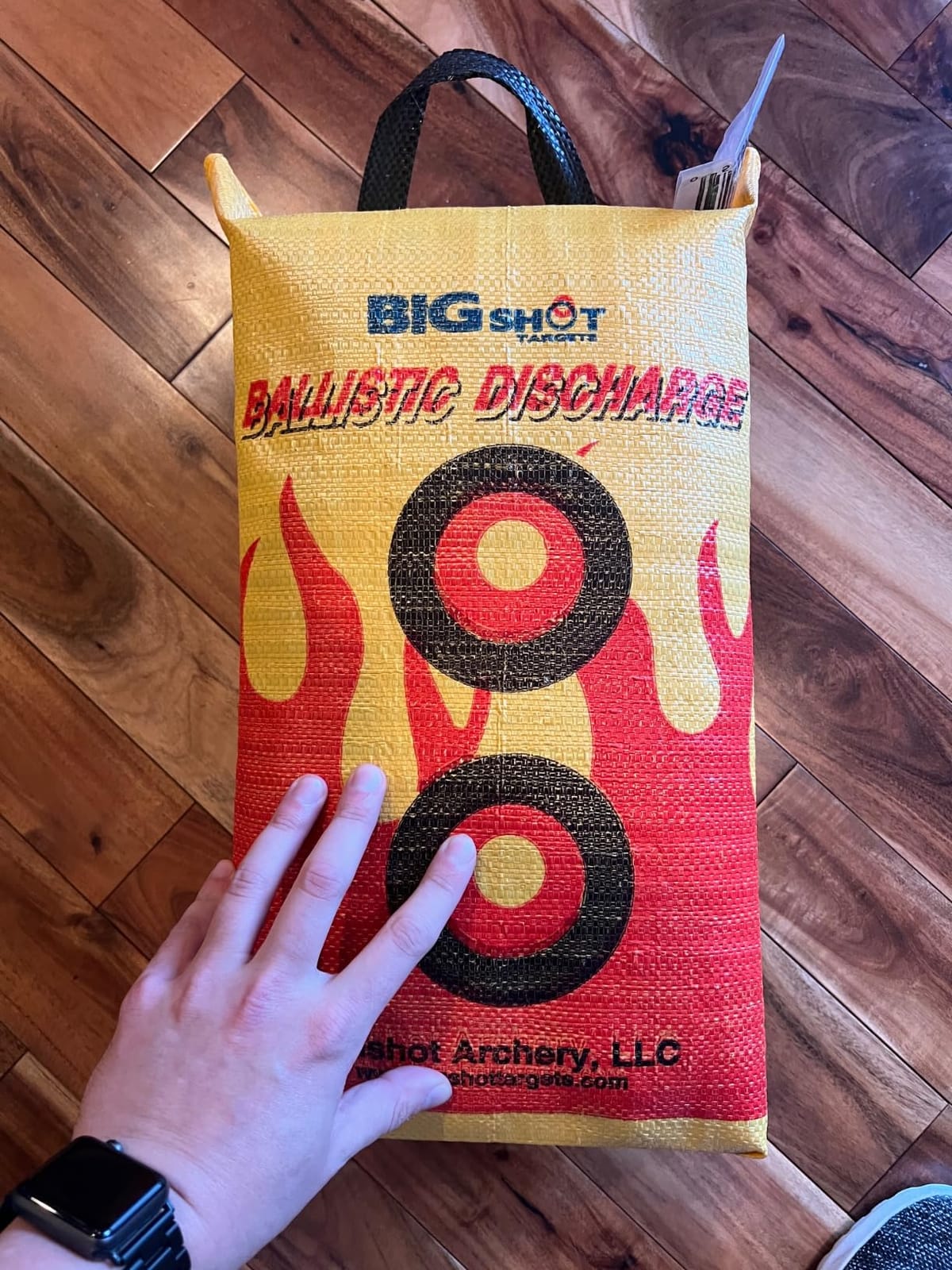
Military-grade ballistic fiber and a weatherproof shell mean it is at home on a camp range or a remote field lane as much as in a suburban backyard. The self-healing face limits visible damage, so it still looks usable after a season of hard shooting.
Owners still report two-finger arrow removal despite the high rating, which is the number that matters most day to day. A target you have to wrestle arrows out of is a target you stop using.
It is the newest design here with the smallest review base, so the long-term durability record is still thin. Judge it on the spec sheet and the warranty, not on a decade of owner reports.
Who This Bag Is For
Buy it if you shoot at a camp, a public range without permanent targets, or a family property with uneven ground. The portability is the feature everything else supports.
Crossbow shooters who practice short sessions will appreciate the 505 FPS rating and easy removal. It also works well as a travel target for sight-in work alongside a rangefinder setup like the ones in our archery rangefinder guide.
What to Watch
The 18 inch face is small, so it is less forgiving for long-distance practice and quicker to fill at the edges. Keep your practice groups tight and it performs well.
It is field point only and not rated for broadheads. If you plan to tune hunting arrows with it, look at a foam block instead.
Bag Target vs Foam Block vs Steel: What You Actually Need
Bag targets are not always the right answer, and buying one without knowing the alternative is how people end up with a target they cannot use for half of their shooting.
Bag target. The best choice for high-volume field point practice. Silent, safe for neighbors, easy arrow pull, and the lowest cost per shot of anything that stops arrows. The wrong choice for broadheads, indoor high-speed crossbow work, or anything where a deflected arrow could reach a neighbor.
Foam block target. The broadhead and high-energy answer. A layered foam block handles wideheads without tearing, and it can be mounted directly on a steel frame or in a wooden backstop. It is heavier, louder when arrows land, and needs arrows pulled with more care. For turkey practice, it is the only correct option.
Steel target. Purpose-built for compounds and crossbows, and cheap per shot at volume. It needs a safe standoff distance, it makes noise, and it is unforgiving in a residential yard. Our target stand guide covers the mounting side if you go that route.
Field points only, or broadhead duty, is the single question that decides your purchase. A bag that will not accept the arrows you actually shoot is an expensive paperweight.
How to Choose a Bag Archery Target for Outdoor Use
Start with your fastest bow, not your favorite target. A traditional or recurve archer shooting 250 FPS field points can be happy with a 425 FPS rated 20 inch bag, while a crossbow at 400-plus FPS needs a 450 or 525 FPS rated bag with a face big enough to absorb the group.
Next, match face size to distance. A 20 inch round face works well at 20 yards and becomes punishing at 40. If you want a sight-in lane for a compound, aim for a 24 inch face or larger.
Then look at durability signals in this order: layer count or core density, number of shootable sides, and whether the cover is replaceable. Layer counts on this list range from 38 to 54, and sides range from two to six.
Weather resistance decides whether the target lives in the yard or in the garage. Look for a UV-resistant shell, weatherproof seams, and a warranty longer than one year. Printed graphics fade in full sun even on well-built bags, so a cover you can replace cheaply is worth planning for.
Finally, check the weight against your setup. Under 20 pounds is easy for one adult or a teenager. Between 20 and 35 pounds is a one-person lift with a strap handle. Anything at 50 pounds is a two-person job.
Face type matters more than beginners expect. Printed bullseyes are permanent and free, but a bare bag gets boring after a few hundred shots. If you lose interest in a plain face, a cube with six sides or a bag you can hang paper target faces on keeps you shooting.
Backyard Safety and Backstop Setup for a Bag Target
A self-standing bag target is safer than most people assume, but it is not a backstop. Arrows can still exit the top, the side, or a spent section of core, and in a residential yard that matters more than anywhere else.
Check overhead clearance first. Never shoot toward a fence that has a power line, a low branch, or a neighbor’s deck above the target line. Walk the entire intended arrow path from the shooting line to the target and beyond.
Leave room behind the target. Arrows that pass through or deflect need somewhere harmless to go. A purpose-built arrow netting panel behind the target, or a tall solid backstop, is the cheapest safety upgrade you can make. Keep the target far enough from the backstop that arrows bury rather than reach it at speed.
Keep the line legal and the distance sane. The bigger the target, the more energy you need behind it. The useful rule is simple: a bigger bag means a longer minimum distance for fast bows, and a 12 inch cube has no business being shot at 40 yards with a crossbow.
Think about neighbors. Bag targets are quiet, which is exactly why they work in a subdivision. A steel target is a different conversation, and even a bag can carry a sound far enough to be annoying after dark.
Set the target so a fall is safe. A 50 pound bag that tips onto a concrete patio is a hazard. Set targets on level ground, face away from doors and windows, and check the bag is stable before every session rather than only when you set it up.
A ranged laser helps you confirm distances if you are building a multi-distance lane. Measuring with one of our recommended archery laser rangefinders is quicker than pacing and far more accurate.
Durability: How Many Arrows Will a Bag Target Take?
Manufacturer shot counts are vague, so the real numbers come from people who have used these targets for years. A Rokslide user reported a composite and foam backstop absorbing roughly 14,000 shots over 11 months completely uncovered, with no significant wear, because arrows follow the path of least resistance between layers.
In the same thread, a foam block target delivered about 12,000 shots before squirrels ruined it. That is the real backyard lesson: wildlife damage ends a practice life faster than arrow count does.
The layer-rotation trick extends life more than most owners realize. Take the top 25 percent and bottom 25 percent of layers apart and rotate them into the center, then repeat the process again later. One user planned to repeat that rotation at around 25,000 shots.
Other maintenance habits matter too. Field points only, keep broadheads on a foam block. Rotate a cube to a fresh side when a group forms. Replace the cover rather than the whole target when the shell wears through.
Use a cover when the target is not in use if squirrels or weather are a problem in your yard, and store bags indoors during prolonged wet weather. Printed graphics will fade in full sun regardless of build quality, so plan for a cover replacement in your ownership costs.
Frequently Asked Questions
What is the best archery target to leave outside?
A weatherproof bag target rated to your bow’s arrow speed is the best archery target to leave outside. In this roundup the Morrell Yellow Jacket Supreme 3 is built for year-round outdoor use, while the Delta McKenzie Speedbag 20 inch uses a weatherproof shell and hanging grommets for a sheltered outdoor lane. Any outdoor target should have a UV-resistant outer shell, and printed faces will still fade in full sun, so expect a cover replacement within a few seasons.
What is the best archery bag target?
The Morrell Double Duty 450 FPS Cube is the best overall archery bag target because it handles 300-415 FPS compound and crossbow field points, offers four shootable faces, and has a replaceable cover that extends the life of the core. For lighter budgets the Morrell Yellow Jacket Stinger covers most backyard practice, and crossbow-only shooters get the rated headroom they need from the Delta McKenzie Crossbow MAX Speedbag.
Can I leave my archery target outside?
Yes, most bag archery targets are built for outdoor use, but not all of them equally. Weatherproof construction, a UV-resistant shell, and stitched rather than stapled seams make the difference between a target that lasts a few seasons and one that lasts years. Keep an eye on the cover each spring, because sunlight eventually fades printed graphics, and bring bags inside during sustained wet weather to protect the core.
What is the best backstop for an archery target?
The best backstop for an archery target is a purpose-built arrow netting panel or a tall solid backstop mounted behind the target, sized larger than the target face. Leave enough standoff that arrows bury in the bag rather than reaching the backstop at speed. Always walk the arrow path for overhead power lines, branches, decks, and windows before you set a backyard lane.
What type of archery target lasts the longest?
A self-healing bag target with a high layer count and a replaceable cover lasts the longest in a backyard. On this list layer counts run from 38 on the Yellow Jacket Stinger to 54 on the Supreme 3, and real-world reports put long-service composite and foam backstops near 14,000 shots over 11 months uncovered. Rotating the top and bottom 25 percent of layers into the center stretches that life further.
Which arrow points are best for shooting bag targets?
Field points are the right points for bag targets. They have a narrow shaft that pierces the woven face, loses energy in the foam core, and slides out by hand. Broadheads and broadhead-style bolts cut wide blades that shred the face, so use a layered foam block for hunting practice instead. On very fast crossbow setups, check the bag’s rated FPS and the penetration depth before you commit.
Conclusion: The Best Bag Archery Targets for Backyards in 2026
After shooting through all eight, the Morrell Double Duty 450 FPS Cube is our pick for the best bag archery targets for backyards because it covers the widest range of real shooters with one purchase: a 450 FPS rating, four shootable faces, and a replaceable cover that keeps the core alive for years.
Pick the Yellow Jacket Stinger for family practice and easy carrying, the Hurricane 2-Sided bag for a short yard, and the Delta McKenzie Crossbow MAX if your fastest shots come from a crossbow. Whatever you choose, shoot field points only, keep a backstop behind the target, and walk the arrow path before you set up the lane.