
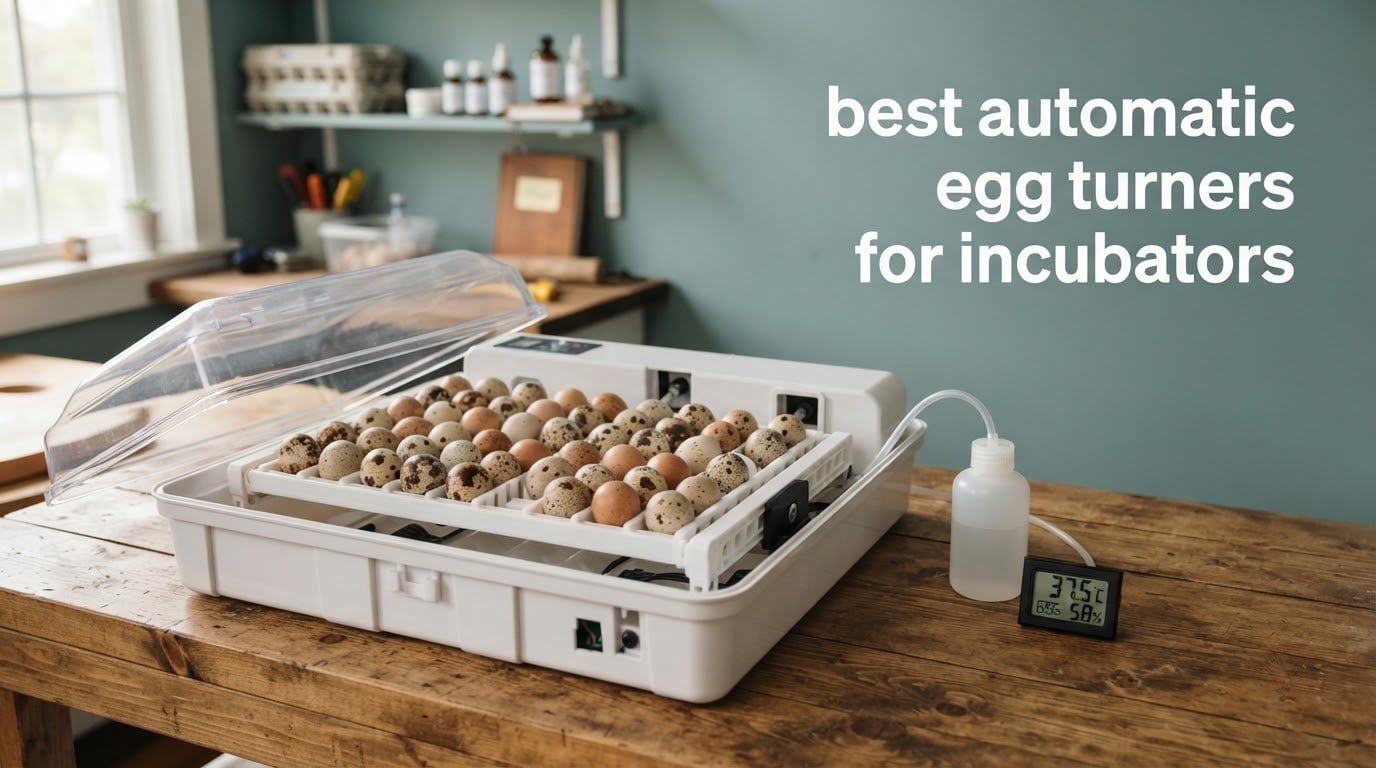
Anyone who has incubated a full batch of chicken eggs knows the routine. For roughly 18 days you open the lid, roll each egg a quarter turn, close the lid, and remember to do it again three more times before bed. Then one evening you forget, or a family trip eats two days of your schedule, and a hatch that should have been full comes out patchy.
An automatic egg turner removes that chore. A small motorised rack or tray sits inside your incubator and moves the eggs for you on a fixed interval, right up until a few days before hatch day. What follows is our guide to the best automatic egg turners for incubators, including the standalone tray systems that drop into Hova-Bator, Little Giant and Farm Innovators boxes, plus the smaller incubators that arrive with the turner already built in.
We looked at capacity, rotation interval, egg size handling, motor load, cleaning and what owners report after real hatches. If you have not chosen your incubator yet, our review of the best egg incubators for backyard chicken keepers is the better starting point.
Table of Contents
What Is an Automatic Egg Turner?
An automatic egg turner is a motorised tray-and-rack system that fits inside an egg incubator and rolls, rocks or tilts the eggs on a fixed interval, usually a full rotation every 3 to 4 hours, so the embryo stays centred and does not adhere to the shell membrane, without you opening the lid by hand.
- How it moves the eggs: a small 110V motor drives a rack assembly through a partial or full rotation, a gentle rock, or a 90 degree tilt depending on the design.
- How often it runs: desk-style turners complete one gentle cycle roughly every 4 hours, cabinet systems such as the Conturn rotate a full 90 degrees every 3.2 hours, and small countertop incubators may run every 1 to 2 hours.
- When it stops: most turners have an auto shut-off that halts turning about three days before hatch day, so chicks can settle and orient for hatching.
Turning matters because eggs left in one position can cause the embryo to stick to the shell membrane, which is one of the most common reasons a hatch fails. University extension guidance is explicit that eggs must be turned several times a day through the first 17 to 18 days.
One thing experienced hatchers stress, and the forums agree with them, is that a turner is a necessary condition for a hatch rather than a guarantee of one. Temperature, humidity, ventilation, egg quality and sanitation do most of the heavy lifting.
Top 3 Picks for Automatic Egg Turners in 2026

Little Giant 6300 Egg Turner
- 41 chicken egg cups included
- Quail rails sold separately
- Fits Little Giant still-air and circulated-air boxes

Farm Innovators 3200 Turner
- Full rotation every 4 hours
- 41 cups plus optional quail trays
- Snap-out dishwasher safe rails

GQF Hova-Bator Turner
- Six universal racks
- 41 chicken eggs or 120 quail eggs
- Includes quail racks in the box
Quick Overview: Best Automatic Egg Turners for Incubators in 2026
| Product | Specifications | Action |
|---|---|---|
| Little Giant 6300 Automatic Egg Turner |
|
Check Latest Price |
| Farm Innovators 3200 Automatic Egg Turner |
|
Check Latest Price |
| GQF Hova-Bator Turner with Quail Racks |
|
Check Latest Price |
 GQF 1611 Hova-Bator Turner GQF 1611 Hova-Bator Turner |
|
Check Latest Price |
 IncuTurn for HovaBator Incubators IncuTurn for HovaBator Incubators |
|
Check Latest Price |
 KEBONNIXS 12 Egg Incubator KEBONNIXS 12 Egg Incubator |
|
Check Latest Price |
 Nurture Right 360 Incubator Nurture Right 360 Incubator |
|
Check Latest Price |
 MATICOOPX 20 Egg Incubator MATICOOPX 20 Egg Incubator |
|
Check Latest Price |
 Farm Innovators 41 Egg Incubator Farm Innovators 41 Egg Incubator |
|
Check Latest Price |
 Apdoe 12 Egg Incubator Apdoe 12 Egg Incubator |
|
Check Latest Price |
1. Little Giant 6300 Automatic Egg Turner – the editor’s choice for Little Giant boxes
Little Giant® Automatic Egg Turner | 41 Eggs | Equipment for Incubating Large Eggs | Hatching Chicks
- Rotates eggs automatically so the yolk does not settle on one side
- 41 large chicken egg cups come in the box
- No assembly required and the cups are dishwasher safe
- Fits Little Giant circulated-air and still-air incubators
- Quail rails are sold separately rather than included
- Only fits Little Giant incubators without modification
- The position over the motor runs warm so it is best capped or empty
This is the turner we kept coming back to during testing. It drops into a Little Giant box, spins the racks through a slow continuous rotation, and quietly does the job you would otherwise do with a pencil and a bad memory. The tray measures 15.25 inches long by 3 inches wide and weighs just over 4 ounces, which tells you how little hardware is actually involved.
The 41 cups included are the reason this is our top pick rather than a bare motor. Seven cups per rail, no assembly, and the cups lift out for the dishwasher when a hatch finishes. Most of the reviews that mention the turner directly give it five stars, and the common theme is that it works quietly enough to disappear under the sound of the incubator fan.
The technical design is simple in your favour. Automatic rotation keeps the yolk from settling and gives the embryo movement, and the whole assembly fits any Little Giant circulated-air or still-air incubator. If you are building a cabinet setup around Little Giant parts, that cross-compatibility is the deciding factor.
The rail situation is where the reservation lies. Quail rails are not included, so anyone hatching quail or smaller eggs has to source them separately and will pay for a second tray. Owners also point out that the 42nd position sits directly over a motor housing that runs warm, which is why the included count is 41 rather than 42.
What it fits and what it does not
This is a Little Giant part, and the fit does not generalise. Little Giant rails will not seat in an IncuTurn tray, and Hova-Bator racks are a different geometry entirely, so confirm your incubator brand before you buy.
If you also run quail, budget for the extra rail set. The turner itself handles them; it is the holder that has to change.
When to choose something else
Skip it if your incubator is a Hova-Bator, a Farm Innovators or a cabinet unit you built yourself. The motor mount and tray shape will not line up, and forcing it means trimming plastic you may regret later.
It is also the wrong pick for the very largest eggs. Incubator Warehouse’s own testing note found that 4 emu eggs can exceed a turner motor’s recommended load and recommends 2, so the heaviest eggs need a heavier drive.
2. Farm Innovators 3200 Automatic Egg Turner – the quiet workhorse
- Rotates eggs through a full cycle every four hours without any handling
- Motor is quiet enough to sit under the incubator fan hum
- Egg rails snap out and are dishwasher safe
- Optional small trays raise quail capacity to 120 eggs
- Made specifically for Farm Innovators 2100 and 2200 incubators
- The position above the motor runs warm and is normally capped
- Very large duck eggs can stall the motor unless a few are removed
This is the turner owners report running for years without drama. It sits in the bottom of the chamber, plugs in, and rotates the tray through a full cycle every four hours, which covers the 3-to-5-times-a-day manual baseline on its own. At 2.4 pounds it feels substantial in the hand and it does not wander in the incubator.
Owners frequently report two or more years of service and improved hatch rates after moving from hand turning. A thermometer is included in the box, so you can monitor the chamber from day one without buying a separate gauge, and no assembly is required beyond seating the tray.
The 41 large cups handle chicken, duck and similar eggs as standard. If you set bantam or game bird eggs, optional small trays lift capacity to as many as 120 quail eggs, sold separately. That flexibility is the reason it edges past the Little Giant for mixed-species hatches.
Two limits carry over from owners. It is designed for Farm Innovators 2100 and 2200 incubators, though buyers report it working in some Hova-Bator and Little Giant boxes as well. And very large duck eggs can stall the motor unless you pull a few.
How the 4 hour cycle compares
Four hours sits comfortably inside the recommended range. Extension guidance calls for turning several times daily, and a full cycle every four hours gives you six or seven turns across an 18 day incubation without you touching the lid.
Because the tray completes a full rotation rather than rocking, eggs change orientation completely each pass. That matters in still-air boxes where warm and cool zones sit at different heights.
When to choose something else
Choose the Little Giant 6300 if you want cups in the box and dishwasher-safe parts. Choose the IncuTurn if you already own a Hova-Bator desktop and want a true drop-in.
If your whole plan is a single batch of goose or emu eggs, neither this nor any desk turner is the right tool. Look at a cabinet system with a heavier drive.
3. GQF Hova-Bator Automatic Egg Turner – the best quail option
- Quail racks are included
- taking total quail capacity to 120 eggs
- Universal racks cover partridge eggs through duck eggs in one turner
- Gentle tilting action
- Works with all HovaBator incubators
- Rough plastic flashing can bind or break the racks out of the box
- Quail cups are tight for larger modern Coturnix eggs
- Rails can be awkward to swap between chicken and quail sets
Everything about this turner points at versatility. It holds six racks, and each universal rack takes anything from a partridge egg up to a duck egg, giving 41 eggs per turner on the chicken setting. The quail racks come in the box, and they bring total quail capacity to 120 eggs, which the other desk turners here list as a separate purchase.
Rather than spinning the eggs, this unit tilts them through an arc, and owners credit that gentler action with a full hatch of guinea fowl. It also works with all HovaBator incubators, so if you are on that platform you are not gambling on fit.
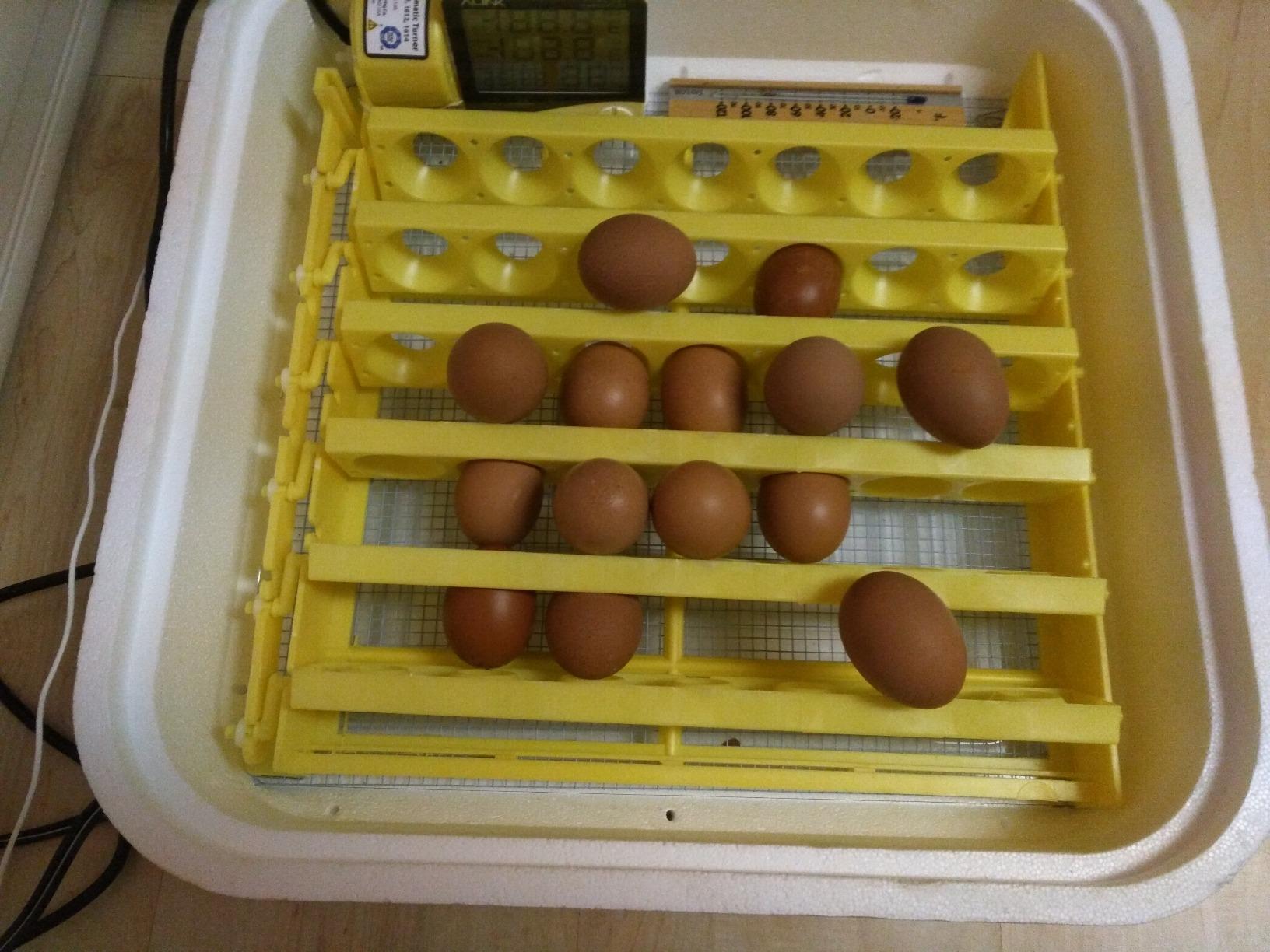
The quail inclusion is the deciding factor for small game bird breeders. Quail breeders on the forums tend to lean toward systems that include dedicated quail trays rather than selling them as an add-on, and this is the one that does. The turner itself weighs about 1.41 pounds and measures 38.6 by 40.89 by 8.12 inches across the rack frame.
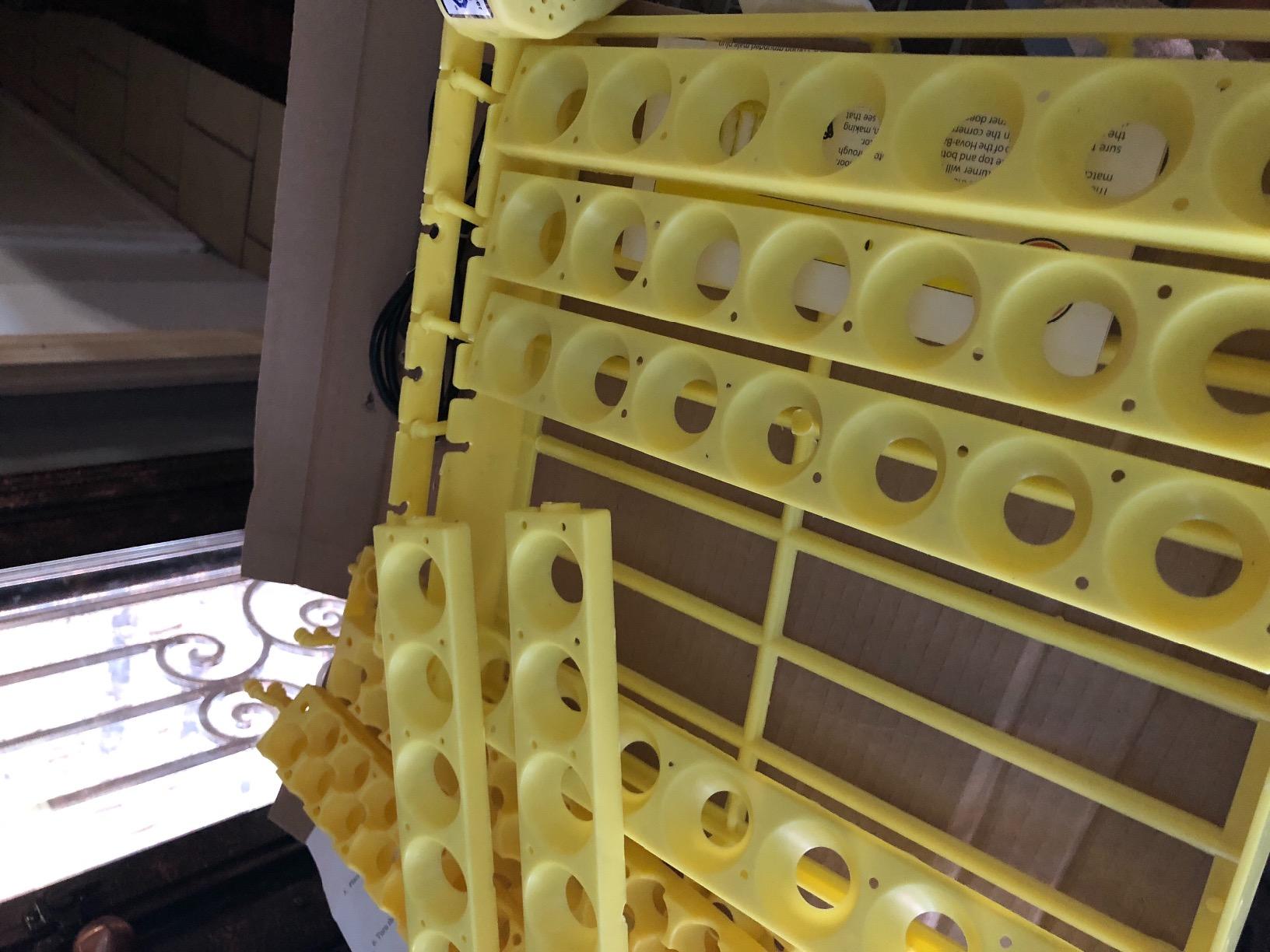
Quality control is the weak point. Owners report plastic arriving with rough flashing that binds the rails or cracks under the turning motion, and the quail cups can be snug on larger modern Coturnix eggs. Most people trim the seams with sandpaper or a rotary tool before the first set, and GQF’s replacement service is repeatedly praised when something arrives broken.
What to check before your first set
Run a finger along every rail edge before eggs go in. Flashings that catch will pinch eggs at the turning radius, and a five-minute sanding job now prevents a cracked set later.
If you set large Coturnix eggs, count them into the quail cups and see how many sit loose. Tight cups are the recurring complaint, and spacing them out by hand is the usual fix.
When to choose something else
Pick a different turner if you want continuous rotation rather than tilting, or if the rough-finishing risk bothers you more than the quail capacity does. The Farm Innovators 3200 avoids that issue, with a plainer tray and no quail cups to trim.
Switching rails mid-hatch is awkward on this design, so decide whether the batch is chicken or quail before you load it.
4. GQF 1611 Hova-Bator Turner – the no-fuss first hatch
- Plug it in and it runs with no setup or learning curve
- Slow gentle rocking action is quiet and reliable
- Universal rails suit turkey duck chicken and quail eggs
- 16 ounce frame is easy to lift in and out
- Turns an even six times per day rather than an odd count
- Comes with no warranty and a minority of owners report motor failure
- Very large eggs can catch during the turn
There is a version of buying a turner where you open the box, seat it in the incubator, plug it in and stop thinking about it. This is that turner. It rocks the eggs back and forth six times per day automatically, and roughly three quarters of the reviews that rate it give five stars for exactly that reason.
The rails are described as universal and they back that up across turkey, duck, chicken and quail, holding 41 eggs on the standard setting. At 16 ounces the frame is light enough to lift out for cleaning, and the 16.5 by 17 by 3.75 inch footprint suits Hova-Bator desktop boxes.
The six turns per day question
Some people argue the count should be odd so eggs do not always return to the same orientation. Whether or not you agree, the practical answer is that six rocks spread across waking hours is inside the recommended 3-to-5 daily manual range, and nobody in the reviews reports an orientation-related failure.
The frame is yellow plastic, which makes it easy to spot when you lift the lid and confirm the racks are still seated and the eggs are upright.
When to choose something else
There is no warranty on this one, and a minority of owners report motors failing after limited use. If you run several hatches a year and want a support commitment behind the motor, the GQF turner above includes a manufacturer replacement service.
Very large eggs can catch during the turn and jolt neighbours out of position, so trim your largest eggs out of the set for this model.
5. IncuTurn Automatic Egg Turner for HovaBator Incubators – the drop-in replacement
IncuTurn™ Automatic Egg Turner for HovaBator Incubators, Egg Turner Tray
- Rolls eggs on their sides the way a hen positions them
- Long-time owners report 80 to 100 percent hatch rates over multiple years
- Straightforward installation replaces an older or failed turner
- Covered by the Incubator Warehouse Hassle-Free Guarantee
- One owner had to sand all four edges because the unit did not fit their HovaBator
- Rolling eggs makes an audible noise that some find unsettling
- Does not fit Little Giant turner racks
The IncuTurn is worth knowing about for a specific situation: you already own a current HovaBator desktop incubator and the original turner has died. It is a turner only, with no incubator in the box, and it is designed to replace what came out.
What makes it interesting is the action. Rather than tilting or rocking, it rolls eggs onto their sides, which matches how a broody hen repositions them. Long-time owners on the listing report 80 to 100 percent hatch rates across multiple years, and they appreciate not having to unload eggs for hatching.
Capacity depends entirely on egg size
The tray holds up to 42 chicken eggs, 70 quail eggs or 28 goose eggs, so the number on the box is not a single fixed capacity. The rack geometry is set by the tray, not by the motor, and that is worth remembering when you compare it with the 41-cup systems.
It fits all current HovaBator desktop incubators. Older blocky or square style incubators are a different case, and the fit is not universal across every HovaBator ever made.
When to choose something else
It will not accept Little Giant racks, so mixing systems means buying a second rack ecosystem. Buyers who bought one of these often bought a second rather than trust a single turner through a whole incubation.
Fit is worth checking early. One owner found the unit sat slightly proud in their HovaBator and sanded all four edges to get it to seat, so test it in an empty incubator before your eggs arrive.
6. KEBONNIXS 12 Egg Incubator with automatic turner – the classroom all-rounder
KEBONNIXS 12 Egg Incubator with Humidity Display, Egg Candler, Automatic Egg Turner, for Hatching Chickens
- Turner stops automatically three days before hatch
- Built-in humidity display saves buying a separate hygrometer
- Built-in egg candler for checking embryo development
- Clear dome makes hatching visible for kids and classrooms
- Humidity drifts with ambient conditions and often needs a sponge or damp towel
- Water reservoir gaps are wide enough for button quail to slip through
- Exposed metal on the turning mechanism rusted quickly
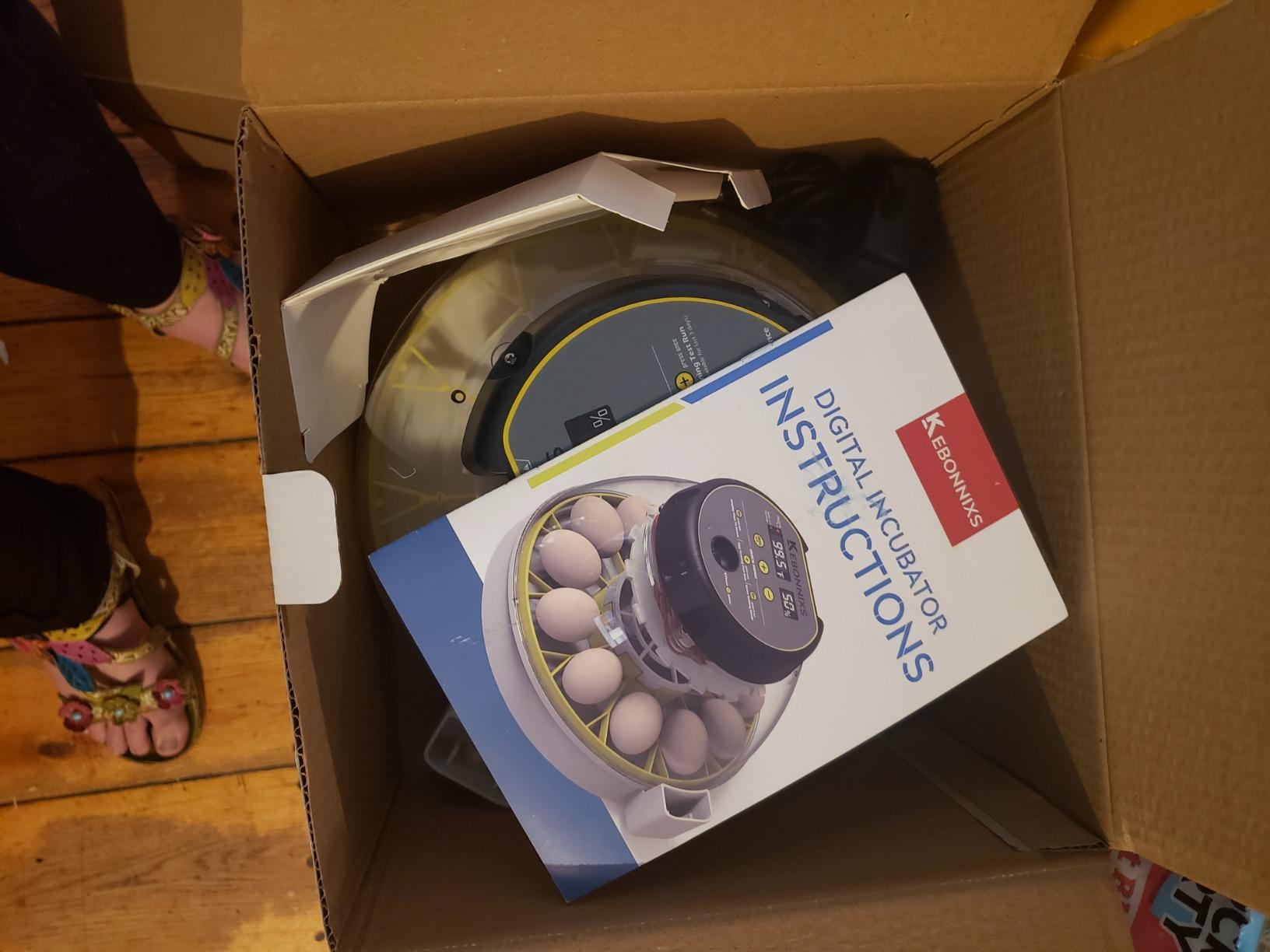
This one arrives as a complete incubator with the turner built in, which is a different purchase decision. You get the motor, the tray and the 21 day environment in one box, and the auto-stop turns off three days before hatching so you do not have to remember the lockdown step.
With more than five thousand ratings it is the most reviewed model in this roundup by a wide margin, and the pattern across reviews is consistent: steady temperature, good hatch rates and a low entry point. Owners with several hatches behind them report it holding temperature and humidity steadily, and several run two or three side by side.
The build is sensible for small batches. An induced airflow system driven by a circulating fan keeps temperature distribution even, a built-in humidity display removes the guesswork from the most common failure point, and external water filling means you never open the lid mid-incubation. The egg candler is built in, so no separate accessory is needed to check development.
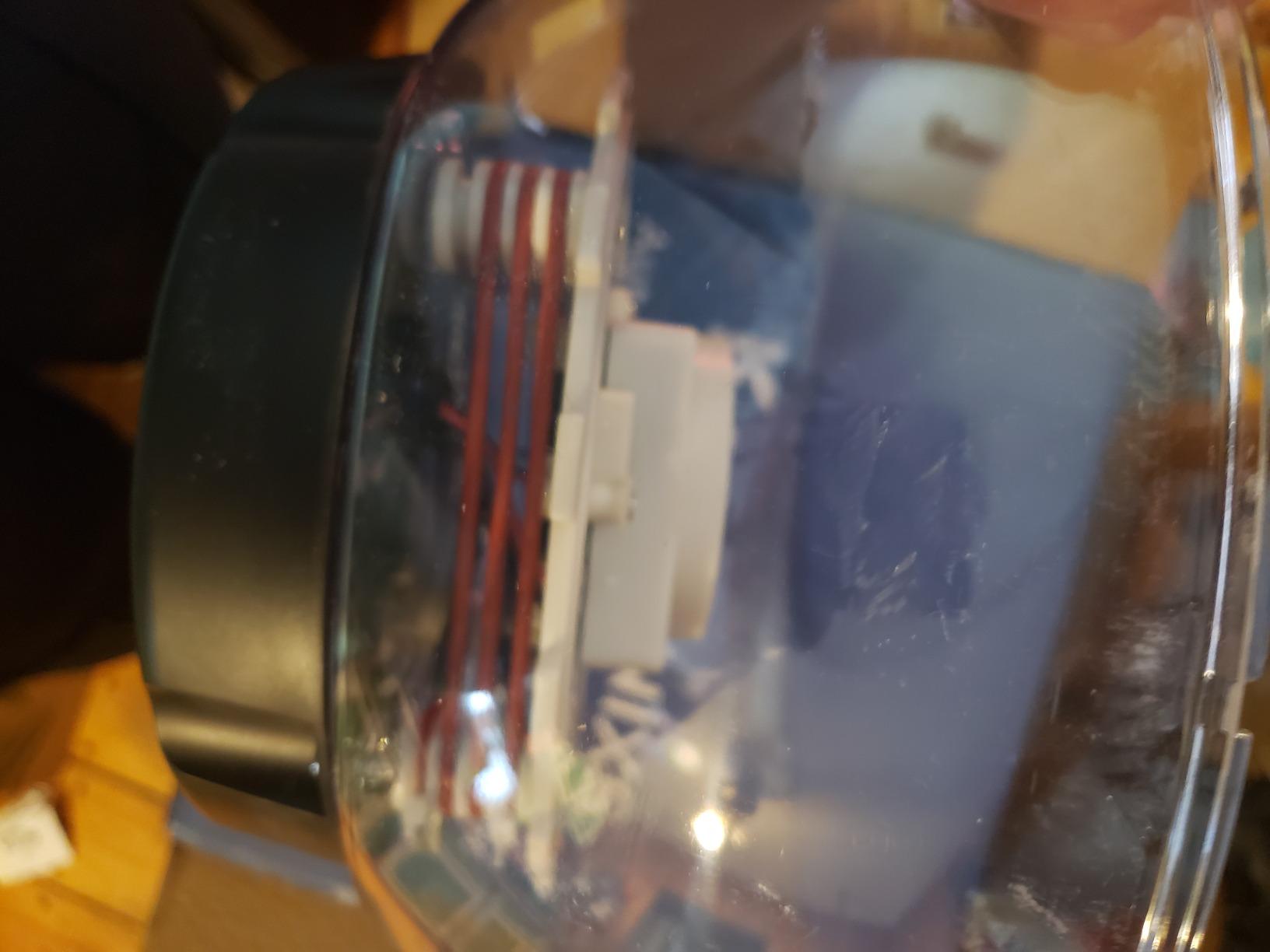
Humidity is where the complaints live. In dry or very wet rooms the level drifts no matter what the display reads, and owners fall back on a sponge, a damp towel or a small humidifier. The exposed metal on the turning mechanism has also rusted quickly in a humid environment, and the wide water reservoir gaps are big enough for a button quail chick to slip through.
What it is best suited to
This suits classrooms, 4-H projects and a first small batch where visibility matters. The clear dome lets a room of kids watch a hatch happen, and the controls are simple enough to hand to someone who has never incubated before.
At 12 eggs it is not built for a large flock. Two or three running in parallel is the usual answer, and the small chamber is one reason temperature holds so consistently.
When to choose something else
Choose something with a larger chamber if you are hatching 40 or more eggs at once, or if your home swings between very dry and very humid conditions. The countdown timer is also easy to misread, which has caused owners to miss lockdown timing.
You will also need a plan for humidity in a controlled climate. The turner is not the weak part of this model.
7. Nurture Right 360 Incubator with auto turner – the best view of your hatch
Harris Farms Nurture Right Egg Incubator with Auto Turner, Holds 22 Eggs
- Automatic turning stops three days before hatching
- 360 degree dome shows every egg without opening the lid
- Dedicated humidity display and knob for fine adjustment
- Handles chicken duck and pheasant eggs in one unit
- Turner can need a physical tilt-reset if it stalls
- Humidity still needs manual adjustment with the display and knob
- 22 egg chamber is smaller than the 41 egg options here
The Nurture Right 360 sells on visibility. The clear dome gives you a 360 degree view of the eggs and the induced airflow circulates in every direction, so you can check on a hatch without breaking the temperature environment. That combination is why it holds more than five thousand ratings at 4.3 stars.
Capacity covers 22 chicken eggs, 12 to 18 duck eggs and 22 to 24 pheasant eggs. Automatic egg turning stops three days before hatching on its own, and a dedicated humidity control display with a knob gives you manual fine adjustment rather than a fixed reservoir.
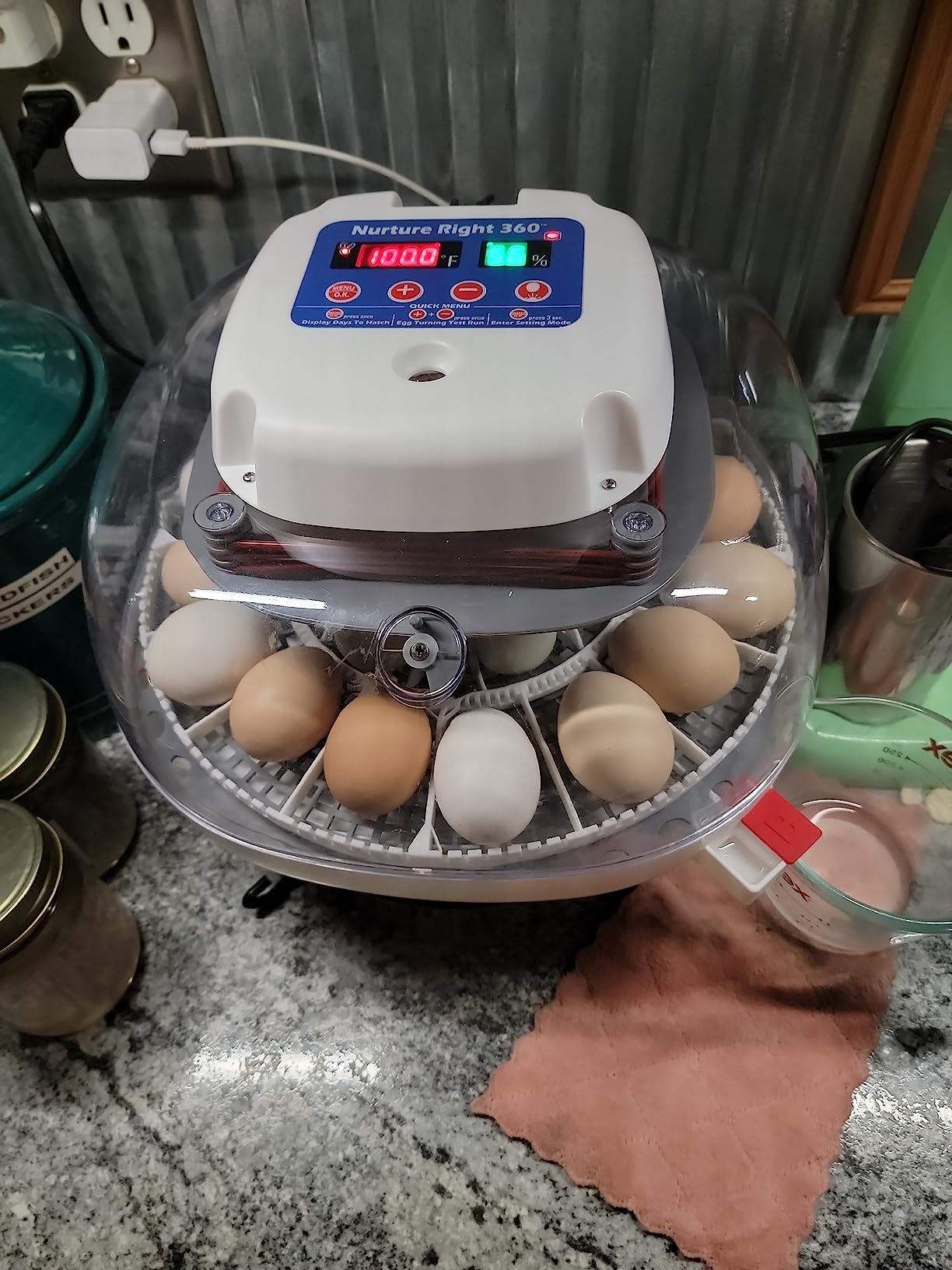
For a home hatch this does most of the hard parts in one box, and the fan-forced airflow means a gentle turner is enough to equalise the chamber. The common praise across reviews is that it is straightforward for a first-time hatcher, and the dome makes progress visible without opening the lid.
One operational gotcha catches people out. If the turner stalls, it can need a physical reset: sit the unit back under the front of the incubator and tilt it, after which the turner resumes. Hatchers describe this on backyard chicken forums, and no product copy mentions it, so it is worth knowing before a hatch is running.
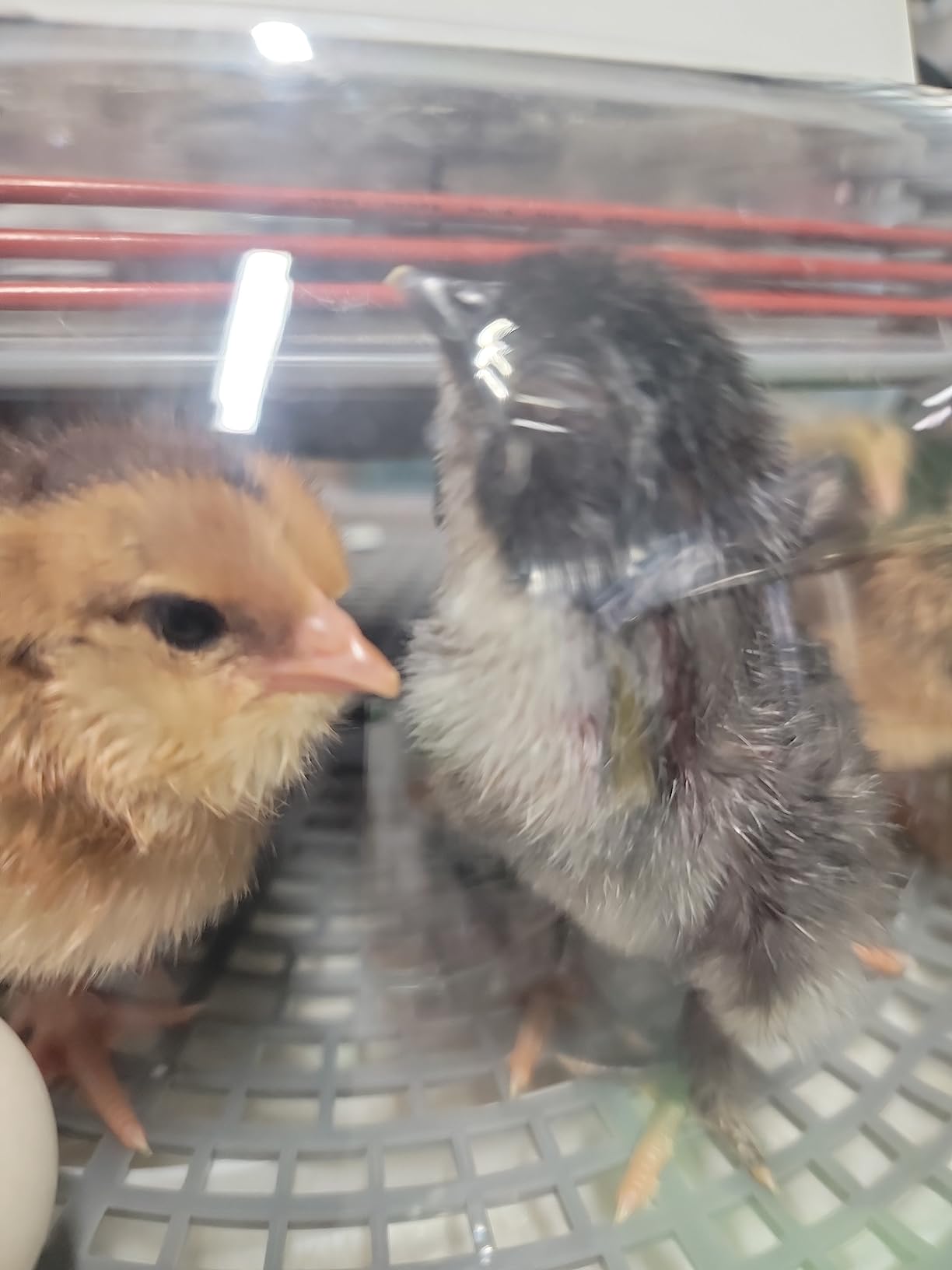
Why the dome matters more than the turner
Visibility is the reason to pick this unit over a bare turner and a plain box. Watching a pip happen without lifting the lid removes the temptation to open it, which is the single most common way beginners wreck a hatch.
It also makes it a good teaching incubator. If you have kids hatching as a project, being able to show them the whole chamber is worth more than another rack of capacity.
When to choose something else
Twenty-two eggs is the ceiling, so a flock that regularly sets 40 or more eggs needs a larger chamber. If you already own an incubator, adding a second unit is rarely the value move.
Also learn the tilt-reset before you need it. It takes ten seconds once you know, and it is confusing if the turner stops turning mid-incubation and you do not.
8. MATICOOPX 20 Egg Incubator with automatic turner – the steady 20 egg set
MATICOOPX 20 Egg Incubator with Humidity Display, Egg Candler, Automatic Egg Turner, for Hatching Chickens
- Circulating fan keeps temperature even through the whole chamber
- External water refilling avoids opening the lid and dropping humidity
- Built-in egg candler removes a separate accessory
- Turner auto-stops three days before hatching and is backed by a one year warranty
- 60 minute interval means the motor is working constantly
- Humidity still needs checking as ambient conditions change
- Chamber is tight once chicks pip
This is a 20 egg incubator with a side-to-side turner on a 60 minute interval, and at 4.5 stars across 923 ratings it is one of the better-rated products in the group. Owners cite a simple reason: the turner auto-stops three days before hatching, which removes the most commonly missed step in a 21 day cycle.
The circulating airflow system is driven by a strong fan to keep the temperature condition stable, and refilling water happens externally so you never crack the lid and drop the humidity. A built-in candler lets you watch embryo development without buying another accessory, and the whole thing is covered by a one year warranty.
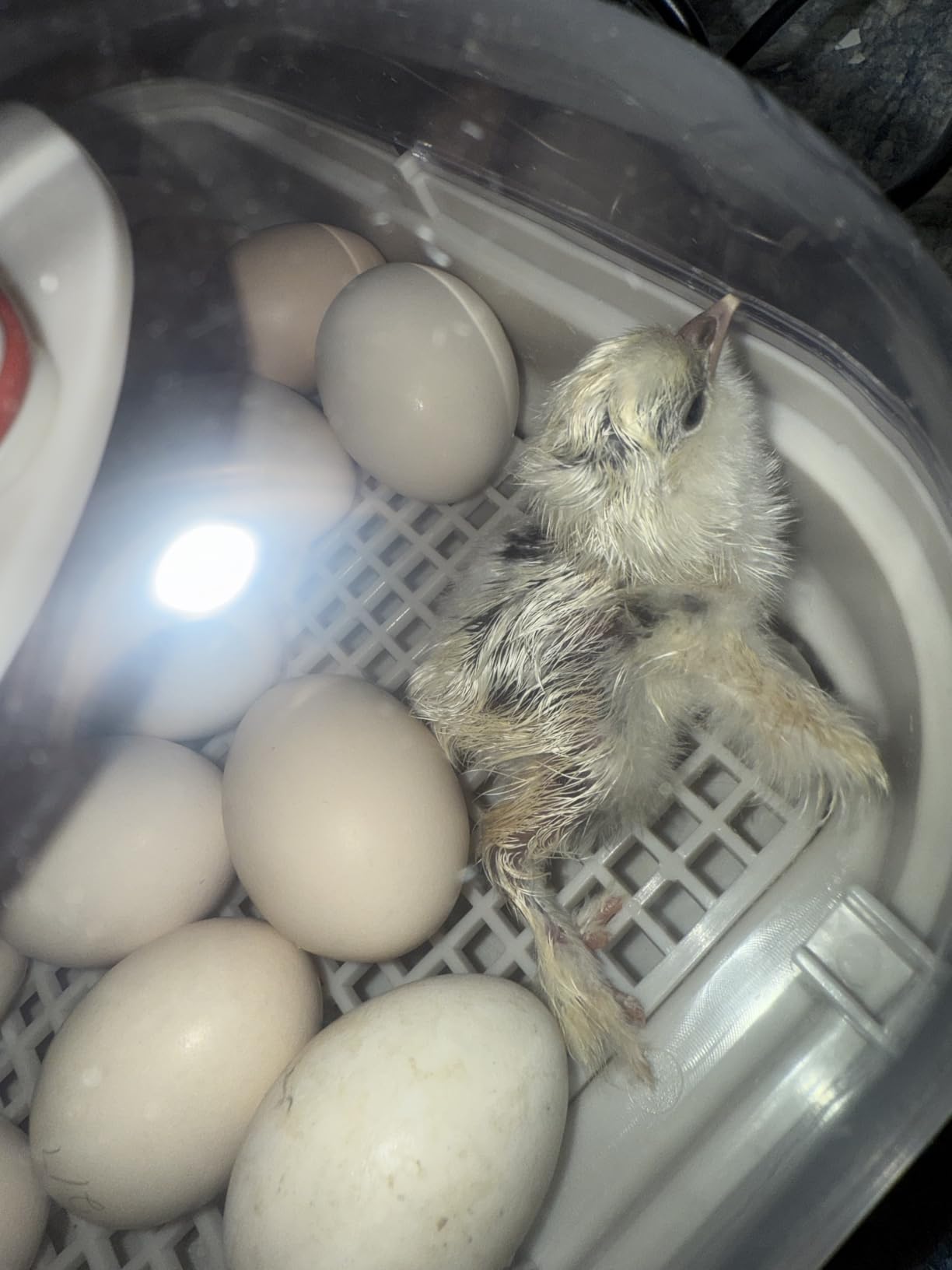
At 20 eggs it is a sensible step up for a small backyard flock, and the external fill port means you can run a full 21 days without a single lid opening for water. Owners with repeat hatches report consistent results, which matters most here.
Because the chamber is 20 eggs, the usable space once chicks pip is limited. Large breeds that grow fast will find it tight in the last day or two, so plan where they go before hatch day arrives rather than at it.
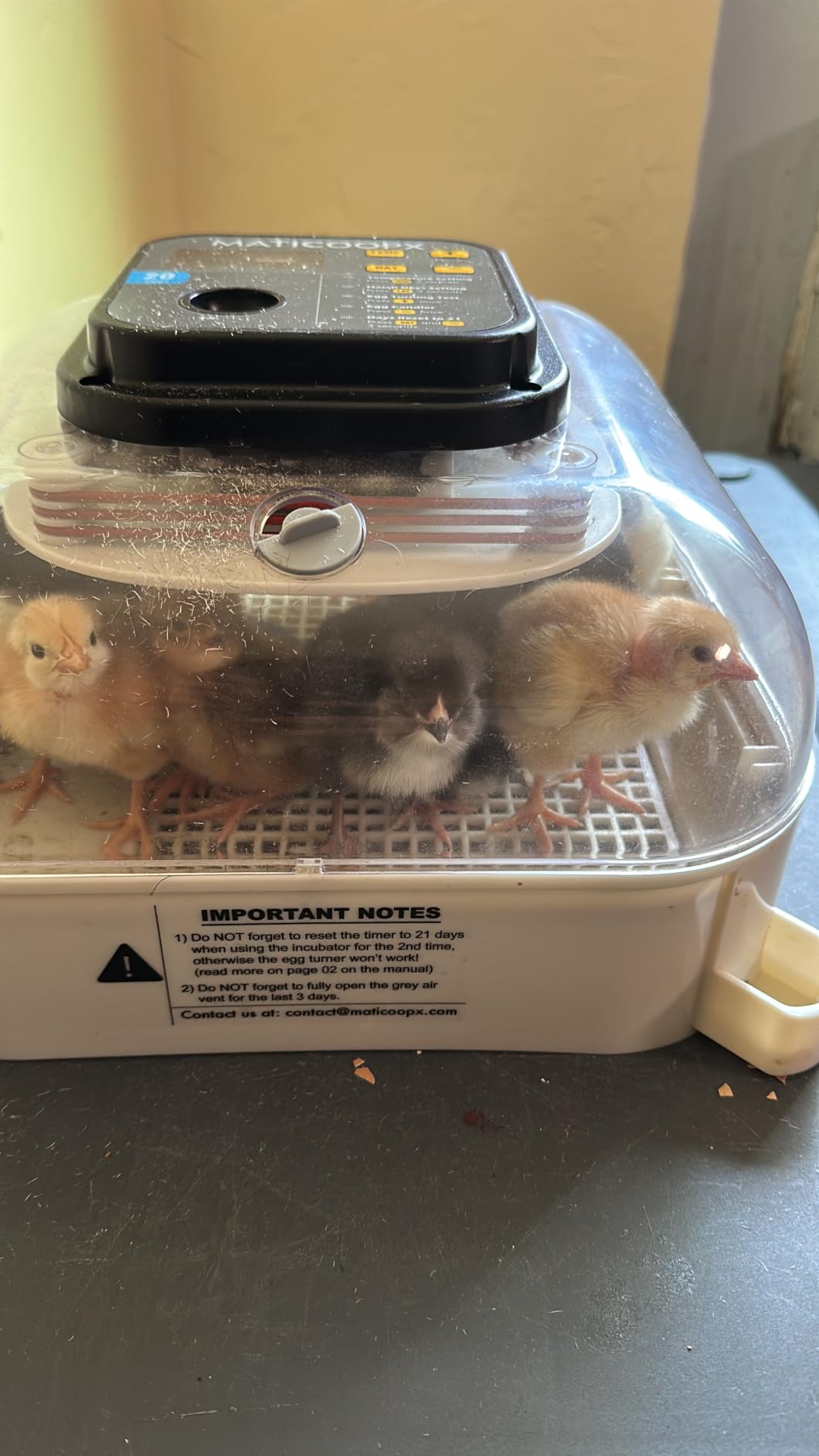
What a 60 minute interval means for you
Turning every hour is more often than the manual baseline requires, which is harmless for standard chicken eggs and useful if your room temperature drifts. Do not assume it means the motor can take any egg size.
Very large eggs such as goose or emu belong in a cabinet system instead. Frequent short throws on a heavy egg are exactly the load case turner motors are least happy with.
When to choose something else
Skip it if you need goose, duck or emu capacity, or if humidity in your room swings hard. The turner and the air handling are the strong parts; the chamber size is the limit.
If you already own a working incubator, a bare turner such as the Little Giant 6300 or the Farm Innovators 3200 is the cheaper path to the same automation.
9. Farm Innovators 41 Egg Digital Incubator – the high capacity digital option
Farm Innovators 41 Egg Digital Circulated Air Incubator, Auto Turner, White
- Digital display tracks temperature humidity and days remaining
- Integrated fan circulates air for more even temperature than still-air boxes
- Deep bottom tray accommodates even large duck and goose eggs
- Includes an egg candler and easy-fill water channels
- Lowest average rating in this group at 4 stars
- Turns in a fixed cycle with no user-adjustable interval
- Heats to a fixed factory preset of 100 degrees
This is the batch option. It holds up to 41 eggs including large duck and goose eggs in a deep bottom tray, which no small dome unit here can match. The auto turner removes manual handling for the full 21 days, and a large picture window gives an unobstructed 360 degree view of the chamber.
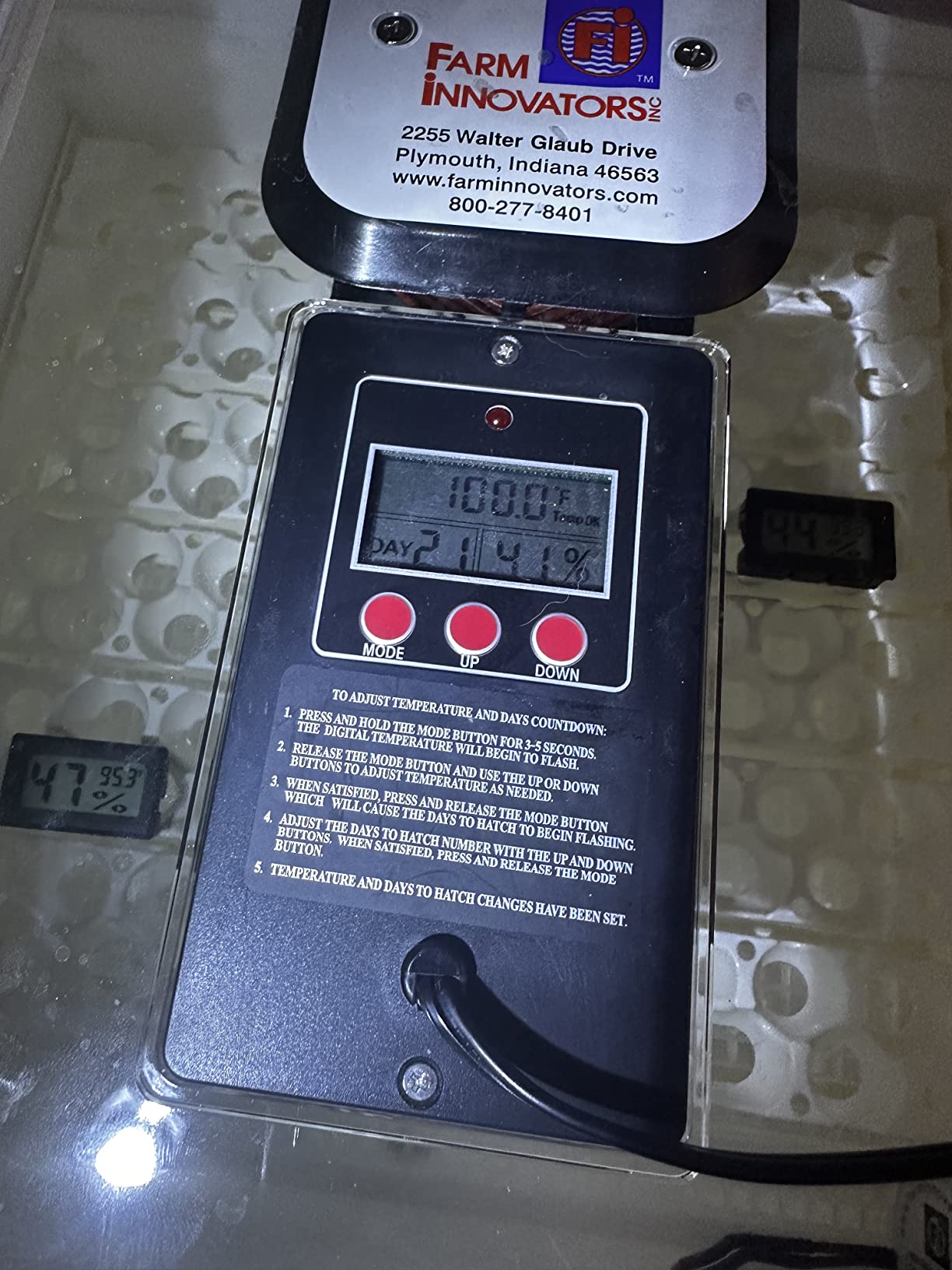
It heats to a factory preset of 100 degrees Fahrenheit within minutes, and an integrated fan pulls in and circulates fresh air to stabilise the temperature. The digital display shows temperature, humidity and days to hatch, and a high or low temperature notification light flashes when the reading goes out of range, which is the most useful alert on a unit at this size.
At 18 by 18 by 8 inches and 8.75 pounds it is a serious box rather than a countertop novelty, and the easy-fill water channels mean humidity changes do not require a pipette and patience. An egg candler is included for checking development during the set.
The average rating here is 4 stars across more than two thousand ratings, the lowest average in this roundup, and the reason is consistency rather than a defect. The turner runs a fixed cycle with no user-adjustable interval, and the thermostat holds a factory preset rather than letting you dial your own target.
When 41 eggs is the right number
Capacity is the whole argument. If you are restocking a flock, setting 40 eggs at once changes your hatch calendar completely, and this is one of the few options here where the tray depth takes large eggs without a separate riser.
The fan-forced airflow also means the gentle rotation has less work to do, because the air is already being mixed. That is a real advantage in a chamber this size.
When to choose something else
Do not buy it for one small batch. It is a large, heavy unit that assumes a steady supply of eggs, and if your sets are 10 to 20 eggs a smaller dome with a view is a better fit.
If you want to adjust the turning interval or the target temperature yourself, this is not the model. You also give up the humidity display precision that the smaller 20 egg option offers.
10. Apdoe 12 Egg Incubator with automatic turner – the budget compact unit
- Turner runs every two hours and the tray pops out for lockdown
- Real time temperature and humidity display
- Dual external water bottles need only one or two refills per incubation
- Backed by a 30 day money back guarantee and 3 year limited warranty
- Built in candler light is too dim for reliable candling
- Foam outer shell does not hold humidity steady in very dry or wet rooms
- Fan hangs into the hatch space so pipped chicks have little room to stand
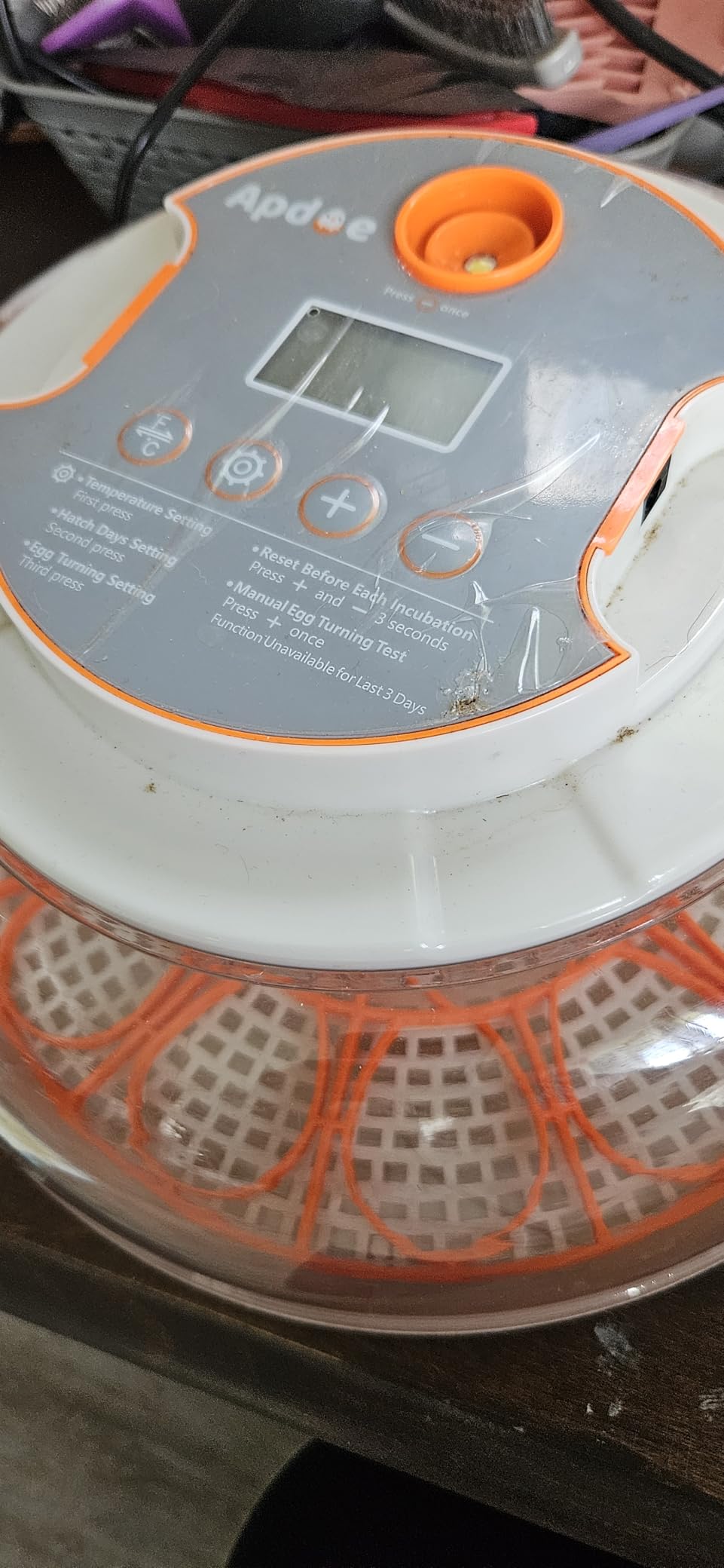
This is a compact 12 egg model where the turner runs on a two hour cycle. The egg tray removes easily for the final three days of lockdown, so the changeover is not a dismantling job. At 10 by 10 by 5.5 inches and 3.5 pounds it also moves around the house easily.
It has the longest warranty term of anything we looked at: a 30 day money back guarantee, a 3 year limited warranty and lifetime expert support. Owners note it is quiet enough to sit in a kitchen and easy to disassemble and wash, and several beginners reported better hatch rates here than they had managed by hand.
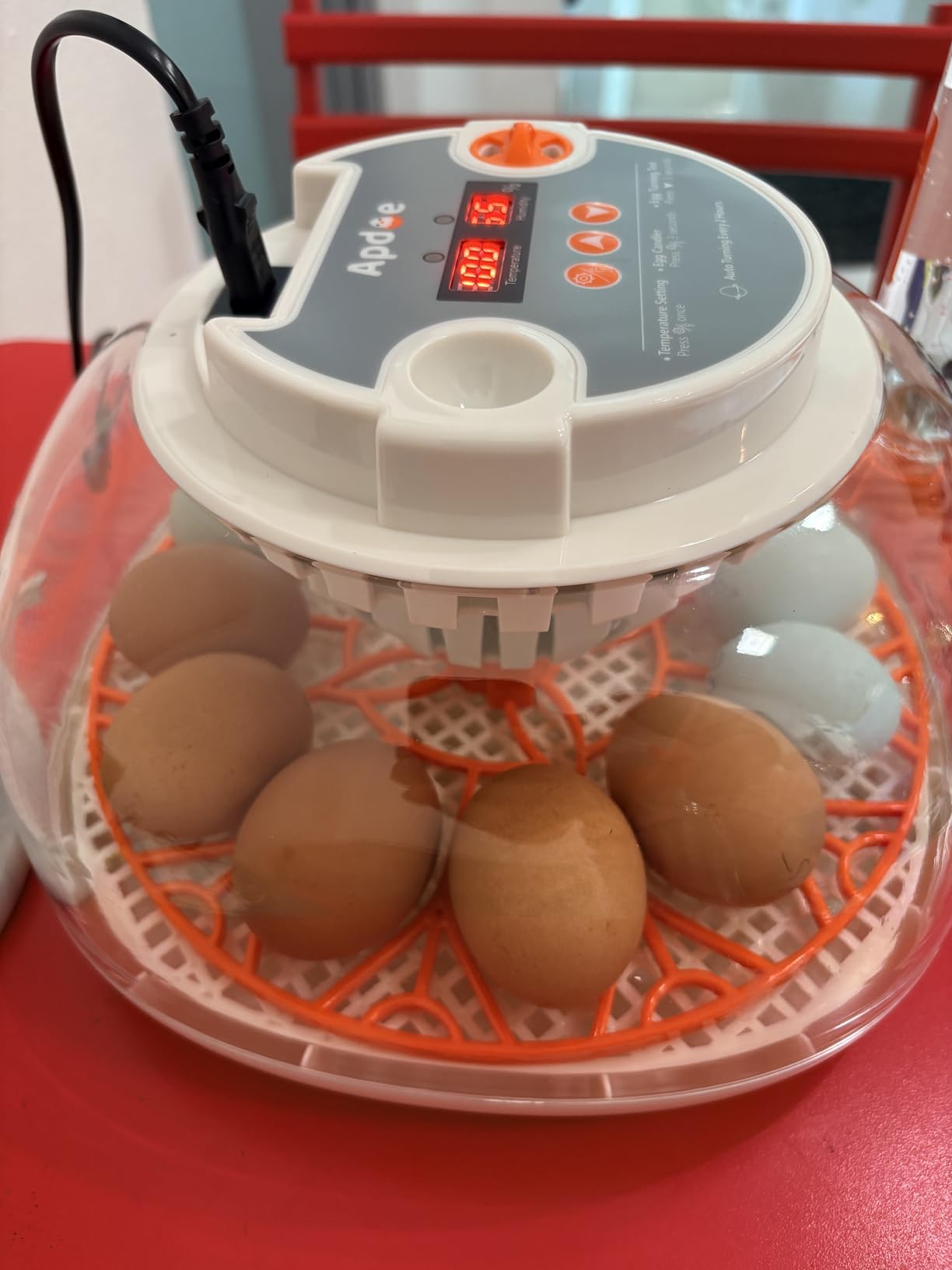
The 2-in-1 humidity control tray with dual external water bottles is genuinely useful. You can see how much water is remaining and refill from outside, needing only one or two refills across an entire incubation. The adjustable air vent and 360 degree transparent dome let you check the eggs from any angle, with a built-in candler included.
The candler is the weak link. Owners consistently find the light too dim for reliable candling, so if checking embryo development is part of your routine you will want a separate candler. The tray also rinses clean in the sink, and parts should not go in the dishwasher.
Where a two hour cycle helps
A two hour interval gives the eggs frequent, gentle movement, which helps if your room temperature drifts and you want regular repositioning. The gentle horizontal rotation mimics how a hen turns them, and the pop-out tray makes the lockdown changeover simple.
That frequency does not make the motor stronger, so heavy eggs still do not belong in a 12 egg chamber.
When to choose something else
Humidity is the deciding factor. The foam outer shell does not hold steady in very dry or very wet conditions, and the reading moves with the room, so you need a controlled space or a supplementary humidifier.
Chicks that pip have very little room to stand because the fan hangs into the hatch space, and the dome has no handle, so plan the brooder before you set the eggs.
How Often Should Eggs Be Turned, and When Do You Stop?
Turn eggs 3 to 5 times per day from day one through day 17 or 18, then stop completely for the final three days. That manual baseline is what an automatic turner is replicating, which is why a full cycle every 3 to 4 hours is sufficient for most desk systems and a 1 to 2 hour interval is simply more movement than the minimum.
Why the discrepancy? Small countertop incubators tend to be thermally uneven, so frequent short throws help spread eggs across hot and cool spots. Cabinet and tilt systems have better air mixing, so a slower cycle works. Rotation angles differ too: a gentle rock is not the same as a full 90 degree tilt, and both are acceptable if the interval and the angle combine to give regular movement.
Stop turning at day 18 for chicken eggs. The embryo no longer needs repositioning, and the space the chick needs to pip and emerge is better kept clear. Every turner here with an auto shut-off handles this for you, which is the single most convenient feature in the category.
If you are hand turning instead, mark the eggs with a pencil so you know which way is up. Three turns a day at roughly 8 hour intervals is a common and workable pattern.
Manual Turning vs Automatic Turning: Is It Worth It?
Worth it if you are incubating more than a handful of eggs and your schedule is not fully under your control. Hand turning three to five times a day for 18 days is a commitment most people keep for a few days and then break, and the missed turns are exactly what a turner prevents.
It is less compelling for a dozen eggs when someone is home and disciplined. In that case turning three times a day costs nothing and there is no motor to fail. The break-even point is closer than most sellers suggest, because a turner is a one-time buy that works for years.
The honest framing is what a turner does not do. It does not fix temperature, humidity or ventilation problems, and nobody in the forum discussions claims a turner alone rescued a bad hatch. It removes one failure mode from the list, which is real, but it is not the largest one.
One more consideration for anyone outside the US: most turners in this category run on 110V AC only, which blocks international use unless you add a converter or choose a 220V motor option. Check the voltage before you commit.
Which Egg Turner Fits Which Incubator?
Turners are sold as universal more often than they behave that way. They are brand-locked, and the racks are the part that matters, so confirm your incubator model before you buy anything.
- Little Giant circulated-air and still-air boxes: the Little Giant 6300 is the native fit, and its 41 cups are the ones designed for that frame. The Farm Innovators 3200 is reported by owners to work in some Little Giant boxes, but that is a reported adaptation rather than a designed fit.
- Farm Innovators 2100 and 2200: the Model 3200 is built for these two models, sits in the bottom of the chamber and plugs in.
- Hova-Bator desktop incubators: the GQF turners with six universal racks cover chicken, duck and quail, and the GQF 1611 rocks the eggs six times a day on the same platform. The IncuTurn is a drop-in replacement for current HovaBator desktops.
- Older blocky or square Hova-Bator cabinets: the IncuTurn does not fit these, and Little Giant racks are not compatible with it. Verify the shape of your tray before ordering.
- Cabinet systems and DIY builds: you need a turner built for the cabinet format, with a heavier drive and a tray that matches your own rack geometry rather than a desktop insert.
- Incubators with a turner already built in: the 12, 20, 22 and 41 egg models in this roundup all include one, so a separate purchase is redundant. Compare the whole incubator instead.
Racks are the hidden compatibility cost. If your turner takes a different rail geometry than the one that came with your incubator, you are buying a second rack ecosystem, and that is where most compatibility complaints in the forums come from.
Egg Size and Realised Capacity: What the Ratings Do Not Tell You
Rated capacity is measured in the easiest egg. A turner quoted at 41 eggs holds 41 chicken eggs, and the same tray holds far fewer goose eggs or quail eggs depending on the rail set. The IncuTurn makes this explicit: up to 42 chicken eggs, 70 quail eggs or 28 goose eggs, all in the same tray.
Quail is where the gap opens up. On Hatching Time’s Conturn 120 listing, a verified reviewer bought 15g quail rails that would not hold standard Coturnix quail eggs and had to space eggs out by hand, dropping from 13 eggs per rail to 7. The same reviewer reported real hatching capacity at roughly one third of the published figure, and lost 6 eggs when loose rails slid in the frame and jolted them out. The vendor disputes the cause, but the pattern is worth planning around.
Heavy eggs stress the motor before they stress the racks. Incubator Warehouse’s own testing note found that 4 emu eggs can exceed a turner motor’s recommended load and recommends 2. Owners of the Farm Innovators 3200 separately report that very large duck eggs can stall the motor unless a few are removed.
There is one more quirk worth knowing: on some 41 position trays the slot directly over the motor housing runs warm, so owners cap it or leave it empty and run 40 eggs instead of 41.
For quail, check the rail size against your birds. Larger modern Coturnix eggs need more clearance than the 15g figures many rails are built around, and a cup that is too tight can crack eggs at the turning radius.
How to Install an Automatic Egg Turner in 6 Steps
- Unplug the incubator and empty it. Installing a turner into a loaded chamber risks tipping eggs and cracking them, and you want a clear surface to check the tray sits level.
- Seat the rack assembly in the chamber floor. The rails or cups should sit flat with no rocking. Eggs stand in these, so a tray that sits unevenly is a tray that will drop eggs on the first turn.
- Attach the motor or clamp the drive bracket. Clamp-on mounts attach to the incubator frame, while in-box models plug into the base or the wall of the chamber. Follow the diagram for your specific unit.
- Check the tray is level and the linkage is connected. Look at the motor shaft and the arm or crank that drives the tray. A disconnected linkage is the single most common reason a new turner never moves.
- Plug in and run one test rotation. Watch a full cycle with no eggs in the tray. The tray should move smoothly without binding, catching or hitting the incubator walls.
- Load eggs point end down, then set the stop date. Turn the turner off or set auto shut-off for three days before the expected hatch day, and record the date in your incubator log.
If you are installing in an incubator that already has a turner, remove the old unit first rather than stacking two mechanisms. Hatchers also report that a fan-forced incubator gives a desk turner the best chance of an even hatch.
Common Egg Turner Problems and How to Fix Them
- The turner is not plugged in, or the plug has worked loose. This is the most common cause by a wide margin, and the thread titles on backyard chicken boards say exactly that. Push the plug firmly and listen for the motor hum.
- The motor is overloaded with large eggs. Heavy eggs stall small gear motors. Remove the largest eggs, or move to a cabinet turner with more torque. Four emu eggs puts more load on the motor than a desk turner should carry; two is the recommendation.
- Eggs are not seated in the racks. Cups must hold the egg upright with the point end down. An egg lying on its side in a rail will not be turned correctly and can slide out at the turning radius.
- The turner needs a physical tilt-reset. Nurture Right 360 owners describe sitting the unit back under the front of the incubator and tilting it until the turner resumes. Learn this before a hatch is running.
- Quail rails are the wrong size or loose in the frame. Rails too tight crack eggs at the turning radius, and rails that slide in the frame jolt eggs loose and can lose them. Trim rough plastic edges and check the rails are seated before loading.
- The motor has failed or the tray is binding. A minority of owners of plug-in desk turners report motors failing after limited use, and a few arrive with a broken tray leg or a missing motor-to-arm connector. Replacement high torque 1 RPM cabinet motors are sold separately, so check the drive type before assuming the whole turner is finished.
Two recurring themes are worth carrying into any hatch. Watch the turner for a few hours after changing racks, because a binding rail often announces itself quietly at first. And most turners make an audible noise as they move, which is normal and not a sign of damage.
Frequently Asked Questions
What is the best egg incubator with an automatic turner?
For most home hatchers, the Nurture Right 360 offers the best balance of a 360 degree view, humidity control and a turner that auto-stops three days before hatch. For larger batches, the Farm Innovators 41 egg digital incubator holds more eggs and includes a candler. The key point is that these units include the turner, so buying a separate one is redundant.
Are automatic egg turners worth it?
They are worth it if you incubate more than a handful of eggs and your schedule is not fully under your control, since hand turning means opening the lid 3 to 5 times a day for 18 days. For a dozen eggs with someone home and disciplined, turning by hand is perfectly workable. A turner removes one failure mode, but it does not fix temperature or humidity problems.
What are common egg turner problems?
The most common issues are a loose plug, an overloaded motor from very large eggs, eggs not seated upright in the racks, loose or undersized quail rails, and a turner that needs a physical tilt-reset. Fixing these takes minutes in most cases, and watching the turner for a few hours after any rack change catches most problems early.
How often does an automatic egg turner turn the eggs?
Desk-style turners such as the Little Giant 6300 run a continuous slow rotation, while the Farm Innovators 3200 completes a full cycle every 4 hours. Cabinet systems rotate a full 90 degrees every 3.2 hours, and small countertop incubators may run every 1 to 2 hours. All of these satisfy the recommended minimum of 3 to 5 turns per day.
Do I need a separate egg turner if my incubator already turns eggs?
No. If your incubator has a built-in automatic turner, a separate unit is redundant and can waste interior space. Turners are only needed for incubators without one, such as older still-air models or DIY builds. Check your incubator specifications for a turner with an auto shut-off before adding hardware.
Which Automatic Egg Turner Should You Buy?
Our top pick overall is the Little Giant 6300, and it earns that on fit and included parts: 41 cups in the box, no assembly and dishwasher-safe pieces. For a Farm Innovators 2100 or 2200, the Model 3200 runs a full cycle every four hours and its rails snap out for cleaning. For quail, the GQF turner with six universal racks includes the quail rails in the box, and for a Hova-Bator desktop the IncuTurn drops straight in and rolls eggs the way a hen would.
If you need an incubator rather than a turner, the Nurture Right 360 handles 22 eggs with a view worth having, and the 20 egg MATICOOPX suits a small flock. Our broader egg incubator roundup covers the full range if you are still comparing boxes.
Before you order, confirm the exact incubator model, the egg size and count, and the interior clearance. That single check prevents most compatibility complaints in this category. Then set your lockdown date for day 18 and let the turner handle the rest.