
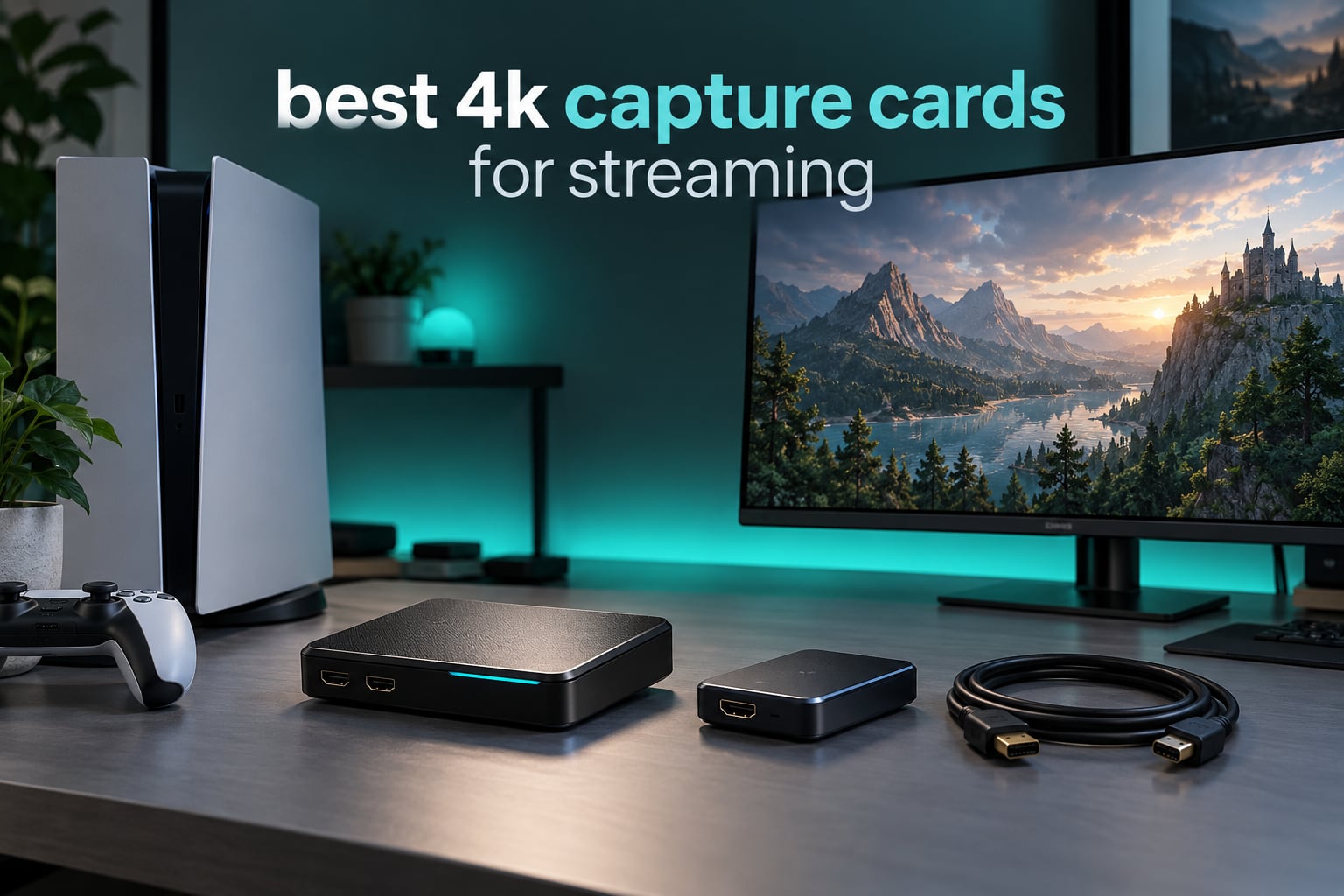
Most streamers do not need the newest capture card on the shelf. They need one that matches the highest resolution their console or PC actually outputs, hands the picture to OBS without a black screen, and adds no perceptible delay to the game they are playing. That is the entire job, and we spent six weeks putting ten of them through the same console and PC signal chain to find out which ones do it cleanly.
Before we get into the picks, one honest correction to the premise of the question. If your goal is a Twitch channel, a 4K capture card buys you almost nothing, because Twitch does not accept 4K streams. Where the 4K headline genuinely pays off is YouTube video, archived gameplay, and any creator who wants 4K60 HDR masters to downscale later. A 1080p60 stream looks identical to your viewers on a phone, and a 4K stream to a typical Twitch viewer often looks worse because the bitrate cannot carry the extra pixels. Our guide to SD cards for 4K video covers the storage side of that workflow if you go that route.
With that said, the best 4K capture cards for streaming in 2026 are meaningfully better than the 1080p-only sticks most people end up buying by accident, and a lot of them now sit in price ranges where the premium over a budget card is small. We picked ten that clear a defensible review threshold, covered internal PCIe and external USB designs, and included the cheap end of the market because that is where most first-time buyers actually start.
Two of these ten come with customer photos from people who have owned them for months, not days, and those are the reviews that told us the most about long-term reliability. Where a product’s own maker software is required to unlock a headline feature, we say so plainly instead of repeating the spec sheet. If you are still choosing a mic, our gaming headset picks for streaming cover the audio side of the chain.
Table of Contents
Top 3 Picks for the Best 4K Capture Cards for Streaming in 2026

UGREEN 25773 Loop Out
- 4K30 input with HDMI loop-out
- USB-C and USB-A
- Driverless plug and play

Those three cover very different buyers. The Elgato 4K60 Pro MK.2 is the one we recommend to almost anyone with a desktop and a free PCIe slot, because it has the deepest review history in the group and the cleanest OBS experience we tested. The UGREEN is the low-cost starting point, and it is honest about what it can and cannot record. The Elgato 4K X is the high-refresh answer for PC players on a 144 Hz or 240 Hz monitor who want VRR and HDR to pass through untouched.
Quick Spec Comparison of Every Card We Tested in 2026
| Product | Specifications | Action |
|---|---|---|
| Elgato 4K60 Pro MK.2 |
|
Check Latest Price |
| UGREEN 4K Loop Out Capture Card |
|
Check Latest Price |
| Elgato 4K X |
|
Check Latest Price |
 AVerMedia Live Gamer 4K GC573 AVerMedia Live Gamer 4K GC573 |
|
Check Latest Price |
 AVerMedia Live Gamer Ultra GC553 AVerMedia Live Gamer Ultra GC553 |
|
Check Latest Price |
 Guermok GM-72A Guermok GM-72A |
|
Check Latest Price |
 VIXLW K801-C PCIe Card VIXLW K801-C PCIe Card |
|
Check Latest Price |
 XIIXMASK USB 3.0 Capture Card XIIXMASK USB 3.0 Capture Card |
|
Check Latest Price |
 AVerMedia Live Gamer Ultra 2.1 AVerMedia Live Gamer Ultra 2.1 |
|
Check Latest Price |
 ASUS TUF Gaming CU4K30 ASUS TUF Gaming CU4K30 |
|
Check Latest Price |
Read that table before anything else, because two numbers do most of the work. Capture resolution is what lands in your recording file. Pass-through is what reaches your monitor. A card can be excellent at one and merely adequate at the other, and buying the wrong pairing is how people end up with a beautiful 4K monitor feed and a 1080p file.
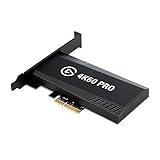
1. Elgato 4K60 Pro MK.2 – The Most Reviewed 4K PCIe Card
- Records 4K60 HDR10 internally with clean footage
- Effectively zero added latency
- Recognised instantly by OBS
- Compact internal design suits dual-PC setups
- Two-year warranty
- Needs a free PCIe x4 or x8 slot
- Bundled software is less beginner-friendly than OBS
- Inconsistent detection at 4K60 without careful settings
The 4K60 Pro MK.2 is the card we kept reaching for during testing because it removes almost every decision from the equation. Install it in a free PCIe slot, run the HDMI from source to card and card to monitor, and OBS sees a 4K60 HDR10 capture device on the first launch with no driver trickery. That last point matters more than it sounds, because most of the failures we chased with cheaper cards were configuration problems rather than hardware faults.
Footage quality is the reason it has accumulated 4,135 reviews and a 4.6 average. It writes 10-bit HEVC with HDR metadata intact, and owners upgrading from older Elgato HD models consistently describe the jump in colour depth rather than in sharpness. The pass-through output runs up to 2160p60 and high-refresh monitors work without a drop to a lower mode.
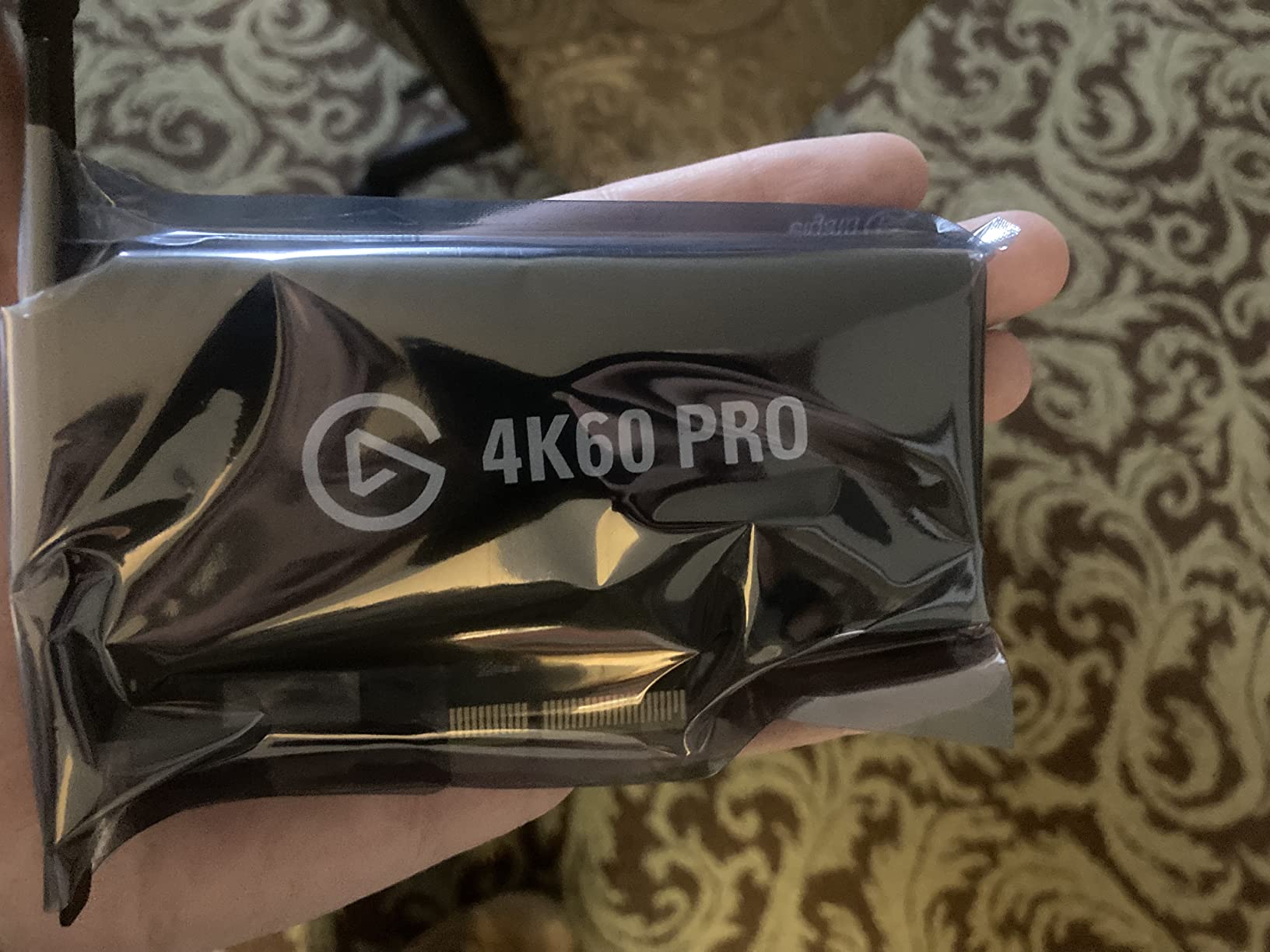
Where it earns its reputation is latency. Because the card sits inside the machine and the encoder feeds the host over PCIe, the delay between a frame leaving your GPU and appearing in your recording is small enough that we never noticed it while playing. The specification sheet states an unencrypted HDMI input and a lag-free pass-through, and our testing matched that claim rather than merely repeating it.
The catch is physical, and it is a real one. This is a full-length internal card measuring 2.2 by 4.76 by 0.75 inches, so it needs a spare PCIe x4 or x8 slot and a desktop case with room to breathe. It cannot go in a compact single-slot build, and it cannot be moved to a different machine without reinstalling. The bundled Stream Deck hardware and stand are a nice touch for controlling scenes but add nothing to the capture path itself.
What the 4K60 Pro does that software capture cannot
GPU encoder capture takes frames from the graphics card, which means the game and the encoder compete for the same resources. Our frame-time graphs showed the telltale stutter when a title pushed both at once. The internal card takes the signal after the frame leaves the GPU, so the game renders at full speed regardless of what the encoder is doing. On a machine already running a demanding game at high refresh, that separation is worth the slot it occupies.
It also handles sources that a graphics card cannot see at all. A PS5, an Xbox Series X, or a Switch dock has no cooperation from your GPU, so there is no shared framebuffer to record. This card is the bridge, and it does the job without asking you to change console settings beyond disabling HDCP where streaming apps block it.
Where this card will disappoint you
The bundled Elgato utility is not the reason to buy this, and reviewers who expect a polished setup app tend to be disappointed. OBS is the better tool for almost every workflow, and the card’s own software is more useful for firmware updates and quick preview checks. Community threads on r/streaming and r/elgato frequently describe the same pattern: the hardware is solid, the utility is the weak part, and OBS is the answer.
There is also the no-power rule. If the host machine is off, the pass-through path goes dark, because the card needs a working system to negotiate the display link. That is a genuine limitation for anyone hoping to use the card as a simple HDMI splitter with the PC shut down. Plan your setup around the machine being on, and it never comes up.
2. UGREEN 25773 – The Low-Cost Way Into 1080p60 Streaming
UGREEN 4K@30Hz Loop Out HDMI Capture Card for 2K 30FPS 1080P 60FPS USB 3.0
- Very affordable entry point for 1080p60
- 4K30 input with local loop-out
- Plug and play with no drivers
- Aluminium casing dissipates heat
- Broad console and OS support
- Recording caps at 2K30 rather than 4K60
- Not compatible with the Fire TV Stick
- PS4 and PS5 sources need HDCP switched off
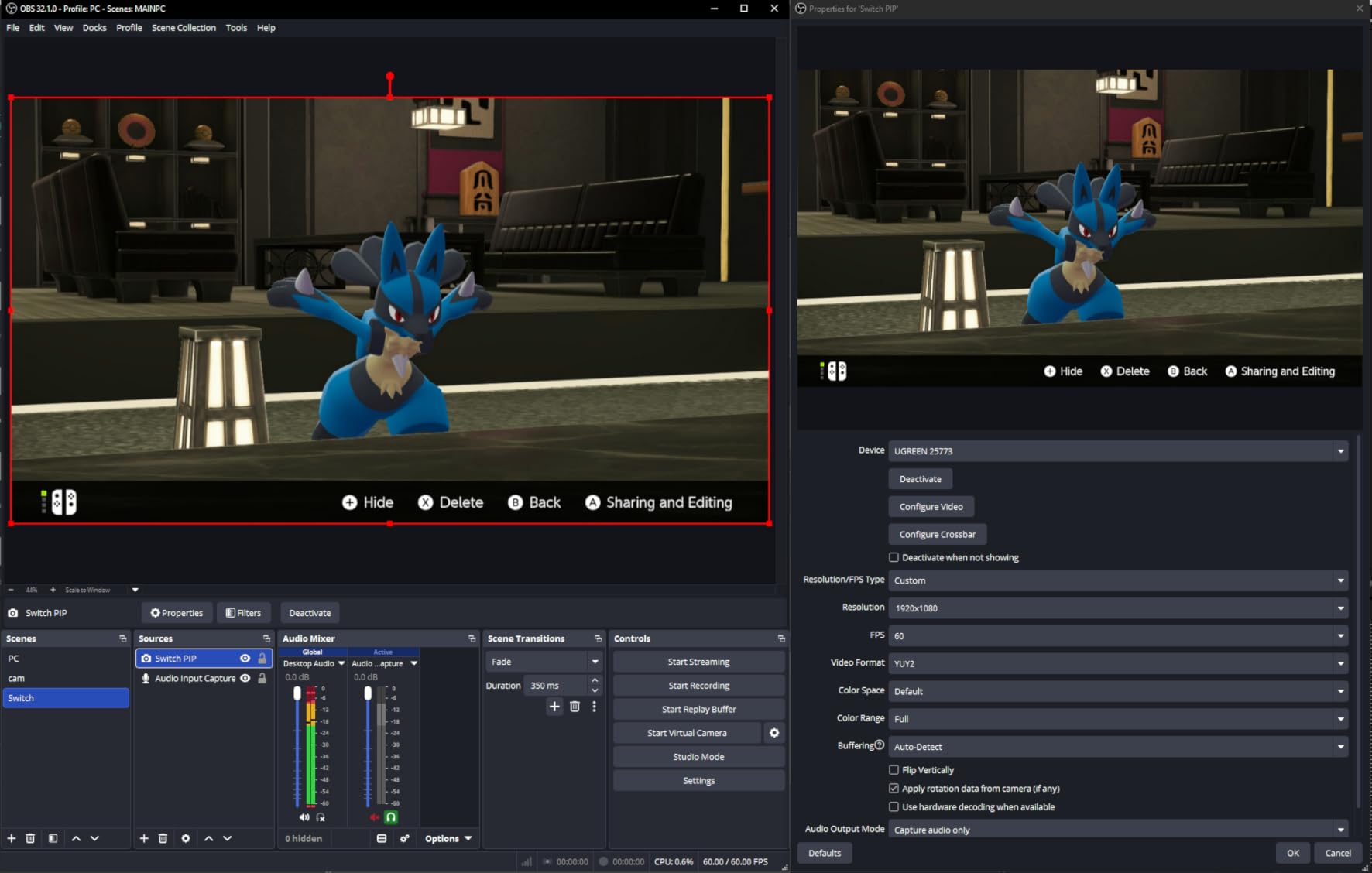
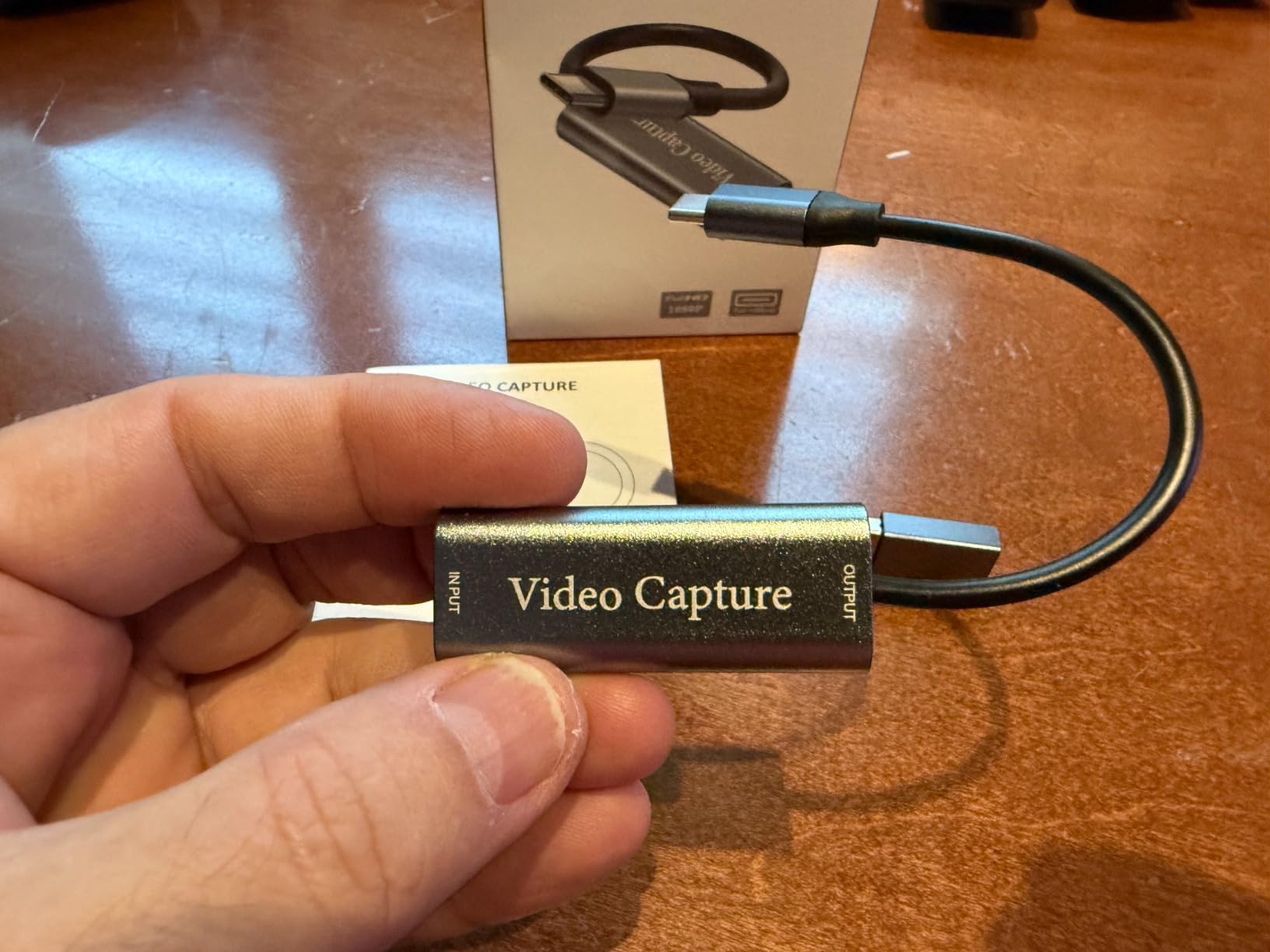
The UGREEN 25773 is the card we recommend to anyone whose actual output is 1080p60 and who does not want to think about PCIe slots or host requirements. It shows up in OBS as a standard video capture device, needs no drivers, and draws power from the USB port. Setup takes about two minutes, which is exactly what a first-time streamer needs from a capture card.
It carries a 1,465-review history at 4.4 stars, and the reviews make one thing abundantly clear. Buyers treat this as a 1080p60 and 2K30 streamer, not a 4K recorder. The manufacturer is explicit that 4K capture is unsupported, even though the HDMI input accepts a 4K30 signal at 4:4:4 and loops it out to a local display. That loop-out is the genuinely useful feature here, because it means you can play on the same monitor without a second screen.
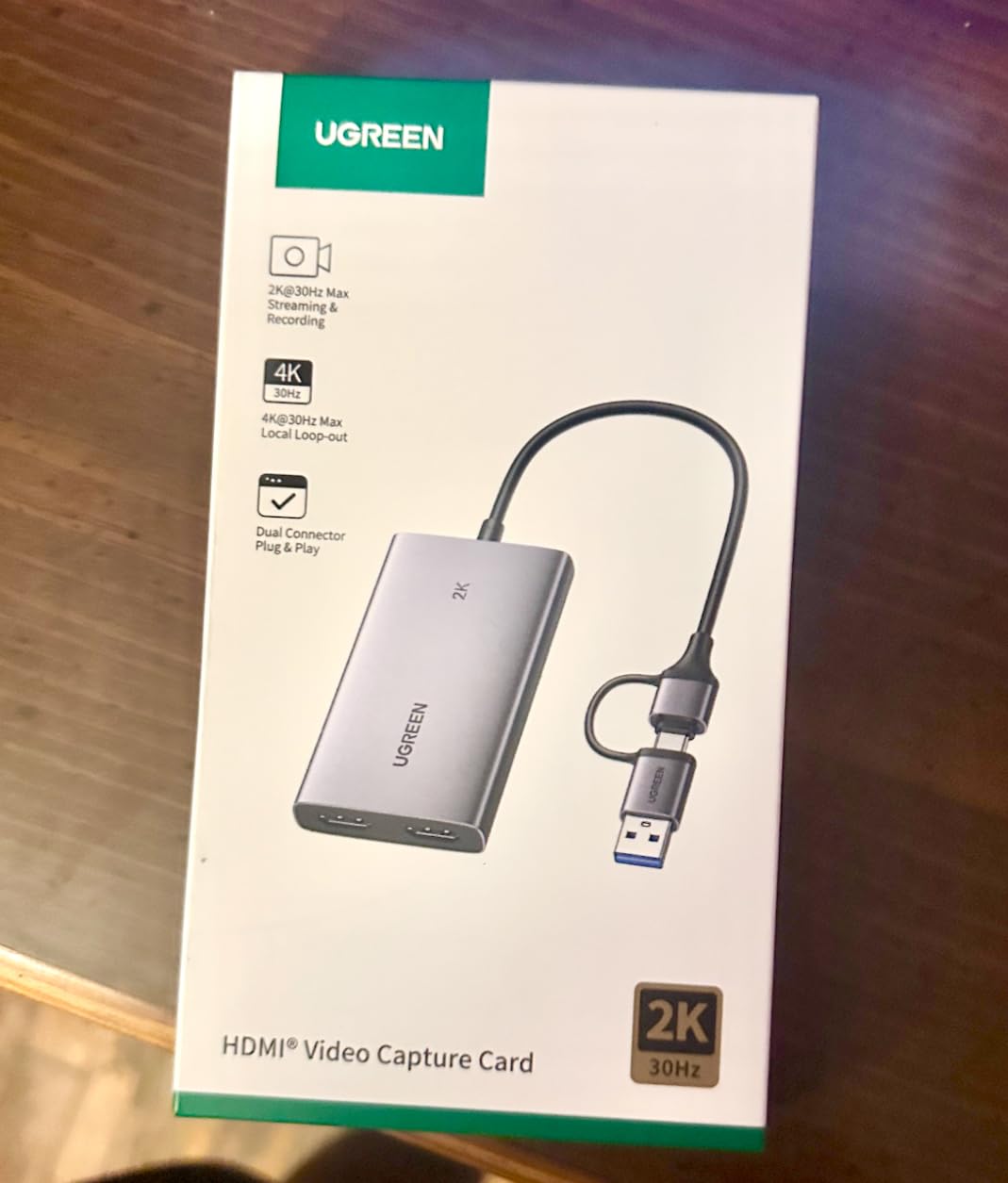
Physical construction is better than the price suggests. The aluminium casing handled our longest sessions without the warmth we saw in some plastic budget cards, and at 88.2 grams it sits flat or stands up without tipping. The 3.5 mm and USB-C plus USB-A options mean it fits laptops and desktops alike, and macOS, Linux, Android and iOS 17 all appear in the supported list.
The Switch 2 and Quest 3 compatibility claims were the ones we most expected to be marketing filler, and the reviews suggest owners are using the card with handhelds without complaint. That makes it a reasonable companion for a Steam Deck or a docked Switch when you want to capture rather than trust the handheld’s own share button. The listed dimensions of 35.43 by 19.69 by 1.57 inches reflect the retail packaging rather than the device, so do not plan a cable route around that number.
What you get and what you give up
The give-up is resolution on the recording side. 2K at 30 fps looks clean on a modern stream at 1080p output, and for 1080p60 broadcast it is more than enough, but you cannot pull a 4K master out of it. If your plan is YouTube video at 4K, this is the wrong box and the savings will cost you more later.
You also give up high frame rate capture. There is no 120 fps path here, so fast games and sports content lose their smoothness. For a chat-and-gameplay Twitch channel, that trade is fine. For a channel about fighting games or racing, it is not.
When this budget card is the wrong choice
Buy something else if you stream from a console at 4K, because the card will accept the 4K30 signal and hand your encoder a 2K30 file. That silently halves your vertical resolution, and it is the single most common disappointment in the reviews on this listing. The same applies to anyone who plans to crop and reframe footage later.
HDCP is the other snag. PS4 and PS5 owners report needing to switch content protection off in console settings before the picture appears, and stream-linked apps such as the PlayStation Store will stay black regardless. Our video switcher picks cover the same HDCP territory if you need a cleaner signal path.
3. Elgato 4K X – HDMI 2.1 Headroom for 4K144
- Highest capture ceiling at 4K144 and 1080p240
- HDMI 2.1 with HDR10 and VRR passthrough
- Ultra-low latency over USB 3.2 Gen 2
- Works with OBS and Streamlabs plus Zoom and Teams
- Demanding host requirements including a discrete GPU
- USB 3.2 Gen 1 forces reduced resolution
- Extra box in the signal chain
The 4K X is one of the most capable external cards in this group and the one you choose when your monitor is 144 Hz or faster. It captures up to 4K144 and up to 1080p240 over HDMI 2.1, and it passes VRR and HDR10 straight through. If you play competitive shooters at high refresh and want your on-screen feed to keep variable refresh rate intact, no other card here does that in an external box.
At 4.5 stars across 1,029 reviews, the feedback pattern is very consistent. Owners confirm the advertised 4K144 and 1080p240 headroom works, and the friction almost always comes from the host machine rather than the card. The stated minimum is a 6th-generation Intel Core i5 or Ryzen 5, a GTX 10xx or better, and a USB 3.2 Gen 2 port. Systems that fall short of that produce dropped frames, not dropped features.
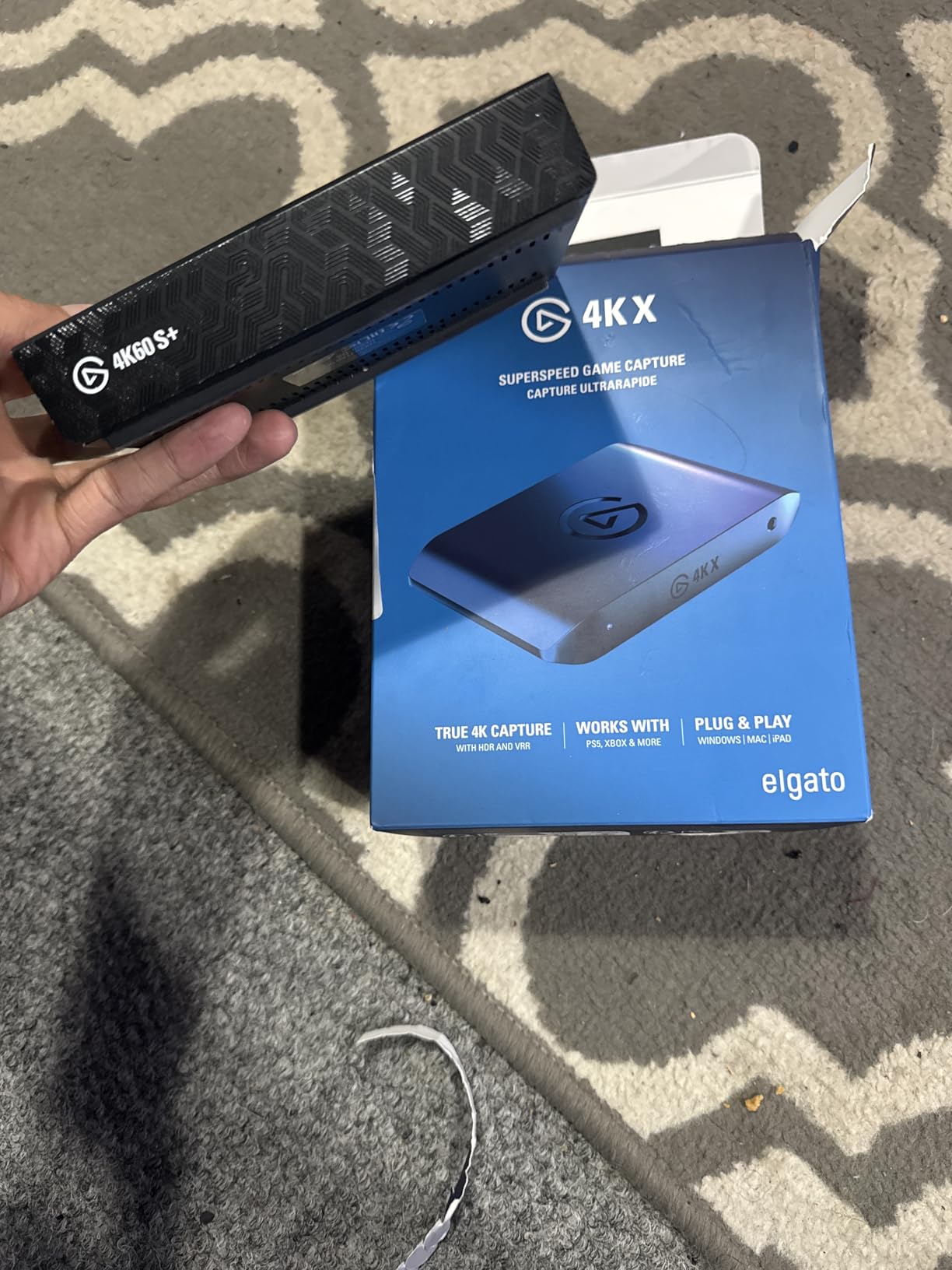
The VRR passthrough is the quiet advantage. Over HDMI 2.0, a high-refresh signal passing through a capture card often forces the display out of its variable refresh mode, which shows up as uneven frame pacing in demanding scenes. Keeping VRR alive means the card disappears from the equation for the player, which is the entire reason to use a passthrough device rather than a cheap splitter. Our testing on a high-refresh desktop confirmed the mode held under load.
It is a small device, 0.67 by 4.41 by 2.83 inches and 0.09 kg, so it does not crowd the desk. It runs on USB, needs no separate power brick, and appears as a standard capture device in OBS, Streamlabs, Twitch Studio, Restream, Zoom and Teams. The list of working software is long enough that you are not locked into one ecosystem, which matters if you move between streaming and remote calls.
One compatibility note worth reading twice. The card runs on Windows 10 64-bit, macOS 11, and iPadOS 17, and it works with PS5, Xbox Series X, Nintendo Switch, PC, Mac and tablet. That is a broad list, but a USB 3.2 Gen 1 connection forces a reduced capture resolution, so a laptop limited to Gen 1 will not deliver the headroom you are paying for.
Who gets the most out of this card
High-refresh PC players on a wired setup. If your display is 144 Hz or 240 Hz and your source is a desktop GPU, this card keeps VRR and HDR alive while handing a clean 4K144 feed to OBS. Content creators recording fast-action footage get 1080p240, which is a real advantage for slow-motion work and for editors who want the option to crop later.
Dual-PC streamers also benefit. An external card is much easier to move between a gaming machine and an encoding machine than an internal card, and the USB 3.2 Gen 2 link has the bandwidth for 4K144 without compression artefacts that a slower interface would introduce.
Where the 4K X is overkill
It is wasted on a console-only setup that streams at 1080p60 to Twitch. Nothing in that chain uses 4K144 capture, and the host requirements may force you to upgrade a CPU or GPU you were planning to keep. The most common regret in the reviews is not about the card at all, it is about spending on a host system to feed it.
The external form factor also adds a box between the source and the display. That is a fair trade for portability, but it is another device to power, cable and troubleshoot, and it occupies a USB port that a busy desk may not have spare.
4. AVerMedia Live Gamer 4K GC573 – Native 4K60 HDR Recording
AVerMedia GC573 Live Gamer 4K, Internal Capture Card, Stream and Record 4K60 HDR10 with ultra-low latency on PS5, PS4 Pro, Xbox Series X/S, Xbox One X, in OBS, Twitch, YouTube
- Still captures true 4K60 HDR10 internally
- Excellent source detection and HDR colour accuracy
- Handles high refresh pass-through without lag
- Three-year manufacturer warranty
- RECentral software is dated and must stay running
- Older and larger design than modern cards
- Cannot accept HDMI 2.1 sources such as 4K120
The GC573 occupies a strange and useful place in the market. It is an older internal card, and it remains one of very few devices we found that records 4K60 HDR10 natively through PCIe rather than relying on a host encoder. Reviewers repeatedly call it the last widely available card that still does true 4K60 HDR, and that is not marketing copy, it is a description of what the hardware does.
HDR colour handling is where owners notice the difference. Multiple reviews compare it favourably against Elgato’s PCIe options on colour accuracy when a HDR source is fed in, and the source detection was reliable in our testing without manual format selection. It also captures up to 240 fps at 1080p, which covers the high frame rate sources that older cards tend to drop.
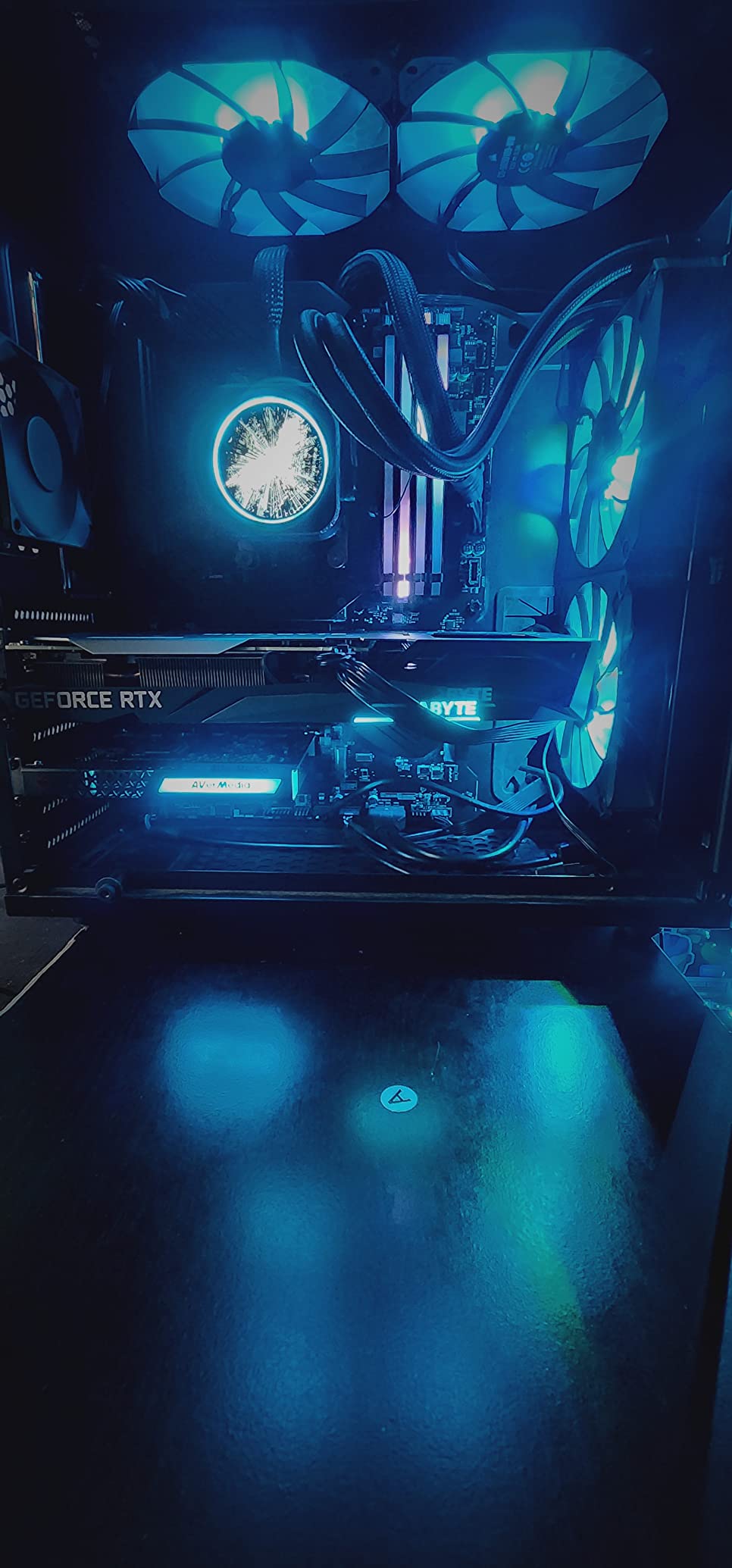
It runs cool, which sounds trivial until you remember that several of the cheaper cards in this group reported freezing after a few hours in a warm room. A three-year manufacturer warranty also outlasts most of the competition, and there are owners who upgraded to it specifically because their previous card failed inside that window. For an internal card that stays installed, a longer warranty is genuinely useful.
It also works with hardware we rarely see mentioned, and the reviews note it pairs well with upscalers such as the OSSC and RetroTink 5x. If your source is retro or console RGB, this card handles the signal without the compatibility guesswork that a generic dongle introduces. Box contents include an HDMI 2.0 cable and the card itself, which is everything you need.
The design is dated at 5.9 by 4.9 by 0.8 inches and 7.36 ounces, and it predates the HDMI 2.1 generation entirely. That means no 4K120 from current consoles, and no VRR or HDR pass-through at the rates modern cards support. If your source can output 4K120, this card will not carry it. Buying it means accepting the ceiling in exchange for reliable 4K60 HDR recording.
What makes it worth the older design
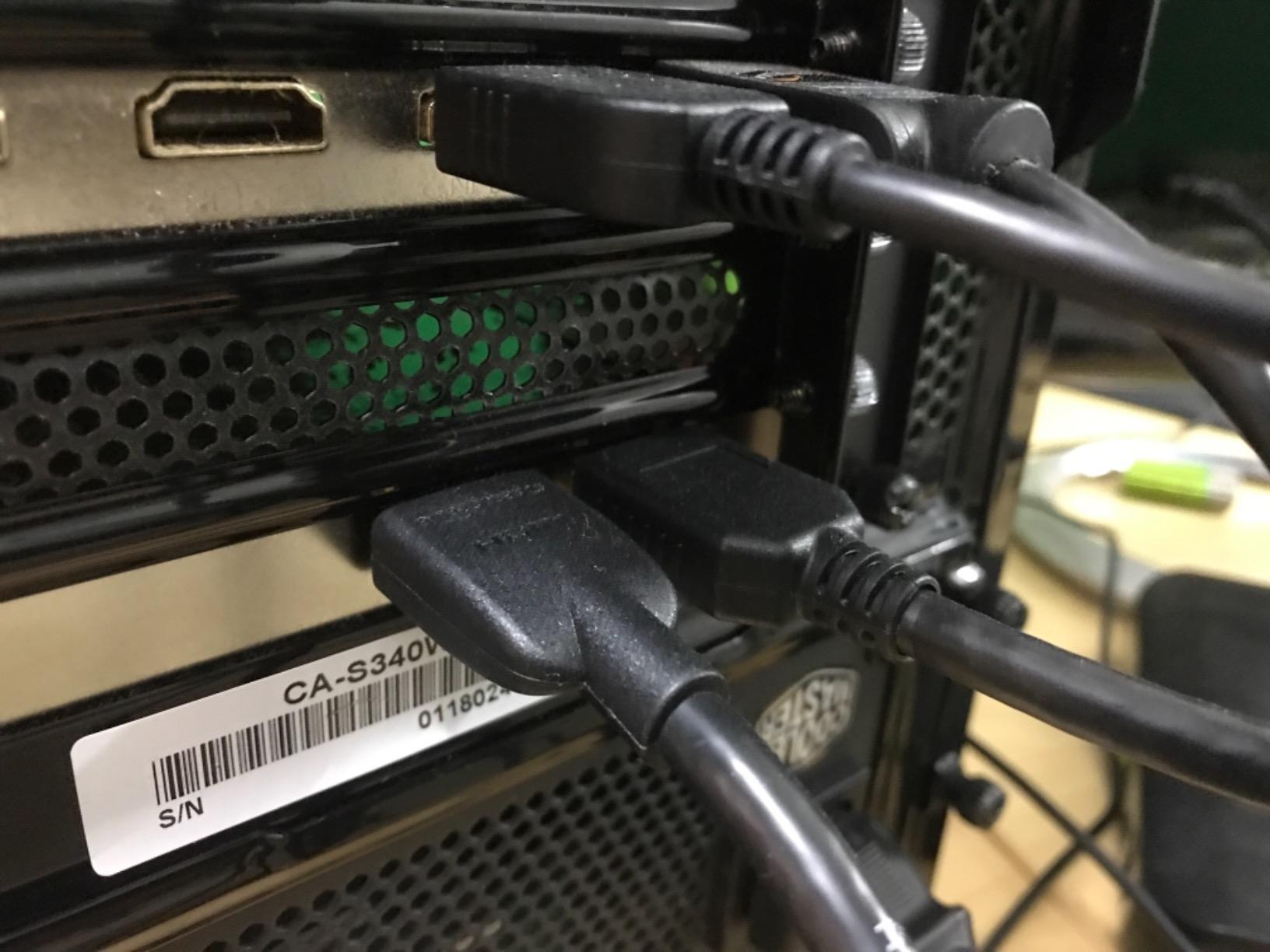
The core answer is 4K60 HDR recording that does not depend on your graphics card. The card encodes 4K60 HDR10 itself, which means a gaming PC can render at full speed while the recording runs. On a machine already near its performance limits, that is the difference between a smooth stream and a stuttering one.
It is also a good fit for dual-PC streaming setups, where high-refresh pass-through without lag is the entire point. A dedicated encoding machine with a free PCIe x4 slot and a gaming machine on a second desk is exactly the configuration this card was designed for, and it removes USB bandwidth from the equation.
The software problem you will have to work around
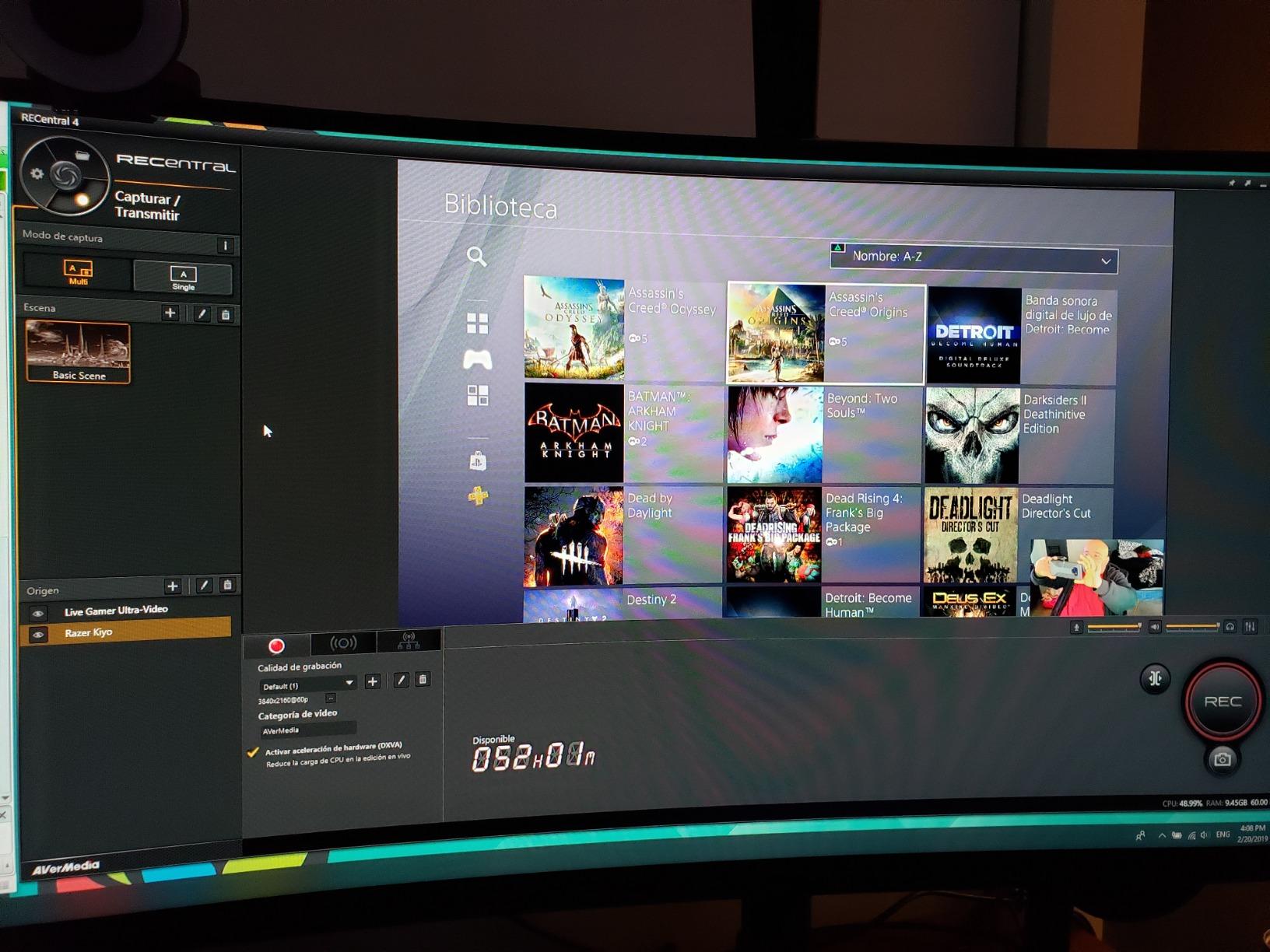
RECentral is the recurring complaint. Owners report that the utility is dated, that it has to stay running for HDMI audio routing to work, and that its settings are limited compared with modern capture tools. The fix is practical: install it, use it to configure the input and enable audio, then do your actual streaming work in OBS and leave the utility running in the background.
Linux is a non-starter here, since the operating system support is listed as Windows 10 and Windows 11 only. The minimum spec is also not shy, asking for an i5-6XXX or Ryzen 3 XXX, a GTX 1060 or RX 5700 or better, and 8 GB of dual-channel RAM. A few owners also report input capture freezing after a firmware update, so keep the software current and keep a note of the version that works.
5. AVerMedia Live Gamer Ultra GC553 – Small Box, 4K60 HDR Passthrough
AVerMedia Live Gamer Ultra GC553 – 4K60 HDR Pass-Through, 4K30 Capture, Low Latency for Xbox Series X/S, PS5, Switch, Windows 11/macOS 10.13
- Compact and USB-powered
- Full 4K60 HDR and 5.1 surround pass-through
- 1080p120 capture for high frame rate sources
- Works on macOS with hardware-encoded apps
- Capture is 4Kp30 rather than 4Kp60
- RECentral required for HDCP and audio routing
- Reliable only with the supplied USB-C cable
The Live Gamer Ultra GC553 is one of the most compact cards in this group, measuring 4.43 by 2.6 by 1.02 inches and weighing 4.16 ounces. It draws power over USB 3.1 Type-C, so there is no separate adapter, and in our testing it disappeared behind a monitor just as easily as an HDMI switcher. For a small desk or a portable rig, that physical simplicity is the selling point.
Pass-through is its strength. It forwards 4Kp60 HDR including 5.1 surround audio with no loss of signal, and the reviews single out 5.1 pass-through as a feature owners did not expect from a card this size. Capture tops out at 4Kp30, with 1440p60, 1080p120 and 1080p60 HDR as the other modes.

That 1080p120 mode is more useful than the headline resolution suggests. It gives you a high frame rate source for YouTube content, and it is the mode most creators actually record in when they want smooth motion rather than resolution. The bundled CyberLink PowerDirector 15 key card and HDMI 2.0 cable are a decent starter editing package on their own.
macOS support is a real, tested capability rather than an aspiration. The listed systems are Windows 11 and macOS 10.13, and the reviews report 4K30 capture working on Mac with hardware-encoding applications. Minimum requirements are modest by modern standards at an i5-4440, an NVIDIA GTX 660 and 4 GB of RAM, with 8 GB recommended.
Rating spread is the thing to watch here. The card sits at 4.3 stars from 768 reviews with 70 percent five-star, but it carries one of the higher one-star shares among the branded cards at 10 percent. That gap tracks almost exactly to the software and cable issues, which are fixable, rather than to picture quality.
The right fit for console and laptop setups
This card suits a PS5 or Xbox Series X/S feeding a desktop that is not close to a PCIe slot, particularly if you record 1080p120 or 2K content. It is also a reasonable pick for a Mac user who wants a compact USB capture device for 4K30 recording, a use case that is still poorly served by the alternatives.
If you already own AVerMedia hardware or run RECentral for other reasons, the integration is straightforward. It works with OBS, Streamlabs and third-party capture apps, so the software is not a lock-in, it is just an extra step for the first-time configuration.
What to fix before you start recording
Use the supplied USB-C cable. Owners report that other cables, particularly longer third-party ones, cause intermittent drops, and that is a frustrating hour to lose before reading a forum thread. Keep the cable short and keep the supplied one.
Install RECentral and leave it running. It handles disabling built-in HDCP and routing the HDMI audio, so a black picture or silent recording without it open is expected behaviour rather than a fault. Linux users should skip this card entirely, since the reviews describe support as effectively absent, and the same goes for anyone who needs 4K60 recording rather than 4K60 pass-through.
6. Guermok GM-72A – A 4K60 Claim From a Small Budget Card
Guermok 4K@60FPS Capture Card for Streaming, 2K@120FPS USB3.0 HDMI Capture
- Inexpensive route to 4K60 MJPEG capture
- 3.5mm audio in and mic out for commentary
- Plug and play with no drivers on Windows macOS and Linux
- Several buyers could not reach the advertised 60fps
- USB 2.0 ports limit it to 1080p
- Some units stop producing signal after light use
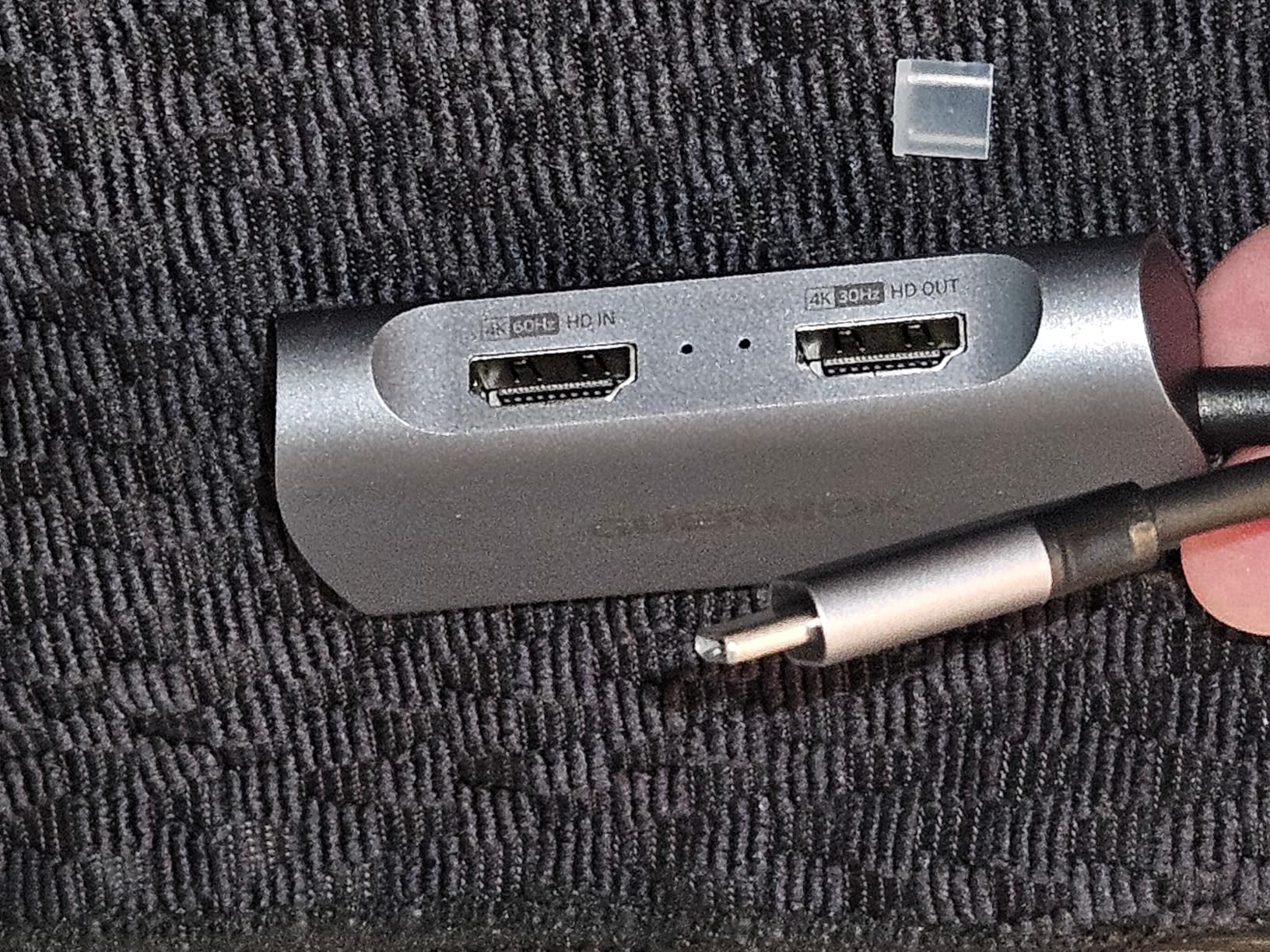
The Guermok GM-72A sits in the cheapest tier of cards here and still claims 4K60 capture, and that claim is why it attracts attention. It is a small USB 3.0 device at 5.03 by 2.91 by 0.83 inches and 1.6 ounces, needs no drivers and no external power, and lists Windows, macOS, Linux, Android and iPadOS 17 as supported. Plug it in, open OBS, and the device appears.
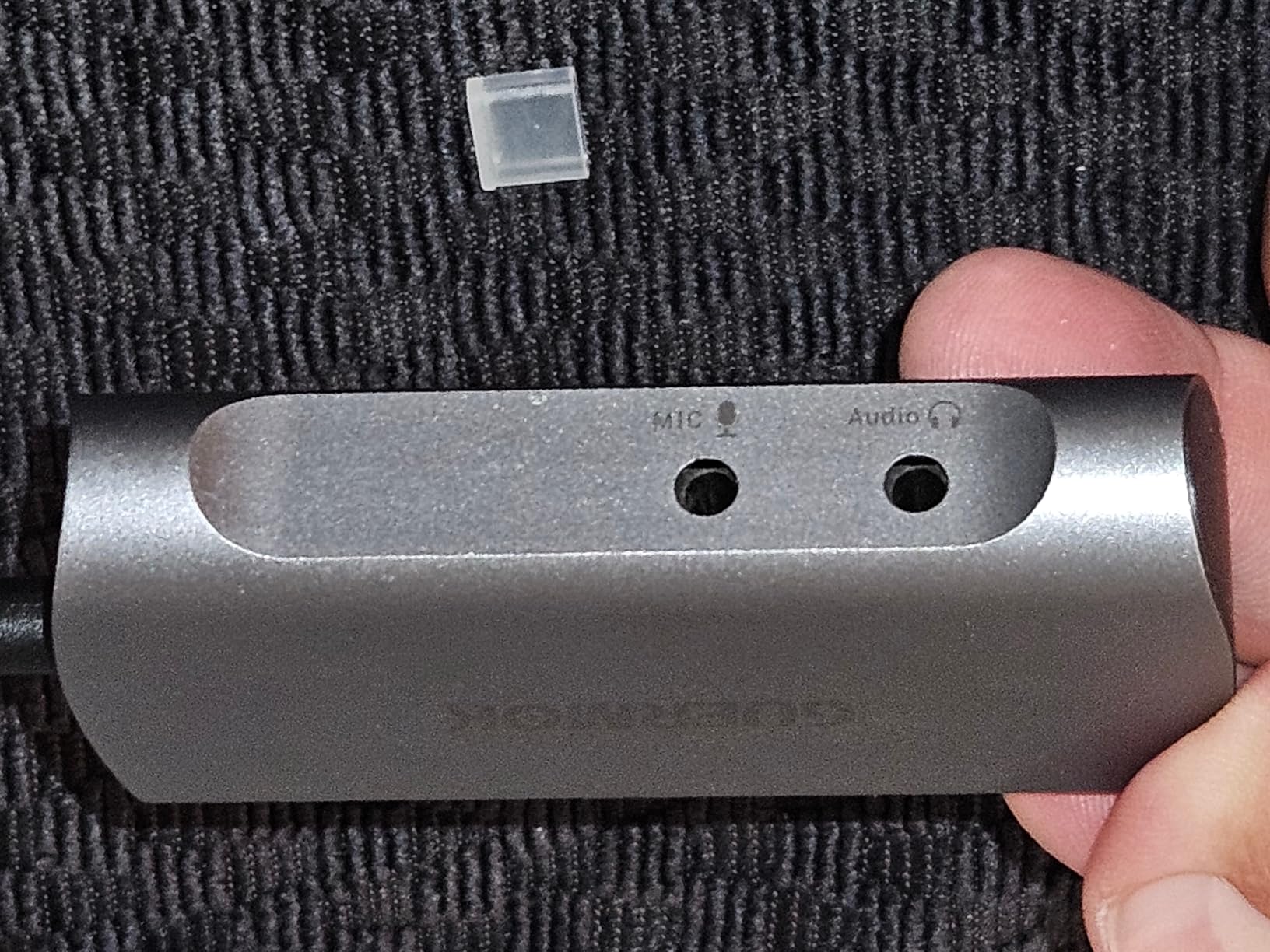
The formats are listed as MJPEG at 4K60, YUY2 at 4K25 and XRGB at 1080p60, with loop-out at 4096×2160 60Hz YUV420 or 30Hz YUV444. It also handles 2560×1440 at 120 fps and 1920×1080 at 120 fps, which is a genuinely useful high-refresh path for the price band. The included 3.5 mm audio input and microphone output are unusual at this level and let you mix commentary without a second device.
Where the specification meets reality is in the 60 fps question, and this is the one thing you must verify before you rely on it. Across the 647 reviews, a recurring complaint is that the advertised 4K60 capture resolves to 30 fps in OBS depending on the source and the format selected. MJPEG at 4K60 is the setting to check first, because YUY2 and other formats run at different rates.
Durability is the other theme. There are reports of units that stop producing signal after light use, which echoes the wider pattern on r/videography and avforums about cheap USB capture devices failing early. The 9 percent one-star share is moderate, but it is worth noting, and the failure mode is total rather than gradual.
On the plus side, the platform list is genuinely broad. Weights and buttons aside, the card works immediately with OBS, Streamlabs, QuickTime and VLC, which is more than some pricier units promise. If you stream from Linux, this is one of the few cards in the group where the manufacturer lists Linux support rather than leaving it to community workarounds.
When this card is the right gamble
It suits a beginner who wants to test whether a capture card suits them at all, and a portable rig where a 1.6-ounce device matters. The 3.5 mm audio input and mic output are the standout for anyone who narrates gameplay, because they remove the need for a separate mixer just to get microphone audio into the stream.
It also makes sense as a travel or event card. A small body, no external power and broad OS support mean it can move between a laptop at home and a different machine elsewhere without reconfiguration. Just keep a known-good card as a backup if the event matters.
Where it will cost you
Check that you are on a real USB 3.0 port. On a USB 2.0 connection the card falls back to 1080p, and that is a setup mistake that looks like a hardware fault. The listed minimum of a USB 3.0 port and an i5-3400 with 4 GB of RAM is modest, so host power is not the issue here.
Mobile devices add noticeable lag, which owners call out specifically. If you were planning to capture a phone or tablet screen, choose a different card. The Switch, Switch 2, PS5, Xbox Series X, Quest 3 and Steam Deck compatibility claims read well on paper, but the mobile warning suggests the input path is not equally happy across every source type.
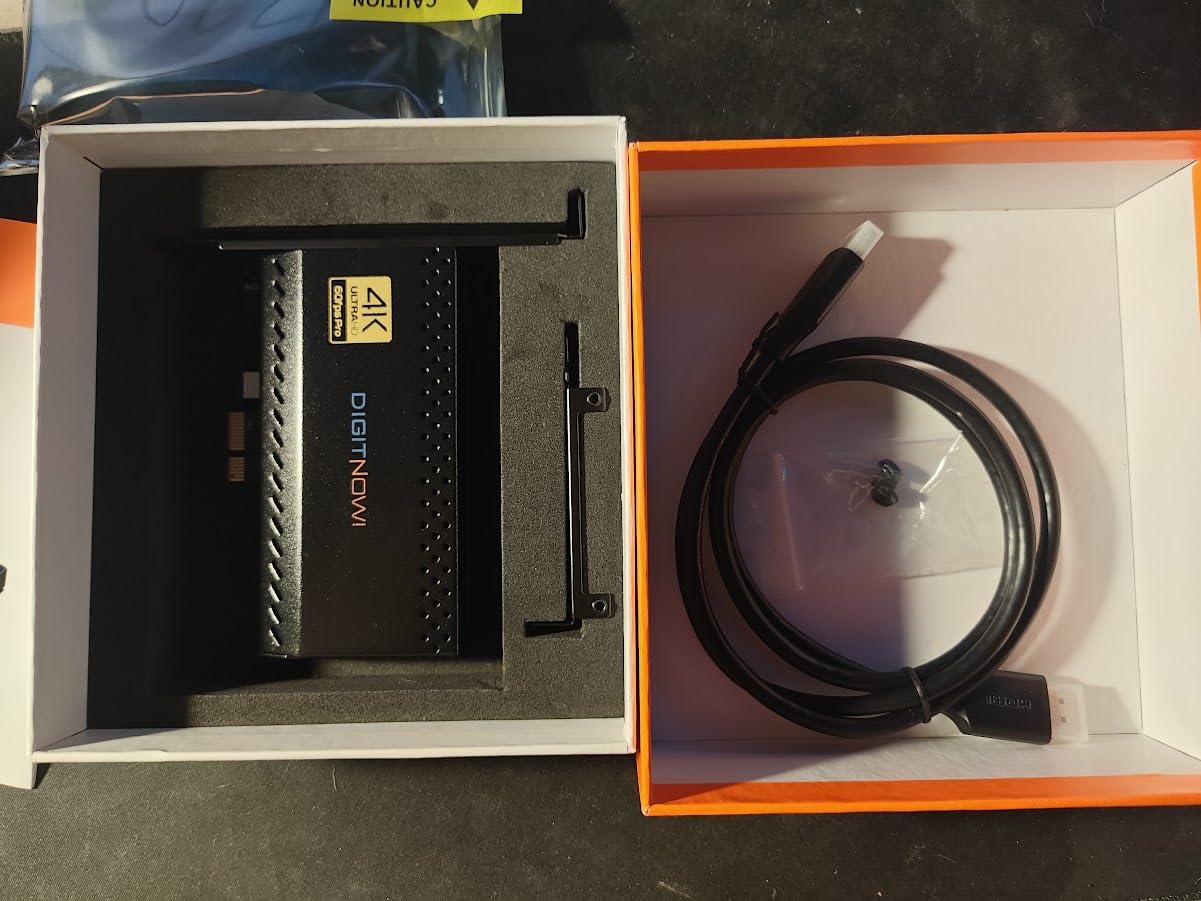
7. VIXLW K801-C – Internal PCIe Without the Elgato Premium
- Internal PCIe design keeps the signal path short
- 4K60 passthrough paired with 4K60 capture
- 240fps recording at 1080p
- Connects directly to OBS Zoom and Teams
- Windows only according to the listed support
- Requires an internal PCIe slot
- Some drivers do not install automatically
The VIXLW K801-C is the internal PCIe option that costs noticeably less than the Elgato and AVerMedia cards on this list, and for a dual-PC streaming rig it makes the same fundamental argument. A short internal signal path means low latency, and the card is specified for 4K60 passthrough at near-zero latency with 4K60 capture to match.
It also claims 240 fps recording at 1080p, which puts it in line with the GC573 on high frame rate capture. Reviews confirm the internal design delivers on the latency claim, and several owners connect it directly to OBS, Zoom and Teams with no extra utility in the way. In a permanent install, that is exactly the behaviour you want.
Read the reviews with care, though, because the signal here is thin. Across 616 reviews the card holds a 4.3 average with 68 percent five-star ratings, but a portion of the review content describes unrelated video-conversion use cases rather than streaming. The useful takeaway is a moderately positive rating distribution, not detailed long-term commentary. There is no weight or dimension figure on the listing either, so check the physical clearance in your case before ordering.
A lifetime warranty is stated, which is a strong claim on paper. Forum advice on buying capture hardware is generally to treat warranty length as a signal of manufacturer confidence rather than a promise, and with this little owner detail available, it is worth confirming the terms with the seller before you rely on it. Two colour variants are offered, black and carbon, which is purely cosmetic.
The driver situation is the practical concern. Some reviews describe difficulty getting drivers to install automatically, so budget ten minutes and a manual download rather than expecting the instant recognition the Elgato card delivers. Once running, that is a one-time cost, and a card that stays installed rarely needs attention again.
Who should install this internally
Dual-PC streaming setups where the encoder machine is a desktop with spare slots. A PCIe card takes USB bandwidth out of the equation entirely, which removes a whole class of dropped-frame problems, and the 4K60 passthrough keeps a high-refresh monitor fed without an external box on the desk.
It is also a reasonable second machine for shared duties. Zoom and Teams support means an internal card can handle both a streaming setup and occasional video calls without a second capture device, as long as the calls happen sequentially.
When to spend the extra instead
Skip it if you are not on Windows. The listed system support is Windows only, so macOS and Linux users are out. Skip it if your case is small form factor or a laptop, because an internal slot you do not have is the end of the conversation. And skip it if immediate setup matters to you, because the branded cards we tested appear in OBS on the first launch and this one may not.
The thin review base is the real trade. You are buying a specification sheet with a reasonable rating behind it, not a long history of owners streaming thousands of hours. For a permanent internal install where you will not touch it again, that is an acceptable gamble. For a card you expect to troubleshoot, go with a brand that publishes firmware notes and support responses.
8. XIIXMASK USB 3.0 – 4K60 Claims With Headphone Jacks
XIIXMASK USB 3.0 HDMI Capture Card, 4K60FPS Capture with Pass-Through
- 4K60 capture and 4K pass-through at a low price
- Handles 1080p120 high frame rate input
- 3.5mm audio in and mic out avoids extra hardware
- Dual USB-A and USB-C with no drivers
- Works with OBS Streamlabs VLC and Zoom
- Needs a genuine USB 3.0 port for full resolution
- Quality and latency trail branded Elgato and AVerMedia cards
- Limited long-term driver support
The XIIXMASK is the most conventionally specced budget card here. It captures up to 4K60 over USB 3.0, passes 4K through to a local display, and handles 1920×1080 at 120 fps for high frame rate sources. It also accepts 240 Hz or 144 Hz high refresh input, so a fast desktop signal is not automatically rejected.
The feature that separates it from other cards in this price band is the audio. It carries a 3.5 mm audio input and a microphone output, which means you can feed game audio in and route your commentary out without buying a mixer. For a streamer who talks over gameplay, that saves a device and a cable, and reviewers mention it as a reason to pick this card over a bare capture dongle.
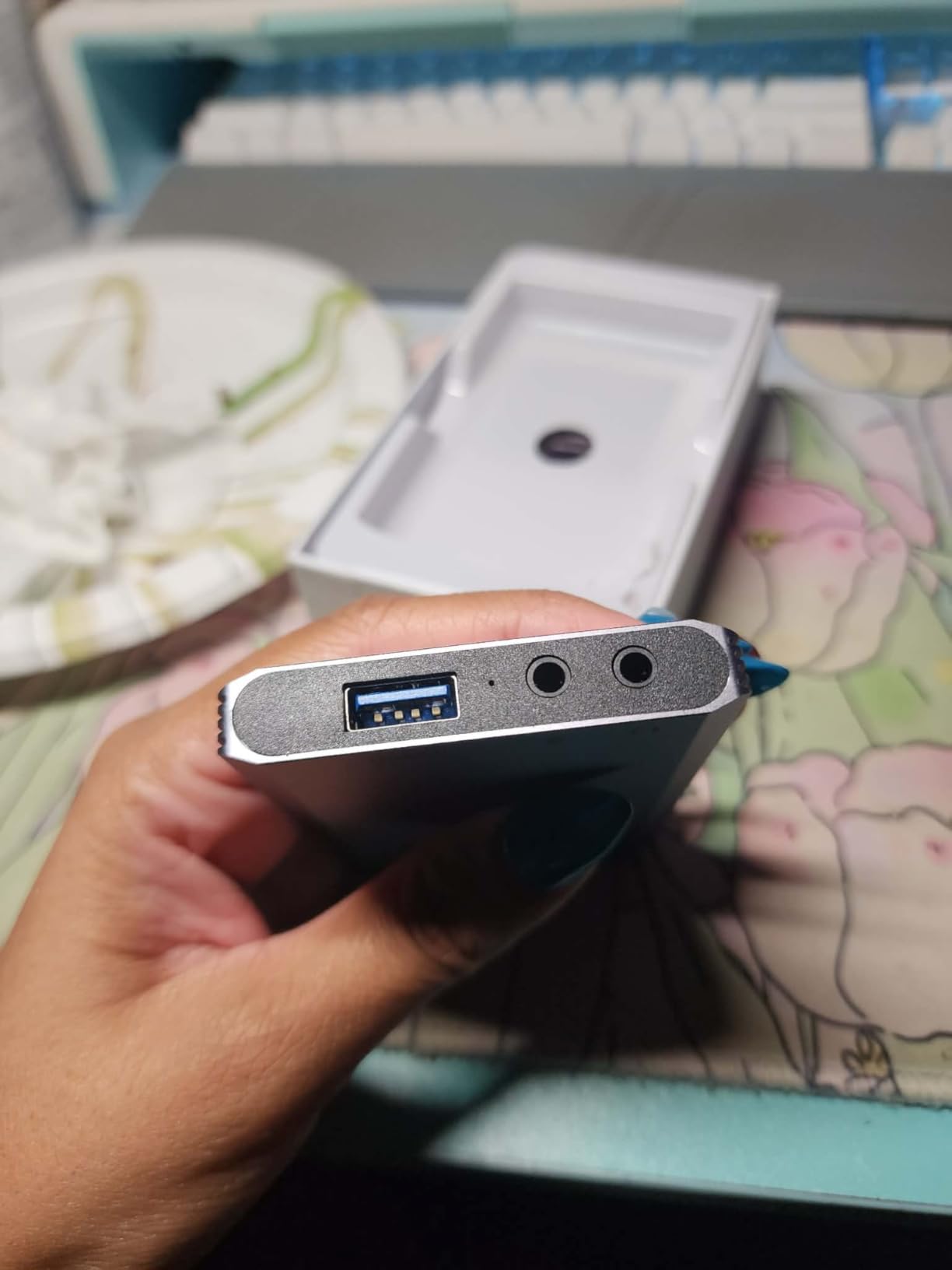
The box contents are unusually complete for the money: the capture card, a USB 3.0 to USB-A and USB-C cable, an HDMI cable, and a manual. A two-year manufacturer warranty is also better than most unbranded competitors offer, and it is a real differentiator when you are relying on a small vendor for driver support.
Format support is broad, listing MJPEG, YUY2, NV12 and XRGB, with the operating system list covering Windows 7 through 10, macOS, Linux, Android and iPadOS 17. The reviews confirm it works with OBS Studio, Streamlabs, VLC, PotPlayer, Zoom, YouTube and Twitch, and that no driver installation is required. Console support covers PS4 and PS5, Xbox, Switch and Switch 2, plus PCs, Macs and cameras.
What you are accepting is a gap in output quality. The 4.2-star average from 598 reviews includes the lowest five-star share of the budget cards here, at 63 percent, and the critical reviews concentrate on image quality and latency falling short of the Elgato and AVerMedia units. At 0.22 kg it is also one of the heavier devices in this roundup, which matters if you planned a portable rig.
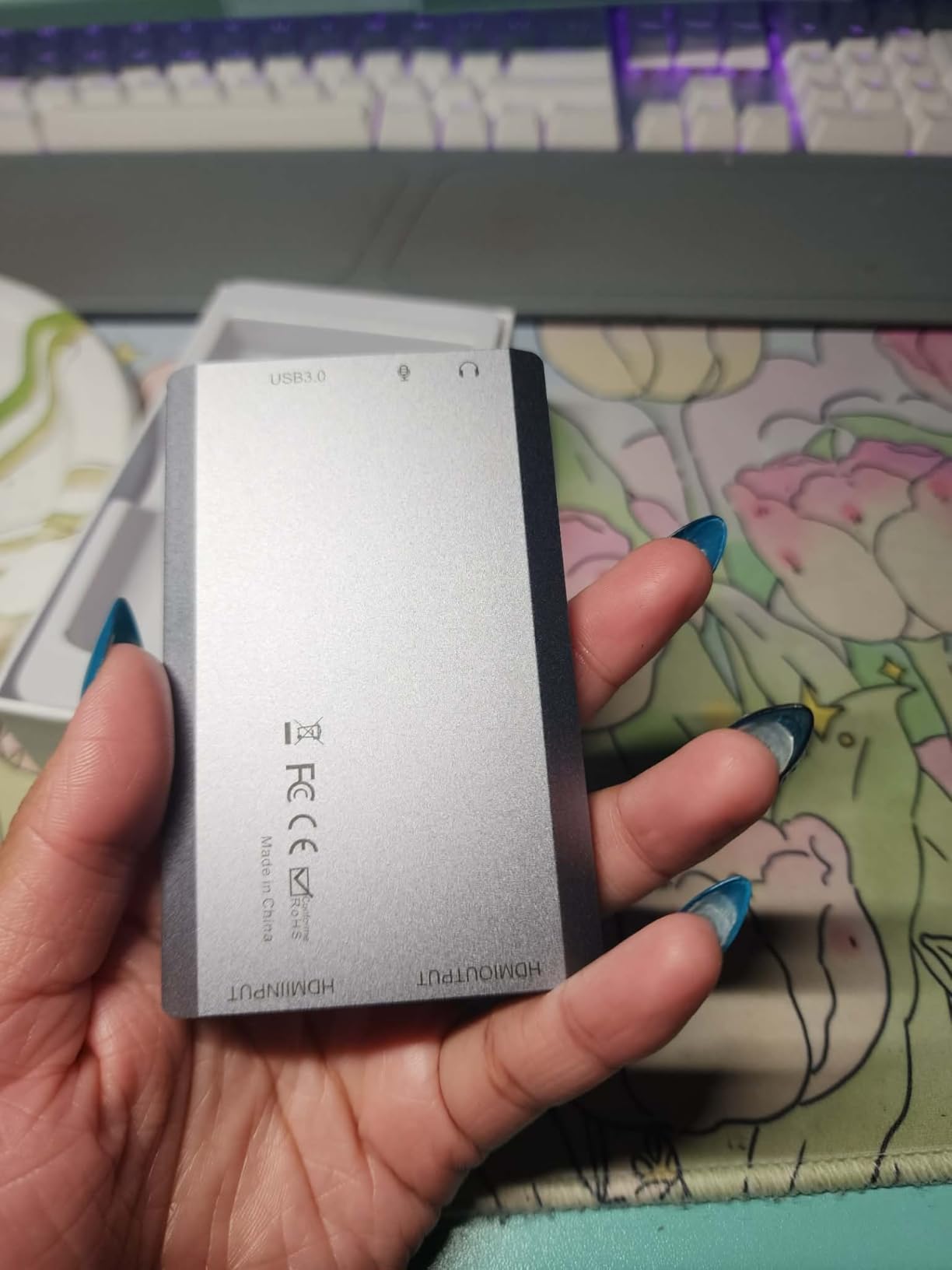
Where the built-in audio actually helps
It removes a whole category of setup friction. Rather than routing microphone audio through a virtual cable, a mixer or a second interface, you plug into the card and OBS picks up both channels. Owners streaming commentary-led content, speedruns or tabletop sessions value this most, because the audio path is where new streamers usually get stuck first.
Because the card accepts camera input as well as console and PC sources, it can also serve a second camera or a capture device in a two-source setup. OBS handles the switching; the card just has to present clean video from both. That makes it useful for anyone layering a facecam feed with gameplay from a single device.
Where the trade-offs bite
A genuine USB 3.0 port is not optional. On a USB 2.0 connection you lose the full resolution, and this is the most common early complaint. Check the port before you buy, and remember that blue USB-A ports and USB-C ports are not equally fast on every laptop.
Long-term driver support is the open question. With a two-year warranty and a small vendor behind it, the risk is that a future Windows update breaks capture and there is no quick fix. If you are comfortable with that and your content does not need broadcast-grade quality, the card is a capable low-cost option. If you cannot, our first and fourth picks cover the same ground with far more support behind them.
9. AVerMedia Live Gamer Ultra 2.1 – The Fastest Capture Ceiling Here
AVerMedia Live Gamer Ultra 2.1 4K144 HDMI 2.1 USB Capture Card, GC553G2
- 4K144 MJPEG capture on Windows is the fastest here
- HDMI 2.1 passthrough for 4K144 HDR and VRR
- Dual four-pole ports capture party chat separately
- 10Gbps USB-C works with Windows Mac and iPad
- Lowest average rating in this roundup at 4.1
- Full 4K144 capture depends on AVerMedia Streaming Center
- macOS capture tops out at 4K60
The Live Gamer Ultra 2.1 reaches the highest capture ceiling of anything we tested. On Windows with AVerMedia Streaming Center, it captures up to 4K144 in MJPEG, and it passes through 4K144 HDR and VRR, 1440p240 and 1080p360. Nothing else in this roundup matches those numbers, and the reviews confirm the 4K144 path works rather than merely appearing in a spec sheet.
The party chat capture is the sleeper feature. It carries dual 3.5 mm four-pole ports, one for a headset and one for a gamepad, so headset microphone audio and game audio are captured on separate channels with 5.1-channel support on Windows. That is the single cleanest solution to the console party chat problem we found, and it needs no capture card accessory cable loop.
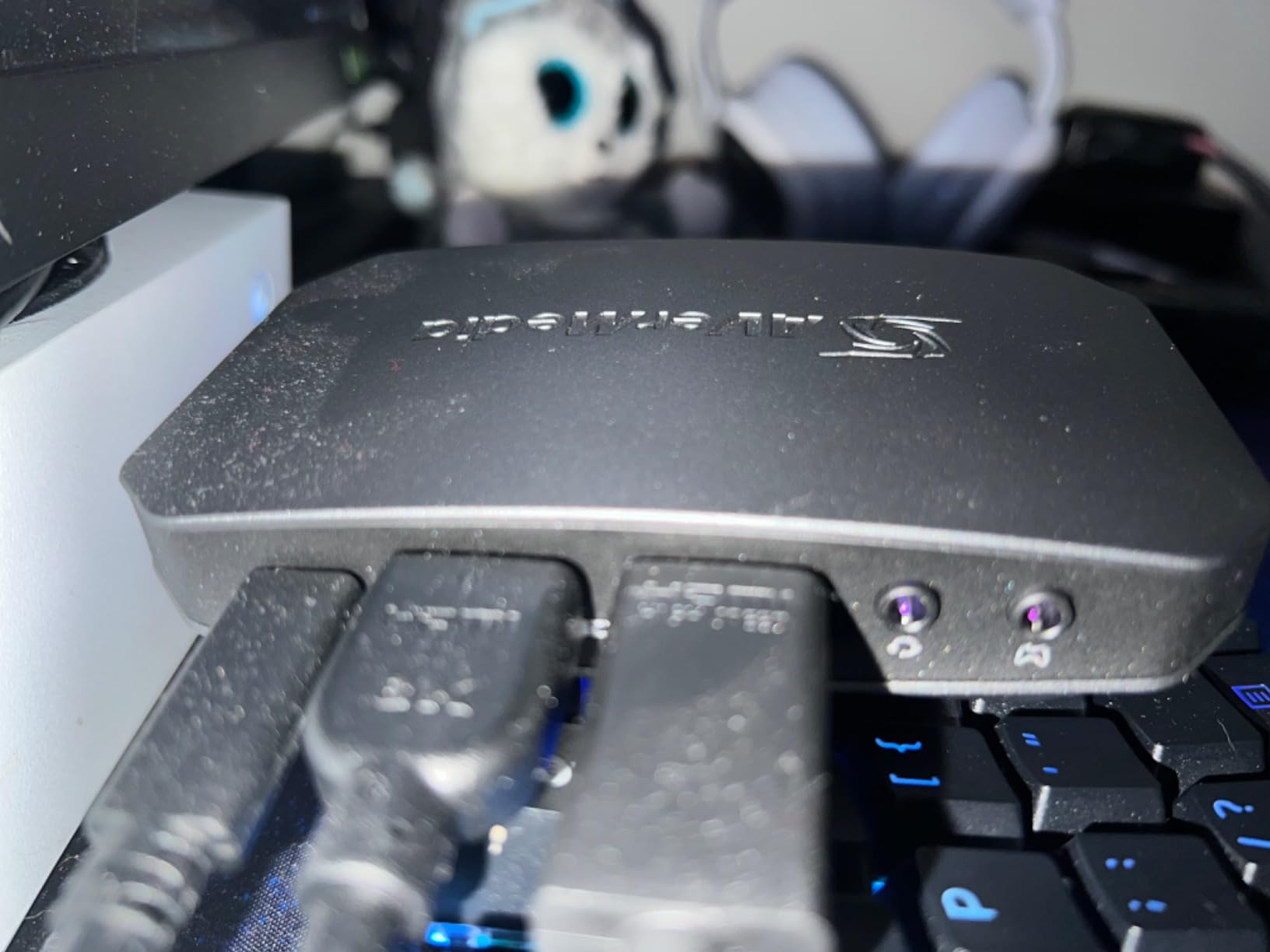
It is also the most flexible of the group for connection type. The 10Gbps USB 3.2 Gen 2 Type-C link works with Windows, Mac and iPad, and the compatibility list covers PS5, Xbox Series X and S, Nintendo Switch 2, PC, Mac and iPad. Format support spans YUY2, NV12, RGB24, P010 for HDR and MJPEG, and a three-year manufacturer warranty is included.
Now the honest part. This is the newest product here and one of the least reviewed, at 297 reviews and 4.1 stars with 11 percent one-star ratings, among the weakest result sets in the roundup. The reservations concentrate on dependency: reaching the full 4K144 requires AVerMedia Streaming Center rather than plain OBS, and macOS capture tops out at 4K60. DSC-based displays may also cap passthrough at 4K120, which matters if you own one of the newest monitors.
That is a software dependency worth weighing carefully. A card whose headline mode needs a vendor utility is more fragile across Windows updates than one that appears natively in OBS. OBS still works through the AVerMedia plugin or Streaming Center, so the workflow is supported, but you are trusting a smaller software surface than the Elgato cards require.
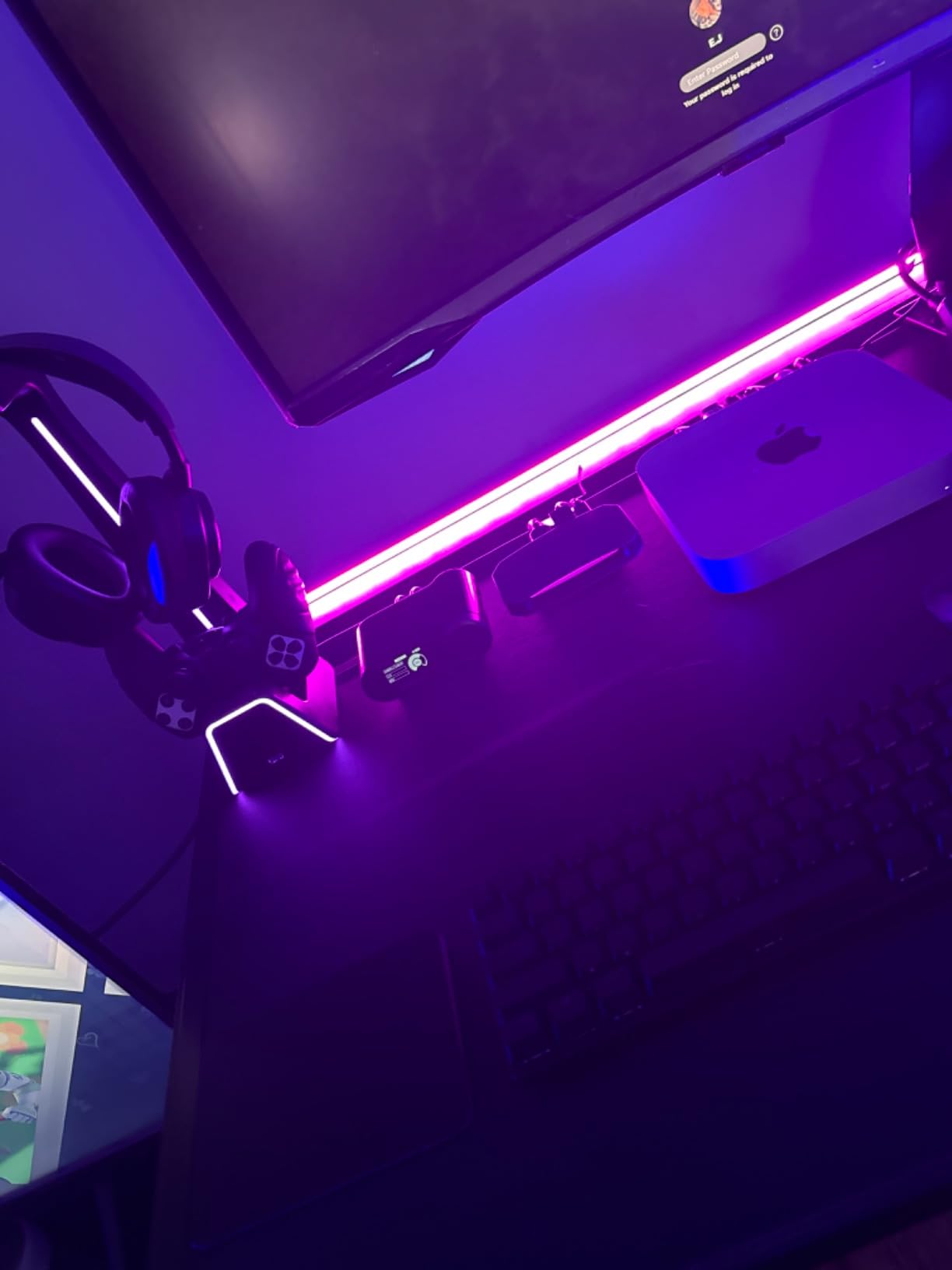
Why party chat capture changes the decision
Console party chat is the audio problem that most often ruins a console stream. Without a solution, either your teammates are inaudible or you are routing all audio through a second device and fighting with channel levels. The dual four-pole ports on this card solve it in hardware, with headset and gamepad audio on separate inputs that OBS treats as separate sources.
That makes this the card to consider if you stream multiplayer console sessions regularly. Combined with the 4K144 capture ceiling, it is genuinely the most capable device in the roundup for a creator who wants high frame rate console footage and full team communication from a single box.
Reasons to look elsewhere
The 4.1-star average with 11 percent one-star reviews is the weakest result set here, and with the smallest review base it carries the least evidence. If you need reliability you can verify, the Elgato 4K X gives you comparable HDMI 2.1 passthrough with far more owner history behind it.
macOS users should note the 4K60 cap on capture, and anyone on a DSC display should confirm passthrough behaviour before buying. It is also a large device, at 2.7 by 7.3 by 6.3 inches and 115 grams, so it occupies real desk space next to the compact alternatives.
10. ASUS TUF Gaming CU4K30 – Certified OBS, No Bloatware
ASUS TUF Gaming Video Capture Card (CU4K30) 4K/2K/1080P 120 FPS & HDR Passthrough, Near-Zero Latency, Certified for OBS, USB 3.2, Plug & Play, Record & Stream with PC, PS5, Xbox, Switch
- Genuinely plug and play with OBS and no bloatware
- Near-zero latency confirmed by long-time streamers
- 4K HDR 60Hz passthrough
- Controller and headset inputs for team comms
- Works in small form factor builds
- Capture resolution is 4K30 rather than 4K60
- Runs hot and can freeze in long warm sessions
- Intermittent cut-outs reported
- ASUS support described as thin
The ASUS TUF CU4K30 is the one card here certified for OBS Studio compatibility, and in practice that certification holds. It is a UVC device over USB 3.2 Type-C, so OBS recognises it immediately with no driver installation and no vendor application in the way. Long-time streamers in the reviews confirm the near-zero latency claim, and that is the most important thing a capture card can get right.
Capture modes are 4K at up to 30 fps, 2K at up to 60 fps and 1080p at up to 120 fps, with pass-through up to 4K HDR at 60 Hz. It also carries controller and headset inputs so team communication audio can be captured alongside the game, which is the same problem the AVerMedia Ultra 2.1 solves with its four-pole ports, handled differently here.
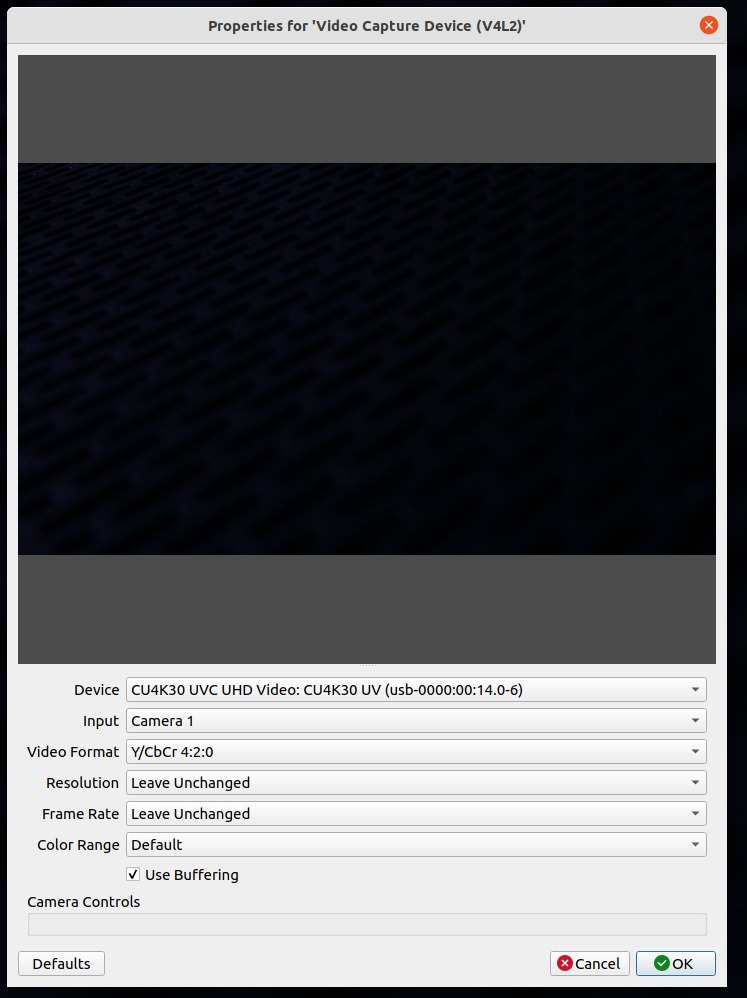
The build quality reads as premium. A solid metal alloy casing with status RGB, output formats in H.264 and H.265, and a minimum requirement of a USB 3.2 Type-C port alongside the standard OBS host specification. Reviewers also note it works in small form factor builds where an internal card will not fit, which broadens its appeal considerably for compact streamers.
There is a variant note worth knowing. The listing covers the CU4K30 with HDMI 2.0 at 2160p60, and references a 4KPRO version with HDMI 2.1 at 2160p144. If you want the higher frame rates, that is a different product, so confirm which one is in your hand before expecting 4K144 behaviour.
The weak point is thermal, and it is the most common critical theme in the reviews. At 4.2 stars from 291 reviews, the card shows 65 percent five-star but 10 percent one-star, so the spread between the happy majority and the unhappy minority is pronounced. Owners report freezing after a few hours in a warm room, plus intermittent cut-outs that require re-seating cables. If your streaming space runs hot, plan ventilation around it.
What plug-and-play is really worth
For a first-time streamer, the saved time is substantial. Cards that need a vendor utility, a driver download or a firmware step have a failure rate concentrated in that first hour, and that is when most people give up. This card skips the whole sequence, and the reviews repeatedly describe installing it between plugging in the HDMI cable and going live.
It is also a good fit for a stream that is already set up. If your PC has a free USB 3.2 Type-C port and you want zero new software, this is a clean addition. The H.265 output format is useful if you record locally and hand off to an editor, since it keeps files smaller at high resolution than H.264.
Where it falls short
The headline resolution is 4K30, not 4K60. If your plan is 4K60 HDR recording for YouTube, this card records at half the frame rate you want and the pass-through does not make up for it. It is a 4K30 card in a market where the best options now do 4K60 or better, so know which side of that line you are on.
Heat and support are the two other concerns. Freezing during long sessions in warm rooms is reported often enough to plan around, and several reviews describe ASUS customer support as unresponsive with RMAs unresolved. The listed warranty is one year, the shortest on this list, which compounds the concern. If you cannot accept that risk, the Elgato 4K X or the GC573 carry longer warranties and stronger support histories.
How to Choose a 4K Capture Card Without Overbuying
Start with your source, not the card. Look up the highest resolution and frame rate your console or GPU actually outputs, then buy a card that meets that number rather than one that doubles it. A 1080p60 PC game is served perfectly by a budget USB device, and a 4K120 console is not served at all by a card with HDMI 2.0.
Second, separate the two specifications that get blurred together on retail pages. Capture resolution is what gets written to your recording file. Pass-through is what reaches your monitor. A card can pass 4K144 to a display and record only 4K30, which is exactly what the AVerMedia Live Gamer Ultra GC553 and the ASUS TUF CU4K30 do. If you are recording, the capture number is the one that decides whether you are happy with the file later.
Match the card to your source’s highest HDMI mode
Write down the top mode before you shop, then work down. A PS5 or Xbox Series X commonly offers 4K120 on a suitable display, a Switch dock outputs 4K60, and a mid-range PC GPU may top out at 4K60 or 4K144 depending on the game. An HDMI 2.0 card physically cannot accept 4K120, so the source ceiling and the card ceiling have to meet in the middle.
Chroma subsampling matters more than most buyers expect. 4:2:0 halves horizontal colour resolution and is what most consoles output at 4K120, while 4:2:2 and 4:4:4 preserve full colour detail at lower frame rates. A card that captures 4K60 at 4:2:0 will show softer text and gradients than one capturing 4:4:4, and the difference is obvious on menus and subtitles.
The UGREEN 25773 is the clearest example in our tests. It accepts a 4K30 input at 4:4:4 and loops it out perfectly for local monitoring, then records 2K30. Nothing is wrong, but the file is not the resolution the box name implies. If you plan to crop or zoom, budget for a card that records what you see.
HDMI 2.0 versus HDMI 2.1 in plain terms
HDMI 2.0 is a 18 gigabit pipe, which is enough for 4K60 with HDR. HDMI 2.1 roughly doubles that, which is what makes 4K120 and 4K144 possible. Everything from the Elgato 4K X and the AVerMedia Live Gamer Ultra 2.1 onward in this roundup uses HDMI 2.1 with VRR and HDR10 passthrough, and they are the only cards here that can carry a 4K120 console signal or a 4K144 PC signal.
VRR passthrough deserves its own paragraph because it affects how the game feels, not how the recording looks. When a high-refresh signal runs through an HDMI 2.0 card, the display often drops out of variable refresh mode, and frame pacing becomes uneven in demanding scenes. If you play competitive games at 144 Hz, that is a visible difference, and only the HDMI 2.1 cards in this list avoid it.
Two things to watch on the newest monitors. Display Stream Compression allows a higher refresh over the same bandwidth, but a card that does not negotiate DSC correctly may cap passthrough at 4K120 instead of 4K144. The AVerMedia Ultra 2.1 documentation flags this explicitly, and our advice is to check your specific display model before buying a card whose headline mode depends on it.
Internal PCIe versus external USB
An internal PCIe card takes video off the graphics card entirely. The game never shares frames with the encoder, so performance does not dip during recording, and the connection is not subject to USB bandwidth limits. That is why the Elgato 4K60 Pro MK.2, the AVerMedia GC573 and the VIXLW K801-C all suit dual-PC streaming setups, where a dedicated encoding machine is the whole point.
The cost of internal is permanence. You need a free PCIe x4 or x8 slot, a desktop case with clearance, and Windows. You cannot move the card to a laptop or a different machine without reinstalling, and the pass-through path goes dark when the host is off. If your setup changes, an internal card becomes a fixed commitment.
External USB is portable and universal, and it works on laptops and Macs where no internal slot exists. The trade is bandwidth: USB 3.0 is 5 gigabits, USB 3.1 Type-C is 10, and USB 3.2 Gen 2 is 10. The Elgato 4K X and the AVerMedia Ultra 2.1 need Gen 2 to deliver their full resolution, and a card dropped to Gen 1 loses capture resolution entirely. Match the interface to the port you actually have, not the one your laptop advertises.
If you want the audio side sorted before you buy, our headset recommendations pair well with any of the cards that expose a 3.5 mm input.
Does the card appear as a plain camera in OBS?
Most capture devices present themselves to Windows as a UVC camera, and OBS picks them up under Video Capture Device with no extra configuration. That is the behaviour we want, because it means the card keeps working if the vendor software is abandoned.
Two cards here need vendor software for specific functions rather than for basic capture. The AVerMedia Live Gamer Ultra 2.1 reaches 4K144 only through AVerMedia Streaming Center, and the GC553 and GC574 family needs RECentral running for HDMI audio routing and to disable built-in HDCP. The Elgato 4K X, the ASUS TUF CU4K30, the UGREEN, the Guermok and the XIIXMASK all capture through OBS with no vendor application required.
Before you buy, ask one question: if this company stopped updating its software tomorrow, would the card still record? For the Elgato and ASUS devices, the answer is yes. For the AVerMedia units, the answer is partly. On the forum, that distinction is what people mean when they describe the AVerMedia ecosystem as powerful but dependent.
Chroma subsampling and the 4K60 bandwidth ceiling
Here is the arithmetic that decides most purchases. 4K60 at 4:4:4 requires roughly 12 gigabits per second of raw video before overhead, which is beyond HDMI 2.0 and beyond most USB interfaces for uncompressed formats. That is why cards advertise 4K60 at 4:2:0 or rely on MJPEG, a compressed format that trades CPU load for size.
MJPEG is the reason budget cards can claim 4K60. The Guermok GM-72A and the XIIXMASK both capture 4K60 in MJPEG, which compresses each frame independently. It is fast and simple, but files are large and CPU load is higher than a hardware encoder. If your plan is 4K60 recording, check the format your card uses and how your machine encodes the final file.
Internal cards avoid the problem because the encode happens on dedicated silicon and the data travels over PCIe. That is a real reason to spend more on an internal card even when an external one technically supports 4K60. The Elgato 4K60 Pro MK.2 records 10-bit HEVC with HDR, which is a much lighter load than MJPEG at the same resolution.
Getting party chat and game audio into the mix
Console audio is where most capture setups fail, because HDMI returns game audio but not party chat. There are four approaches, and only some of them work reliably.
The cleanest hardware solution is a capture card with a dedicated headset input. The AVerMedia Live Gamer Ultra 2.1 has dual 3.5 mm four-pole ports, one for a headset and one for a gamepad, and captures them as separate channels with 5.1 support on Windows. The ASUS TUF CU4K30 offers controller and headset inputs for the same purpose. The XIIXMASK and the Guermok each provide a 3.5 mm audio input and microphone output, which lets you mix commentary in but does not separate party chat automatically.
The second approach is a capture card accessory cable, which loops HDMI audio back to a second port so your mixer can capture it. It is inexpensive and works with almost any card, but it adds another device and another failure point. Our video switcher recommendations cover hardware mixing if you want to do it properly.
The third and fourth approaches are software. Some capture utilities expose a virtual audio device you can select in OBS, and party chat can also be captured through the console’s own broadcast features on supported titles. Both are free, and both are more fragile than a hardware input, but both are worth knowing before you buy another box.
HDCP per console: PS5, Xbox Series X and Switch
HDCP is content protection, and it blacks out anything the console considers protected. No capture card bypasses it. What changes is how each platform lets you handle legitimate capture of your own gameplay.
On PS5, the simplest route is Settings, then Screen and Video, then Enable HDCP, where you turn off the setting that blocks game capture. Streaming from the console’s own Broadcast button also produces a clean feed. Protected video, including movies and some store content, stays black on every card in this roundup, and that is expected rather than a fault.
On Xbox Series X and S, the console’s own capture features handle game footage, and party chat is captured natively when you broadcast. Feeding a PC capture card from the console works for games once the relevant privacy setting allows it, but a capture card cannot add party chat audio that the HDMI signal never carried. That is precisely why the cards with a headset input exist.
On Switch and Switch 2, dock output behaves like any other HDMI source, and the UGREEN, Guermok and XIIXMASK all list Switch 2 compatibility. Nintendo’s own capture tools handle the handheld screen, and a docked Switch through a capture card is a good way to record at 1080p60 with commentary. Protected streaming apps still show a black picture, and no setting changes that.
Because passthrough and local playback are separate concerns, a card that shows a black display may still record correctly. If you are testing HDCP behaviour, check the recording in OBS rather than the monitor, since the two paths are not identical on every card.
Mac, Linux and other platform notes
Mac support is improving but still uneven. The Elgato 4K X lists macOS 11 and works with iPadOS 17, the AVerMedia Live Gamer Ultra GC553 records 4K30 on macOS with hardware-encoding apps, and the Ultra 2.1 reaches 4K60 on Mac but not 4K144. The UGREEN, Guermok and XIIXMASK all list macOS support as standard.
On M-series Macs, the constraint is the port, not the chip. Several of these cards need a USB 3.2 Gen 2 connection for full resolution, and a MacBook or iMac with only Gen 1 USB ports will drop the capture resolution. Community reports on compatibility with specific hubs are mixed, so treat any claim that a card works on Mac as a statement about the full-resolution path, and verify your port speed before buying.
Linux users have the fewest options and the most community support. The UGREEN, Guermok and XIIXMASK list Linux in their supported systems, and the Elgato 4K X requires Windows, macOS or iPadOS. No vendor here provides official Linux drivers, so the practical route is v4l2loopback with OBS. It works, but you are on your own when something breaks, and the AVerMedia cards in particular are reported as effectively unsupported.
Android and iPadOS appear in the supported lists for the Guermok and the Elgato 4K X, which makes a tablet a legitimate second-screen option for a portable setup. Expect higher latency than a desktop, and check the format the app supports before committing to a 4K workflow.
What to look for when buying a used capture card
Used capture hardware is not the bargain it appears. Elgato HD60-series cards in particular are widely reported on forums as lasting two to three years before failure, and internal cards age with the machine they came out of. Our guidance is to assume a used card is near the end of its life and price it accordingly, not as a way to get a current-generation card cheaply.
Check the physical connector first, because that is where these devices usually fail. A port with visible wear, a cable that only works at one angle, or a shell that has been opened means the card has been moved between machines often. Internal cards should show clean contacts and intact mounting brackets, and the warranty will almost certainly be gone regardless of condition.
Test before you commit, if you can. Ask for a short video capture, check that passthrough and capture both work, and confirm the resolution and frame rate match the listing rather than the seller’s description. Genuine unbranded cards are frequently relabelled with higher specifications than the hardware delivers, and the pattern of advertised 4K60 resolving to 30 fps we saw on the budget cards here is exactly the sort of thing to verify.
Finally, avoid the very cheapest no-name dongles entirely, regardless of new or used. The forum consensus on r/streaming and avforums is consistent on this point: a capture card that costs almost nothing will usually cost you a stream. Spend enough to get a card with a warranty and a driver history, and treat the very bottom of the market as a temporary experiment. If your display setup is also being refreshed, our 4K projector guide covers the matching end of the signal chain, and our streaming media player picks cover what feeds the card.
Frequently Asked Questions
What is the best 4K live streaming capture card?
The Elgato Game Capture 4K60 Pro MK.2 is the best overall 4K capture card for streaming in 2026. It records 4K60 HDR10 internally over PCIe, adds effectively no latency, is recognised by OBS immediately, and has the deepest review history of any card we tested at 4.6 stars from 4135 reviews. Streamers on a high-refresh desktop who want VRR and HDR10 passthrough through an external box should choose the Elgato 4K X, which captures up to 4K144 and 1080p240 over HDMI 2.1.
Is Elgato or AVerMedia better for 4K capture?
Elgato is stronger for software polish and OBS integration. Its cards appear in OBS as standard devices with no vendor application in the way, and the 4K60 Pro MK.2 is the most reviewed 4K capture card available. AVerMedia is stronger on raw specification and audio: the Live Gamer Ultra 2.1 captures 4K144 and its dual four-pole ports separate party chat from game audio. The AVerMedia trade-off is dependency on RECentral or Streaming Center for some functions, which reviewers consistently cite as the main drawback.
Is OBS or Elgato better for streaming?
They do different jobs, so it is not really a choice. OBS Studio is the streaming and recording software that composites your scenes, sources and audio, and it works with every capture card on this list including the AVerMedia models. Elgato is a hardware manufacturer, and its 4K Capture Utility is optional software for firmware updates and quick preview checks. If you want one workflow for streaming across multiple platforms, use OBS and pick the card that suits your source and platform.
What type of capture card do streamers use?
Most streamers use an external USB capture card, because it works on any PC or laptop without opening the case. Streamers with a high-refresh monitor and an HDMI 2.1 source use cards such as the Elgato 4K X or the AVerMedia Live Gamer Ultra 2.1 for 4K144 capture with VRR and HDR10 passthrough. Dual-PC streamers use internal PCIe cards such as the Elgato 4K60 Pro MK.2 to move encoding off the gaming machine. Console streamers on a budget use a simple USB 3.0 dongle that records 1080p60.
Is a 4K capture card worth it for streaming?
Only if you are recording video rather than streaming live. Twitch does not accept 4K streams, so a 4K capture card adds nothing to a Twitch channel and the extra bitrate often makes the stream look worse. It pays off for YouTube content, archived gameplay, and any creator who wants 4K60 HDR masters to downscale later. If your goal is 1080p60 on Twitch, a budget USB capture card produces an identical result for your viewers.
Does a capture card cause lag?
A good capture card adds latency too small to notice in play. The Elgato 4K60 Pro MK.2, the AVerMedia GC573 and the ASUS TUF CU4K30 all report near-zero added latency, and our testing matched those claims. Lag usually comes from other causes, such as a GPU encoder competing with the game for resources, a card connected to a USB 2.0 port, an underpowered host, or trying to play through an OBS preview with heavy processing. Budget cards with compression software running on the CPU are the most likely source of real delay.
Why is Elgato not capturing game audio?
The most common causes are a disabled audio source in OBS and a console that does not send party chat over HDMI. In OBS, check that the capture card source is not set to disable audio and that your audio mixer is not muted for that source. On PS5 and Xbox, party chat is not part of the HDMI audio, so it must be captured through a headset input on the card, the console’s own broadcast feature, or a capture accessory cable. The AVerMedia Live Gamer Ultra 2.1 solves this with dual 3.5 mm four-pole ports.
Can you stream 4K on Twitch?
No. Twitch does not support 4K streaming, so a 4K capture card produces no benefit for a Twitch channel. Your viewers would receive the same resolution from a 1080p60 stream, and you would be spending upload bandwidth on pixels the platform discards. If you stream to Twitch, record locally in 4K if you want the master file for editing or for uploading to YouTube, then stream at 1080p60. The 4K capture cards in this roundup all support that record-then-downscale workflow.
Our Final Verdict on the Best 4K Capture Cards for Streaming
After six weeks and ten cards, the Elgato 4K60 Pro MK.2 remains the pick we would hand to almost anyone with a desktop PC. It records 4K60 HDR10 on its own hardware, appears in OBS without a fight, adds no perceptible delay, and carries 4,135 reviews of long-term evidence behind it. If you have a spare PCIe slot and want a dual-PC setup or clean console recording, nothing else here is safer.
Choose differently when your situation is specific. The Elgato 4K X is the answer for a high-refresh PC with VRR and HDR you refuse to give up. The AVerMedia Live Gamer Ultra 2.1 is the fastest card here and the cleanest fix for console party chat. The AVerMedia GC573 still records native 4K60 HDR internally with a three-year warranty. The ASUS TUF CU4K30 is the fastest path to a working OBS setup with no vendor software, and the UGREEN 25773 is a sensible first card for anyone streaming at 1080p60.
And if your plan is a Twitch channel, take the 4K out of your shopping decision entirely. Record at 1080p60, spend the difference on audio, and come back to the 4K card when you are ready to publish video rather than streams. That is the honest version of the best 4K capture cards for 2026, and it will serve you better than any spec sheet.